sensor KIA Sportage 2008 JE_ / 2.G Owner's Manual
[x] Cancel search | Manufacturer: KIA, Model Year: 2008, Model line: Sportage, Model: KIA Sportage 2008 JE_ / 2.GPages: 350, PDF Size: 6.42 MB
Page 39 of 350
Knowing your vehicle
30 3
1
2
3
4
5
6
7
8
9
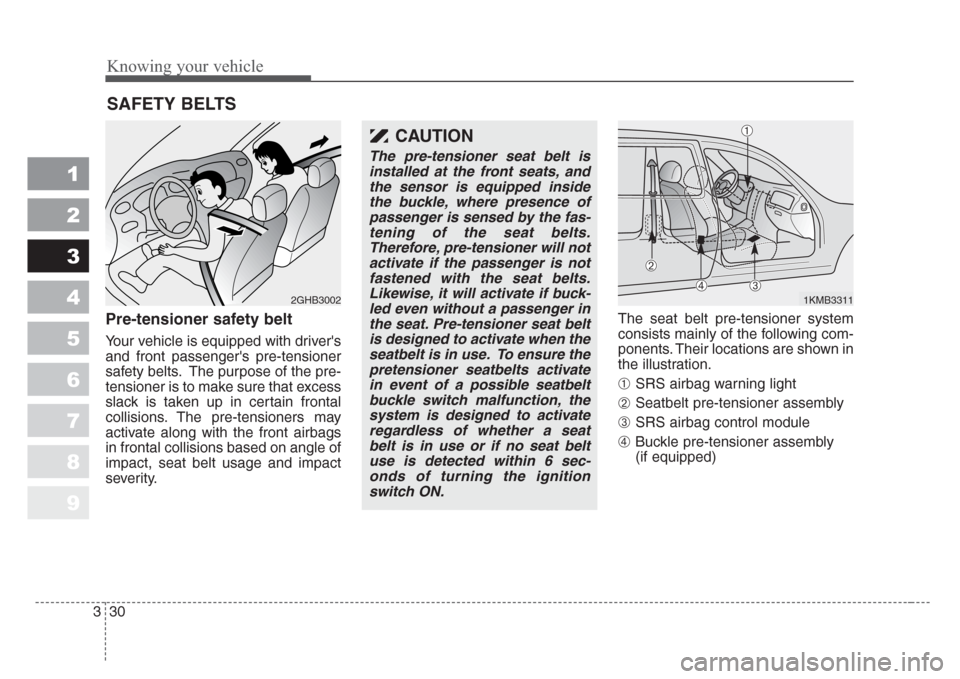
Pre-tensioner safety belt
Your vehicle is equipped with driver's
and front passenger's pre-tensioner
safety belts. The purpose of the pre-
tensioner is to make sure that excess
slack is taken up in certain frontal
collisions. The pre-tensioners may
activate along with the front airbags
in frontal collisions based on angle of
impact, seat belt usage and impact
severity.The seat belt pre-tensioner system
consists mainly of the following com-
ponents. Their locations are shown in
the illustration.
➀ SRS airbag warning light
➁ Seatbelt pre-tensioner assembly
➂ SRS airbag control module
➃ Buckle pre-tensioner assembly
(if equipped)
SAFETY BELTS
2GHB30021KMB3311
➀
➁
➂➃
CAUTION
The pre-tensioner seat belt is
installed at the front seats, and
the sensor is equipped inside
the buckle, where presence of
passenger is sensed by the fas-
tening of the seat belts.
Therefore, pre-tensioner will not
activate if the passenger is not
fastened with the seat belts.
Likewise,it will activate if buck-
led even without a passenger in
the seat.Pre-tensioner seat belt
is desi
gned to activate when the
seatbelt is in use.To e nsure the
pretensioner seatbelts activate
in event of a possible seatbelt
buckle switch malfunction, the
system is designed to activate
regardless of whether a seat
belt is in use or if no seat belt
use is detected within 6 sec-
onds of turning the ignition
switch ON.
Page 63 of 350
Knowing your vehicle
54 3
1
2
3
4
5
6
7
8
9
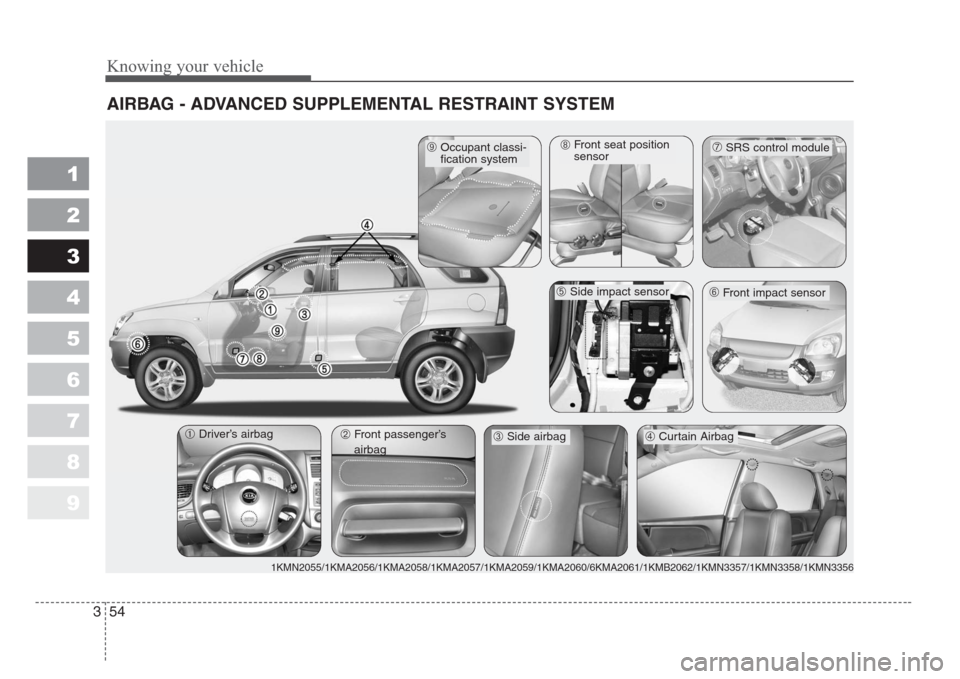
AIRBAG - ADVANCED SUPPLEMENTAL RESTRAINT SYSTEM
➀Driver’s airbag➁Front passenger’s
airbag➃Curtain Airbag
➅Front impact sensor
➆SRS control module
1KMN2055/1KMA2056/1KMA2058/1KMA2057/1KMA2059/1KMA2060/6KMA2061/1KMB2062/1KMN3357/1KMN3358/1KMN3356
➂Side airbag
➄Side impact sensor
➈Occupant classi-
fication system➇Front seat position
sensor
Page 64 of 350
355
1
2
3
4
5
6
7
8
9
Knowing your vehicle
➀Driver’s airbag
(see page 3- 59)
➁Front passenger’s airbag
(see page 3- 60)
➂Side airbag
(if equipped, see page 3- 67)
➃Curtain Airbag
(if equipped, see page 3- 67)
➄Front impact sensor
(see page 3- 69)
➅Side impact sensor
(if equipped, see page 3- 69)
➆SRS Control Module
(see page 3- 69)
➇Front seat position sensor
➈Occupant classification system
(see page 3- 60)
■Airbag inflation condition
(see page 3- 70)
■Airbag non-inflation condition
(see page 3- 71)
■Airbag warning light
(see page 3- 76)
■Airbag service
(see page 3- 77)
■Airbag warning label
(see page 3- 79)
What your airbag system does
Driver’s airbag and front passenger’s
airbag are designed to supplement
the protection offered by the safety
belt in certain frontal collisions.
Likewise, side airbag and curtain
airbags are designed to supplement
the protection offered by the safety
belt in side collisions. Safety belts
are designed to reduce the injury of
the driver or passengers in case of
impact or collision. No safety belt or
airbag system can completely elimi-
nate injuries that may cause in colli-
sions or impacts. To help reduce
impact on driver or passengers in
any collision, safety belts must be
correctly worn.
What your airbag system does
not do
The air bag system is designed to
supplement the protection offered by
the safety belt system.IT IS NOT A
SUBSTITUTE FOR THE SAFETY
BELT.
Page 66 of 350
357
1
2
3
4
5
6
7
8
9
Knowing your vehicle
Airbag system components
The main components of your SRS
are:
• To indicate that your vehicle is
equipped with airbags, the corre-
sponding airbag covers are
marked with “SRS AIRBAG”.
- Driver’s airbag (see page 3- 59)
- Passenger’s airbag(see page 3- 60)
- Side airbag
(if equipped, see page 3- 67)
- Curtain airbag
(if equipped, see page 3- 67)
• A diagnostic system that continual-
ly monitors the system operation.
• Airbag warning light to warn you of
a possible problem with the sys-
tem.
• Emergency power backup in case
your car’s electrical system is dis-
connected in a crash.The SRS uses a collection of sen-
sors to gather information about the
driver’s and front passenger’s seat
position, the driver’s and front pas-
senger’s safety belt usage and
impact severity.
The driver's and front passenger's
seat position sensors, which are
installed on the seat track let the
airbag control module know where
the seats are positioned. Similarly,
the safety belt usage sensors mea-
sure if the driver and front passen-
ger’s safety belts are fastened. These
sensors provide the ability to control
the SRS deployment based on how
close the driver’s seat is to the steer-
ing wheel, how close the passen-
ger’s seat is to the instrument panel,
whether or not the safety belts are
fastened, and the severity of the
impact.
(Continued)
• If your vehicle has been sub-
jected to flood conditions (e.g.
soaked carpeting/standing
water on the floor of the vehi-
cle, etc.) or if your vehicle has
become flood damaged in any
way, do not attempt to start
the vehicle or put the key in
the ignition.Have the vehicle
towed to an authorized Kia
dealer for inspection and nec-
essary repairs.
Disregarding this precaution
may cause an unexpected
airbag deployment, which
could result i
n serious per-
sonal injury or death.
Page 67 of 350
Knowing your vehicle
58 3
1
2
3
4
5
6
7
8
9
The advanced SRS offers the ability
to control the airbag inflation with two
levels. A first stage level is provided
for moderate-severity impacts. A sec-
ond stage level is provided for more
severe impacts.
According to the impact severity,
seating position and safety belt
usage, the SRS Control Module con-
trols the airbag inflation.
Additionally, your SRS is equipped
with an occupant classification sys-
tem in the front passenger’s seat.
The occupant classification system
detects the presence of a passenger
in the front passenger’s seat and will
turn off the front passenger’s airbag
under certain conditions in order to
protect smaller front passenger seat
occupants. For more detail, see
“Occupant Classification System”
later in this section.
WARNING-Seating sen-
sors malfunction
If the seat position sensor is not
working properly, the airbag
warning light ( ) on the instru-
ment panel will illuminate
because the airbag warning
light is connected with the seat
position sensor.If the airbag
warning light does not illumi-
nate when the ignition key is
turned to the "ON" position,if i
t
remains illuminated after illumi-
nating for approximately 6 sec-
onds, or if it illuminates while
the vehicle is being driven, have
an authorized Kia dealer inspect
your vehicle as soon as possi-
ble.
AIR
BAG
WARNING-Seat usage
• Modification to the seat struc-
ture can damage the seat
position sensor and cause the
airbag to deploy at a different
level than should be provided.
• Do not place any objects
underneath the front seats
since they could damage the
seat position sensor or inter-
fere with the occupant classi-
fication system.
• Do not place any objects that
may cause magnetic fields
near the front seat.These may
cause a malfunction of the
seat position sensor.
(Continued)
Page 78 of 350
369
1
2
3
4
5
6
7
8
9
Knowing your vehicle
Why didn’t my airbag go off in
a collision?
(Inflation and non-inflation condi-
tions of the airbag)
There are many types of accidents
in which one or more of the
airbags would not be expected to
provide additional protection.
These include rear impacts,sec-
ond or third collisions in multiple
impact accidents,as well as low
speed impacts.Just because your
vehicle is damaged and even if it
is totally unusable, don’t be sur-
prised that the airbags did not
inflate.
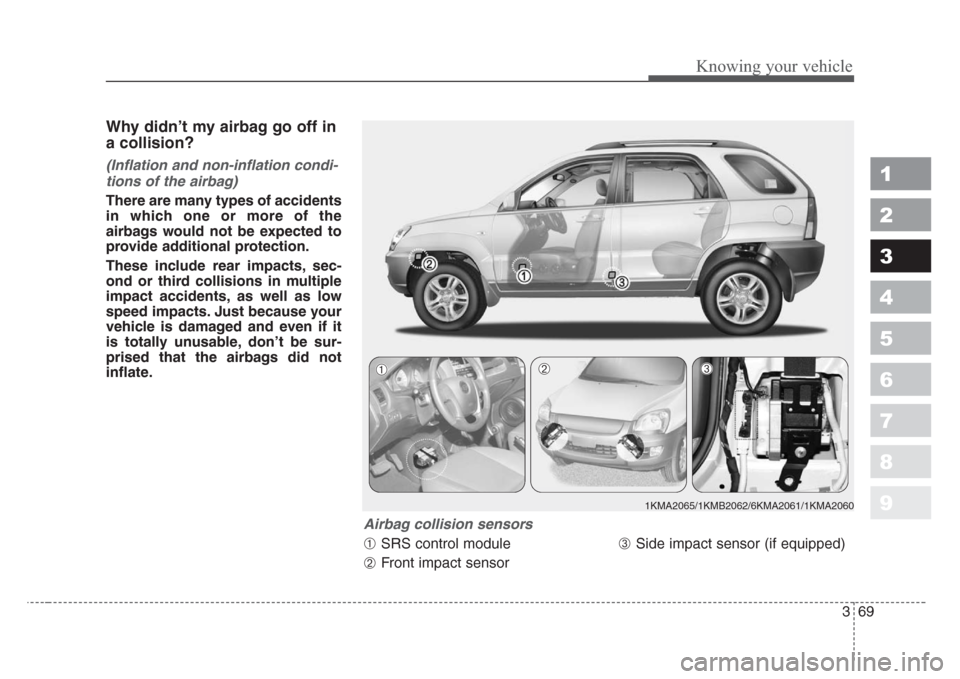
Airbag collision sensors
➀ SRS control module
➁ Front impact sensor
➂ Side impact sensor (if equipped)
1KMA2065/1KMB2062/6KMA2061/1KMA2060
➀➁➂
Page 79 of 350
Knowing your vehicle
70 3
1
2
3
4
5
6
7
8
9
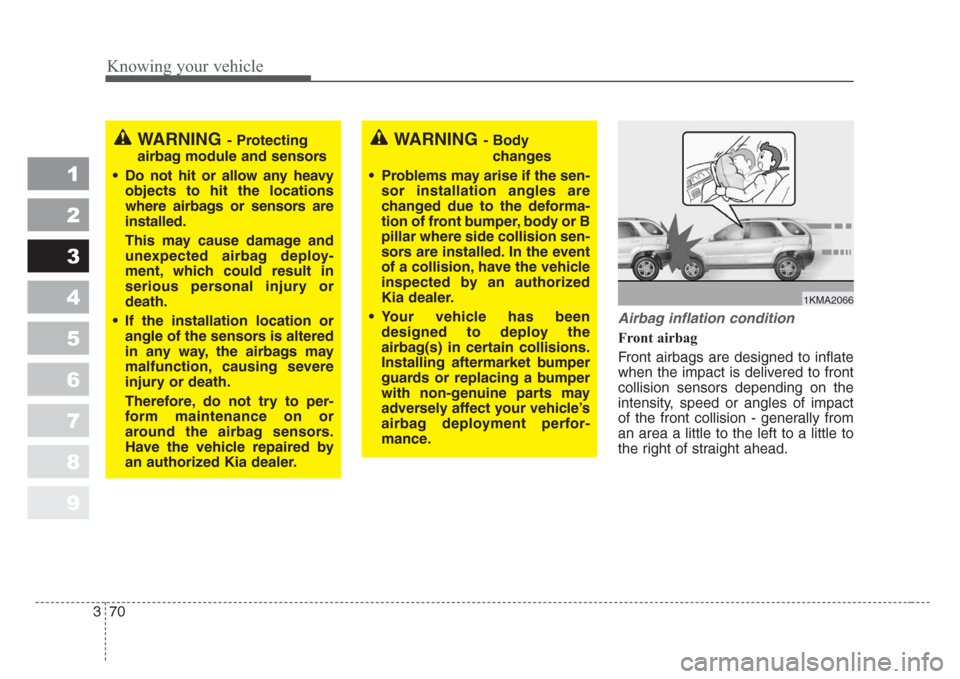
Airbag inflation condition
Front airbag
Front airbags are designed to inflate
when the impact is delivered to front
collision sensors depending on the
intensity, speed or angles of impact
of the front collision - generally from
an area a little to the left to a little to
the right of straight ahead.
WARNING- Protecting
airbag module and sensors
• Do not hit or allow any heavy
objects to hit the locations
where airbags or sensors are
installed.
This may cause damage and
unexpected airbag deploy-
ment, which could result in
serious personal injury or
death.
• If the installation location or
angle of the sensors is altered
in any way, the airbags may
malfunction, causing severe
i
njury or death.
Therefore, do not try to per-
form maintenance on or
around the airbag sensors.
Have the vehicle repaired by
an authorized Kia dealer.
WARNING- Body
changes
• Problems may arise if the sen-
sor installation angles are
changed due to the deforma-
tion of front bumper, body or B
pillar where side collision sen-
sors are installed.In the event
of a collision, have the vehicle
inspected by an authorized
Kia dealer.
• Your vehicle has been
designed to deploy the
airbag(s) in certain collisions.
Installing aftermarket bumper
guards or replacing a bumper
with non-genuine parts may
adversely affect your vehicle’
s
airbag deployment perfor-
mance.
1KMA2066
Page 81 of 350
Knowing your vehicle
72 3
1
2
3
4
5
6
7
8
9
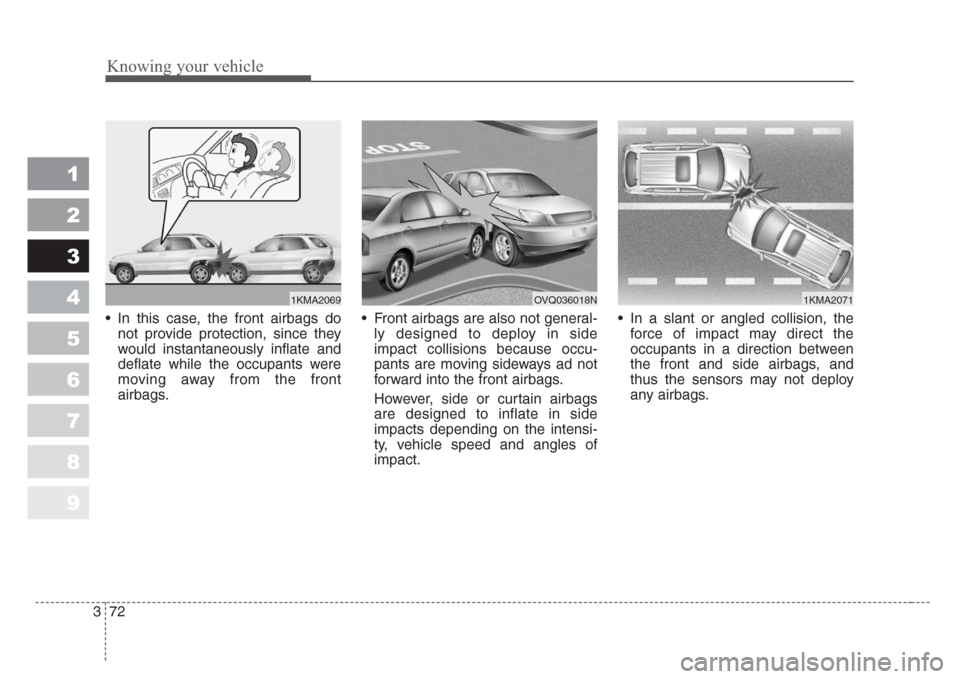
• In this case, the front airbags do
not provide protection, since they
would instantaneously inflate and
deflate while the occupants were
moving away from the front
airbags.• Front airbags are also not general-
ly designed to deploy in side
impact collisions because occu-
pants are moving sideways ad not
forward into the front airbags.
However, side or curtain airbags
are designed to inflate in side
impacts depending on the intensi-
ty, vehicle speed and angles of
impact.• In a slant or angled collision, the
force of impact may direct the
occupants in a direction between
the front and side airbags, and
thus the sensors may not deploy
any airbags.
1KMA2069OVQ036018N1KMA2071
Page 82 of 350
373
1
2
3
4
5
6
7
8
9
Knowing your vehicle
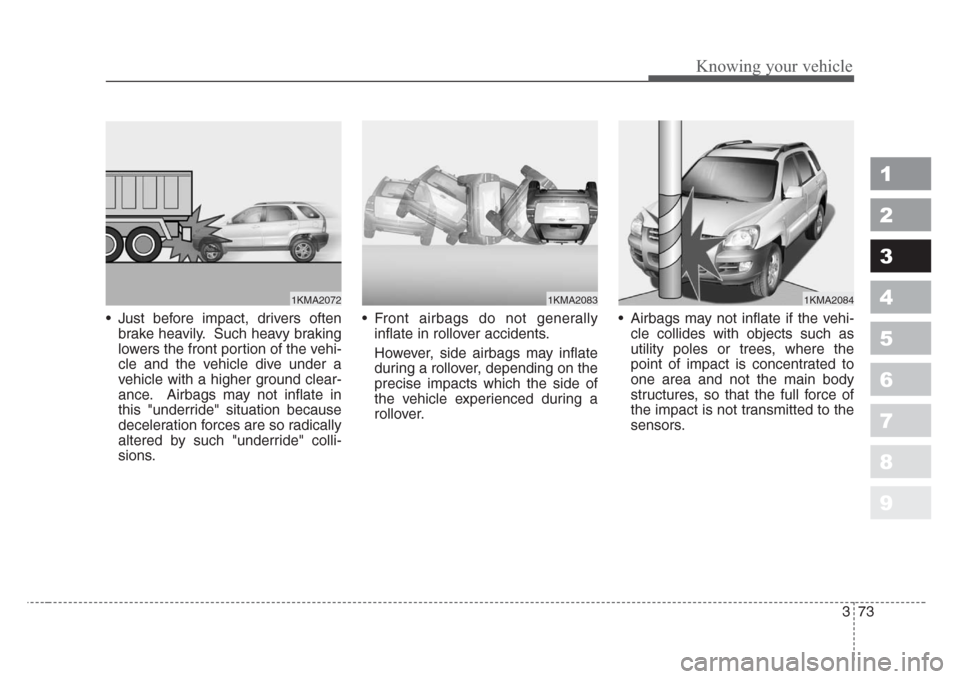
• Just before impact, drivers often
brake heavily. Such heavy braking
lowers the front portion of the vehi-
cle and the vehicle dive under a
vehicle with a higher ground clear-
ance. Airbags may not inflate in
this "underride" situation because
deceleration forces are so radically
altered by such "underride" colli-
sions.• Front airbags do not generally
inflate in rollover accidents.
However, side airbags may inflate
during a rollover, depending on the
precise impacts which the side of
the vehicle experienced during a
rollover.• Airbags may not inflate if the vehi-
cle collides with objects such as
utility poles or trees, where the
point of impact is concentrated to
one area and not the main body
structures, so that the full force of
the impact is not transmitted to the
sensors.
1KMA20721KMA20831KMA2084
Page 97 of 350
Knowing your vehicle
88 3
1
2
3
4
5
6
7
8
9
Electric type (if equipped)
The electric day/night rearview mir-
ror automatically controls the glare
from the headlights of the car behind
you in nighttime or low light driving
conditions. The sensor mounted in
the mirror senses the light level
around the vehicle, and through a
chemical reaction, automatically
controls the headlight glare from
vehicles behind you.
When the engine is running, the
glare is automatically controlled by
the sensor mounted in the rearview
mirror.
Whenever the shift lever is shifted
into reverse (R), the mirror will auto-
matically go to the brightest setting in
order to improve the drivers view
behind the vehicle.
✽
NOTICE
When cleaning the mirror, use a
paper towel or similar material
dampened with glass cleaner. Do not
spray glass cleaner directly on the
mirror as that may cause the liquid
cleaner to enter the mirror housing.
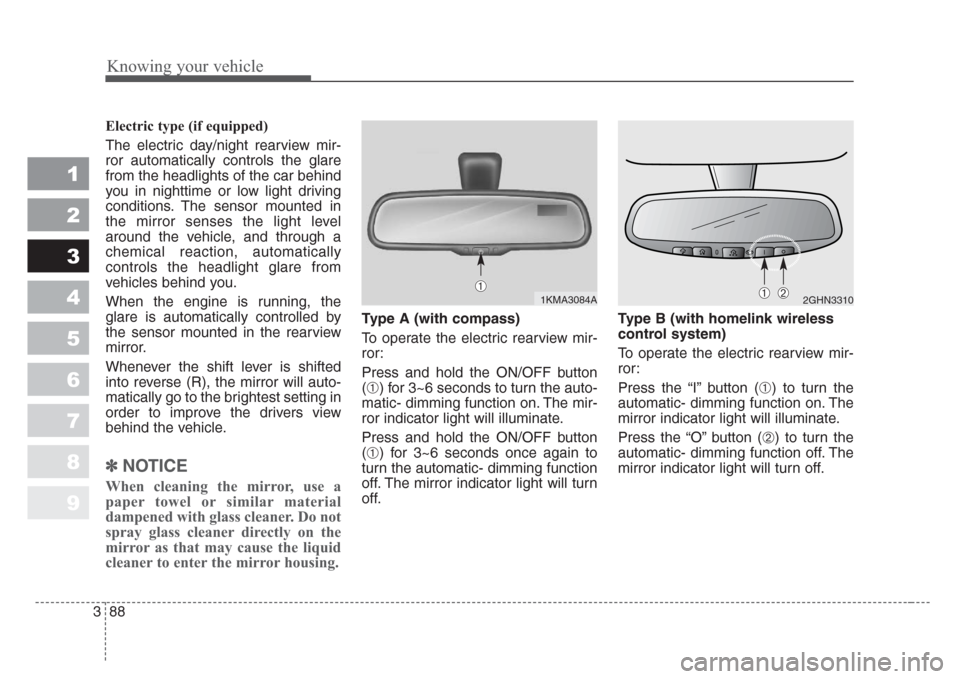
Type A (with compass)
To operate the electric rearview mir-
ror:
Press and hold the ON/OFF button
(
➀) for 3~6 seconds to turn the auto-
matic- dimming function on. The mir-
ror indicator light will illuminate.
Press and hold the ON/OFF button
(
➀) for 3~6 seconds once again to
turn the automatic- dimming function
off. The mirror indicator light will turn
off.Type B (with homelink wireless
control system)
To operate the electric rearview mir-
ror:
Press the “I” button (
➀) to turn the
automatic- dimming function on. The
mirror indicator light will illuminate.
Press the “O” button (
➁) to turn the
automatic- dimming function off. The
mirror indicator light will turn off.
2GHN3310➀➁1KMA3084A
➀