ignition KIA Sportage 2010 SL / 3.G User Guide
[x] Cancel search | Manufacturer: KIA, Model Year: 2010, Model line: Sportage, Model: KIA Sportage 2010 SL / 3.GPages: 371, PDF Size: 5.23 MB
Page 21 of 371
Knowing your vehicle
12
3
1
2
3
4
5
6
7
8
9
Impact sensing door unlock
system (if equipped)
All doors will be automatically
unlocked when the Supplemental
Restraint System (SRS) detects a
collision while the ignition switch is
ON.
However, the doors may not be
unlocked, if electrical power in the
vehicle should fail.
WARNING- Unlocked
vehicles
Leaving your vehicle unlocked
can invite theft or possible harm
to you or others from someone
hiding in your vehicle while you
are gone. Always remove the
ignition key, engage the parking
brake, close all windows and
lock all doors when leaving your
vehicle unattended.WARNING- Unattended children
An enclosed vehicle can
become extremely hot, causing
death or severe injury to unat-
tended children or animals who
cannot escape the vehicle.
Furthermore, children might
operate features of the vehicle
that could injure them, or they
could encounter other harm,
possibly from someone gaining
entry to the vehicle. Never leave
children or animals unattended
in your vehicle.
Page 26 of 371
317
Knowing your vehicle
1
2
3
4
5
6
7
8
9
The ignition switch must be in the ON
position for power windows to oper-
ate. Each door has a power window
switch that controls that door’s win-
dow. However, the driver has a power
window lock switch which can block
the operation of passenger windows.
The power windows can be operated
for approximately 30 seconds after
the ignition key is removed or turned
to the ACC or LOCK position.
However, if the front doors are
opened, the power windows cannot
be operated even within the 30 sec-
onds after the ignition key removal.✽ ✽NOTICE
While driving with the rear windows
down or with the sunroof (if
equipped) in an open (or partially
open) position, your vehicle may
demonstrate a wind buffeting or
pulsation noise. This noise is a nor-
mal occurrence and can be reduced
or eliminated by taking the follow-
ing actions. If the noise occurs with
one or both of the rear windows
down, partially lower both front
windows approximately one inch. If
you experience the noise with the
sunroof open, slightly reduce the
size of the sunroof opening.
✽ ✽NOTICE
• To prevent the power window sys-
tem from the possibility of dam-
age, do not open or close two win-
dows at the same time. This will
also ensure the longevity of the
fuse. (Continued)(Continued)
• Never try to operate the main
switch on the driver's door and the
individual door window switch in
opposing directions at the same
time. If this is done, the window
will stop and cannot be opened or
closed.
CAUTION - Windows
Always double check to make
sure all arms, hands, head andother obstructions are safelyout of the way before closing awindow.
Do not allow children to play with the power windows. Keepthe driver’s door power win-dow lock switch in the LOCKposition (depressed). Seriousinjury can result from uninten-tional window operation bythe child.
Do not extend face or arms outside through the windowopening while driving.
Page 27 of 371
Knowing your vehicle
18
3
1
2
3
4
5
6
7
8
9
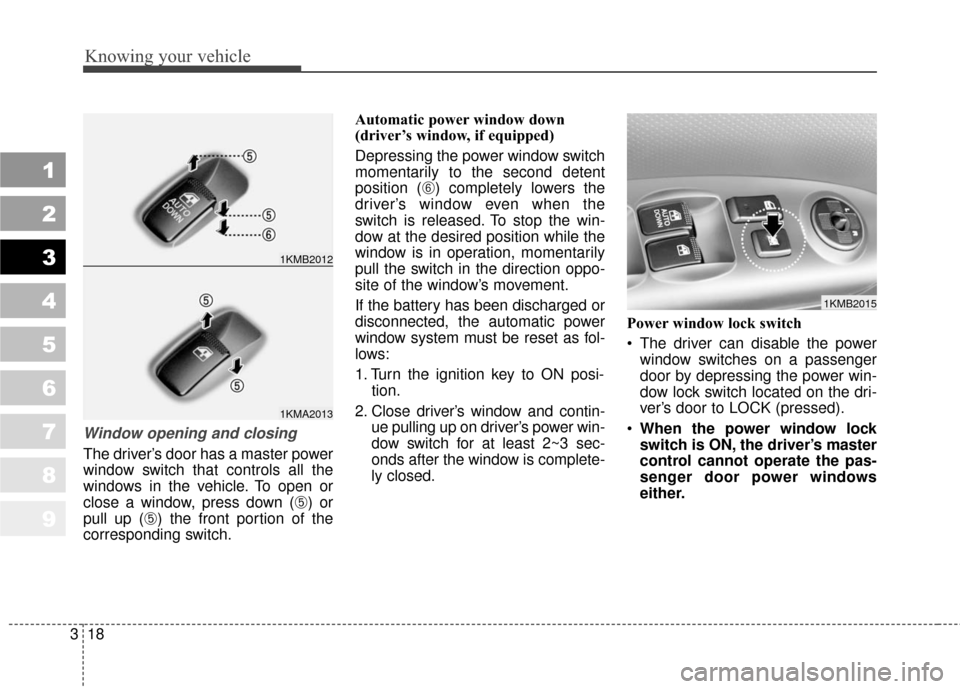
Window opening and closing
The driver’s door has a master power
window switch that controls all the
windows in the vehicle. To open or
close a window, press down (
➄) or
pull up (
➄) the front portion of the
corresponding switch. Automatic power window down
(driver’s window, if equipped)
Depressing the power window switch
momentarily to the second detent
position (
\b) completely lowers the
driver’s window even when the
switch is released. To stop the win-
dow at the desired position while the
window is in operation, momentarily
pull the switch in the direction oppo-
site of the window’s movement.
If the battery has been discharged or
disconnected, the automatic power
window system must be reset as fol-
lows:
1. Turn the ignition key to ON posi- tion.
2. Close driver’s window and contin- ue pulling up on driver’s power win-
dow switch for at least 2~3 sec-
onds after the window is complete-
ly closed. Power window lock switch
The driver can disable the power
window switches on a passenger
door by depressing the power win-
dow lock switch located on the dri-
ver’s door to LOCK (pressed).
When the power window lock
switch is ON, the driver’s master
control cannot operate the pas-
senger door power windows
either.
1KMA2013
1KMB2012
1KMB2015
Page 32 of 371
323
Knowing your vehicle
1
2
3
4
5
6
7
8
9
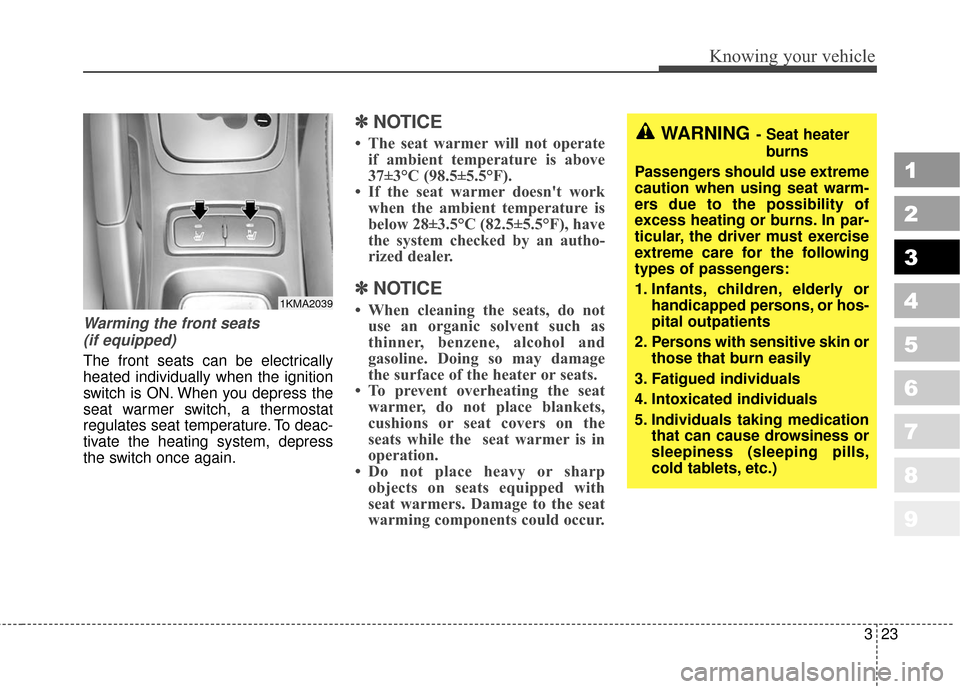
Warming the front seats(if equipped)
The front seats can be electrically
heated individually when the ignition
switch is ON. When you depress the
seat warmer switch, a thermostat
regulates seat temperature. To deac-
tivate the heating system, depress
the switch once again.
✽ ✽ NOTICE
• The seat warmer will not operate
if ambient temperature is above
37±3°C (98.5±5.5°F).
• If the seat warmer doesn't work when the ambient temperature is
below 28±3.5°C (82.5±5.5°F), have
the system checked by an autho-
rized dealer.
✽ ✽ NOTICE
• When cleaning the seats, do not
use an organic solvent such as
thinner, benzene, alcohol and
gasoline. Doing so may damage
the surface of the heater or seats.
• To prevent overheating the seat warmer, do not place blankets,
cushions or seat covers on the
seats while the seat warmer is in
operation.
• Do not place heavy or sharp objects on seats equipped with
seat warmers. Damage to the seat
warming components could occur.
WARNING- Seat heater
burns
Passengers should use extreme
caution when using seat warm-
ers due to the possibility of
excess heating or burns. In par-
ticular, the driver must exercise
extreme care for the following
types of passengers:
1. Infants, children, elderly or handicapped persons, or hos-
pital outpatients
2. Persons with sensitive skin or those that burn easily
3. Fatigued individuals
4. Intoxicated individuals
5. Individuals taking medication that can cause drowsiness or
sleepiness (sleeping pills,
cold tablets, etc.)
1KMA2039
Page 40 of 371
331
Knowing your vehicle
1
2
3
4
5
6
7
8
9
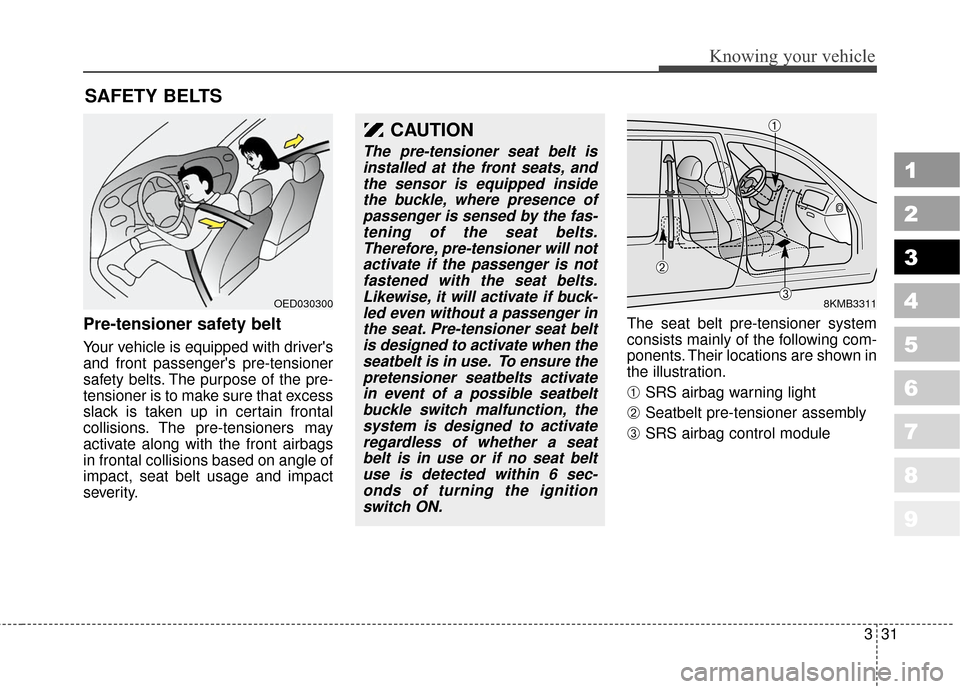
Pre-tensioner safety belt
Your vehicle is equipped with driver's
and front passenger's pre-tensioner
safety belts. The purpose of the pre-
tensioner is to make sure that excess
slack is taken up in certain frontal
collisions. The pre-tensioners may
activate along with the front airbags
in frontal collisions based on angle of
impact, seat belt usage and impact
severity.The seat belt pre-tensioner system
consists mainly of the following com-
ponents. Their locations are shown in
the illustration.
➀ SRS airbag warning light
➁ Seatbelt pre-tensioner assembly
➂ SRS airbag control module
SAFETY BELTS
OED030300
CAUTION
The pre-tensioner seat belt is
installed at the front seats, andthe sensor is equipped insidethe buckle, where presence ofpassenger is sensed by the fas-tening of the seat belts.Therefore, pre-tensioner will notactivate if the passenger is notfastened with the seat belts.Likewise, it will activate if buck-led even without a passenger inthe seat. Pre-tensioner seat beltis designed to activate when theseatbelt is in use. To ensure thepretensioner seatbelts activatein event of a possible seatbeltbuckle switch malfunction, thesystem is designed to activateregardless of whether a seatbelt is in use or if no seat beltuse is detected within 6 sec-onds of turning the ignitionswitch ON.
8KMB3311
➀
➁
➂
Page 41 of 371
Knowing your vehicle
32
3
1
2
3
4
5
6
7
8
9
Load limiter
When the pre-tentioner activates, if
the system senses excessive seat
belt tension on the driver or passen-
ger’s seat belt, the load limiter inside
the pre-tensioner will release some
of the pressure on the affected seat
belt.
CAUTION - Airbag/Pre-
tensioner dust
When the airbags and pre-ten- sioners are activated, a loudnoise may be heard and finedust, which may appear to besmoke, may be visible in thepassenger compartment. Thisdust is not toxic. The dust maycause skin irritation and shouldnot be breathed for prolongedperiods. Ventilate the vehicleafter impact and wash yourhands and face thoroughly afteran accident.
WARNING- Airbag/pre-
tensioner warning light
If the SRS airbag warning light
does not illuminate when the
ignition key is turned to “ON”, or
if it remains illuminated after
approximately 6 seconds, or if it
illuminates while the vehicle is
being driven, please have an
authorized Kia dealer inspect
the pre-tensioner and airbag
system as soon as possible.WARNING- Safety belt adjustment
To obtain maximum benefit from
a pre-tensioner seat belt:
The safety belt must be worn correctly.
The safety belt must be adjusted to the correct posi-
tion.
Page 67 of 371
Knowing your vehicle
58
3
1
2
3
4
5
6
7
8
9
The SRS uses a collection of sen-
sors to gather information about the
driver’s and front passenger’s seat
position, the driver’s and front pas-
senger’s safety belt usage and
impact severity.
The driver's and front passenger's
seat position sensors, which are
installed on the seat track let the
airbag control module know where
the seats are positioned. Similarly,
the safety belt usage sensors mea-
sure if the driver and front passen-
ger’s safety belts are fastened. These
sensors provide the ability to control
the SRS deployment based on how
close the driver’s seat is to the steer-
ing wheel, how close the passen-
ger’s seat is to the instrument panel,
whether or not the safety belts are
fastened, and the severity of the
impact.(Continued)
If your vehicle has been sub-
jected to flood conditions (e.g.
soaked carpeting/standing
water on the floor of the vehi-
cle, etc.) or if your vehicle has
become flood damaged in any
way, do not attempt to start
the vehicle or put the key in
the ignition. Have the vehicle
towed to an authorized Kia
dealer for inspection and nec-
essary repairs.
Disregarding this precaution
may cause an unexpected
airbag deployment, which
could result in serious per-
sonal injury or death.(Continued)
If occupants are not wearingsafety belts or correctly seat-
ed, they cannot be fully pro-
tected, and thus face a greater
risk of serious injury or death.
Driver’s and front passenger’s airbag are designed to inflate
only in certain frontal colli-
sion, and side and curtain
airbags are designed to inflate
in certain side impacts.
Frontal airbags are not
designed to provide protec-
tion in side impacts, rear
impacts, rollovers, or less
severe frontal collisions. They
will not provide protection
from later impacts in a multi-
impact collision.
(Continued)
Page 68 of 371
359
1
2
3
4
5
6
7
8
9
Knowing your vehicle
The advanced SRS offers the ability
to control the airbag inflation with two
levels. A first stage level is provided
for moderate-severity impacts. A sec-
ond stage level is provided for more
severe impacts.
According to the impact severity,
seating position and safety belt
usage, the SRS Control Module con-
trols the airbag inflation.
Additionally, your SRS is equipped
with an occupant classification sys-
tem in the front passenger’s seat.
The occupant classification system
detects the presence of a passenger
in the front passenger’s seat and will
turn off the front passenger’s airbag
under certain conditions in order to
protect smaller front passenger seat
occupants. For more detail, see
“Occupant Classification System”
later in this section.WARNING- Seating sen-
sors malfunction
If the seat position sensor is not
working properly, the airbag
warning light ( ) on the instru-
ment panel will illuminate
because the airbag warning
light is connected with the seat
position sensor. If the airbag
warning light does not illumi-
nate when the ignition key is
turned to the "ON" position, if it
remains illuminated after illumi-
nating for approximately 6 sec-
onds, or if it illuminates while
the vehicle is being driven, have
an authorized Kia dealer inspect
your vehicle as soon as possi-
ble.WARNING- Seat usage
Modification to the seat struc- ture can damage the seat
position sensor and cause the
airbag to deploy at a different
level than should be provided.
Do not place any objects underneath the front seats
since they could damage the
seat position sensor or inter-
fere with the occupant classi-
fication system.
Do not place any objects that may cause magnetic fields
near the front seat. These may
cause a malfunction of the
seat position sensor.
(Continued)
Page 73 of 371
Knowing your vehicle
64
3
1
2
3
4
5
6
7
8
9
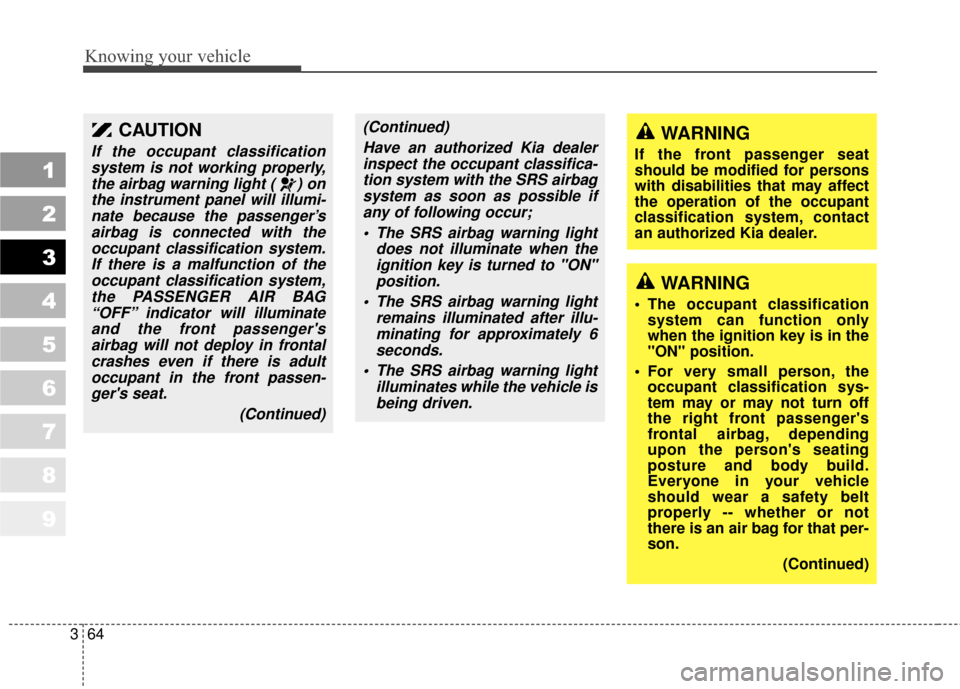
CAUTION
If the occupant classification
system is not working properly,the airbag warning light ( ) onthe instrument panel will illumi-nate because the passenger’sairbag is connected with theoccupant classification system.If there is a malfunction of theoccupant classification system,the PASSENGER AIR BAG“OFF” indicator will illuminateand the front passenger'sairbag will not deploy in frontalcrashes even if there is adultoccupant in the front passen-ger's seat.
(Continued)
(Continued)Have an authorized Kia dealerinspect the occupant classifica-tion system with the SRS airbagsystem as soon as possible ifany of following occur;
The SRS airbag warning light does not illuminate when theignition key is turned to "ON"position.
The SRS airbag warning light remains illuminated after illu-minating for approximately 6seconds.
The SRS airbag warning light illuminates while the vehicle isbeing driven.
WARNING
The occupant classification system can function only
when the ignition key is in the
"ON" position.
For very small person, the occupant classification sys-
tem may or may not turn off
the right front passenger's
frontal airbag, depending
upon the person's seating
posture and body build.
Everyone in your vehicle
should wear a safety belt
properly -- whether or not
there is an air bag for that per-
son.
(Continued)
WARNING
If the front passenger seat
should be modified for persons
with disabilities that may affect
the operation of the occupant
classification system, contact
an authorized Kia dealer.
Page 84 of 371
375
1
2
3
4
5
6
7
8
9
Knowing your vehicle
How does the airbag system
operate
Airbags only operate when theignition switch is turned to the ON
or START positions.
Airbags inflate instantly in the event of serious frontal or side col-
lision in order to help protect the
occupants from physical injury.
The airbag Electronic Control Unit
(ECU) is a small computer which
calculates the immediate impact
information and sends out a
deployment signal based on the
ECU's calculation of the likely
severity of the developing collision.
There is no single vehicle speed at which the airbags will inflate. Airbag deployment depends on a
number of factors including vehicle
speed, angles of impact and the
density and stiffness of the vehi-
cles or objects which your vehicle
hits in the collision. However, fac-
tors are not limited to those men-
tioned above.
The front airbags will completely inflate and deflate in an instant.
It is impossible for you to see the
airbags inflate during an accident.
It is much more likely that you will
simply see the deflated airbags
hanging out of their storage com-
partments after the collision. In order to help provide protection
in a severe collision, the airbags
must inflate rapidly. The speed of
airbag inflation has been deter-
mined by the Canadian Motor
Vehicle Safety Standard (CMVSS)
to reduce the likelihood of serious
or life-threatening injuries and is
thus a mandatory part of the airbag
design.
However, airbag inflation can also
cause injuries which normally can
include facial abrasions, bruises
and broken bones, and sometimes
more serious injuries because that
inflation speed also causes the
airbags to expand with a great deal
force.
There are even circumstances under which contact with the
steering wheel airbag can cause
fatal injuries, especially if the
occupant is positioned exces-
sively close to the steering
wheel.