brakes KIA Sportage 2010 SL / 3.G Owner's Guide
[x] Cancel search | Manufacturer: KIA, Model Year: 2010, Model line: Sportage, Model: KIA Sportage 2010 SL / 3.GPages: 371, PDF Size: 5.23 MB
Page 314 of 371
75
Maintenance
1
2
3
4
5
6
7
8
9
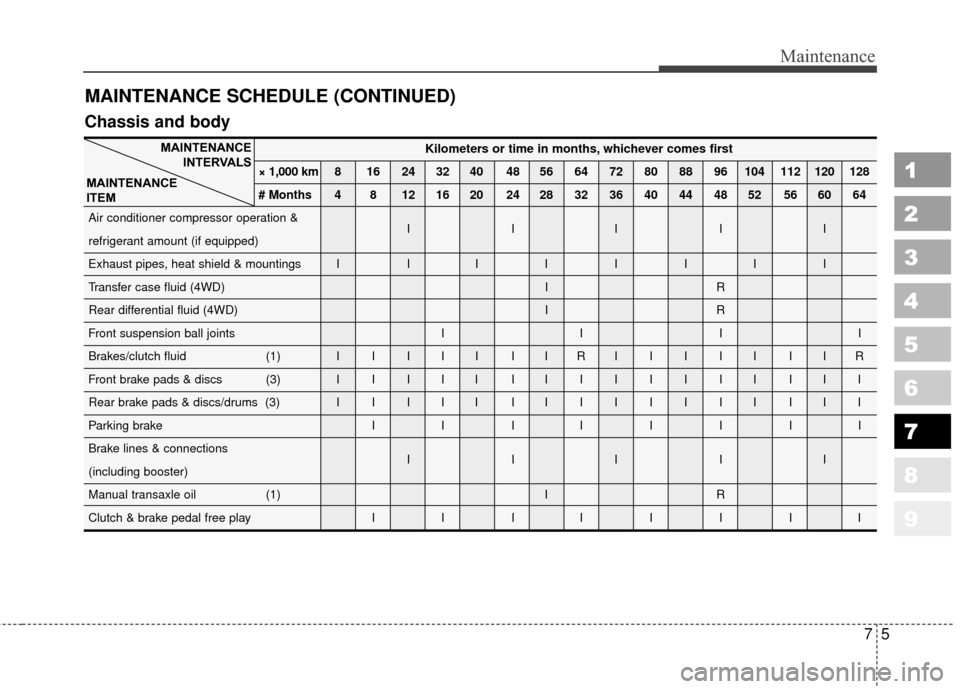
MAINTENANCE SCHEDULE (CONTINUED)
Kilometers or time in months, whichever comes first
× 1,000 km 8 16 24 32 40 48 56 64 72 80 88 96 104 112 120 128
# Months 4 8 12 16 20 24 28 32 36 40 44 48 52 56 60 64
Air conditioner compressor operation & IIIII
refrigerant amount (if equipped)
Exhaust pipes, heat shield & mountings I I IIIIII
Transfer case fluid (4WD) I R
Rear differential fluid (4WD) I R
Front suspension ball joints I I I I
Brakes/clutch fluid (1) I I I I I I I R IIIII IIR
Front brake pads & discs (3) I I I I I I IIIIIII III
Rear brake pads & discs/drums (3) I I I I I I IIIIIII III
Parking brake I I I IIIII
Brake lines & connections IIIII
(including booster)
Manual transaxle oil (1) I R
Clutch & brake pedal free play I I I I I I IIIIIII III
MAINTENANCE
INTERVALS
MAINTENANCE
ITEM
Chassis and body
Page 331 of 371
Maintenance
22
7
1
2
3
4
5
6
7
8
9
BRAKES AND CLUTCH (IF EQUIPPED)
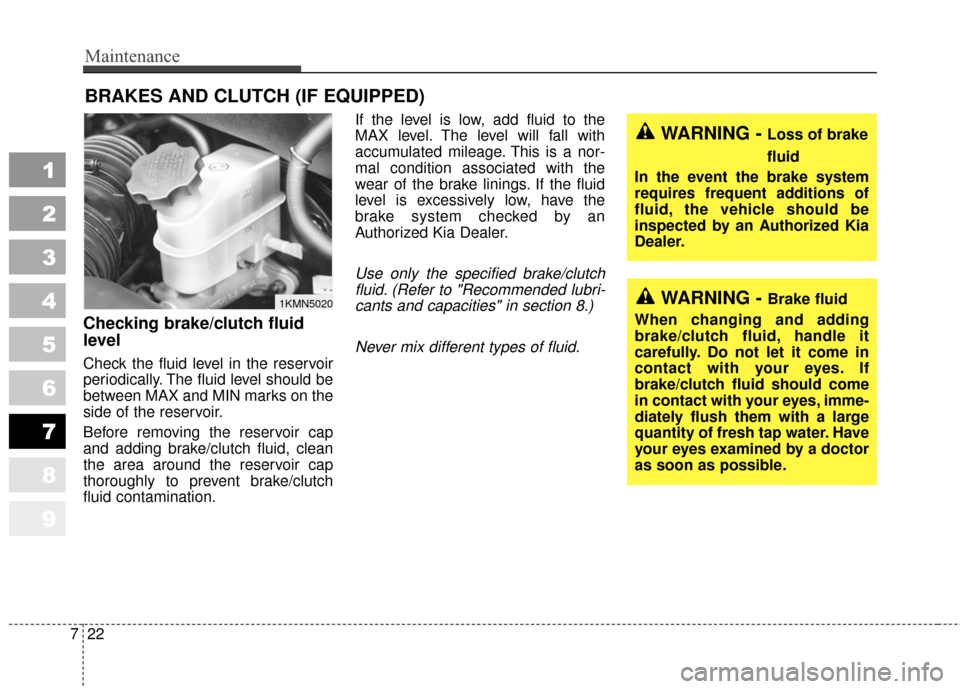
Checking brake/clutch fluid
level
Check the fluid level in the reservoir
periodically. The fluid level should be
between MAX and MIN marks on the
side of the reservoir.
Before removing the reservoir cap
and adding brake/clutch fluid, clean
the area around the reservoir cap
thoroughly to prevent brake/clutch
fluid contamination. If the level is low, add fluid to the
MAX level. The level will fall with
accumulated mileage. This is a nor-
mal condition associated with the
wear of the brake linings. If the fluid
level is excessively low, have the
brake system checked by an
Authorized Kia Dealer.
Use only the specified brake/clutch
fluid. (Refer to "Recommended lubri-cants and capacities" in section 8.)
Never mix different types of fluid.
WARNING - Brake fluid
When changing and adding
brake/clutch fluid, handle it
carefully. Do not let it come in
contact with your eyes. If
brake/clutch fluid should come
in contact with your eyes, imme-
diately flush them with a large
quantity of fresh tap water. Have
your eyes examined by a doctor
as soon as possible.
WARNING - Loss of brake
fluid
In the event the brake system
requires frequent additions of
fluid, the vehicle should be
inspected by an Authorized Kia
Dealer.
1KMN5020
Page 359 of 371
Maintenance
50
7
1
2
3
4
5
6
7
8
9
EXTERIOR CARE
Exterior general caution
It is very important to follow the label
directions when using any chemical
cleaner or polish. Read all warning
and caution statements that appear
on the label.
Finish maintenance
Washing
To help protect your vehicle’s finish
from rust and deterioration, wash it
thoroughly and frequently at least
once a month with lukewarm or cold
water.
If you use your vehicle for off-road
driving, you should wash it after each
off-road trip. Pay special attention to
the removal of any accumulation of
salt, dirt, mud, and other foreign
materials. Make sure the drain holes
in the lower edges of the doors and
rocker panels are kept clear and
clean.
Insects, tar, tree sap, bird droppings,
industrial pollution and similar
deposits can damage your vehicle’s
finish if not removed immediately.
Even prompt washing with plain
water may not completely remove all
these deposits. A mild soap, safe for
use on painted surfaces, may be
used.
After washing, rinse the vehicle thor-
oughly with lukewarm or cold water.
Do not allow soap to dry on the finish.
WARNING - Wet brakes
After washing the vehicle, test
the brakes while driving slowly
to see if they have been affected
by water. If braking performance
is impaired, dry the brakes by
applying them lightly while
maintaining a slow forward
speed.
CAUTION
Do not use strong soap, chem- ical detergents or hot water,and do not wash the vehicle indirect sunlight or when thebody of the vehicle is warm.
Do not wash the side windows too close with high pressurewater. Water may leak throughthe windows and wet the inte-rior.
To prevent damage to the plastic parts, do not clean withchemical solvents or strongdetergents.
Page 361 of 371
Maintenance
52
7
1
2
3
4
5
6
7
8
9
Bright-metal maintenance
To remove road tar and insects,
use a tar remover, not a scraper or
other sharp object.
To protect the surfaces of bright- metal parts from corrosion, apply a
coating of wax or chrome preserv-
ative and rub to a high luster.
During winter weather or in coastal areas, cover the bright metal parts
with a heavier coating of wax or
preservative. If necessary, coat the
parts with non-corrosive petroleum
jelly or other protective compound.
Underbody maintenance
Corrosive materials used for ice and
snow removal and dust control may
collect on the underbody. If these
materials are not removed, acceler-
ated rusting can occur on underbody
parts such as the fuel lines, frame,
floor pan and exhaust system, even
though they have been treated with
rust protection. Thoroughly flush the vehicle under-
body and wheel openings with luke-
warm or cold water once a month,
after off-road driving and at the end
of each winter. Pay special attention
to these areas because it is difficult
to see all the mud and dirt. It will do
more harm than good to wet down
the road grime without removing it.
The lower edges of doors, rocker
panels, and frame members have
drain holes that should not be
allowed to clog with dirt; trapped
water in these areas can cause rust-
ing.
Aluminum wheel maintenance
The aluminum wheels are coated
with a clear protective finish.
Do not use any abrasive cleaner,
polishing compound, solvent, or
wire brushes on aluminum wheels.
They may scratch or damage the
finish.
Use only a mild soap or neutral detergent, and rinse thoroughly
with water. Also, be sure to clean
the wheels after driving on salted
roads. This helps prevent corro-
sion.
Avoid washing the wheels with high-speed car wash brushes.
Do not use any cleaners containing acid or acid detergents. It may
damage and corrode the aluminum
wheels coated with a clear protec-
tive finish.
WARNING
After washing the vehicle, test
the brakes while driving slowly
to see if they have been affected
by water. If braking performance
is impaired, dry the brakes by
applying them lightly while
maintaining a slow forward
speed.
Page 369 of 371

Index
29
1
2
3
4
5
6
7
8
9
Air cleaner. . . . . . . . . . . . . . . . . . . . . . . . . . . . . . . . . . 7-29\
Airbags-supplemental restraint system . . . . . . . . . . 3-55
Audio system . . . . . . . . . . . . . . . . . . . . . . . . . . . . . . . 3-105
Automatic climate control system. . . . . . . . . . . . . . . 4-71
Automatic transaxle . . . . . . . . . . . . . . . . . . . . . . 4-6, 7-25
Battery . . . . . . . . . . . . . . . . . . . . . . . . . . . . . . . . . . . . \
. 7-33
Before driving . . . . . . . . . . . . . . . . . . . . . . . . . . . . . . . . 5-5
Brake system . . . . . . . . . . . . . . . . . . . . . . . . . . . . . . . . 4-18
Brakes and clutch . . . . . . . . . . . . . . . . . . . . . . . . . . . . 7-22
Climate control air filter . . . . . . . . . . . . . . . . . . . . . . 7-30
Compass . . . . . . . . . . . . . . . . . . . . . . . . . . . . . . . . . . . 4-\
51
Cruise control system. . . . . . . . . . . . . . . . . . . . . . . . . 4-26
Defroster . . . . . . . . . . . . . . . . . . . . . . . . . . . . . . . . . . . 4-\
61
Door locks . . . . . . . . . . . . . . . . . . . . . . . . . . . . . . . . . . . 3-\
9
Electrical circuit protection . . . . . . . . . . . . . . . . . . . . . 6-7
Electronic stability control . . . . . . . . . . . . . . . . . . . . 4-30
Emergency starting . . . . . . . . . . . . . . . . . . . . . . . . . . . 6-4Emission control system . . . . . . . . . . . . . . . . . . . . . . . 5-3
Engine compartment . . . . . . . . . . . . . . . . . . . . . . . . . 7-15
Engine cooling system . . . . . . . . . . . . . . . . . . . . . . . . 7-19
Engine oil and oil filter . . . . . . . . . . . . . . . . . . . . . . . 7-17
Explanation of scheduled maintenance items . . . . . . 7-8
Exterior care . . . . . . . . . . . . . . . . . . . . . . . . . . . . . . . . 7-50
Four wheel drive (4WD) . . . . . . . . . . . . . . . . . . . . . . 4-12
Fuel filler lid . . . . . . . . . . . . . . . . . . . . . . . . . . . . . . . . 3-81
Fuel requirements . . . . . . . . . . . . . . . . . . . . . . . . . . . . 5-2
Gauges . . . . . . . . . . . . . . . . . . . . . . . . . . . . . . . . . . . . \
. 4-34
Hazard warning flasher . . . . . . . . . . . . . . . . . . . . . . . 4-62
Homelink® wireless control system . . . . . . . . . . . . . 5-45
Hood. . . . . . . . . . . . . . . . . . . . . . . . . . . . . . . . . . \
. . . . . 3-80
How to use this manual . . . . . . . . . . . . . . . . . . . . . . . . 1-2
If you have a flat tire . . . . . . . . . . . . . . . . . . . . . . . . . 6-19
Ignition switch . . . . . . . . . . . . . . . . . . . . . . . . . . . . . . . 4-2
Immobilizer system . . . . . . . . . . . . . . . . . . . . . . . . . . . 3-6
In case of an emergency while driving . . . . . . . . . . . . 6-2
Instrument cluster . . . . . . . . . . . . . . . . . . . . . . . . . . . 4-33
A
B
C
D
E
G
F
H
I