Conditions KIA Sportage 2014 SL / 3.G Repair Manual
[x] Cancel search | Manufacturer: KIA, Model Year: 2014, Model line: Sportage, Model: KIA Sportage 2014 SL / 3.GPages: 457, PDF Size: 11.61 MB
Page 415 of 457
Maintenance
42
7
Traction - AA, A, B & C
The traction grades, from highest to
lowest, are AA, A, B and C. Those
grades represent the tire’s ability to
stop on wet pavement as measured
under controlled conditions on spec-
ified government test surfaces of
asphalt and concrete. A tire marked
C may have poor traction perform-
ance. Temperature -A, B & C
The temperature grades are A (the
highest), B and C representing the
tire’s resistance to the generation of
heat and its ability to dissipate heat
when tested under controlled condi-
tions on a specified indoor laboratory
test wheel.
Sustained high temperature can
cause the material of the tire to
degenerate and reduce tire life, and
excessive temperature can lead to
sudden tire failure. The grade C cor-
responds to a level of performance
which all passenger car tires must
meet under the Federal Motor
Vehicle Safety Standard No. 109.
Grades B and A represent higher
levels of performance on the labora-
tory test wheel than the minimum
required by law.
WARNING - Tire
temperature
The temperature grade for this
tire is established for a tire that
is properly inflated and not
overloaded. Excessive speed,
underinflation, or excessive
loading, either separately or in
combination, can cause heat
build-up and possible sudden
tire failure. This can cause loss
of vehicle control and serious
injury or death.
WARNING
The traction grade assigned to
this tire is based on straight-
ahead braking traction tests,
and does not include accelera-
tion, cornering, hydroplaning,
or peak traction characteristics.
Page 418 of 457
745
Maintenance
Summer tires
Kia specifies summer tires on some
models to provide superior perform-
ance on dry roads. Summer tire per-
formance is substantially reduced in
snow and ice. Summer tires do not
have the tire traction rating M+S
(Mud and Snow) on the tire side wall.
if you plan to operate your vehicle in
snowy or icy conditions. Kia recom-
mends the use of snow tires or all
season tires on all four wheels.
Snow tires
If you equip your car with snow tires,
they should be the same size and
have the same load capacity as the
original tires. Snow tires should be
installed on all four wheels; other-
wise, poor handling may result.
Snow tires should carry 28 kPa (4
psi) more air pressure than the pres-
sure recommended for the standard
tires on the tire label on the driver's
side of the center pillar, or up to the
maximum pressure shown on the tire
sidewall, whichever is less.
Do not drive faster than 120 km/h (75
mph) when your vehicle is equipped
with snow tires.
Radial-ply tires
Radial-ply tires provide improved
tread life, road hazard resistance and
smoother high speed ride. The radi-
al-ply tires used on this vehicle are of
belted construction, and are selected
to complement the ride and handling
characteristics of your vehicle.
Radial-ply tires have the same load
carrying capacity, as bias-ply or bias
belted tires of the same size, and use
the same recommended inflation
pressure. Mixing of radial-ply tires
with bias-ply or bias belted tires is
not recommended. Any combina-
tions of radial-ply and bias-ply or bias
belted tires when used on the same
vehicle will seriously deteriorate
vehicle handling. The best rule to fol-
low is: Identical radial-ply tires should
always be used as a set of four.Longer wearing tires can be more
susceptible to irregular tread wear. It
is very important to follow the tire
rotation interval shown in this section
to achieve the tread life potential of
these tires. Cuts and punctures in
radial-ply tires are repairable only in
the tread area, because of sidewall
flexing. Consult your tire dealer for
radial-ply tire repairs.
Page 436 of 457
763
Maintenance
High-corrosion areas
If you live in an area where your vehi-
cle is regularly exposed to corrosive
materials, corrosion protection is
particularly important. Some of the
common causes of accelerated cor-
rosion are road salts, dust control
chemicals, ocean air and industrial
pollution.
Moisture breeds corrosion
Moisture creates the conditions in
which corrosion is most likely to
occur. For example, corrosion is
accelerated by high humidity, partic-
ularly when temperatures are just
above freezing. In such conditions,
the corrosive material is kept in con-
tact with the vehicle’s surface by
moisture that evaporate slowly.
Mud is particularly corrosive
because it dries slowly and holds
moisture in contact with the vehicle.
Although the mud appears to be dry,
it can still retain the moisture and
promote corrosion.High temperatures can also acceler-
ate corrosion of parts that are not
properly ventilated so the moisture
can be dispersed. For all these rea-
sons, it is particularly important to
keep your vehicle clean and free of
mud or accumulations of other mate-
rials. This applies not only to the vis-
ible surfaces but particularly to the
underside of the vehicle.
To help prevent corrosion
You can help prevent corrosion from
getting started by observing the fol-
lowing:
Keep your vehicle clean
The best way to prevent corrosion is
to keep your vehicle clean and free
of corrosive materials. Attention to
the underside of the vehicle is partic-
ularly important.
If you live in a high-corrosion area
— where road salts are used, near
the ocean, areas with industrial
pollution, acid rain, etc.—, you
should take extra care to prevent
corrosion. In winter, hose off the
underside of your vehicle at least
once a month and be sure to clean
the underside thoroughly when
winter is over.
vehicle, give particular attention to
the components under the fenders
and other areas that are hidden
from view. Do a thorough job; just
dampening the accumulated mud
rather than washing it away will
accelerate corrosion rather than
prevent it. Water under high pres-
sure and steam are particularly
effective in removing accumulated
mud and corrosive materials.
When cleaning lower door panels, rocker panels and frame members,
be sure that drain holes are kept
open so that moisture can escape
and not be trapped inside to accel-
erate corrosion.
Page 441 of 457
Maintenance
68
7
Do not operate the engine in con-
fined or closed areas (such as
garages) any more than what is
necessary to move the vehicle in or
out of the area.
When the vehicle is stopped in an open area for more than a short
time with the engine running,
adjust the ventilation system (as
needed) to draw outside air into the
vehicle.
Never sit in a parked or stopped vehicle for any extended time with
the engine running.
When the engine stalls or fails to start, excessive attempts to restart
the engine may cause damage to
the emission control system.G270303AAM
Operating precautions for catalyt-
ic converters (if equipped)
Your vehicle is equipped with a cat-
alytic converter emission control
device.
Therefore, the following precautions
must be observed:
Use only UNLEADED FUEL for gasoline engines.
Do not operate the vehicle when there are signs of engine malfunc-
tion, such as misfire or a noticeable
loss of performance.
Do not misuse or abuse the engine. Examples of misuse are
coasting with the ignition off and
descending steep grades in gear
with the ignition off.
Do not operate the engine at high idle speed for extended periods (5
minutes or more).
Do not modify or tamper with any part of the engine or emission con-
trol system. All inspections and
adjustments must be made by an
authorized Kia dealer.
WARNING- Fire
A hot exhaust system canignite flammable items under
your vehicle. Do not park, idle
or drive the vehicle over or
near flammable objects, such
as grass, vegetation, paper,
leaves, etc.
The exhaust system and cat- alytic system are very hot
while the engine is running or
immediately after the engine
is turned off. Keep away from
the exhaust system and cat-
alytic, you may get burned.
Also, do not remove the heat
sink around the exhaust sys-
tem, do not seal the bottom of
the vehicle or do not coat the
vehicle for corrosion control.
It may present a fire risk under
certain conditions.
Page 452 of 457
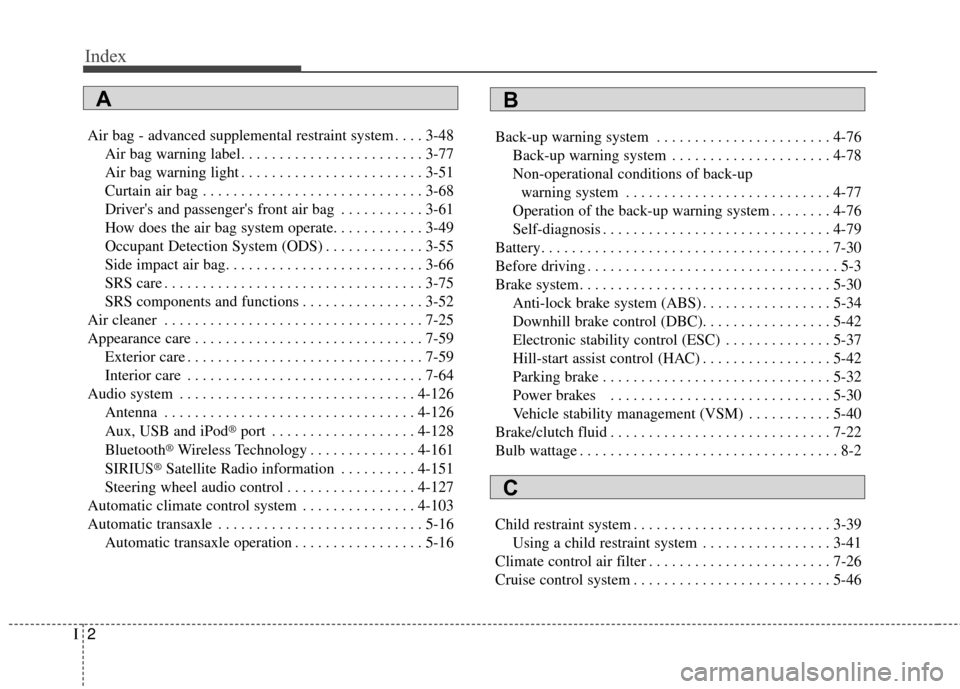
Index
2I
Air bag - advanced supplemental restraint system . . . . 3-48Air bag warning label. . . . . . . . . . . . . . . . . . . . . . . . 3-77
Air bag warning light . . . . . . . . . . . . . . . . . . . . . . . . 3-51
Curtain air bag . . . . . . . . . . . . . . . . . . . . . . . . . . . . . 3-68
Driver's and passenger's front air bag . . . . . . . . . . . 3-61
How does the air bag system operate. . . . . . . . . . . . 3-49
Occupant Detection System (ODS) . . . . . . . . . . . . . 3-55
Side impact air bag. . . . . . . . . . . . . . . . . . . . . . . . . . 3-66
SRS care . . . . . . . . . . . . . . . . . . . . . . . . . . . . . . . . . . 3-75\
SRS components and functions . . . . . . . . . . . . . . . . 3-52
Air cleaner . . . . . . . . . . . . . . . . . . . . . . . . . . . . . . . . . . 7-25\
Appearance care . . . . . . . . . . . . . . . . . . . . . . . . . . . . . . 7-59 Exterior care . . . . . . . . . . . . . . . . . . . . . . . . . . . . . . . 7-59
Interior care . . . . . . . . . . . . . . . . . . . . . . . . . . . . . . . 7-64
Audio system . . . . . . . . . . . . . . . . . . . . . . . . . . . . . . . 4-126 Antenna . . . . . . . . . . . . . . . . . . . . . . . . . . . . . . . . . 4-126
Aux, USB and iPod
®port . . . . . . . . . . . . . . . . . . . 4-128
Bluetooth®Wireless Technology . . . . . . . . . . . . . . 4-161
SIRIUS®Satellite Radio information . . . . . . . . . . 4-151
Steering wheel audio control . . . . . . . . . . . . . . . . . 4-127
Automatic climate control system . . . . . . . . . . . . . . . 4-103
Automatic transaxle . . . . . . . . . . . . . . . . . . . . . . . . . . . 5-16 Automatic transaxle operation . . . . . . . . . . . . . . . . . 5-16 Back-up warning system . . . . . . . . . . . . . . . . . . . . . . . 4-76
Back-up warning system . . . . . . . . . . . . . . . . . . . . . 4-78
Non-operational conditions of back-upwarning system . . . . . . . . . . . . . . . . . . . . . . . . . . . 4-77
Operation of the back-up warning system . . . . . . . . 4-76
Self-diagnosis . . . . . . . . . . . . . . . . . . . . . . . . . . . . . . 4-79
Battery. . . . . . . . . . . . . . . . . . . . . . . . . . . . . . . . . . . . \
. . 7-30
Before driving . . . . . . . . . . . . . . . . . . . . . . . . . . . . . . . . . 5-3
Brake system. . . . . . . . . . . . . . . . . . . . . . . . . . . . . . . . . 5-30 Anti-lock brake system (ABS) . . . . . . . . . . . . . . . . . 5-34
Downhill brake control (DBC). . . . . . . . . . . . . . . . . 5-42
Electronic stability control (ESC) . . . . . . . . . . . . . . 5-37
Hill-start assist control (HAC) . . . . . . . . . . . . . . . . . 5-42
Parking brake . . . . . . . . . . . . . . . . . . . . . . . . . . . . . . 5-32
Power brakes . . . . . . . . . . . . . . . . . . . . . . . . . . . . . 5-30
Vehicle stability management (VSM) . . . . . . . . . . . 5-40
Brake/clutch fluid . . . . . . . . . . . . . . . . . . . . . . . . . . . . . 7-22
Bulb wattage . . . . . . . . . . . . . . . . . . . . . . . . . . . . . . . . . . 8-2
Child restraint system . . . . . . . . . . . . . . . . . . . . . . . . . . 3-39 Using a child restraint system . . . . . . . . . . . . . . . . . 3-41
Climate control air filter . . . . . . . . . . . . . . . . . . . . . . . . 7-26
Cruise control system . . . . . . . . . . . . . . . . . . . . . . . . . . 5-46
AB
C
Page 455 of 457
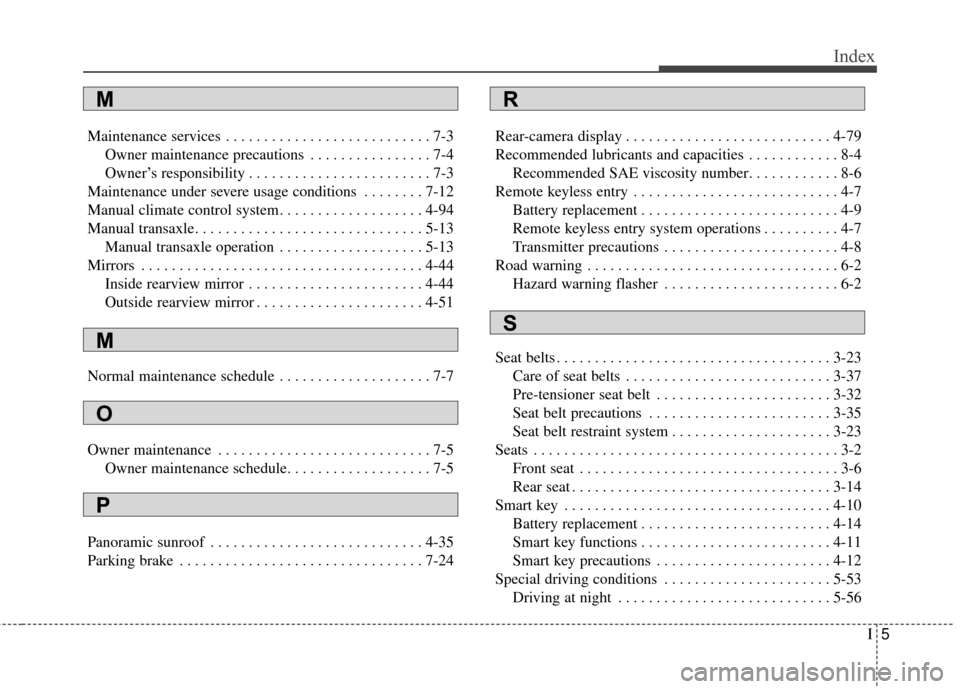
I5
Index
Maintenance services . . . . . . . . . . . . . . . . . . . . . . . . . . . 7-3Owner maintenance precautions . . . . . . . . . . . . . . . . 7-4
Owner’s responsibility . . . . . . . . . . . . . . . . . . . . . . . . 7-3
Maintenance under severe usage conditions . . . . . . . . 7-12
Manual climate control system. . . . . . . . . . . . . . . . . . . 4-94
Manual transaxle. . . . . . . . . . . . . . . . . . . . . . . . . . . . . . 5-13 Manual transaxle operation . . . . . . . . . . . . . . . . . . . 5-13
Mirrors . . . . . . . . . . . . . . . . . . . . . . . . . . . . . . . . . . . . \
. 4-44 Inside rearview mirror . . . . . . . . . . . . . . . . . . . . . . . 4-44
Outside rearview mirror . . . . . . . . . . . . . . . . . . . . . . 4-51
Normal maintenance schedule . . . . . . . . . . . . . . . . . . . . 7-7
Owner maintenance . . . . . . . . . . . . . . . . . . . . . . . . . . . . 7-5 Owner maintenance schedule. . . . . . . . . . . . . . . . . . . 7-5
Panoramic sunroof . . . . . . . . . . . . . . . . . . . . . . . . . . . . 4-35
Parking brake . . . . . . . . . . . . . . . . . . . . . . . . . . . . . . . . 7-24 Rear-camera display . . . . . . . . . . . . . . . . . . . . . . . . . . . 4-79
Recommended lubricants and capacities . . . . . . . . . . . . 8-4
Recommended SAE viscosity number. . . . . . . . . . . . 8-6
Remote keyless entry . . . . . . . . . . . . . . . . . . . . . . . . . . . 4-7 Battery replacement . . . . . . . . . . . . . . . . . . . . . . . . . . 4-9
Remote keyless entry system operations . . . . . . . . . . 4-7
Transmitter precautions . . . . . . . . . . . . . . . . . . . . . . . 4-8
Road warning . . . . . . . . . . . . . . . . . . . . . . . . . . . . . . . . . 6-2 Hazard warning flasher . . . . . . . . . . . . . . . . . . . . . . . 6-2
Seat belts . . . . . . . . . . . . . . . . . . . . . . . . . . . . . . . . . . . . \
3-23 Care of seat belts . . . . . . . . . . . . . . . . . . . . . . . . . . . 3-37
Pre-tensioner seat belt . . . . . . . . . . . . . . . . . . . . . . . 3-32
Seat belt precautions . . . . . . . . . . . . . . . . . . . . . . . . 3-35
Seat belt restraint system . . . . . . . . . . . . . . . . . . . . . 3-23
Seats . . . . . . . . . . . . . . . . . . . . . . . . . . . . . . . . . . . . \
. . . . 3-2 Front seat . . . . . . . . . . . . . . . . . . . . . . . . . . . . . . . . . . 3-6
Rear seat . . . . . . . . . . . . . . . . . . . . . . . . . . . . . . . . . . 3-14\
Smart key . . . . . . . . . . . . . . . . . . . . . . . . . . . . . . . . . . . 4-\
10 Battery replacement . . . . . . . . . . . . . . . . . . . . . . . . . 4-14
Smart key functions . . . . . . . . . . . . . . . . . . . . . . . . . 4-11
Smart key precautions . . . . . . . . . . . . . . . . . . . . . . . 4-12
Special driving conditions . . . . . . . . . . . . . . . . . . . . . . 5-53 Driving at night . . . . . . . . . . . . . . . . . . . . . . . . . . . . 5-56
M
M
R
S
O
P
Page 456 of 457
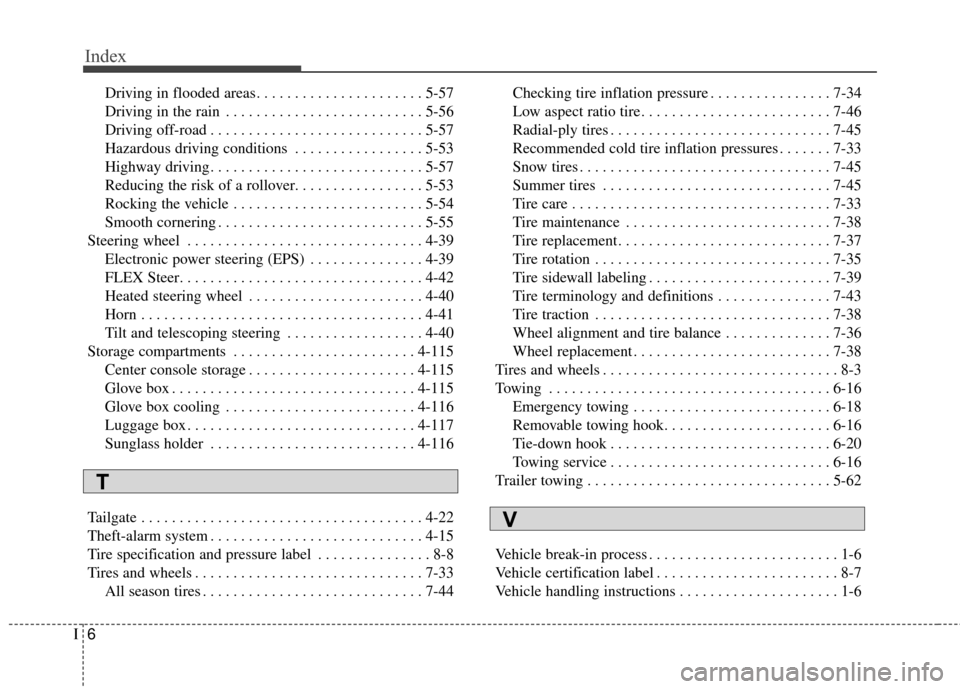
Index
6I
Driving in flooded areas. . . . . . . . . . . . . . . . . . . . . . 5-57
Driving in the rain . . . . . . . . . . . . . . . . . . . . . . . . . . 5-56
Driving off-road . . . . . . . . . . . . . . . . . . . . . . . . . . . . 5-57
Hazardous driving conditions . . . . . . . . . . . . . . . . . 5-53
Highway driving. . . . . . . . . . . . . . . . . . . . . . . . . . . . 5-57
Reducing the risk of a rollover. . . . . . . . . . . . . . . . . 5-53
Rocking the vehicle . . . . . . . . . . . . . . . . . . . . . . . . . 5-54
Smooth cornering . . . . . . . . . . . . . . . . . . . . . . . . . . . 5-55
Steering wheel . . . . . . . . . . . . . . . . . . . . . . . . . . . . . . . 4-39 Electronic power steering (EPS) . . . . . . . . . . . . . . . 4-39
FLEX Steer. . . . . . . . . . . . . . . . . . . . . . . . . . . . . . . . 4-42
Heated steering wheel . . . . . . . . . . . . . . . . . . . . . . . 4-40
Horn . . . . . . . . . . . . . . . . . . . . . . . . . . . . . . . . . . . . \
. 4-41
Tilt and telescoping steering . . . . . . . . . . . . . . . . . . 4-40
Storage compartments . . . . . . . . . . . . . . . . . . . . . . . . 4-115 Center console storage . . . . . . . . . . . . . . . . . . . . . . 4-115
Glove box . . . . . . . . . . . . . . . . . . . . . . . . . . . . . . . . 4-115
Glove box cooling . . . . . . . . . . . . . . . . . . . . . . . . . 4-116
Luggage box . . . . . . . . . . . . . . . . . . . . . . . . . . . . . . 4-117
Sunglass holder . . . . . . . . . . . . . . . . . . . . . . . . . . . 4-116
Tailgate . . . . . . . . . . . . . . . . . . . . . . . . . . . . . . . . . . . . \
. 4-22
Theft-alarm system . . . . . . . . . . . . . . . . . . . . . . . . . . . . 4-15
Tire specification and pressure label . . . . . . . . . . . . . . . 8-8
Tires and wheels . . . . . . . . . . . . . . . . . . . . . . . . . . . . . . 7-33 All season tires . . . . . . . . . . . . . . . . . . . . . . . . . . . . . 7-44 Checking tire inflation pressure . . . . . . . . . . . . . . . . 7-34
Low aspect ratio tire. . . . . . . . . . . . . . . . . . . . . . . . . 7-46
Radial-ply tires . . . . . . . . . . . . . . . . . . . . . . . . . . . . . 7-45
Recommended cold tire inflation pressures . . . . . . . 7-33
Snow tires . . . . . . . . . . . . . . . . . . . . . . . . . . . . . . . . . 7-45
Summer tires . . . . . . . . . . . . . . . . . . . . . . . . . . . . . . 7-45
Tire care . . . . . . . . . . . . . . . . . . . . . . . . . . . . . . . . . . 7-33\
Tire maintenance . . . . . . . . . . . . . . . . . . . . . . . . . . . 7-38
Tire replacement . . . . . . . . . . . . . . . . . . . . . . . . . . . . 7-37
Tire rotation . . . . . . . . . . . . . . . . . . . . . . . . . . . . . . . 7-35
Tire sidewall labeling . . . . . . . . . . . . . . . . . . . . . . . . 7-39
Tire terminology and definitions . . . . . . . . . . . . . . . 7-43
Tire traction . . . . . . . . . . . . . . . . . . . . . . . . . . . . . . . 7-38
Wheel alignment and tire balance . . . . . . . . . . . . . . 7-36
Wheel replacement . . . . . . . . . . . . . . . . . . . . . . . . . . 7-38
Tires and wheels . . . . . . . . . . . . . . . . . . . . . . . . . . . . . . . 8-3
Towing . . . . . . . . . . . . . . . . . . . . . . . . . . . . . . . . . . . . \
. 6-16 Emergency towing . . . . . . . . . . . . . . . . . . . . . . . . . . 6-18
Removable towing hook. . . . . . . . . . . . . . . . . . . . . . 6-16
Tie-down hook . . . . . . . . . . . . . . . . . . . . . . . . . . . . . 6-20
Towing service . . . . . . . . . . . . . . . . . . . . . . . . . . . . . 6-16
Trailer towing . . . . . . . . . . . . . . . . . . . . . . . . . . . . . . . . 5-62
Vehicle break-in process . . . . . . . . . . . . . . . . . . . . . . . . . 1-6
Vehicle certification label . . . . . . . . . . . . . . . . . . . . . . . . 8-7
Vehicle handling instructions . . . . . . . . . . . . . . . . . . . . . 1-6
T
V