engine KIA Sportage 2014 SL / 3.G Owner's Manual
[x] Cancel search | Manufacturer: KIA, Model Year: 2014, Model line: Sportage, Model: KIA Sportage 2014 SL / 3.GPages: 457, PDF Size: 11.61 MB
Page 6 of 457
13
Introduction
A020101AHM-EU
Your new vehicle is designed to use
only unleaded fuel having a pump
octane number ((R+M)/2) of 87
(Research Octane Number 91) or
higher.
Your new vehicle is designed to
obtain maximum performance with
UNLEADED FUEL, as well as mini-
mize exhaust emissions and spark
plug fouling.
A020103AUN-EU
Gasoline containing alcohol andmethanol
Gasohol, a mixture of gasoline and
ethanol (also known as grain alcohol),
and gasoline or gasohol containing
methanol (also known as wood alco-
hol) are being marketed along with or
instead of leaded or unleaded gaso-
line.
Pursuant to EPA regulations, ethanol
may be used in your vehicle. Do not
use gasohol containing more than
10% ethanol, and do not use gasoline
or gasohol containing any methanol.
Ethanol provides less energy than
gasoline and it attracts water, and it is
thus likely to reduce your fuel efficien-
cy and could lower your MPG results.
Methanol may cause drivability prob-
lems and damage to the fuel system.
Discontinue using gasohol of any kind
if drivability problems occur. Vehicle
damage or drivability problems may
not be covered by the manufacturer's
warranty if they result from the use of:
1. Gasoline or gasohol containing methanol.
2. Leaded fuel or leaded gasohol.
FUEL REQUIREMENTS
CAUTION
Never add any fuel system cleaning agents to the fuel tankother than what has been speci-fied. (Consult an authorized Kiadealer for details.)
WARNING
• Do not "top off" after the noz- zle automatically shuts off
when refueling.
Tighten the cap until it clicks once. otherwise the Check
Engine light will illumi-
nate.
Always check that the fuel cap is installed securely to pre-
vent fuel spillage in the event
of an accident.
Page 7 of 457
Introduction
41
"E85" fuel is an alternative fuel com-
prised of 85 percent ethanol and 15
percent gasoline, and is manufac-
tured exclusively for use in Flexible
Fuel Vehicles. “E85” is not compati-
ble with your vehicle. Use of “E85”
may result in poor engine perform-
ance and damage to your vehicle's
engine and fuel system. Kia recom-
mends that customers do not use
fuel with an ethanol content exceed-
ing 10%.A020104AUN
Use of MTBE
Kia recommends avoiding fuels con-
taining MTBE (Methyl Tertiary Butyl
Ether) over 15.0% vol. (Oxygen
Content 2.7% weight) in your vehicle.
Fuel containing MTBE over 15.0%
vol. (Oxygen Content 2.7% weight)
may reduce vehicle performance and
produce vapor lock or hard starting.
Gasoline containing MMT
Some gasoline contains harmful
manganese-based fuel additives
such as MMT
(Methylcyclopentadienyl Manganese
Tricarbonyl).
Kia does not recommend the use of
gasoline containing MMT.
This type of fuel can reduce vehicle
performance and affect your emis-
sion control system.
The malfunction indicator lamp on
the cluster may come on.
A020105AUN
Do not use methanol
Fuels containing methanol (wood
alcohol) should not be used in your
vehicle. This type of fuel can reduce
vehicle performance and damage
components of the fuel system.
CAUTION
Never use gasohol which con-tains methanol. Discontinue useof any gasohol product whichimpairs drivability.
CAUTION
Your New Vehicle LimitedWarranty does not cover dam-age to the fuel system or anyperformance problems causedby the use of “E85” fuel.
CAUTION
Your New Vehicle LimitedWarranty may not cover damageto the fuel system and any per-formance problems that arecaused by the use of fuels con-taining methanol or fuels con-taining MTBE (Methyl TertiaryButyl Ether) over 15.0% vol.(Oxygen Content 2.7% weight.)
Page 8 of 457
15
Introduction
Fuel Additives
Kia recommends that you use good
quality gasolines treated with deter-
gent additives such as TOP TIER
Detergent Gasoline, which help pre-
vent deposit formation in the engine.
These gasolines will help the engine
run cleaner and enhance perform-
ance of the Emission Control
System. For more information on
TOP TIER Detergent Gasoline,
please go to the website (www
.top-
tiergas.com)
For customers who do not use TOP
Tier Detergent Gasoline regularly,
and have problems starting or the
engine does not run smoothly, addi-
tives that you can buy separately
may be added to the gasoline. If
TOP TIER Detergent Gasoline is not
available, one bottle of additive
added to the fuel tank at every
12,000 km (7,500 mile) or 12 months
is recommended. Additives are avail-
able from your authorized Kia dealer
along with information on how to use
them. Do not mix other additives.
A020107AUN
Operation in foreign countries
If you are going to drive your vehicle
in another country, be sure to:
Observe all regulations regarding registration and insurance.
Determine that acceptable fuel is available.
Page 9 of 457
Introduction
61
A090000AEN
As with other vehicles of this type,
failure to operate this vehicle correct-
ly may result in loss of control, an
accident or vehicle rollover.
Specific design characteristics (high-
er ground clearance, track, etc.) give
this vehicle a higher center of gravity
than other types of vehicles. In other
words they are not designed for cor-
nering at the same speeds as con-
ventional 2-wheel drive vehicles.
Avoid sharp turns or abrupt maneu-
vers. Again, failure to operate this
vehicle correctly may result in loss of
control, an accident or vehicle
rollover.Be sure to read the
“Reducing the risk of a rollover”
driving guidelines, in section 5 of
this manual.
A030000AUN
No special break-in period is need-
ed. By following a few simple precau-
tions for the first 1,000 km (600
miles) you may add to the perform-
ance, economy and life of your vehi-
cle.
Do not race the engine.
While driving, keep your engine speed (rpm, or revolutions per
minute) between 2,000 rpm and
4,000 rpm.
Do not maintain a single speed for long periods of time, either fast or
slow. Varying engine speed is
needed to properly break-in the
engine.
Avoid hard stops, except in emer- gencies, to allow the brakes to seat
properly.
Don't tow a trailer during the first 2,000 km (1,200 miles) of opera-
tion.
VEHICLE BREAK-IN
PROCESS
VEHICLE HANDLING
INSTRUCTIONS
Page 10 of 457
Your vehicle at a glance
Exterior overview I . . . . . . . . . . . . . . . . . . . . . . . . . 2-2
Exterior overview II. . . . . . . . . . . . . . . . . . . . . . . . . 2-3
Interior overview . . . . . . . . . . . . . . . . . . . . . . . . . . . 2-4
Instrument panel overview . . . . . . . . . . . . . . . . . . . 2-5
Engine compartment . . . . . . . . . . . . . . . . . . . . . . . . 2-6
2
Page 14 of 457
25
Your vehicle at a glance
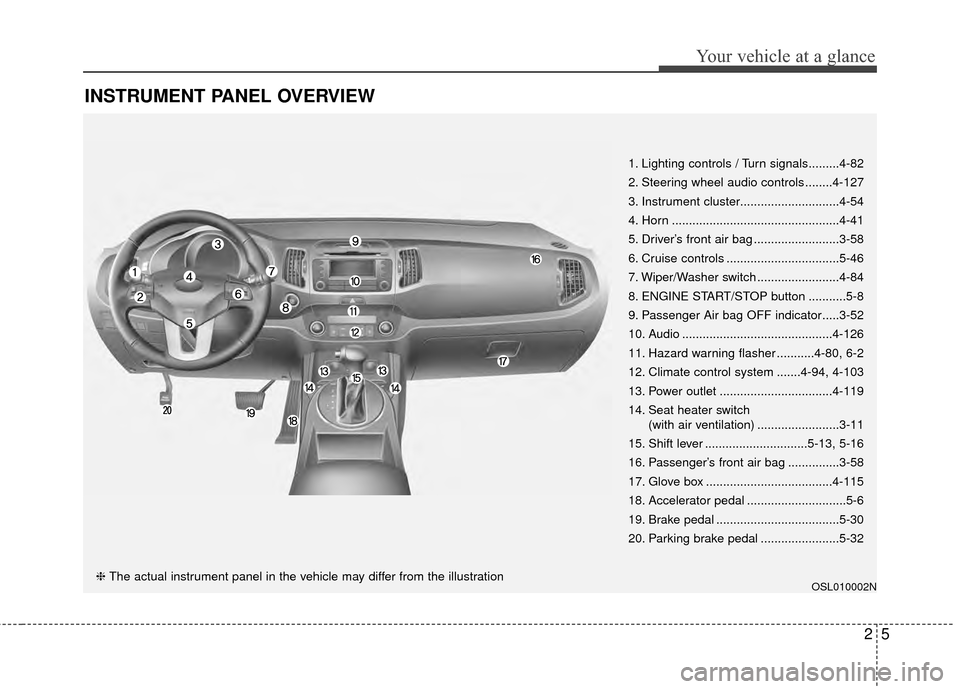
INSTRUMENT PANEL OVERVIEW
OSL010002N
1. Lighting controls / Turn signals.........4-82
2. Steering wheel audio controls ........4-127
3. Instrument cluster.............................4-54
4. Horn .................................................4-41
5. Driver’s front air bag .........................3-58
6. Cruise controls .................................5-46
7. Wiper/Washer switch ........................4-84
8. ENGINE START/STOP button ...........5-8
9. Passenger Air bag OFF indicator.....3-52
10. Audio ............................................4-126
11. Hazard warning flasher ...........4-80, 6-2
12. Climate control system .......4-94, 4-103
13. Power outlet .................................4-119
14. Seat heater switch(with air ventilation) ........................3-11
15. Shift lever ..............................5-13, 5-16
16. Passenger’s front air bag ...............3-58
17. Glove box .....................................4-115
18. Accelerator pedal .............................5-6
19. Brake pedal ....................................5-30
20. Parking brake pedal .......................5-32
❈ The actual instrument panel in the vehicle may differ from the illustration
Page 15 of 457

Your vehicle at a glance
62
ENGINE COMPARTMENT
B030000AUN-C1
1. Engine coolant reservoir ..................7-21
2. Engine oil filler cap ..........................7-18
3. Brake/clutch* fluid reservoir ............7-23
4. Positive battery terminal ..................7-31
5. Negative battery terminal ................7-31
6. Fuse box ..........................................7-50
7. Air cleaner ........................................7-26
8. Engine oil dipstick ............................7-18
9. Radiator cap ....................................7-22
10. Windshield washer fluid reservoir ..7-25
* if equipped
OSL074101N/OSL071001N
❈The actual engine room in the vehicle may differ from the illustration.
■
■
GDI engine
■
■ T-GDI engine
Page 22 of 457
37
Safety features of your vehicle
Front seat adjustment - power
(if equipped)
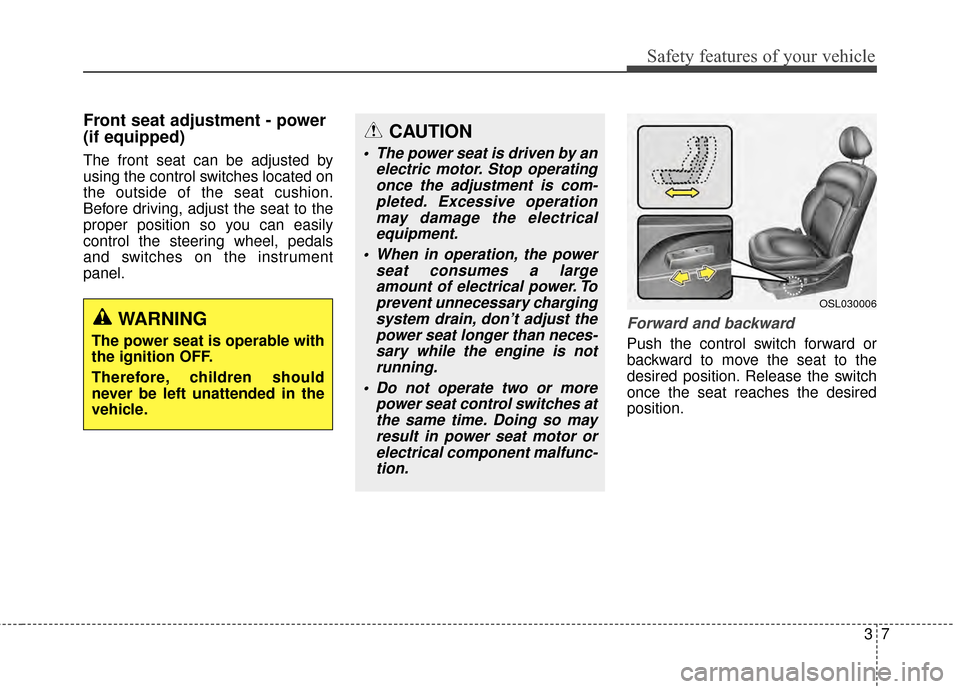
The front seat can be adjusted by
using the control switches located on
the outside of the seat cushion.
Before driving, adjust the seat to the
proper position so you can easily
control the steering wheel, pedals
and switches on the instrument
panel.
Forward and backward
Push the control switch forward or
backward to move the seat to the
desired position. Release the switch
once the seat reaches the desired
position.
CAUTION
The power seat is driven by anelectric motor. Stop operatingonce the adjustment is com-pleted. Excessive operationmay damage the electricalequipment.
When in operation, the power seat consumes a largeamount of electrical power. Toprevent unnecessary chargingsystem drain, don’t adjust thepower seat longer than neces-sary while the engine is notrunning.
Do not operate two or more power seat control switches atthe same time. Doing so mayresult in power seat motor orelectrical component malfunc-tion.
OSL030006
WARNING
The power seat is operable with
the ignition OFF.
Therefore, children should
never be left unattended in the
vehicle.
Page 34 of 457
319
Safety features of your vehicle
C010303AHM
Headrest
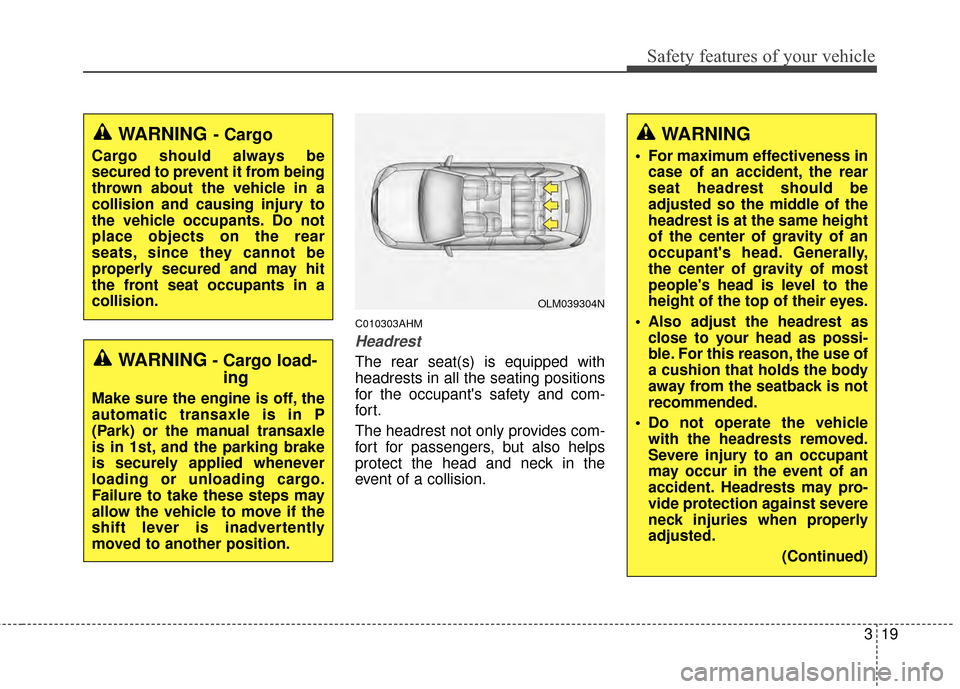
The rear seat(s) is equipped with
headrests in all the seating positions
for the occupant's safety and com-
for t.
The headrest not only provides com-
fort for passengers, but also helps
protect the head and neck in the
event of a collision.
OLM039304N
WARNING
For maximum effectiveness incase of an accident, the rear
seat headrest should be
adjusted so the middle of the
headrest is at the same height
of the center of gravity of an
occupant's head. Generally,
the center of gravity of most
people's head is level to the
height of the top of their eyes.
Also adjust the headrest as close to your head as possi-
ble. For this reason, the use of
a cushion that holds the body
away from the seatback is not
recommended.
Do not operate the vehicle with the headrests removed.
Severe injury to an occupant
may occur in the event of an
accident. Headrests may pro-
vide protection against severe
neck injuries when properly
adjusted.
(Continued)
WARNING- Cargo load-ing
Make sure the engine is off, the
automatic transaxle is in P
(Park) or the manual transaxle
is in 1st, and the parking brake
is securely applied whenever
loading or unloading cargo.
Failure to take these steps may
allow the vehicle to move if the
shift lever is inadvertently
moved to another position.
WARNING- Cargo
Cargo should always be
secured to prevent it from being
thrown about the vehicle in a
collision and causing injury to
the vehicle occupants. Do not
place objects on the rear
seats, since they cannot be
properly secured and may hit
the front seat occupants in a
collision.
Page 70 of 457
355
Safety features of your vehicle
C040300AAM
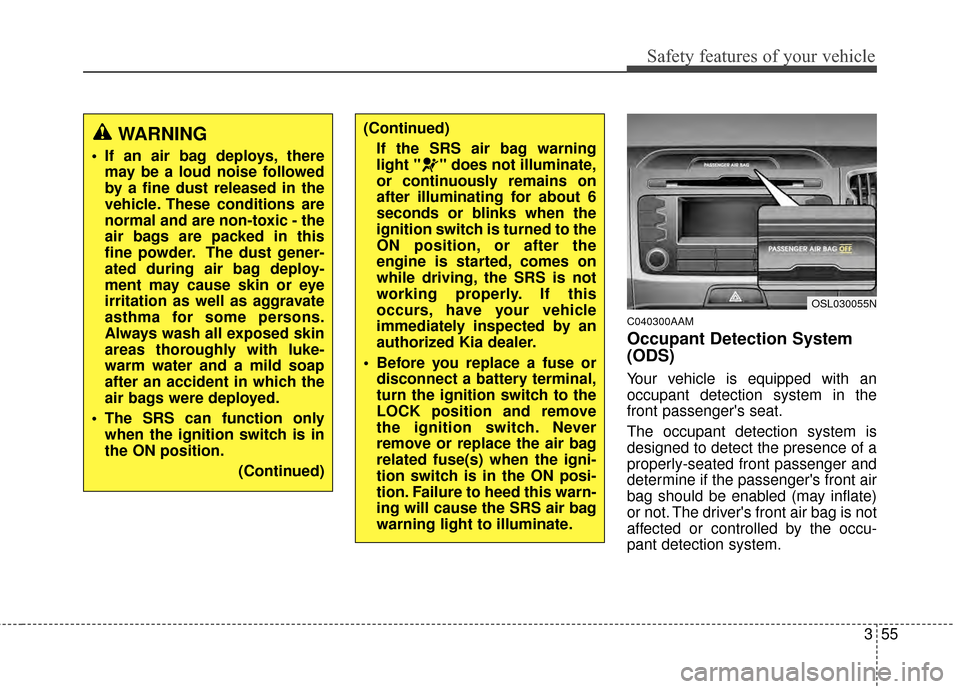
Occupant Detection System
(ODS)
Your vehicle is equipped with an
occupant detection system in the
front passenger's seat.
The occupant detection system is
designed to detect the presence of a
properly-seated front passenger and
determine if the passenger's front air
bag should be enabled (may inflate)
or not. The driver's front air bag is not
affected or controlled by the occu-
pant detection system.
WARNING
If an air bag deploys, theremay be a loud noise followed
by a fine dust released in the
vehicle. These conditions are
normal and are non-toxic - the
air bags are packed in this
fine powder. The dust gener-
ated during air bag deploy-
ment may cause skin or eye
irritation as well as aggravate
asthma for some persons.
Always wash all exposed skin
areas thoroughly with luke-
warm water and a mild soap
after an accident in which the
air bags were deployed.
The SRS can function only when the ignition switch is in
the ON position.
(Continued)
(Continued)If the SRS air bag warning
light " " does not illuminate,
or continuously remains on
after illuminating for about 6
seconds or blinks when the
ignition switch is turned to the
ON position, or after the
engine is started, comes on
while driving, the SRS is not
working properly. If this
occurs, have your vehicle
immediately inspected by an
authorized Kia dealer.
Before you replace a fuse or disconnect a battery terminal,
turn the ignition switch to the
LOCK position and remove
the ignition switch. Never
remove or replace the air bag
related fuse(s) when the igni-
tion switch is in the ON posi-
tion. Failure to heed this warn-
ing will cause the SRS air bag
warning light to illuminate.
OSL030055N