window KIA Sportage 2014 SL / 3.G Owner's Manual
[x] Cancel search | Manufacturer: KIA, Model Year: 2014, Model line: Sportage, Model: KIA Sportage 2014 SL / 3.GPages: 457, PDF Size: 11.61 MB
Page 11 of 457

Your vehicle at a glance
22
EXTERIOR OVERVIEW I
1. Hood ......................................................4-30
2. Headlamp ..............................................8-2
3. Fog light ................................................8-2
4. Tires and wheels ....................................7-345. Outside rearview mirror..........................4-49
6. Sunroof ..................................................4-35
7. Wiper blade ............................................7-28
8. Windows ................................................4-25
OSL012003N
■
■
Front
Page 12 of 457
23
Your vehicle at a glance
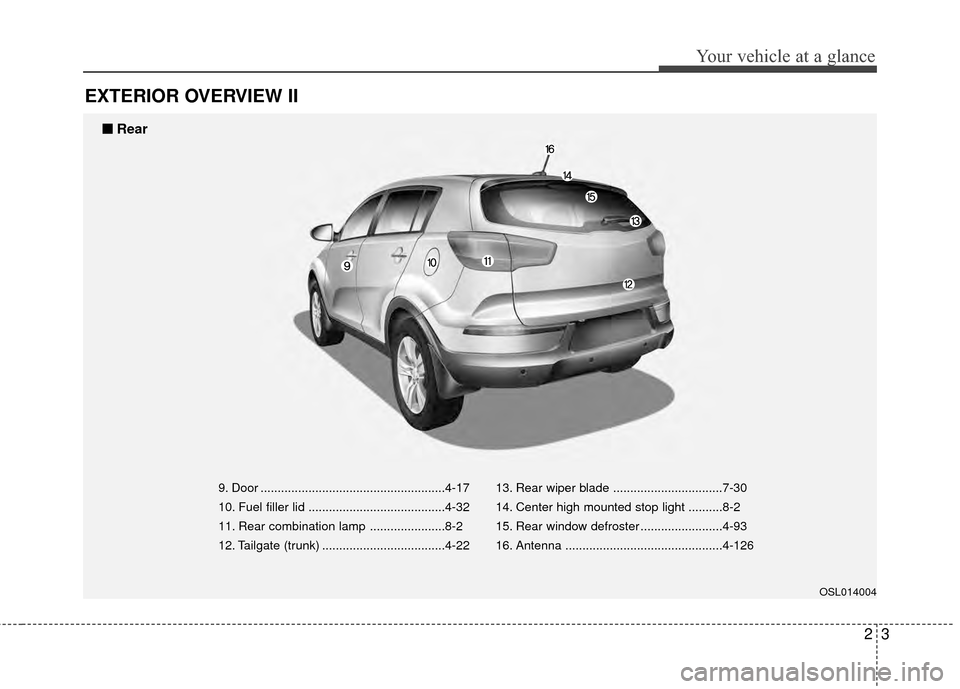
EXTERIOR OVERVIEW II
9. Door ......................................................4-17
10. Fuel filler lid ........................................4-32
11. Rear combination lamp ......................8-2
12. Tailgate (trunk) ....................................4-2213. Rear wiper blade ................................7-30
14. Center high mounted stop light ..........8-2
15. Rear window defroster ........................4-93
16. Antenna ..............................................4-126
OSL014004
■
■
Rear
Page 13 of 457
Your vehicle at a glance
42
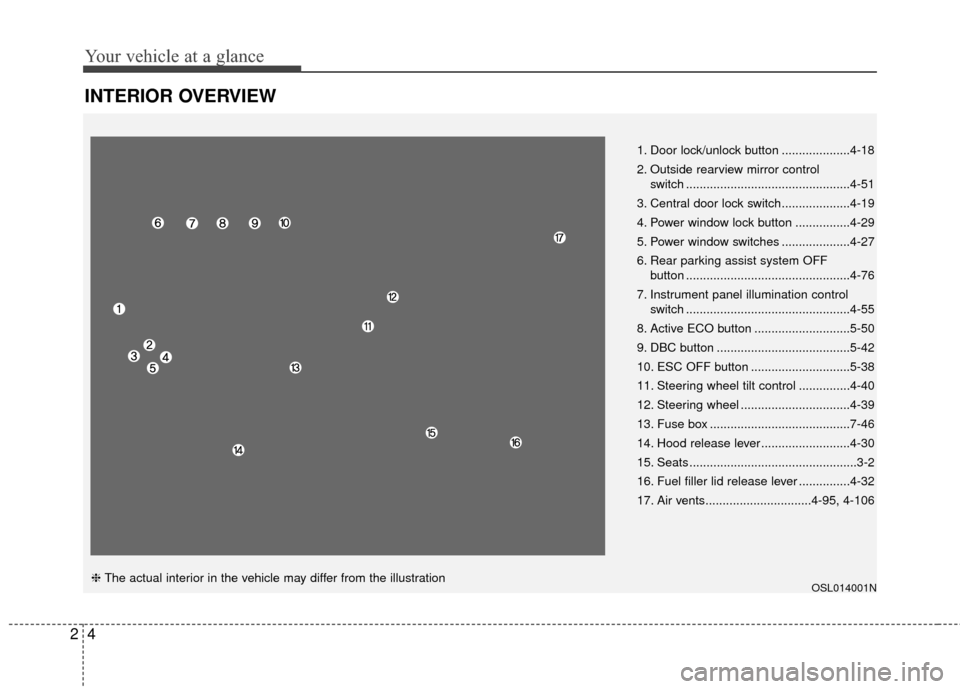
INTERIOR OVERVIEW
OSL014001N
1. Door lock/unlock button ....................4-18
2. Outside rearview mirror control switch ................................................4-51
3. Central door lock switch....................4-19
4. Power window lock button ................4-29
5. Power window switches ....................4-27
6. Rear parking assist system OFF button ................................................4-76
7. Instrument panel illumination control switch ................................................4-55
8. Active ECO button ............................5-50
9. DBC button .......................................5-42
10. ESC OFF button .............................5-38
11. Steering wheel tilt control ...............4-40
12. Steering wheel ................................4-39
13. Fuse box .........................................7-46
14. Hood release lever ..........................4-30
15. Seats .................................................3-2
16. Fuel filler lid release lever ...............4-32
17. Air vents...............................4-95, 4-106
❈ The actual interior in the vehicle may differ from the illustration
Page 55 of 457
Safety features of your vehicle
40
3
WARNING
To reduce the chance of serious
or fatal injuries:
Children of all ages are safer
when restrained in the rear
seat. A child riding in the front
passenger seat can be force-
fully struck by an inflating air
bag resulting in serious or
fatal injuries.
Always follow the child restraint system manufactur-
er’s instructions for installa-
tion and use of the child
restraint.
Always make sure the child seat is secured properly in the
car and your child is securely
restrained in the child seat.
Never hold a child in your arms or lap when riding in a
vehicle. The violent forces cre-
ated during a crash will tear
the child from your arms and
throw the child against the
car’s interior.
(Continued)
(Continued)
Never put a seat belt overyourself and a child. During a
crash, the belt could press
deep into the child causing
serious internal injuries.
Never leave children unat- tended in a vehicle – not even
for a short time. The car can
heat up very quickly, resulting
in serious injuries to children
inside. Even very young chil-
dren may inadvertently cause
the vehicle to move, entangle
themselves in the windows, or
lock themselves or others
inside the vehicle.
Never allow two children, or any two persons, to use the
same seat belt.
Children often squirm and reposition themselves
improperly. Never let a child
ride with the shoulder belt
under their arm or behind
their back. Always properly
position and secure children
in the rear seat.
(Continued)(Continued)
Never allow a child to stand-up or kneel on the seat or floor
of a moving vehicle. During a
collision or sudden stop, the
child can be violently thrown
against the vehicle’s interior,
resulting in serious injury.
Never use an infant carrier or a child safety seat that "hooks"
over a seatback, it may not
provide adequate security in
an accident.
Seat belts can become very hot, especially when the car is
parked in direct sunlight.
Always check the seat belt
buckles before fastening them
over a child.
After an accident, have an authorized Kia dealer check
the child restraint system, seat
belt, tether anchor and lower
anchor.
If there is not enough space to place the child restraint sys-
tem because of the driver's
seat, install the child restraint
system in the rear right seat.
Page 65 of 457
Safety features of your vehicle
50
3
C040902AUN
Noise and smoke
When the air bags inflate, they make
a loud noise and they leave smoke
and powder in the air inside of the
vehicle. This is normal and is a result
of the ignition of the air bag inflator.
After the air bag inflates, you may
feel substantial discomfort in breath-
ing due to the contact of your chest
with both the seat belt and the air
bag, as well as from breathing the
smoke and powder. Open your
doors and/or windows as soon as
possible after impact in order to
reduce discomfort and prevent
prolonged exposure to the smoke
and powder.
Though smoke and powder are non-
toxic, it may cause irritation to the
skin (eyes, nose and throat, etc). If
this is the case, wash and rinse with
cold water immediately and consult a
doctor if the symptom persists.
WARNING
When the air bags deploy, the
air bag related parts in the
steering wheel and/or instru-
ment panel and/or in both sides
of the roof rails above the front
and rear doors are very hot. To
prevent injury, do not touch the
air bag storage area’s internal
components immediately after
an air bag has inflated.
WARNING
To avoid severe personal injury or death caused by
deploying air bags in a colli-
sion, the driver should sit as
far back from the steering
wheel air bag as possible (at
least 250 mm (10 inches)
away). The front passengers
should always move their
seats as far back as possible
and sit back in their seat.
Air bags inflate instantly in the event of a collision, and
passengers may be injured by
the air bag expansion force if
they are not in a proper posi-
tion.
Air bag inflation may cause injuries including facial or
bodily abrasions, injuries
from broken glasses or burns.
Page 82 of 457
367
Safety features of your vehicle
The purpose of the air bag is to pro-
vide the vehicle's driver and/or the
front passenger with additional pro-
tection than that offered by the seat
belt alone.
The side impact air bags aredesigned to deploy during certain
side-impact collisions, depending
on the crash severity, angle, speed
and point of impact.
The side impact air bags do not only deploy on the side of the
impact but also on the opposite
side.
Also, both sides of the side impact air bags deploy in certain rollover
situations.
The side impact air bags are not designed to deploy in all side
impact or rollover situations.
WARNING
The side impact air bag issupplemental to the driver's
and the passenger's seat belt
systems and is not a substi-
tute for them. Therefore your
seat belts must be worn at all
times while the vehicle is in
motion. The air bags deploy
only in certain side impact or
rollover conditions severe
enough to cause significant
injury to the vehicle occu-
pants.
For best protection from the side air bag system and to
avoid being injured by the
deploying side air bag, both
front seat occupants should
sit in an upright position with
the seat belt properly fas-
tened. The driver's hands
should be placed on the steer-
ing wheel at the 9:00 and 3:00
positions. The passenger's
arms and hands should be
placed on their laps.
(Continued)
WARNING
Do not allow the passengers to
lean their heads or bodies onto
doors, put their arms on the
doors, stretch their arms out of
the window, or place objects
between the doors and passen-
gers when they are seated on
seats equipped with side and/or
curtain air bags.
Page 84 of 457
369
Safety features of your vehicle
They are designed to help protect
the heads of the front seat occupants
and the rear outboard seat occu-
pants in certain side impact colli-
sions.
to deploy during certain side
impact collisions, depending on the
crash severity, angle, speed and
point of impact.
The curtain air bags do not only deploy on the side of the impact
but also on the opposite side.
Also, both sides of the curtain air bags deploy in certain rollover situ-
ations.
The curtain air bags are not designed to deploy in all side
impact or rollover situations.
WARNING
In order for side and curtainair bags to provide the best
protection, front seat occu-
pants and outboard rear occu-
pants should sit in an upright
position with the seat belts
properly fastened.
Importantly, children should
sit in a proper child restraint
system in the rear seat.
When children are seated in the rear outboard seats, they
must be seated in the proper
child restraint system. Make
sure to position the child
restraint system as far away
from the door side as possi-
ble, and secure the child
restraint system in a locked
position.
(Continued)
(Continued)
Do not allow the passengersto lean their heads or bodies
against the doors, put their
arms on the doors, stretch
their arms out of the window
or place objects between the
doors and passengers when
they are seated on seats
equipped with side impact
and/or curtain air bags.
Never try to open or repair any components of the side and
curtain air bag system. This
should only be done by an
authorized Kia dealer.
Failure to follow the above men-
tioned instructions can result in
injury or death to the vehicle
occupants in an accident.
Page 93 of 457

Features of your vehicle
Keys . . . . . . . . . . . . . . . . . . . . . . . . . . . . . . . . . . . . \
. . 4-3
• Record your key number . . . . . . . . . . . . . . . . . . . . . . . 4-3
. . . . . . . . . . . . . . . . . . . . . . . . . . . . . . . . 4-3
Remote keyless entry . . . . . . . . . . . . . . . . . . . . . . . . 4-7
. . . . . . . . . . . 4-7
. . . . . . . . . . . . . . . . . . . . . . . . 4-8
. . . . . . . . . . . . . . . . . . . . . . . . . . . 4-9
Smart key . . . . . . . . . . . . . . . . . . . . . . . . . . . . . . . . 4-10
. . . . . . . . . . . . . . . . . . . . . . . . . . 4-11
. . . . . . . . . . . . . . . . . . . . . . . . 4-12
. . . . . . . . . . . . . . . . . . . . . . . . . . 4-14
Theft-alarm system . . . . . . . . . . . . . . . . . . . . . . . . 4-15
Door locks . . . . . . . . . . . . . . . . . . . . . . . . . . . . . . . . 4-17
. . . . . . . . . . . . . . . . . . . . . . . . . . . 4-17
. . . . . . . . . . . . . . . . . . . . . . . . . . . . . 4-18
. . . . . . . . . . . . . . . . 4-20
. . . . . . . . . . . . . . . . . 4-21
Tailgate . . . . . . . . . . . . . . . . . . . . . . . . . . . . . . . . . . 4-22\
Windows . . . . . . . . . . . . . . . . . . . . . . . . . . . . . . . . . 4-25
Hood. . . . . . . . . . . . . . . . . . . . . . . . . . . . . . . . . . . . \
. 4-30
Fuel filler lid . . . . . . . . . . . . . . . . . . . . . . . . . . . . . . 4-32
Panoramic sunroof . . . . . . . . . . . . . . . . . . . . . . . . . 4-35Steering wheel . . . . . . . . . . . . . . . . . . . . . . . . . . . . . 4-39
. . . . . . . . . . . . . . . . 4-39
. . . . . . . . . . . . . . . . . . . . 4-40
. . . . . . . . . . . . . . . . . . . . . . . . . 4-40
. . . . . . . . . . . . . . . . . . . . . . . . . . . . . . . . . . . . \
. . . 4-41
. . . . . . . . . . . . . . . . . . . . . . . . . . . . . . . . . 4-42
Mirrors . . . . . . . . . . . . . . . . . . . . . . . . . . . . . . . . . . 4-44\
. . . . . . . . . . . . . . . . . . . . . . . . 4-44
. . . . . . . . . . . . . . . . . . . . . . . 4-51
Instrument cluster . . . . . . . . . . . . . . . . . . . . . . . . . . . . . 4-54
. . . . . . . . . . . . . . . . . . 4-55
. . . . . . . . . . . . . . . . . . . . . . . . . . . . . . . . . . . . \
. 4-55
. . . . . . . . . . . . . . . . . . . . . . . 4-62
Back-up warning system . . . . . . . . . . . . . . . . . . . . 4-76
. . . . . . . . 4-76
system . . . . . . . . . . . . . . . . . . . . . . . . . . . . . . . . . . . . \
. 4-77
. . . . . . . . . . . . . . . . . . . . . . . . . . . . . . . . 4-79
Rear-camera display . . . . . . . . . . . . . . . . . . . . . . . 4-79
Hazard warning flasher . . . . . . . . . . . . . . . . . . . . . 4-80
4
Page 96 of 457
Features of your vehicle
44
D010300AAM
Immobilizer system
(if equipped)
Your vehicle may be equipped with
an electronic engine immobilizer sys-
tem to reduce the risk of unautho-
rized vehicle use.
Your immobilizer system is com-
prised of a small transponder in the
ignition key and electronic devices
inside the vehicle.
With the immobilizer system, when-
ever you insert your ignition key into
the ignition switch and turn it to ON,
it checks and determines and verifies
that the ignition key is valid.
If the key is determined to be valid,
the engine will start.
If the key is determined to be invalid,
the engine will not start.
WARNING - Ignition key(smart key)
Leaving children unattended in
a vehicle with the Ignition key
(smart key) is dangerous even if
the key is not in the ignition
switch or start button is ACC or
ON position. Children copy
adults and they could place the
key in the ignition switch or
press the start button. The
Ignition key (smart key) would
enable children to operate
power windows or other con-
trols, or even make the vehicle
move, which could result in
serious bodily injury or even
death. Never leave the keys in
your vehicle with unsupervised
children, when the engine is
running.
WARNING
Use only Kia original parts for
the ignition key in your vehicle.
If an aftermarket key is used,
the ignition switch may not
return to ON after START. If this
happens, the starter will contin-
ue to operate causing damage
to the starter motor and possi-
ble fire due to excessive current
in the wiring.
Page 110 of 457
Features of your vehicle
18
4
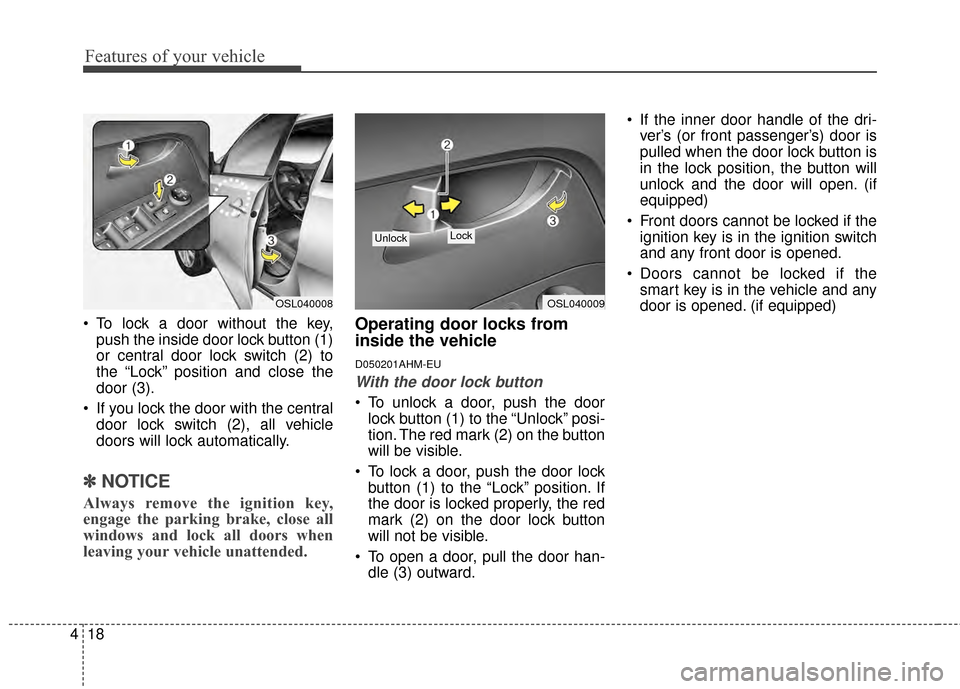
To lock a door without the key,
push the inside door lock button (1)
or central door lock switch (2) to
the “Lock” position and close the
door (3).
If you lock the door with the central door lock switch (2), all vehicle
doors will lock automatically.
✽ ✽ NOTICE
Always remove the ignition key,
engage the parking brake, close all
windows and lock all doors when
leaving your vehicle unattended.
Operating door locks from
inside the vehicle
D050201AHM-EU
With the door lock button
To unlock a door, push the door
lock button (1) to the “Unlock” posi-
tion. The red mark (2) on the button
will be visible.
To lock a door, push the door lock button (1) to the “Lock” position. If
the door is locked properly, the red
mark (2) on the door lock button
will not be visible.
To open a door, pull the door han- dle (3) outward. If the inner door handle of the dri-
ver’s (or front passenger’s) door is
pulled when the door lock button is
in the lock position, the button will
unlock and the door will open. (if
equipped)
Front doors cannot be locked if the ignition key is in the ignition switch
and any front door is opened.
Doors cannot be locked if the smart key is in the vehicle and any
door is opened. (if equipped)
OSL040009
Lock Unlock
OSL040008