brakes KIA Sportage 2015 QL / 4.G Owner's Guide
[x] Cancel search | Manufacturer: KIA, Model Year: 2015, Model line: Sportage, Model: KIA Sportage 2015 QL / 4.GPages: 499, PDF Size: 16.07 MB
Page 391 of 499
Driving your vehicle
68
5
E150103AEN
Towing capacity:
Without trailer brakes
: 454 kg (1000 lbs)
With trailer brakes : 907 kg (2000 lbs)
Towing capacity is the maximum
trailer weight including its cargo
weight, your vehicle can tow.
E150104AUN
Cargo capacity:
The cargo capacity of your vehicle
will increase or decrease depending
on the weight and the number of
occupants and the tongue load, if
your vehicle is equipped with a trail-
er.
E150105AUN-C1
Steps for determining correct load limit
1.Locate the statement "The com- bined weight of occupants and
cargo should never exceed XXX kg
or XXX lbs.'' on your vehicle's plac-
ard.
2.Determine the combined weight of the driver and passengers that will
be riding in your vehicle.
3.Subtract the combined weight of the driver and passengers from
XXX kg or XXX lbs.
4.The resulting figure equals the available amount of cargo and lug-
gage load capacity. For example, if
the "XXX" amount equals 635 kg
(1400 lbs.) and there will be five 68
kg (150 lbs.) passengers in your
vehicle, the amount of available
cargo and luggage load capacity is
295 kg (650 lbs).
(635-340 (5 x 68) = 295 kg or
1400-750 (5 x 150) = 650 lbs.) 5.Determine the combined weight of
luggage and cargo being loaded
on the vehicle. That weight may not
safely exceed the available cargo
and luggage load capacity calcu-
lated in Step 4.
6.If your vehicle will be towing a trail- er, load from your trailer will be
transferred to your vehicle. Consult
this manual to determine how this
reduces the available cargo and
luggage load capacity of your vehi-
cle.
Page 398 of 499
63
What to do in an emergency
IN CASE OF AN EMERGENCY WHILE DRIVING
F020100AUN-EU
If the engine stalls at a cross-
road or crossing
If the engine stalls at a crossroad or
crossing, set the shift lever in the N
(Neutral) position and then push the
vehicle to a safe place.
F020200AUN
If you have a flat tire while
driving
If a tire goes flat while you are driv-
ing:
1.Take your foot off the acceleratorpedal and let the vehicle slow
down while driving straight ahead.
Do not apply the brakes immedi-
ately or attempt to pull off the road
as this may cause a loss of control.
When the vehicle has slowed to
such a speed that it is safe to do
so, brake carefully and pull off the
road. Drive off the road as far as
possible and park on a firm level
ground. If you are on a divided
highway, do not park in the median
area between the two traffic lanes. 2.When the vehicle is stopped, turn
on your emergency hazard flash-
ers, set the parking brake and put
the transaxle in P (Park, automatic
transaxle) or reverse (manual
transaxle).
3.Have all passengers get out of the vehicle. Be sure they all get out on
the side of the car that is away from
traffic.
4.When changing a flat tire, follow the instruction provided later in this
section.
F020300AUN
If the engine stalls while driv-
ing
1.Reduce your speed gradually,keeping a straight line. Move cau-
tiously off the road to a safe place.
2.Turn on your emergency flashers.
3.Try to start the engine again. If your vehicle will not start, contact an
authorized Kia dealer or seek other
qualified assistance.
Page 414 of 499
619
What to do in an emergency
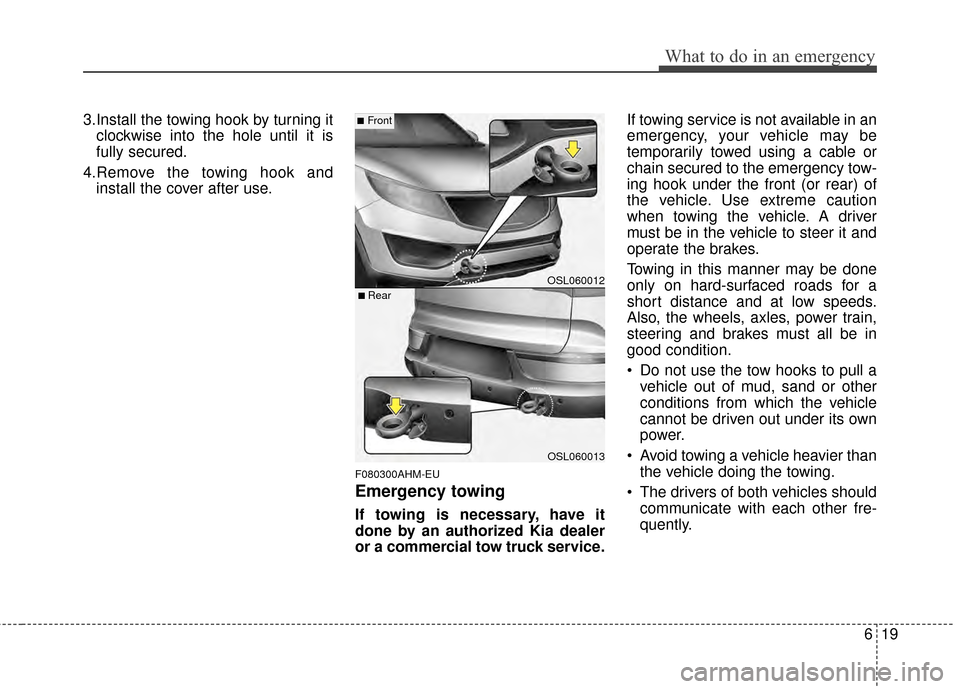
3.Install the towing hook by turning itclockwise into the hole until it is
fully secured.
4.Remove the towing hook and install the cover after use.
F080300AHM-EU
Emergency towing
If towing is necessary, have it
done by an authorized Kia dealer
or a commercial tow truck service. If towing service is not available in an
emergency, your vehicle may be
temporarily towed using a cable or
chain secured to the emergency tow-
ing hook under the front (or rear) of
the vehicle. Use extreme caution
when towing the vehicle. A driver
must be in the vehicle to steer it and
operate the brakes.
Towing in this manner may be done
only on hard-surfaced roads for a
short distance and at low speeds.
Also, the wheels, axles, power train,
steering and brakes must all be in
good condition.
Do not use the tow hooks to pull a
vehicle out of mud, sand or other
conditions from which the vehicle
cannot be driven out under its own
power.
Avoid towing a vehicle heavier than the vehicle doing the towing.
The drivers of both vehicles should communicate with each other fre-
quently.
OSL060012
OSL060013
■Front
■ Rear
Page 416 of 499
621
What to do in an emergency
F080301AAM-EU
Emergency towing precautions
Turn the ignition switch to ACC sothe steering wheel isn’t locked.
Place the transaxle shift lever in N (Neutral).
Release the parking bake.
Press the brake pedal with more force than usual since you will have
reduced brake performance.
More steering effort will be required because the power steer-
ing system will be disabled.
If you are driving down a long hill, the brakes may overheat and brake
performance will be reduced. Stop
often and let the brakes cool off.
If the car is being towed with all four wheels on the ground, it can
be towed only from the front. Be
sure that the transaxle is in neutral.
Be sure the steering is unlocked by
placing the ignition switch in the
ACC position. A driver must be in
the towed vehicle to operate the
steering and brakes.
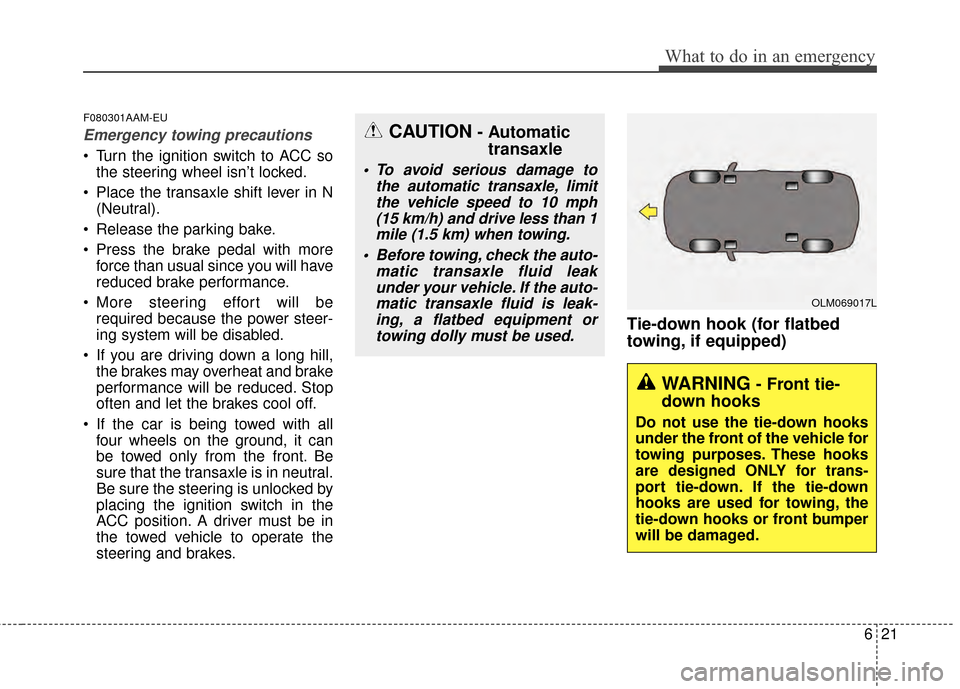
Tie-down hook (for flatbed
towing, if equipped)
WARNING- Front tie-
down hooks
Do not use the tie-down hooks
under the front of the vehicle for
towing purposes. These hooks
are designed ONLY for trans-
port tie-down. If the tie-down
hooks are used for towing, the
tie-down hooks or front bumper
will be damaged.
OLM069017L
CAUTION- Automatic transaxle
To avoid serious damage to
the automatic transaxle, limitthe vehicle speed to 10 mph(15 km/h) and drive less than 1mile (1.5 km) when towing.
Before towing, check the auto- matic transaxle fluid leakunder your vehicle. If the auto-matic transaxle fluid is leak-ing, a flatbed equipment ortowing dolly must be used.
Page 474 of 499
Maintenance
58
7
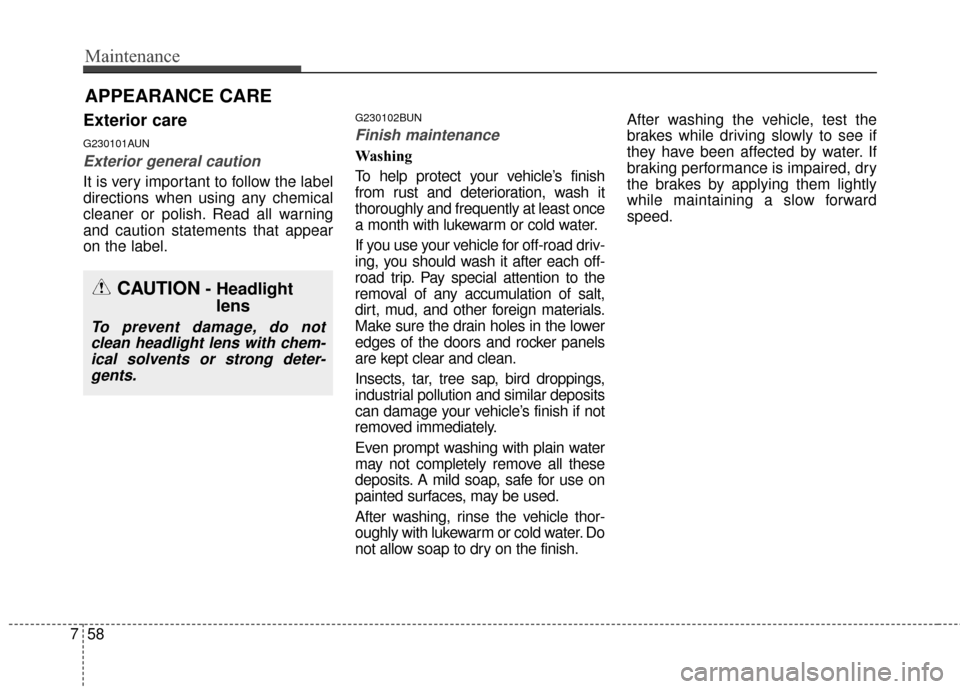
APPEARANCE CARE
Exterior care
G230101AUN
Exterior general caution
It is very important to follow the label
directions when using any chemical
cleaner or polish. Read all warning
and caution statements that appear
on the label.
G230102BUN
Finish maintenance
Washing
To help protect your vehicle’s finish
from rust and deterioration, wash it
thoroughly and frequently at least once
a month with lukewarm or cold water.
If you use your vehicle for off-road driv-
ing, you should wash it after each off-
road trip. Pay special attention to the
removal of any accumulation of salt,
dirt, mud, and other foreign materials.
Make sure the drain holes in the lower
edges of the doors and rocker panels
are kept clear and clean.
Insects, tar, tree sap, bird droppings,
industrial pollution and similar deposits
can damage your vehicle’s finish if not
removed immediately.
Even prompt washing with plain water
may not completely remove all these
deposits. A mild soap, safe for use on
painted surfaces, may be used.
After washing, rinse the vehicle thor-
oughly with lukewarm or cold water. Do
not allow soap to dry on the finish. After washing the vehicle, test the
brakes while driving slowly to see if
they have been affected by water. If
braking performance is impaired, dry
the brakes by applying them lightly
while maintaining a slow forward
speed.
CAUTION- Headlight
lens
To prevent damage, do not
clean headlight lens with chem-ical solvents or strong deter-gents.
Page 494 of 499
Index
2I
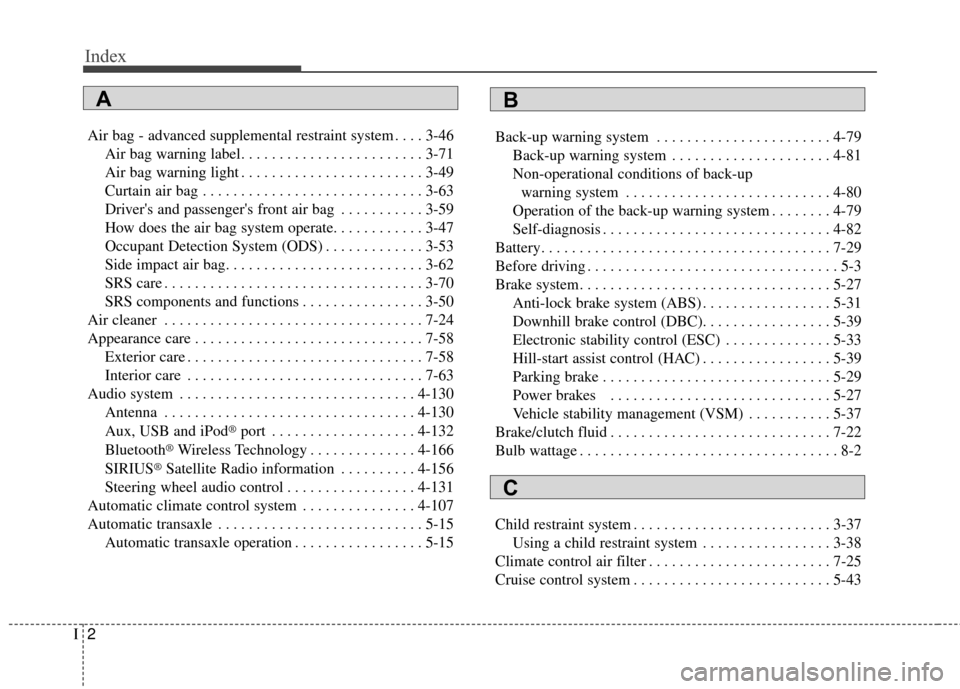
Air bag - advanced supplemental restraint system . . . . 3-46Air bag warning label. . . . . . . . . . . . . . . . . . . . . . . . 3-71
Air bag warning light . . . . . . . . . . . . . . . . . . . . . . . . 3-49
Curtain air bag . . . . . . . . . . . . . . . . . . . . . . . . . . . . . 3-63
Driver's and passenger's front air bag . . . . . . . . . . . 3-59
How does the air bag system operate. . . . . . . . . . . . 3-47
Occupant Detection System (ODS) . . . . . . . . . . . . . 3-53
Side impact air bag. . . . . . . . . . . . . . . . . . . . . . . . . . 3-62
SRS care . . . . . . . . . . . . . . . . . . . . . . . . . . . . . . . . . . 3-70\
SRS components and functions . . . . . . . . . . . . . . . . 3-50
Air cleaner . . . . . . . . . . . . . . . . . . . . . . . . . . . . . . . . . . 7-24\
Appearance care . . . . . . . . . . . . . . . . . . . . . . . . . . . . . . 7-58 Exterior care . . . . . . . . . . . . . . . . . . . . . . . . . . . . . . . 7-58
Interior care . . . . . . . . . . . . . . . . . . . . . . . . . . . . . . . 7-63
Audio system . . . . . . . . . . . . . . . . . . . . . . . . . . . . . . . 4-130 Antenna . . . . . . . . . . . . . . . . . . . . . . . . . . . . . . . . . 4-130
Aux, USB and iPod
®port . . . . . . . . . . . . . . . . . . . 4-132
Bluetooth®Wireless Technology . . . . . . . . . . . . . . 4-166
SIRIUS®Satellite Radio information . . . . . . . . . . 4-156
Steering wheel audio control . . . . . . . . . . . . . . . . . 4-131
Automatic climate control system . . . . . . . . . . . . . . . 4-107
Automatic transaxle . . . . . . . . . . . . . . . . . . . . . . . . . . . 5-15 Automatic transaxle operation . . . . . . . . . . . . . . . . . 5-15 Back-up warning system . . . . . . . . . . . . . . . . . . . . . . . 4-79
Back-up warning system . . . . . . . . . . . . . . . . . . . . . 4-81
Non-operational conditions of back-upwarning system . . . . . . . . . . . . . . . . . . . . . . . . . . . 4-80
Operation of the back-up warning system . . . . . . . . 4-79
Self-diagnosis . . . . . . . . . . . . . . . . . . . . . . . . . . . . . . 4-82
Battery. . . . . . . . . . . . . . . . . . . . . . . . . . . . . . . . . . . . \
. . 7-29
Before driving . . . . . . . . . . . . . . . . . . . . . . . . . . . . . . . . . 5-3
Brake system. . . . . . . . . . . . . . . . . . . . . . . . . . . . . . . . . 5-27 Anti-lock brake system (ABS) . . . . . . . . . . . . . . . . . 5-31
Downhill brake control (DBC). . . . . . . . . . . . . . . . . 5-39
Electronic stability control (ESC) . . . . . . . . . . . . . . 5-33
Hill-start assist control (HAC) . . . . . . . . . . . . . . . . . 5-39
Parking brake . . . . . . . . . . . . . . . . . . . . . . . . . . . . . . 5-29
Power brakes . . . . . . . . . . . . . . . . . . . . . . . . . . . . . 5-27
Vehicle stability management (VSM) . . . . . . . . . . . 5-37
Brake/clutch fluid . . . . . . . . . . . . . . . . . . . . . . . . . . . . . 7-22
Bulb wattage . . . . . . . . . . . . . . . . . . . . . . . . . . . . . . . . . . 8-2
Child restraint system . . . . . . . . . . . . . . . . . . . . . . . . . . 3-37 Using a child restraint system . . . . . . . . . . . . . . . . . 3-38
Climate control air filter . . . . . . . . . . . . . . . . . . . . . . . . 7-25
Cruise control system . . . . . . . . . . . . . . . . . . . . . . . . . . 5-43
AB
C