child restraint KIA Sportage 2016 QL / 4.G User Guide
[x] Cancel search | Manufacturer: KIA, Model Year: 2016, Model line: Sportage, Model: KIA Sportage 2016 QL / 4.GPages: 501, PDF Size: 18.95 MB
Page 57 of 501
341
Safety features of your vehicle
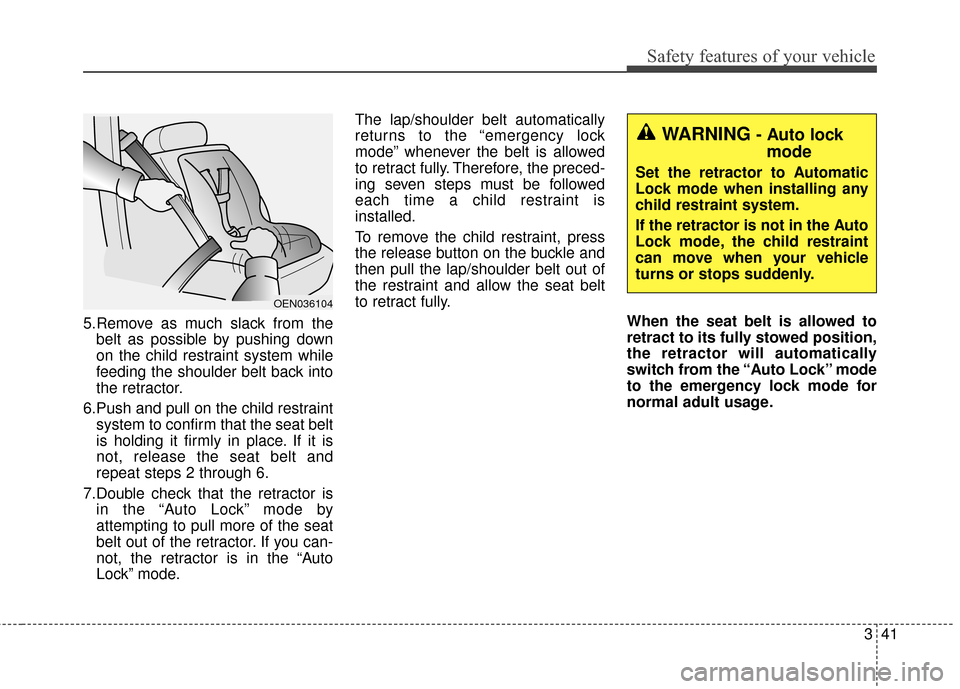
5.Remove as much slack from thebelt as possible by pushing down
on the child restraint system while
feeding the shoulder belt back into
the retractor.
6.Push and pull on the child restraint system to confirm that the seat belt
is holding it firmly in place. If it is
not, release the seat belt and
repeat steps 2 through 6.
7.Double check that the retractor is in the “Auto Lock” mode by
attempting to pull more of the seat
belt out of the retractor. If you can-
not, the retractor is in the “Auto
Lock” mode. The lap/shoulder belt automatically
returns to the “emergency lock
mode” whenever the belt is allowed
to retract fully. Therefore, the preced-
ing seven steps must be followed
each time a child restraint is
installed.
To remove the child restraint, press
the release button on the buckle and
then pull the lap/shoulder belt out of
the restraint and allow the seat belt
to retract fully.
When the seat belt is allowed to
retract to its fully stowed position,
the retractor will automatically
switch from the “Auto Lock” mode
to the emergency lock mode for
normal adult usage.
OEN036104
WARNING- Auto lockmode
Set the retractor to Automatic
Lock mode when installing any
child restraint system.
If the retractor is not in the Auto
Lock mode, the child restraint
can move when your vehicle
turns or stops suddenly.
Page 58 of 501
Safety features of your vehicle
42
3
C030103AEN
Securing a child restraint seat
with tether anchor system
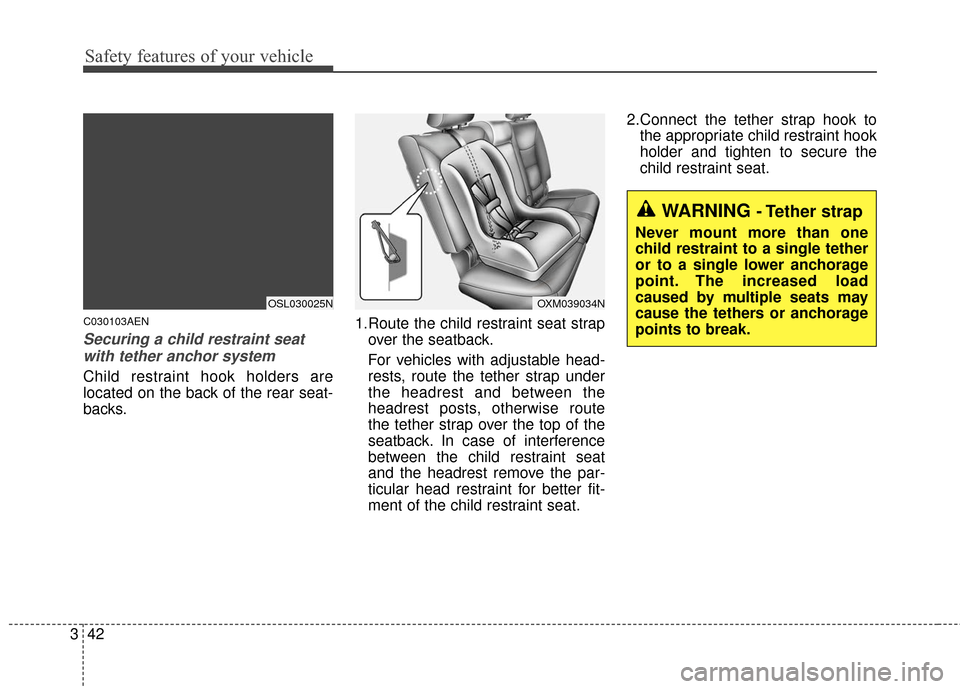
Child restraint hook holders are
located on the back of the rear seat-
backs. 1.Route the child restraint seat strap
over the seatback.
For vehicles with adjustable head-
rests, route the tether strap under
the headrest and between the
headrest posts, otherwise route
the tether strap over the top of the
seatback. In case of interference
between the child restraint seat
and the headrest remove the par-
ticular head restraint for better fit-
ment of the child restraint seat. 2.Connect the tether strap hook to
the appropriate child restraint hook
holder and tighten to secure the
child restraint seat.
OXM039034NOSL030025N
WARNING - Tether strap
Never mount more than one
child restraint to a single tether
or to a single lower anchorage
point. The increased load
caused by multiple seats may
cause the tethers or anchorage
points to break.
Page 59 of 501
343
Safety features of your vehicle
Check that the child restraint system
is secure by pushing and pulling it in
different directions. Incorrectly fitted
child restraints may swing, twist, tip
or separate causing death or serious
injury.
C030104AHM-EU
Securing a child restraint seat withchild seat lower anchor system
Some child seat manufacturers
make child restraint seats that are
labeled as LATCH or LATCH-com-
patible child restraint seats. LATCH
stands for "Lower Anchors and
Tethers for Children". These seats
include two rigid or webbing mount-
ed attachments that connect to two
LATCH anchors at specific seating
positions in your vehicle. This type of
child restraint seat eliminates the
need to use seat belts to attach the
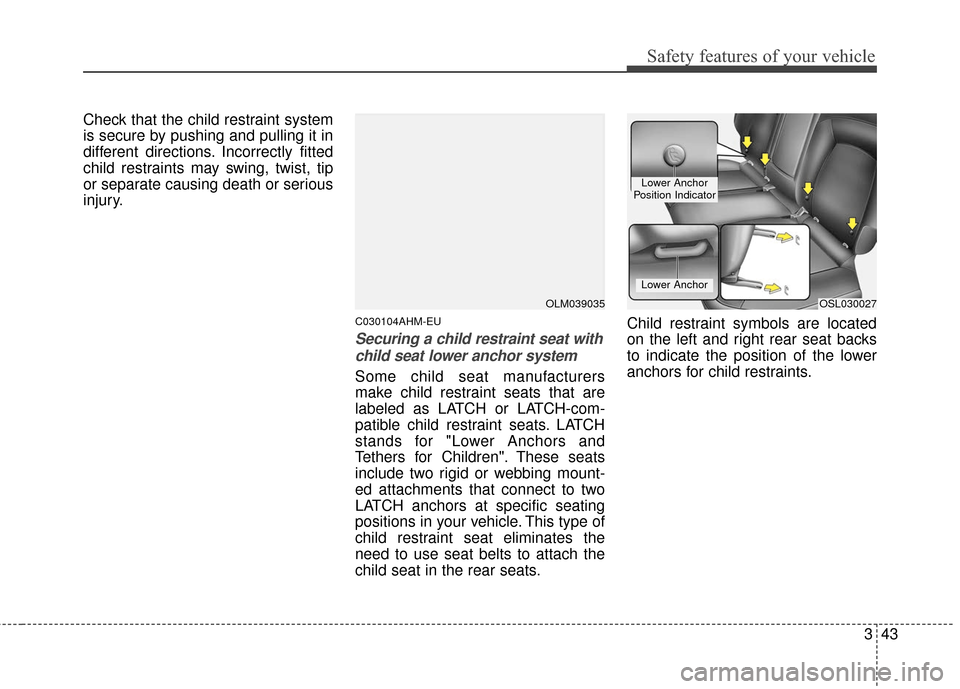
child seat in the rear seats. Child restraint symbols are located
on the left and right rear seat backs
to indicate the position of the lower
anchors for child restraints.
OLM039035OSL030027
Lower Anchor
Lower Anchor
Position Indicator
Page 60 of 501
Safety features of your vehicle
44
3
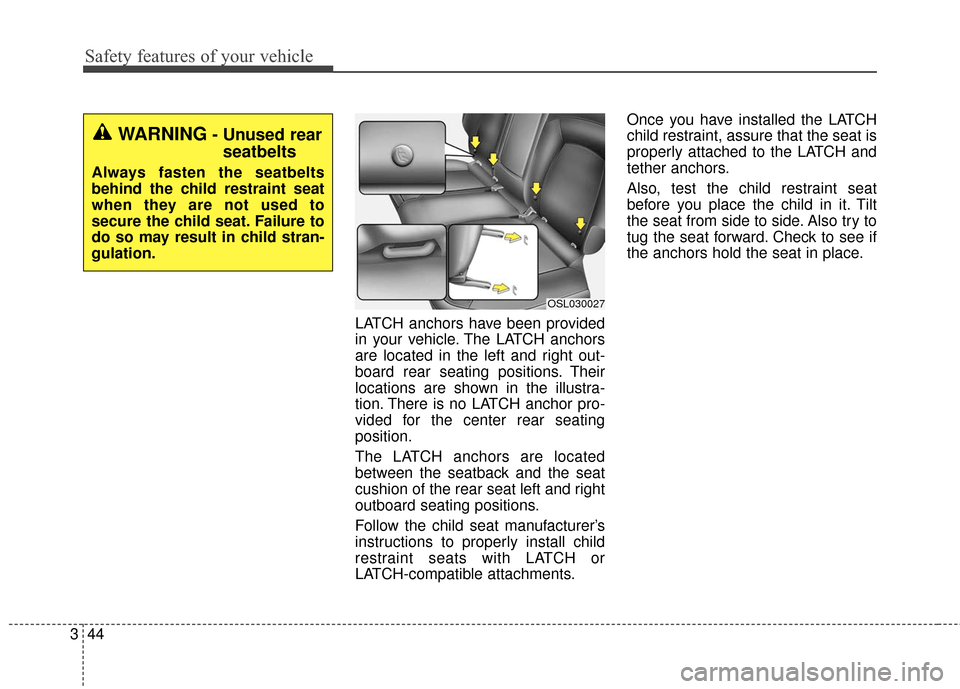
LATCH anchors have been provided
in your vehicle. The LATCH anchors
are located in the left and right out-
board rear seating positions. Their
locations are shown in the illustra-
tion. There is no LATCH anchor pro-
vided for the center rear seating
position.
The LATCH anchors are located
between the seatback and the seat
cushion of the rear seat left and right
outboard seating positions.
Follow the child seat manufacturer’s
instructions to properly install child
restraint seats with LATCH or
LATCH-compatible attachments. Once you have installed the LATCH
child restraint, assure that the seat is
properly attached to the LATCH and
tether anchors.
Also, test the child restraint seat
before you place the child in it. Tilt
the seat from side to side. Also try to
tug the seat forward. Check to see if
the anchors hold the seat in place.
OSL030027
WARNING- Unused rear
seatbelts
Always fasten the seatbelts
behind the child restraint seat
when they are not used to
secure the child seat. Failure to
do so may result in child stran-
gulation.
Page 65 of 501
349
Safety features of your vehicle
C040903AEN
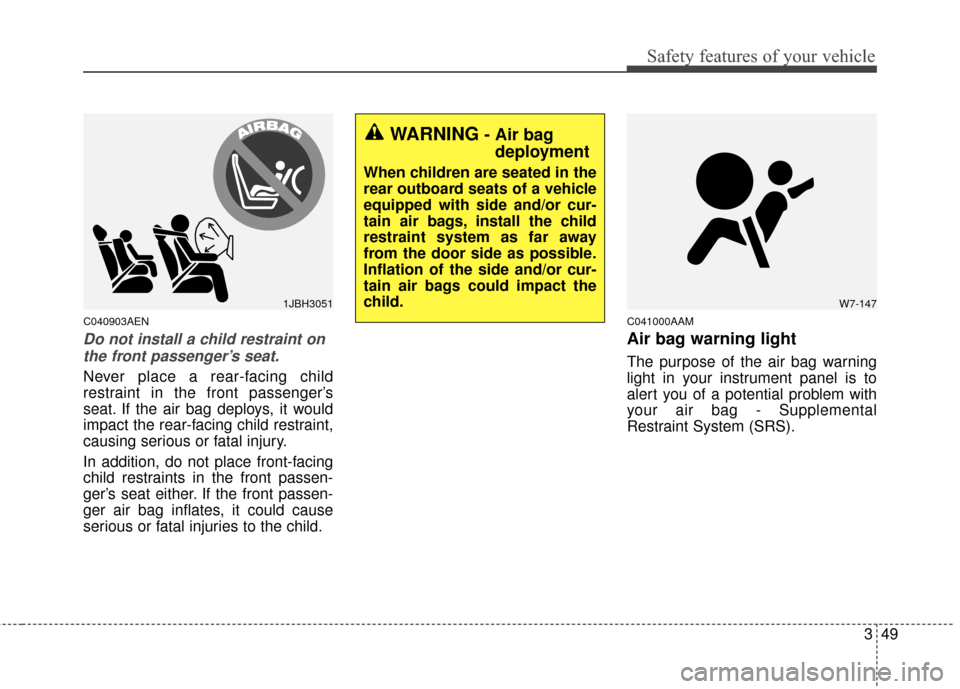
Do not install a child restraint onthe front passenger’s seat.
Never place a rear-facing child
restraint in the front passenger’s
seat. If the air bag deploys, it would
impact the rear-facing child restraint,
causing serious or fatal injury.
In addition, do not place front-facing
child restraints in the front passen-
ger’s seat either. If the front passen-
ger air bag inflates, it could cause
serious or fatal injuries to the child.
C041000AAM
Air bag warning light
The purpose of the air bag warning
light in your instrument panel is to
alert you of a potential problem with
your air bag - Supplemental
Restraint System (SRS).
W7-1471JBH3051
WARNING- Air bag deployment
When children are seated in the
rear outboard seats of a vehicle
equipped with side and/or cur-
tain air bags, install the child
restraint system as far away
from the door side as possible.
Inflation of the side and/or cur-
tain air bags could impact the
child.
Page 71 of 501
355
Safety features of your vehicle
✽
✽NOTICE
Do not modify or replace the front
passenger seat. Don't place anything
on or attach anything such as a blan-
ket, front seat cover or after market
seat heater to the front passenger
seat. This can adversely affect the
occupant detection system.
C040301AMG
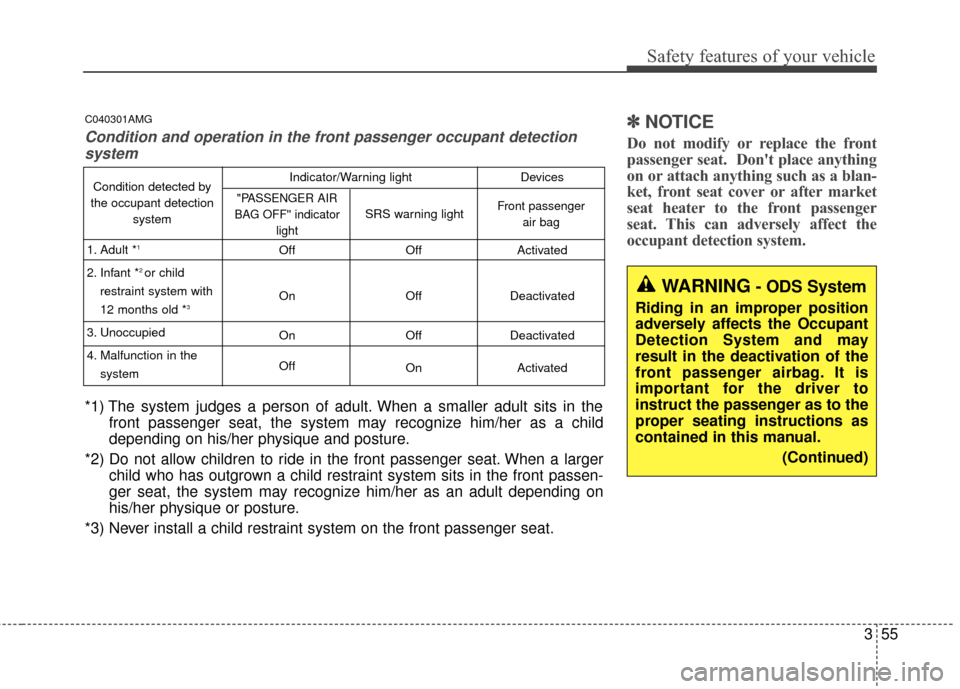
Condition and operation in the front passenger occupant detection
system
*1) The system judges a person of adult. When a smaller adult sits in the front passenger seat, the system may recognize him/her as a child
depending on his/her physique and posture.
*2) Do not allow children to ride in the front passenger seat. When a larger child who has outgrown a child restraint system sits in the front passen-
ger seat, the system may recognize him/her as an adult depending on
his/her physique or posture.
*3) Never install a child restraint system on the front passenger seat.
Condition detected by
the occupant detection system
1. Adult *
1
2. Infant *2 or child
restraint system with
12 months old *
3
3. Unoccupied
4. Malfunction in the system Off
On
On
Off Off
Off
Off
On Activated
Deactivated
Deactivated Activated
"PASSENGER AIR
BAG OFF" indicator light
SRS warning lightFront passenger air bag
Indicator/Warning light Devices
WARNING- ODS System
Riding in an improper position
adversely affects the Occupant
Detection System and may
result in the deactivation of the
front passenger airbag. It is
important for the driver to
instruct the passenger as to the
proper seating instructions as
contained in this manual.
(Continued)
Page 74 of 501
Safety features of your vehicle
58
3
✽
✽
NOTICE
The PASSENGER AIR BAG “OFF”
indicator illuminates for about 4 sec-
onds after the ignition switch is
turned to the ON position or after
the engine is started. If the front
passenger seat is occupied, the occu-
pant detection sensor will then clas-
sify the front passenger after several
more seconds.
Any child age 12 and under should
ride in the rear seat. Children too
large for child restraints should use
the available lap/shoulder belts. No
matter what type of crash, children of
all ages are safer when restrained in
the rear seat.
If the occupant detection system is
not working properly, the SRS air
bag warning light on the instru-
ment panel will illuminate because
the passenger's front air bag is con-
nected with the occupant detection
system. If there is a malfunction of
the occupant detection system, the
PASSENGER AIR BAG “OFF” indi-
cator will not illuminate and the pas-
senger's front air bag will inflate in
frontal impact crashes even if there is
no occupant in the front passenger's
seat.
WARNING- Replacement
/ modifica-
tions
The front passenger seat, dash-
board or door should not be
replaced except by an author-
ized Kia dealer using original
Kia parts designed for this vehi-
cle and model. Any other such
replacement or modification
could adversely affect the oper-
ation of the occupant detection
system and your advanced air
bags.
Page 496 of 501
Index
2I
Air bag - advanced supplemental restraint system . . . . 3-46Air bag warning label. . . . . . . . . . . . . . . . . . . . . . . . 3-71
Air bag warning light . . . . . . . . . . . . . . . . . . . . . . . . 3-49
Curtain air bag . . . . . . . . . . . . . . . . . . . . . . . . . . . . . 3-63
Driver's and passenger's front air bag . . . . . . . . . . . 3-59
How does the air bag system operate. . . . . . . . . . . . 3-47
Occupant Detection System (ODS) . . . . . . . . . . . . . 3-53
Side impact air bag. . . . . . . . . . . . . . . . . . . . . . . . . . 3-62
SRS care . . . . . . . . . . . . . . . . . . . . . . . . . . . . . . . . . . 3-70\
SRS components and functions . . . . . . . . . . . . . . . . 3-50
Air cleaner . . . . . . . . . . . . . . . . . . . . . . . . . . . . . . . . . . 7-24\
Appearance care . . . . . . . . . . . . . . . . . . . . . . . . . . . . . . 7-58 Exterior care . . . . . . . . . . . . . . . . . . . . . . . . . . . . . . . 7-58
Interior care . . . . . . . . . . . . . . . . . . . . . . . . . . . . . . . 7-63
Audio system . . . . . . . . . . . . . . . . . . . . . . . . . . . . . . . 4-130 Antenna . . . . . . . . . . . . . . . . . . . . . . . . . . . . . . . . . 4-130
Aux, USB and iPod
®port . . . . . . . . . . . . . . . . . . . 4-132
Bluetooth®Wireless Technology . . . . . . . . . . 4-166, 226
SIRIUS®Satellite Radio information . . . . . . 4-156, 199
Steering wheel audio control . . . . . . . . . . . . . . . . . 4-131
Automatic climate control system . . . . . . . . . . . . . . . 4-107
Automatic transaxle . . . . . . . . . . . . . . . . . . . . . . . . . . . 5-15 Automatic transaxle operation . . . . . . . . . . . . . . . . . 5-15 Back-up warning system . . . . . . . . . . . . . . . . . . . . . . . 4-79
Back-up warning system . . . . . . . . . . . . . . . . . . . . . 4-81
Non-operational conditions of back-upwarning system . . . . . . . . . . . . . . . . . . . . . . . . . . . 4-80
Operation of the back-up warning system . . . . . . . . 4-79
Self-diagnosis . . . . . . . . . . . . . . . . . . . . . . . . . . . . . . 4-82
Battery. . . . . . . . . . . . . . . . . . . . . . . . . . . . . . . . . . . . \
. . 7-29
Before driving . . . . . . . . . . . . . . . . . . . . . . . . . . . . . . . . . 5-3
Brake system. . . . . . . . . . . . . . . . . . . . . . . . . . . . . . . . . 5-27 Anti-lock brake system (ABS) . . . . . . . . . . . . . . . . . 5-31
Downhill brake control (DBC). . . . . . . . . . . . . . . . . 5-39
Electronic stability control (ESC) . . . . . . . . . . . . . . 5-33
Hill-start assist control (HAC) . . . . . . . . . . . . . . . . . 5-39
Parking brake . . . . . . . . . . . . . . . . . . . . . . . . . . . . . . 5-29
Power brakes . . . . . . . . . . . . . . . . . . . . . . . . . . . . . 5-27
Vehicle stability management (VSM) . . . . . . . . . . . 5-37
Brake/clutch fluid . . . . . . . . . . . . . . . . . . . . . . . . . . . . . 7-22
Bulb wattage . . . . . . . . . . . . . . . . . . . . . . . . . . . . . . . . . . 8-2
Child restraint system . . . . . . . . . . . . . . . . . . . . . . . . . . 3-37 Using a child restraint system . . . . . . . . . . . . . . . . . 3-38
Climate control air filter . . . . . . . . . . . . . . . . . . . . . . . . 7-25
Cruise control system . . . . . . . . . . . . . . . . . . . . . . . . . . 5-43
AB
C