back seat KIA SPORTAGE 2018 Owner's Guide
[x] Cancel search | Manufacturer: KIA, Model Year: 2018, Model line: SPORTAGE, Model: KIA SPORTAGE 2018Pages: 605, PDF Size: 13.79 MB
Page 331 of 605
Driving your vehicle
46
Before entering vehicle
• Be sure that all windows, outsidemirror(s), and outside lights are
clean.
Check the condition of the tires.
Check under the vehicle for any sign of leaks.
Be sure there are no obstacles behind you if you intend to back up.
Necessary inspections
Fluid levels, such as engine oil,
engine coolant, brake fluid, and
washer fluid should be checked on a
regular basis, at the exact interval
depending on the fluid. Further
details are provided in chapter 8,
“Maintenance”.
Before starting
Close and lock all doors.
Position the seat so that all con-trols are easily reached.
Buckle your seat belt.
Adjust the inside and outside rearview mirrors.
Be sure that all lights work.
Check all gauges.
Check the operation of warning lights when the ignition switch is
turned to the ON position.
Release the parking brake and make sure the brake warning light
goes out.
For safe operation, be sure you are
familiar with your vehicle and its
equipment.
BEFORE DRIVING
WARNING - Distracted driving
Focus on the road while driving.
The driver's primary responsi-
bility is in the safe and legal
operation of the vehicle. Use of
any handled devices, other
equipment or vehicle systems
that distract the drive should
not be used during vehicle
operation.
Page 341 of 605

Driving your vehicle
14
6
For smooth operation, depress the
brake pedal and the lock release but-ton when shifting from N (Neutral) toa forward or reverse gear.
When stopped on an incline, do not
hold the vehicle with the engine
power. Use the service brake or the
parking brake.
Transaxle ranges
The indicator in the instrument clus-
ter displays the shift lever position
when the ignition switch is in the ON
position. P (Park)
Always come to a complete stop
before shifting into P (Park). This
position locks the transaxle and pre-
vents the drive wheels from rotating.
Shifting into P (Park) while the vehi-
cle is in motion will cause the drive
wheels to lock which will cause you
to lose control of the vehicle.
R (Reverse)
Use this position to drive the vehicle
backward.
WARNING- Leaving
Vehicle
Before leaving the driver’s seat,
always make sure the shift lever
is in the P (Park) position; then
set the parking brake fully and
shut the engine off. Do not use
the P position in place of the
parking brake. Always make
sure the shift lever is locked in
the P position and set the park-
ing brake fully. Unexpected and
sudden vehicle movement can
occur if these precautions are
not followed.
CAUTION- Transaxle
To avoid damage to your transaxle, do not accelerate theengine in R (Reverse) or any for-ward gear position with thebrakes on. The transaxle may bedamaged if you shift into P (Park)while the vehicle is in motion.
CAUTION- Shifting
Always come to a complete stopbefore shifting into or out of R(Reverse); you may damage thetransaxle if you shift into R(Reverse) while the vehicle is inmotion, except when “Rockingthe vehicle” explained in thischapter.
Page 360 of 605
633
Driving your vehicle
To release EPB (electronic parking
brake) automatically:
Shift lever in P (Park)With the engine running depress
the brake pedal and shift out of P
(Park) to R (Reverse) or D (Drive).
Shift lever in N (Neutral) With the engine running depress
the brake pedal and shift out of N
(Neutral) to R (Reverse) or D
(Drive).
Automatic Transaxle 1. Start the engine.
2. Fasten the driver's seat belt.
3. Close the driver's door, engine hood and tailgate.
4. Depress the accelerator pedal while the shift lever is in R (Rear),
D (Drive) or manual mode.
Make sure the brake warning light
goes off.✽ ✽ NOTICE
• For your safety, you can engage
the EPB even though the ignition
switch or engine stop/start button
is in the OFF position, but you
cannot release it.
• For your safety, depress the brake pedal and release the parking
brake manually with the EPB
switch when you drive downhill or
when backing up the vehicle.
Do not follow the above procedure
when driving on a flat level ground.
The vehicle may suddenly move for-
ward.
✽ ✽ NOTICE
If the parking brake warning light is
still on even though the EPB has
been released, have the system
checked by an authorized Kia dealer.
EPB (electronic parking brake) may
be automatically applied when:
The EPB is overheated
Requested by other systems
✽ ✽NOTICE
If the driver turns the engine off by
mistake while Auto Hold is operat-
ing, EPB will be automatically
applied. (Vehicles equipped with
Auto Hold)
CAUTION
Do not drive your vehicle with
the EPB applied. It may causeexcessive brake pad and brakerotor wear.
Page 376 of 605
649
Driving your vehicle
Malfunction indicator
The VSM can be deactivated even if
you don’t cancel the VSM operation
by pressing the ESC OFF button. It
indicates that a malfunction has
been detected somewhere in the
Electric Power Steering system or
VSM system. If the ESC indicator
light ( ) or EPS warning light
remains on, take your vehicle to an
authorized Kia dealer and have the
system checked.
✽ ✽NOTICE
• The VSM is designed to function
above approximately 13 mph (22
km/h) on curves.
• The VSM is designed to function above approximately 6 mph (10
km/h) when a vehicle is braking on
a split-mu surface. A split-mu sur-
face is made of two surfaces which
have different friction forces.
The Vehicle Stability Management
system is not a substitute for safe
driving practices but a supplemen-
tary function only. It is the respon-
sibility of the driver to always check
the speed and the distance to the
vehicle ahead. Always hold the
steering wheel firmly while driving.
Your vehicle is designed to activate according to the driver’s intention,
even with installed VSM. Always fol-
low all the normal precautions for
driving at safe speeds for the condi-
tions – including driving in clement
weather and on a slippery road.
✽ ✽ NOTICE
For maximum protection, always
wear your seat belt. No system, no
matter how advanced, can compen-
sate for all driver error and/or driv-
ing conditions. Always drive respon-
sibly.
Hill-start assist control (HAC)
A vehicle has the tendency to roll
back on a steep hill when it starts to
go after stopping. The Hill-start
Assist Control (HAC) prevents the
vehicle from rolling back by applying
the brakes automatically for about 2
seconds. The brakes are released
when the accelerator pedal is
depressed or after about 2 seconds.
The HAC is activated only for about 2
seconds, so when the vehicle is
starting off always depress the accel-
erator pedal.
WARNING- Maintaining
Brake Pressure on Incline
HAC does not replace the need
to apply brakes while stopped on
an incline. While stopped, make
sure you maintain brake pres-
sure sufficient to prevent your
vehicle from rolling backward
and causing an accident. Don’t
release the brake pedal until you
are ready to accelerate forward.
Page 453 of 605
719
What to do in an emergency
9. Loosen the wheel nuts andremove them with your fingers.
Slide the wheel off the studs and
lay it flat so it cannot roll away. To
put the wheel on the hub, pick up
the spare tire, line up the holes
with the studs and slide the wheel
onto them. If this is difficult, tip the
wheel slightly and get the top hole
in the wheel lined up with the top
stud. Jiggle the wheel back and
forth until the wheel can slide over
the other studs. Wheels may have sharp edges.
Handle them carefully to avoid possi-
ble severe injury. Before putting the
wheel into place, be sure that there
is nothing on the hub or wheel (such
as mud, tar, gravel, etc.) that pre-
vents the wheel from fitting solidly
against the hub.
10. To install the wheel, hold it on the
studs, put the wheel nuts on the
studs and tighten them finger
tight. Jiggle the tire to be sure it is
completely seated, then tighten
the nuts as much as possible
with your fingers again.
11. Insert the wrench into the jack and lower the vehicle to the
ground by turning the wheel nut
wrench counterclockwise.
WARNING- Installing a
wheel
Make sure the wheel makes
good contact with the hub when
installed. If the contact of the
mounting surface between the
wheel and hub is not good, the
wheel nuts could come loose
and cause the loss of a wheel.
Loss of a wheel may result in
loss of control of the vehicle.
Page 593 of 605
I3
Index
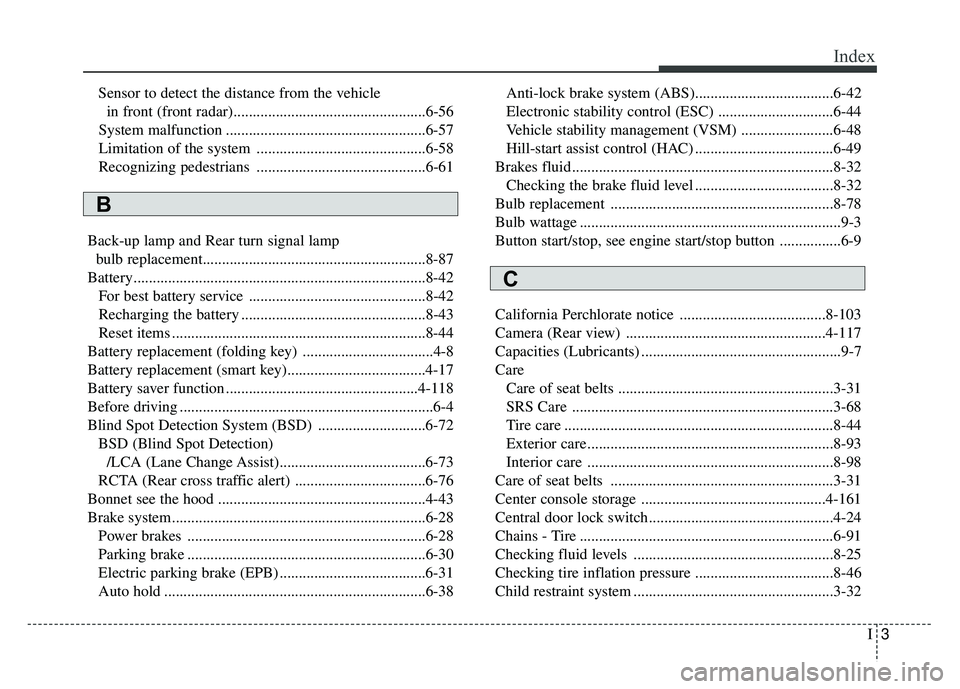
Sensor to detect the distance from the vehiclein front (front radar)..................................................6-56
System malfunction ....................................................6-57
Limitation of the system ............................................6-58
Recognizing pedestrians ............................................6-61
Back-up lamp and Rear turn signal lamp bulb replacement..........................................................8-87
Battery........................................................................\
....8-42 For best battery service ..............................................8-42
Recharging the battery ................................................8-43
Reset items ..................................................................8-44
Battery replacement (folding key) ..................................4-8
Battery replacement (smart key)....................................4-17
Battery saver function ..................................................4-118
Before driving ..................................................................6-4
Blind Spot Detection System (BSD) ............................6-72 BSD (Blind Spot Detection)/LCA (Lane Change Assist)......................................6-73
RCTA (Rear cross traffic alert) ..................................6-76
Bonnet see the hood ......................................................4-43
Brake system..................................................................6-28 Power brakes ..............................................................6-28
Parking brake ..............................................................6-30
Electric parking brake (EPB) ......................................6-31
Auto hold ....................................................................6-38\
Anti-lock brake system (ABS)....................................6-42
Electronic stability control (ESC) ..............................6-44
Vehicle stability management (VSM) ........................6-48
Hill-start assist control (HAC) ....................................6-49
Brakes fluid....................................................................8-32\
Checking the brake fluid level ....................................8-32
Bulb replacement ..........................................................8-78
Bulb wattage ....................................................................9-3
Button start/stop, see engine start/stop button ................6-9
California Perchlorate notice ......................................8-103
Camera (Rear view) ....................................................4-117
Capacities (Lubricants) ....................................................9-7
Care Care of seat belts ........................................................3-31
SRS Care ....................................................................3-68\
Tire care ......................................................................8-\
44
Exterior care ................................................................8-93
Interior care ................................................................8-98
Care of seat belts ..........................................................3-31
Center console storage ................................................4-161
Central door lock switch................................................4-24
Chains - Tire ..................................................................6-91
Checking fluid levels ....................................................8-25
Checking tire inflation pressure ....................................8-46
Child restraint system ....................................................3-32
B
C
Page 601 of 605
I11
Index
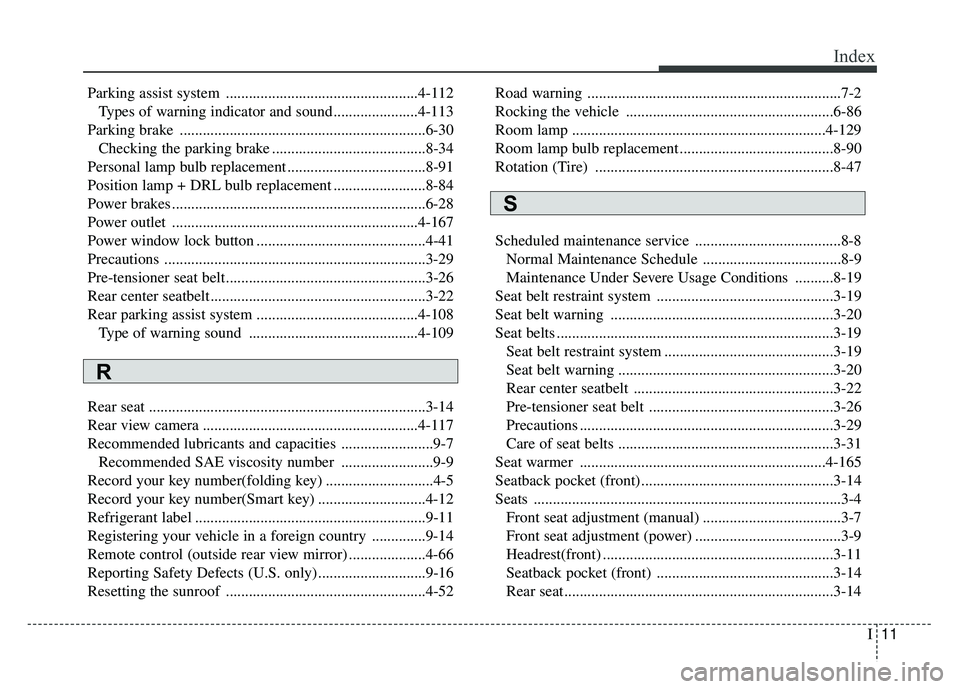
Parking assist system ..................................................4-112Types of warning indicator and sound......................4-113
Parking brake ................................................................6-30 Checking the parking brake ........................................8-34
Personal lamp bulb replacement ....................................8-91
Position lamp + DRL bulb replacement ........................8-84
Power brakes ..................................................................6-28
Power outlet ................................................................4-167
Power window lock button ............................................4-41
Precautions ....................................................................3-29\
Pre-tensioner seat belt....................................................3-26
Rear center seatbelt........................................................3-22
Rear parking assist system ..........................................4-108 Type of warning sound ............................................4-109
Rear seat ........................................................................\
3-14
Rear view camera ........................................................4-117
Recommended lubricants and capacities ........................9-7 Recommended SAE viscosity number ........................9-9
Record your key number(folding key) ............................4-5
Record your key number(Smart key) ............................4-12
Refrigerant label ............................................................9-11
Registering your vehicle in a foreign country ..............9-14
Remote control (outside rear view mirror) ....................4-66
Reporting Safety Defects (U.S. only) ............................9-16
Resetting the sunroof ....................................................4-52 Road warning ..................................................................7-2
Rocking the vehicle ......................................................6-86
Room lamp ..................................................................4-129
Room lamp bulb replacement ........................................8-90
Rotation (Tire) ..............................................................8-47
Scheduled maintenance service ......................................8-8
Normal Maintenance Schedule ....................................8-9
Maintenance Under Severe Usage Conditions ..........8-19
Seat belt restraint system ..............................................3-19
Seat belt warning ..........................................................3-20
Seat belts ........................................................................\
3-19 Seat belt restraint system ............................................3-19
Seat belt warning ........................................................3-20
Rear center seatbelt ....................................................3-22
Pre-tensioner seat belt ................................................3-26
Precautions ..................................................................3-29
Care of seat belts ........................................................3-31
Seat warmer ................................................................4-165
Seatback pocket (front) ..................................................3-14
Seats ........................................................................\
........3-4 Front seat adjustment (manual) ....................................3-7
Front seat adjustment (power) ......................................3-9
Headrest(front) ............................................................3-11
Seatback pocket (front) ..............................................3-14
Rear seat ......................................................................3-\
14
S
R