coolant KIA SPORTAGE 2019 Owner's Manual
[x] Cancel search | Manufacturer: KIA, Model Year: 2019, Model line: SPORTAGE, Model: KIA SPORTAGE 2019Pages: 607, PDF Size: 16.97 MB
Page 501 of 607
Maintenance
28
8
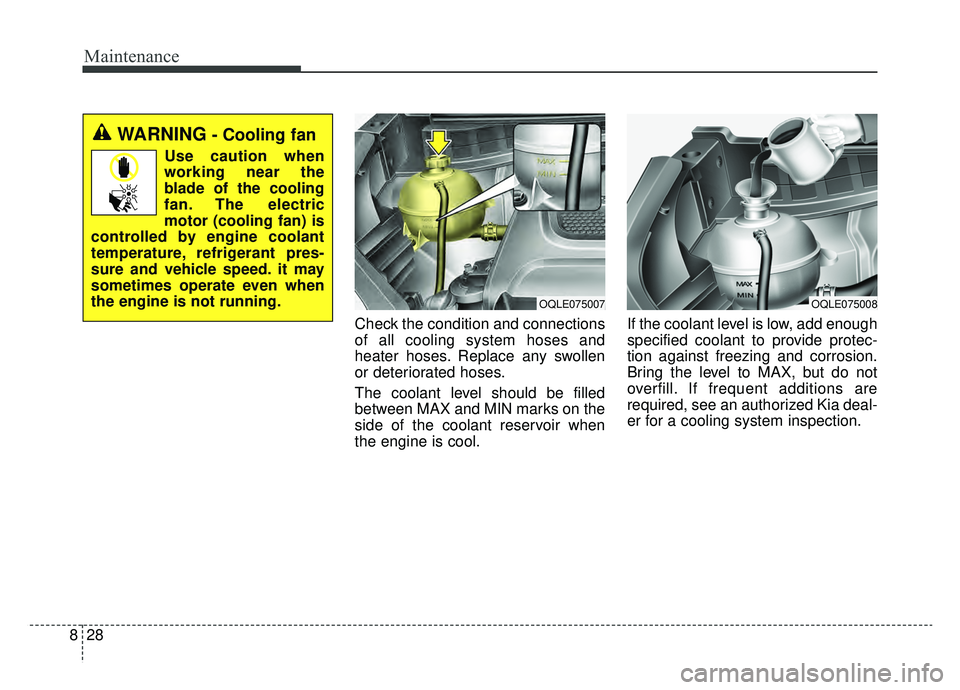
Check the condition and connections
of all cooling system hoses and
heater hoses. Replace any swollen
or deteriorated hoses.
The coolant level should be filled
between MAX and MIN marks on the
side of the coolant reservoir when
the engine is cool. If the coolant level is low, add enough
specified coolant to provide protec-
tion against freezing and corrosion.
Bring the level to MAX, but do not
overfill. If frequent additions are
required, see an authorized Kia deal-
er for a cooling system inspection.
OQLE075007OQLE075008
WARNING- Cooling fan
Use caution when
working near the
blade of the cooling
fan. The electric
motor (cooling fan) is
controlled by engine coolant
temperature, refrigerant pres-
sure and vehicle speed. it may
sometimes operate even when
the engine is not running.
Page 502 of 607
829
Maintenance
✽ ✽NOTICE
Make sure the coolant cap is proper-
ly closed after refill of coolant.
Otherwise the engine could be over-
heated while driving.
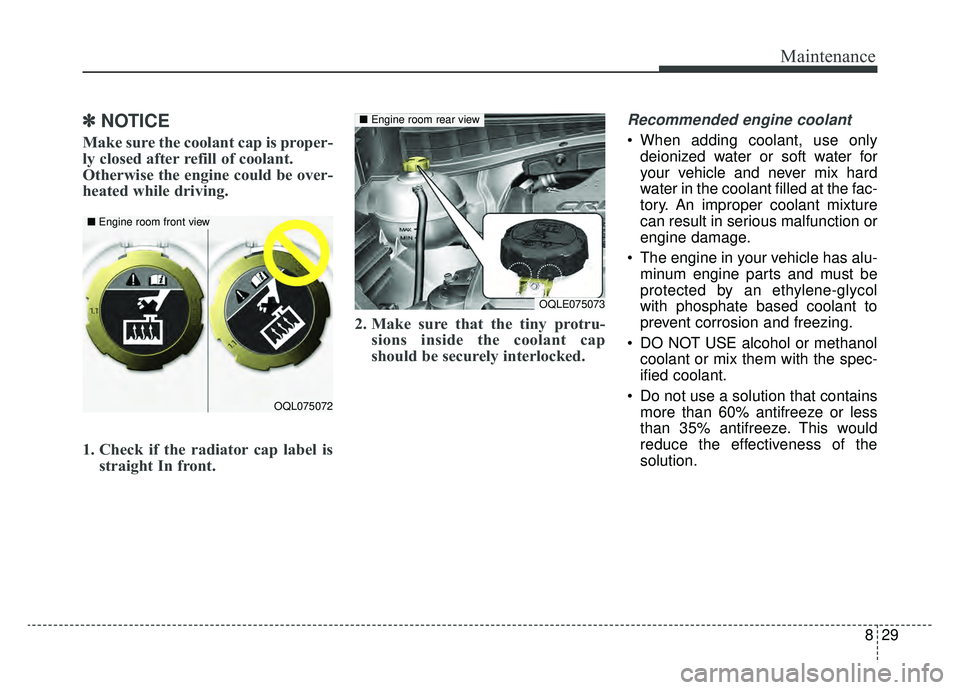
1. Check if the radiator cap label is
straight In front. 2. Make sure that the tiny protru-
sions inside the coolant cap
should be securely interlocked.
Recommended engine coolant
When adding coolant, use only
deionized water or soft water for
your vehicle and never mix hard
water in the coolant filled at the fac-
tory. An improper coolant mixture
can result in serious malfunction or
engine damage.
The engine in your vehicle has alu- minum engine parts and must be
protected by an ethylene-glycol
with phosphate based coolant to
prevent corrosion and freezing.
DO NOT USE alcohol or methanol coolant or mix them with the spec-
ified coolant.
Do not use a solution that contains more than 60% antifreeze or less
than 35% antifreeze. This would
reduce the effectiveness of the
solution.
OQL075072
■ Engine room front view
OQLE075073
■Engine room rear view
Page 503 of 607
Maintenance
30
8
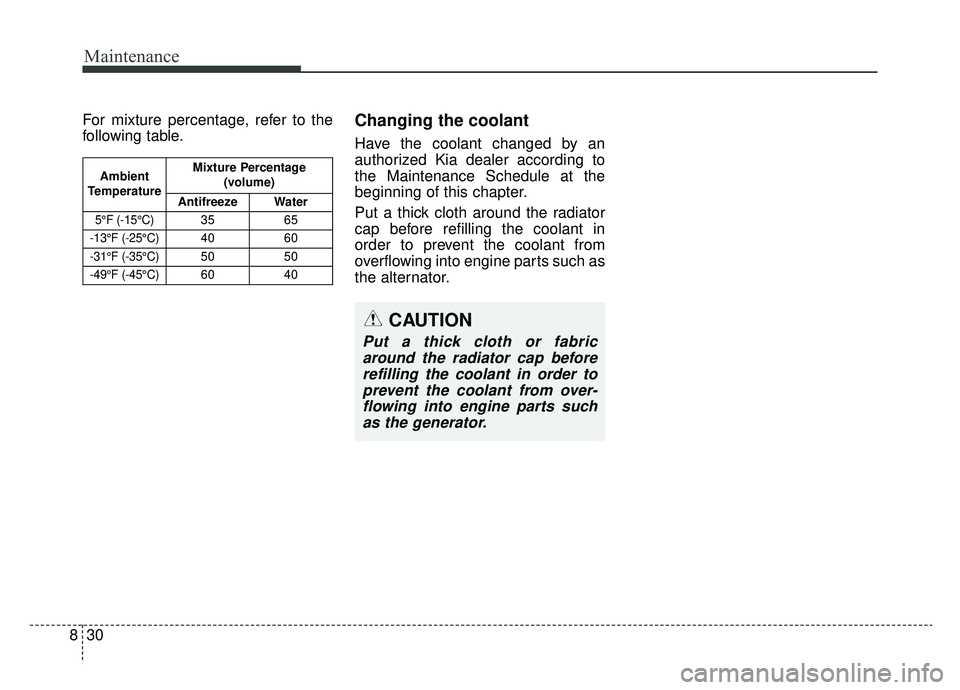
For mixture percentage, refer to the
following table.Changing the coolant
Have the coolant changed by an
authorized Kia dealer according to
the Maintenance Schedule at the
beginning of this chapter.
Put a thick cloth around the radiator
cap before refilling the coolant in
order to prevent the coolant from
overflowing into engine parts such as
the alternator.
Ambient
Temperature Mixture Percentage
(volume)
Antifreeze Water
5°F (-15°C)35 65
-13°F (-25°C)4060
-31°F (-35°C)5050
-49°F (-45°C)6040
CAUTION
Put a thick cloth or fabric
around the radiator cap beforerefilling the coolant in order toprevent the coolant from over-flowing into engine parts suchas the generator.
Page 505 of 607
Maintenance
32
8
WASHER FLUID
Checking the washer fluid
level
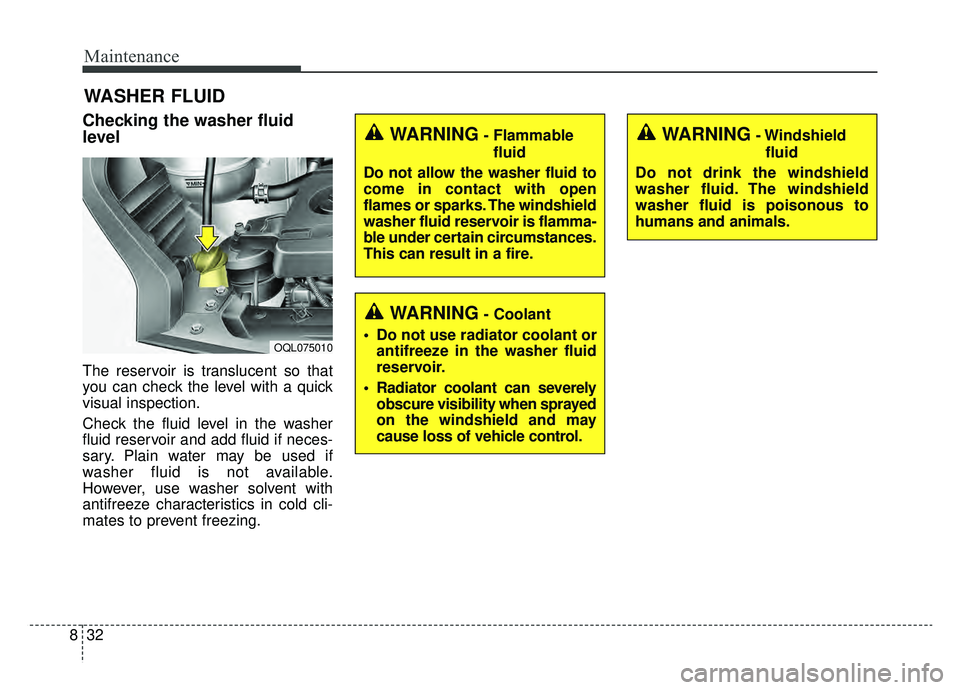
The reservoir is translucent so that
you can check the level with a quick
visual inspection.
Check the fluid level in the washer
fluid reservoir and add fluid if neces-
sary. Plain water may be used if
washer fluid is not available.
However, use washer solvent with
antifreeze characteristics in cold cli-
mates to prevent freezing.
WARNING- Flammable
fluid
Do not allow the washer fluid to
come in contact with open
flames or sparks. The windshield
washer fluid reservoir is flamma-
ble under certain circumstances.
This can result in a fire.WARNING- Windshield fluid
Do not drink the windshield
washer fluid. The windshield
washer fluid is poisonous to
humans and animals.
WARNING- Coolant
Do not use radiator coolant or antifreeze in the washer fluid
reservoir.
Radiator coolant can severely obscure visibility when sprayed
on the windshield and may
cause loss of vehicle control.
OQL075010
Page 526 of 607
853
Maintenance
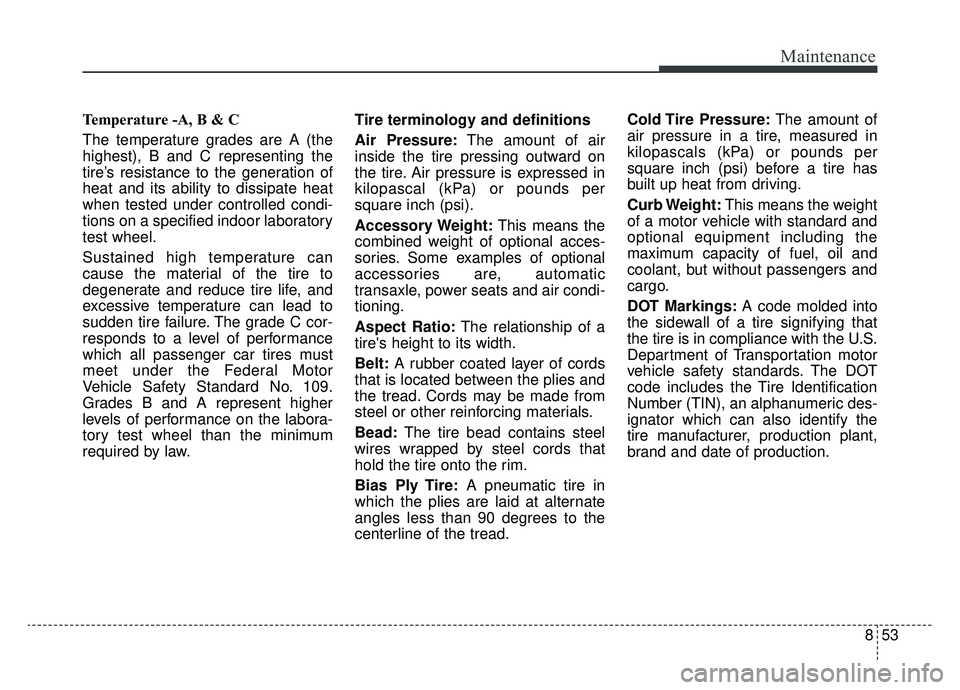
Temperature -A, B & C
The temperature grades are A (the
highest), B and C representing the
tire’s resistance to the generation of
heat and its ability to dissipate heat
when tested under controlled condi-
tions on a specified indoor laboratory
test wheel.
Sustained high temperature can
cause the material of the tire to
degenerate and reduce tire life, and
excessive temperature can lead to
sudden tire failure. The grade C cor-
responds to a level of performance
which all passenger car tires must
meet under the Federal Motor
Vehicle Safety Standard No. 109.
Grades B and A represent higher
levels of performance on the labora-
tory test wheel than the minimum
required by law.Tire terminology and definitions
Air Pressure:
The amount of air
inside the tire pressing outward on
the tire. Air pressure is expressed in
kilopascal (kPa) or pounds per
square inch (psi).
Accessory Weight: This means the
combined weight of optional acces-
sories. Some examples of optional
accessories are, automatic
transaxle, power seats and air condi-
tioning.
Aspect Ratio: The relationship of a
tire's height to its width.
Belt: A rubber coated layer of cords
that is located between the plies and
the tread. Cords may be made from
steel or other reinforcing materials.
Bead: The tire bead contains steel
wires wrapped by steel cords that
hold the tire onto the rim.
Bias Ply Tire: A pneumatic tire in
which the plies are laid at alternate
angles less than 90 degrees to the
centerline of the tread. Cold Tire Pressure:
The amount of
air pressure in a tire, measured in
kilopascals (kPa) or pounds per
square inch (psi) before a tire has
built up heat from driving.
Curb Weight: This means the weight
of a motor vehicle with standard and
optional equipment including the
maximum capacity of fuel, oil and
coolant, but without passengers and
cargo.
DOT Markings: A code molded into
the sidewall of a tire signifying that
the tire is in compliance with the U.S.
Department of Transportation motor
vehicle safety standards. The DOT
code includes the Tire Identification
Number (TIN), an alphanumeric des-
ignator which can also identify the
tire manufacturer, production plant,
brand and date of production.
Page 574 of 607
8101
Maintenance
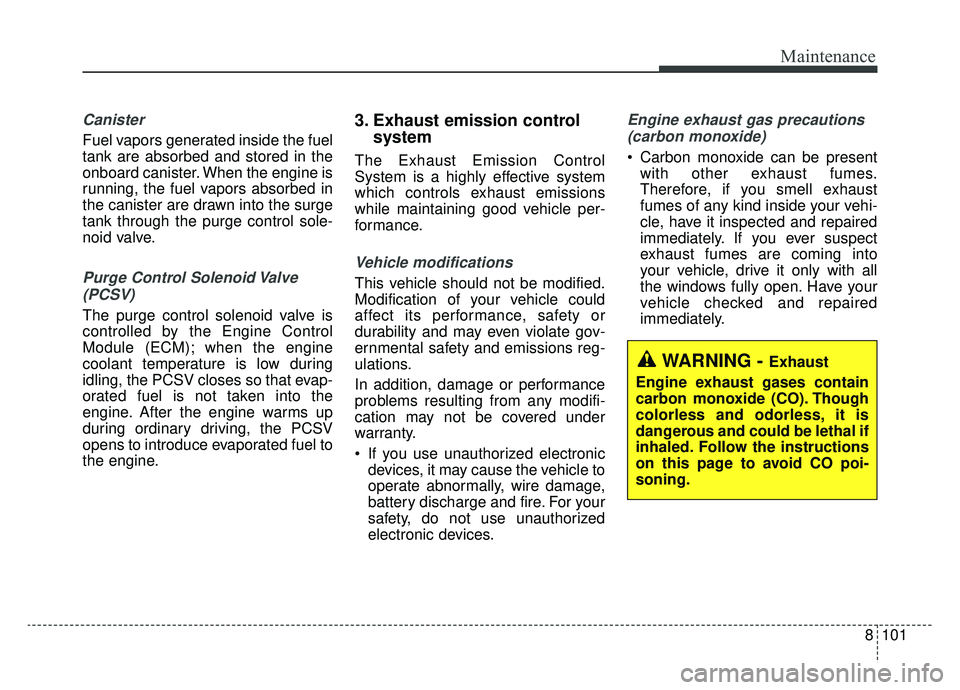
Canister
Fuel vapors generated inside the fuel
tank are absorbed and stored in the
onboard canister. When the engine is
running, the fuel vapors absorbed in
the canister are drawn into the surge
tank through the purge control sole-
noid valve.
Purge Control Solenoid Valve(PCSV)
The purge control solenoid valve is
controlled by the Engine Control
Module (ECM); when the engine
coolant temperature is low during
idling, the PCSV closes so that evap-
orated fuel is not taken into the
engine. After the engine warms up
during ordinary driving, the PCSV
opens to introduce evaporated fuel to
the engine.
3. Exhaust emission control system
The Exhaust Emission Control
System is a highly effective system
which controls exhaust emissions
while maintaining good vehicle per-
formance.
Vehicle modifications
This vehicle should not be modified.
Modification of your vehicle could
affect its performance, safety or
durability and may even violate gov-
ernmental safety and emissions reg-
ulations.
In addition, damage or performance
problems resulting from any modifi-
cation may not be covered under
warranty.
If you use unauthorized electronic
devices, it may cause the vehicle to
operate abnormally, wire damage,
battery discharge and fire. For your
safety, do not use unauthorized
electronic devices.
Engine exhaust gas precautions
(carbon monoxide)
Carbon monoxide can be present with other exhaust fumes.
Therefore, if you smell exhaust
fumes of any kind inside your vehi-
cle, have it inspected and repaired
immediately. If you ever suspect
exhaust fumes are coming into
your vehicle, drive it only with all
the windows fully open. Have your
vehicle checked and repaired
immediately.
WARNING - Exhaust
Engine exhaust gases contain
carbon monoxide (CO). Though
colorless and odorless, it is
dangerous and could be lethal if
inhaled. Follow the instructions
on this page to avoid CO poi-
soning.
Page 583 of 607
97
Specifications, Consumer information, Reporting safety defects
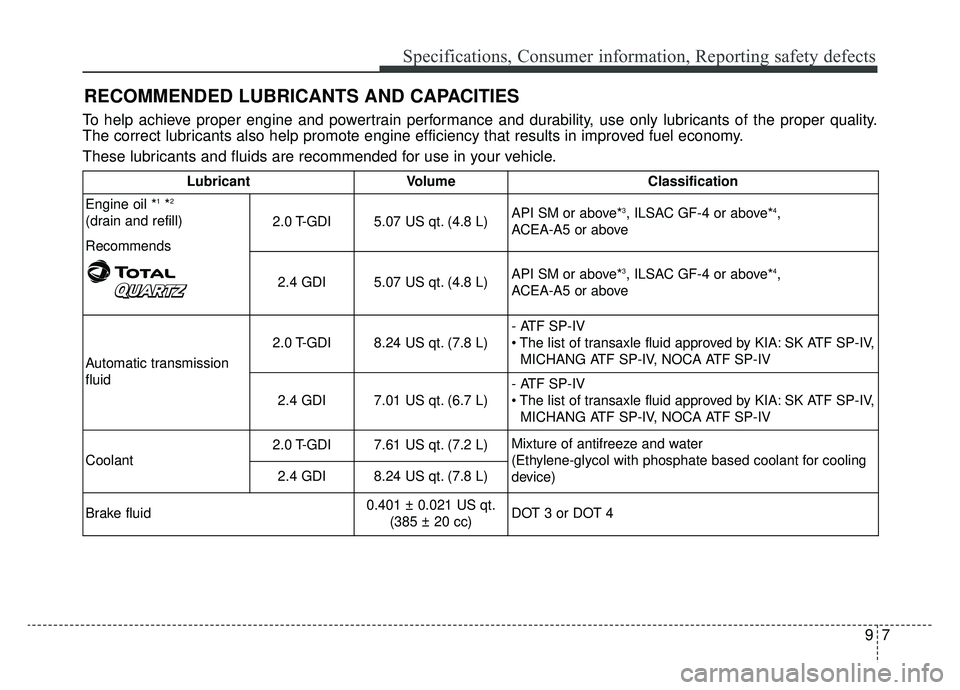
RECOMMENDED LUBRICANTS AND CAPACITIES
To help achieve proper engine and powertrain performance and durability, use only lubricants of the proper quality.
The correct lubricants also help promote engine efficiency that results in improved fuel economy.
These lubricants and fluids are recommended for use in your vehicle.
LubricantVolumeClassification
Engine oil *
1*2
(drain and refill)
Recommends 2.0 T-GDI5.07 US qt. (4.8 L)
API SM or above*3, ILSAC GF-4 or above*4,
ACEA-A5 or above
2.4 GDI
5.07 US qt. (4.8 L) API SM or above*3, ILSAC GF-4 or above*4,
ACEA-A5 or above
Automatic transmission
fluid 2.0 T-GDI
8.24 US qt. (7.8 L)
- ATF SP-IV
• The list of transaxle fluid approved by KIA: SK ATF SP-IV,
MICHANG ATF SP-IV, NOCA ATF SP-IV
2.4 GDI
7.01 US qt. (6.7 L) - ATF SP-IV
SK ATF SP-IV,
MICHANG ATF SP-IV, NOCA ATF SP-IV
Coolant 2.0 T-GDI
7.61 US qt. (7.2 L)
Mixture of antifreeze and water
(Ethylene-glycol with phosphate based coolant for cooling
device)
2.4 GDI
8.24 US qt. (7.8 L)
Brake fluid
0.401 ± 0.021 US qt. (385 ± 20 cc) DOT 3 or DOT 4
Page 596 of 607
Index
4I
Children Always in the Rear ......................................3-32
Selecting a Child Restraint System (CRS) ................3-33
Installing a Child Restraint System (CRS) ................3-36
Securing a child restraint withthe LATCH anchors system ..........................................................3-38
Securing a child restraint seatwith Tether Anchor system ..............................................3-39
Child-protector rear door lock ......................................4-26
Climate control air filter ................................................8-36 Filter inspection ..........................................................8-36
Climate control system ................................................4-134 Manual climate control system ................................4-134
Automatic climate control system ............................4-144
Automatic heating and air conditioning ..................4-145
Closing the sunroof........................................................4-52
Clothes hanger ............................................................4-172
Combined instrument, see instrument cluster ..............4-68
Compact spare tire ........................................................7-21
Components of the Tire Mobility Kit ............................7-26
Consumer assistance (U.S. only) ..................................9-12 Toll free consumer assistance ....................................9-12
Emergency roadside assistance ..................................9-12
Trip interruption ..........................................................9-13
Registering your vehicle in a foreign country ............9-14
Coolant ........................................................................\
..8-27
Cooling fluid, see engine coolant ..................................8-27
Crankcase emission control system ............................8-100
Cruise control system ....................................................6-66 Cruise control switch ..................................................6-66
To set cruise control speed..........................................6-67
To increase cruise control set speed ..........................6-67
To decrease the cruising speed ..................................6-68
To temporarily accelerate with the cruise control on 6-68
To cancel cruise control ..............................................6-68
To resume cruising speed at more than approximately 20mph (30 km/h) ..............................6-69
To turn cruise control off ............................................6-69
Cup holder ..................................................................4-164
Curtain air bag ..............................................................3-61
Dashboard illumination, see instrument panel illumination ........................................................4-69
Dashboard, see instrument cluster ................................4-68
Day/night rearview mirror ............................................4-58
Declaration of Conformity ............................................5-64 FCC ........................................................................\
....5-64
Defogging (Windshield) ..............................................4-156
Defroster (Rear window) ............................................4-133
Defrosting (Windshield) ..............................................4-156
Dimensions ......................................................................9-\
2
Disarmed stage ..............................................................4-20
Display illumination, see instrument panel illumination..................................................................4-69
Displays, see instrument cluster ....................................4-68
D
Page 597 of 607

I5
Index
Door locks......................................................................4-\
22From outside the vehicle ............................................4-22
From inside the vehicle ..............................................4-23
Central door lock switch ............................................4-24
Child-protector rear door lock ....................................4-26
Downhill Brake Control (DBC) ....................................6-62 DBC operation ............................................................6-63
Drinks holders, see cup holders ..................................4-164
DRIVE mode (Drive mode integrated control system) ..6-70
Drive mode integrated control system ..........................6-70 DRIVE mode ..............................................................6-70
ECO mode ..................................................................6-70
SPORT mode ..............................................................6-71
Driver's and passenger's front air bag ............................3-58
Driving at night ..............................................................6-89
Driving in flooded areas ................................................6-90
Driving in the rain..........................................................6-89
Driving off-road ............................................................6-90
ECO mode (Drive mode integrated control system) ....6-70
Economical operation ....................................................6-84
Electric parking brake (EPB) ........................................6-31
Electrical Equipment (U.S. only) ..................................9-15 Installation of a mobile two-way radio system ..........9-15
Electrochromic mirror (ECM) ......................................4-59
Electrochromic mirror with HomeLink system ............4-60 Electronic power steering ..............................................4-54
Electronic stability control (ESC) ................................6-44
Emergency liftgate safety release ..................................4-28
Emergency roadside assistance......................................9-12
Emergency starting ..........................................................7-5
Jump starting ................................................................7-5
Emergency while driving ................................................7-3
Emission control system ..............................................8-100 Crankcase emission control system ..........................8-100
Evaporative emission control System ......................8-100
Exhaust emission control system ..............................8-101
Engine ........................................................................\
......9-2
Engine compartment ........................................................2-6
Engine compartment ........................................................8-3
Engine coolant ..............................................................8-27 Checking the coolant level..........................................8-27
Changing the coolant ..................................................8-30
Engine Coolant Temperature Gauge..............................4-70
Engine number ..............................................................9-11
Engine oil ......................................................................8-\
25 Checking the engine oil level ....................................8-25
Changing the engine oil and filter ..............................8-26
Engine overheats ..............................................................7-7
Engine start/stop button ..................................................6-9 Illuminated engine start/stop button ............................6-9
Engine start/stop button position ..................................6-9
Starting the engine with a smart key ..........................6-11
Engine start/stop button illumination ..............................6-9
E
Page 598 of 607
Index
6I
Engine start/stop button position ....................................6-9
Engine will not start ........................................................7-4
Evaporative emission control System ..........................8-100
Exhaust emission control system ................................8-101
Explanation of scheduled maintenance items ..............8-20Engine oil and filter ....................................................8-20
Drive belts ..................................................................8-20
Fuel filter (cartridge) ..................................................8-20
Fuel filter (for gasoline) ..............................................8-20
Fuel lines, fuel hoses and connections ......................8-20
Vapor hose and fuel filler cap ....................................8-20
Vacuum crankcase ventilation hoses ..........................8-21
Air cleaner filter ..........................................................8-21(for gasoline engine) ..................................................8-21
Valve clearance ..........................................................8-21
Cooling system ..........................................................8-21
Coolant ........................................................................\
8-21
Automatic transaxle fluid............................................8-2\
2
Brake hoses and lines..................................................8-22
Brake fluid ..................................................................8-22
Parking brake ..............................................................8-22
Brake discs, pads, calipers and rotors ........................8-23
Exhaust pipe and muffler ............................................8-23
Suspension mounting bolts ........................................8-23
Steering gear box, linkage & boots /lower arm ball joint ................................................8-23
Drive shafts and boots ................................................8-23
Air conditioning refrigerant ........................................8-23 Exterior care ..................................................................8-92
Exterior features ..........................................................4-175
Roof rack ..................................................................4-175
Exterior overview (Front) ................................................2-2
Exterior overview (Rear) ................................................2-3
Flat tire ........................................................................\
..7-15 Jack and tools ..............................................................7-15
Removing the spare tire ..............................................7-16
Storing the spare tire ..................................................7-16
Changing tires ............................................................7-17
Compact spare tire ......................................................7-21
Floor mat anchor(s) ....................................................4-172
Fluid Brake fluid ..................................................................8-31
Washer fluid ................................................................8-32
Fog light (front) ..........................................................4-123
Folding key ......................................................................4-\
5 Record your key number ..............................................4-5
Key operations ..............................................................4-5
Transmitter precautions ................................................4-7
Battery replacement ......................................................4-8
Immobilizer system ......................................................4-9
Folding the outside rearview mirror ..............................4-66
Folding the rear seat ......................................................3-16
F