Sae KIA SPORTAGE 2019 Owners Manual
[x] Cancel search | Manufacturer: KIA, Model Year: 2019, Model line: SPORTAGE, Model: KIA SPORTAGE 2019Pages: 607, PDF Size: 16.97 MB
Page 227 of 607
Features of your vehicle
140
4
System operation
Ventilation
1.Set the mode to the position.
2.Set the air intake control to the out-
side (fresh) air position.
3.Set the temperature control to the desired position.
4.Set the fan speed control to the desired speed.
Heating
1.Set the mode to the position.
2.Set the air intake control to the out-side (fresh) air position.
3.Set the temperature control to the desired position.
4.Set the fan speed control to the desired speed.
5.If dehumidified heating is desired, turn the air conditioning system (if
equipped) on.
If the windshield fogs up, set the mode to the or position. Operation Tips
To keep dust or unpleasant fumes
from entering the vehicle through
the ventilation system, temporarily
set the air intake control to the
recirculated air position. Be sure to
return the control to the fresh air
position when the irritation has
passed to keep fresh air in the
vehicle. This will help keep the driv-
er alert and comfortable.
Air for the heating/cooling system is drawn in through the grilles just
ahead of the windshield. Care
should be taken that these are not
blocked by leaves, snow, ice or
other obstructions.
To prevent interior fog on the wind- shield, set the air intake control to
the fresh air position and fan speed
to the desired position, turn on the
air conditioning system, and adjust
the temperature control to desired
temperature.
Air conditioning
Kia Air Conditioning Systems are
filled with refrigerant.
1.Start the engine. Push the air con-ditioning button.
2.Set the mode to the position.
3.Set the air intake control to the out- side air or recirculated air position.
4.Adjust the fan speed control and temperature control to maintain
maximum comfort.
The refrigerant system should only be serviced by trained and certified
technicians to ensure proper and
safe operation.
The refrigerant system should be serviced in a well-ventilated place.
The air conditioning evaporator (cooling coil) shall never be repaired
or replaced with one removed from
a used or salvaged vehicle and new
replacement MAC evaporators
should be certified (and labeled) as
meeting SAE Standard J2842.
Page 421 of 607
693
Driving your vehicle
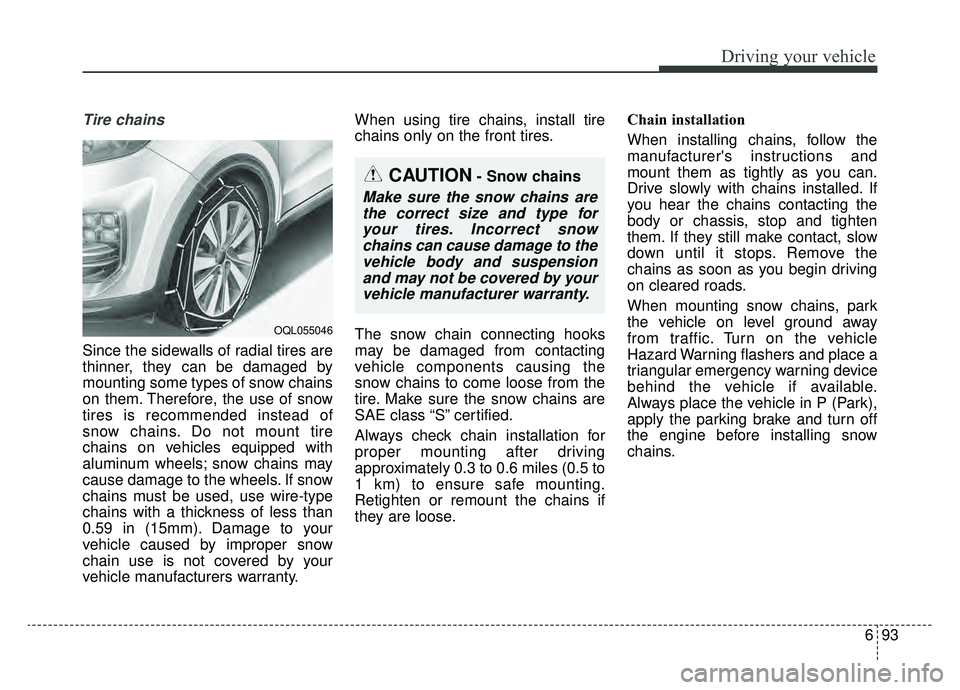
Tire chains
Since the sidewalls of radial tires are
thinner, they can be damaged by
mounting some types of snow chains
on them. Therefore, the use of snow
tires is recommended instead of
snow chains. Do not mount tire
chains on vehicles equipped with
aluminum wheels; snow chains may
cause damage to the wheels. If snow
chains must be used, use wire-type
chains with a thickness of less than
0.59 in (15mm). Damage to your
vehicle caused by improper snow
chain use is not covered by your
vehicle manufacturers warranty.When using tire chains, install tire
chains only on the front tires.
The snow chain connecting hooks
may be damaged from contacting
vehicle components causing the
snow chains to come loose from the
tire. Make sure the snow chains are
SAE class “S” certified.
Always check chain installation for
proper mounting after driving
approximately 0.3 to 0.6 miles (0.5 to
1 km) to ensure safe mounting.
Retighten or remount the chains if
they are loose.
Chain installation
When installing chains, follow the
manufacturer's instructions and
mount them as tightly as you can.
Drive slowly with chains installed. If
you hear the chains contacting the
body or chassis, stop and tighten
them. If they still make contact, slow
down until it stops. Remove the
chains as soon as you begin driving
on cleared roads.
When mounting snow chains, park
the vehicle on level ground away
from traffic. Turn on the vehicle
Hazard Warning flashers and place a
triangular emergency warning device
behind the vehicle if available.
Always place the vehicle in P (Park),
apply the parking brake and turn off
the engine before installing snow
chains.
CAUTION- Snow chains
Make sure the snow chains are
the correct size and type foryour tires. Incorrect snowchains can cause damage to thevehicle body and suspensionand may not be covered by yourvehicle manufacturer warranty.
OQL055046
Page 529 of 607
Maintenance
56
8
All season tires
Kia specifies all season tires on
some models to provide good per-
formance for use all year round,
including snowy and icy road condi-
tions. All season tires are identified
by ALL SEASON and/or M+S (Mud
and Snow) on the tire sidewall. Snow
tires have better snow traction than
all season tires and may be more
appropriate in some areas.
Summer tires
Kia specifies summer tires on some
models to provide superior perform-
ance on dry roads. Summer tire per-
formance is substantially reduced in
snow and ice. Summer tires do not
have the tire traction rating M+S
(Mud and Snow) on the tire side wall.
If you plan to operate your vehicle in
snowy or icy conditions, Kia recom-
mends the use of snow tires or all
season tires on all four wheels.
Snow tires
If you equip your car with snow tires,
they should be the same size and
have the same load capacity as the
original tires. Snow tires should be
installed on all four wheels; other-
wise, poor handling may result.
Snow tires should carry 4 psi (28
kPa) more air pressure than the
pressure recommended for the stan-
dard tires on the tire label on the dri-
ver's side of the center pillar, or up to
the maximum pressure shown on the
tire sidewall, whichever is less.
Do not drive faster than 75 mph (120
km/h) when your vehicle is equipped
with snow tires.
Tire chains
Tire chains, if necessary, should be
installed on the front wheels.
Be sure that the chains are installed
in accordance with the manufactur-
er's instructions.
To minimize tire and chain wear, do
not continue to use tire chains when
they are no longer needed.
When driving on roads covered
with snow or ice, drive at less than
20 mph (30 km/h).
Use the SAE “S” class or wire chains.
If you hear noise caused by chains contacting the body, retighten the
chain to avoid contact with the
vehicle body.
To prevent body damage, retighten the chains after driving 0.3~0.6
miles (0.5~1.0 km).
Do not use tire chains on vehicles equipped with aluminum wheels.
In unavoidable circumstances, use
a wire type chain.
Use wire chains less than 0.47 inches (12 mm) to prevent damage
to the chain’s connection.
Page 577 of 607

Specifications, Consumer information and Reporting safety defects
Engine . . . . . . . . . . . . . . . . . . . . . . . . . . . . . . . . . . . . \
9-2
Dimensions . . . . . . . . . . . . . . . . . . . . . . . . . . . . . . . . 9-2
Bulb wattage . . . . . . . . . . . . . . . . . . . . . . . . . . . . . . . 9-3
Tires and wheels . . . . . . . . . . . . . . . . . . . . . . . . . . . . 9-4
Luggage volume . . . . . . . . . . . . . . . . . . . . . . . . . . . . 9-6
Air conditioning system . . . . . . . . . . . . . . . . . . . . . . 9-6
Gross vehicle weight. . . . . . . . . . . . . . . . . . . . . . . . . 9-6
Recommended lubricants and capacities . . . . . . . . 9-7
• Recommended SAE viscosity number. . . . . . . . . . . . . 9-9
Vehicle certification label. . . . . . . . . . . . . . . . . . . . 9-10
Vehicle identification number (VIN) . . . . . . . . . . 9-10
Refrigerant label. . . . . . . . . . . . . . . . . . . . . . . . . . . 9-11
Tire specification and pressure label . . . . . . . . . . 9-11
Engine number . . . . . . . . . . . . . . . . . . . . . . . . . . . . 9-11
Consumer assistance (U.S. only) . . . . . . . . . . . . . . 9-12
. . . . . . . . . . . . . . . . . . . 9-12
. . . . . . . . . . . . . . . . . 9-12
. . . . . . . . . . . . . . . . . . . . . . . . . . . . . 9-13
. . . . . 9-14
Electrical Equipment (U.S. only) . . . . . . . . . . . . . 9-15
. . . . . 9-15
Reporting Safety Defects (U.S. only) . . . . . . . . . . 9-16
Online factory authorized manuals (U.S. only) . . 9-16
. . . . . . . . . . . . . . . . . . . . . . . . . . . . . . 9-16
. . . . . . . . . . . . . . 9-16
. . . . . . . . . . . . . . . . . . . . . . . . . . . . . 9-16
9
Page 582 of 607
Specifications, Consumer information, Reporting safety defects
69
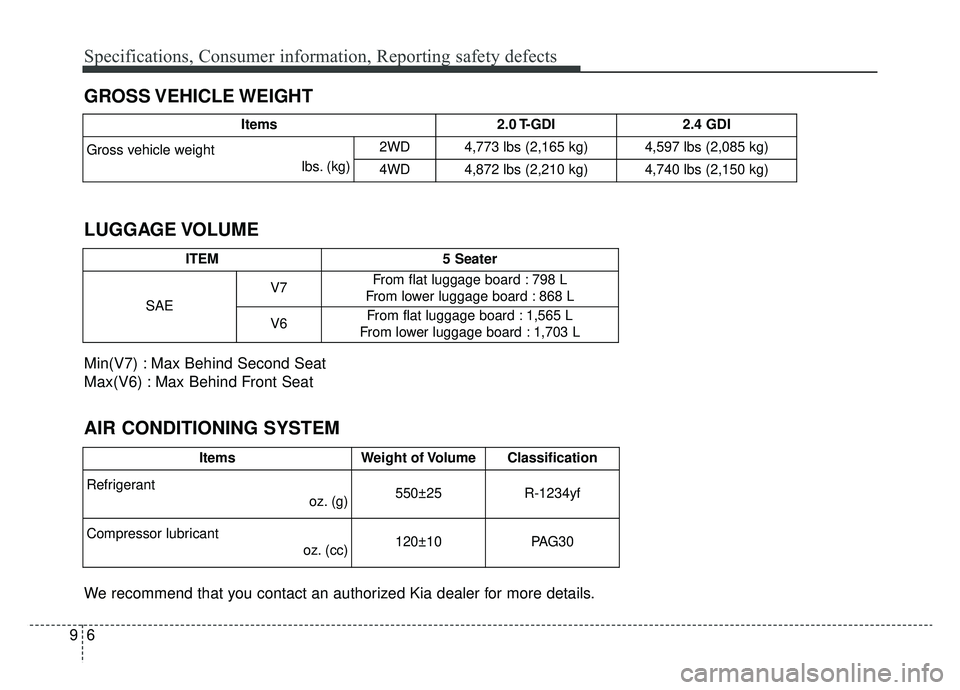
GROSS VEHICLE WEIGHT
AIR CONDITIONING SYSTEM LUGGAGE VOLUME
We recommend that you contact an authorized Kia dealer for more details. Min(V7) : Max Behind Second Seat
Max(V6) : Max Behind Front Seat
Items2.0 T-GDI2.4 GDI
Gross vehicle weightlbs. (kg)2WD4,773 lbs (2,165 kg)4,597 lbs (2,085 kg)
4WD4,872 lbs (2,210 kg)4,740 lbs (2,150 kg)
ITEM5 Seater
SAE
V7From flat luggage board : 798 L
From lower luggage board : 868 L
V6From flat luggage board : 1,565 L
From lower luggage board : 1,703 L
ItemsWeight of VolumeClassification
Refrigerant oz. (g)550±25R-1234yf
Compressor lubricantoz. (cc) 120±10PAG30
Page 584 of 607
Specifications, Consumer information, Reporting safety defects
89
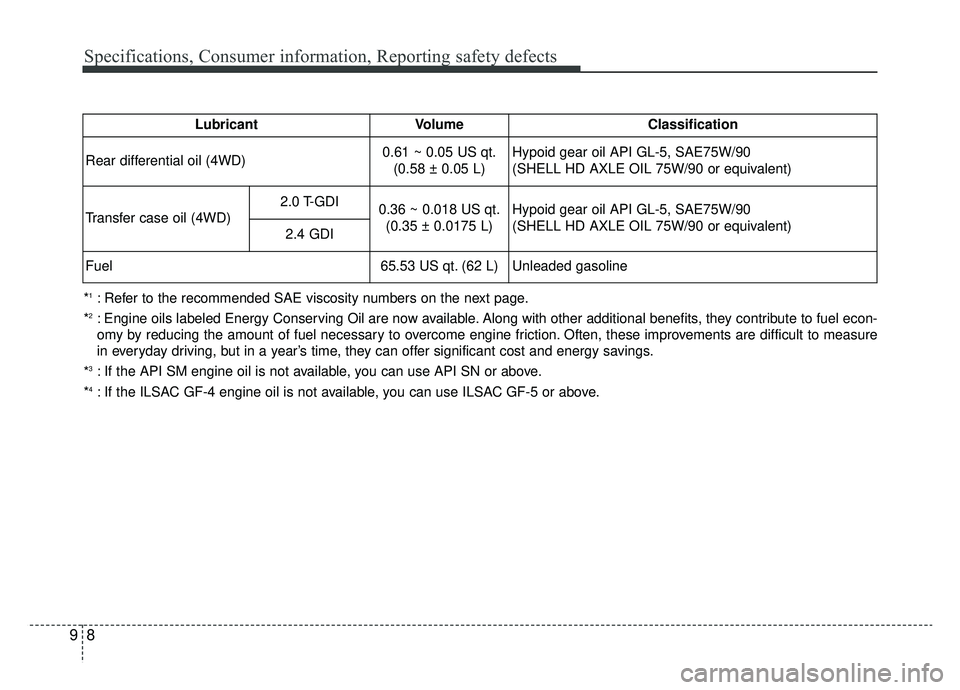
*1: Refer to the recommended SAE viscosity numbers on the next page.
*
2: Engine oils labeled Energy Conserving Oil are now available. Along with other additional benefits, they contribute to fuel econ-
omy by reducing the amount of fuel necessary to overcome engine friction. Often, these improvements are difficult to measure
in everyday driving, but in a year’s time, they can offer significant cost and energy savings.
*
3: If the API SM engine oil is not available, you can use API SN or above.
*
4: If the ILSAC GF-4 engine oil is not available, you can use ILSAC GF-5 or above. Lubricant
Volume
Classification
Rear differential oil (4WD)
0.61 ~ 0.05 US qt. (0.58 ± 0.05 L) Hypoid gear oil API GL-5, SAE75W/90
(SHELL HD AXLE OIL 75W/90 or equivalent)
Transfer case oil (4WD) 2.0 T-GDI
0.36 ~ 0.018 US qt.
(0.35 ± 0.0175 L) Hypoid gear oil API GL-5, SAE75W/90
(SHELL HD AXLE OIL 75W/90 or equivalent)
2.4 GDI
Fuel
65.53 US qt. (62 L) Unleaded gasoline
Page 585 of 607
99
Specifications, Consumer information, Reporting safety defects
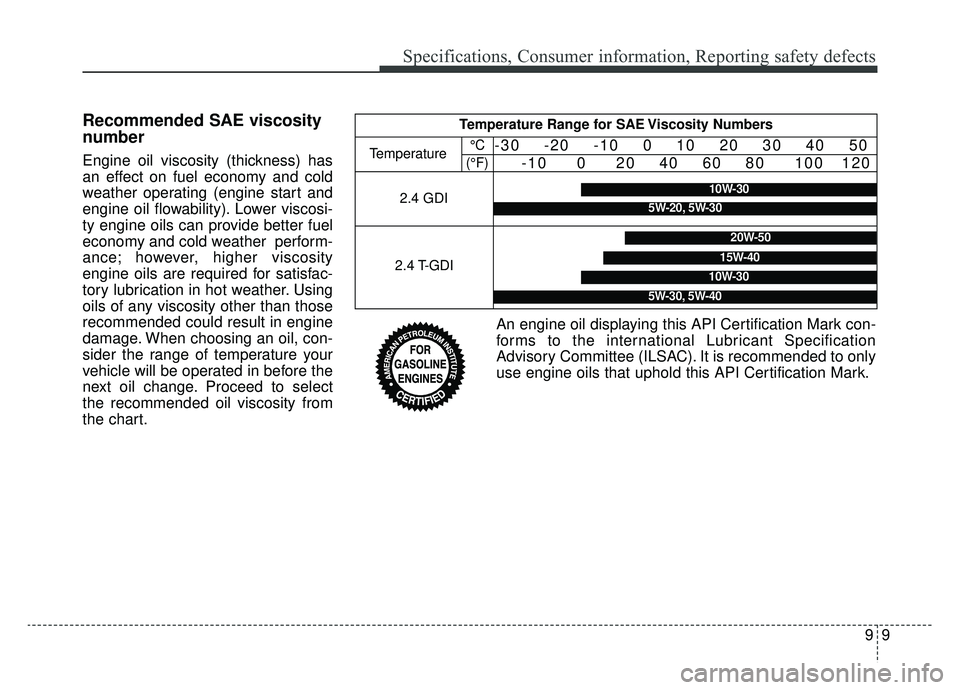
Recommended SAE viscosity
number
Engine oil viscosity (thickness) has
an effect on fuel economy and cold
weather operating (engine start and
engine oil flowability). Lower viscosi-
ty engine oils can provide better fuel
economy and cold weather perform-
ance; however, higher viscosity
engine oils are required for satisfac-
tory lubrication in hot weather. Using
oils of any viscosity other than those
recommended could result in engine
damage. When choosing an oil, con-
sider the range of temperature your
vehicle will be operated in before the
next oil change. Proceed to select
the recommended oil viscosity from
the chart.
Temperature Range for SAE Viscosity Numbers
Temperature°C
(°F)-30 -20 -10 0 10 20 30 40 50 -10 0 20 40 60 80 100 120
2.4 T-GDI
20W-50
10W-30
15W-40
5W-30, 5W-40
2.4 GDI10W-30
5W-20, 5W-30
An engine oil displaying this API Certification Mark con-
forms to the international Lubricant Specification
Advisory Committee (ILSAC). It is recommended to only
use engine oils that uphold this API Certification Mark.
Page 603 of 607
I11
Index
Parking assist system ..................................................4-112Types of warning indicator and sound......................4-113
Parking brake ................................................................6-30 Checking the parking brake ........................................8-33
Personal lamp bulb replacement ....................................8-90
Position lamp + DRL bulb replacement ........................8-83
Power brakes ..................................................................6-28
Power outlet ................................................................4-167
Power window lock button ............................................4-41
Precautions ....................................................................3-29\
Pre-tensioner seat belt....................................................3-26
Rear parking assist system ..........................................4-108 Operation of the rear parking assist system..............4-108
Non-operational conditions of rear parking assist system ....................................................................4-10\
9
Rear parking assist system precautions ....................4-110
Self-diagnosis............................................................4-111
Rear seat ........................................................................\
3-14
Rear view camera ........................................................4-117
Recommended lubricants and capacities ........................9-7 Recommended SAE viscosity number ........................9-9
Record your key number(folding key) ............................4-5
Record your key number(Smart key) ............................4-12
Refrigerant label ............................................................9-11
Registering your vehicle in a foreign country ..............9-14 Remote control (outside rear view mirror) ....................4-66
Reporting Safety Defects (U.S. only) ............................9-16
Resetting the sunroof ....................................................4-52
Road warning ..................................................................7-2
Rocking the vehicle ......................................................6-88
Room lamp ..................................................................4-129
Room lamp bulb replacement ........................................8-89
Rotation (Tire) ..............................................................8-46
Scheduled maintenance service ......................................8-8
Normal Maintenance Schedule ....................................8-9
Maintenance Under Severe Usage Conditions ..........8-19
Seat belt restraint system ..............................................3-19
Seat belt warning ..........................................................3-20
Seat belts ........................................................................\
3-19 Seat belt restraint system ............................................3-19
Seat belt warning ........................................................3-20
Rear center seatbelt ....................................................3-22
Pre-tensioner seat belt ................................................3-26
Precautions ..................................................................3-29
Care of seat belts ........................................................3-31
Seat warmer ................................................................4-165
Seatback pocket (front) ..................................................3-14
Seats ........................................................................\
........3-4 Front seat adjustment (manual) ....................................3-7
Front seat adjustment (power) ......................................3-9
S
R