sensor KIA SPORTAGE 2021 Manual PDF
[x] Cancel search | Manufacturer: KIA, Model Year: 2021, Model line: SPORTAGE, Model: KIA SPORTAGE 2021Pages: 631, PDF Size: 10.56 MB
Page 485 of 631
6 25
What to do in an emergency
Introduction
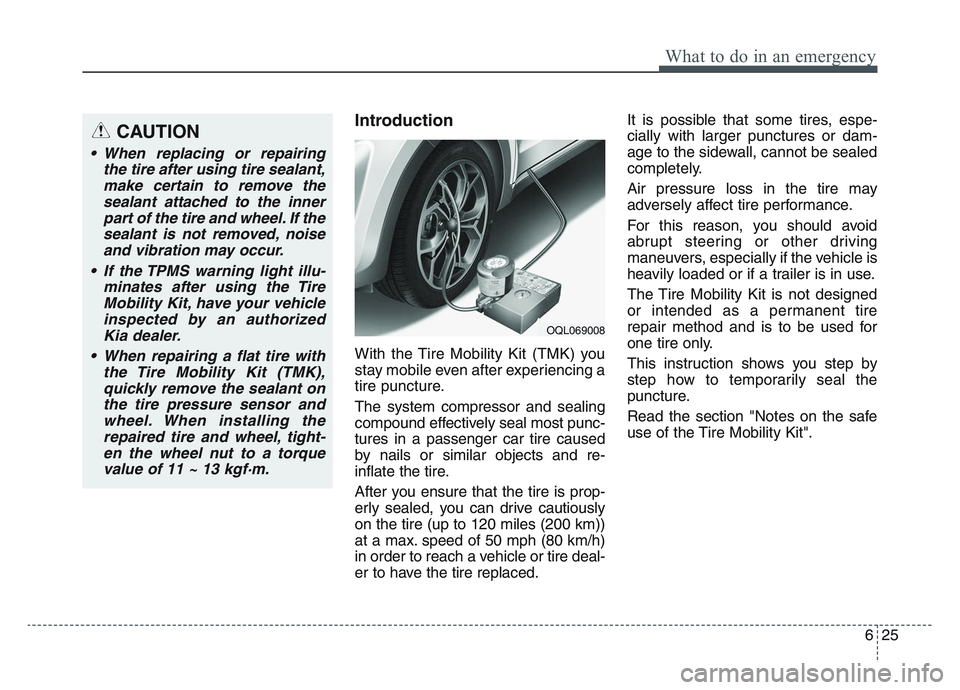
With the Tire Mobility Kit (TMK) you
stay mobile even after experiencing a
tire puncture.
The system compressor and sealing
compound effectively seal most punc-
tures in a passenger car tire caused
by nails or similar objects and re-
inflate the tire.
After you ensure that the tire is prop-
erly sealed, you can drive cautiously
on the tire (up to 120 miles (200 km))
at a max. speed of 50 mph (80 km/h)
in order to reach a vehicle or tire deal-
er to have the tire replaced.It is possible that some tires, espe-
cially with larger punctures or dam-
age to the sidewall, cannot be sealed
completely.
Air pressure loss in the tire may
adversely affect tire performance.
For this reason, you should avoid
abrupt steering or other driving
maneuvers, especially if the vehicle is
heavily loaded or if a trailer is in use.
The Tire Mobility Kit is not designed
or intended as a permanent tire
repair method and is to be used for
one tire only.
This instruction shows you step by
step how to temporarily seal the
puncture.
Read the section "Notes on the safe
use of the Tire Mobility Kit".
OQL069008
CAUTION
• When replacing or repairing
the tire after using tire sealant,make certain to remove thesealant attached to the innerpart of the tire and wheel. If thesealant is not removed, noiseand vibration may occur.
• If the TPMS warning light illu- minates after using the TireMobility Kit, have your vehicleinspected by an authorizedKia dealer.
• When repairing a flat tire with the Tire Mobility Kit (TMK),quickly remove the sealant onthe tire pressure sensor andwheel. When installing therepaired tire and wheel, tight-en the wheel nut to a torquevalue of 11 ~ 13 kgf·m.
Page 491 of 631
6 31
What to do in an emergency
11. Switch off the compressor.
12. Detach the hose from the sealantbottle connector and from the tire
valve.
Return the Tire Mobility Kit to its stor-
age location in the vehicle.Distributing the sealant
13. Immediately drive approximately 4 ~ 6 miles (7 ~ 10 km or, about
10 min) to evenly distribute the
sealant in the tire.
Checking the tire inflation
pressure
1. After driving approximately 4 ~ 6miles (7 ~ 10 km or about 10 min-
utes), stop at a suitable location.
2. Connect the filling hose (3) of the compressor (clip mounted side)
directly and then connect the filling
hose (3) (opposite side) to the tire
valve.
3. Connect between compressor and the vehicle power outlet using the
cable and connectors.
4. Adjust the tire inflation pressure to 29 psi (200 kPa). With the Engine
Start/Stop button ON position,
proceed as follows.
- To increase the inflation pres- sure: Switch on the compressor,
position I. To check the current
inflation pressure setting, briefly
switch off the compressor.
CAUTION
Do not exceed a speed of 50 mph (80 km/h). If possible, donot fall below a speed of 12 mph(20 km/h).
While driving, if you experienceany unusual vibration, ride dis-turbance or noise, reduce yourspeed and drive with cautionuntil you can safely pull off ofthe side of the road. Call forroad side service or towing.
When you use the Tire MobilityKit, the wheel may be stained bysealant. Therefore, remove thetire pressure sensors and haveyour vehicle inspected by anauthorized Kia dealer.WARNING
Carbon monoxide poisoning
and suffocation is possible if the
engine is left running in a poorly
ventilated or unventilated loca-
tion (such as inside a building).
Page 493 of 631
6 33
What to do in an emergency
TOWING
Towing service
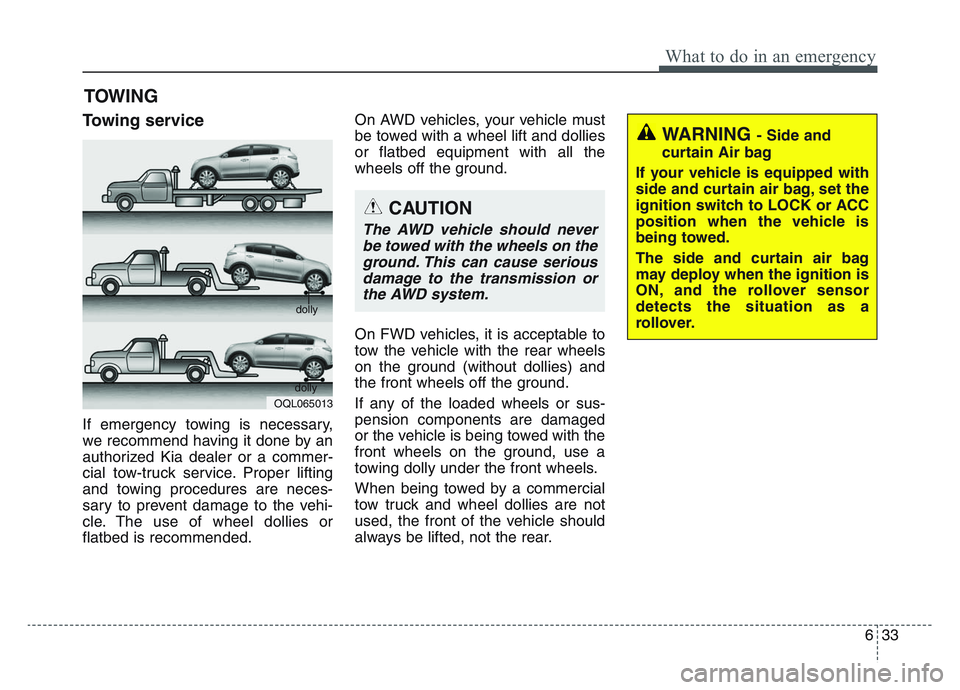
If emergency towing is necessary,
we recommend having it done by an
authorized Kia dealer or a commer-
cial tow-truck service. Proper lifting
and towing procedures are neces-
sary to prevent damage to the vehi-
cle. The use of wheel dollies or
flatbed is recommended.On AWD vehicles, your vehicle must
be towed with a wheel lift and dollies
or flatbed equipment with all the
wheels off the ground.
On FWD vehicles, it is acceptable to
tow the vehicle with the rear wheels
on the ground (without dollies) and
the front wheels off the ground.
If any of the loaded wheels or sus-
pension components are damaged
or the vehicle is being towed with the
front wheels on the ground, use a
towing dolly under the front wheels.
When being towed by a commercial
tow truck and wheel dollies are not
used, the front of the vehicle should
always be lifted, not the rear.
OQL065013
dolly
dolly
WARNING - Side and
curtain Air bag
If your vehicle is equipped with
side and curtain air bag, set the
ignition switch to LOCK or ACC
position when the vehicle is
being towed.
The side and curtain air bag
may deploy when the ignition is
ON, and the rollover sensor
detects the situation as a
rollover.
CAUTION
The AWD vehicle should never be towed with the wheels on theground. This can cause seriousdamage to the transmission orthe AWD system.
Page 534 of 631
7 37
Maintenance
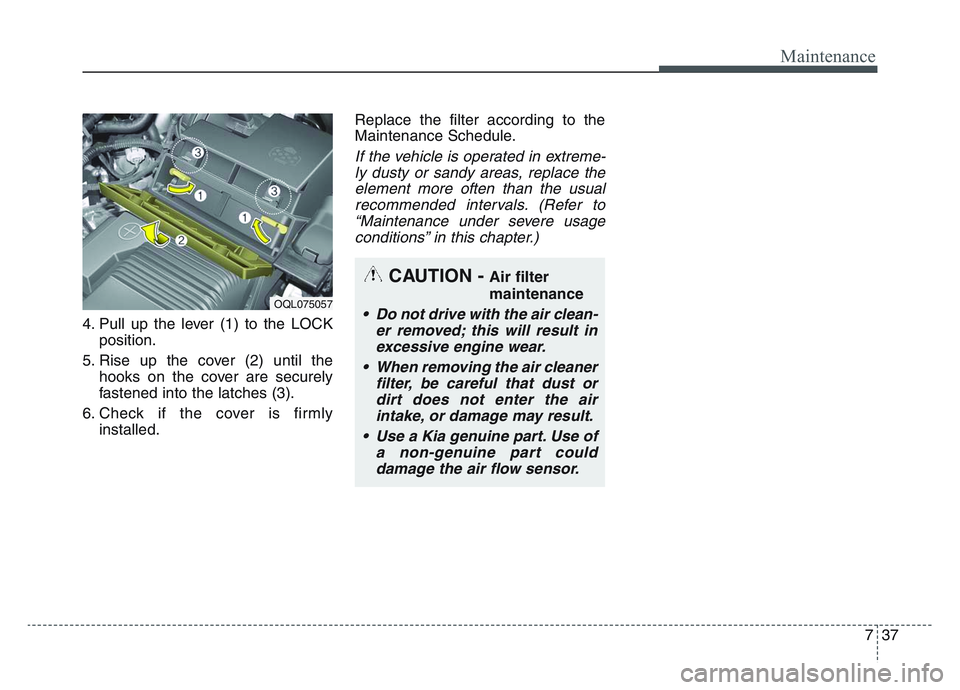
4. Pull up the lever (1) to the LOCKposition.
5. Rise up the cover (2) until the hooks on the cover are securely
fastened into the latches (3).
6. Check if the cover is firmly installed. Replace the filter according to the
Maintenance Schedule.
If the vehicle is operated in extreme-
ly dusty or sandy areas, replace theelement more often than the usualrecommended intervals. (Refer to“Maintenance under severe usageconditions” in this chapter.)
CAUTION - Air filter
maintenance
• Do not drive with the air clean- er removed; this will result inexcessive engine wear.
• When removing the air cleaner filter, be careful that dust ordirt does not enter the airintake, or damage may result.
• Use a Kia genuine part. Use of a non-genuine part coulddamage the air flow sensor.OQL075057
Page 568 of 631
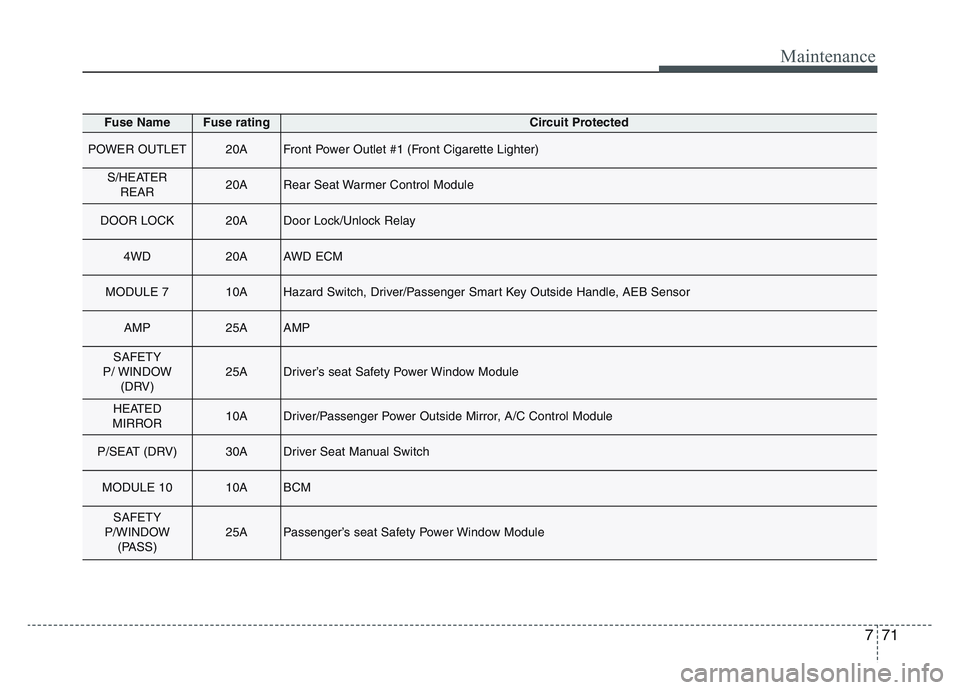
7 71
Maintenance
Fuse NameFuse ratingCircuit Protected
POWER OUTLET20AFront Power Outlet #1 (Front Cigarette Lighter)
S/HEATERREAR20ARear Seat Warmer Control Module
DOOR LOCK20ADoor Lock/Unlock Relay
4WD20AAWD ECM
MODULE 710AHazard Switch, Driver/Passenger Smart Key Outside Handle, AEB Sensor
AMP25AAMP
SAFETY
P/ WINDOW (DRV)25ADriver’s seat Safety Power Window Module
HEATED
MIRROR10ADriver/Passenger Power Outside Mirror, A/C Control Module
P/SEAT (DRV)30ADriver Seat Manual Switch
MODULE 1010ABCM
SAFETY
P/WINDOW (PASS)25APassenger’s seat Safety Power Window Module
Page 572 of 631
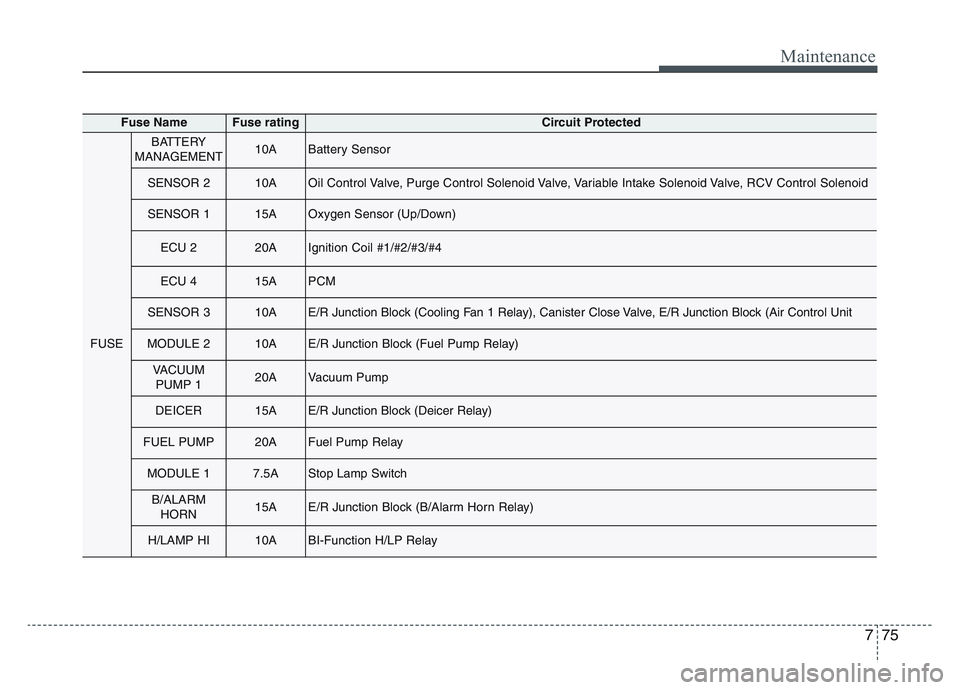
7 75
Maintenance
Fuse NameFuse ratingCircuit Protected
FUSE
BATTERY
MANAGEMENT10ABattery Sensor
SENSOR 210AOil Control Valve, Purge Control Solenoid Valve, Variable Intake Solenoid Valve, RCV Control Solenoid
SENSOR 115AOxygen Sensor (Up/Down)
ECU 2 20AIgnition Coil #1/#2/#3/#4
ECU 415APCM
SENSOR 310AE/R Junction Block (Cooling Fan 1 Relay), Canister Close Valve, E/R Junction Block (Air Control Unit
MODULE 210AE/R Junction Block (Fuel Pump Relay)
VACUUM PUMP 120AVacuum Pump
DEICER15AE/R Junction Block (Deicer Relay)
FUEL PUMP20AFuel Pump Relay
MODULE 17.5AStop Lamp Switch
B/ALARM HORN15AE/R Junction Block (B/Alarm Horn Relay)
H/LAMP HI10ABI-Function H/LP Relay
Page 573 of 631
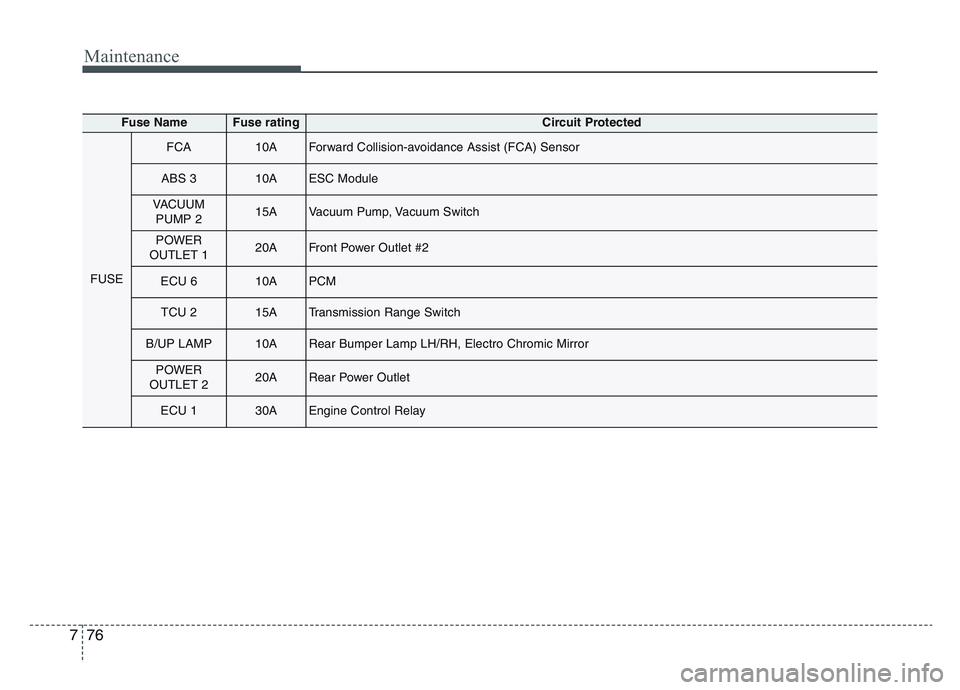
Maintenance
767
Fuse NameFuse ratingCircuit Protected
FUSE
FCA10AForward Collision-avoidance Assist (FCA) Sensor
ABS 310AESC Module
VACUUMPUMP 215AVacuum Pump, Vacuum Switch
POWER
OUTLET 120AFront Power Outlet #2
ECU 610APCM
TCU 215ATransmission Range Switch
B/UP LAMP10ARear Bumper Lamp LH/RH, Electro Chromic Mirror
POWER
OUTLET 220ARear Power Outlet
ECU 130AEngine Control Relay
Page 592 of 631
7 95
Maintenance
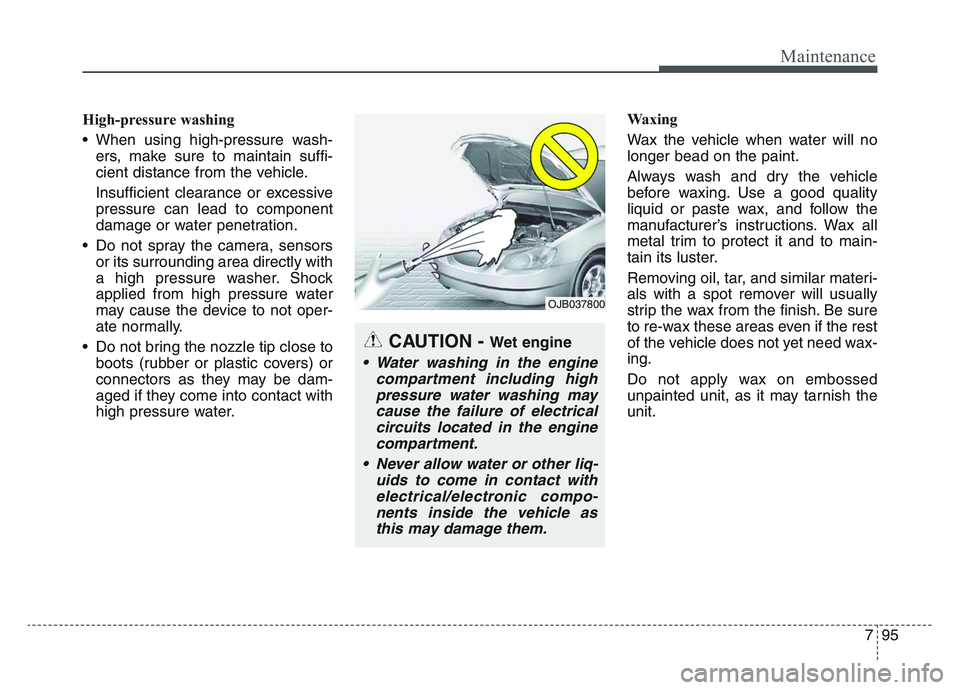
High-pressure washing
• When using high-pressure wash-ers, make sure to maintain suffi-
cient distance from the vehicle.
Insufficient clearance or excessive
pressure can lead to component
damage or water penetration.
• Do not spray the camera, sensors or its surrounding area directly with
a high pressure washer. Shock
applied from high pressure water
may cause the device to not oper-
ate normally.
• Do not bring the nozzle tip close to boots (rubber or plastic covers) or
connectors as they may be dam-
aged if they come into contact with
high pressure water. Waxing
Wax the vehicle when water will no
longer bead on the paint.
Always wash and dry the vehicle
before waxing. Use a good quality
liquid or paste wax, and follow the
manufacturer’s instructions. Wax all
metal trim to protect it and to main-
tain its luster.
Removing oil, tar, and similar materi-
als with a spot remover will usually
strip the wax from the finish. Be sure
to re-wax these areas even if the rest
of the vehicle does not yet need wax-
ing.
Do not apply wax on embossed
unpainted unit, as it may tarnish the
unit.
OJB037800
CAUTION - Wet engine
• Water washing in the engine
compartment including highpressure water washing maycause the failure of electricalcircuits located in the enginecompartment.
• Never allow water or other liq- uids to come in contact withelectrical/electronic compo-nents inside the vehicle asthis may damage them.
Page 623 of 631
Index
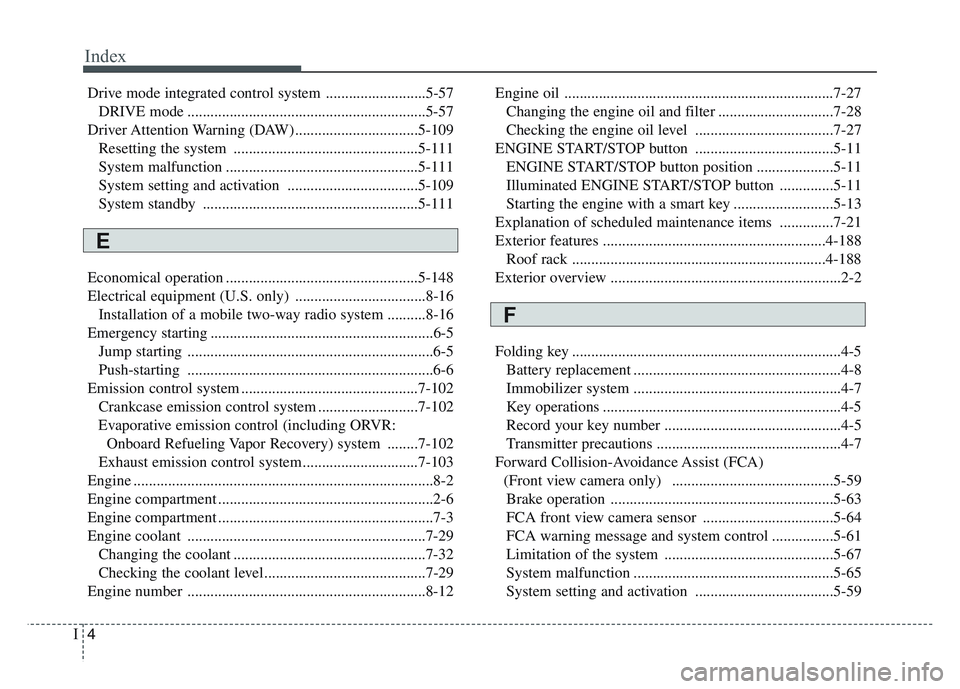
4I
Drive mode integrated control system ..........................5-57DRIVE mode ..............................................................5-57
Driver Attention Warning (DAW)................................5-109 Resetting the system ................................................5-111
System malfunction ..................................................5-111
System setting and activation ..................................5-109
System standby ........................................................5-111
Economical operation ..................................................5-148
Electrical equipment (U.S. only) ..................................8-16 Installation of a mobile two-way radio system ..........8-16
Emergency starting ..........................................................6-5 Jump starting ................................................................6-5
Push-starting ................................................................6-6
Emission control system ..............................................7-102 Crankcase emission control system ..........................7-102
Evaporative emission control (including ORVR: Onboard Refueling Vapor Recovery) system ........7-102
Exhaust emission control system ..............................7-103
Engine ........................................................................\
......8-2
Engine compartment ........................................................2-6
Engine compartment ........................................................7-3
Engine coolant ..............................................................7-29 Changing the coolant ..................................................7-32
Checking the coolant level..........................................7-29
Engine number ..............................................................8-12 Engine oil ......................................................................7-\
27
Changing the engine oil and filter ..............................7-28
Checking the engine oil level ....................................7-27
ENGINE START/STOP button ....................................5-11 ENGINE START/STOP button position ....................5-11
Illuminated ENGINE START/STOP button ..............5-11
Starting the engine with a smart key ..........................5-13
Explanation of scheduled maintenance items ..............7-21
Exterior features ..........................................................4-188 Roof rack ..................................................................4-188
Exterior overview ............................................................2-2
Folding key ......................................................................4-\
5 Battery replacement ......................................................4-8
Immobilizer system ......................................................4-7
Key operations ..............................................................4-5
Record your key number ..............................................4-5
Transmitter precautions ................................................4-7
Forward Collision-Avoidance Assist (FCA) (Front view camera only) ..........................................5-59Brake operation ..........................................................5-63
FCA front view camera sensor ..................................5-64
FCA warning message and system control ................5-61
Limitation of the system ............................................5-67
System malfunction ....................................................5-65
System setting and activation ....................................5-59
E
F
Page 624 of 631
I5
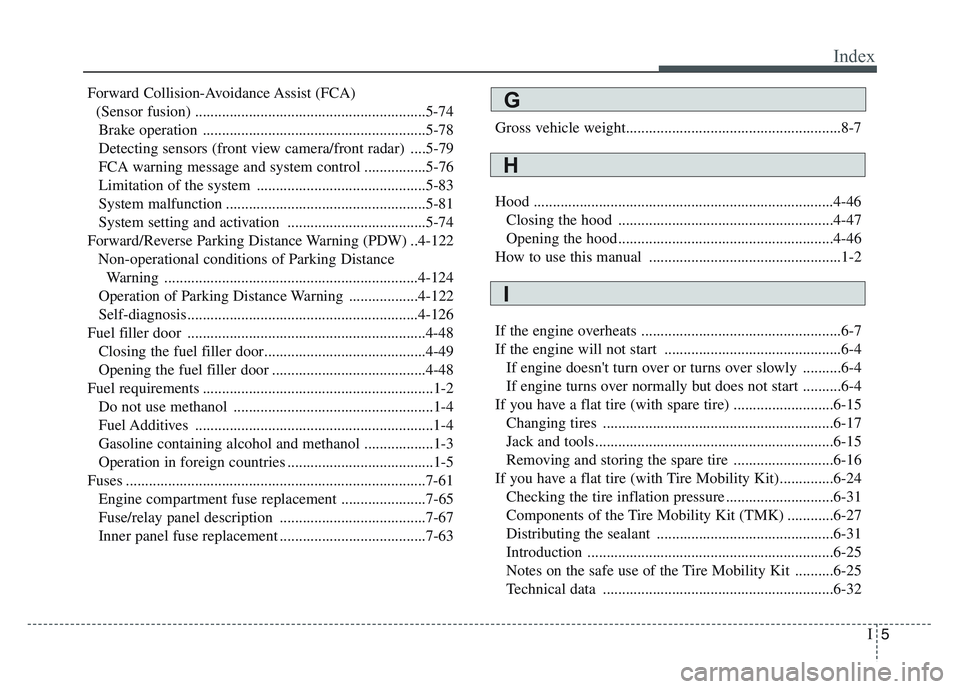
Index
Forward Collision-Avoidance Assist (FCA)(Sensor fusion) ............................................................5-74Brake operation ..........................................................5-78
Detecting sensors (front view camera/front radar) ....5-79
FCA warning message and system control ................5-76
Limitation of the system ............................................5-83
System malfunction ....................................................5-81
System setting and activation ....................................5-74
Forward/Reverse Parking Distance Warning (PDW) ..4-122 Non-operational conditions of Parking DistanceWarning ..................................................................4-124
Operation of Parking Distance Warning ..................4-122
Self-diagnosis............................................................4-126
Fuel filler door ..............................................................4-48 Closing the fuel filler door..........................................4-49
Opening the fuel filler door ........................................4-48
Fuel requirements ............................................................1-2 Do not use methanol ....................................................1-4
Fuel Additives ..............................................................1-4
Gasoline containing alcohol and methanol ..................1-3
Operation in foreign countries ......................................1-5
Fuses ........................................................................\
......7-61 Engine compartment fuse replacement ......................7-65
Fuse/relay panel description ......................................7-67
Inner panel fuse replacement ......................................7-63 Gross vehicle weight........................................................8-7\
Hood ........................................................................\
......4-46
Closing the hood ........................................................4-47
Opening the hood ........................................................4-46
How to use this manual ..................................................1-2
If the engine overheats ....................................................6-7
If the engine will not start ..............................................6-4 If engine doesn't turn over or turns over slowly ..........6-4
If engine turns over normally but does not start ..........6-4
If you have a flat tire (with spare tire) ..........................6-15 Changing tires ............................................................6-17
Jack and tools ..............................................................6-15
Removing and storing the spare tire ..........................6-16
If you have a flat tire (with Tire Mobility Kit)..............6-24 Checking the tire inflation pressure ............................6-31
Components of the Tire Mobility Kit (TMK) ............6-27
Distributing the sealant ..............................................6-31
Introduction ................................................................6-25
Notes on the safe use of the Tire Mobility Kit ..........6-25
Technical data ............................................................6-32
H
G
I