ABS KIA STINGER 2021 User Guide
[x] Cancel search | Manufacturer: KIA, Model Year: 2021, Model line: STINGER, Model: KIA STINGER 2021Pages: 585, PDF Size: 10.87 MB
Page 400 of 585
5139
Driving your vehicle
Hazardous driving conditions
When hazardous driving conditions
are encountered such as water,
snow, ice, mud, sand, or similar haz-
ards, follow these suggestions:
Drive cautiously and allow extra
distance for braking.
Avoid sudden braking or steering.
When braking with non-ABS
brakes pump the brake pedal with
a light up-and-down motion until
the vehicle is stopped.
Do not pump the brake pedal on a
vehicle equipped with ABS. If stalled in snow, mud, or sand,
use the second gear. Accelerate
slowly to avoid spinning the drive
wheels.
Use sand, rock salt, or other non-
slip material under the drive
wheels to provide traction when
stalled in ice, snow, or mud.
Rocking the vehicle
If it is necessary to rock the vehicle
to free it from snow, sand, or mud,
first turn the steering wheel right and
left to clear the area around your
front wheels. Then, shift back and
forth between R (Reverse) and any
forward gear in vehicles equipped
with an Automatic Transmission. Do
not race the engine, and spin the
wheels as little as possible. If you are
still stuck after a few tries, have the
vehicle pulled out by a tow vehicle to
avoid engine overheating and possi-
ble damage to the transmission.
SPECIAL DRIVING CONDITIONS
WARNING- Downshifting
Do not downshift with an auto-
matic transmission while driv-
ing on slippery surfaces. The
sudden change in tire speed
could cause the tires to skid
and result in an accident.
WARNING- Sudden
Vehicle Movement
Do not attempt to rock the vehi-
cle if people or objects are near-
by. The vehicle may suddenly
move forward or backwards as it
becomes unstuck.
Page 431 of 585

617
What to do in an emergency
6. Loosen the wheel lug nuts coun-
terclockwise one turn each, but do
not remove any nut until the tire
has been raised off the ground.
7. Place the jack at the front (1) or
rear (2) jacking position closest to
the tire you are changing. Place
the jack at the designated loca-
tions under the frame. The jacking
positions are plates welded to the
frame with two tabs and a raised
dot to line up with the jack.8. Insert the wheel lug nut wrench
into the jack and turn it clockwise,
raising the vehicle until the tire just
clears the ground. This measure-
ment is approximately 1 in. (30
mm).
Before removing the wheel lug
nuts, make sure the vehicle is sta-
ble and that there is no chance for
movement or slippage.
OCK067029LOCK067026L
OCK067027L
OCK067028L
Page 495 of 585

743
Maintenance
Flat Spots
If a vehicle is parked/not operated for
a long period of time, tires may
develop “flat spots”. Once the vehi-
cle is driven again, these flat spots
may cause a vibration which typical-
ly disappears gradually as the tires
warm up and regain their original
shape. To minimize tire flat spots
developing during periods of extend-
ed storage, inflate the tires to the
maximum pressure as indicated on
the tire’s sidewall. When the vehicle
is made ready to drive again, lower
the tire pressure to the recommend-
ed levels as shown on the Tire and
Loading Information label in the dri-
ver’s side center pillar for your vehi-
cle (Refer to “Tire specification and
pressure label” in chapter 8).
Tire replacement
If the tire is worn evenly, a tread wear
Indicator (A) will appear as a solid
band across the tread. This shows
there is less than 1/16 inch (1.6 mm)
of tread left on the tire. Replace the
tire when this happens.
Do not wait for the band to appear
across the entire tread before replac-
ing the tire.The ABS (Anti-lock Brake System)
works by comparing the speed of the
wheels. The tire size affects wheel
speed. When replacing tires, all 4
tires must use the same size origi-
nally supplied with the vehicle. Using
tires of a different size can cause the
ABS and ESC (Electronic Stability
Control) to work irregularly.
✽ ✽
NOTICE
We recommend that when replacing
tires, use the same which were origi-
nally supplied with the vehicle. If
not, driving performance could be
altered.
OUM076204L
Page 535 of 585

783
Maintenance
Headlamp (Low/High beam)
bulb replacement (Headlamp
Type A)
1. Remove the service cover clip on
the wheel housing.
2. Remove the headlamp bulb cover
by turning it counterclockwise.
3. Disconnect the headlamp bulb
socket-connector.4. Remove the bulb-socket from the
headlamp assembly by turning the
bulb-socket counterclockwise until
the tabs on the bulb-socket align
with the slots on the headlamp
assembly.
5. Install a new bulb-socket assem-
bly in the headlamp assembly by
aligning the tabs on the bulb-sock-
et with the slots in the headlamp
assembly. Push the bulb-socket
into the headlamp assembly and
turn the bulb-socket clockwise.
6. Connect the headlamp bulb sock-
et-connector.
7. Install the headlamp bulb cover by
turning it clockwise.
8. Install the clip on the service
cover.
❈If it is difficult to replace light bulbs,
have the vehicle checked by an
authorized Kia dealer.
OCK077075
OCK077076
OCK077074
■Head lamp - Type A
Page 537 of 585

785
Maintenance
3. Remove the bulb-socket from the
headlamp assembly by turning the
bulb-socket counterclockwise until
the tabs on the bulb-socket align
with the slots on the headlamp
assembly.
4. Remove the bulb from the bulb-
socket by pressing it in and rotat-
ing it counterclockwise until the
tabs on the bulb align with the
slots in the bulb-socket. Pull the
bulb out of the bulb-socket.
5. Insert a new bulb by inserting it
into the bulb-socket and rotating it
until it locks into place.6. Install the socket in the headlamp
assembly by aligning the tabs on
the bulb-socket with the slots in
the assembly. Push the bulb-sock-
et into the headlamp assembly
and turn the socket clockwise.
7. Install the strut bar and the air
cleaner assembly.
❈If it is difficult to replace light bulbs,
have the vehicle checked by an
authorized Kia dealer.
Stop and tail lamp (LED type)
bulb replacement
If the stop and tail lamp (LED) (1, 2)
does not operate, have the vehicle
checked by an authorized Kia dealer.
The LED lamps cannot be replaced
as a single component because they
are part of an integrated unit. The
LED lamps have to be replaced with
the unit.
A skilled technician should check or
repair the stop and tail lamp (LED),
for it may damage related parts of
the vehicle.
OCK077053
OCK077079
Page 539 of 585
787
Maintenance
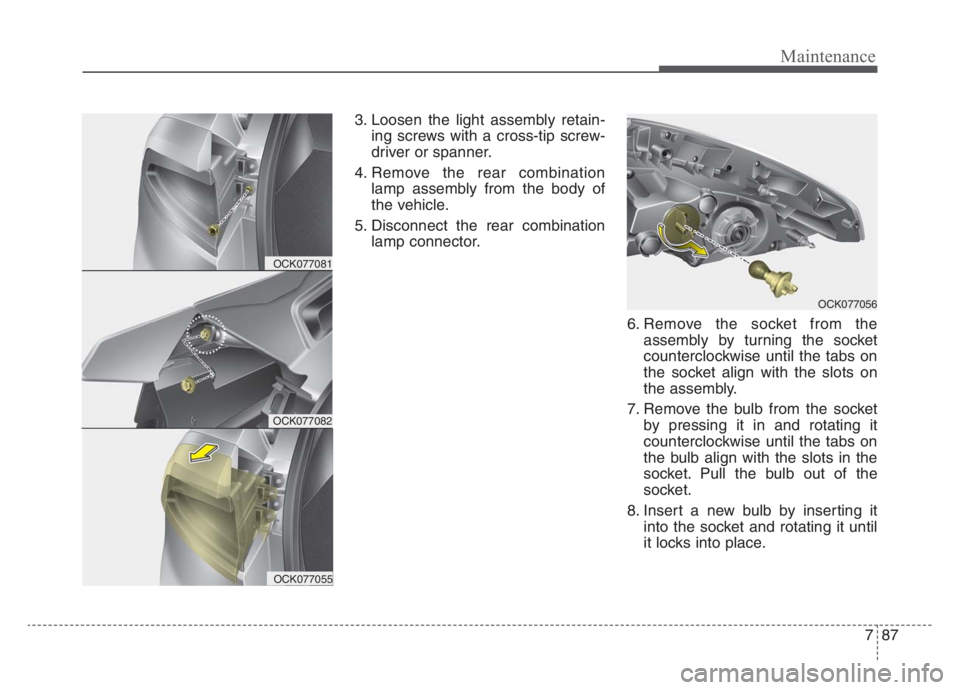
3. Loosen the light assembly retain-
ing screws with a cross-tip screw-
driver or spanner.
4. Remove the rear combination
lamp assembly from the body of
the vehicle.
5. Disconnect the rear combination
lamp connector.
6. Remove the socket from the
assembly by turning the socket
counterclockwise until the tabs on
the socket align with the slots on
the assembly.
7. Remove the bulb from the socket
by pressing it in and rotating it
counterclockwise until the tabs on
the bulb align with the slots in the
socket. Pull the bulb out of the
socket.
8. Insert a new bulb by inserting it
into the socket and rotating it until
it locks into place.
OCK077056
OCK077081
OCK077082
OCK077055
Page 540 of 585
Maintenance
88 7
9. Install the socket in the assembly
by aligning the tabs on the socket
with the slots in the assembly.
Push the socket into the assembly
and turn the socket clockwise.
10. Install the rear combination lamp
assembly to the body of the vehi-
cle.
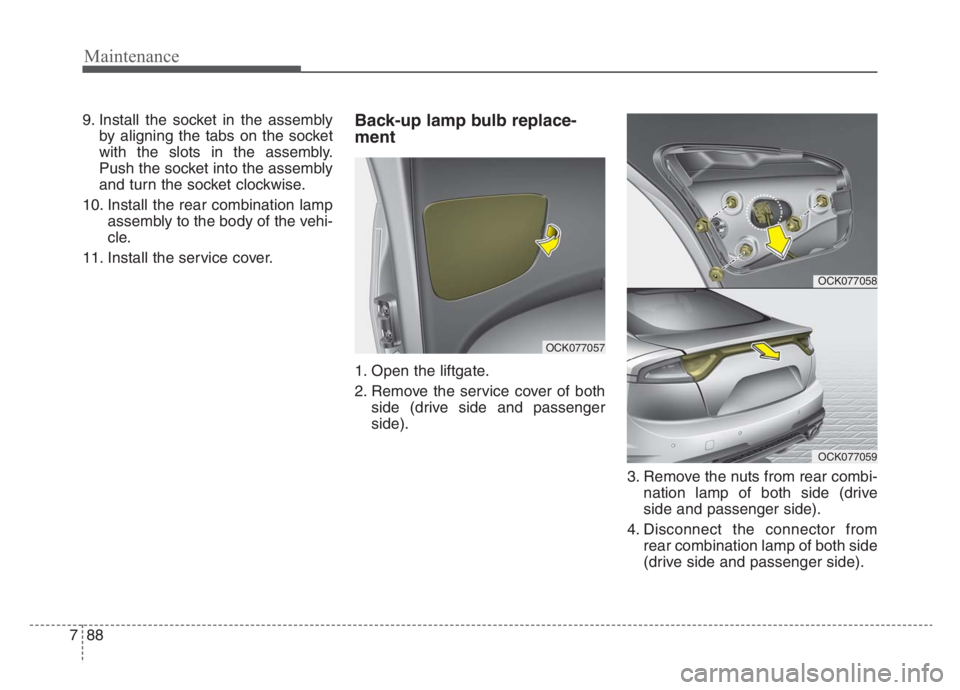
11. Install the service cover.Back-up lamp bulb replace-
ment
1. Open the liftgate.
2. Remove the service cover of both
side (drive side and passenger
side).
3. Remove the nuts from rear combi-
nation lamp of both side (drive
side and passenger side).
4. Disconnect the connector from
rear combination lamp of both side
(drive side and passenger side).
OCK077057
OCK077058
OCK077059
Page 541 of 585

789
Maintenance
5. Remove the rear combination
lamp assembly from the body of
the vehicle.
6. Remove the socket from the
assembly by turning the socket
counterclockwise until the tabs on
the socket align with the slots on
the assembly.
7. Remove the bulb from the socket by
pressing it in and rotating it counter-
clockwise until the tabs on the bulb
align with the slots in the socket.
Pull the bulb out of the socket.
8. Insert a new bulb by inserting it
into the socket and rotating it until
it locks into place.9. Install the socket in the assembly
by aligning the tabs on the socket
with the slots in the assembly.
Push the socket into the assembly
and turn the socket clockwise.
10. Install the rear combination lamp
assembly to the body of the vehi-
cle.
11. Install the service cover by put-
ting it into the service hole.
OCK077060
Page 551 of 585
799
Maintenance
Taking care of leather seats
Vacuum the seat periodically to
remove dust and sand on the seat.
It will prevent abrasion or damage of
the leather and maintain its quality.
Wipe the natural leather seat cover
often with dry or soft cloth.
Sufficient use of a leather protec-
tive may prevent abrasion of the
cover and helps maintain the color.
Be sure to read the instructions
and consult a specialist when
using leather coating or protective
agents.
Leather with bright colors(beige,
cream beige) is easily contaminat-
ed and clear in appearance. Clean
the seats frequently.
Avoid wiping with wet cloth. It may
cause the surface to crack.
Cleaning the leather seats
Remove all contaminations instant-
ly. Refer to instructions below for
removal of each contaminant.
Cosmetic products(sunscreen,
foundation, etc.)
- Apply cleansing cream on a cloth
and wipe the contaminated point.
Wipe off the cream with a wet
cloth and remove water with a dry
cloth.
Beverages(coffee, soft drink, etc.)
- Apply a small amount of neutral
detergent and wipe until contami-
nations do not smear.
Oil
- Remove oil instantly with
absorbable cloth and wipe with
stain remover for natural leather
only.
Chewing gum
- Harden the gum with ice and
remove gradually.CAUTION - Electrical
components
Never allow water or other liq-
uids to come in contact with
electrical/electronic compo-
nents inside the vehicle as this
may damage them.
CAUTION - Leather
When cleaning leather products
(steering wheel, seats etc.), use
neutral detergents or low alco-
hol content solutions. If you use
high alcohol content solutions
or acid/alkaline detergents, the
color of the leather may fade or
the surface may get stripped off.
Page 554 of 585
Maintenance
102 7
Canister
Fuel vapors generated inside the fuel
tank are absorbed and stored in the
onboard canister. When the engine is
running, the fuel vapors absorbed in
the canister are drawn into the surge
tank through the purge control sole-
noid valve.
Purge Control Solenoid Valve
(PCSV)
The purge control solenoid valve is
controlled by the Engine Control
Module (ECM); when the engine
coolant temperature is low during
idling, the PCSV closes so that evap-
orated fuel is not taken into the
engine. After the engine warms up
during ordinary driving, the PCSV
opens to introduce evaporated fuel to
the engine.
3. Exhaust emission control
system
The Exhaust Emission Control
System is a highly effective system
which controls exhaust emissions
while maintaining good vehicle per-
formance.
Engine exhaust gas precautions
(carbon monoxide)
Carbon monoxide can be present
with other exhaust fumes.
Therefore, if you smell exhaust
fumes of any kind inside your vehi-
cle, have it inspected and repaired
immediately. If you ever suspect
exhaust fumes are coming into
your vehicle, drive it only with all
the windows fully open. Have your
vehicle checked and repaired
immediately.
WARNING - Exhaust
Engine exhaust gases contain
carbon monoxide (CO). Though
colorless and odorless, it is
dangerous and could be lethal if
inhaled. Follow the instructions
on this page to avoid CO poi-
soning.