power steering KIA STINGER 2021 User Guide
[x] Cancel search | Manufacturer: KIA, Model Year: 2021, Model line: STINGER, Model: KIA STINGER 2021Pages: 585, PDF Size: 10.87 MB
Page 324 of 585
563
Driving your vehicle
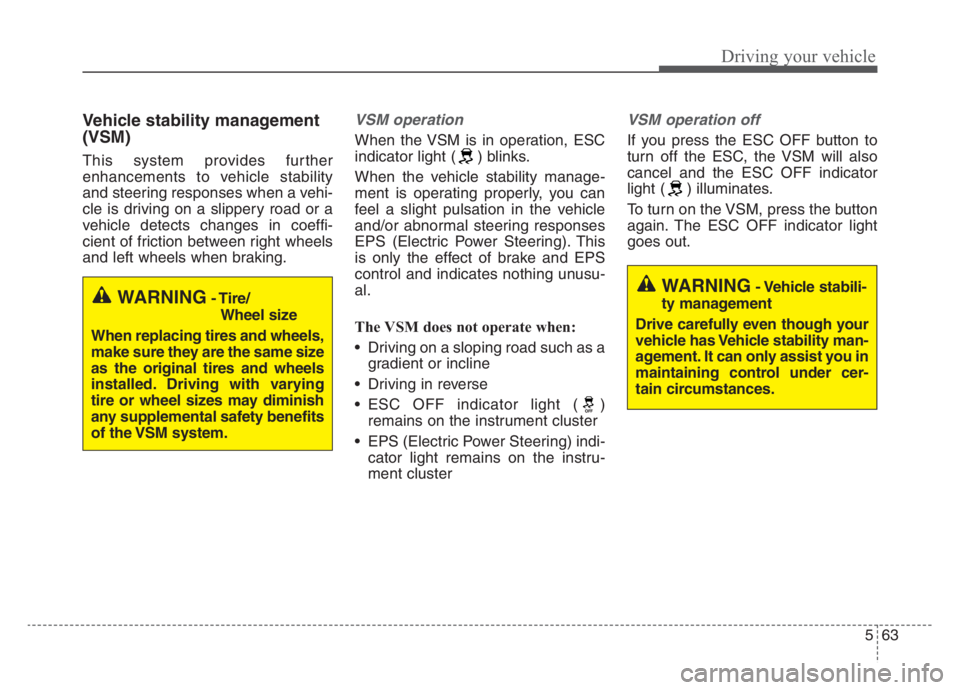
Vehicle stability management
(VSM)
This system provides further
enhancements to vehicle stability
and steering responses when a vehi-
cle is driving on a slippery road or a
vehicle detects changes in coeffi-
cient of friction between right wheels
and left wheels when braking.
VSM operation
When the VSM is in operation, ESC
indicator light ( ) blinks.
When the vehicle stability manage-
ment is operating properly, you can
feel a slight pulsation in the vehicle
and/or abnormal steering responses
EPS (Electric Power Steering). This
is only the effect of brake and EPS
control and indicates nothing unusu-
al.
The VSM does not operate when:
Driving on a sloping road such as a
gradient or incline
Driving in reverse
ESC OFF indicator light ( )
remains on the instrument cluster
EPS (Electric Power Steering) indi-
cator light remains on the instru-
ment cluster
VSM operation off
If you press the ESC OFF button to
turn off the ESC, the VSM will also
cancel and the ESC OFF indicator
light ( ) illuminates.
To turn on the VSM, press the button
again. The ESC OFF indicator light
goes out.
WARNING- Tire/
Wheel size
When replacing tires and wheels,
make sure they are the same size
as the original tires and wheels
installed. Driving with varying
tire or wheel sizes may diminish
any supplemental safety benefits
of the VSM system.WARNING- Vehicle stabili-
ty management
Drive carefully even though your
vehicle has Vehicle stability man-
agement. It can only assist you in
maintaining control under cer-
tain circumstances.
Page 325 of 585

Driving your vehicle
64 5
Malfunction indicator
The VSM can be deactivated even if
you don’t cancel the VSM operation
by pressing the ESC OFF button. It
indicates that a malfunction has
been detected somewhere in the
Electric Power Steering system or
VSM system. If the ESC indicator
light ( ) or EPS warning light
remains on, take your vehicle to an
authorized Kia dealer and have the
system checked.
✽ ✽
NOTICE
• The VSM is designed to function
above approximately 13 mph (22
km/h) on curves.
• The VSM is designed to function
above approximately 6 mph (10
km/h) when a vehicle is braking on
a split-mu surface. A split-mu sur-
face is made of two surfaces which
have different friction forces.
The Vehicle Stability Management
system is not a substitute for safe
driving practices but a supplemen-
tary function only. It is the respon-
sibility of the driver to always check
the speed and the distance to the
vehicle ahead. Always hold the
steering wheel firmly while driving.
Your vehicle is designed to activate
according to the driver’s intention,
even with installed VSM. Always fol-
low all the normal precautions for
driving at safe speeds for the condi-
tions - including driving in inclement
weather and on a slippery road.Hill-start assist control (HAC)
A vehicle has the tendency to roll
back on a steep hill when it starts to
go after stopping. The Hill-start
Assist Control (HAC) prevents the
vehicle from rolling back by applying
the brakes automatically for about 2
seconds. The brakes are released
when the accelerator pedal is
depressed or after about 2 seconds.
The HAC is activated only for about 2
seconds, so when the vehicle is
starting off always depress the accel-
erator pedal.
WARNING
For maximum protection, always
wear your seat belt. No system,
no matter how advanced, can
compensate for all driver error
and/or driving conditions.
Always drive responsibly.
Page 332 of 585

571
Driving your vehicle
Brake operation
In an urgent situation, the braking
system enters into the ready status
for prompt reaction against the dri-
ver’s depressing the brake pedal.
FCA provides additional braking
power for optimum braking per-
formance when the driver depress-
es the brake pedal.
The braking control is automatical-
ly deactivated, when the driver
sharply depresses the accelerator
pedal, or when the driver abruptly
operates the steering wheel.
The braking control is automatical-
ly canceled when risk factors dis-
appear.
✽ ✽
NOTICE
FCA system assesses the risk of a
collision by monitoring several vari-
ables such as the distance to the
vehicle/pedestrian ahead, the speed
of the vehicle/pedestrian ahead, and
the driver's operation of the vehicle.
Certain conditions such as
inclement weather and road condi-
tions may affect the operation of
FCA system.
WARNING
Never deliberately drive danger-
ously to activate the system as
such conduct increases the risk
of an accident.
WARNING
FCA is a supplemental system
and cannot completely stop the
vehicle in all situations or avoid
all collisions. It is the responsi-
bility of the driver to safely drive
and control the vehicle.
CAUTION
The driver should always exer-
cise caution when operating the
vehicle, even though there is no
warning message or warning
alarm. While other beeps such
as the seat belt warning sound
are in operation and override
FCA alarming system, FCA
beeps may not occur.
Page 399 of 585

Driving your vehicle
138 5
WARNING - Engine off
during motion
Never turn the engine off to
coast down hills or anytime the
vehicle is in motion. The power
steering and power brakes will
not function properly without the
engine running. In addition, turn-
ing off the ignition while driving
could lead to out of working
power driven steering wheel and
hard to control steering wheel.
Keep the engine on and down-
shift to an appropriate gear for
an engine braking effect.
Remember, your vehicle does not
require extended warm-up. After
the engine has started, allow the
engine to run for 10 to 20 seconds
prior to placing the vehicle in gear.
In very cold weather, however, give
your engine a slightly longer warm-
up period.
Don't "lug" or "over-rev" the engine.
Lugging is driving too slowly in a
very high gear resulting in engine
bucking. If this happens, shift to a
lower gear. Over-revving is racing
the engine beyond its safe limit.
This can be avoided by shifting at
the recommended speed. Use your air conditioning sparingly.
The air conditioning system is
operated by engine power so your
fuel economy is reduced when you
use it.
Open windows at high speeds can
reduce fuel economy.
Fuel economy is less in crosswinds
and headwinds. To help offset
some of this loss, slow down when
driving in these conditions.
Keeping a vehicle in good operating
condition is important both for econ-
omy and safety. Therefore, have an
authorized Kia dealer perform
scheduled inspections and mainte-
nance.
Page 450 of 585

What to do in an emergency
36 6
If towing service is not available in an
emergency, your vehicle may be
temporarily towed using a cable or
chain secured to the emergency tow-
ing hook under the front (or rear) of
the vehicle. Use extreme caution
when towing the vehicle. A driver
must be in the vehicle to steer it and
operate the brakes.
Towing in this manner may be done
only on hard-surfaced roads for a
short distance and at low speed.
Also, the wheels, axles, power train,
steering and brakes must all be in
good condition.
Do not use the tow hooks to pull a
vehicle out of mud, sand or other
conditions from which the vehicle
cannot be driven out under its own
power.
Avoid towing a vehicle heavier than
the vehicle doing the towing.
The drivers of both vehicles should
communicate with each other fre-
quently. Attach a towing strap to the tow
hook.
Use only a cable or chain specifical-
ly intended for use in towing vehi-
cles. Securely fasten the cable or
chain to the towing hook provided.
Accelerate or decelerate the vehi-
cle in a slow and gradual manner
while maintaining tension on the
tow rope or chain to start or drive
the vehicle, otherwise tow hooks
and the vehicle may be damaged.
Before emergency towing, check if
the hook is not broken or damaged.
Fasten the towing cable or chain
securely to the hook.
Do not jerk the hook. Apply it
steadily and with even force.
To avoid damaging the hook, do not
pull from the side or at a vertical
angle. Always pull straight ahead.CAUTION
Using a portion of the vehicle
other than the tow hooks for
towing may damage the body of
your vehicle.
Page 451 of 585

637
What to do in an emergency
Use a towing strap less than 16
feet (5 m) long. Attach a white or
red cloth (about 12 inches (30 cm)
wide) in the middle of the strap for
easy visibility.
Drive carefully so that the towing
strap is not loosened during tow-
ing.
The driver must be in the vehicle
for steering and braking operations
when the vehicle is towed and pas-
sengers other than the driver must
not be allowed to be on board.
Emergency towing precautions
Turn the Engine Start/Stop button
to ACC position so the steering
wheel isn’t locked.
Place the transmission shift lever in
N (Neutral).
Release the parking bake.
Press the brake pedal with more
force than normal since you will
have reduced brake performance.
More steering effort will be
required because the power steer-
ing system will be disabled.
If you are driving down a long hill,
the brakes may overheat and brake
performance will be reduced. Stop
often and let the brakes cool off.
The vehicle should be towed at a
speed of 15 mph (25 km/h) or less
within the distance of 12 miles (20
km).WARNING- Emergency
Towing Precautions
Use extreme caution when tow-
ing the vehicle.
Avoid sudden starts or erratic
driving maneuvers which
would place excessive stress
on the emergency towing hook
and towing cable or chain. The
hook and towing cable or
chain may break and cause
serious injury or damage.
If the disabled vehicle is
unable to be moved, do not
forcibly continue the towing.
In this case, contact an
authorized Kia dealer or a
commercial tow truck service
for assistance.
Tow the vehicle as straight
ahead as possible.
Keep away from the vehicle
during towing.
OYG066034
Page 518 of 585
Maintenance
66 7
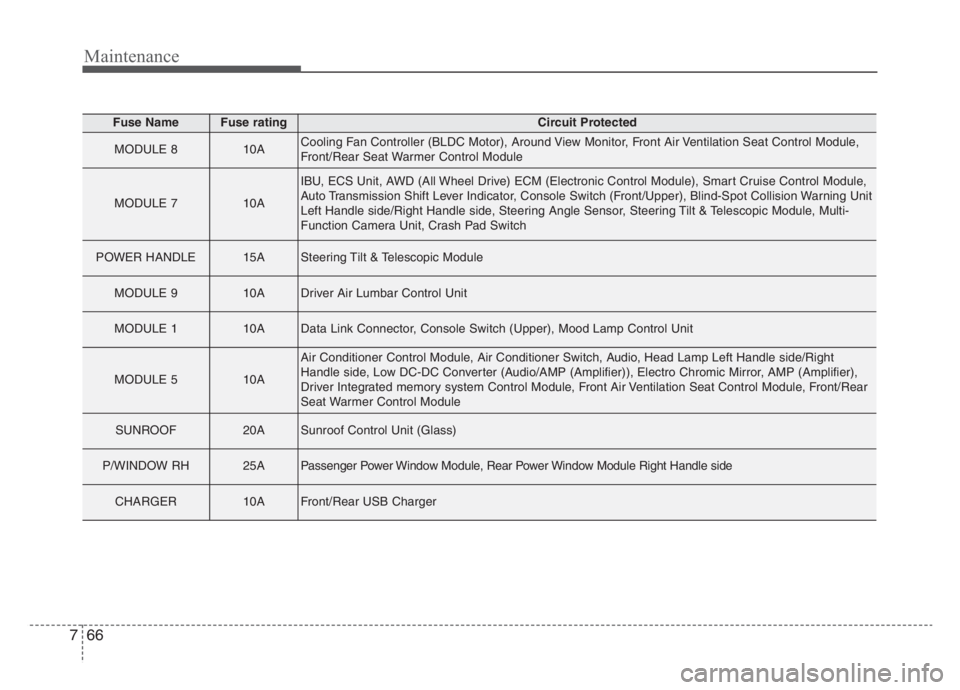
Fuse NameFuse ratingCircuit Protected
MODULE 810ACooling Fan Controller (BLDC Motor), Around View Monitor, Front Air Ventilation Seat Control Module,
Front/Rear Seat Warmer Control Module
MODULE 710A
IBU, ECS Unit, AWD (All Wheel Drive) ECM (Electronic Control Module), Smart Cruise Control Module,
Auto Transmission Shift Lever Indicator, Console Switch (Front/Upper), Blind-Spot Collision Warning Unit
Left Handle side/Right Handle side, Steering Angle Sensor, Steering Tilt & Telescopic Module, Multi-
Function Camera Unit, Crash Pad Switch
POWER HANDLE15ASteering Tilt & Telescopic Module
MODULE 910ADriver Air Lumbar Control Unit
MODULE 110AData Link Connector, Console Switch (Upper), Mood Lamp Control Unit
MODULE 510A
Air Conditioner Control Module, Air Conditioner Switch, Audio, Head Lamp Left Handle side/Right
Handle side, Low DC-DC Converter (Audio/AMP (Amplifier)), Electro Chromic Mirror, AMP (Amplifier),
Driver Integrated memory system Control Module, Front Air Ventilation Seat Control Module, Front/Rear
Seat Warmer Control Module
SUNROOF20ASunroof Control Unit (Glass)
P/WINDOW RH25APassenger Power Window Module, Rear Power Window Module Right Handle side
CHARGER10AFront/Rear USB Charger
Page 519 of 585

767
Maintenance
Fuse NameFuse ratingCircuit Protected
WASHER15AMultifunction Switch
MDPS10AMDPS (Motor Driven Power Steering) Unit (R-MDPS (Motor Driven Power Steering))
P/SEAT (DRV)30ADriver Integrated memory system Control Module, Drive Seat Module
P/SEAT (PASS)30APassenger Seat Module
P/WINDOW LH25ADriver Power Window Module, Rear Power Window Module Left Handle side
MODULE 610AIBU, Low DC-DC Converter (Audio/AMP (Amplifier)), Electronic Auto Transmission Shift Lever (SBW
(Shift By Wire)), Engine Room Junction Block (RLY. 4 - Power Outlet Relay)
A/C10AAir Conditioner Control Module, Air Conditioner Switch, Engine Room Junction Block (Blower Relay)
MODULE 410AHead Lamp Left Handle side/Right Handle side, AFS Control Unit, Auto Head Lamp Leveling Device Module
Page 522 of 585
Maintenance
70 7
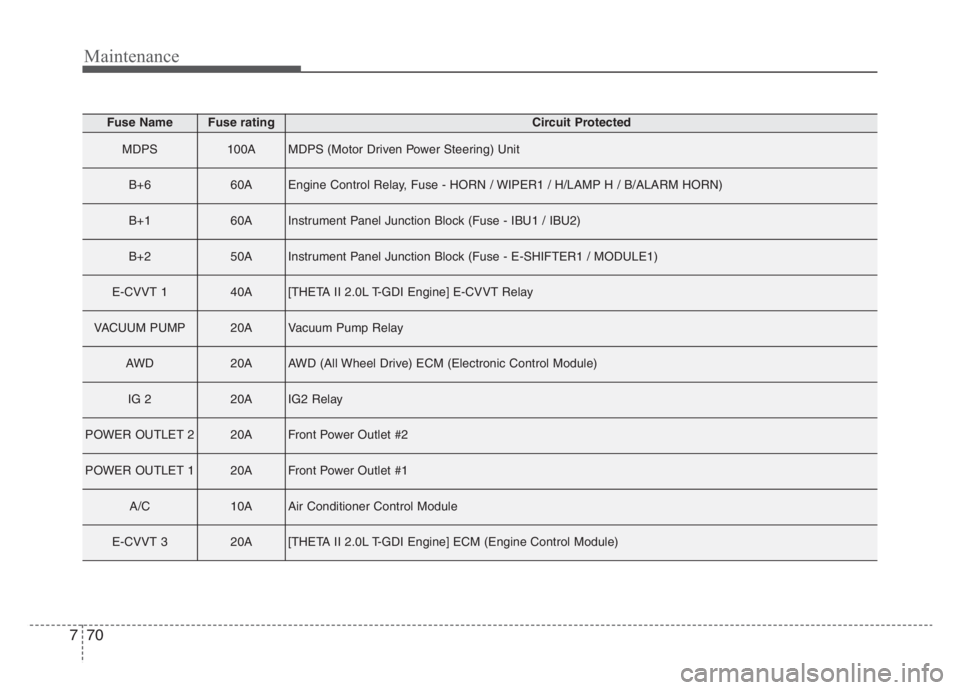
Fuse NameFuse ratingCircuit Protected
MDPS100AMDPS (Motor Driven Power Steering) Unit
B+660AEngine Control Relay, Fuse - HORN / WIPER1 / H/LAMP H / B/ALARM HORN)
B+160AInstrument Panel Junction Block (Fuse - IBU1 / IBU2)
B+250AInstrument Panel Junction Block (Fuse - E-SHIFTER1 / MODULE1)
E-CVVT 140A[THETA II 2.0L T-GDI Engine] E-CVVT Relay
VACUUM PUMP20AVacuum Pump Relay
AWD20AAWD (All Wheel Drive) ECM (Electronic Control Module)
IG 220AIG2 Relay
POWER OUTLET 220AFront Power Outlet #2
POWER OUTLET 120AFront Power Outlet #1
A/C10AAir Conditioner Control Module
E-CVVT 320A[THETA II 2.0L T-GDI Engine] ECM (Engine Control Module)
Page 582 of 585
I9
Index
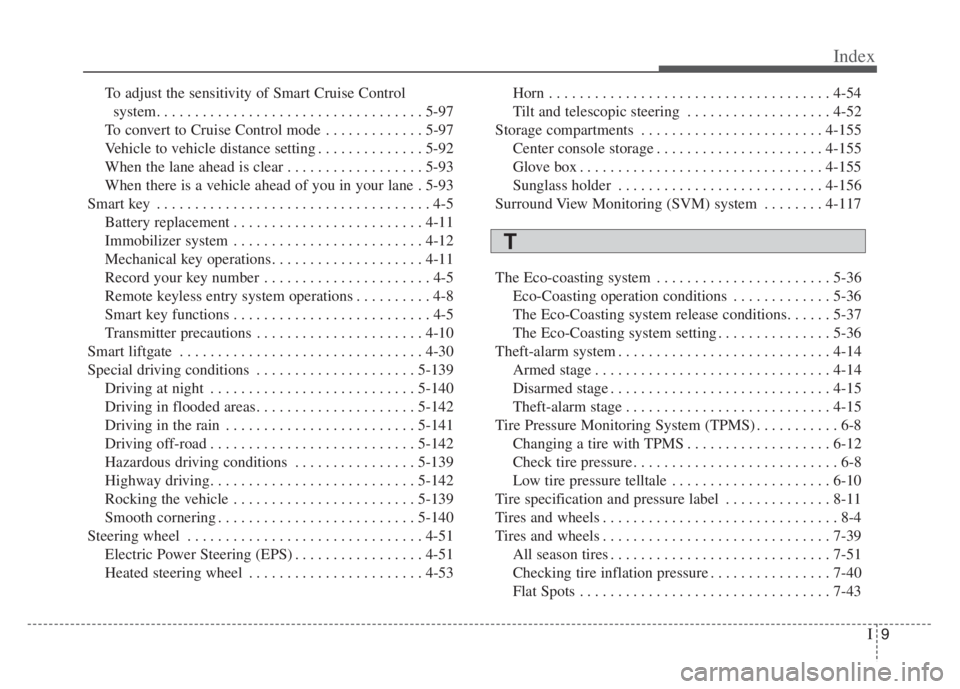
To adjust the sensitivity of Smart Cruise Control
system. . . . . . . . . . . . . . . . . . . . . . . . . . . . . . . . . . . 5-97
To convert to Cruise Control mode . . . . . . . . . . . . . 5-97
Vehicle to vehicle distance setting . . . . . . . . . . . . . . 5-92
When the lane ahead is clear . . . . . . . . . . . . . . . . . . 5-93
When there is a vehicle ahead of you in your lane . 5-93
Smart key . . . . . . . . . . . . . . . . . . . . . . . . . . . . . . . . . . . . 4-5
Battery replacement . . . . . . . . . . . . . . . . . . . . . . . . . 4-11
Immobilizer system . . . . . . . . . . . . . . . . . . . . . . . . . 4-12
Mechanical key operations. . . . . . . . . . . . . . . . . . . . 4-11
Record your key number . . . . . . . . . . . . . . . . . . . . . . 4-5
Remote keyless entry system operations . . . . . . . . . . 4-8
Smart key functions . . . . . . . . . . . . . . . . . . . . . . . . . . 4-5
Transmitter precautions . . . . . . . . . . . . . . . . . . . . . . 4-10
Smart liftgate . . . . . . . . . . . . . . . . . . . . . . . . . . . . . . . . 4-30
Special driving conditions . . . . . . . . . . . . . . . . . . . . . 5-139
Driving at night . . . . . . . . . . . . . . . . . . . . . . . . . . . 5-140
Driving in flooded areas. . . . . . . . . . . . . . . . . . . . . 5-142
Driving in the rain . . . . . . . . . . . . . . . . . . . . . . . . . 5-141
Driving off-road . . . . . . . . . . . . . . . . . . . . . . . . . . . 5-142
Hazardous driving conditions . . . . . . . . . . . . . . . . 5-139
Highway driving . . . . . . . . . . . . . . . . . . . . . . . . . . . 5-142
Rocking the vehicle . . . . . . . . . . . . . . . . . . . . . . . . 5-139
Smooth cornering . . . . . . . . . . . . . . . . . . . . . . . . . . 5-140
Steering wheel . . . . . . . . . . . . . . . . . . . . . . . . . . . . . . . 4-51
Electric Power Steering (EPS) . . . . . . . . . . . . . . . . . 4-51
Heated steering wheel . . . . . . . . . . . . . . . . . . . . . . . 4-53Horn . . . . . . . . . . . . . . . . . . . . . . . . . . . . . . . . . . . . . 4-54
Tilt and telescopic steering . . . . . . . . . . . . . . . . . . . 4-52
Storage compartments . . . . . . . . . . . . . . . . . . . . . . . . 4-155
Center console storage . . . . . . . . . . . . . . . . . . . . . . 4-155
Glove box . . . . . . . . . . . . . . . . . . . . . . . . . . . . . . . . 4-155
Sunglass holder . . . . . . . . . . . . . . . . . . . . . . . . . . . 4-156
Surround View Monitoring (SVM) system . . . . . . . . 4-117
The Eco-coasting system . . . . . . . . . . . . . . . . . . . . . . . 5-36
Eco-Coasting operation conditions . . . . . . . . . . . . . 5-36
The Eco-Coasting system release conditions. . . . . . 5-37
The Eco-Coasting system setting . . . . . . . . . . . . . . . 5-36
Theft-alarm system . . . . . . . . . . . . . . . . . . . . . . . . . . . . 4-14
Armed stage . . . . . . . . . . . . . . . . . . . . . . . . . . . . . . . 4-14
Disarmed stage . . . . . . . . . . . . . . . . . . . . . . . . . . . . . 4-15
Theft-alarm stage . . . . . . . . . . . . . . . . . . . . . . . . . . . 4-15
Tire Pressure Monitoring System (TPMS) . . . . . . . . . . . 6-8
Changing a tire with TPMS . . . . . . . . . . . . . . . . . . . 6-12
Check tire pressure . . . . . . . . . . . . . . . . . . . . . . . . . . . 6-8
Low tire pressure telltale . . . . . . . . . . . . . . . . . . . . . 6-10
Tire specification and pressure label . . . . . . . . . . . . . . 8-11
Tires and wheels . . . . . . . . . . . . . . . . . . . . . . . . . . . . . . . 8-4
Tires and wheels . . . . . . . . . . . . . . . . . . . . . . . . . . . . . . 7-39
All season tires . . . . . . . . . . . . . . . . . . . . . . . . . . . . . 7-51
Checking tire inflation pressure . . . . . . . . . . . . . . . . 7-40
Flat Spots . . . . . . . . . . . . . . . . . . . . . . . . . . . . . . . . . 7-43
T