emergency towing KIA STINGER 2021 Owners Manual
[x] Cancel search | Manufacturer: KIA, Model Year: 2021, Model line: STINGER, Model: KIA STINGER 2021Pages: 585, PDF Size: 10.87 MB
Page 363 of 585
Driving your vehicle
102 5
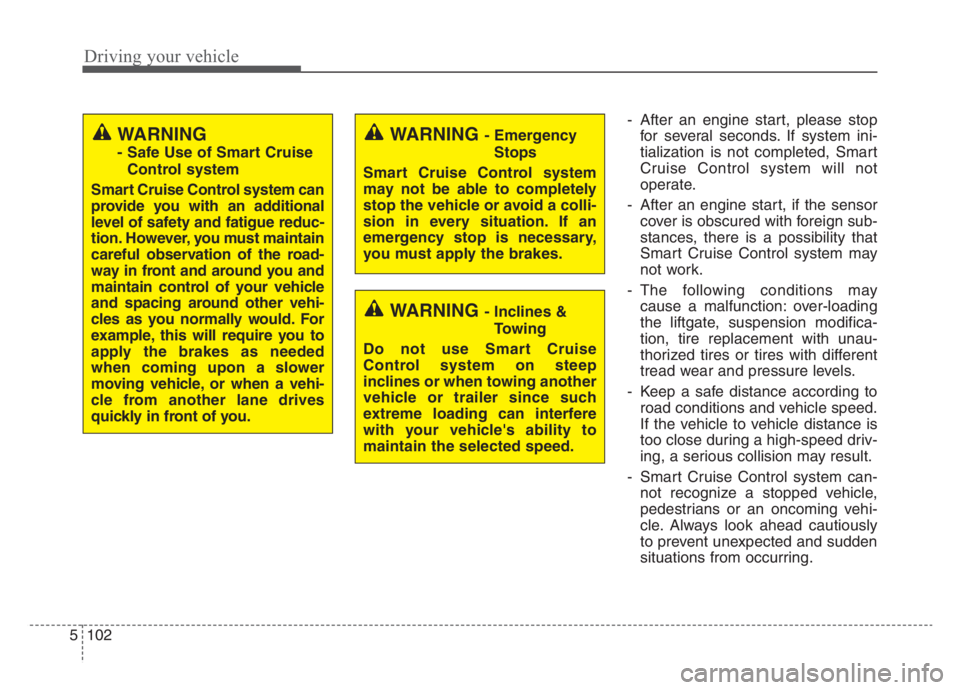
- After an engine start, please stop
for several seconds. If system ini-
tialization is not completed, Smart
Cruise Control system will not
operate.
- After an engine start, if the sensor
cover is obscured with foreign sub-
stances, there is a possibility that
Smart Cruise Control system may
not work.
- The following conditions may
cause a malfunction: over-loading
the liftgate, suspension modifica-
tion, tire replacement with unau-
thorized tires or tires with different
tread wear and pressure levels.
- Keep a safe distance according to
road conditions and vehicle speed.
If the vehicle to vehicle distance is
too close during a high-speed driv-
ing, a serious collision may result.
- Smart Cruise Control system can-
not recognize a stopped vehicle,
pedestrians or an oncoming vehi-
cle. Always look ahead cautiously
to prevent unexpected and sudden
situations from occurring.
WARNING - Inclines &
Towing
Do not use Smart Cruise
Control system on steep
inclines or when towing another
vehicle or trailer since such
extreme loading can interfere
with your vehicle's ability to
maintain the selected speed.
WARNING
- Safe Use of Smart Cruise
Control system
Smart Cruise Control system can
provide you with an additional
level of safety and fatigue reduc-
tion. However, you must maintain
careful observation of the road-
way in front and around you and
maintain control of your vehicle
and spacing around other vehi-
cles as you normally would. For
example, this will require you to
apply the brakes as needed
when coming upon a slower
moving vehicle, or when a vehi-
cle from another lane drives
quickly in front of you.
WARNING - Emergency
Stops
Smart Cruise Control system
may not be able to completely
stop the vehicle or avoid a colli-
sion in every situation. If an
emergency stop is necessary,
you must apply the brakes.
Page 408 of 585

5147
Driving your vehicle
Don't let ice and snow accu-
mulate underneath
Under some conditions, snow and
ice can build up under the fenders
and interfere with the steering. When
driving in severe winter conditions
where this may happen, you should
periodically check underneath the
vehicle to be sure the movement of
the front wheels and the steering
components are not obstructed.
Carry emergency equipment
Depending on the severity of the
weather, you should carry appropri-
ate emergency equipment. Some of
the items you may want to carry
include tow straps or chains, flash-
light, emergency flares, sand, shov-
el, jumper cables, window scraper,
gloves, ground cloth, coveralls, blan-
ket, etc.We do not recommend using this
vehicle for trailer towing.
TRAILER TOWING
Page 415 of 585

What to do in an emergency
Road warning . . . . . . . . . . . . . . . . . . . . . . . . . . . . . . 6-2
• Hazard warning flasher . . . . . . . . . . . . . . . . . . . . . . . . 6-2
In case of an emergency while driving . . . . . . . . . . 6-3
• If the engine stalls at a crossroad or crossing. . . . . . . 6-3
• If you have a flat tire while driving . . . . . . . . . . . . . . . 6-3
• If the engine stalls while driving . . . . . . . . . . . . . . . . . 6-3
If the engine will not start . . . . . . . . . . . . . . . . . . . . 6-4
• If engine doesn't turn over or turns over slowly . . . . 6-4
• If engine turns over normally but does not start . . . . 6-4
Emergency starting . . . . . . . . . . . . . . . . . . . . . . . . . 6-5
• Jump starting . . . . . . . . . . . . . . . . . . . . . . . . . . . . . . . . . 6-5
• Push-starting . . . . . . . . . . . . . . . . . . . . . . . . . . . . . . . . . 6-6
If the engine overheats . . . . . . . . . . . . . . . . . . . . . . . 6-7
Tire Pressure Monitoring System (TPMS) . . . . . . 6-8
• Check tire pressure . . . . . . . . . . . . . . . . . . . . . . . . . . . . 6-8
• Low tire pressure telltale . . . . . . . . . . . . . . . . . . . . . . 6-10
• Changing a tire with TPMS . . . . . . . . . . . . . . . . . . . . 6-12
If you have a flat tire (with spare tire) . . . . . . . . . 6-14
• Jack and tools . . . . . . . . . . . . . . . . . . . . . . . . . . . . . . . 6-14
• Removing and storing the spare tire . . . . . . . . . . . . . 6-15
• Changing tires . . . . . . . . . . . . . . . . . . . . . . . . . . . . . . . 6-16
If you have a flat tire (with Tire Mobility Kit) . . 6-23
• Introduction . . . . . . . . . . . . . . . . . . . . . . . . . . . . . . . . . 6-24
• Notes on the safe use of the Tire Mobility Kit . . . . . 6-25
• Components of the Tire Mobility Kit (TMK). . . . . . 6-26
• Using the Tire Mobility Kit . . . . . . . . . . . . . . . . . . . . 6-27
• Distributing the sealant. . . . . . . . . . . . . . . . . . . . . . . . 6-30
• Checking the tire inflation pressure . . . . . . . . . . . . . 6-31
• Technical Data . . . . . . . . . . . . . . . . . . . . . . . . . . . . . . . 6-31
Towing . . . . . . . . . . . . . . . . . . . . . . . . . . . . . . . . . . . 6-33
• Towing service . . . . . . . . . . . . . . . . . . . . . . . . . . . . . . . 6-33
• Removable towing hook . . . . . . . . . . . . . . . . . . . . . . . 6-35
• Emergency towing . . . . . . . . . . . . . . . . . . . . . . . . . . . . 6-35
6
Page 419 of 585

65
What to do in an emergency
EMERGENCY STARTING
Connect cables in numerical order
and disconnect in reverse order.
Jump starting
Jump starting can be dangerous if
done incorrectly. Therefore, to avoid
harm to yourself or damage to your
vehicle or battery, follow these jump
starting procedures. If in doubt, we
strongly recommend that you have a
competent technician or towing serv-
ice jump start your vehicle.
CAUTION - Push/pull start
to 12 Volt Battery
Use only a 12-volt jumper sys-
tem. You can damage a 12-volt
starting motor, ignition system,
and other electrical parts
beyond repair by use of a 24-
volt power supply (either two
12-volt batteries in series or a
24-volt motor generator set).
WARNING- Battery
Never attempt to check the elec-
trolyte level of the battery as
this may cause the battery to
rupture or explode.
WARNING- Frozen
batteries
Do not attempt to jump start the
vehicle if the discharged battery
is frozen or if the electrolyte
level is low as the battery may
rupture or explode.
WARNING- Sulfuric acid
risk
When jump starting your vehi-
cle, be careful not to get acid on
yourself, your clothing or on the
vehicle. Automobile batteries
contain sulfuric acid. This is poi-
sonous and highly corrosive.
WARNING- Battery
Keep all flames or sparks away
from the battery. The battery
produces hydrogen gas which
will explode if exposed to flame
or sparks.OCK067003
Page 428 of 585

What to do in an emergency
14 6
IF YOU HAVE A FLAT TIRE (WITH SPARE TIRE)
Jack and tools
The jack and wheel lug nut wrench
are stored in the luggage compart-
ment.
Remove the panel indicated in the
illustration.
(1) Jack handle
(2) Jack
(3) Wheel lug nut wrench
Jacking instructions
The jack is provided for emergency
tire changing only.
To prevent the jack from “rattling”
while the vehicle is in motion, store it
properly.
Follow jacking instructions to reduce
the possibility of personal injury. Always move the vehicle complete-
ly off the road and onto the shoulder
before trying to change a tire. The
jack should be used on a firm level
ground. If you cannot find a firm,
level place off the road, call a towing
service company for assistance.
Be sure to use the correct front and
rear jacking positions on the vehi-
cle; never use the bumpers or any
other part of the vehicle for jack
support.
Do not allow anyone to remain in
the vehicle while it is on the jack.
Make sure any children present
are in a secure place away from
the road and from the vehicle to be
raised with the jack.
WARNING- Changing
tires
Never attempt vehicle repairs in
the traffic lanes of a public road
or highway.
OCK067031L
WARNING- Tire Jack
Do not place any portion of your
body under a vehicle that is
only supported by a jack since
the vehicle can easily roll off the
jack. Use vehicle support
stands.
WARNING- Running vehi-
cle on jack
Do not start or run the engine of
the vehicle while the vehicle is
on the jack as this may cause
the vehicle to fall off the jack.
Page 444 of 585

What to do in an emergency
30 6
11. Switch off the compressor.
12. Detach the hose from the sealant
bottle connector and from the tire
valve.
Return the Tire Mobility Kit to its stor-
age location in the vehicle.Distributing the sealant
13. Immediately drive approximately
4 ~ 6 miles (7 ~ 10 km or, about
10 min) to evenly distribute the
sealant in the tire.CAUTION
Do not exceed a speed of 50
mph (80 km/h). If possible, do
not fall below a speed of 12 mph
(20 km/h).
While driving, if you experience
any unusual vibration, ride dis-
turbance or noise, reduce your
speed and drive with caution
until you can safely pull off of
the side of the road. Call for
road side service or towing.
When you use the Tire Mobility
Kit, the wheel may be stained by
sealant. Therefore, remove the
tire pressure sensors and have
your vehicle inspected by an
authorized Kia dealer.
WARNING
Carbon monoxide poisoning
and suffocation is possible if the
engine is left running in a poorly
ventilated or unventilated loca-
tion (such as inside a building).
Page 445 of 585

631
What to do in an emergency
Checking the tire inflation
pressure
1. After driving approximately 4 ~ 6
miles (7 ~ 10 km or about 10 min-
utes), stop at a suitable location.
2. Connect the filling hose (3) of the
compressor (clip mounted side)
directly and then connect the filling
hose (3) (opposite side) to the tire
valve.
3. Connect between compressor and
the vehicle power outlet using the
cable and connectors.
4. Adjust the tire inflation pressure to
29 psi (200 kPa). With the Engine
Start/Stop button ON position,
proceed as follows.
- To increase the inflation pres-
sure:Switch on the compressor,
position I. To check the current
inflation pressure setting, briefly
switch off the compressor.- To reduce the inflation pres-
sure:Press the button (9) on the
compressor.
Technical Data
System voltage: DC 12 V
Working voltage: DC 10 - 15 V
Amperage rating: max. 15 A ± 1A (at
DC 12V operation)
Suitable for use at temperatures:
-22 ~ +158°F (-30 ~ +70°C)
Max. working pressure:
6 bar (87 psi)
Size
Compressor: 161 x 150 x 55.8 mm
(6.3 x 5.9 x 2.2 in.)
Sealant bottle: 104 x 85 ø mm
(4.1 x 3.3 ø in.)
Compressor weight:
805g ± 30g (1.77 lbs ± 0.07 lbs)
Sealant volume:
300 ml (18.3 cu. in.)WARNING
Do not let the compressor run
for more than 10 minutes, other-
wise the device will overheat
and may be damaged.
WARNING
The tire inflation pressure must
be at least 29 psi (200 kPa, 2 bar).
If it is not, do not continue driv-
ing.
Call for road side service or
towing.
Page 447 of 585

633
What to do in an emergency
TOWING
Towing service
If emergency towing is necessary,
we recommend having it done by an
authorized Kia dealer or a commer-
cial tow-truck service. Proper lifting
and towing procedures are neces-
sary to prevent damage to the vehi-
cle. The use of wheel dollies(1) or
flatbed is recommended.On AWD vehicles, your vehicle must
be towed with a wheel lift and dollies
or flatbed equipment with all the
wheels off the ground.
If any of the loaded wheels or sus-
pension components are damaged
or the vehicle is being towed with the
front wheels on the ground, use a
towing dolly under the front wheels.
When being towed by a commercial
tow truck and wheel dollies are not
used, the rear of the vehicle should
always be lifted, not the front.
✽ ✽
NOTICE
If the EPB does not release normal-
ly, take your vehicle to an author-
ized Kia dealer by loading the vehi-
cle on a flatbed tow truck and have
the system checked.
OCK067013L
CAUTION
The AWD vehicle should never
be towed with the wheels on the
ground. This can cause serious
damage to the transmission or
the AWD system.
Page 448 of 585

What to do in an emergency
34 6
Ensure any metal parts on the
tiedown straps do not contact
painted surfaces or the face of the
wheels.
Do not place straps over the body
panels or through the wheels.
WARNING - Side and
curtain Air bag
If your vehicle is equipped with
side and curtain air bag, set the
the Engine Start/Stop button to
ACC position when the vehicle
is being towed.
The side and curtain air bag
may deploy when the ignition is
ON, and the rollover sensor
detects the situation as a
rollover.
OCK067024
CAUTION
Attaching straps to the chassis,
suspension or other parts of the
body can cause damage.
OCK067014
OCK067015
CAUTION - Towing
Do not tow the vehicle back-
wards with the rear wheels on
the ground as this may cause
damage to the vehicle.
Do not tow with sling-type
equipment. Use wheel lift or
flatbed equipment.
Page 449 of 585

635
What to do in an emergency
When towing your vehicle in an
emergency without wheel dollies :
1. Set the Engine Start/Stop button
to ACC position.
2. Place the transmission shift lever
in N (Neutral).
3. Release the parking brake.Removable towing hook
1. Open the liftgate, and remove the
towing hook from the tool case.
2. Remove the hole cover pressing
the right side part or lower part of
the cover on the bumper.
3. Install the towing hook by turning it
clockwise into the hole until it is
fully secured.
4. Remove the towing hook and
install the cover after use.
Emergency towing
If towing is necessary, have it
done by an authorized Kia dealer
or a commercial tow truck service.
CAUTION - Towing gear
position
Failure to place the transmis-
sion shift lever in N (Neutral)
may cause internal damage to
the transmission.
OCK067017
OCK067019
OCK067020
■Front
■ Rear