parking brake KIA STONIC 2018 User Guide
[x] Cancel search | Manufacturer: KIA, Model Year: 2018, Model line: STONIC, Model: KIA STONIC 2018Pages: 523, PDF Size: 24.99 MB
Page 234 of 523
NOTICE
If you press the ENGINE START/
STOP button without depressing the
clutch pedal for manual transaxle
vehicles or without depressing the
brake pedal for automatic transaxle
vehicles, the engine will not start
and the engine start/stop button
changes as follow:
OFF ➔ACC ➔ ON ➔ OFF or ACC
NOTICE
If you leave the ENGINE START/STOP
button in the ACC or ON position for
a long time, the battery will dis‐
charge.
WARNING
•Never press the ENGINE START/STOP button while the vehicle is inmotion. This would result in loss ofdirectional control and brakingfunction, which could cause an ac‐cident.
•The anti-theft steering columnlock is not a substitute for theparking brake. Before leaving thedriver's seat, always make surethe shift lever is engaged in P(Park), set the parking brake fullyand shut the engine off. Unexpec‐ted and sudden vehicle movementmay occur if these precautions arenot taken.
•Never reach for the ENGINESTART/STOP button or any othercontrols through the steeringwheel while the vehicle is in mo‐tion. The presence of your hand orarm in the area could cause loss ofvehicle control, an accident and se‐rious bodily injury or death.
(Continued)
(Continued)
•Do not place any movable objectsaround the driver's seat as theymay move while driving, interferewith the driver and lead to an acci‐dent.
Starting the engine
WARNING
•Always wear appropriate shoeswhen operating your vehicle. Un‐suitable shoes (high heels, skiboots, etc.) may interfere withyour ability to use the brake andaccelerator pedal.
•Do not start the vehicle with theaccelerator pedal depressed. Thevehicle can move and lead to anaccident.
•Wait until the engine rpm is nor‐mal. The vehicle may suddenlymove if the brake pedal is releasedwhen the rpm is high.
Driving your vehicle
6-12
Page 235 of 523
NOTICE
nKick down mechanism (if
equipped)
If your vehicle is equipped with a kick
down mechanism in the accelerator
pedal, it prevents you from driving
at full throttle unintentionally by
making the driver require increased
effort to depress the accelerator
pedal. However, if you depress the
pedal more than approximately 80%,
the vehicle can be at full throttle and
the accelerator pedal will be easier
to depress. This is not a malfunction
but a normal condition.
Starting the gasoline engine
1. Carry the smart key or leave it in‐side the vehicle.
2. Make sure the parking brake is firmly applied. 3.
Manual Transaxle
- Depress the
clutch pedal fully and shift the
transaxle into Neutral. Keep the
clutch pedal and brake pedal de‐
pressed while starting the engine.
Automatic Transaxle - Place the
transaxle shift lever in P (Park). De‐ press the brake pedal fully.
You can also start the engine when
the shift lever is in the N (Neutral)position.
4. Press the engine start/stop button.
It should be started without de‐pressing the accelerator.
5. Do not wait for the engine to warm up while the vehicle remains sta‐
tionary.
Start driving at moderate engine
speeds. (Steep accelerating and de‐
celerating should be avoided.)
CAUTION
Do not turn the ignition switch tothe START position with the enginerunning. It may damage the starter.
Starting the diesel engine
To start the diesel engine when the en‐
gine is cold, it has to be pre-heated be‐
fore starting the engine and then have to be warmed up before starting to
drive. 1. Make sure the parking brake is ap‐ plied.
2.
Manual Transaxle - Depress the
clutch pedal fully and shift the
transaxle into Neutral. Keep the
clutch pedal and brake pedal de‐
pressed while pressing the engine
start/stop button to the START po‐
sition.
Automatic Transaxle - Place the
transaxle shift lever in P (Park). De‐ press the brake pedal fully.
You can also start the engine when
the shift lever is in the N (Neutral) position.
6-13
6
Driving your vehicle
Page 238 of 523
ISG (IDLE STOP AND GO) SYSTEM (IF EQUIPPED)
Your vehicle may be equipped with the
ISG system, which reduces fuel con‐ sumption by automatically shutting
down the engine, when the vehicle is at
a standstill. (For example : red light, stop sign and traffic jam)
The engine starts automatically as
soon as the starting conditions are
met.
The ISG system is ON whenever the en‐ gine is running.
NOTICE
When the engine automatically
starts by the ISG system, some
warning lights (ABS, ESC, ESC OFF,
EPS or Parking brake warning light)
may turn on for a few seconds.
This happens because of low battery
voltage. It does not mean the sys‐
tem is malfunctioning.
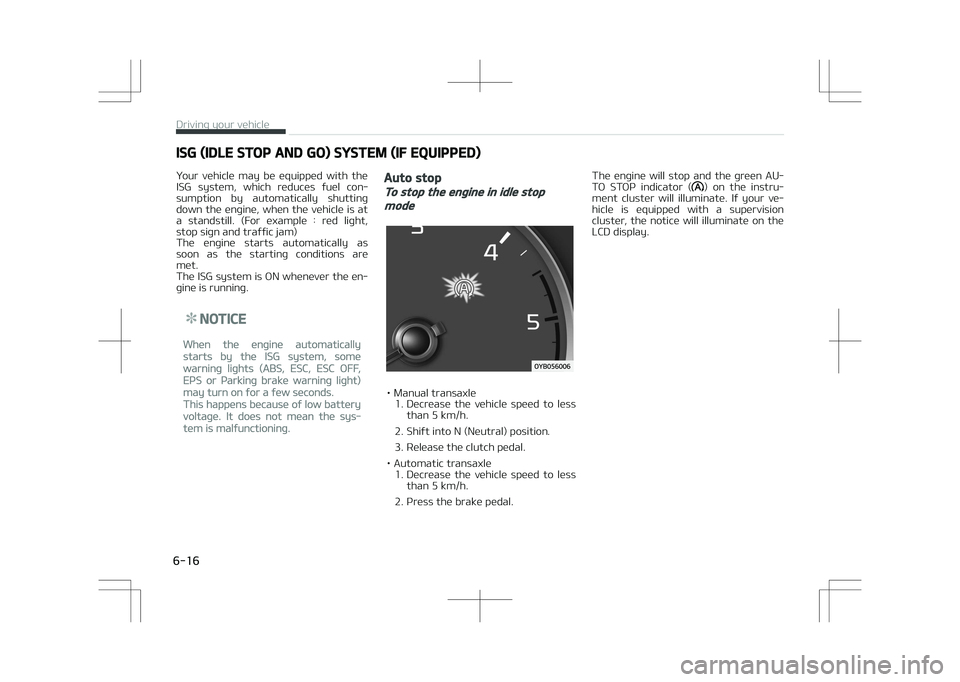
Auto stop
To stop the engine in idle stop
mode
• Manual transaxle 1. Decrease the vehicle speed to less than 5 km/h.
2. Shift into N (Neutral) position.
3. Release the clutch pedal.
• Automatic transaxle 1. Decrease the vehicle speed to less than 5 km/h.
2. Press the brake pedal. The engine will stop and the green AU‐
TO STOP indicator (
) on the instru‐
ment cluster will illuminate. If your ve‐ hicle is equipped with a supervision
cluster, the notice will illuminate on the
LCD display.
Driving your vehicle
6-16
Page 244 of 523
WARNING
•Before leaving the driver’s seat, al‐ways set the parking brake fullyand shut the engine off. Thenmake sure the transaxle is shiftedinto 1st gear when the vehicle isparked on a level or uphill grade,and shifted into R (Reverse) on adownhill grade. Unexpected andsudden vehicle movement can oc‐cur if these precautions are notfollowed in the order identified.
•Do not use the engine brake (shift‐ing from a high gear to lower gear)rapidly on slippery roads.The vehicle may slip causing an ac‐cident.
Using the clutch
The clutch should be pressed all theway to the floor before shifting, then
released slowly. The clutch pedal should
always be fully released while driving. Do not rest your foot on the clutch
pedal while driving. This can cause un‐
necessary wear. Do not partially en‐ gage the clutch to hold the vehicle on
an incline. This causes unnecessary
wear. Use the foot brake or parking brake to hold the vehicle on an incline.
Do not operate the clutch pedal rapidly
and repeatedly.
CAUTION
When operating the clutch pedal,press the clutch pedal down fully. Ifyou don’t press the clutch pedalfully, the clutch may be damaged ornoise may occur.
Downshifting
When you must slow down in heavy
traffic or while driving up steep hills, downshift before the engine starts to
labor. Downshifting reduces the chance
of stalling and gives better acceleration when you again need to increase your
speed. When the vehicle is traveling
down steep hills, downshifting helps maintain safe speed and prolongs brake life.
Good driving practices
• Never take the vehicle out of gear and coast down a hill. This is ex‐
tremely hazardous. Always leave the vehicle in gear.
• Don't "ride" the brakes. This can cause them to overheat and malfunc‐
tion. Instead, when you are driving
down a long hill, shift to a lower gear.
When you do this, engine braking will help slow down the vehicle.
• Slow down before shifting to a lower gear. This will help avoid over-revving
the engine, which can cause damage.
• Slow down when you encounter cross winds. This gives you much better
control of your vehicle.
Driving your vehicle
6-22
Page 247 of 523
(Continued)
•Always check the surroundingareas near your vehicle for people,especially children, before shiftinga car into D (Drive) or R (Reverse).
•Before leaving the driver’s seat, al‐ways make sure the shift lever isin the P (Park) position; then setthe parking brake fully and shutthe engine off. Unexpected andsudden vehicle movement can oc‐cur if these precautions are notfollowed in the order identified.
•Do not use the engine brake (shift‐ing from a high gear to lower gear)rapidly on slippery roads.The vehicle may slip causing an ac‐cident.
CAUTION
•To avoid damage to your trans‐axle, do not accelerate the enginein R (Reverse) or any forward gearposition with the brakes on.
(Continued)
(Continued)
•When stopped on an incline, do nothold the vehicle stationary withengine power.Use the service brake or the park‐ing brake.
•Do not shift from N (Neutral) or P(Park) into D (Drive), or R (Reverse)when the engine is above idlespeed.
Transaxle ranges
The indicator in the instrument cluster
displays the shift lever position when the ignition switch is in the ON position.
P (Park)
Always come to a complete stop before
shifting into P (Park). This position
locks the transaxle and prevents the drive wheels from rotating.
WARNING
•Shifting into P (Park) while the ve‐hicle is in motion will cause thedrive wheels to lock which willcause you to lose control of thevehicle.
•Do not use the P (Park) position inplace of the parking brake. Alwaysmake sure the shift lever is latch‐ed in the P (Park) position and setthe parking brake fully.
•Never leave a child unattended in avehicle.
CAUTION
The transaxle may be damaged ifyou shift into P (Park) while the ve‐hicle is in motion.
R (Reverse)
Use this position to drive the vehicle
backward.
6-25
6
Driving your vehicle
Page 250 of 523
2. Move the shift lever.
If the brake pedal is repeatedly de‐
pressed and released with the shift lev‐ er in the P (Park) position, a chattering
noise near the shift lever may be heard.
This is a normal condition.
WARNING
Always fully depress the brake pedalbefore and while shifting out of theP (Park) position into another posi‐tion to avoid inadvertent motion ofthe vehicle which could injure per‐sons in or around the car.
Good driving practices
• Never move the shift lever from P (Park) or N (Neutral) to any other po‐
sition with the accelerator pedal de‐ pressed.
• Never move the shift lever into P (Park) when the vehicle is in motion.
• Be sure the car is completely stopped before you attempt to shift into R
(Reverse) or D (Drive). • Never take the car out of gear and
coast down a hill. This may be ex‐tremely hazardous. Always leave the
car in gear when moving.
• Do not "ride" the brakes. This can cause them to overheat and malfunc‐
tion. Instead, when you are driving
down a long hill, slow down and shift to a lower gear. When you do this,
engine braking will help slow the car.
• Slow down before shifting to a lower gear. Otherwise, the lower gear may
not be engaged.
• Always use the parking brake. Do not depend on placing the transaxle in P
(Park) to keep the car from moving.
• Exercise extreme caution when driv‐ ing on a slippery surface. Be especial‐
ly careful when braking, accelerating
or shifting gears. On a slippery sur‐ face, an abrupt change in vehicle
speed can cause the drive wheels to
lose traction and the vehicle to go out
of control.
• Optimum vehicle performance and economy is obtained by smoothly de‐
pressing and releasing the accelera‐
tor pedal.
WARNING
•Always buckle-up! In a collision, anunbelted occupant is significantlymore likely to be seriously injuredor killed than a properly belted oc‐cupant.
•Avoid high speeds when corneringor turning.
•Do not make quick steering wheelmovements, such as sharp lanechanges or fast, sharp turns.
•The risk of rollover is greatly in‐creased if you lose control of yourvehicle at highway speeds.
•Loss of control often occurs if twoor more wheels drop off the road‐way and the driver over-steers toreenter the roadway.
•In the event your vehicle leavesthe roadway, do not steer sharply.Instead, slow down before pullingback into the travel lanes.
•Never exceed posted speed limits.
Driving your vehicle
6-28
Page 251 of 523
WARNING
If your vehicle becomes stuck insnow, mud, sand, etc., then you mayattempt to rock the vehicle free bymoving it forward and backward. Donot attempt this procedure if peopleor objects are anywhere near the ve‐hicle. During the rocking operationthe vehicle may suddenly move for‐ward of backward as it becomes un‐stuck, causing injury or damage tonearby people or objects.
Moving up a steep grade from a
standing start
To move up a steep grade from a
standing start, depress the brake pedal,
shift the shift lever to D (Drive). Select the appropriate gear depending on load
weight and steepness of the grade, and
release the parking brake. Depress the accelerator gradually while releasing
the service brakes.
When accelerating from a stop on asteep hill, the vehicle may have a ten‐dency to roll backwards. Shifting theshift lever into 2 (Second Gear) will helpprevent the vehicle from rolling back‐wards.
6-29
6
Driving your vehicle
Page 252 of 523
BRAKE SYSTEM
Power brakes
Your vehicle has power-assisted brakesthat adjust automatically through nor‐
mal usage.
In the event that the power-assisted
brakes lose power because of a stalled engine or some other reason, you can
still stop your vehicle by applying
greater force to the brake pedal than you normally would. The stopping dis‐
tance, however, will be longer.
When the engine is not running, the re‐
serve brake power is partially depleted each time the brake pedal is applied. Do
not pump the brake pedal when the
power assist has been interrupted.
Pump the brake pedal only when nec‐ essary to maintain steering control on
slippery surfaces.
WARNING
nBrakes
(Continued)
(Continued)
•Do not drive with your foot restingon the brake pedal. This will createabnormal high brake tempera‐tures, excessive brake lining andpad wear, and increased stoppingdistances.
•When descending a long or steephill, shift to a lower gear and avoidcontinuous application of thebrakes. Continuous brake applica‐tion will cause the brakes to over‐heat and could result in a tempo‐rary loss of braking performance.
•Wet brakes may impair the vehi‐cle’s ability to safely slow down;the vehicle may also pull to oneside when the brakes are applied.Applying the brakes lightly will in‐dicate whether they have been af‐fected in this way. Always testyour brakes in this fashion afterdriving through deep water. To drythe brakes, apply them lightlywhile maintaining a safe forwardspeed until brake performance re‐turns to normal.
(Continued)
(Continued)
•Always, confirm the position ofthe brake and accelerator pedalbefore driving. If you don't checkthe position of the accelerator andbrake pedal before driving, youmay depress the accelerator in‐stead of the brake pedal. It maycause a serious accident.
In the event of brake failure
If service brakes fail to operate while
the vehicle is in motion, you can make an emergency stop with the parking
brake. The stopping distance, however,
will be much greater than normal.
WARNING
nParking brake
Applying the parking brake while thevehicle is moving at normal speedscan cause a sudden loss of control ofthe vehicle. If you must use theparking brake to stop the vehicle,use great caution in applying thebrake.
Driving your vehicle
6-30
Page 253 of 523
Disc brakes wear indicator
Your vehicle has disc brakes.
When your brake pads are worn andnew pads are required, you will hear a
high-pitched warning sound from your
front brakes or rear brakes. You may hear this sound come and go or it may
occur whenever you depress the brake
pedal.
Please remember that some driving conditions or climates may cause a
brake squeal when you first apply (or
lightly apply) the brakes. This is normal and does not indicate a problem with
your brakes.
CAUTION
•To avoid costly brake repairs, donot continue to drive with wornbrake pads.
•Always replace the front or rearbrake pads as pairs.
WARNING
nBrake wear
(Continued)
(Continued)
This brake wear warning soundmeans your vehicle needs service. Ifyou ignore this audible warning, youwill eventually lose braking perform‐ance, which could lead to a seriousaccident.
Rear drum brakes (if equipped)
Your rear drum brakes do not have
wear indicators. Therefore, have the rear brake linings inspected if you hear
a rear brake rubbing noise. Also have
your rear brakes inspected each time you change or rotate your tires and
when you have the front brakes re‐
placed.
Parking brake
Applying the parking brake
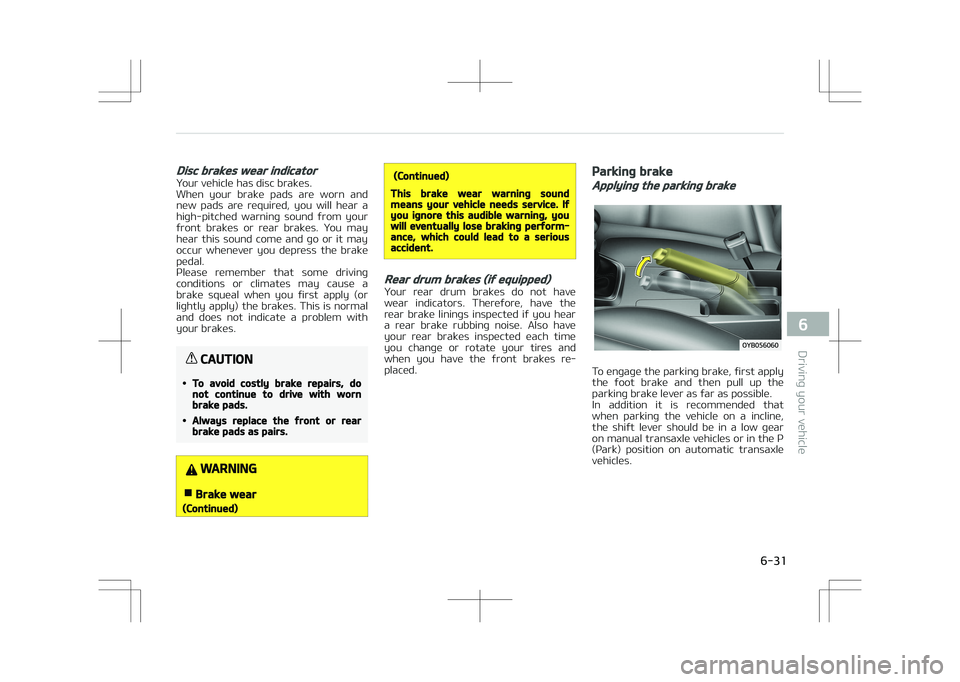
To engage the parking brake, first apply
the foot brake and then pull up the
parking brake lever as far as possible.
In addition it is recommended that when parking the vehicle on a incline,
the shift lever should be in a low gear
on manual transaxle vehicles or in the P (Park) position on automatic transaxle
vehicles.
6-31
6
Driving your vehicle
Page 254 of 523
CAUTION
•Driving with the parking brake ap‐plied will cause excessive brakepad and brake rotor wear.
•Do not operate the parking brakewhile the vehicle is moving exceptin an emergency situation. It coulddamage the vehicle system andmake endanger driving safety.
Releasing the parking brake
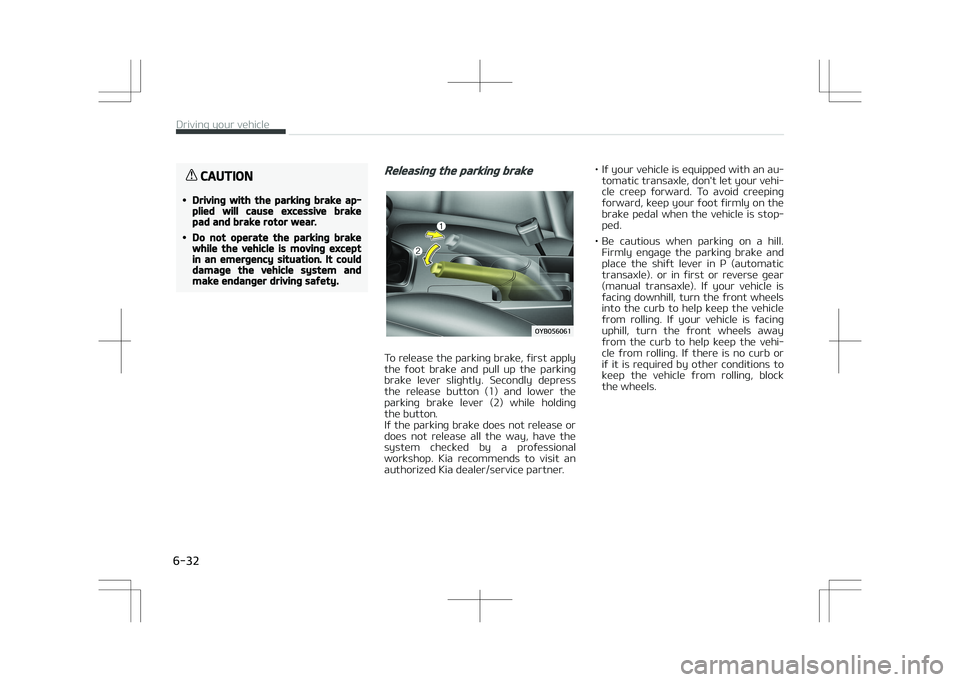
To release the parking brake, first apply
the foot brake and pull up the parking brake lever slightly. Secondly depress
the release button (1) and lower the
parking brake lever (2) while holding the button.
If the parking brake does not release or
does not release all the way, have the
system checked by a professional workshop. Kia recommends to visit an
authorized Kia dealer/service partner. • If your vehicle is equipped with an au‐
tomatic transaxle, don't let your vehi‐
cle creep forward. To avoid creeping
forward, keep your foot firmly on the brake pedal when the vehicle is stop‐
ped.
• Be cautious when parking on a hill. Firmly engage the parking brake and
place the shift lever in P (automatic
transaxle). or in first or reverse gear (manual transaxle). If your vehicle is
facing downhill, turn the front wheels
into the curb to help keep the vehicle
from rolling. If your vehicle is facing
uphill, turn the front wheels away from the curb to help keep the vehi‐
cle from rolling. If there is no curb or
if it is required by other conditions to
keep the vehicle from rolling, block the wheels.
Driving your vehicle
6-32