tire pressure KIA STONIC 2018 User Guide
[x] Cancel search | Manufacturer: KIA, Model Year: 2018, Model line: STONIC, Model: KIA STONIC 2018Pages: 523, PDF Size: 24.99 MB
Page 332 of 523
If you have a tire gauge, remove the
valve cap and check the air pressure. If the pressure is lower than recommen‐
ded, drive slowly to the nearest service
station and inflate to the correct pres‐ sure. If it is too high, adjust it until it is
correct. Always reinstall the valve cap
after checking or adjusting tire pres‐ sure. If the cap is not replaced, air may
leak from the tire. If you lose a valve
cap, buy another and install it as soon as possible.
After you have changed wheels, always
secure the flat tire in its place and re‐
turn the jack and tools to their proper storage locations.
CAUTION
Your vehicle has metric threads onthe wheel studs and nuts. Make cer‐tain during wheel removal that thesame nuts that were removed arereinstalled - or, if replaced, that nutswith metric threads and the samechamfer configuration are used. In‐stallation of a non-metric thread nuton a metric stud or vice-versa willnot secure the wheel to the hubproperly and will damage the stud sothat it must be replaced.
(Continued)
(Continued)
Note that most lug nuts do not havemetric threads. Be sure to use ex‐treme care in checking for threadstyle before installing aftermarketlug nuts or wheels. If in doubt, con‐sult a professional workshop. Kiarecommends to consult an author‐ized Kia dealer/service partner.
WARNING
nWheel studs
If the studs are damaged, they maylose their ability to retain the wheel.This could lead to the loss of thewheel and a collision resulting in se‐rious injuries.
To prevent the jack, jack handle, wheel
lug nut wrench and spare tire from rat‐ tling while the vehicle is in motion,
store them properly.
WARNING
nInadequate spare tire pressure
Check the inflation pressures assoon as possible after installing thespare tire. Adjust it to the specifiedpressure, if necessary. Refer toL
Page 333 of 523
(Continued)
•The operation of this vehicle is notrecommended with more than onecompact spare tire in use at thesame time.
WARNING
The compact spare tire is for emer‐gency use only. Do not operate yourvehicle on this compact spare at thespeed over 80 km/h (50 mph). Theoriginal tire should be repaired or re‐placed as soon as possible to avoidfailure of the spare possibly leadingto personal injury or death.
The compact spare should be inflated
to 420 kPa (60 psi).
NOTICE
Check the inflation pressure after in‐
stalling the spare tire. Adjust it to
the specified pressure, as necessary.
When using a compact spare tire, ob‐
serve the following precautions: • Under no circumstances should you
exceed 80 km/h (50 mph); a higherspeed could damage the tire.
• Ensure that you drive slowly enough to avoid all hazards. Any road hazard,
such as a pothole or debris, could se‐
riously damage the compact spare.
• Any continuous road use of this tire could result in tire failure, loss of ve‐
hicle control, and possible personal in‐ jury.
• Do not exceed the vehicle’s maximum load rating or the load-carrying ca‐
pacity shown on the sidewall of the
compact spare tire.
• Avoid driving over obstacles. The compact spare tire diameter is small‐
er than the diameter of a convention‐
al tire and reduces the ground clear‐
ance approximately 2.5 cm (1 inch),
which could result in damage to the
vehicle.
• Do not take the vehicle through an automatic car wash while the com‐
pact spare tire is installed.
• Do not use tire chains on the tempo‐ rary compact tire. Because of the
smaller size, a tire chain will not fit properly. This could damage the vehi‐
cle and result in loss of the chain. • Temporary compact tire should not
be installed on the front axle if the
vehicle must be driven in snow or on
ice.
• Do not use the temporary compact tire on any other vehicle because this
tire has been designed especially for
your vehicle.
• The temporary compact tire tread life is shorter than a regular tire. In‐
spect your temporary compact tire regularly and replace worn compact
spare tires with the same size and
design, mounted on the same wheel.
• The temporary compact tire should not be used on any other wheels, norshould standard tires, snow tires,
wheel covers or trim rings be used
with the temporary compact spare
wheel. If such use is attempted, dam‐
age to these items or other car com‐ ponents may occur.
• Do not use more than one temporary compact tire at a time.
• Do not tow a trailer while the tempo‐ rary compact tire is installed.
7-17
7
What to do in an emergency
Page 337 of 523
Introduction
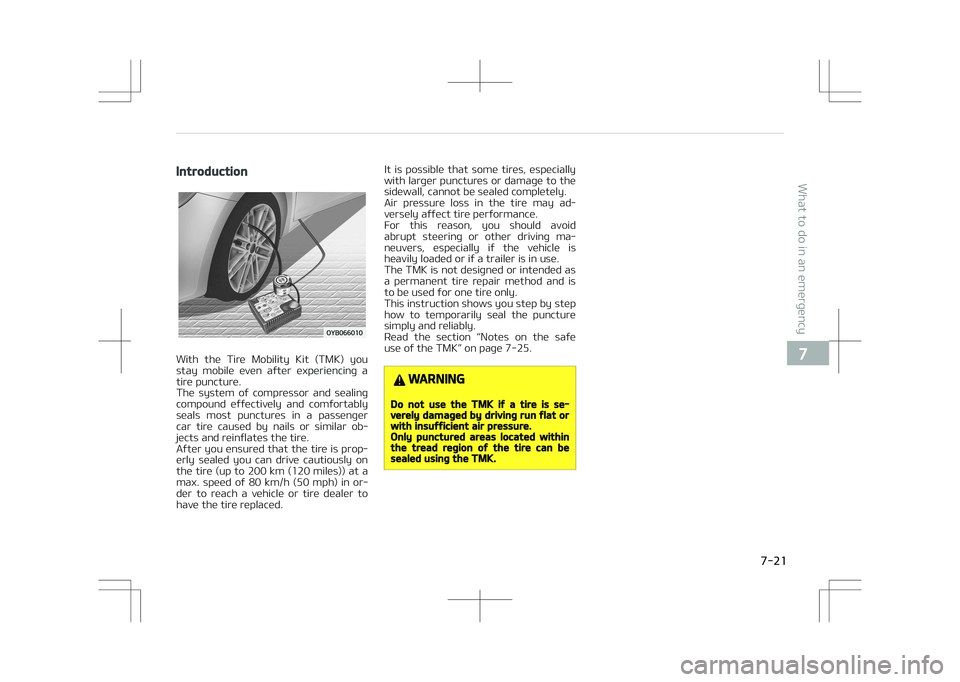
With the Tire Mobility Kit (TMK) you
stay mobile even after experiencing a tire puncture.
The system of compressor and sealing
compound effectively and comfortably
seals most punctures in a passenger car tire caused by nails or similar ob‐
jects and reinflates the tire.
After you ensured that the tire is prop‐
erly sealed you can drive cautiously on the tire (up to 200 km (120 miles)) at a
max. speed of 80 km/h (50 mph) in or‐
der to reach a vehicle or tire dealer to have the tire replaced. It is possible that some tires, especially
with larger punctures or damage to the
sidewall, cannot be sealed completely.
Air pressure loss in the tire may ad‐ versely affect tire performance.
For this reason, you should avoid
abrupt steering or other driving ma‐
neuvers, especially if the vehicle is heavily loaded or if a trailer is in use.
The TMK is not designed or intended as
a permanent tire repair method and is
to be used for one tire only.This instruction shows you step by step
how to temporarily seal the puncture simply and reliably.
Read the section L
Page 338 of 523
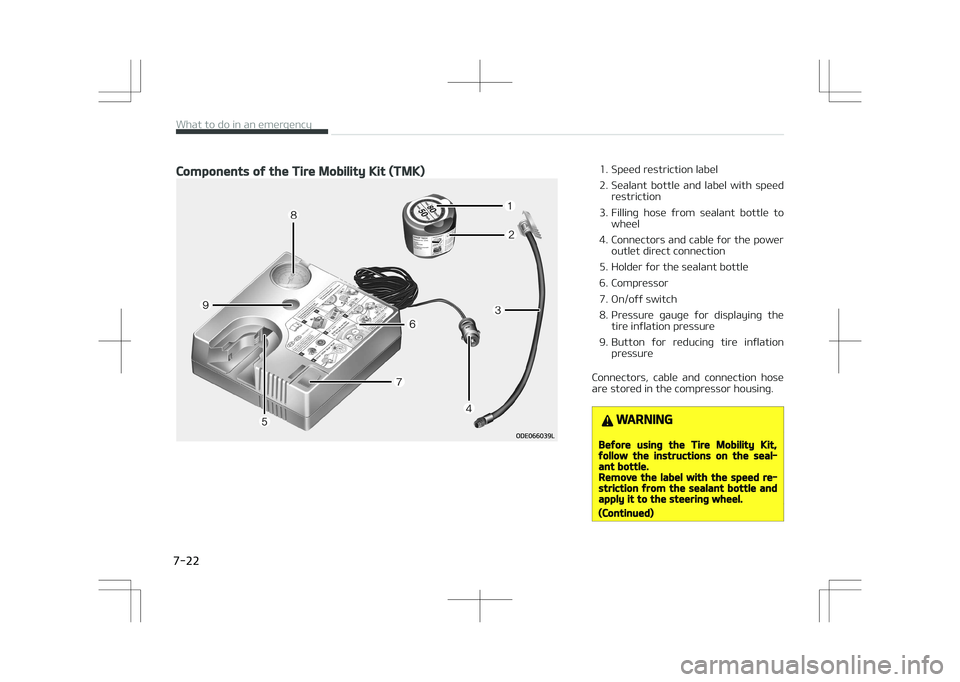
Components of the Tire Mobility Kit (TMK)1. Speed restriction label
2. Sealant bottle and label with speedrestriction
3. Filling hose from sealant bottle to wheel
4. Connectors and cable for the power outlet direct connection
5. Holder for the sealant bottle
6. Compressor
7. On/off switch
8. Pressure gauge for displaying the tire inflation pressure
9. Button for reducing tire inflation pressure
Connectors, cable and connection hose are stored in the compressor housing.
WARNING
Before using the Tire Mobility Kit,follow the instructions on the seal‐ant bottle.Remove the label with the speed re‐striction from the sealant bottle andapply it to the steering wheel.
(Continued)
What to do in an emergency
7-22
Page 339 of 523
(Continued)
Please note the expiry date on thesealant bottle.
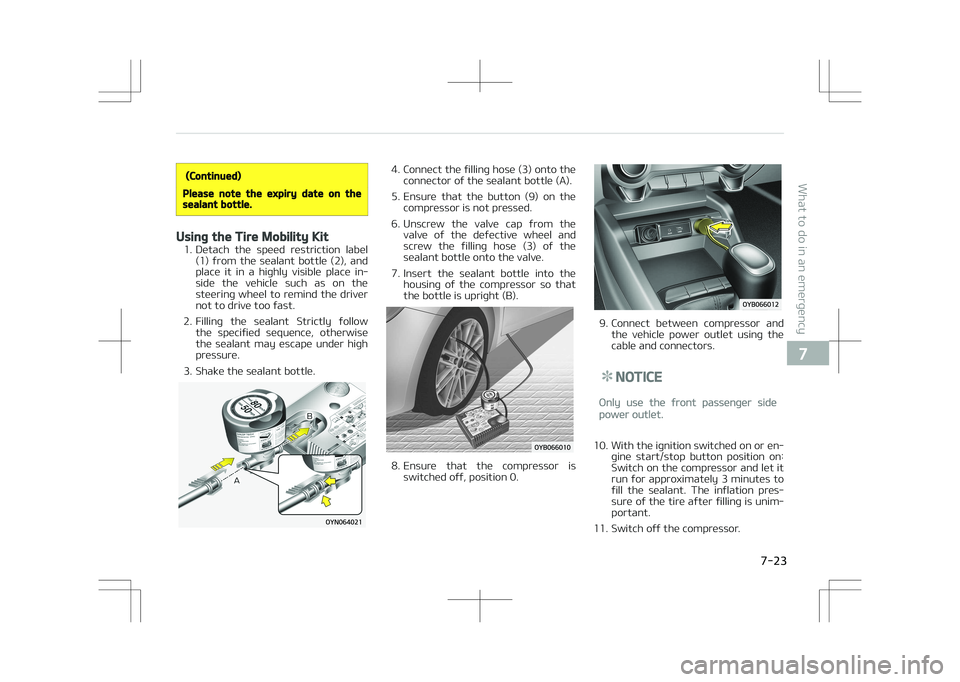
Using the Tire Mobility Kit
1. Detach the speed restriction label(1) from the sealant bottle (2), and
place it in a highly visible place in‐
side the vehicle such as on the
steering wheel to remind the driver
not to drive too fast.
2. Filling the sealant Strictly follow the specified sequence, otherwise
the sealant may escape under high pressure.
3. Shake the sealant bottle.
4. Connect the filling hose (3) onto the connector of the sealant bottle (A).
5. Ensure that the button (9) on the compressor is not pressed.
6. Unscrew the valve cap from the valve of the defective wheel and
screw the filling hose (3) of the
sealant bottle onto the valve.
7. Insert the sealant bottle into the housing of the compressor so that
the bottle is upright (B).
8. Ensure that the compressor is switched off, position 0.
9. Connect between compressor and the vehicle power outlet using the
cable and connectors.
NOTICE
Only use the front passenger side
power outlet.
10. With the ignition switched on or en‐ gine start/stop button position on:
Switch on the compressor and let it
run for approximately 3 minutes to
fill the sealant. The inflation pres‐
sure of the tire after filling is unim‐
portant.
11. Switch off the compressor.
7-23
7
What to do in an emergency
Page 340 of 523
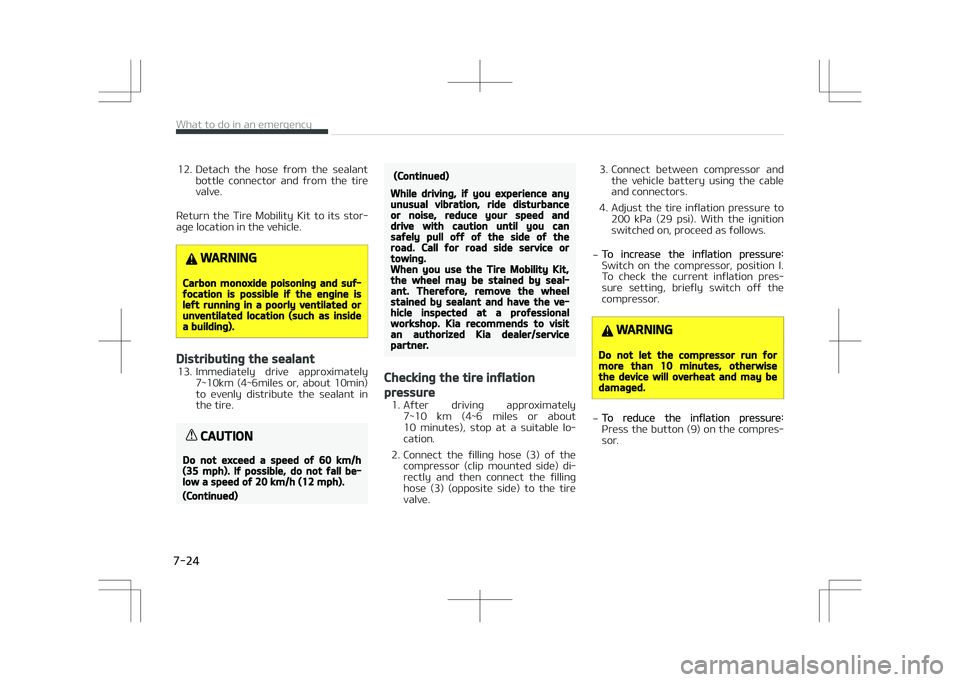
12. Detach the hose from the sealantbottle connector and from the tire
valve.
Return the Tire Mobility Kit to its stor‐ age location in the vehicle.
WARNING
Carbon monoxide poisoning and suf‐focation is possible if the engine isleft running in a poorly ventilated orunventilated location (such as insidea building).
Distributing the sealant
13. Immediately drive approximately 7~10km (4~6miles or, about 10min)
to evenly distribute the sealant in
the tire.
CAUTION
Do not exceed a speed of 60 km/h(35 mph). If possible, do not fall be‐low a speed of 20 km/h (12 mph).
(Continued)
(Continued)
While driving, if you experience anyunusual vibration, ride disturbanceor noise, reduce your speed anddrive with caution until you cansafely pull off of the side of theroad. Call for road side service ortowing.When you use the Tire Mobility Kit,the wheel may be stained by seal‐ant. Therefore, remove the wheelstained by sealant and have the ve‐hicle inspected at a professionalworkshop. Kia recommends to visitan authorized Kia dealer/servicepartner.
Checking the tire inflation
pressure
1. After driving approximately 7~10 km (4~6 miles or about
10 minutes), stop at a suitable lo‐
cation.
2. Connect the filling hose (3) of the compressor (clip mounted side) di‐
rectly and then connect the filling
hose (3) (opposite side) to the tire
valve. 3. Connect between compressor and
the vehicle battery using the cable
and connectors.
4. Adjust the tire inflation pressure to 200 kPa (29 psi). With the ignition
switched on, proceed as follows.
-
To increase the inflation pressure:
Switch on the compressor, position I.
To check the current inflation pres‐
sure setting, briefly switch off the
compressor.
WARNING
Do not let the compressor run formore than 10 minutes, otherwisethe device will overheat and may bedamaged.
-To reduce the inflation pressure:
Press the button (9) on the compres‐
sor.
What to do in an emergency
7-24
Page 346 of 523
EMERGENCY COMMODITY (IF EQUIPPED)
There are some emergency commodi‐ ties in the vehicle to help you respond
to the emergency situation.
Fire extinguisher
If there is a small fire and you know
how to use the fire extinguisher, take the following steps carefully. 1. Pull the pin at the top of the extin‐ guisher that keeps the handle from
being accidentally pressed.
2. Aim the nozzle toward the base of the fire.
3. Stand approximately 2.5 m (8 ft) away from the fire and squeeze
the handle to discharge the extin‐
guisher. If you release the handle,
the discharge will stop.
4. Sweep the nozzle back and forth at the base of the fire. After the fire
appears to be out, watch it careful‐
ly since it may re-ignite.
First aid kit
There are some items such as scissors,
bandage and adhesive tape etc. in the kit to give first aid to an injured person.
Triangle reflector
Place the triangle reflector on the roadto warn oncoming vehicles during
emergencies, such as when the vehicle
is parked by the roadside due to any problems.
Tire pressure gauge (if
equipped)
Tires normally lose some air in day-to-
day use, and you may have to add a
few pounds of air periodically and it is
not usually a sign of a leaking tire, but
of normal wear. Always check tire pres‐
sure when the tires are cold because
tire pressure increases with tempera‐
ture.
To check the tire pressure, take the fol‐ lowing steps; 1. Unscrew the inflation valve cap that is located on the rim of the
tire.
2. Press and hold the gauge against the tire valve. Some air will escape
as you begin and more will escape
if you don't press the gauge in
firmly.
3. A firm non-leaking push will acti‐ vate the gauge. 4. Read the tire pressure on the
gauge to know whether the tire
pressure is low or high.
5. Adjust the tire pressures to the specified pressure. Refer to L
Page 348 of 523
Changing the engine oil and filter...................................... 8-45
Engine oil (Diesel)...................................................................... 8-46 Checking the engine oil level................................................8-46
Changing the engine oil and filter...................................... 8-46
Engine coolant........................................................................... 8-48 Checking the coolant level................................................... 8-48
Changing the coolant............................................................ 8-51
Brake/Clutch fluid .....................................................................8-52 Checking the brake/clutch fluid level................................. 8-52
Automatic transaxle fluid ....................................................... 8-53 Checking the automatic transaxle fluid level .................. 8-53
Changing the automatic transaxle fluid............................ 8-54
Washer fluid............................................................................... 8-55 Checking the washer fluid level.......................................... 8-55
Parking brake............................................................................. 8-56 Checking the parking brake................................................. 8-56
Fuel filter (for diesel)................................................................ 8-57 Draining water from the fuel filter.................................... 8-57
Fuel filter cartridge replacement....................................... 8-57
Air cleaner.................................................................................. 8-58 Filter replacement.................................................................8-58
Climate control air filter........................................................... 8-59 Filter inspection..................................................................... 8-59
Wiper blades...............................................................................8-60 Blade inspection.................................................................... 8-60
Blade replacement................................................................ 8-60
Battery........................................................................................8-63 For best battery service...................................................... 8-63
Battery capacity label.......................................................... 8-64
Battery recharging................................................................8-65 Reset items............................................................................ 8-65
Tires and wheels....................................................................... 8-67 Tire care.................................................................................. 8-67
Recommended cold tire inflation pressures..................... 8-67
Checking tire inflation pressure.......................................... 8-68
Tire rotation........................................................................... 8-69
Wheel alignment and tire balance...................................... 8-70
Tire replacement................................................................... 8-70
Wheel replacement............................................................... 8-72
Tire traction........................................................................... 8-72
Tire maintenance.................................................................. 8-72
Tire sidewall labeling............................................................ 8-72
Low aspect ratio tire ........................................................... 8-75
Fuses........................................................................................... 8-77 Inner panel fuse replacement............................................. 8-79
Engine compartment fuse replacement........................... 8-80
Fuse/relay panel description............................................... 8-82
Light bulbs................................................................................8-104 Bulb replacement precaution............................................8-104
Light bulb position (Front).................................................8-106
Light bulb position (Rear).................................................. 8-107
Light bulb position (Side)................................................... 8-108
Side repeater lamp (LED type) bulb Replacement........ 8-108
Side repeater lamp (bulb type) bulb Replacement....... 8-109
Headlamp (Low/High beam) bulb replacement
(Headlamp Type A)............................................................. 8-109
Front turn signal lamp bulb replacement (Head‐
lamp Type A)........................................................................8-110
Position lamp / Day time running lamp bulb re‐
placement (Headlamp Type A)......................................... 8-110
8
Page 355 of 523
OWNER MAINTENANCE
The following lists are vehicle checks
and inspections that should be per‐
formed at the frequencies indicated to help ensure safe, dependable operation
of your vehicle.
Any adverse conditions should be
brought to the attention of your dealer as soon as possible.
These Owner Maintenance Checks are
generally not covered by warranties
and you may be charged for labor, parts and lubricants used.
Owner maintenance schedule
When you stop for fuel:
• Check the engine oil level.
• Check the coolant level in the coolant reservoir.
• Check the windshield washer fluid level.
• Look for low or under-inflated tires.
WARNING
Be careful when checking your en‐gine coolant level when the engine ishot. Scalding hot coolant and steam
(Continued)
(Continued)
may blow out under pressure. Thiscould cause burns or other seriousinjury.
While operating your vehicle:
• Note any changes in the sound of the exhaust or any smell of exhaust
fumes in the vehicle.
• Check for vibrations in the steering wheel. Notice any increased steering
effort or looseness in the steering
wheel, or change in its straight-
ahead position.
• Notice if your vehicle constantly turns slightly or L
Page 362 of 523
![KIA STONIC 2018 User Guide MAINTENANCE INTERVALS
Normal Maintenance Schedule - For Gasoline Engine [For Europe (Except Russia)]
Number of months or driving distance, whichever comes first
Months1224364860728496
Miles×1,0001020](/img/2/40480/w960_40480-361.png "KIA STONIC 2018 User Guide MAINTENANCE INTERVALS
Normal Maintenance Schedule - For Gasoline Engine [For Europe (Except Russia)]
Number of months or driving distance, whichever comes first
Months1224364860728496
Miles×1,0001020")
MAINTENANCE INTERVALS
Normal Maintenance Schedule - For Gasoline Engine [For Europe (Except Russia)]
Number of months or driving distance, whichever comes first
Months1224364860728496
Miles×1,0001020304050607080
Km×1,000153045607590105120
MAINTENANCE ITEM
Parking brake - I - I - I - I
Steering gear rack, linkage and boots I I I I I I I I
Suspension ball joints I I I I I I I I
Tire (pressure & tread wear) I I I I I I I I
Battery condition I I I I I I I I
I : Inspect and if necessary, adjust, correct, clean or replace.
R : Replace or change.
Maintenance
8-16