child seat KIA STONIC 2018 Owner's Manual
[x] Cancel search | Manufacturer: KIA, Model Year: 2018, Model line: STONIC, Model: KIA STONIC 2018Pages: 523, PDF Size: 24.99 MB
Page 70 of 523
CAUTION
•If the passenger’s front air bagON/OFF switch is not workingproperly, the air bag warning light() on the instrument panel willilluminate.And, the passenger's front air bagOFF indicator () will not illumi‐nate (The passenger's front airbag ON indicator comes on andgoes off after approximately 60seconds), the SRS Control Modulereactivate the passenger’s frontair bag and the passenger’s frontair bag will inflate in frontal impactcrashes even if the passenger’sfront air bag ON/OFF switch is setto the OFF position.In this case, have the system in‐spected by a professional work‐shop. Kia recommends to visit anauthorized Kia dealer/service part‐ner.
(Continued)
(Continued)
•If the SRS air bag warning lightblinks or does not illuminate whenthe ignition switch is turned to theON position, or if it illuminateswhile the vehicle is being driven,have the system inspected by aprofessional workshop. Kia recom‐mends to visit an authorized Kiadealer/service partner.
WARNING
•The driver is responsible for theproper position of the passenger’sfront air bag ON/OFF switch.
•Deactivate the passenger's frontair bag only when the ignitionswitch is switched off, or the mal‐function may occur in the SRSControl Module.And there may be a danger thatthe driver's and/or front passeng‐er’s and/or side and curtain air bagmay fail to trigger, or not triggercorrectly during a collision.
(Continued)
(Continued)
•Never install a rearward facingchild seat on the front passenger'sseat unless the passenger's frontair bag has been deactivated. Theinfant or child could be severely in‐jured or killed by an air bag deploy‐ment in case of an accident.
•Even though your vehicle is equip‐ped with the passenger's front airbag ON/OFF switch, do not install achild restraint system in the frontpassenger's seat. A child restraintsystem must never be placed inthe front seat. Children who aretoo large for child restraint sys‐tems should always occupy therear seat and use the available lap/shoulder belts. Children are affor‐ded the most safety in the eventof an accident when they are re‐strained by a proper restraint sys‐tem in the rear seat.
•As soon as the child seat is no lon‐ger needed on the front passeng‐er's seat, reactivate the front pas‐senger's air bag.
(Continued)
Safety features of your vehicle
3-50
Page 73 of 523
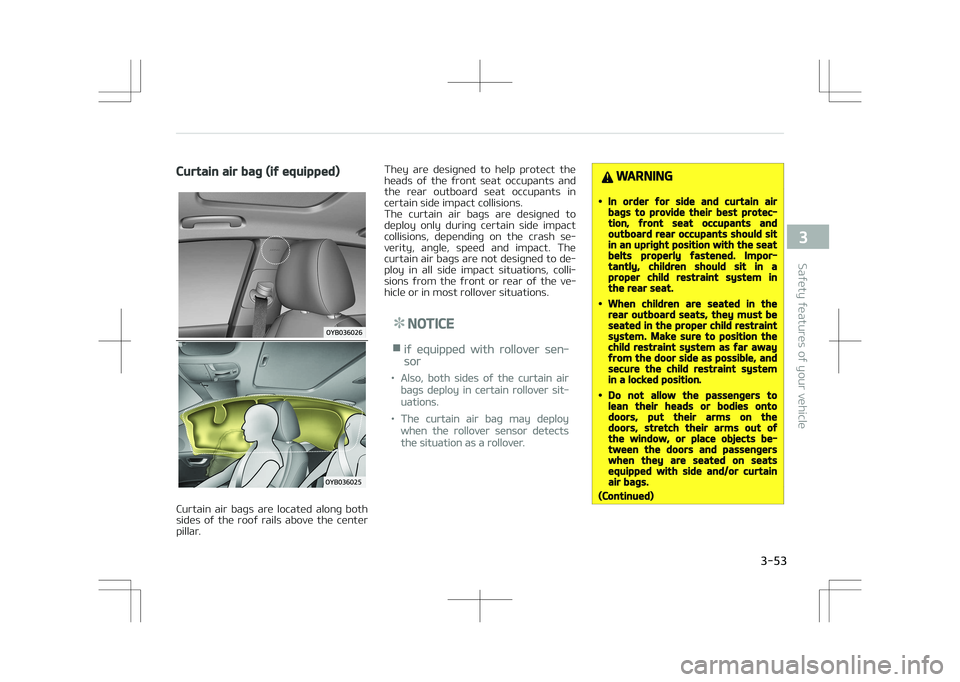
Curtain air bag (if equipped)
Curtain air bags are located along both
sides of the roof rails above the center pillar. They are designed to help protect the
heads of the front seat occupants and
the rear outboard seat occupants in certain side impact collisions.
The curtain air bags are designed to
deploy only during certain side impact
collisions, depending on the crash se‐ verity, angle, speed and impact. The
curtain air bags are not designed to de‐
ploy in all side impact situations, colli‐ sions from the front or rear of the ve‐
hicle or in most rollover situations.
NOTICE
nif equipped with rollover sen‐
sor
•Also, both sides of the curtain air
bags deploy in certain rollover sit‐
uations.
•The curtain air bag may deploy
when the rollover sensor detects
the situation as a rollover.
WARNING
•In order for side and curtain airbags to provide their best protec‐tion, front seat occupants andoutboard rear occupants should sitin an upright position with the seatbelts properly fastened. Impor‐tantly, children should sit in aproper child restraint system inthe rear seat.
•When children are seated in therear outboard seats, they must beseated in the proper child restraintsystem. Make sure to position thechild restraint system as far awayfrom the door side as possible, andsecure the child restraint systemin a locked position.
•Do not allow the passengers tolean their heads or bodies ontodoors, put their arms on thedoors, stretch their arms out ofthe window, or place objects be‐tween the doors and passengerswhen they are seated on seatsequipped with side and/or curtainair bags.
(Continued)
3-53
3
Safety features of your vehicle
Page 81 of 523
•Passengers should not move out ofor change seats while the vehicle ismoving. A passenger who is not
wearing a seat belt during a crash or
emergency stop can be thrown
against the inside of the vehicle,
against other occupants, or out of
the vehicle.
•
Each seat belt is designed to restrainone occupant. If more than one per‐
son uses the same seat belt, they
could be seriously injured or killed in a
collision.
•
Do not use any accessories on seatbelts. Devices claiming to improve oc‐
cupant comfort or reposition the seat
belt can reduce the protection provi‐
ded by the seat belt and increase the
chance of serious injury in a crash.
•
Passengers should not place hard orsharp objects between themselvesand the air bags. Carrying hard or
sharp objects on your lap or in your
mouth can result in injuries if an air
bag inflates. •
Keep occupants away from the airbag covers.
All occupants should sit
upright, fully back in their seats with
their seat belts on and their feet on
the floor. If occupants are too close
to the air bag covers, they could be injured if the air bags inflate.
•
Do not attach or place objects on ornear the air bag covers. Any object
attached to or placed on the front or
side air bag covers could interfere with the proper operation of the air
bags.
•
Do not modify the front seats. Modi‐
fication of the front seats could in‐
terfere with the operation of the
supplemental restraint system sens‐ ing components or side air bags.
•
Do not place items under the frontseats. Placing items under the front
seats could interfere with the opera‐
tion of the supplemental restraint
system sensing components and wir‐ ing harnesses.
•
Never hold an infant or child on yourlap. The infant or child could be seri‐
ously injured or killed in the event of
a crash. All infants and children should be properly restrained in ap‐
propriate child safety seats or seat
belts in the rear seat.
WARNING
•Sitting improperly or out of posi‐tion can cause occupants to beshifted too close to a deploying airbag, strike the interior structureor be thrown from the vehicle re‐sulting in serious injury or death.
•Always sit upright with the seat‐back in an upright position, cen‐tered on the seat cushion withyour seat belt on, legs comfortablyextended and your feet on thefloor.
Adding equipment to or
modifying your air bag-
equipped vehicle
If you modify your vehicle by changing
your vehicle's frame, bumper system, front end or side sheet metal or ride
height, this may affect the operation of
your vehicle's air bag system.
3-61
3
Safety features of your vehicle
Page 211 of 523

(Continued)
•To prevent overheating the seatwarmer, do not place anything onthe seats that insulates againstheat, such as blankets, cushions orseat covers while the seat warmeris in operation.
•Do not place heavy or sharp ob‐jects on seats equipped with seatwarmers. Damage to the seatwarming components could occur.
•Do not change the seat cover. Itmay damage the seat warmer orairventilation system.
WARNING
nSeat warmer burns
Passengers should use extreme cau‐tion when using seat warmers dueto the possibility of excess heatingor burns. The seat warmer maycause burns even at low tempera‐tures, especially if used for long pe‐riods of time. In particular, the drivermust exercise extreme care for thefollowing types of passengers:
(Continued)
(Continued)
1.Infants, children, elderly orhandicapped persons, or hospitaloutpatients
2.Persons with sensitive skin orthose that burn easily
3.Fatigued individuals
4.Intoxicated individuals
5.Individuals taking medicationthat can cause drowsiness orsleepiness (sleeping pills, coldtablets, etc.)
Power outlet
The power outlet is designed to provide
power for mobile telephones or other devices designed to operate with vehi‐
cle electrical systems. The devices
should draw less than 10 amps with the engine running.
4-129
4
Features of your vehicle
Page 247 of 523
(Continued)
•Always check the surroundingareas near your vehicle for people,especially children, before shiftinga car into D (Drive) or R (Reverse).
•Before leaving the driver’s seat, al‐ways make sure the shift lever isin the P (Park) position; then setthe parking brake fully and shutthe engine off. Unexpected andsudden vehicle movement can oc‐cur if these precautions are notfollowed in the order identified.
•Do not use the engine brake (shift‐ing from a high gear to lower gear)rapidly on slippery roads.The vehicle may slip causing an ac‐cident.
CAUTION
•To avoid damage to your trans‐axle, do not accelerate the enginein R (Reverse) or any forward gearposition with the brakes on.
(Continued)
(Continued)
•When stopped on an incline, do nothold the vehicle stationary withengine power.Use the service brake or the park‐ing brake.
•Do not shift from N (Neutral) or P(Park) into D (Drive), or R (Reverse)when the engine is above idlespeed.
Transaxle ranges
The indicator in the instrument cluster
displays the shift lever position when the ignition switch is in the ON position.
P (Park)
Always come to a complete stop before
shifting into P (Park). This position
locks the transaxle and prevents the drive wheels from rotating.
WARNING
•Shifting into P (Park) while the ve‐hicle is in motion will cause thedrive wheels to lock which willcause you to lose control of thevehicle.
•Do not use the P (Park) position inplace of the parking brake. Alwaysmake sure the shift lever is latch‐ed in the P (Park) position and setthe parking brake fully.
•Never leave a child unattended in avehicle.
CAUTION
The transaxle may be damaged ifyou shift into P (Park) while the ve‐hicle is in motion.
R (Reverse)
Use this position to drive the vehicle
backward.
6-25
6
Driving your vehicle