cooling KIA STONIC 2018 Owners Manual
[x] Cancel search | Manufacturer: KIA, Model Year: 2018, Model line: STONIC, Model: KIA STONIC 2018Pages: 523, PDF Size: 24.99 MB
Page 182 of 523
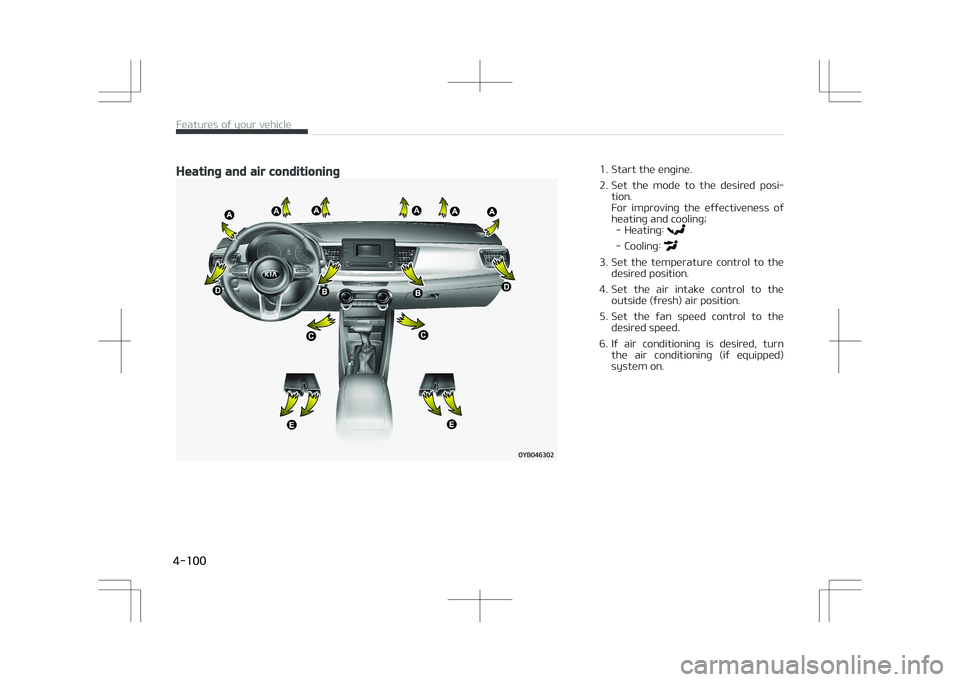
Heating and air conditioning1. Start the engine.
2. Set the mode to the desired posi‐tion.
For improving the effectiveness of
heating and cooling; - Heating:
- Cooling:
3. Set the temperature control to the desired position.
4. Set the air intake control to the outside (fresh) air position.
5. Set the fan speed control to the desired speed.
6. If air conditioning is desired, turn the air conditioning (if equipped)
system on.
Features of your vehicle
4-100
Page 186 of 523
Air conditioning (A/C)
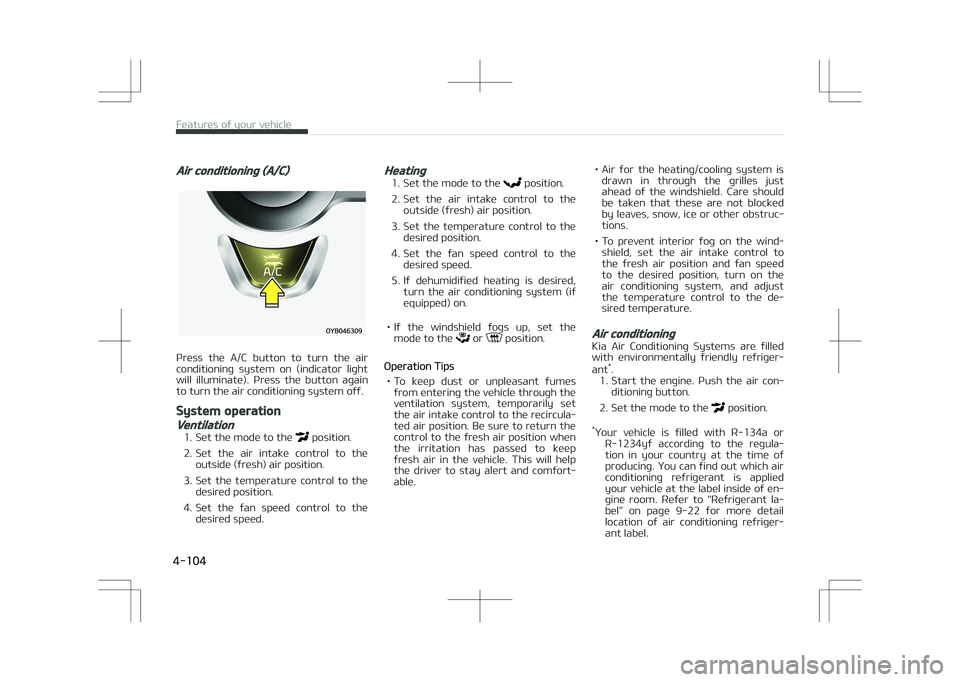
Press the A/C button to turn the air
conditioning system on (indicator light will illuminate). Press the button again
to turn the air conditioning system off.
System operation
Ventilation
1. Set the mode to the position.
2. Set the air intake control to the outside (fresh) air position.
3. Set the temperature control to the desired position.
4. Set the fan speed control to the desired speed.
Heating
1. Set the mode to the position.
2. Set the air intake control to the outside (fresh) air position.
3. Set the temperature control to the desired position.
4. Set the fan speed control to the desired speed.
5. If dehumidified heating is desired, turn the air conditioning system (if
equipped) on.
• If the windshield fogs up, set the mode to the
or position.
Operation Tips
• To keep dust or unpleasant fumes from entering the vehicle through the
ventilation system, temporarily set the air intake control to the recircula‐
ted air position. Be sure to return the
control to the fresh air position when
the irritation has passed to keep
fresh air in the vehicle. This will help the driver to stay alert and comfort‐
able. • Air for the heating/cooling system is
drawn in through the grilles just
ahead of the windshield. Care should
be taken that these are not blocked by leaves, snow, ice or other obstruc‐
tions.
• To prevent interior fog on the wind‐ shield, set the air intake control to
the fresh air position and fan speed to the desired position, turn on the
air conditioning system, and adjust
the temperature control to the de‐
sired temperature.
Air conditioning
Kia Air Conditioning Systems are filled
with environmentally friendly refriger‐
ant *
.
1. Start the engine. Push the air con‐ ditioning button.
2. Set the mode to the
position.
* Your vehicle is filled with R-134a or
R-1234yf according to the regula‐tion in your country at the time of
producing. You can find out which air
conditioning refrigerant is applied
your vehicle at the label inside of en‐
gine room. Refer to L
Page 187 of 523
3. Set the air intake control to theoutside air or recirculated air posi‐
tion.
4. Adjust the fan speed control and temperature control to maintain
maximum comfort.
CAUTION
•The refrigerant system should on‐ly be serviced by trained and certi‐fied technicians to insure properand safe operation.
•The refrigerant system should beserviced in a well-ventilated place.
•The air conditioning evaporator(cooling coil) shall never be re‐paired or replaced with one re‐moved from a used or salvagedvehicle and new replacement MACevaporators shall be certified (andlabeled) as meeting SAE StandardJ2842.
NOTICE
•When using the air conditioning
system, monitor the temperature
gauge closely while driving up hills
or in heavy traffic when outside
temperatures are high. Air condi‐
tioning system operation may
cause engine overheating. Contin‐
ue to use the blower fan but turn
the air conditioning system off if
the temperature gauge indicates
engine overheating.
•When opening the windows in hu‐
mid weather air conditioning may
create water droplets inside the
vehicle. Since excessive water
droplets may cause damage to
electrical equipment, air condition‐
ing should only be used with the
windows closed.
Air conditioning system operation tips
• If the vehicle has been parked in di‐ rect sunlight during hot weather,
open the windows for a short time to let the hot air inside the vehicle es‐
cape. • To help reduce moisture inside of the
windows on rainy or humid days, de‐
crease the humidity inside the vehicle
by operating the air conditioning sys‐ tem.
• During air conditioning system opera‐ tion, you may occasionally notice a
slight change in engine speed as the
air conditioning compressor cycles.
This is a normal system operation characteristic.
• Use the air conditioning system every month only for a few minutes to en‐
sure maximum system performance.
• When using the air conditioning sys‐ tem, you may notice clear waterdripping (or even puddling) on the
ground under the passenger side of
the vehicle. This is a normal system
operation characteristic.
• Operating the air conditioning system in the recirculated air position pro‐vides maximum cooling, however,
continual operation in this mode may
cause the air inside the vehicle to be‐
come stale.
• During cooling operation, you may oc‐ casionally notice a misty air flow be‐
cause of rapid cooling and humid air
intake. This is a normal system oper‐
ation characteristic.
4-105
4
Features of your vehicle
Page 192 of 523
NOTICE
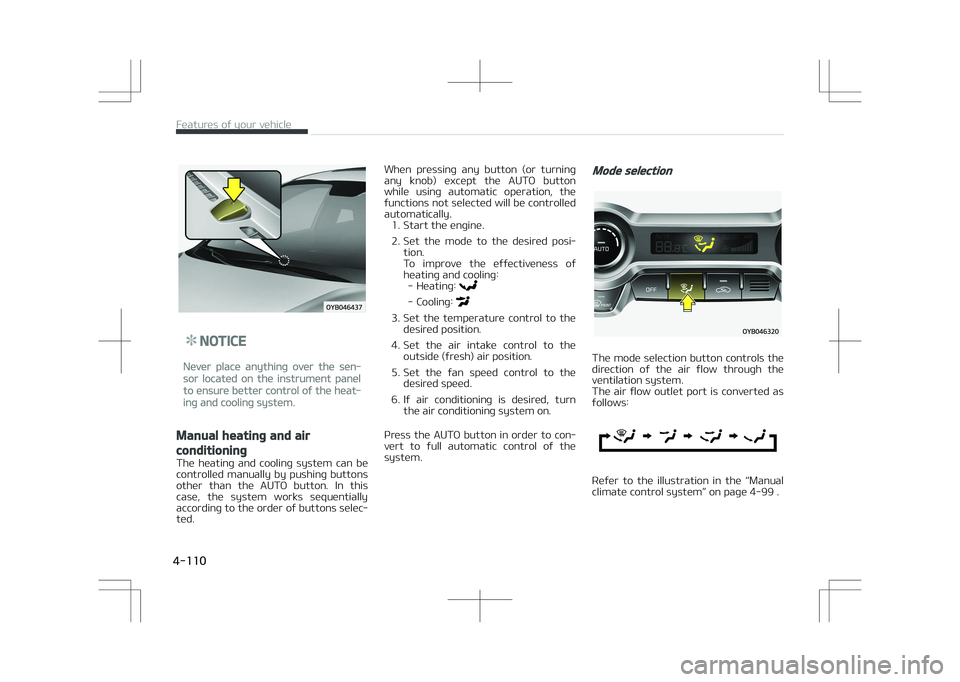
Never place anything over the sen‐
sor located on the instrument panel
to ensure better control of the heat‐
ing and cooling system.
Manual heating and air
conditioning
The heating and cooling system can be
controlled manually by pushing buttons other than the AUTO button. In this
case, the system works sequentially
according to the order of buttons selec‐ ted. When pressing any button (or turning
any knob) except the AUTO button
while using automatic operation, the
functions not selected will be controlled automatically. 1. Start the engine.
2. Set the mode to the desired posi‐ tion.
To improve the effectiveness of
heating and cooling: - Heating:
- Cooling:
3. Set the temperature control to the desired position.
4. Set the air intake control to the outside (fresh) air position.
5. Set the fan speed control to the desired speed.
6. If air conditioning is desired, turn the air conditioning system on.
Press the AUTO button in order to con‐ vert to full automatic control of the
system.
Mode selection
The mode selection button controls the
direction of the air flow through the ventilation system.
The air flow outlet port is converted as
follows:
Refer to the illustration in the L
Page 196 of 523
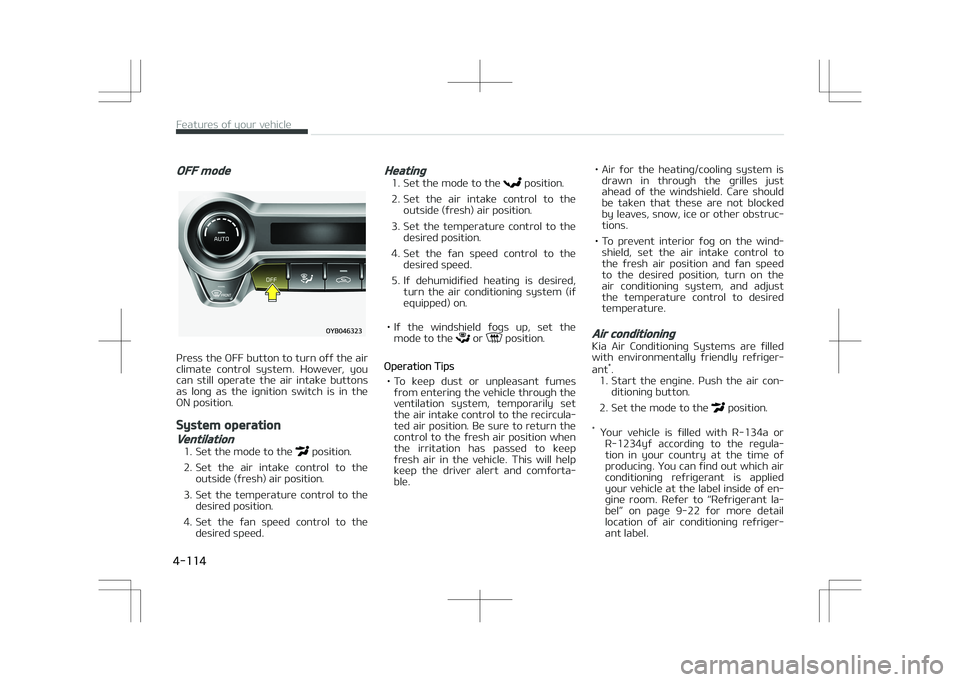
OFF mode
Press the OFF button to turn off the air
climate control system. However, you can still operate the air intake buttons
as long as the ignition switch is in the
ON position.
System operation
Ventilation
1. Set the mode to the position.
2. Set the air intake control to the outside (fresh) air position.
3. Set the temperature control to the desired position.
4. Set the fan speed control to the desired speed.
Heating
1. Set the mode to the position.
2. Set the air intake control to the outside (fresh) air position.
3. Set the temperature control to the desired position.
4. Set the fan speed control to the desired speed.
5. If dehumidified heating is desired, turn the air conditioning system (if
equipped) on.
• If the windshield fogs up, set the mode to the
or position.
Operation Tips
• To keep dust or unpleasant fumes from entering the vehicle through the
ventilation system, temporarily set the air intake control to the recircula‐
ted air position. Be sure to return the
control to the fresh air position when
the irritation has passed to keep
fresh air in the vehicle. This will help keep the driver alert and comforta‐
ble. • Air for the heating/cooling system is
drawn in through the grilles just
ahead of the windshield. Care should
be taken that these are not blocked by leaves, snow, ice or other obstruc‐
tions.
• To prevent interior fog on the wind‐ shield, set the air intake control to
the fresh air position and fan speed to the desired position, turn on the
air conditioning system, and adjust
the temperature control to desired
temperature.
Air conditioning
Kia Air Conditioning Systems are filled
with environmentally friendly refriger‐
ant *
.
1. Start the engine. Push the air con‐ ditioning button.
2. Set the mode to the
position.
* Your vehicle is filled with R-134a or
R-1234yf according to the regula‐tion in your country at the time of
producing. You can find out which air
conditioning refrigerant is applied
your vehicle at the label inside of en‐
gine room. Refer to L
Page 197 of 523
3. Set the air intake control to theoutside air or recirculated air posi‐
tion.
4. Adjust the fan speed control and temperature control to maintain
maximum comfort.
CAUTION
•The refrigerant system should on‐ly be serviced by trained and certi‐fied technicians to insure properand safe operation.
•The refrigerant system should beserviced in a well-ventilated place.
•The air conditioning evaporator(cooling coil) shall never be re‐paired or replaced with one re‐moved from a used or salvagedvehicle and new replacement MACevaporators shall be certified (andlabeled) as meeting SAE StandardJ2842.
NOTICE
•When using the air conditioning
system, monitor the temperature
gauge closely while driving up hills
or in heavy traffic when outside
temperatures are high. Air condi‐
tioning system operation may
cause engine overheating. Contin‐
ue to use the blower fan but turn
the air conditioning system off if
the temperature gauge indicates
engine overheating.
•When opening the windows in hu‐
mid weather air conditioning may
create water droplets inside the
vehicle. Since excessive water
droplets may cause damage to
electrical equipment, air condition‐
ing should only be used with the
windows closed.
Air conditioning system operation tips
• If the vehicle has been parked in di‐ rect sunlight during hot weather,
open the windows for a short time to let the hot air inside the vehicle es‐
cape. • To help reduce moisture inside of the
windows on rainy or humid days, de‐
crease the humidity inside the vehicle
by operating the air conditioning sys‐ tem.
• During air conditioning system opera‐ tion, you may occasionally notice a
slight change in engine speed as the
air conditioning compressor cycles.
This is a normal system operation characteristic.
• Use the air conditioning system every month only for a few minutes to en‐
sure maximum system performance.
• When using the air conditioning sys‐ tem, you may notice clear waterdripping (or even puddling) on the
ground under the passenger side of
the vehicle. This is a normal system
operation characteristic.
• Operating the air conditioning system in the recirculated air position pro‐vides maximum cooling, however,
continual operation in this mode may
cause the air inside the vehicle to be‐
come stale.
• During cooling operation, you may oc‐ casionally notice a misty air flow be‐
cause of rapid cooling and humid air
intake. This is a normal system oper‐
ation characteristic.
4-115
4
Features of your vehicle
Page 200 of 523
WINDSHIELD DEFROSTING AND DEFOGGING
WARNING
nWindshield heating
Do not use the or positionduring cooling operation in extreme‐ly humid weather. The difference be‐tween the temperature of the out‐side air and that of the windshieldcould cause the outer surface of thewindshield to fog up, causing loss ofvisibility. In this case, set the modeselection knob or button to the position and fan speed control knobor button to the lower speed.
• For maximum defrosting, set thetemperature control to the extreme
right/hot position and the fan speed control to the highest speed.
• If warm air to the floor is desired while defrosting or defogging, set the
mode to the floor-defrost position.
• Before driving, clear all snow and ice from the windshield, rear window,
outside rear view mirrors, and all side windows. • Clear all snow and ice from the hood
and air inlet in the cowl grill to im‐
prove heater and defroster efficiency
and to reduce the probability of fog‐
ging up the inside of the windshield.
Manual climate control system
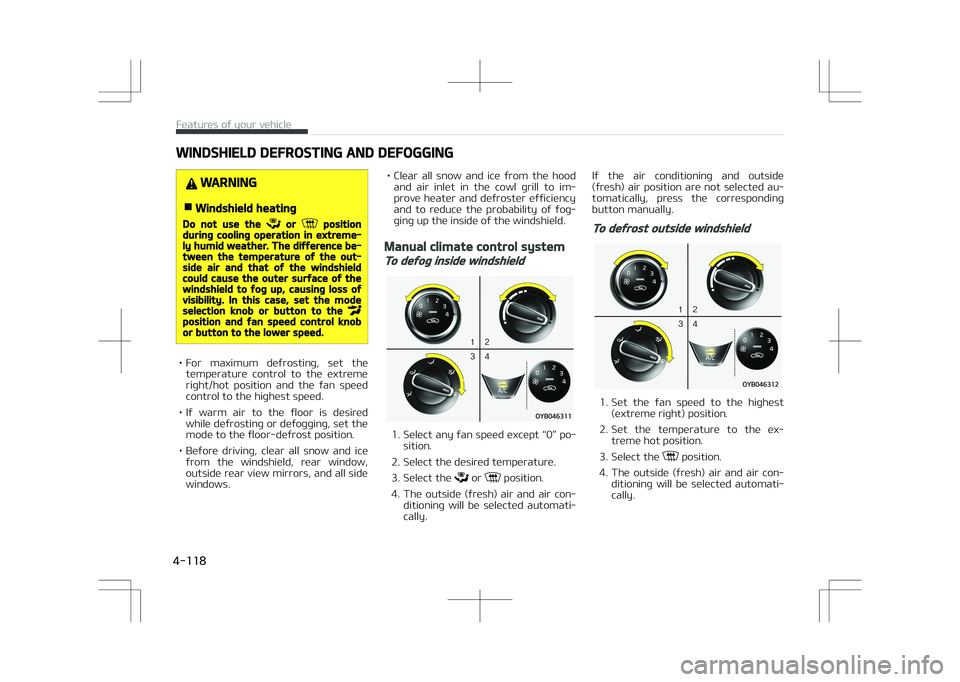
To defog inside windshield
1. Select any fan speed except L
Page 306 of 523
(Continued)
ways place the vehicle in P (Park),apply the parking brake and turn offthe engine before installing snowchains.
WARNING
nTire chains
•The use of chains may adverselyaffect vehicle handling.
•Do not exceed 30 km/h (20 mph)or the chain manufacturer’s rec‐ommended speed limit, whicheveris lower.
•Drive carefully and avoid bumps,holes, sharp turns, and other roadhazards, which may cause the ve‐hicle to bounce.
•Avoid sharp turns or lockedwheelbraking.
CAUTION
•Chains that are the wrong size orimproperly installed can damageyour vehicle's brake lines, suspen‐sion, body and wheels.
•Stop driving and retighten thechains any time you hear themhitting the vehicle.
Use high quality ethylene glycol
coolant
Your vehicle is delivered with high quali‐
ty ethylene glycol coolant in the cooling
system. It is the only type of coolant
that should be used because it helps
prevent corrosion in the cooling sys‐ tem, lubricates the water pump and
prevents freezing. Be sure to replace or
replenish your coolant in accordance with the maintenance schedule in
L
Page 323 of 523
IF THE ENGINE OVERHEATS
If your temperature gauge indicates
overheating, you will experience a loss of power, or hear loud pinging or knock‐
ing, the engine is probably too hot. If
this happens, you should: 1. Pull off the road and stop as soon as it is safe to do so.
2. Place the shift lever in P (automatic transaxle) or neutral (manual
transaxle) and set the parking
brake. If the air conditioning is on, turn it off.
3. If engine coolant is running out un‐ der the vehicle or steam is coming
out from the hood, stop the engine.
Do not open the hood until the
coolant has stopped running or the
steaming has stopped. If there is no
visible loss of engine coolant and no
steam, leave the engine running
and check to be sure the engine
cooling fan is operating. If the fan is
not running, turn the engine off.
4. Check to see if the water pump drive belt is missing. If it is not
missing, check to see that it is
tight.
If the drive belt seems to be satis‐
factory, check for coolant leaking
from the radiator, hoses or under
the vehicle. (If the air conditioning had been in use, it is normal for
cold water to be draining from it
when you stop).
WARNING
While the engine is running, keephair, hands and clothing away frommoving parts such as the fan anddrive belts to prevent injury.
5. If the water pump drive belt is bro‐ ken or engine coolant is leaking out,
stop the engine immediately and
call a professional workshop. Kia
recommends to call an authorized
Kia dealer/service partner.
WARNING
Do not remove the radiator capwhen the engine is hot. This can al‐low coolant to blow out of the open‐ing and cause serious burns.
6. If you cannot find the cause of the overheating, wait until the engine
temperature has returned to nor‐
mal. Then, if coolant has been lost,
carefully add coolant to the reser‐
voir to bring the fluid level in the
reservoir up to the halfway mark.
7. Proceed with caution, keeping alert for further signs of overheating. Ifoverheating happens again, call a
professional workshop. Kia recom‐
mends to call an authorized Kia
dealer/service partner.
CAUTION
•Serious loss of coolant indicatesthere is a leak in the cooling sys‐tem. In this case, have the sys‐tem checked by a professionalworkshop. Kia recommends tovisit an authorized Kia dealer/service partner.
•When the engine overheats fromlow engine coolant, suddenlyadding engine coolant may causecracks in the engine. To preventdamage, add engine coolantslowly in small quantities.
7-07
7
What to do in an emergency
Page 347 of 523
Engine compartment................................................................ 8-04
Maintenance services............................................................... 8-07Owner’s responsibility.......................................................... 8-07
Owner maintenance precautions....................................... 8-07
Owner maintenance................................................................. 8-09 Owner maintenance schedule.............................................8-09
Scheduled maintenance service............................................. 8-11 Scheduled maintenance service precaution..................... 8-11
Normal Maintenance Schedule - For Gasoline
Engine [For Europe (Except Russia)]................................. 8-12
Normal Maintenance Schedule - For Gasoline
Engine [For Europe (Except Russia)] (continued)............ 8-14
Maintenance Under Severe Usage Conditions -
For Gasoline Engine [For Europe (Except Russia)].......... 8-17
Normal Maintenance Schedule - For Gasoline
Engine [Except Europe (Including Russia)]........................8-19
Normal Maintenance Schedule - For Gasoline
Engine [Except Europe (Including Russia)] (con‐
tinued)..................................................................................... 8-21
Maintenance Under Severe Usage Conditions -
For Gasoline Engine [Except Europe (Including
Russia)]................................................................................... 8-25
Normal Maintenance Schedule - For Diesel En‐
gine [For Europe (Except Russia)]...................................... 8-28
Normal Maintenance Schedule - For Diesel En‐
gine [For Europe (Except Russia)] (continued).................8-30
Maintenance Under Severe Usage Conditions -
For Diesel Engine [For Europe (Except Russia)]............... 8-32
Normal Maintenance Schedule - For Diesel En‐
gine [Except Europe (Including Russia)]............................ 8-34 Normal Maintenance Schedule - For Diesel En‐
gine [Except Europe (Including Russia)] (continued)....... 8-36
Maintenance Under Severe Usage Conditions -
For Diesel Engine [Except Europe (Including Russia)]..... 8-39
Explanation of scheduled maintenance items..................... 8-41 Engine oil and filter............................................................... 8-41
Drive belts.............................................................................. 8-41
Fuel filter cartridge (for diesel).......................................... 8-41
Fuel filter (for gasoline)....................................................... 8-41
Fuel lines, fuel hoses and connections.............................. 8-41
Vapor hose (for gasoline engine) and fuel filler cap........8-42
Vacuum crankcase ventilation hoses ................................8-42
Air cleaner filter.....................................................................8-42
Spark plugs (for gasoline engine)....................................... 8-42
Valve clearance (for Kappa 1.0L T-GDI engine)............... 8-42
Cooling system...................................................................... 8-42
Coolant.................................................................................... 8-42
Manual transaxle fluid .........................................................8-42
Automatic transaxle fluid ................................................... 8-42
Brake hoses and lines........................................................... 8-43
Brake/Clutch fluid ................................................................ 8-43
Parking brake......................................................................... 8-43
Brake discs, pads, calipers and rotors............................... 8-43
Suspension mounting bolts................................................. 8-43Steering gear box linkage & boots/lower arm
ball joint.................................................................................. 8-43
Drive shafts and boots......................................................... 8-43
Air conditioning refrigerant ................................................ 8-43
Engine oil (Gasoline)..................................................................8-44 Checking the engine oil level................................................8-44
Maintenance
8