maintenance KIA STONIC 2018 Repair Manual
[x] Cancel search | Manufacturer: KIA, Model Year: 2018, Model line: STONIC, Model: KIA STONIC 2018Pages: 523, PDF Size: 24.99 MB
Page 397 of 523
Changing the coolant
Have the coolant replaced by a profes‐
sional workshop. Kia recommends to visit an authorized Kia dealer/service
partner.
CAUTION
Put a thick cloth around the radiatorcap before refilling the coolant in or‐der to prevent the coolant fromoverflowing into engine parts suchas the alternator.
WARNING
nCoolant
•Do not use radiator coolant or an‐tifreeze in the washer fluid reser‐voir.
•Radiator coolant can severely ob‐scure visibility when sprayed onthe windshield and may cause lossof vehicle control or damage thepaint and body trim.
8-51
8
Maintenance
Page 399 of 523
AUTOMATIC TRANSAXLE FLUID (IF EQUIPPED)
Checking the automatic
transaxle fluid level
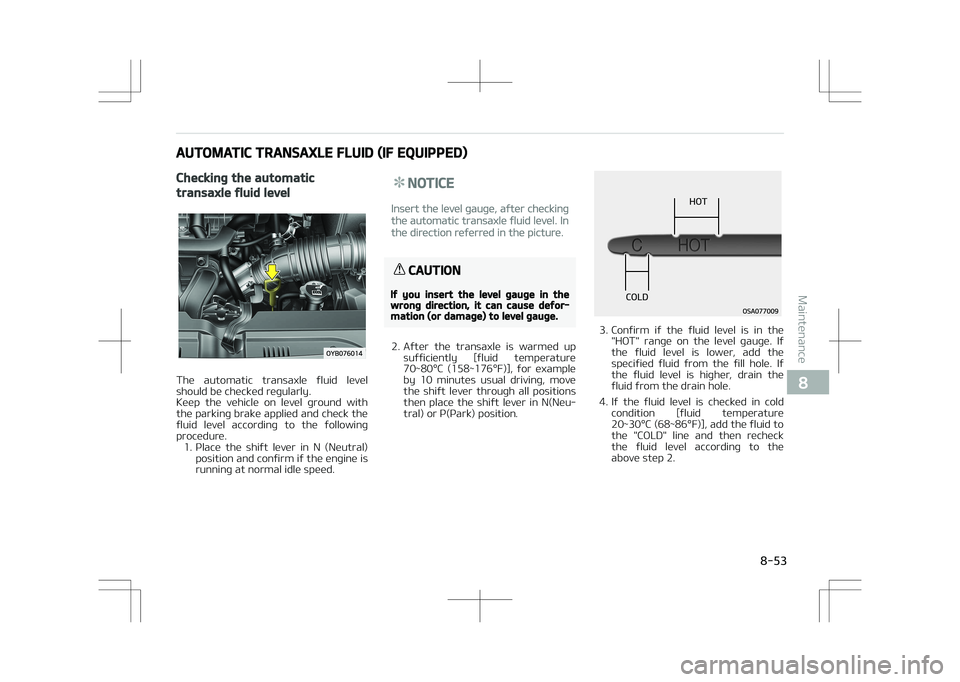
The automatic transaxle fluid level
should be checked regularly.
Keep the vehicle on level ground with the parking brake applied and check the
fluid level according to the following
procedure. 1. Place the shift lever in N (Neutral) position and confirm if the engine is
running at normal idle speed.
NOTICE
Insert the level gauge, after checking
the automatic transaxle fluid level. In
the direction referred in the picture.
CAUTION
If you insert the level gauge in thewrong direction, it can cause defor‐mation (or damage) to level gauge.
2. After the transaxle is warmed up sufficiently [fluid temperature
70~80°C (158~176°F)], for example
by 10 minutes usual driving, move
the shift lever through all positions
then place the shift lever in N(Neu‐
tral) or P(Park) position.
)05
$0-%
3. Confirm if the fluid level is in the "HOT" range on the level gauge. If
the fluid level is lower, add the
specified fluid from the fill hole. If
the fluid level is higher, drain the
fluid from the drain hole.
4. If the fluid level is checked in cold condition [fluid temperature
20~30°C (68~86°F)], add the fluid to
the "COLD" line and then recheck the fluid level according to the
above step 2.
8-53
8
Maintenance
Page 401 of 523
WASHER FLUID
Checking the washer fluid level
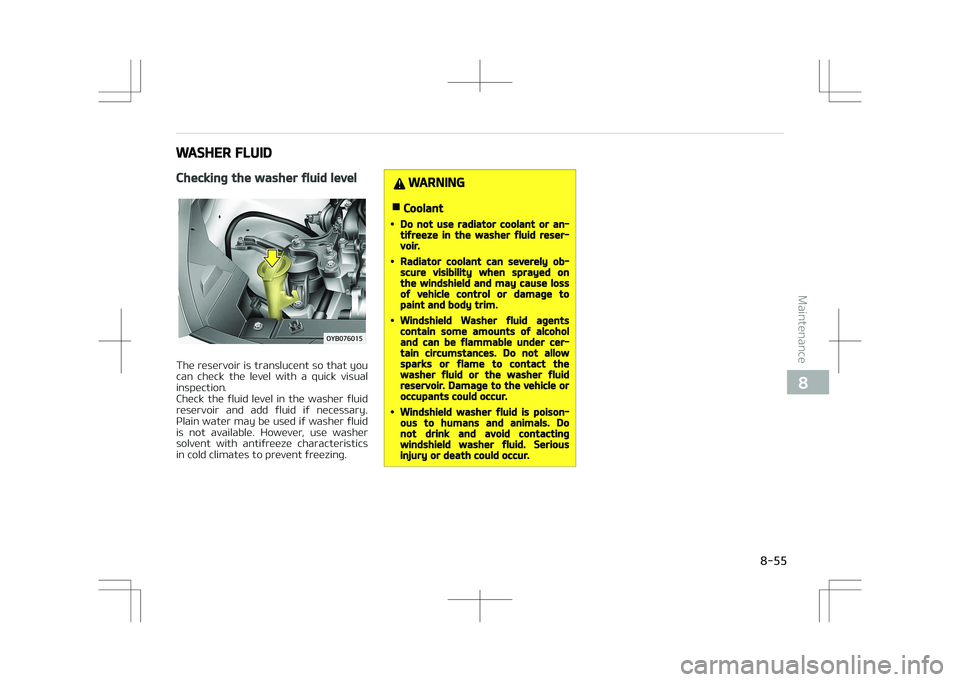
The reservoir is translucent so that you
can check the level with a quick visual inspection.
Check the fluid level in the washer fluid
reservoir and add fluid if necessary.
Plain water may be used if washer fluid is not available. However, use washer
solvent with antifreeze characteristics
in cold climates to prevent freezing.
WARNING
nCoolant
•Do not use radiator coolant or an‐tifreeze in the washer fluid reser‐voir.
•Radiator coolant can severely ob‐scure visibility when sprayed onthe windshield and may cause lossof vehicle control or damage topaint and body trim.
•Windshield Washer fluid agentscontain some amounts of alcoholand can be flammable under cer‐tain circumstances. Do not allowsparks or flame to contact thewasher fluid or the washer fluidreservoir. Damage to the vehicle oroccupants could occur.
•Windshield washer fluid is poison‐ous to humans and animals. Donot drink and avoid contactingwindshield washer fluid. Seriousinjury or death could occur.
8-55
8
Maintenance
Page 403 of 523
FUEL FILTER (FOR DIESEL)
Draining water from the fuel
filter
The fuel filter for diesel engine plays an
important role of separating water
from fuel and accumulating the water in its bottom.
If water accumulates in the fuel filter,
the warning light comes on when the
ignition switch is in the ON position.
If this warning light illumi‐ nates, take your car to a pro‐
fessional workshop and havedrain the water and check the
system. Kia recommends tovisit an authorized Kia dealer/
service partner.
CAUTION
If the water accumulated in the fuelfilter is not drained at proper times,damages to the major parts such asthe fuel system can be caused bywater permeation in the fuel filter.
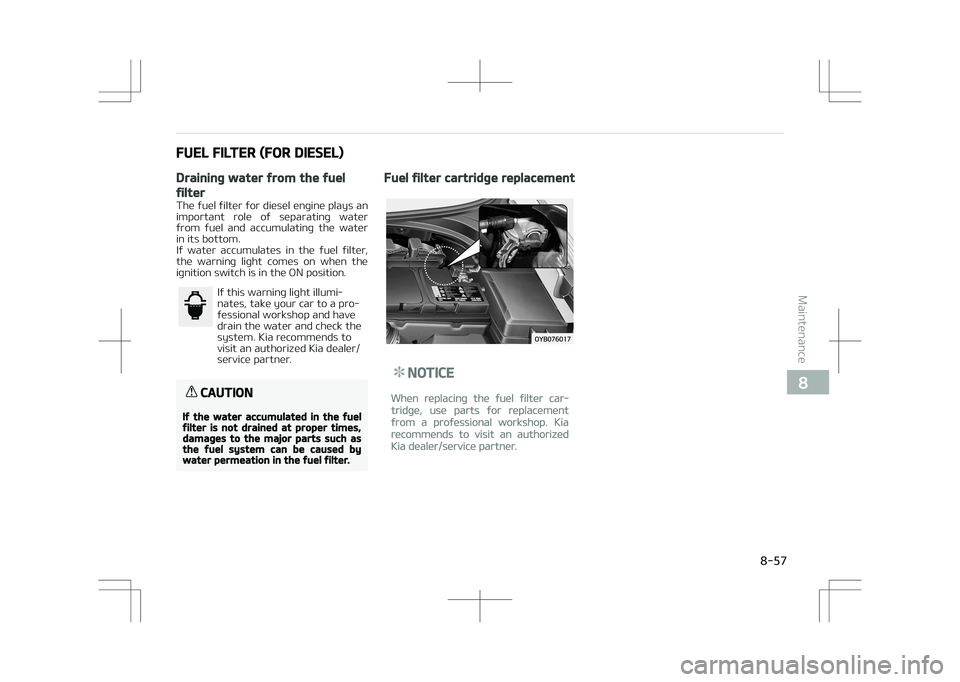
Fuel filter cartridge replacement
NOTICE
When replacing the fuel filter car‐
tridge, use parts for replacement
from a professional workshop. Kia
recommends to visit an authorized
Kia dealer/service partner.
8-57
8
Maintenance
Page 404 of 523
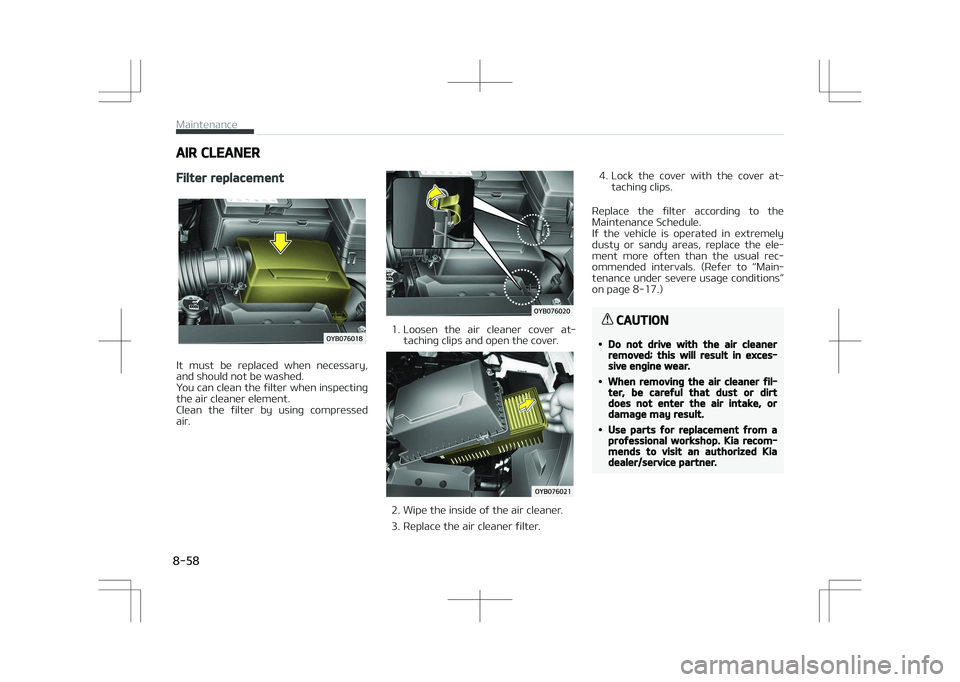
AIR CLEANER
Filter replacement
It must be replaced when necessary,
and should not be washed.
You can clean the filter when inspecting the air cleaner element.
Clean the filter by using compressed
air.
1. Loosen the air cleaner cover at‐ taching clips and open the cover.
2. Wipe the inside of the air cleaner.
3. Replace the air cleaner filter. 4. Lock the cover with the cover at‐
taching clips.
Replace the filter according to the
Maintenance Schedule.
If the vehicle is operated in extremely dusty or sandy areas, replace the ele‐
ment more often than the usual rec‐
ommended intervals. (Refer to L
Page 405 of 523
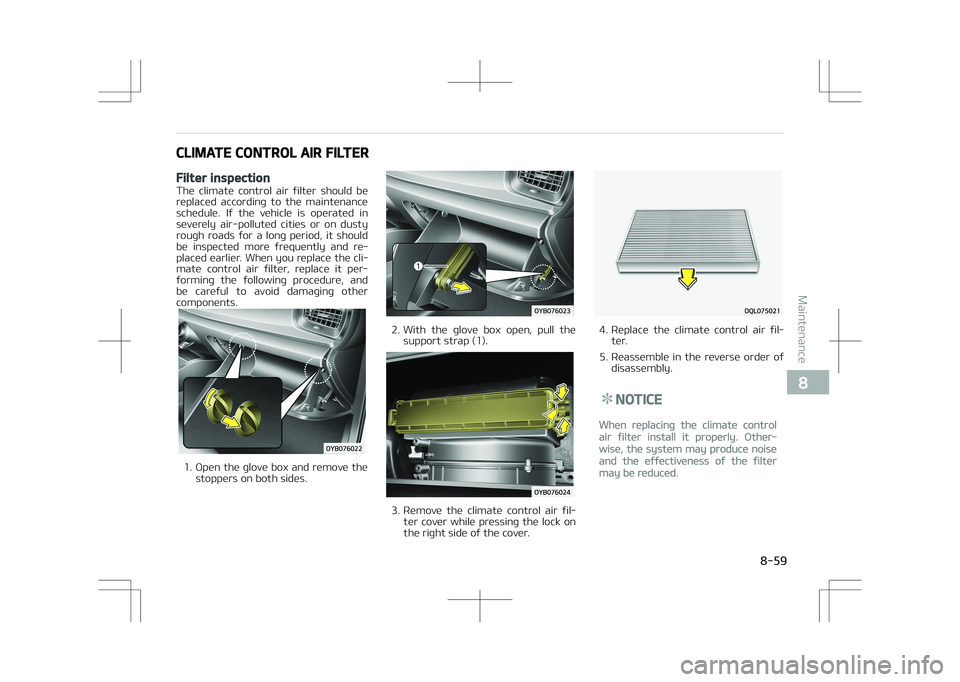
CLIMATE CONTROL AIR FILTER
Filter inspection
The climate control air filter should bereplaced according to the maintenance
schedule. If the vehicle is operated in
severely air-polluted cities or on dusty rough roads for a long period, it should
be inspected more frequently and re‐
placed earlier. When you replace the cli‐ mate control air filter, replace it per‐
forming the following procedure, and
be careful to avoid damaging other components.
1. Open the glove box and remove the stoppers on both sides.
2. With the glove box open, pull thesupport strap (1).
3. Remove the climate control air fil‐ter cover while pressing the lock on
the right side of the cover.
4. Replace the climate control air fil‐ ter.
5. Reassemble in the reverse order of disassembly.
NOTICE
When replacing the climate control
air filter install it properly. Other‐
wise, the system may produce noise
and the effectiveness of the filter
may be reduced.
8-59
8
Maintenance
Page 406 of 523
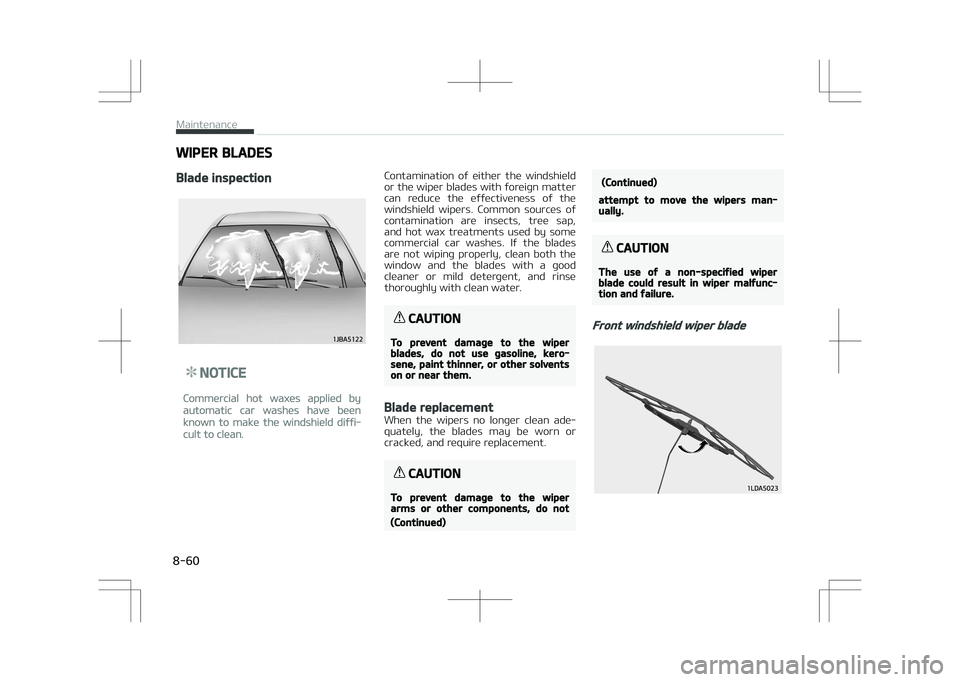
WIPER BLADES
Blade inspection
NOTICE
Commercial hot waxes applied by
automatic car washes have been
known to make the windshield diffi‐
cult to clean.
Contamination of either the windshield
or the wiper blades with foreign matter can reduce the effectiveness of the
windshield wipers. Common sources of
contamination are insects, tree sap, and hot wax treatments used by some
commercial car washes. If the blades
are not wiping properly, clean both the window and the blades with a good
cleaner or mild detergent, and rinse
thoroughly with clean water.
CAUTION
To prevent damage to the wiperblades, do not use gasoline, kero‐sene, paint thinner, or other solventson or near them.
Blade replacement
When the wipers no longer clean ade‐
quately, the blades may be worn or cracked, and require replacement.
CAUTION
To prevent damage to the wiperarms or other components, do not
(Continued)
(Continued)
attempt to move the wipers man‐ually.
CAUTION
The use of a non-specified wiperblade could result in wiper malfunc‐tion and failure.
Front windshield wiper blade
Maintenance
8-60
Page 407 of 523
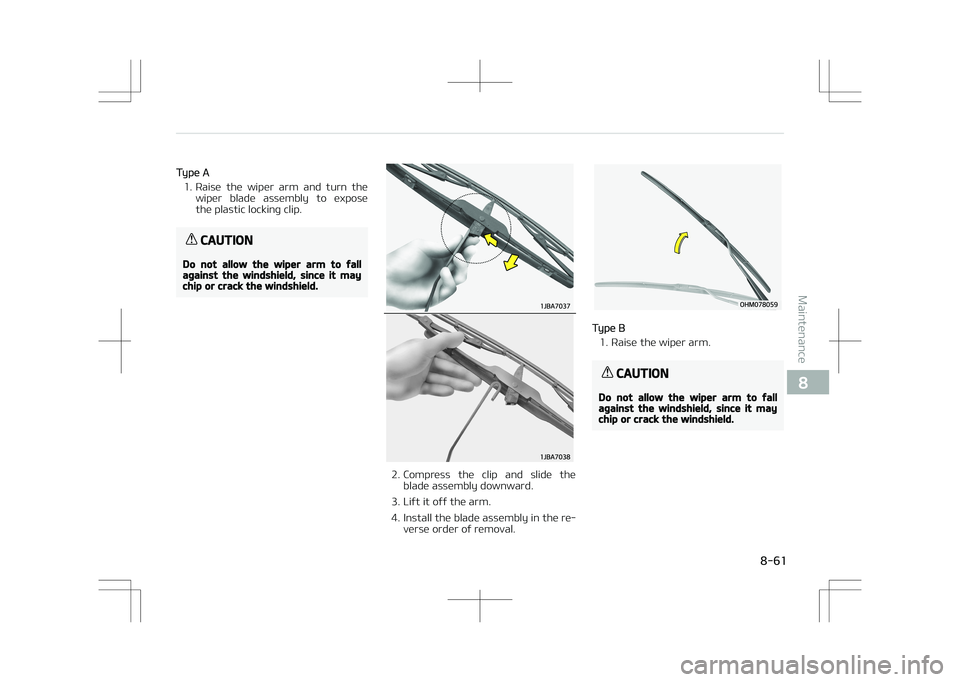
Type A
1. Raise the wiper arm and turn the wiper blade assembly to expose
the plastic locking clip.
CAUTION
Do not allow the wiper arm to fallagainst the windshield, since it maychip or crack the windshield.
2. Compress the clip and slide the blade assembly downward.
3. Lift it off the arm.
4. Install the blade assembly in the re‐ verse order of removal.
Type B
1. Raise the wiper arm.
CAUTION
Do not allow the wiper arm to fallagainst the windshield, since it maychip or crack the windshield.
8-61
8
Maintenance
Page 408 of 523
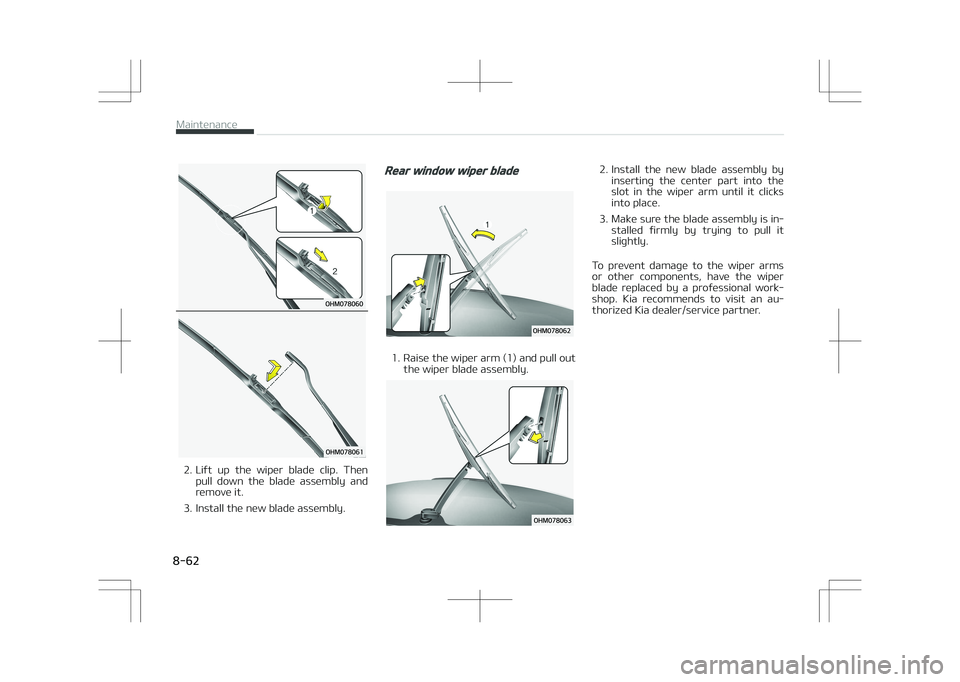
2. Lift up the wiper blade clip. Thenpull down the blade assembly and
remove it.
3. Install the new blade assembly.
Rear window wiper blade
1. Raise the wiper arm (1) and pull out the wiper blade assembly.
2. Install the new blade assembly byinserting the center part into the
slot in the wiper arm until it clicks
into place.
3. Make sure the blade assembly is in‐ stalled firmly by trying to pull it
slightly.
To prevent damage to the wiper arms or other components, have the wiper
blade replaced by a professional work‐
shop. Kia recommends to visit an au‐ thorized Kia dealer/service partner.
Maintenance
8-62
Page 409 of 523
BATTERY
For best battery service
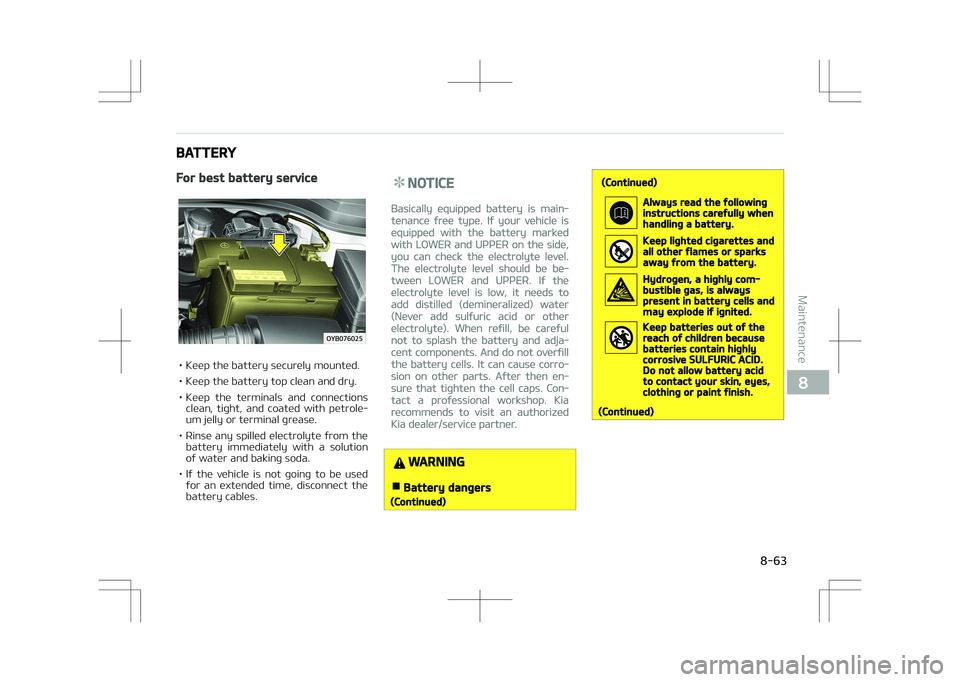
• Keep the battery securely mounted.
• Keep the battery top clean and dry.
• Keep the terminals and connectionsclean, tight, and coated with petrole‐
um jelly or terminal grease.
• Rinse any spilled electrolyte from the battery immediately with a solution
of water and baking soda.
• If the vehicle is not going to be used for an extended time, disconnect the
battery cables.
NOTICE
Basically equipped battery is main‐
tenance free type. If your vehicle is
equipped with the battery marked
with LOWER and UPPER on the side,
you can check the electrolyte level.
The electrolyte level should be be‐
tween LOWER and UPPER. If the
electrolyte level is low, it needs to
add distilled (demineralized) water
(Never add sulfuric acid or other
electrolyte). When refill, be careful
not to splash the battery and adja‐
cent components. And do not overfill
the battery cells. It can cause corro‐
sion on other parts. After then en‐
sure that tighten the cell caps. Con‐
tact a professional workshop. Kia
recommends to visit an authorized
Kia dealer/service partner.
WARNING
nBattery dangers
(Continued)
(Continued)
Always read the followinginstructions carefully whenhandling a battery.
Keep lighted cigarettes andall other flames or sparksaway from the battery.
Hydrogen, a highly com‐bustible gas, is alwayspresent in battery cells andmay explode if ignited.
Keep batteries out of thereach of children becausebatteries contain highlycorrosive SULFURIC ACID.Do not allow battery acidto contact your skin, eyes,clothing or paint finish.
(Continued)
8-63
8
Maintenance