service KIA VENGA 2011 Repair Manual
[x] Cancel search | Manufacturer: KIA, Model Year: 2011, Model line: VENGA, Model: KIA VENGA 2011Pages: 761, PDF Size: 34.65 MB
Page 632 of 761
621
What to do in an emergency
✽✽NOTICE
If the TPMS, Low Tyre Pressure and Position indicators do not illuminate
for 3 seconds when the ignitionswitch is turned to the ON position
or engine is running, or if they
remain illuminated after coming on
for approximately 3 seconds, take
your car to your nearest authorised
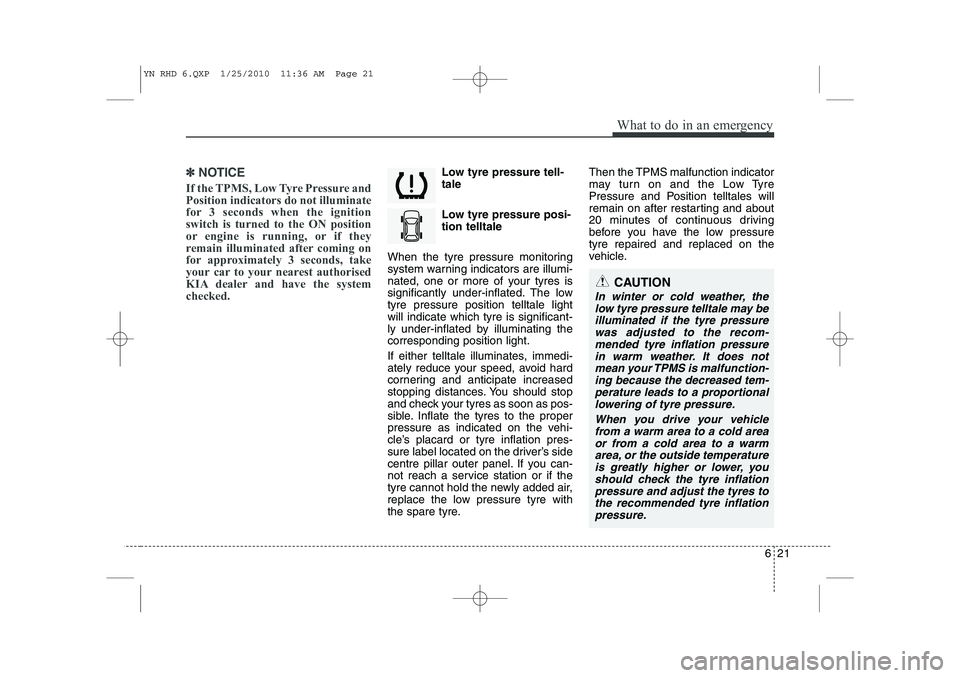
KIA dealer and have the systemchecked.Low tyre pressure tell- tale
Low tyre pressure posi- tion telltale
When the tyre pressure monitoring
system warning indicators are illumi-
nated, one or more of your tyres is
significantly under-inflated. The lowtyre pressure position telltale lightwill indicate which tyre is significant-
ly under-inflated by illuminating thecorresponding position light.
If either telltale illuminates, immedi-
ately reduce your speed, avoid hard
cornering and anticipate increased
stopping distances. You should stop
and check your tyres as soon as pos-
sible. Inflate the tyres to the proper
pressure as indicated on the vehi-
cle’s placard or tyre inflation pres-
sure label located on the driver’s side
centre pillar outer panel. If you can-
not reach a service station or if the
tyre cannot hold the newly added air,
replace the low pressure tyre with
the spare tyre. Then the TPMS malfunction indicator
may turn on and the Low Tyre
Pressure and Position telltales will
remain on after restarting and about
20 minutes of continuous driving
before you have the low pressuretyre repaired and replaced on the
vehicle.
CAUTION
In winter or cold weather, the
low tyre pressure telltale may beilluminated if the tyre pressurewas adjusted to the recom- mended tyre inflation pressurein warm weather. It does notmean your TPMS is malfunction- ing because the decreased tem-perature leads to a proportionallowering of tyre pressure.
When you drive your vehiclefrom a warm area to a cold area or from a cold area to a warmarea, or the outside temperatureis greatly higher or lower, you should check the tyre inflationpressure and adjust the tyres tothe recommended tyre inflation pressure.
YN RHD 6.QXP 1/25/2010 11:36 AM Page 21
Page 634 of 761
623
What to do in an emergency
Changing a tyre with TPMS
If you have a flat tyre, the Low Tyre
Pressure and Position telltales will
come on. Have the flat tyre repaired
by an authorised KIA dealer as soon
as possible or replace the flat tyre
with the spare tyre. Each wheel is equipped with a tyre pressure sensor mounted inside the
tyre behind the valve stem. You must
use TPMS specific wheels. It is rec-
ommended that you always have
your tyres serviced by an authorised
KIA dealer.Even if you replace the low pressure
tyre with the spare tyre, the Low Tyre
Pressure and Position telltales will
remain on until the low pressure tyre
is repaired and placed on the vehi-
cle.
After you replace the low pressure
tyre with the spare tyre, the TPMS
malfunction indicator may illuminate
after a few minutes because theTPMS sensor mounted on the sparewheel is not initiated.
Once the low pressure tyre is rein- flated to the recommended pressure
and installed on the vehicle or theTPMS sensor mounted on the
replaced spare wheel is initiated by
an authorised KIA dealer, the TPMS
malfunction indicator and the lowtyre pressure and position telltales
will extinguish within a few minutes of
driving.
If the indicators are not extinguished
after a few minutes of driving, please
visit an authorised KIA dealer.CAUTION
If a original mounted tyre is
replaced with the spare tyre, theTPMS sensor on the replaced spare wheel should be initiatedand the TPMS sensor on theoriginal mounted wheel shouldbe deactivated. If the TPMS sen- sor on the original mountedwheel located in the spare tyrecarrier still activates, the tyre pressure monitoring systemmay not operate properly. Havethe tyre with TPMS serviced or replaced by an authorised KIAdealer.
CAUTION
NEVER use a puncture-repair-ing agent to repair and/or inflatea low pressure tyre. The tyre sealant can damage the tyrepressure sensor. If used, youwill have to replace the tyre pressure sensor.
YN RHD 6.QXP 1/25/2010 11:36 AM Page 23
Page 636 of 761
625
What to do in an emergency
TOWING
Towing service
If emergency towing is necessary, we
recommend having it done by an autho-
rised KIA dealer or a commercial tow-
truck service. Proper lifting and towing
procedures are necessary to prevent
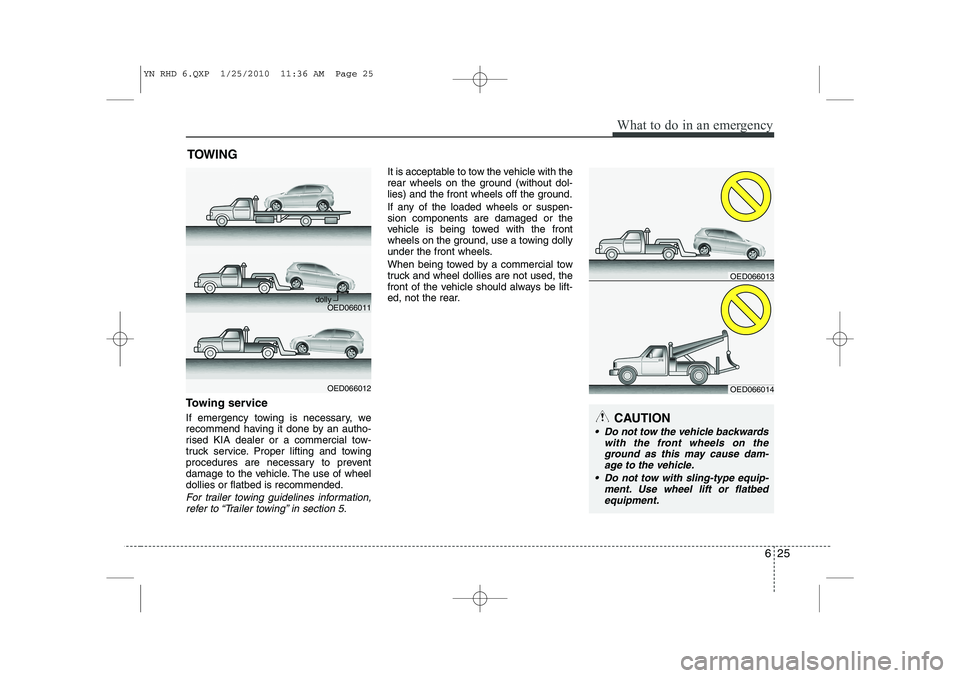
damage to the vehicle. The use of wheeldollies or flatbed is recommended.
For trailer towing guidelines information, refer to “Trailer towing” in section 5.
It is acceptable to tow the vehicle with the
rear wheels on the ground (without dol-
lies) and the front wheels off the ground.
If any of the loaded wheels or suspen- sion components are damaged or the
vehicle is being towed with the front
wheels on the ground, use a towing dolly
under the front wheels.
When being towed by a commercial tow
truck and wheel dollies are not used, the
front of the vehicle should always be lift-
ed, not the rear.
CAUTION
Do not tow the vehicle backwards with the front wheels on the
ground as this may cause dam-age to the vehicle.
Do not tow with sling-type equip- ment. Use wheel lift or flatbedequipment.
OED066011
OED066012
dolly
OED066014
OED066013
YN RHD 6.QXP 1/25/2010 11:36 AM Page 25
Page 638 of 761
Emergency towing
If towing is necessary, we recommend
you to have it done by an authorised
KIA dealer or a commercial tow truck
service.If towing service is not available in an
emergency, your vehicle may be tem-
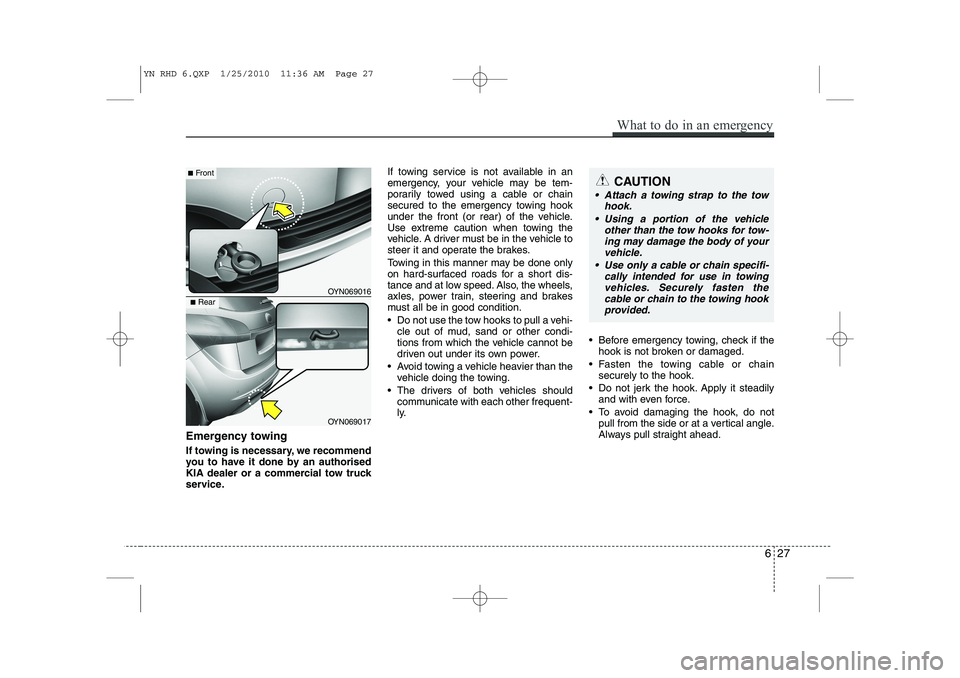
porarily towed using a cable or chain
secured to the emergency towing hook
under the front (or rear) of the vehicle.
Use extreme caution when towing the
vehicle. A driver must be in the vehicle to
steer it and operate the brakes.
Towing in this manner may be done only
on hard-surfaced roads for a short dis-
tance and at low speed. Also, the wheels,
axles, power train, steering and brakes
must all be in good condition.
Do not use the tow hooks to pull a vehi-
cle out of mud, sand or other condi-
tions from which the vehicle cannot be
driven out under its own power.
Avoid towing a vehicle heavier than the vehicle doing the towing.
The drivers of both vehicles should communicate with each other frequent-
ly. Before emergency towing, check if the
hook is not broken or damaged.
Fasten the towing cable or chain securely to the hook.
Do not jerk the hook. Apply it steadily and with even force.
To avoid damaging the hook, do not pull from the side or at a vertical angle.
Always pull straight ahead.
CAUTION
Attach a towing strap to the tow
hook.
Using a portion of the vehicle other than the tow hooks for tow-ing may damage the body of yourvehicle.
Use only a cable or chain specifi- cally intended for use in towingvehicles. Securely fasten thecable or chain to the towing hookprovided.
What to do in an emergency
27
6
OYN069016
■ Front
OYN069017
■Rear
YN RHD 6.QXP 1/25/2010 11:36 AM Page 27
Page 639 of 761
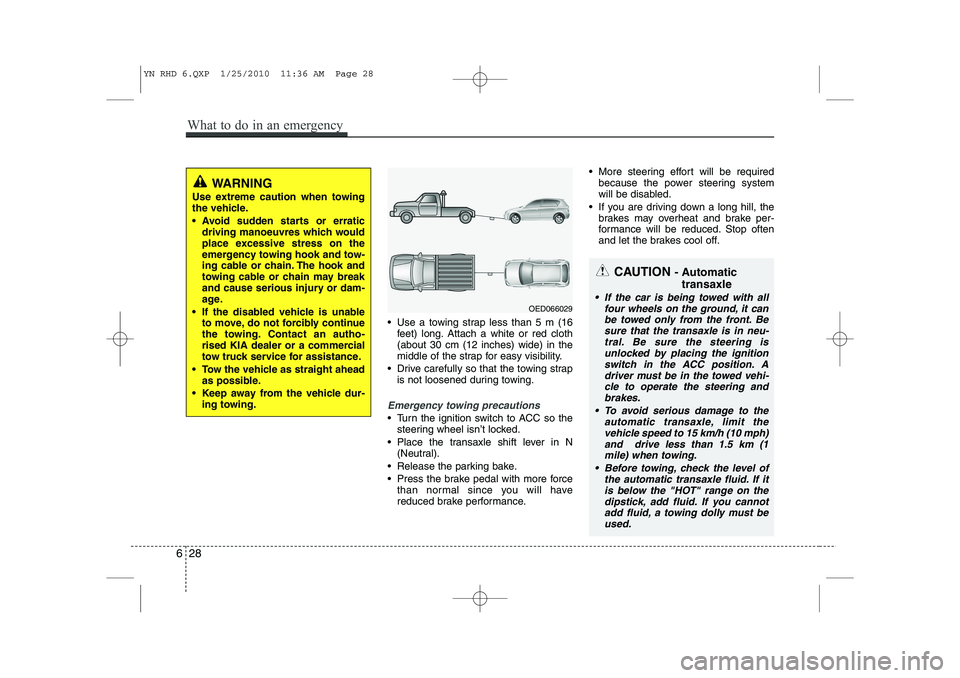
Use a towing strap less than 5 m (16feet) long. Attach a white or red cloth (about 30 cm (12 inches) wide) in the
middle of the strap for easy visibility.
Drive carefully so that the towing strap is not loosened during towing.
Emergency towing precautions
Turn the ignition switch to ACC so thesteering wheel isn’t locked.
Place the transaxle shift lever in N (Neutral).
Release the parking bake.
Press the brake pedal with more force than normal since you will have
reduced brake performance. More steering effort will be required
because the power steering system
will be disabled.
If you are driving down a long hill, the brakes may overheat and brake per-
formance will be reduced. Stop often
and let the brakes cool off.
WARNING
Use extreme caution when towing
the vehicle.
Avoid sudden starts or erratic driving manoeuvres which would
place excessive stress on the
emergency towing hook and tow-
ing cable or chain. The hook and
towing cable or chain may break
and cause serious injury or dam-
age.
If the disabled vehicle is unable to move, do not forcibly continue
the towing. Contact an autho-
rised KIA dealer or a commercial
tow truck service for assistance.
Tow the vehicle as straight ahead as possible.
Keep away from the vehicle dur- ing towing.
CAUTION - Automatic
transaxle
If the car is being towed with all four wheels on the ground, it can
be towed only from the front. Besure that the transaxle is in neu- tral. Be sure the steering isunlocked by placing the ignition
switch in the ACC position. Adriver must be in the towed vehi-cle to operate the steering and brakes.
To avoid serious damage to the automatic transaxle, limit thevehicle speed to 15 km/h (10 mph)and drive less than 1.5 km (1
mile) when towing.
Before towing, check the level of the automatic transaxle fluid. If itis below the "HOT" range on thedipstick, add fluid. If you cannot
add fluid, a towing dolly must beused.OED066029
628
What to do in an emergency
YN RHD 6.QXP 1/25/2010 11:36 AM Page 28
Page 641 of 761
7
Engine compartment / 7-2 Maintenance services / 7-3
Owner maintenance / 7-5Scheduled maintenance service / 7-7Explanation of scheduled maintenance items / 7-20Engine oil / 7-24Engine coolant / 7-25Brake/clutch fluid / 7-28Automatic transaxle fluid / 7-29
Washer fluid / 7-31Parking brake / 7-31
Fuel filter / 7-32
Air cleaner / 7-33
Wiper blades / 7-34Battery / 7-37
Tyres and wheels / 7-40Fuses / 7-50Light bulbs / 7-59
Appearance care / 7-68
Emission control system / 7-74
Maintenance
YN RHD 7.QXP 10/20/2009 4:45 PM Page 1
Page 643 of 761

73
Maintenance
MAINTENANCE SERVICES
You should exercise the utmost care to
prevent damage to your vehicle and
injury to yourself whenever performing
any maintenance or inspection proce-
dures.
Should you have any doubts concerning
the inspection or servicing of your vehi-
cle, we strongly recommend that you
have an authorised KIA dealer perform
this work.
An authorised KIA dealer has factory-
trained technicians and genuine KIA
parts to service your vehicle properly. For
expert advice and quality service, see an
authorised KIA dealer.
Inadequate, incomplete or insufficient
servicing may result in operational prob-
lems with your vehicle that could lead to
vehicle damage, an accident, or person-
al injury. Owner’s responsibility
✽✽
NOTICE
Maintenance Service and Record
Retention are the owner's responsibility.
You should retain documents that show
proper maintenance has been performed
on your vehicle in accordance with the
scheduled maintenance service charts
shown on the following pages. You need
this information to establish your compli-
ance with the servicing and maintenance
requirements of your vehicle warranties.
Detailed warranty information is provided
in your Warranty & Maintenance book. Repairs and adjustments required as a
result of improper maintenance or a lack
of required maintenance are not covered.
We recommend you have your vehicle
maintained and repaired by an autho-
rised KIA dealer. An authorised KIA deal-
er meets KIA’s high service quality stan-
dards and receives technical support
from KIA in order to provide you with a
high level of service satisfaction.
YN RHD 7.QXP 10/20/2009 4:45 PM Page 3
Page 644 of 761
Maintenance
4
7
Owner maintenance precautions
Improper or incomplete service may
result in problems. This section gives
instructions only for the maintenance
items that are easy to perform.
As explained earlier in this section, sev-
eral procedures can be done only by an
authorised KIA dealer with special tools.
✽✽
NOTICE
Improper owner maintenance during the warranty period may affect warran-
ty coverage. For details, read the sepa-
rate Warranty & Maintenance book
provided with the vehicle. If you're
unsure about any servicing or mainte-
nance procedure, have it done by an
authorised KIA dealer.
WARNING - Maintenance
work
Performing maintenance work on a vehicle can be dangerous. You
can be seriously injured whilst
performing some maintenance
procedures. If you lack sufficient
knowledge and experience or the
proper tools and equipment to do
the work, have it done by an
authorised KIA dealer.
Working under the bonnet with the engine running is dangerous.
It becomes even more dangerous
when you wear jewelry or loose
clothing. These can become
entangled in moving parts and
result in injury. Therefore, if you
must run the engine whilst work-
ing under the bonnet, make cer-
tain that you remove all jewelry
(especially rings, bracelets,
watches, and necklaces) and all
neckties, scarves, and similar
loose clothing before gettingnear the engine or cooling fans.WARNING - Diesel Engine
Never work on injection system with engine running or within 30
seconds after shutting off engine.
High-pressure pump, rail, injectorsand high-pressure pipes are sub-
ject to high pressure even after the
engine stopped. The fuel jet pro-
duced by fuel leaks may cause seri-
ous injury, if it touches the body.
People using pacemakers should
not move than 30cm closer to theECU or wiring harness within the
engine room whilst engine is run-
ning, since the high currents in the
electronic engine control system
produce considerable magneticfields.
YN RHD 7.QXP 10/20/2009 4:45 PM Page 4
Page 647 of 761
77
Maintenance
SCHEDULED MAINTENANCE SERVICE
Follow the Normal Maintenance
Schedule if the vehicle is usually operated
where none of the following conditions
apply. If any of the following conditions
apply, follow Maintenance Under Severe
Usage Conditions.
Repeated short distance driving.
Driving in dusty conditions or sandy areas.
Extensive use of brakes.
Driving in areas where salt or other corrosive materials are being used.
Driving on rough or muddy roads.
Driving in mountainous areas.
Extended periods of idling or low speed operation.
Driving for a prolonged period in cold temperatures and/or extremely humid
climates.
More than 50% driving in heavy city traffic during hot weather above 32°C(90°F).
If your vehicle is operated under the
above conditions, you should inspect, replace or refill more frequently than thefollowing Normal Maintenance Schedule.
After the periods or distance shown inthe chart, continue to follow the pre- scribed maintenance intervals.
YN RHD 7.QXP 10/20/2009 4:45 PM Page 7
Page 652 of 761
Maintenance
12
7
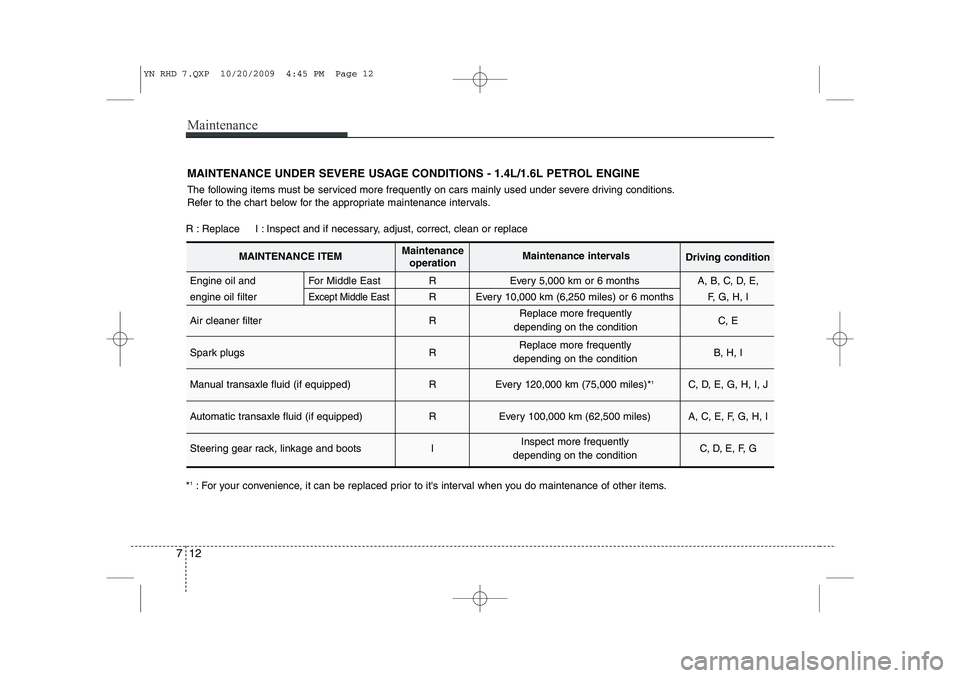
The following items must be serviced more frequently on cars mainly used under severe driving conditions.
Refer to the chart below for the appropriate maintenance intervals.
R : Replace I : Inspect and if necessary, adjust, correct, clean or replace
Engine oil and For Middle East R Every 5,000 km or 6 months A, B, C, D, E, engine oil filter
Except Middle EastR Every 10,000 km (6,250 miles) or 6 months F, G, H, I
Air cleaner filter R C, E
Spark plugs R B, H, I
Manual transaxle fluid (if equipped) R Every 120,000 km (75,000 miles)* 1
C, D, E, G, H, I, J
Automatic transaxle fluid (if equipped) R Every 100,000 km (62,500 miles) A, C, E, F, G, H, I
Steering gear rack, linkage and boots I C, D, E, F, G
MAINTENANCE ITEMMaintenance
operation Maintenance intervals
Driving condition
Replace more frequently
depending on the condition
Inspect more frequently
depending on the condition Replace more frequently
depending on the condition
* 1
: For your convenience, it can be replaced prior to it's interval when you do maintenance of other items.
MAINTENANCE UNDER SEVERE USAGE CONDITIONS - 1.4L/1.6L PETROL ENGINE
YN RHD 7.QXP 10/20/2009 4:45 PM Page 12