start stop button KIA VENGA 2013 User Guide
[x] Cancel search | Manufacturer: KIA, Model Year: 2013, Model line: VENGA, Model: KIA VENGA 2013Pages: 751, PDF Size: 27.49 MB
Page 230 of 751
Driving your vehicle
26
5
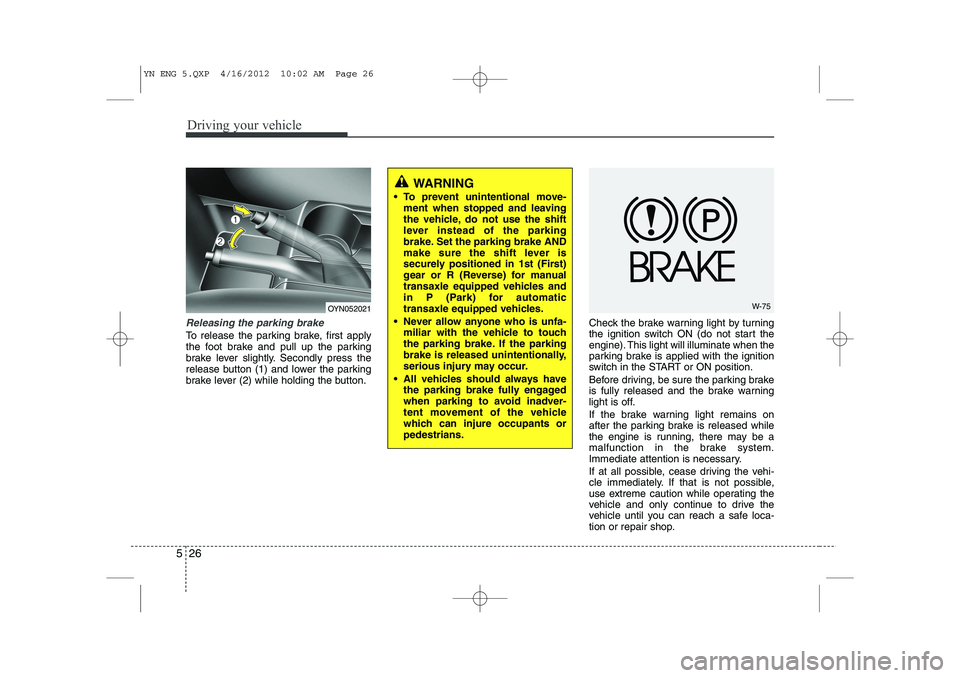
Releasing the parking brake
To release the parking brake, first apply
the foot brake and pull up the parking
brake lever slightly. Secondly press the
release button (1) and lower the parking
brake lever (2) while holding the button. Check the brake warning light by turning
the ignition switch ON (do not start the
engine). This light will illuminate when the
parking brake is applied with the ignition
switch in the START or ON position.
Before driving, be sure the parking brake
is fully released and the brake warning
light is off.
If the brake warning light remains on
after the parking brake is released while
the engine is running, there may be a
malfunction in the brake system.
Immediate attention is necessary.
If at all possible, cease driving the vehi-
cle immediately. If that is not possible,
use extreme caution while operating the
vehicle and only continue to drive the
vehicle until you can reach a safe loca-
tion or repair shop.
WARNING
To prevent unintentional move- ment when stopped and leaving
the vehicle, do not use the shift
lever instead of the parking
brake. Set the parking brake AND
make sure the shift lever is
securely positioned in 1st (First)
gear or R (Reverse) for manual
transaxle equipped vehicles and
in P (Park) for automatic
transaxle equipped vehicles.
Never allow anyone who is unfa- miliar with the vehicle to touch
the parking brake. If the parking
brake is released unintentionally,
serious injury may occur.
All vehicles should always have the parking brake fully engaged
when parking to avoid inadver-
tent movement of the vehicle
which can injure occupants orpedestrians.
W-75OYN052021
YN ENG 5.QXP 4/16/2012 10:02 AM Page 26
Page 385 of 751
Index
2
I
Air bag warning label . . . . . . . . . . . . . . . . . . . . . . . . . . 3-59
Air bag warning light . . . . . . . . . . . . . . . . . . . . . . . . . . 3-40
Air bags. . . . . . . . . . . . . . . . . . . . . . . . . . . . . . . . . . . . . 3-37
Air bag warning label . . . . . . . . . . . . . . . . . . . . . . . . . 3-59
Air bag warning light . . . . . . . . . . . . . . . . . . . . . . . . . 3-40
Curtain air bag . . . . . . . . . . . . . . . . . . . . . . . . . . . . . . 3-51
Driver's and passenger's front air bag . . . . . . . . . . . . 3-44
Side impact air bag . . . . . . . . . . . . . . . . . . . . . . . . . . . 3-49
SRS components and functions . . . . . . . . . . . . . . . . . 3-42
Air cleaner . . . . . . . . . . . . . . . . . . . . . . . . . . . . . . . . . . 7-33
Alarm system . . . . . . . . . . . . . . . . . . . . . . . . . . . . . . . . 4-11
Antenna . . . . . . . . . . . . . . . . . . . . . . . . . . . . . . . . . . . . 4-100
Anti-lock brake system (ABS) . . . . . . . . . . . . . . . . . . . 5-27
Appearance care . . . . . . . . . . . . . . . . . . . . . . . . . . . . . . 7-72 Exterior care . . . . . . . . . . . . . . . . . . . . . . . . . . . . . . . . 7-72
Interior care . . . . . . . . . . . . . . . . . . . . . . . . . . . . . . . . 7-77
Ashtray . . . . . . . . . . . . . . . . . . . . . . . . . . . . . . . . . . . . . 4-94
Audio system . . . . . . . . . . . . . . . . . . . . . . . . . . . . . . . 4-100 Antenna. . . . . . . . . . . . . . . . . . . . . . . . . . . . . . . . . . . 4-100
Auto seat warmer(front) . . . . . . . . . . . . . . . . . . . . . . . . . 3-8
Automatic climate control system . . . . . . . . . . . . . . . . 4-81 Air conditioning . . . . . . . . . . . . . . . . . . . . . . . . . . . . . 4-87
Automatic heating and air conditioning . . . . . . . . . . . 4-82
Manual heating and air conditioning . . . . . . . . . . . . . 4-83 Automatic transaxle . . . . . . . . . . . . . . . . . . . . . . . . . . . 5-19
Aux, USB and iPod port . . . . . . . . . . . . . . . . . . . . . . . . 4-96
Battery. . . . . . . . . . . . . . . . . . . . . . . . . . . . . . . . . . . . . . 7-39
Battery saver function. . . . . . . . . . . . . . . . . . . . . . . . . . 4-61
Before driving . . . . . . . . . . . . . . . . . . . . . . . . . . . . . . . . . 5-3
Bottle holders, see cup holders . . . . . . . . . . . . . . . . . . . 4-94
Brake system. . . . . . . . . . . . . . . . . . . . . . . . . . . . . . . . . 5-24
Anti-lock brake system (ABS) . . . . . . . . . . . . . . . . . . 5-27
Electronic stability program (ESP) . . . . . . . . . . . . . . 5-29
Parking brake . . . . . . . . . . . . . . . . . . . . . . . . . . . . . . . 5-25
Power brakes . . . . . . . . . . . . . . . . . . . . . . . . . . . . . . . 5-24
Emergency Stop Signal . . . . . . . . . . . . . . . . . . . . . . . 5-32
Hill-start assist control . . . . . . . . . . . . . . . . . . . . . . . . 5-32
Vehicle stability management. . . . . . . . . . . . . . . . . . . 5-33
Brakes fluid. . . . . . . . . . . . . . . . . . . . . . . . . . . . . . . . . . 7-28
Bulb replacement . . . . . . . . . . . . . . . . . . . . . . . . . . . . . 7-63
Bulb wattage . . . . . . . . . . . . . . . . . . . . . . . . . . . . . . . . . . 8-2
Button start/stop, see engine start/stop button . . . . . . . . 5-8
Camera (Rear view) . . . . . . . . . . . . . . . . . . . . . . . . . . . 4-60
Capacities (Lubricants) . . . . . . . . . . . . . . . . . . . . . . . . . . 8-4
A
C
B
YN eng INDEX.QXP 2011.09.22. 16:35 Page 2
Page 387 of 751
Index
4
I
Drinks holders, see cup holders . . . . . . . . . . . . . . . . . . 4-94
Driver's and passenger's front air bag. . . . . . . . . . . . . . 3-44
Driving at night. . . . . . . . . . . . . . . . . . . . . . . . . . . . . . . 5-45
Driving in flooded areas . . . . . . . . . . . . . . . . . . . . . . . . 5-46
Driving in the rain . . . . . . . . . . . . . . . . . . . . . . . . . . . . 5-46
Economical operation . . . . . . . . . . . . . . . . . . . . . . . . . . 5-41
Electric power steering . . . . . . . . . . . . . . . . . . . . . . . . . 4-33
Electronic stability program (ESP). . . . . . . . . . . . . . . . 5-29
Emergency starting . . . . . . . . . . . . . . . . . . . . . . . . . . . . . 6-4
Jump starting . . . . . . . . . . . . . . . . . . . . . . . . . . . . . . . . 6-4
Push starting . . . . . . . . . . . . . . . . . . . . . . . . . . . . . . . . . 6-5
Emergency while driving . . . . . . . . . . . . . . . . . . . . . . . . 6-2
Emission control system . . . . . . . . . . . . . . . . . . . . . . . . 7-78 Crankcase emission control system . . . . . . . . . . . . . . 7-78
Evaporative emission control System . . . . . . . . . . . . 7-78
Exhaust emission control system . . . . . . . . . . . . . . . . 7-79
Engine compartment . . . . . . . . . . . . . . . . . . . . . . . . . . . . 2-4
Engine coolant . . . . . . . . . . . . . . . . . . . . . . . . . . . . . . . 7-25
Engine number . . . . . . . . . . . . . . . . . . . . . . . . . . . . . . . . 8-8
Engine oil . . . . . . . . . . . . . . . . . . . . . . . . . . . . . . . . . . . 7-24
Engine overheats. . . . . . . . . . . . . . . . . . . . . . . . . . . . . . . 6-6
Engine start/stop button . . . . . . . . . . . . . . . . . . . . . . . . . 5-8
Engine will not start . . . . . . . . . . . . . . . . . . . . . . . . . . . . 6-3
Evaporative emission control system . . . . . . . . . . . . . . 7-78 Exhaust emission control system . . . . . . . . . . . . . . . . . 7-79
Explanation of scheduled maintenance items . . . . . . . 7-20
Exterior care . . . . . . . . . . . . . . . . . . . . . . . . . . . . . . . . . 7-72
Flat tire . . . . . . . . . . . . . . . . . . . . . . . . . . . . . . . . . . . . . . 6-7
Changing tires. . . . . . . . . . . . . . . . . . . . . . . . . . . . . . . . 6-8
Compact spare tire . . . . . . . . . . . . . . . . . . . . . . . . . . . 6-13
Components of the tire mobility kit . . . . . . . . . . . . . . 6-16
Jack and tools . . . . . . . . . . . . . . . . . . . . . . . . . . . . . . . . 6-7
Removing and storing the spare tire . . . . . . . . . . . . . . 6-8
Tiremobilitykit . . . . . . . . . . . . . . . . . . . . . . . . . . . . . . 6-15
Floor mat anchor(s) . . . . . . . . . . . . . . . . . . . . . . . . . . . 4-97Fluid Automatic transaxle fluid . . . . . . . . . . . . . . . . . . . . . . 7-29
Brakes fluid . . . . . . . . . . . . . . . . . . . . . . . . . . . . . . . . 7-28
Washer fluid . . . . . . . . . . . . . . . . . . . . . . . . . . . . . . . . 7-31
Fog light (front) . . . . . . . . . . . . . . . . . . . . . . . . . . . . . . 7-66
Fog light (rear) . . . . . . . . . . . . . . . . . . . . . . . . . . . . . . . 7-69Fog light bulbs replacement Fog light (front) . . . . . . . . . . . . . . . . . . . . . . . . . . . . . 7-66
Fog light (rear) . . . . . . . . . . . . . . . . . . . . . . . . . . . . . . 7-69
Folding the rear seat . . . . . . . . . . . . . . . . . . . . . . . . . . . 3-10
Front seat adjustment . . . . . . . . . . . . . . . . . . . . . . . . . . . 3-5
Fuel filler lid . . . . . . . . . . . . . . . . . . . . . . . . . . . . . . . . . 4-26
Fuel filter . . . . . . . . . . . . . . . . . . . . . . . . . . . . . . . . . . . 7-32
E
F
YN eng INDEX.QXP 2011.09.22. 16:35 Page 4
Page 472 of 751
Features of your vehicle
8
4
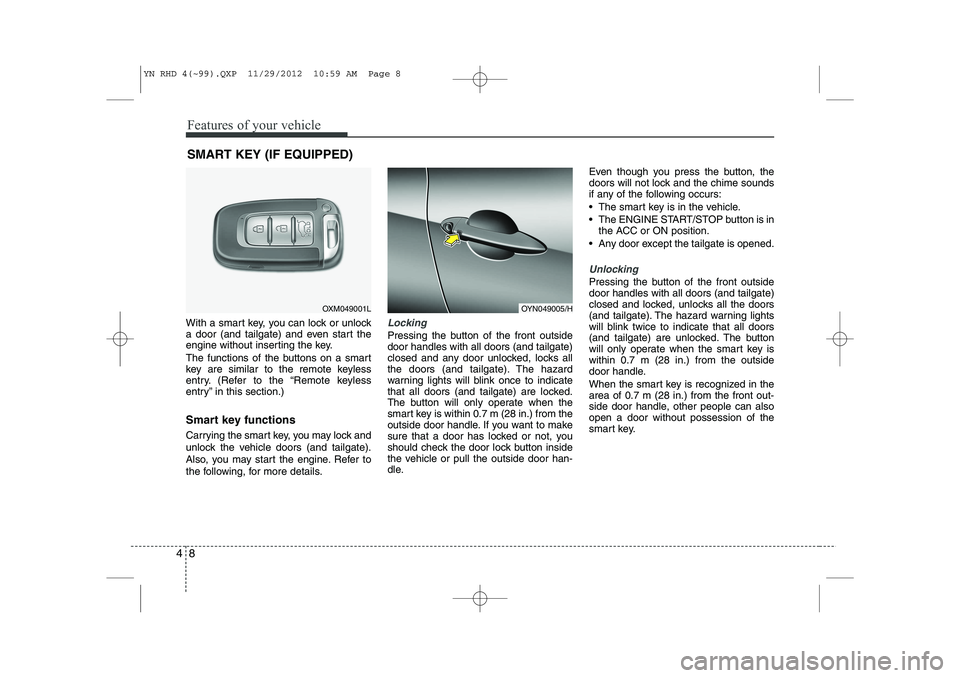
With a smart key, you can lock or unlock
a door (and tailgate) and even start the
engine without inserting the key.
The functions of the buttons on a smart
key are similar to the remote keyless
entry. (Refer to the “Remote keyless
entry” in this section.)
Smart key functions
Carrying the smart key, you may lock and
unlock the vehicle doors (and tailgate).
Also, you may start the engine. Refer to
the following, for more details.Locking
Pressing the button of the front outside door handles with all doors (and tailgate)
closed and any door unlocked, locks all
the doors (and tailgate). The hazard
warning lights will blink once to indicate
that all doors (and tailgate) are locked.
The button will only operate when the
smart key is within 0.7 m (28 in.) from the
outside door handle. If you want to make
sure that a door has locked or not, you
should check the door lock button inside
the vehicle or pull the outside door han-
dle. Even though you press the button, the
doors will not lock and the chime sounds
if any of the following occurs:
The smart key is in the vehicle.
The ENGINE START/STOP button is in
the ACC or ON position.
Any door except the tailgate is opened.
Unlocking
Pressing the button of the front outside door handles with all doors (and tailgate)
closed and locked, unlocks all the doors
(and tailgate). The hazard warning lights
will blink twice to indicate that all doors
(and tailgate) are unlocked. The button
will only operate when the smart key iswithin 0.7 m (28 in.) from the outside
door handle.
When the smart key is recognized in the area of 0.7 m (28 in.) from the front out-
side door handle, other people can alsoopen a door without possession of the
smart key.
SMART KEY (IF EQUIPPED)
OXM049001LOYN049005/H
YN RHD 4(~99).QXP 11/29/2012 10:59 AM Page 8
Page 520 of 751
Features of your vehicle
56
4
KEY OUT indicator
(if equipped)
When the ENGINE START/STOP button
is in the ACC or ON position, if any door
is open, the system checks for the smart
key. If the smart key is not in the vehicle,
the indicator will blink, and if all doors areclosed, the chime (if equipped) will also
sound for about 5 seconds. The indicator
will go off whilst the vehicle is moving.
Keep the smart key in the vehicle or
insert it in the smart key holder.
Key reminder warning chime
(if equipped)
If the driver’s door is opened whilst the
ignition key is left in the ignition switch
(ACC or LOCK position), the key
reminder warning chime will sound. This
is to prevent you from locking your keys
in the vehicle. The chime sounds until the
key is removed from the ignition switch or
the driver’s door is closed.
Glow indicator (Diesel engine)
The indicator illuminates when the igni-
tion switch is in the ON position. The
engine can be started after the preheat
indicator light goes off. The illuminating
time varies with the water temperature,
air temperature and battery condition.
✽✽ NOTICE
If the engine does not start within 10
seconds after the preheating is complet-
ed, turn the ignition key once more to
the LOCK position for 10 seconds, and
then to the ON position, in order to pre-heat again.
Fuel filter warning light (Diesel engine)
This warning light illuminates for 3 sec-
onds after the ignition switch is set to the
ON position and then it will go off. If it
lights up whilst the engine is running, it
indicates that water has accumulated
inside the fuel filter. If this happens,
remove the water from the fuel filter. For
more information, refer to “Fuel filter” insection 7.
CAUTION
When the fuel filter warning light isilluminated, engine power (vehicle
speed & idle speed) may decrease. If you keep driving with the warninglight on, you can damage your vehi-cle's engine parts and injection sys-
tem of the Common Rail.
If this occurs, we recommend thatthe system be checked by an autho-rised Kia dealer.
CAUTION
If the preheat indicator continues to illuminate or blink on and off afterthe engine has warmed up or whilst
driving, we recommend that the system be checked by an autho-rised Kia dealer.
KEY
OUT
YN RHD 4(~99).QXP 11/29/2012 11:02 AM Page 56
Page 564 of 751
5
Before driving / 5-3 Key positions / 5-4Engine start/stop button / 5-8ISG(idle stop and go) system / 5-14Manual transaxle / 5-16Automatic transaxle / 5-19Brake system / 5-24
Cruise control system / 5-35
Speed limit control system / 5-39Economical operation / 5-41Special driving conditions / 5-43
Winter driving / 5-48
Trailer towing / 5-52
Vehicle weight / 5-60
Driving your vehicle
YN RHD 5.QXP 3/31/2012 4:06 PM Page 1
Page 571 of 751
Driving your vehicle
8
5
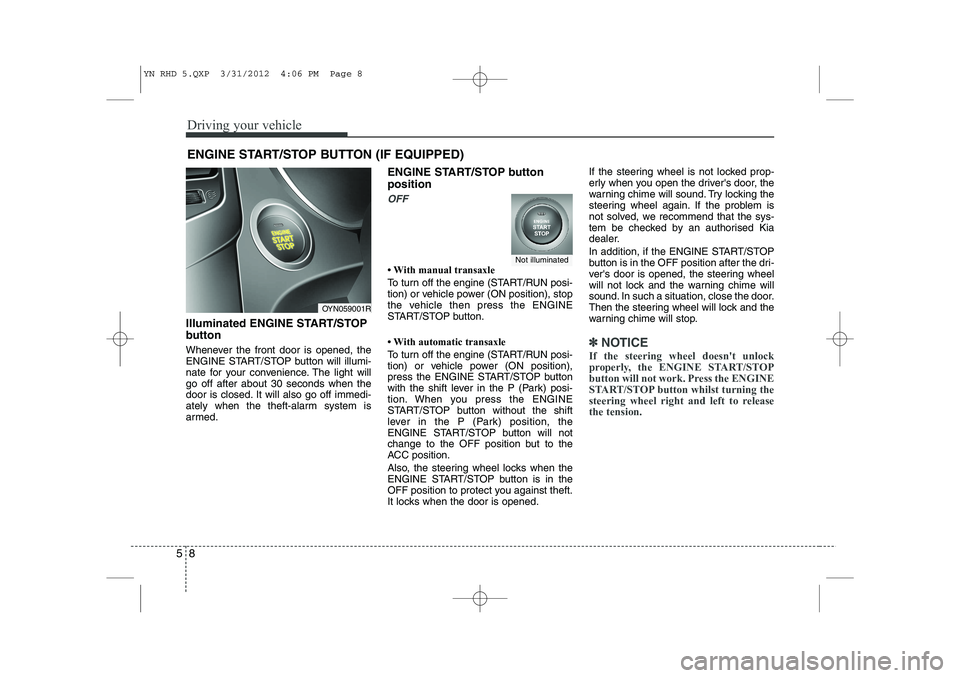
Illuminated ENGINE START/STOP
button
Whenever the front door is opened, the
ENGINE START/STOP button will illumi-
nate for your convenience. The light willgo off after about 30 seconds when the
door is closed. It will also go off immedi-
ately when the theft-alarm system is
armed. ENGINE START/STOP button position
OFF
Page 574 of 751
511
Driving your vehicle
Starting the engine
✽✽
NOTICE - Kick down mecha- nism (if equipped)
If your vehicle is equipped with a kick down mechanism in the accelerator
pedal, it prevents you from driving at
full throttle unintentionally by making
the driver require increased effort to
depress the accelerator pedal. However,
if you depress the pedal more than
approximately 80%, the vehicle can be
at full throttle and the accelerator pedal
will be easier to depress. This is not amalfunction but a normal condition.
Starting the petrol engine (if equipped)
1. Carry the smart key or leave it inside the vehicle.
2. Make sure the parking brake is firmly applied
3. Manual Transaxle - Depress the
clutch pedal fully and shift the
transaxle into Neutral. Keep the clutch
pedal and brake pedal depressed
whilst starting the engine.
Automatic Transaxle - Place the
transaxle shift lever in P (Park).
Depress the brake pedal fully.
You can also start the engine when
the shift lever is in the N (Neutral)position.
4. Press the ENGINE START/STOP but- ton.
5. In extremely cold weather (below - 18°C / 0°F) or after the vehicle has not
been operated for several days, let the
engine warm up without depressing
the accelerator.
Whether the engine is cold or warm, it
should be started without depressing the
accelerator.
Starting the diesel engine (if equipped)
To start the diesel engine when the engine is cold, it has to be pre-heated
before starting the engine and then have
to be warmed up before starting to drive.
1. Make sure the parking brake is applied.
2. Manual Transaxle - Depress the
clutch pedal fully and shift the
transaxle into Neutral. Keep the clutch
pedal and brake pedal depressed
whilst pressing the ENGINE START/
STOP button to the START position.
Automatic Transaxle - Place the
transaxle shift lever in P (Park).
Depress the brake pedal fully.
You can also start the engine when the
shift lever is in the N (Neutral) position.
WARNING
Always wear appropriate shoes
when operating your vehicle.
Unsuitable shoes (high heels, ski
boots,etc.) may interfere with yourability to use the brake and acceler-
ator pedal, and the clutch (ifequipped).
YN RHD 5.QXP 3/31/2012 4:06 PM Page 11
Page 575 of 751
Driving your vehicle
12
5
3. Press the ENGINE START/STOP but-
ton whilst depressing the brake pedal.
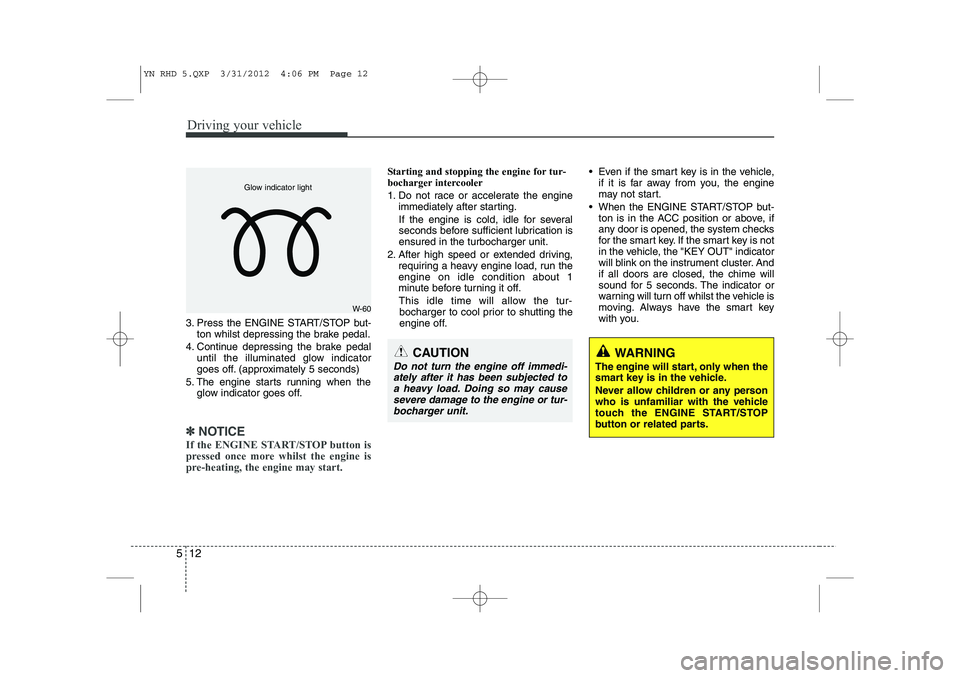
4. Continue depressing the brake pedal until the illuminated glow indicator
goes off. (approximately 5 seconds)
5. The engine starts running when the glow indicator goes off.
✽✽
NOTICE
If the ENGINE START/STOP button is
pressed once more whilst the engine is
pre-heating, the engine may start.
Starting and stopping the engine for tur-
bocharger intercooler
1. Do not race or accelerate the engine immediately after starting.
If the engine is cold, idle for several
seconds before sufficient lubrication isensured in the turbocharger unit.
2. After high speed or extended driving, requiring a heavy engine load, run theengine on idle condition about 1
minute before turning it off.
This idle time will allow the tur- bocharger to cool prior to shutting the
engine off. Even if the smart key is in the vehicle,
if it is far away from you, the engine
may not start.
When the ENGINE START/STOP but- ton is in the ACC position or above, if
any door is opened, the system checks
for the smart key. If the smart key is not
in the vehicle, the "KEY OUT" indicator
will blink on the instrument cluster. Andif all doors are closed, the chime will
sound for 5 seconds. The indicator or
warning will turn off whilst the vehicle is
moving. Always have the smart key
with you.
WARNING
The engine will start, only when the
smart key is in the vehicle.
Never allow children or any person
who is unfamiliar with the vehicle
touch the ENGINE START/STOP
button or related parts.
W-60
Glow indicator light
CAUTION
Do not turn the engine off immedi- ately after it has been subjected toa heavy load. Doing so may causesevere damage to the engine or tur-
bocharger unit.
YN RHD 5.QXP 3/31/2012 4:06 PM Page 12
Page 578 of 751
515
Driving your vehicle
ISG auto-starting
Before and after the engine enters the
idle stop mode, the ISG system will auto-
matically check all the necessary items
such as the safety of the vehicle and pas-
senger comfort.
The engine will start automatically with-
out the driver's action if any of the follow-ing occurs:
If the brake vacuum pressure is low
If the fan speed of the manual climatecontrol system is set above the 3rd position when the air conditioning is on
If the fan speed of the automatic cli- mate control system is set above the6th position when the air conditioningis on
When a certain amount of time has passed with the climate control systemon
When the defroster is ON
When the battery charge status is low
If the vehicle speed is over 5km/h by rolling down a hill
It could be different up to the vehicle con-dition.
When the automatic starting occurs, the
"AUTO STOP" indicator on the cluster
will blink for 5 seconds. ISG(Idle Stop and Go) system
deactivation
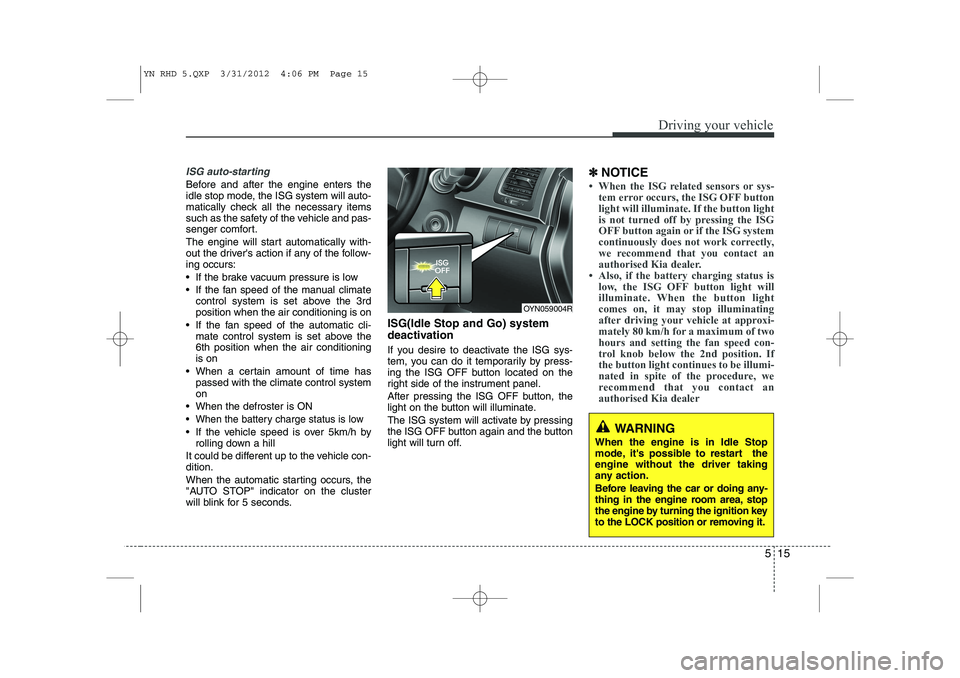
If you desire to deactivate the ISG sys-
tem, you can do it temporarily by press-
ing the ISG OFF button located on the
right side of the instrument panel.
After pressing the ISG OFF button, the
light on the button will illuminate.
The ISG system will activate by pressing
the ISG OFF button again and the button
light will turn off. ✽
✽
NOTICE