Axle KIA VENGA 2013 Service Manual
[x] Cancel search | Manufacturer: KIA, Model Year: 2013, Model line: VENGA, Model: KIA VENGA 2013Pages: 751, PDF Size: 27.49 MB
Page 292 of 751
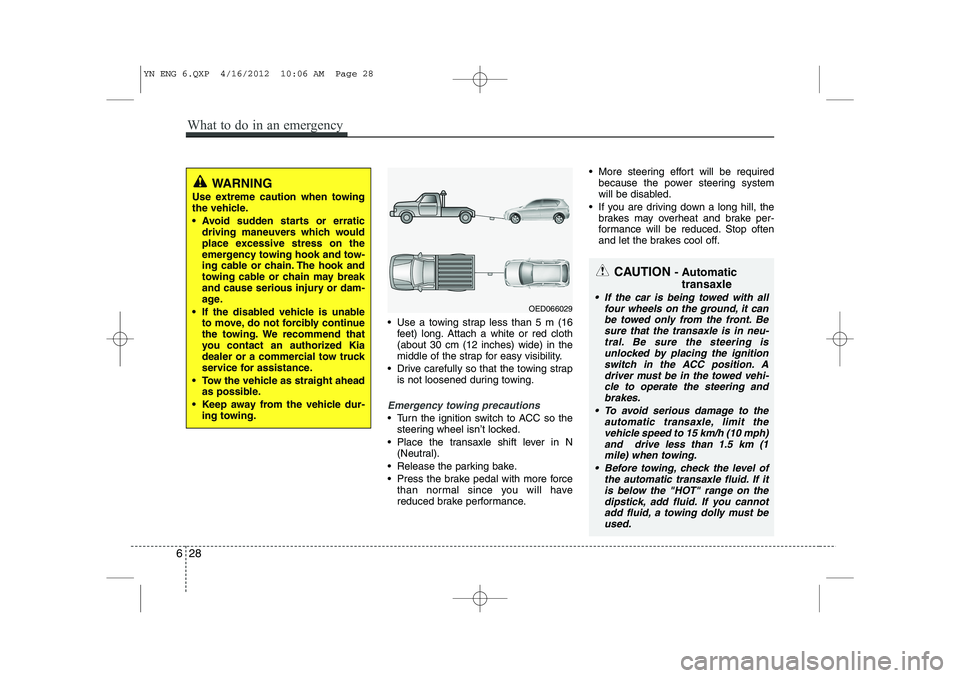
Use a towing strap less than 5 m (16feet) long. Attach a white or red cloth (about 30 cm (12 inches) wide) in the
middle of the strap for easy visibility.
Drive carefully so that the towing strap is not loosened during towing.
Emergency towing precautions
Turn the ignition switch to ACC so thesteering wheel isn’t locked.
Place the transaxle shift lever in N (Neutral).
Release the parking bake.
Press the brake pedal with more force than normal since you will have
reduced brake performance. More steering effort will be required
because the power steering system
will be disabled.
If you are driving down a long hill, the brakes may overheat and brake per-
formance will be reduced. Stop often
and let the brakes cool off.
CAUTION - Automatic
transaxle
If the car is being towed with all four wheels on the ground, it can
be towed only from the front. Besure that the transaxle is in neu- tral. Be sure the steering isunlocked by placing the ignition
switch in the ACC position. Adriver must be in the towed vehi-cle to operate the steering and brakes.
To avoid serious damage to the automatic transaxle, limit thevehicle speed to 15 km/h (10 mph)and drive less than 1.5 km (1
mile) when towing.
Before towing, check the level of the automatic transaxle fluid. If itis below the "HOT" range on thedipstick, add fluid. If you cannot
add fluid, a towing dolly must beused.OED066029
628
What to do in an emergency
WARNING
Use extreme caution when towing
the vehicle.
Avoid sudden starts or erratic driving maneuvers which would
place excessive stress on the
emergency towing hook and tow-
ing cable or chain. The hook and
towing cable or chain may break
and cause serious injury or dam-
age.
If the disabled vehicle is unable to move, do not forcibly continue
the towing. We recommend that
you contact an authorized Kia
dealer or a commercial tow truck
service for assistance.
Tow the vehicle as straight ahead as possible.
Keep away from the vehicle dur- ing towing.
YN ENG 6.QXP 4/16/2012 10:06 AM Page 28
Page 294 of 751
7
Engine compartment / 7-2 Maintenance services / 7-3
Owner maintenance / 7-5Scheduled maintenance service / 7-7Explanation of scheduled maintenance items / 7-20Engine oil / 7-24Engine coolant / 7-25Brake/clutch fluid / 7-28Automatic transaxle fluid / 7-29
Washer fluid / 7-31Parking brake / 7-31
Fuel filter / 7-32
Air cleaner / 7-33
Climate control air filter / 7-34
Wiper blades / 7-36Battery / 7-39
Tires and wheels / 7-42Fuses / 7-52 Light bulbs / 7-63
Appearance care / 7-72
Emission control system / 7-78
Maintenance
YN ENG 7.QXP 4/16/2012 10:07 AM Page 1
Page 295 of 751
Maintenance
2
7
ENGINE COMPARTMENT
OYN022003/OYN072002-1
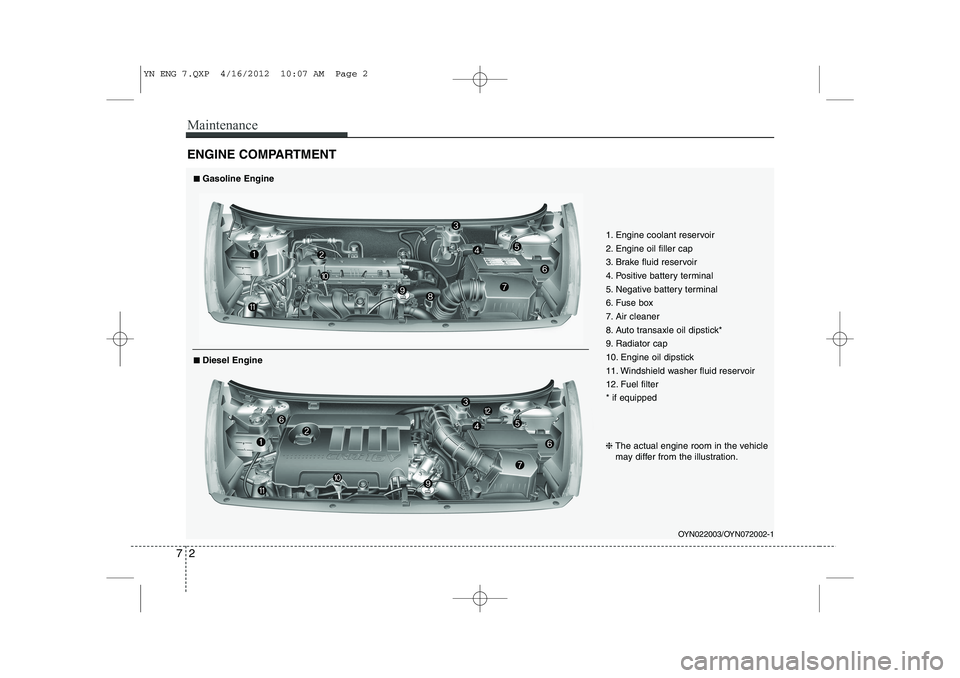
1. Engine coolant reservoir
2. Engine oil filler cap
3. Brake fluid reservoir
4. Positive battery terminal
5. Negative battery terminal
6. Fuse box
7. Air cleaner
8. Auto transaxle oil dipstick*
9. Radiator cap
10. Engine oil dipstick
11. Windshield washer fluid reservoir
12. Fuel filter * if equipped
■■
Gasoline Engine
❈ The actual engine room in the vehicle
may differ from the illustration.
■■ Diesel Engine
YN ENG 7.QXP 4/16/2012 10:07 AM Page 2
Page 298 of 751
75
Maintenance
OWNER MAINTENANCE
The following lists are vehicle checks and
inspections that should be performed atthe frequencies indicated to help ensure
safe, dependable operation of your vehi-
cle. If you have any question, we recom-
mend that you consult an authorized Kia
dealer.
These Owner Maintenance Checks are
generally not covered by warranties and
you may be charged for labor, parts and
lubricants used. Owner maintenance schedule
When you stop for fuel:
• Check the engine oil level.
Check the coolant level in coolant
reservoir.
Check the windshield washer fluid level.
Look for low or under-inflated tires.
While operating your vehicle:
Note any changes in the sound of the exhaust or any smell of exhaust fumes
in the vehicle.
Check for vibrations in the steering wheel. Notice any increased steering
effort or looseness in the steering
wheel, or change in its straight-aheadposition.
Notice if your vehicle constantly turns slightly or “pulls” to one side when trav-
eling on smooth, level road.
When stopping, listen and check for unusual sounds, pulling to one side,
increased brake pedal travel or “hard-
to-push” brake pedal.
If any slipping or changes in the oper- ation of your transaxle occurs, check
the transaxle fluid level.
Check automatic transaxle P (Park) function.
Check the parking brake.
Check for fluid leaks under your vehicle (water dripping from the air condition-
ing system during or after use is nor-mal).
WARNING
Be careful when checking your
engine coolant level when the
engine is hot. Scalding hot coolant
and steam may blow out under
pressure. This could cause burns
or other serious injury.
YN ENG 7.QXP 4/16/2012 10:07 AM Page 5
Page 299 of 751
Maintenance
6
7
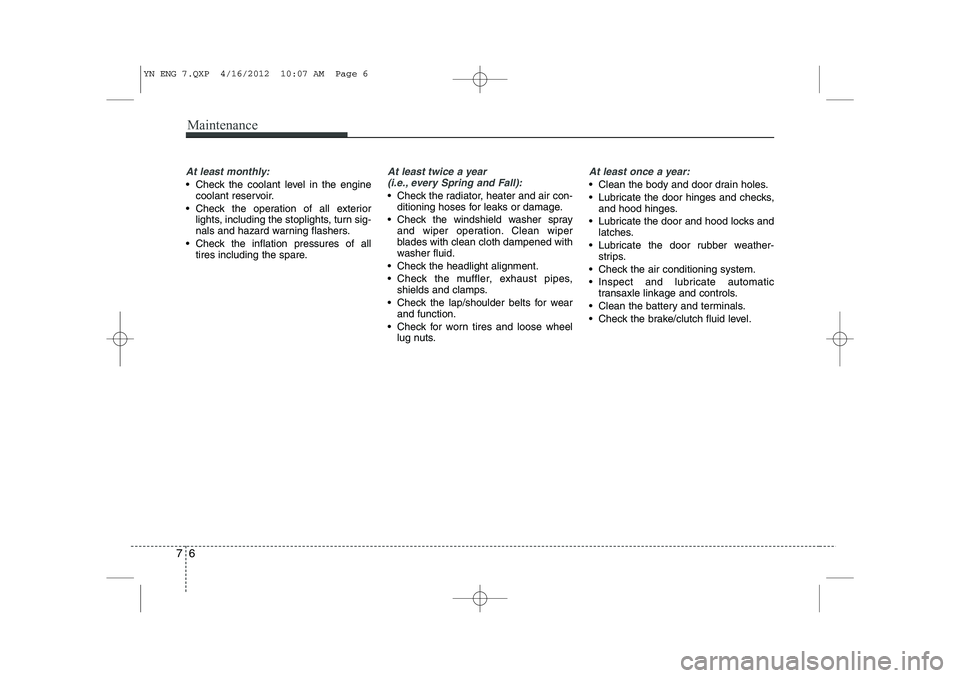
At least monthly:
Check the coolant level in the engine
coolant reservoir.
Check the operation of all exterior lights, including the stoplights, turn sig-
nals and hazard warning flashers.
Check the inflation pressures of all tires including the spare.
At least twice a year
(i.e., every Spring and Fall):
Check the radiator, heater and air con- ditioning hoses for leaks or damage.
Check the windshield washer spray and wiper operation. Clean wiper
blades with clean cloth dampened with
washer fluid.
Check the headlight alignment.
Check the muffler, exhaust pipes, shields and clamps.
Check the lap/shoulder belts for wear and function.
Check for worn tires and loose wheel lug nuts.
At least once a year:
Clean the body and door drain holes.
Lubricate the door hinges and checks,and hood hinges.
Lubricate the door and hood locks and latches.
Lubricate the door rubber weather- strips.
Check the air conditioning system.
Inspect and lubricate automatic transaxle linkage and controls.
Clean the battery and terminals.
Check the brake/clutch fluid level.
YN ENG 7.QXP 4/16/2012 10:07 AM Page 6
Page 304 of 751
711
Maintenance
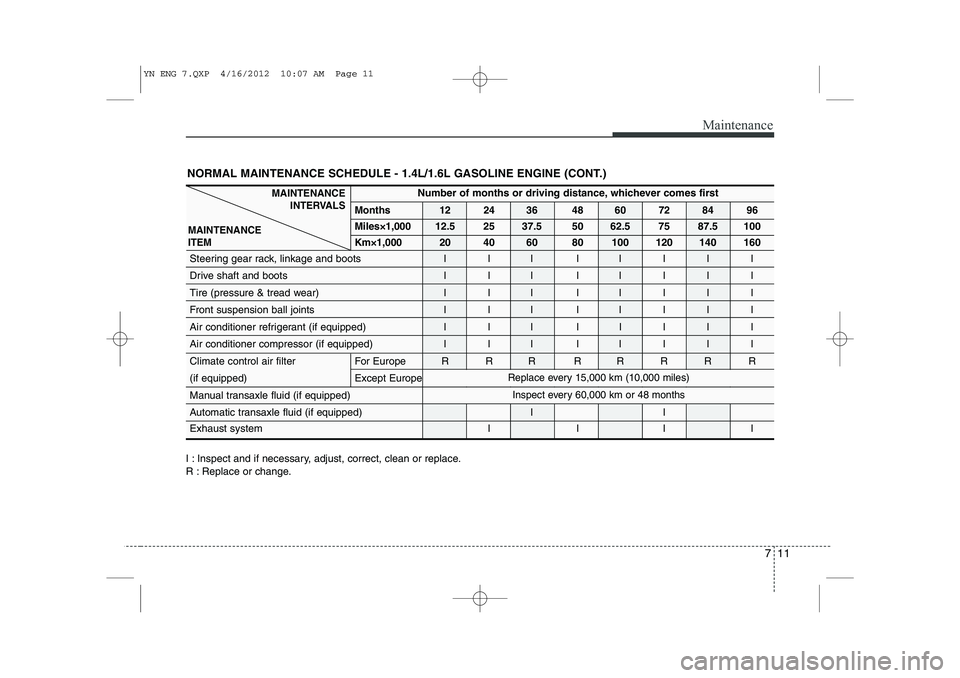
I : Inspect and if necessary, adjust, correct, clean or replace.
R : Replace or change.
Number of months or driving distance, whichever comes first
Months 12 24 36 48 60 72 84 96 Miles×1,000
12.5 25 37.5 50 62.5 75 87.5 100
Km×1,00020 40 60 80 100 120 140 160
Steering gear rack, linkage and boots I I I I I I I I
Drive shaft and boots I I I I I I I I
Tire (pressure & tread wear) I I I I I I I I
Front suspension ball joints I I I I I I I I
Air conditioner refrigerant (if equipped) I I I I I I I I
Air conditioner compressor (if equipped) I I I I I I I I
Climate control air filter For Europe R R R R R R R R
(if equipped) Except Europe
Manual transaxle fluid (if equipped)
Automatic transaxle fluid (if equipped) I I Exhaust system I I I I
MAINTENANCE
INTERVALS
MAINTENANCE ITEM
NORMAL MAINTENANCE SCHEDULE - 1.4L/1.6L GASOLINE ENGINE (CONT.)
Replace every 15,000 km (10,000 miles)
Inspect every 60,000 km or 48 months
YN ENG 7.QXP 4/16/2012 10:07 AM Page 11
Page 305 of 751
Maintenance
12
7
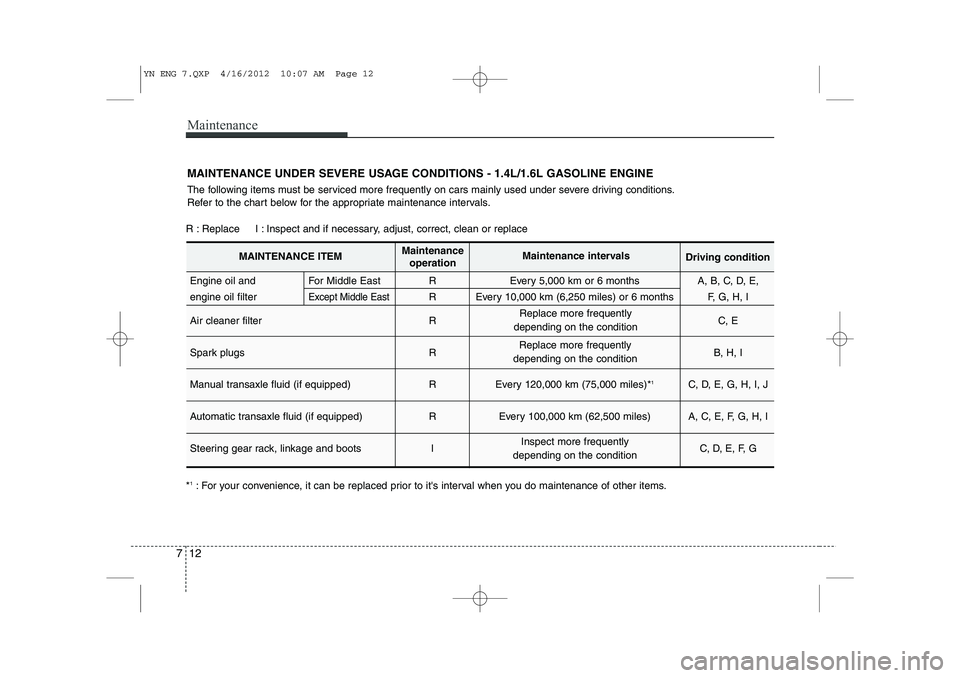
The following items must be serviced more frequently on cars mainly used under severe driving conditions.
Refer to the chart below for the appropriate maintenance intervals.
R : Replace I : Inspect and if necessary, adjust, correct, clean or replace
Engine oil and For Middle East R Every 5,000 km or 6 months A, B, C, D, E, engine oil filter
Except Middle EastR Every 10,000 km (6,250 miles) or 6 months F, G, H, I
Air cleaner filter R C, E
Spark plugs R B, H, I
Manual transaxle fluid (if equipped) R Every 120,000 km (75,000 miles)* 1
C, D, E, G, H, I, J
Automatic transaxle fluid (if equipped) R Every 100,000 km (62,500 miles) A, C, E, F, G, H, I
Steering gear rack, linkage and boots I C, D, E, F, G
MAINTENANCE ITEMMaintenance
operation Maintenance intervals
Driving condition
Replace more frequently
depending on the condition
Inspect more frequently
depending on the condition Replace more frequently
depending on the condition
* 1
: For your convenience, it can be replaced prior to it's interval when you do maintenance of other items.
MAINTENANCE UNDER SEVERE USAGE CONDITIONS - 1.4L/1.6L GASOLINE ENGINE
YN ENG 7.QXP 4/16/2012 10:07 AM Page 12
Page 310 of 751
717
Maintenance
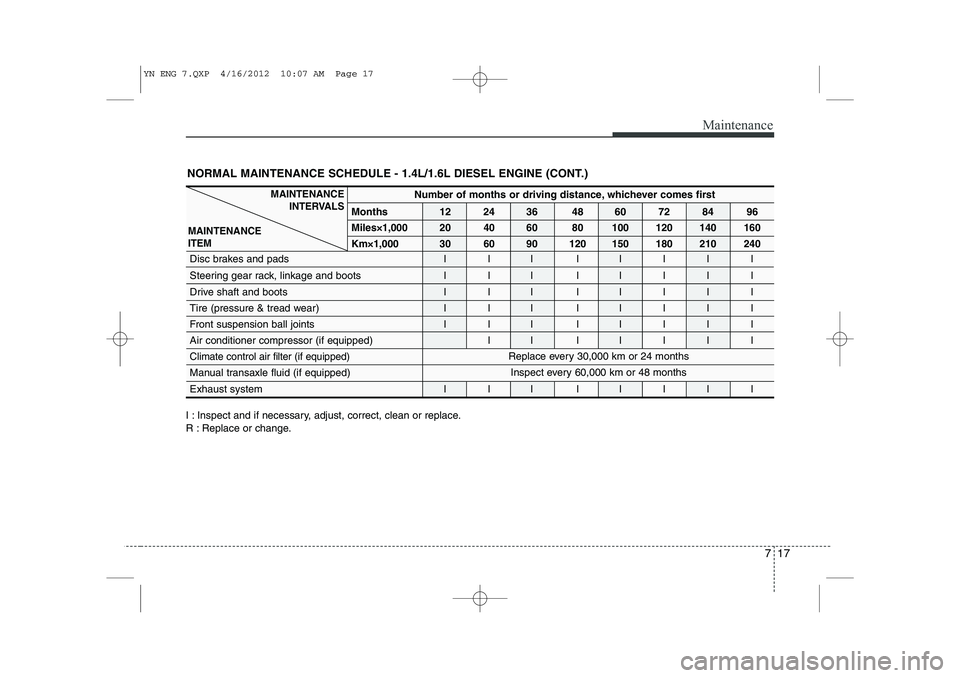
NORMAL MAINTENANCE SCHEDULE - 1.4L/1.6L DIESEL ENGINE (CONT.)
I : Inspect and if necessary, adjust, correct, clean or replace.
R : Replace or change.
MAINTENANCEINTERVALS
MAINTENANCE ITEMNumber of months or driving distance, whichever comes first
Months 12 24 36 48 60 72 84 96
Miles×1,000 20 40 60 80 100 120 140 160
Km×1,000 30 60 90 120 150 180 210 240
Disc brakes and pads I I I I I I I I
Steering gear rack, linkage and boots I I I I I I I I
Drive shaft and boots I I I I I I I I
Tire (pressure & tread wear) I I I I I I I I
Front suspension ball joints I I I I I I I I
Air conditioner compressor (if equipped) I I I I I I I
Climate control air filter (if equipped)
Manual transaxle fluid (if equipped) Exhaust system I I I I I I I IReplace every 30,000 km or 24 months
Inspect every 60,000 km or 48 months
YN ENG 7.QXP 4/16/2012 10:07 AM Page 17
Page 311 of 751
Maintenance
18
7
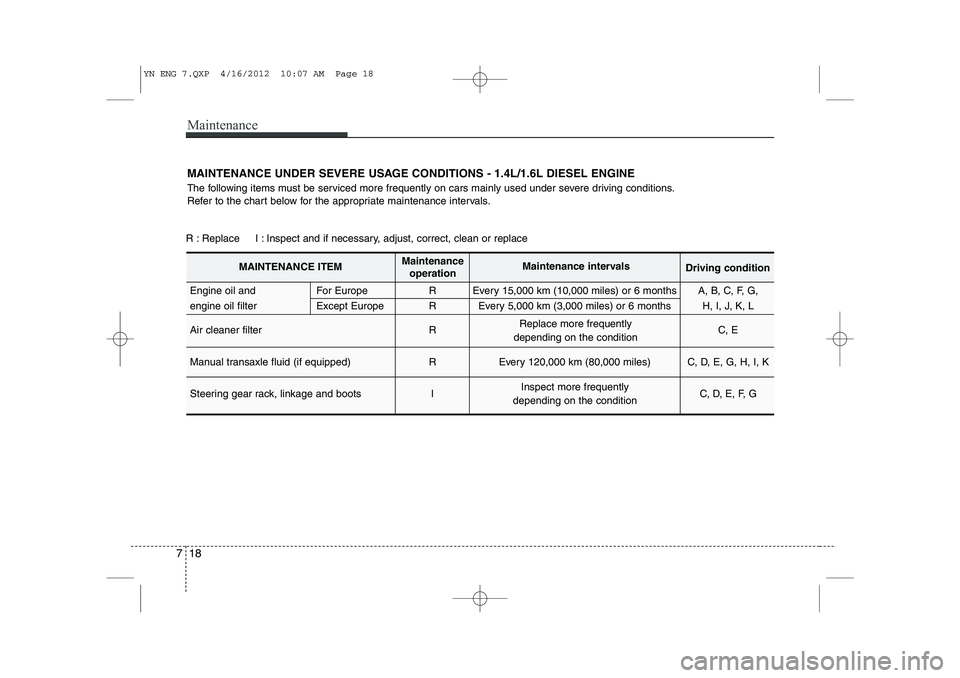
MAINTENANCE UNDER SEVERE USAGE CONDITIONS - 1.4L/1.6L DIESEL ENGINE
The following items must be serviced more frequently on cars mainly used under severe driving conditions.
Refer to the chart below for the appropriate maintenance intervals.
R : Replace I : Inspect and if necessary, adjust, correct, clean or replace
MAINTENANCE ITEM Maintenance
operation Maintenance intervals
Driving condition
Engine oil and For Europe R Every 15,000 km (10,000 miles) or 6 months A, B, C, F, G,
engine oil filter Except Europe R Every 5,000 km (3,000 miles) or 6 months H, I, J, K, L
Air cleaner filter R C, E
Manual transaxle fluid (if equipped) R Every 120,000 km (80,000 miles) C, D, E, G, H, I, K
Steering gear rack, linkage and boots I C, D, E, F, G
Inspect more frequently
depending on the condition
Replace more frequently
depending on the condition
YN ENG 7.QXP 4/16/2012 10:07 AM Page 18
Page 315 of 751
Maintenance
22
7
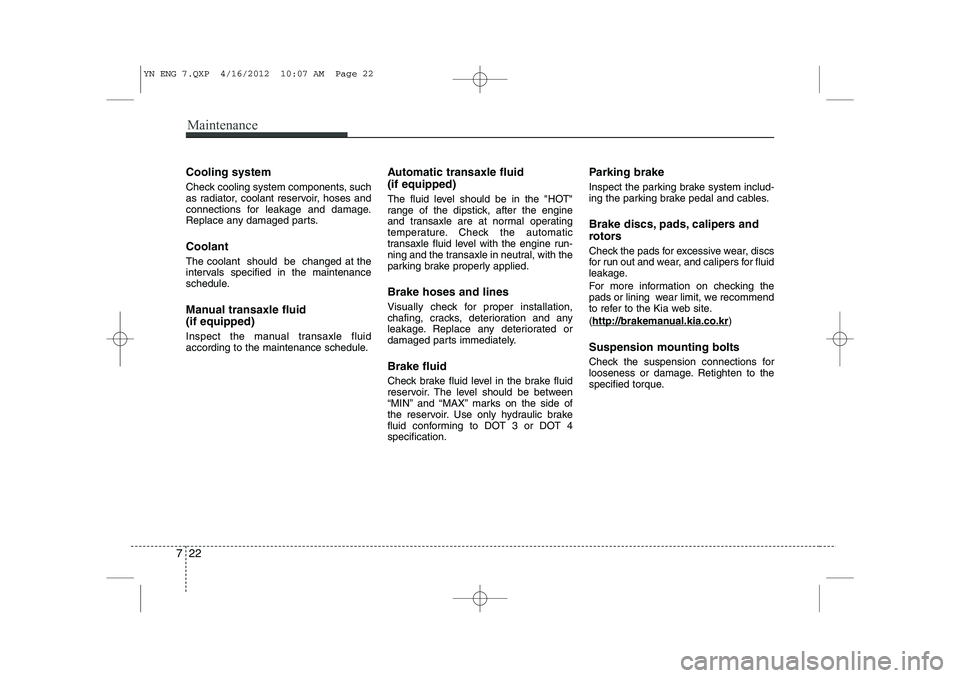
Cooling system
Check cooling system components, such
as radiator, coolant reservoir, hoses and
connections for leakage and damage.
Replace any damaged parts. Coolant The coolant should be changed at the
intervals specified in the maintenance
schedule.
Manual transaxle fluid (if equipped)
Inspect the manual transaxle fluid
according to the maintenance schedule. Automatic transaxle fluid (if equipped)
The fluid level should be in the "HOT"
range of the dipstick, after the engine
and transaxle are at normal operating
temperature. Check the automatic
transaxle fluid level with the engine run-
ning and the transaxle in neutral, with the
parking brake properly applied. Brake hoses and lines
Visually check for proper installation,
chafing, cracks, deterioration and any
leakage. Replace any deteriorated or
damaged parts immediately. Brake fluid
Check brake fluid level in the brake fluid
reservoir. The level should be between
“MIN” and “MAX” marks on the side of
the reservoir. Use only hydraulic brake
fluid conforming to DOT 3 or DOT 4specification.Parking brake
Inspect the parking brake system includ-
ing the parking brake pedal and cables.
Brake discs, pads, calipers and
rotors
Check the pads for excessive wear, discs
for run out and wear, and calipers for fluid
leakage.
For more information on checking the
pads or lining wear limit, we recommend
to refer to the Kia web site. (
http://brakeman
ual.kia.co.kr)
Suspension mounting bolts
Check the suspension connections for
looseness or damage. Retighten to the
specified torque.
YN ENG 7.QXP 4/16/2012 10:07 AM Page 22