service KIA VENGA 2013 Service Manual
[x] Cancel search | Manufacturer: KIA, Model Year: 2013, Model line: VENGA, Model: KIA VENGA 2013Pages: 751, PDF Size: 27.49 MB
Page 342 of 751
749
Maintenance
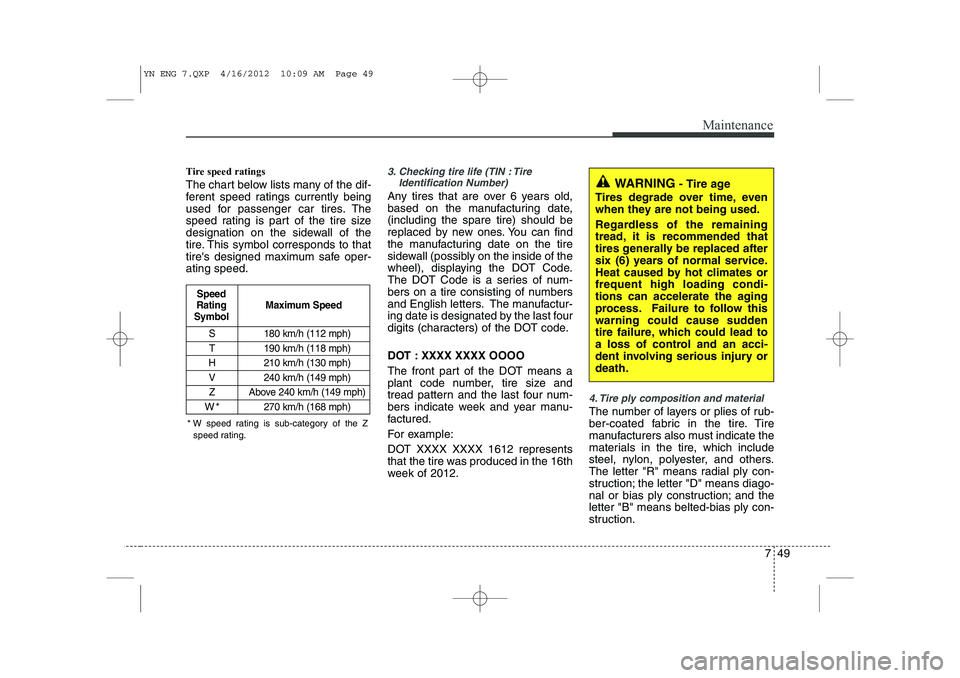
Tire speed ratings
The chart below lists many of the dif-
ferent speed ratings currently being
used for passenger car tires. The
speed rating is part of the tire size
designation on the sidewall of the
tire. This symbol corresponds to that
tire's designed maximum safe oper-ating speed.3. Checking tire life (TIN : TireIdentification Number)
Any tires that are over 6 years old,
based on the manufacturing date,(including the spare tire) should be
replaced by new ones. You can find
the manufacturing date on the tire
sidewall (possibly on the inside of the
wheel), displaying the DOT Code.
The DOT Code is a series of num-
bers on a tire consisting of numbers
and English letters. The manufactur-
ing date is designated by the last four
digits (characters) of the DOT code.
DOT : XXXX XXXX OOOO
The front part of the DOT means a
plant code number, tire size and
tread pattern and the last four num-
bers indicate week and year manu-
factured.
For example:
DOT XXXX XXXX 1612 represents
that the tire was produced in the 16th
week of 2012.
4. Tire ply composition and material
The number of layers or plies of rub-
ber-coated fabric in the tire. Tire
manufacturers also must indicate the
materials in the tire, which include
steel, nylon, polyester, and others.
The letter "R" means radial ply con-
struction; the letter "D" means diago-
nal or bias ply construction; and theletter "B" means belted-bias ply con-
struction.
S 180 km/h (112 mph)
T 190 km/h (118 mph)
H 210 km/h (130 mph) V 240 km/h (149 mph)
Z Above 240 km/h (149 mph)
W*270 km/h (168 mph)
Maximum Speed
Speed
Rating
Symbol
WARNING - Tire age
Tires degrade over time, even
when they are not being used.
Regardless of the remaining
tread, it is recommended that
tires generally be replaced after
six (6) years of normal service.
Heat caused by hot climates orfrequent high loading condi-
tions can accelerate the aging
process. Failure to follow this
warning could cause sudden
tire failure, which could lead to
a loss of control and an acci-
dent involving serious injury ordeath.
* W speed rating is sub-category of the Z speed rating.
YN ENG 7.QXP 4/16/2012 10:09 AM Page 49
Page 343 of 751
Maintenance
50
7
5. Maximum permissible inflation
pressure
This number is the greatest amount of air pressure that should be put in
the tire. Do not exceed the maximum
permissible inflation pressure. Refer
to the Tire and Loading Information
label for recommended inflation
pressure.
6. Maximum load rating
This number indicates the maximum
load in kilograms and pounds that
can be carried by the tire. When
replacing the tires on the vehicle,
always use a tire that has the same
load rating as the factory installed
tire.
7. Uniform tire quality grading
Quality grades can be found where
applicable on the tire sidewall
between tread shoulder and maxi-
mum section width.
For example:
TREAD wear 200
TRACTION AA
TEMPERATURE A
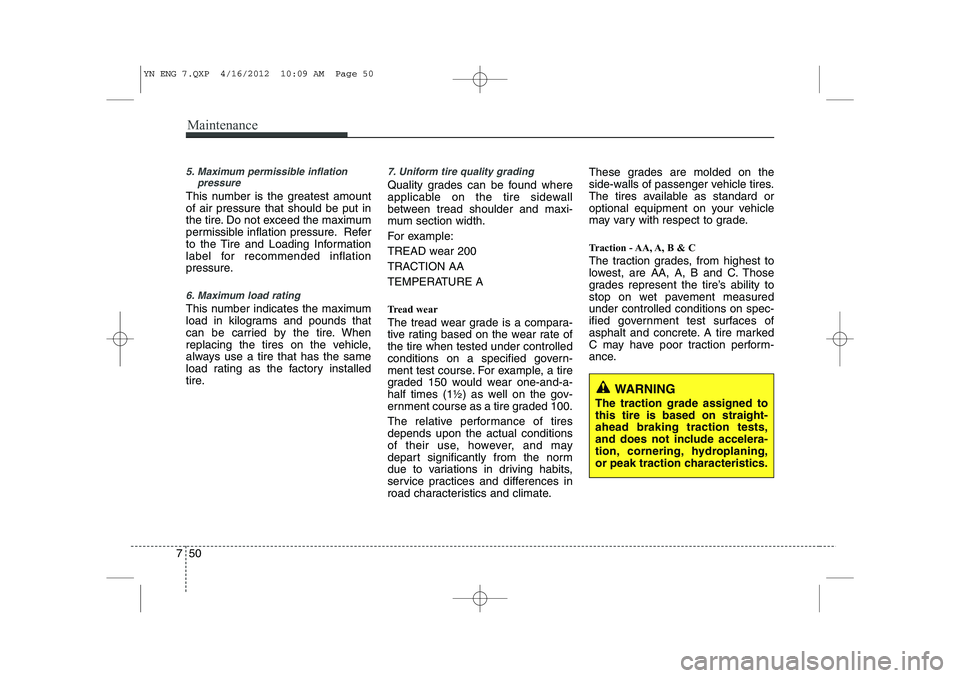
Tread wear
The tread wear grade is a compara-
tive rating based on the wear rate ofthe tire when tested under controlled
conditions on a specified govern-
ment test course. For example, a tire
graded 150 would wear one-and-a-
half times (1½) as well on the gov-
ernment course as a tire graded 100.
The relative performance of tires depends upon the actual conditions
of their use, however, and may
depart significantly from the norm
due to variations in driving habits,
service practices and differences in
road characteristics and climate. These grades are molded on the
side-walls of passenger vehicle tires.
The tires available as standard or
optional equipment on your vehicle
may vary with respect to grade.
Traction - AA, A, B & C
The traction grades, from highest to
lowest, are AA, A, B and C. Those
grades represent the tire’s ability to
stop on wet pavement measuredunder controlled conditions on spec-
ified government test surfaces of
asphalt and concrete. A tire marked
C may have poor traction perform-
ance.
WARNING
The traction grade assigned to this tire is based on straight-ahead braking traction tests,
and does not include accelera-
tion, cornering, hydroplaning,
or peak traction characteristics.
YN ENG 7.QXP 4/16/2012 10:09 AM Page 50
Page 378 of 751
Specifications & Consumer information
4
8
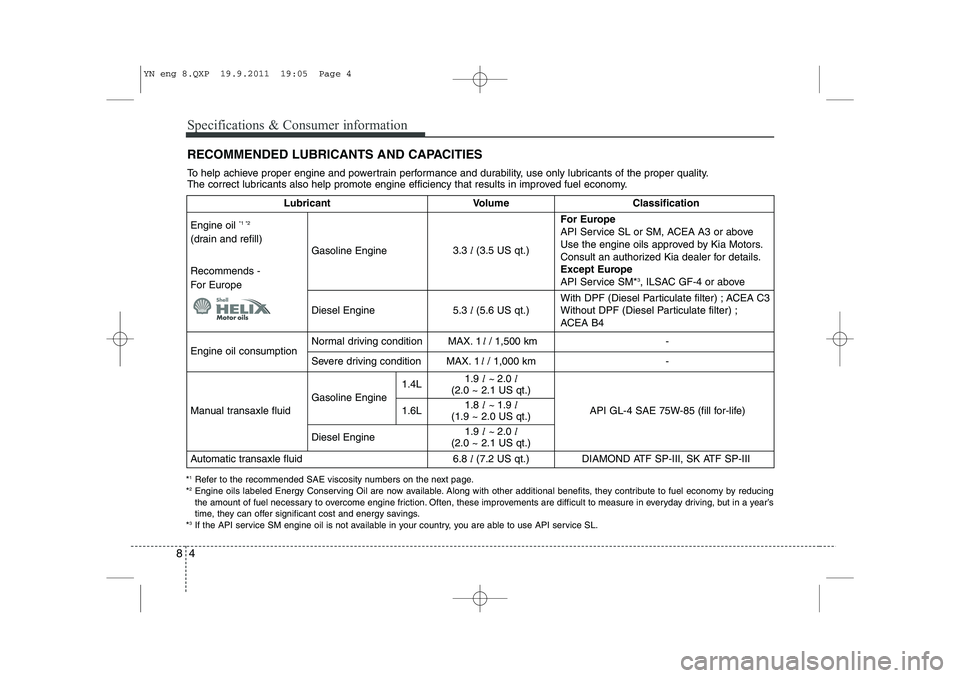
RECOMMENDED LUBRICANTS AND CAPACITIES
To help achieve proper engine and powertrain performance and durability, use only lubricants of the proper quality.
The correct lubricants also help promote engine efficiency that results in improved fuel economy.
* 1
Refer to the recommended SAE viscosity numbers on the next page.
* 2
Engine oils labeled Energy Conserving Oil are now available. Along with other additional benefits, they contribute to fuel economy by reducing
the amount of fuel necessary to overcome engine friction. Often, these improvements are difficult to measure in everyday driving, but in a year’s
time, they can offer significant cost and energy savings.
* 3
If the API service SM engine oil is not available in your country, you are able to use API service SL.
LubricantVolumeClassification
Engine oil *1 *2
(drain and refill) Recommends -
For Europe
Gasoline Engine3.3 l(3.5 US qt.)
For Europe
API Service SL or SM, ACEA A3 or above
Use the engine oils approved by Kia Motors.
Consult an authorized Kia dealer for details.
Except Europe
API Service SM* 3
, ILSAC GF-4 or above
Diesel Engine5.3 l(5.6 US qt.)
With DPF (Diesel Particulate filter) ; ACEA C3
Without DPF (Diesel Particulate filter) ;
ACEA B4
Engine oil consumptionNormal driving conditionMAX. 1 l/ 1,500 km-
Severe driving conditionMAX. 1 l/ 1,000 km-
Manual transaxle fluid
Gasoline Engine
1.9 l~ 2.0 l
(2.0 ~ 2.1 US qt.)
API GL-4 SAE 75W-85 (fill for-life)1.8 l~ 1.9 l
(1.9 ~ 2.0 US qt.)
Diesel Engine1.9 l~ 2.0 l
(2.0 ~ 2.1 US qt.)
Automatic transaxle fluid6.8 l(7.2 US qt.)DIAMOND ATF SP-III, SK ATF SP-III
1.4L 1.6L
YN eng 8.QXP 19.9.2011 19:05 Page 4
Page 380 of 751
Specifications & Consumer information
6
8
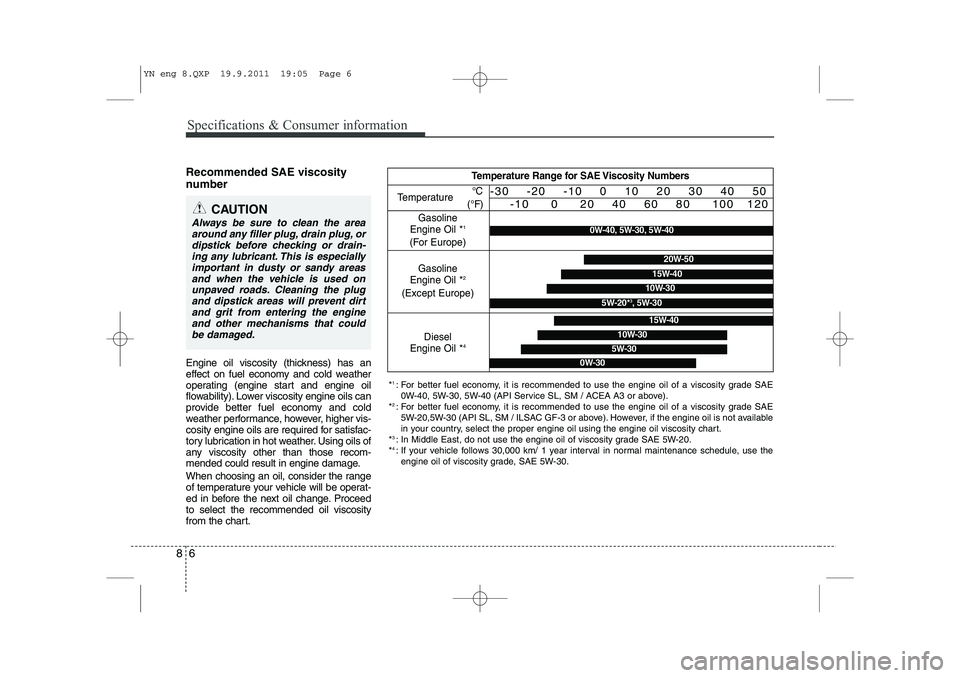
Recommended SAE viscosity
number
Engine oil viscosity (thickness) has an
effect on fuel economy and cold weather
operating (engine start and engine oil
flowability). Lower viscosity engine oils can
provide better fuel economy and cold
weather performance, however, higher vis-
cosity engine oils are required for satisfac-
tory lubrication in hot weather. Using oils of
any viscosity other than those recom-
mended could result in engine damage.
When choosing an oil, consider the range
of temperature your vehicle will be operat-
ed in before the next oil change. Proceedto select the recommended oil viscosity
from the chart.
CAUTION
Always be sure to clean the area
around any filler plug, drain plug, ordipstick before checking or drain-ing any lubricant. This is especially
important in dusty or sandy areas and when the vehicle is used onunpaved roads. Cleaning the plugand dipstick areas will prevent dirt
and grit from entering the engine and other mechanisms that couldbe damaged.
* 1
: For better fuel economy, it is recommended to use the engine oil of a viscosity grade SAE
0W-40, 5W-30, 5W-40 (API Service SL, SM / ACEA A3 or above).
* 2
: For better fuel economy, it is recommended to use the engine oil of a viscosity grade SAE
5W-20,5W-30 (API SL, SM / ILSAC GF-3 or above). However, if the engine oil is not available
in your country, select the proper engine oil using the engine oil viscosity chart.
* 3
: In Middle East, do not use the engine oil of viscosity grade SAE 5W-20.
* 4
: If your vehicle follows 30,000 km/ 1 year interval in normal maintenance schedule, use the
engine oil of viscosity grade, SAE 5W-30.
Temperature Range for SAE Viscosity Numbers
Temperature
Gasoline
Engine Oil * 1
(For Europe) °C
(°F)-30 -20 -10 0 10 20 30 40 50 -10 0 20 40 60 80 100 120
Diesel
Engine Oil * 4
5W-30
15W-40
10W-30
0W-40, 5W-30, 5W-40
Gasoline
Engine Oil * 2
(Except Europe)20W-50
10W-30
15W-40
5W-20* 3
, 5W-30
0W-30
YN eng 8.QXP 19.9.2011 19:05 Page 6
Page 389 of 751
Index
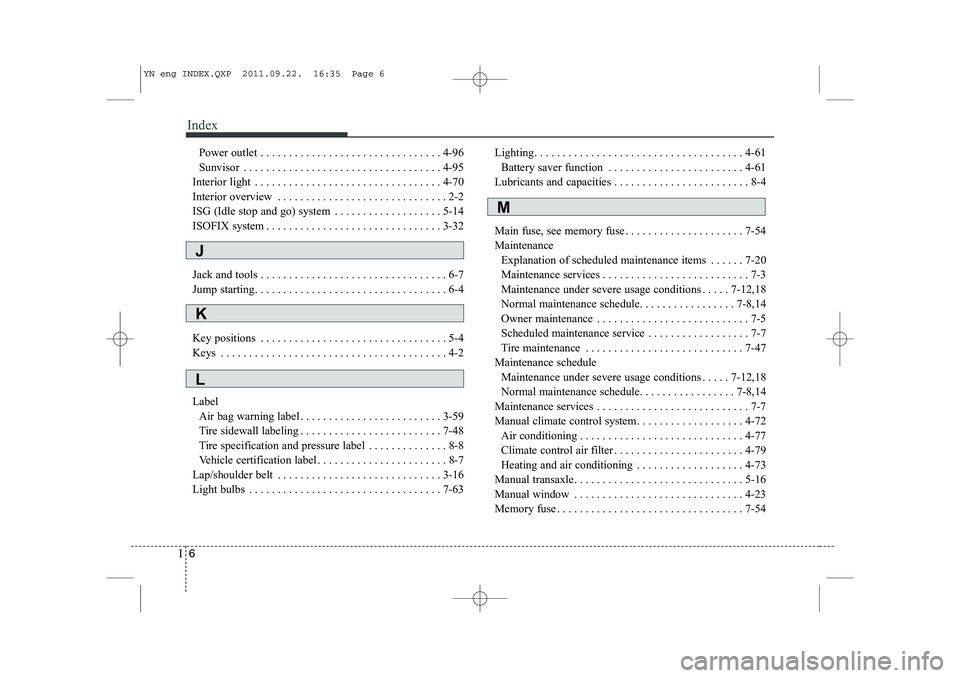
6
I
Power outlet . . . . . . . . . . . . . . . . . . . . . . . . . . . . . . . . 4-96
Sunvisor . . . . . . . . . . . . . . . . . . . . . . . . . . . . . . . . . . . 4-95
Interior light . . . . . . . . . . . . . . . . . . . . . . . . . . . . . . . . . 4-70
Interior overview . . . . . . . . . . . . . . . . . . . . . . . . . . . . . . 2-2
ISG (Idle stop and go) system . . . . . . . . . . . . . . . . . . . 5-14
ISOFIX system . . . . . . . . . . . . . . . . . . . . . . . . . . . . . . . 3-32
Jack and tools . . . . . . . . . . . . . . . . . . . . . . . . . . . . . . . . . 6-7
Jump starting. . . . . . . . . . . . . . . . . . . . . . . . . . . . . . . . . . 6-4
Key positions . . . . . . . . . . . . . . . . . . . . . . . . . . . . . . . . . 5-4
Keys . . . . . . . . . . . . . . . . . . . . . . . . . . . . . . . . . . . . . . . . 4-2 Label Air bag warning label . . . . . . . . . . . . . . . . . . . . . . . . . 3-59
Tire sidewall labeling . . . . . . . . . . . . . . . . . . . . . . . . . 7-48
Tire specification and pressure label . . . . . . . . . . . . . . 8-8
Vehicle certification label . . . . . . . . . . . . . . . . . . . . . . . 8-7
Lap/shoulder belt . . . . . . . . . . . . . . . . . . . . . . . . . . . . . 3-16
Light bulbs . . . . . . . . . . . . . . . . . . . . . . . . . . . . . . . . . . 7-63 Lighting. . . . . . . . . . . . . . . . . . . . . . . . . . . . . . . . . . . . . 4-61
Battery saver function . . . . . . . . . . . . . . . . . . . . . . . . 4-61
Lubricants and capacities . . . . . . . . . . . . . . . . . . . . . . . . 8-4
Main fuse, see memory fuse . . . . . . . . . . . . . . . . . . . . . 7-54 Maintenance Explanation of scheduled maintenance items . . . . . . 7-20
Maintenance services . . . . . . . . . . . . . . . . . . . . . . . . . . 7-3
Maintenance under severe usage conditions . . . . . 7-12,18
Normal maintenance schedule. . . . . . . . . . . . . . . . . 7-8,14
Owner maintenance . . . . . . . . . . . . . . . . . . . . . . . . . . . 7-5
Scheduled maintenance service . . . . . . . . . . . . . . . . . . 7-7
Tire maintenance . . . . . . . . . . . . . . . . . . . . . . . . . . . . 7-47
Maintenance schedule Maintenance under severe usage conditions . . . . . 7-12,18
Normal maintenance schedule. . . . . . . . . . . . . . . . . 7-8,14
Maintenance services . . . . . . . . . . . . . . . . . . . . . . . . . . . 7-7
Manual climate control system. . . . . . . . . . . . . . . . . . . 4-72 Air conditioning . . . . . . . . . . . . . . . . . . . . . . . . . . . . . 4-77
Climate control air filter . . . . . . . . . . . . . . . . . . . . . . . 4-79
Heating and air conditioning . . . . . . . . . . . . . . . . . . . 4-73
Manual transaxle. . . . . . . . . . . . . . . . . . . . . . . . . . . . . . 5-16
Manual window . . . . . . . . . . . . . . . . . . . . . . . . . . . . . . 4-23
Memory fuse . . . . . . . . . . . . . . . . . . . . . . . . . . . . . . . . . 7-54
J
K
L
M
YN eng INDEX.QXP 2011.09.22. 16:35 Page 6
Page 390 of 751
I7
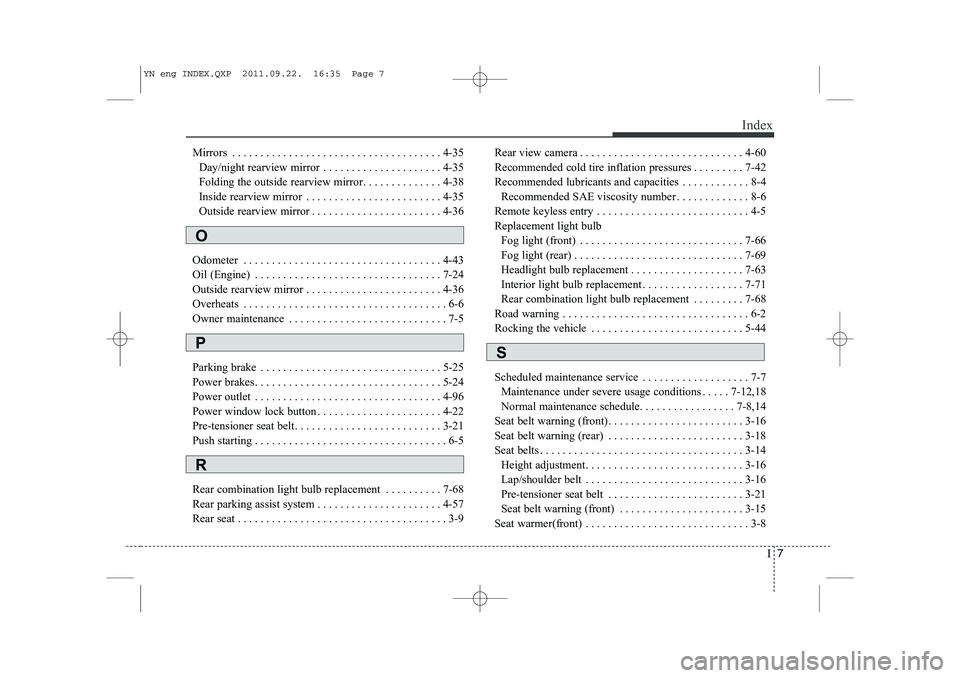
Index
Mirrors . . . . . . . . . . . . . . . . . . . . . . . . . . . . . . . . . . . . . 4-35
Day/night rearview mirror . . . . . . . . . . . . . . . . . . . . . 4-35
Folding the outside rearview mirror. . . . . . . . . . . . . . 4-38
Inside rearview mirror . . . . . . . . . . . . . . . . . . . . . . . . 4-35
Outside rearview mirror . . . . . . . . . . . . . . . . . . . . . . . 4-36
Odometer . . . . . . . . . . . . . . . . . . . . . . . . . . . . . . . . . . . 4-43
Oil (Engine) . . . . . . . . . . . . . . . . . . . . . . . . . . . . . . . . . 7-24
Outside rearview mirror . . . . . . . . . . . . . . . . . . . . . . . . 4-36
Overheats . . . . . . . . . . . . . . . . . . . . . . . . . . . . . . . . . . . . 6-6
Owner maintenance . . . . . . . . . . . . . . . . . . . . . . . . . . . . 7-5
Parking brake . . . . . . . . . . . . . . . . . . . . . . . . . . . . . . . . 5-25
Power brakes. . . . . . . . . . . . . . . . . . . . . . . . . . . . . . . . . 5-24
Power outlet . . . . . . . . . . . . . . . . . . . . . . . . . . . . . . . . . 4-96
Power window lock button . . . . . . . . . . . . . . . . . . . . . . 4-22
Pre-tensioner seat belt. . . . . . . . . . . . . . . . . . . . . . . . . . 3-21
Push starting . . . . . . . . . . . . . . . . . . . . . . . . . . . . . . . . . . 6-5
Rear combination light bulb replacement . . . . . . . . . . 7-68
Rear parking assist system . . . . . . . . . . . . . . . . . . . . . . 4-57
Rear seat . . . . . . . . . . . . . . . . . . . . . . . . . . . . . . . . . . . . . 3-9 Rear view camera . . . . . . . . . . . . . . . . . . . . . . . . . . . . . 4-60
Recommended cold tire inflation pressures . . . . . . . . . 7-42
Recommended lubricants and capacities . . . . . . . . . . . . 8-4
Recommended SAE viscosity number . . . . . . . . . . . . . 8-6
Remote keyless entry . . . . . . . . . . . . . . . . . . . . . . . . . . . 4-5Replacement light bulb Fog light (front) . . . . . . . . . . . . . . . . . . . . . . . . . . . . . 7-66
Fog light (rear) . . . . . . . . . . . . . . . . . . . . . . . . . . . . . . 7-69
Headlight bulb replacement . . . . . . . . . . . . . . . . . . . . 7-63
Interior light bulb replacement . . . . . . . . . . . . . . . . . . 7-71
Rear combination light bulb replacement . . . . . . . . . 7-68
Road warning . . . . . . . . . . . . . . . . . . . . . . . . . . . . . . . . . 6-2
Rocking the vehicle . . . . . . . . . . . . . . . . . . . . . . . . . . . 5-44
Scheduled maintenance service . . . . . . . . . . . . . . . . . . . 7-7
Maintenance under severe usage conditions . . . . . 7-12,18
Normal maintenance schedule. . . . . . . . . . . . . . . . . 7-8,14
Seat belt warning (front). . . . . . . . . . . . . . . . . . . . . . . . 3-16
Seat belt warning (rear) . . . . . . . . . . . . . . . . . . . . . . . . 3-18
Seat belts . . . . . . . . . . . . . . . . . . . . . . . . . . . . . . . . . . . . 3-14 Height adjustment. . . . . . . . . . . . . . . . . . . . . . . . . . . . 3-16
Lap/shoulder belt . . . . . . . . . . . . . . . . . . . . . . . . . . . . 3-16
Pre-tensioner seat belt . . . . . . . . . . . . . . . . . . . . . . . . 3-21
Seat belt warning (front) . . . . . . . . . . . . . . . . . . . . . . 3-15
Seat warmer(front) . . . . . . . . . . . . . . . . . . . . . . . . . . . . . 3-8
O
SP
R
YN eng INDEX.QXP 2011.09.22. 16:35 Page 7
Page 393 of 751
kia, tthe ccompany
Thank you for becoming the owner of a new Kia vehicle.
As a global car manufacturer focused on building high-quality, value for reasonable prices, Kia Motors is dedicated to providing you with a cus-tomer service experience that exceeds your expectations. At all of our Kia dealerships you will be treated with warmth, hospitality and professionalism by people who care based on our “Family-like Care”
promise.
All information contained in this Owner’s Manual is accurate at the
time of publication. However, Kia reserves the right to make changesat any time so that our policy of continual product improvement can becarried out. This manual applies to all models of this vehicle and includes descrip-
tions and explanations of optional as well as standard equipment. As aresult, you may encounter material in this manual that is not applicableto your specific Kia vehicle.
Enjoy your vehicle and Kia’s “Family-like Care” experience!
YN RHD FOREWORD.QXP 1/15/2013 1:00 PM Page 1
Page 428 of 751

323
Safety features of your vehicle
Seat belt precautions
Infant or small child
You should be aware of the specific
requirements in your country. Child
and/or infant seats must be properly
placed and installed in the rear seat. For
more information about the use of these
restraints, refer to “Child restraint sys-
tem” in this section.
✽✽NOTICE
Small children are best protected from
injury in an accident when properly
restrained in the rear seat by a child
restraint system that meets the require-
ments of the Safety Standards of your
country. Before buying any child
restraint system, make sure that it has alabel certifying that it meets Safety
Standards of your country. The restraint
must be appropriate for your child'sheight and weight. Check the label on
the child restraint for this information.
Refer to “Child restraint system” in thissection.
WARNING
All occupants of the vehicle must wear their seat belts at all times.
Seat belts and child restraintsreduce the risk of serious or fatal
injuries for all occupants in the
event of a collision or sudden stop.
Without a seat belt, occupants
could be shifted too close to a
deploying air bag, strike the interior
structure or be thrown from the
vehicle. Properly worn seat belts
greatly reduce these hazards.
Always follow the precautions
about seat belts, air bags and occu-pant seating contained in this man-ual.
WARNING
Every person in your vehicle needs
to be properly restrained at all
times, including infants and chil-
dren. Never hold a child in yourarms or lap when riding in a vehi-
cle. The violent forces created dur-
ing a crash will tear the child from
your arms and throw the child
against the interior. Always use a
child restraint appropriate for your
child's height and weight.(Continued)
The pre-tensioner seat belt assembly mechanisms become
hot during activation. Do not
touch the pre-tensioner seat belt
assemblies for several minutes
after they have been activated.
Do not attempt to inspect or replace the pre-tensioner seat
belts yourself. We recommend
that the system be serviced by an
authorised Kia dealer.
Do not strike the pre-tensioner seat belt assemblies.
Improper handling of the pre-ten- sioner seat belt assemblies, andfailure to heed the warnings not
to strike, modify, inspect, replace,
service or repair the pre-tension-
er seat belt assemblies may lead
to improper operation or inadver-
tent activation and serious injury.
Always wear the seat belts when driving or riding in a motor vehi-
cle.
If the vehicle or pre-tensioner seat belt must be discarded, we
recommend that you contact anauthorised Kia dealer
YN RHD 3.QXP 3/31/2012 4:03 PM Page 23
Page 455 of 751
Safety features of your vehicle
50
3
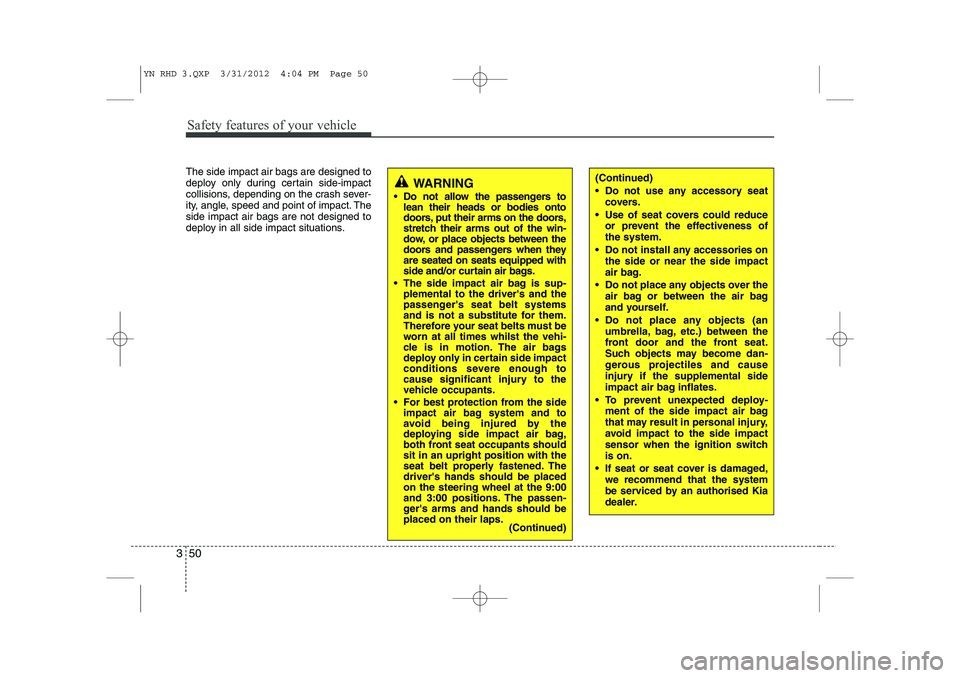
The side impact air bags are designed to
deploy only during certain side-impact
collisions, depending on the crash sever-
ity, angle, speed and point of impact. Theside impact air bags are not designed to
deploy in all side impact situations.(Continued)
Do not use any accessory seat
covers.
Use of seat covers could reduce or prevent the effectiveness of the system.
Do not install any accessories on the side or near the side impact
air bag.
Do not place any objects over the air bag or between the air bag
and yourself.
Do not place any objects (an umbrella, bag, etc.) between the
front door and the front seat.
Such objects may become dan-
gerous projectiles and cause
injury if the supplemental side
impact air bag inflates.
To prevent unexpected deploy- ment of the side impact air bag
that may result in personal injury,
avoid impact to the side impact
sensor when the ignition switchis on.
If seat or seat cover is damaged, we recommend that the system
be serviced by an authorised Kia
dealer.WARNING
Do not allow the passengers to lean their heads or bodies onto
doors, put their arms on the doors,
stretch their arms out of the win-
dow, or place objects between the
doors and passengers when theyare seated on seats equipped with
side and/or curtain air bags.
The side impact air bag is sup- plemental to the driver's and the
passenger's seat belt systems
and is not a substitute for them.
Therefore your seat belts must be
worn at all times whilst the vehi-
cle is in motion. The air bags
deploy only in certain side impact
conditions severe enough to
cause significant injury to the
vehicle occupants.
For best protection from the side impact air bag system and to
avoid being injured by the
deploying side impact air bag,
both front seat occupants shouldsit in an upright position with the
seat belt properly fastened. Thedriver's hands should be placedon the steering wheel at the 9:00
and 3:00 positions. The passen-
ger's arms and hands should beplaced on their laps. (Continued)
YN RHD 3.QXP 3/31/2012 4:04 PM Page 50
Page 456 of 751
351
Safety features of your vehicle
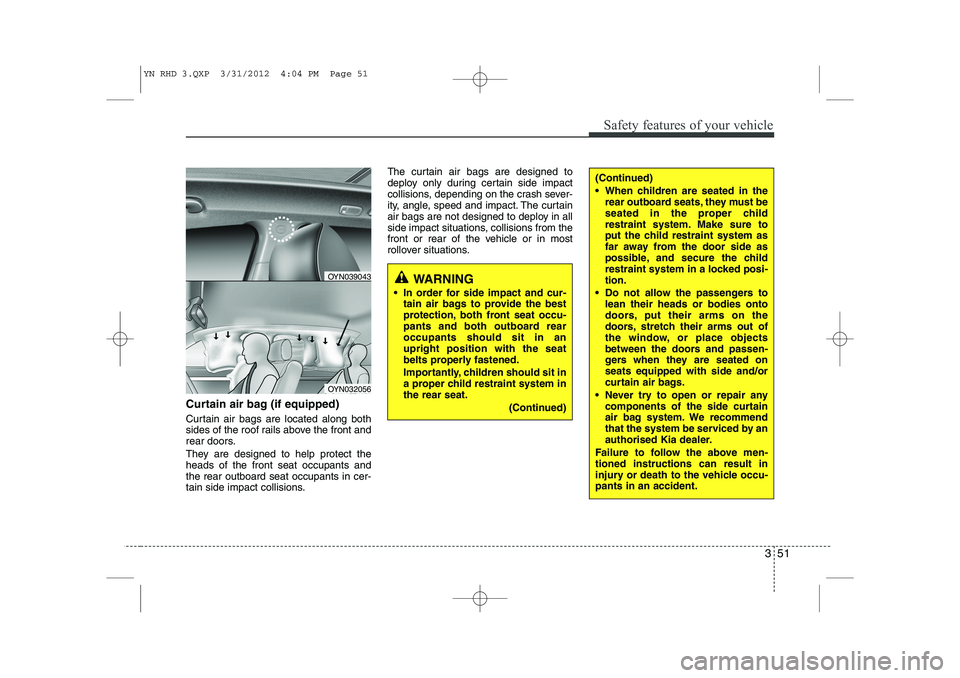
Curtain air bag (if equipped)
Curtain air bags are located along both
sides of the roof rails above the front and
rear doors.
They are designed to help protect the heads of the front seat occupants andthe rear outboard seat occupants in cer-
tain side impact collisions.The curtain air bags are designed to
deploy only during certain side impact
collisions, depending on the crash sever-
ity, angle, speed and impact. The curtain
air bags are not designed to deploy in all
side impact situations, collisions from the
front or rear of the vehicle or in most
rollover situations.
WARNING
In order for side impact and cur- tain air bags to provide the best
protection, both front seat occu-
pants and both outboard rearoccupants should sit in anupright position with the seat
belts properly fastened.
Importantly, children should sit in
a proper child restraint system inthe rear seat.
(Continued)
(Continued)
When children are seated in therear outboard seats, they must be
seated in the proper child
restraint system. Make sure to
put the child restraint system as
far away from the door side as
possible, and secure the child
restraint system in a locked posi-tion.
Do not allow the passengers to lean their heads or bodies onto
doors, put their arms on the
doors, stretch their arms out of
the window, or place objects
between the doors and passen-
gers when they are seated onseats equipped with side and/or
curtain air bags.
Never try to open or repair any components of the side curtain
air bag system. We recommend
that the system be serviced by an
authorised Kia dealer.
Failure to follow the above men-tioned instructions can result in
injury or death to the vehicle occu-pants in an accident.
OYN032056
OYN039043
YN RHD 3.QXP 3/31/2012 4:04 PM Page 51