fuel cap KIA VENGA 2015 User Guide
[x] Cancel search | Manufacturer: KIA, Model Year: 2015, Model line: VENGA, Model: KIA VENGA 2015Pages: 480, PDF Size: 23.15 MB
Page 186 of 480
443
Features of your vehicle
Fuel gauge
The fuel gauge indicates the approxi- mate amount of fuel remaining in the fueltank.
The fuel tank capacity is given in sec-
tion 8.The fuel gauge is supplemented by
a low fuel warning light, which will illumi-
nate when the fuel tank is nearly empty.
On inclines or curves, the fuel gauge
pointer may fluctuate or the low fuel
warning light may come on earlier than
usual due to the movement of fuel in thetank.
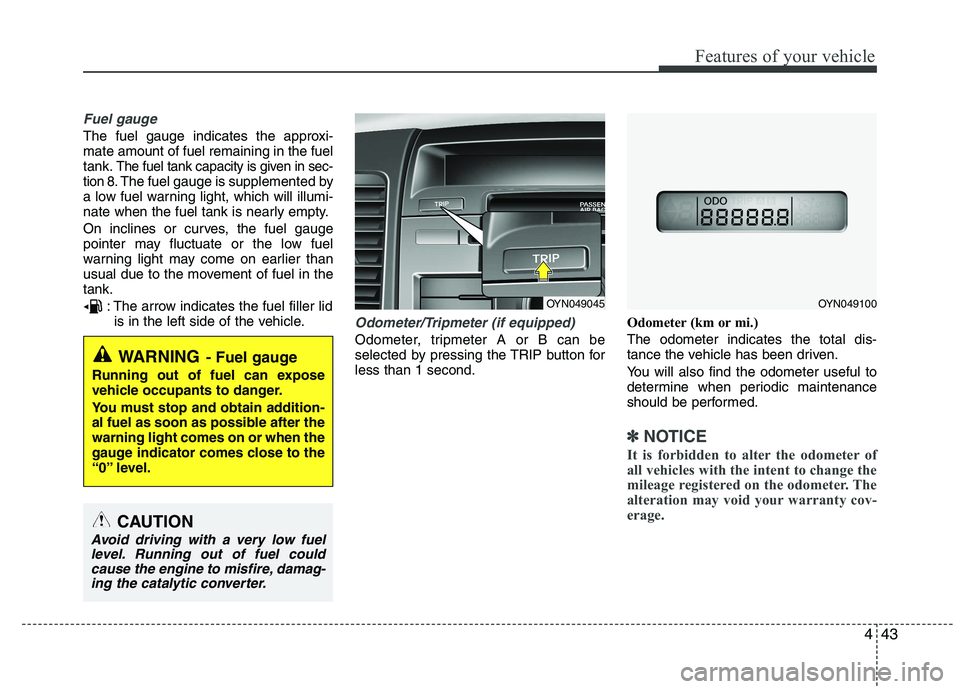
: The arrow indicates the fuel filler lidis in the left side of the vehicle.
Odometer/Tripmeter (if equipped)
Odometer, tripmeter A or B can be
selected by pressing the TRIP button forless than 1 second. Odometer (km or mi.) The odometer indicates the total dis-
tance the vehicle has been driven.
You will also find the odometer useful to
determine when periodic maintenance
should be performed.
✽✽
NOTICE
It is forbidden to alter the odometer of
all vehicles with the intent to change the
mileage registered on the odometer. The
alteration may void your warranty cov-
erage.
WARNING - Fuel gauge
Running out of fuel can expose
vehicle occupants to danger.
You must stop and obtain addition-
al fuel as soon as possible after thewarning light comes on or when the
gauge indicator comes close to the
“0” level.
CAUTION
Avoid driving with a very low fuel level. Running out of fuel could cause the engine to misfire, damag-ing the catalytic converter.
OYN049045OYN049100
Page 330 of 480
553
Driving your vehicle
If you are considering towing with your
vehicle, you should first check with your
country's Department of Motor Vehicles
to determine their legal requirements.
Since laws vary the requirements for tow-
ing trailers, cars, or other types of vehi-
cles or apparatus may differ. We recom-
mend that you ask an authorised Kia
dealer.✽✽NOTICE - For Europe
The technically permissible maximum load on the rear axle(s) may be
exceeded by not more than 15% and
the technically permissible maximum
laden mass of the vehicle may be
exceeded by not more than 10% or
100kg (220.4 lbs), whichever value is
lower. In this case, do not exceed 100
km/h (62.1 mph) for vehicle of catego-
ry M1 or 80 km/h (49.7 mph) for vehi-
cle of category N1.
When towing a trailer, the additional load imposed at the trailer coupling
device may cause the rear tyre maxi-
mum load ratings to be exceeded, but
not by more than 15%. In such a case,
do not exceed 100km/h, and the rear
tyre pressure should be at least 20
kPa(0.2 bar) above the tyre pres-
sure(s) as recommended for normal
use (i.e. without a trailer attached).Your vehicle can tow a trailer. To identify
what the vehicle trailering capacity is for
your vehicle, you should read the infor-
mation in “Weight of the trailer” thatappears later in this section.
Remember that trailering is different than
just driving your vehicle by itself.
Trailering means changes in handling,
durability, and fuel economy. Successful,
safe trailering requires correct equip-
ment, and it has to be used properly.
This section contains many time-tested,
important trailering tips and safety rules.
Many of these are important for your
safety and that of your passengers.
Please read this section carefully before
you pull a trailer. Load-pulling components such as the
engine, transaxle, wheel assemblies, and
tyres are forced to work harder against
the load of the added weight. The engine
is required to operate at relatively higher
speeds and under greater loads. This
additional burden generates extra heat.
The trailer also considerably adds wind
resistance, increasing pulling require-
ments.
TRAILER TOWING (FOR EUROPE)
WARNING
- Towing a trailer
If you don't use the correct equip-
ment and drive improperly, you can
lose control when you pull a trailer.
For example, if the trailer is too
heavy, the brakes may not work
well - or even at all. You and your
passengers could be seriously or
fatally injured. Pull a trailer only if
you have followed all the steps inthis section.
WARNING - Weight limits
Before towing, make sure the total
trailer weight, gross combination
weight, gross vehicle weight, grossaxle weight and trailer nose weightare all within the limits.CAUTION
Pulling a trailer improperly can damage your vehicle and result in costly repairs not covered by yourwarranty. To pull a trailer correctly,
follow the advice in this section.
YN RHD 5.QXP 11/20/2014 6:39 PM Page 53
Page 338 of 480
561
Driving your vehicle
This section will guide you in the proper
loading of your vehicle and/or trailer, to
keep your loaded vehicle weight within its
design rating capability, with or without a
trailer. Properly loading your vehicle will
provide maximum return of the vehicle
design performance. Before loading your
vehicle, familiarize yourself with the fol-
lowing terms for determining your vehi-
cle's weight ratings, with or without a
trailer, from the vehicle's specifications
and the certification label: Base kerb weight
This is the weight of the vehicle including a full tank of fuel and all standard equip-
ment. It does not include passengers,
cargo, or optional equipment.
Vehicle kerb weight
This is the weight of your new vehicle
when you picked it up from your dealer
plus any aftermarket equipment.Cargo weight
This figure includes all weight added to
the Base Kerb Weight, including cargoand optional equipment.
GAW (Gross axle weight)
This is the total weight placed on each
axle (front and rear) - including vehicle
kerb weight and all payload.
GAWR (Gross axle weight rating)
This is the maximum allowable weight
that can be carried by a single axle (front
or rear). These numbers are shown on
the certification label.
The total load on each axle must never
exceed its GAWR.
GVW (Gross vehicle weight)
This is the Base Kerb Weight plus actual
Cargo Weight plus passengers.
GVWR (Gross vehicle weight rating)
This is the maximum allowable weight of
the fully loaded vehicle (including all
options, equipment, passengers and
cargo). The GVWR is shown on the cer-
tification label located on the driver’s (or
front passenger’s) door sill. Overloading
VEHICLE WEIGHTWARNING -
Vehicle weight
The gross axle weight rating
(GAWR) and the gross vehicle
weight rating (GVWR) for your vehi-
cle are on the certification label
attached to the driver's (or front
passenger’s) door. Exceeding theseratings can cause an accident or
vehicle damage. You can calculate
the weight of your load by weighing
the items (and people) before put-
ting them in the vehicle. Be careful
not to overload your vehicle.
YN RHD 5.QXP 11/20/2014 6:39 PM Page 61
Page 381 of 480
Maintenance
2
7
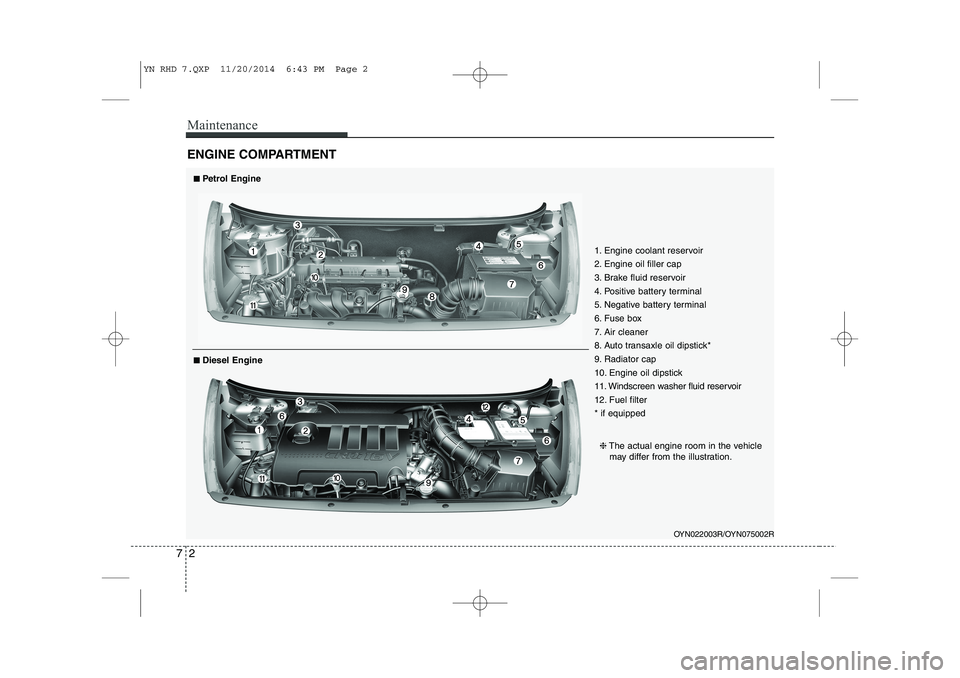
ENGINE COMPARTMENT
OYN022003R/OYN075002R
■■
Petrol Engine
❈ The actual engine room in the vehicle
may differ from the illustration.
■
■
Diesel Engine 1. Engine coolant reservoir
2. Engine oil filler cap
3. Brake fluid reservoir
4. Positive battery terminal
5. Negative battery terminal
6. Fuse box
7. Air cleaner
8. Auto transaxle oil dipstick*
9. Radiator cap
10. Engine oil dipstick
11. Windscreen washer fluid reservoir
12. Fuel filter * if equipped
YN RHD 7.QXP 11/20/2014 6:43 PM Page 2
Page 388 of 480
79
Maintenance
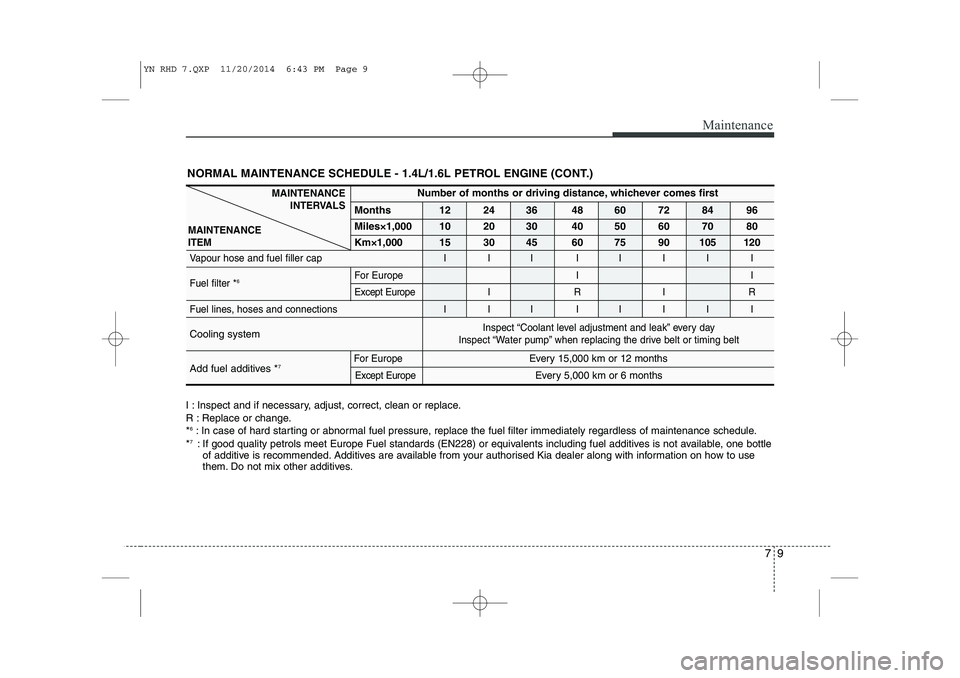
I : Inspect and if necessary, adjust, correct, clean or replace.
R : Replace or change.*6
: In case of hard starting or abnormal fuel pressure, replace the fuel filter immediately regardless of maintenance schedule.
* 7
: If good quality petrols meet Europe Fuel standards (EN228) or equivalents including fuel additives is not available, one bottl e
of additive is recommended. Additives are available from your authorised Kia dealer along with information on how to use
them. Do not mix other additives.
Number of months or driving distance, whichever comes first
Months 12 24 36 48 60 72 84 96 Miles×1,000
10 20 30 40 50 60 70 80
Km×1,00015 30 45 60 75 90 105 120
Vapour hose and fuel filler cap I I I I I I I I Fuel filter * 6 For Europe
II
Except EuropeIRIR
Fuel lines, hoses and connections I I I I I I I I
Cooling system
Add fuel additives *
7Inspect “Coolant level adjustment and leak” every day
Inspect “Water pump” when replacing the drive belt or timing belt
Every 15,000 km or 12 months
Every 5,000 km or 6 monthsFor EuropeExcept Europe
MAINTENANCE INTERVALS
MAINTENANCE ITEM
NORMAL MAINTENANCE SCHEDULE - 1.4L/1.6L PETROL ENGINE (CONT.)
YN RHD 7.QXP 11/20/2014 6:43 PM Page 9
Page 394 of 480
715
Maintenance
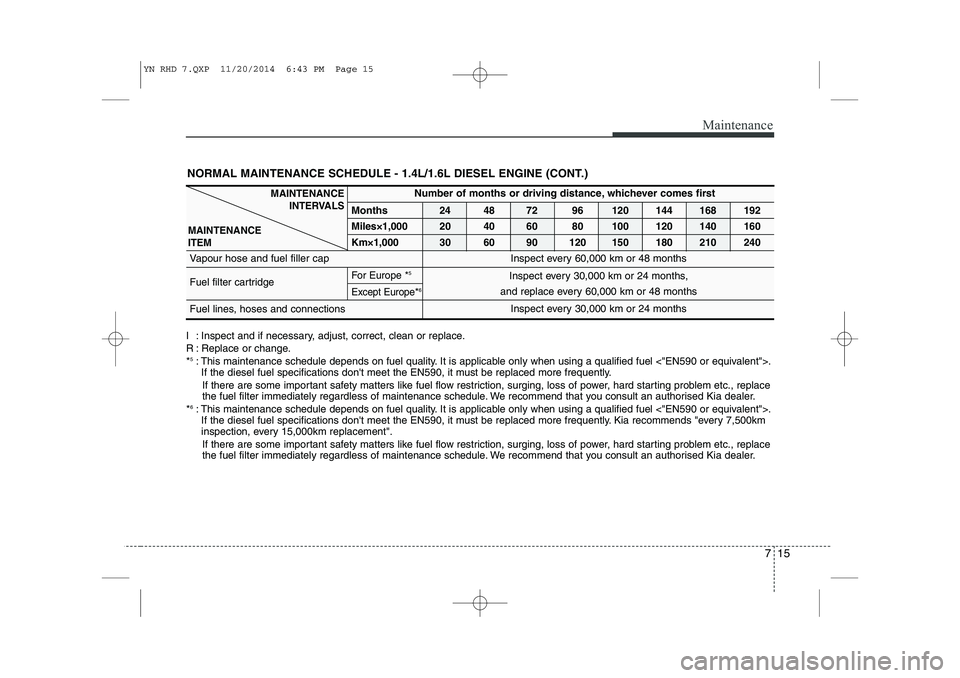
NORMAL MAINTENANCE SCHEDULE - 1.4L/1.6L DIESEL ENGINE (CONT.)
Number of months or driving distance, whichever comes first
Months
24 48 72 96 120 144 168 192
Miles×1,000 20 40 60 80 100 120 140 160
Km×1,000 30 60 90 120 150 180 210 240
Vapour hose and fuel filler cap
Fuel filter cartridge For Europe *
5Except Europe*6
Fuel lines, hoses and connections
I : Inspect and if necessary, adjust, correct, clean or replace.
R : Replace or change.* 5
: This maintenance schedule depends on fuel quality. It is applicable only when using a qualified fuel <"EN590 or equivalent">.
If the diesel fuel specifications don't meet the EN590, it must be replaced more frequently.
If there are some important safety matters like fuel flow restriction, surging, loss of power, hard starting problem etc., repl ace
the fuel filter immediately regardless of maintenance schedule. We recommend that you consult an authorised Kia dealer.
* 6
: This maintenance schedule depends on fuel quality. It is applicable only when using a qualified fuel <"EN590 or equivalent">.
If the diesel fuel specifications don't meet the EN590, it must be replaced more frequently. Kia recommends "every 7,500km
inspection, every 15,000km replacement".
If there are some important safety matters like fuel flow restriction, surging, loss of power, hard starting problem etc., repl ace
the fuel filter immediately regardless of maintenance schedule. We recommend that you consult an authorised Kia dealer.
MAINTENANCE
INTERVALS
MAINTENANCE ITEM
Inspect every 30,000 km or 24 months
Inspect every 30,000 km or 24 months,
and replace every 60,000 km or 48 months
Inspect every 60,000 km or 48 months
YN RHD 7.QXP 11/20/2014 6:43 PM Page 15
Page 400 of 480
721
Maintenance
Timing belt (if equipped)
Inspect all parts related to the timing belt
for damage and deformation. Replace
any damaged parts immediately.
Vapour hose and fuel filler cap
The vapour hose and fuel filler cap
should be inspected at those intervals
specified in the maintenance schedule.
Make sure that a new vapour hose or fuelfiller cap is correctly replaced.Vacuum crankcase ventilation hoses (if equipped)
Inspect the surface of hoses for evidence
of heat and/or mechanical damage. Hard
and brittle rubber, cracking, tears, cuts,
abrasions, and excessive swelling indi-
cate deterioration. Particular attention
should be paid to examine those hose
surfaces nearest to high heat sources,
such as the exhaust manifold. Inspect the hose routing to assure that the hoses do not come in contact with
any heat source, sharp edges or movingcomponent which might cause heat dam-
age or mechanical wear. Inspect all hose
connections, such as clamps and cou-
plings, to make sure they are secure, and
that no leaks are present. Hoses should
be replaced immediately if there is any
evidence of deterioration or damage.Air cleaner filter
We recommend that you use air cleaner
filter for replacement from an authorised
Kia dealer.
Spark plugs (for petrol engine)
Make sure to install new spark plugs of
the correct heat range.
Valve clearance (if equipped)
Inspect for excessive valve noise and/or
engine vibration and adjust if necessary.
We recommend that the system be serv-
iced by an authorised Kia dealer.
YN RHD 7.QXP 11/20/2014 6:43 PM Page 21
Page 458 of 480
779
Maintenance
EMISSION CONTROL SYSTEM
The emission control system of your
vehicle is covered by a written limited
warranty. Please see the warranty infor-
mation contained in the Warranty &
Maintenance booklet in your vehicle.
Your vehicle is equipped with an emis- sion control system to meet all emission
regulations. There are three emission control sys-
tems which are as follows.
(1) Crankcase emission control system
(2) Evaporative emission control system(3) Exhaust emission control system In order to assure the proper function of
the emission control systems, it is rec-
ommended that you have your vehicle
inspected and maintained by an autho-
rised Kia dealer in accordance with the
maintenance schedule in this manual. Caution for the Inspection and
Maintenance Test (With Electronic
Stability Program (ESP) system)
To prevent the vehicle from misfir-
ing during dynamometer testing,
turn the Electronic Stability
Program (ESP) system off by press-
ing the ESP switch.
After dynamometer testing is com- pleted, turn the ESP system back on
by pressing the ESP switch again. 1. Crankcase emission control
system
The positive crankcase ventilation sys-
tem is employed to prevent air pollution
caused by blow-by gases being emitted
from the crankcase. This system supplies
fresh filtered air to the crankcase through
the air intake hose. Inside the crankcase,
the fresh air mixes with blow-by gases,
which then pass through the PCV valveinto the induction system.
2. Evaporative emission control system
The Evaporative Emission Control
System is designed to prevent fuel
vapours from escaping into the atmos-
phere.
YN RHD 7.QXP 11/20/2014 6:46 PM Page 79
Page 466 of 480
85
Specifications & Consumer information
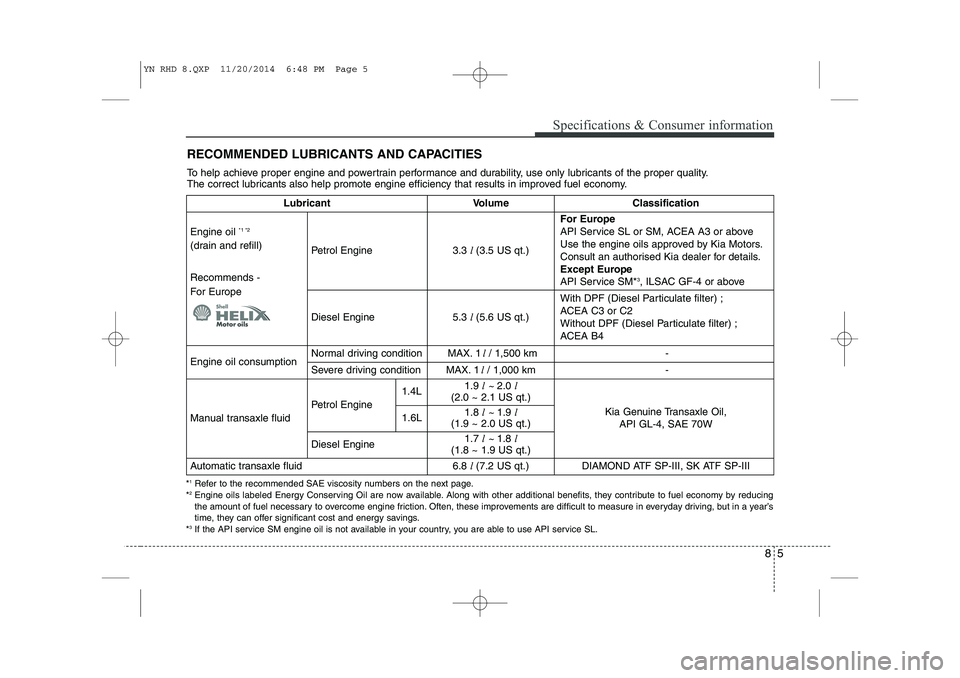
RECOMMENDED LUBRICANTS AND CAPACITIES
To help achieve proper engine and powertrain performance and durability, use only lubricants of the proper quality.
The correct lubricants also help promote engine efficiency that results in improved fuel economy.
* 1
Refer to the recommended SAE viscosity numbers on the next page.
* 2
Engine oils labeled Energy Conserving Oil are now available. Along with other additional benefits, they contribute to fuel economy by reducing
the amount of fuel necessary to overcome engine friction. Often, these improvements are difficult to measure in everyday driving, but in a year’s
time, they can offer significant cost and energy savings.
* 3
If the API service SM engine oil is not available in your country, you are able to use API service SL.
LubricantVolumeClassification
Engine oil *1 *2
(drain and refill) Recommends -
For Europe
Petrol Engine3.3 l(3.5 US qt.)
For Europe
API Service SL or SM, ACEA A3 or above
Use the engine oils approved by Kia Motors.
Consult an authorised Kia dealer for details.
Except Europe
API Service SM* 3
, ILSAC GF-4 or above
Diesel Engine5.3 l(5.6 US qt.)
With DPF (Diesel Particulate filter) ;
ACEA C3 or C2
Without DPF (Diesel Particulate filter) ;
ACEA B4
Engine oil consumptionNormal driving conditionMAX. 1 l/ 1,500 km-
Severe driving conditionMAX. 1 l/ 1,000 km-
Manual transaxle fluid
Petrol Engine
1.9 l~ 2.0 l
(2.0 ~ 2.1 US qt.)
Kia Genuine Transaxle Oil,
API GL-4, SAE 70W1.8 l~ 1.9 l
(1.9 ~ 2.0 US qt.)
Diesel Engine1.7 l~ 1.8 l
(1.8 ~ 1.9 US qt.)
Automatic transaxle fluid6.8 l(7.2 US qt.)DIAMOND ATF SP-III, SK ATF SP-III
1.4L
1.6L
YN RHD 8.QXP 11/20/2014 6:48 PM Page 5