ignition KIA VENGA 2015 User Guide
[x] Cancel search | Manufacturer: KIA, Model Year: 2015, Model line: VENGA, Model: KIA VENGA 2015Pages: 480, PDF Size: 23.15 MB
Page 55 of 480
55
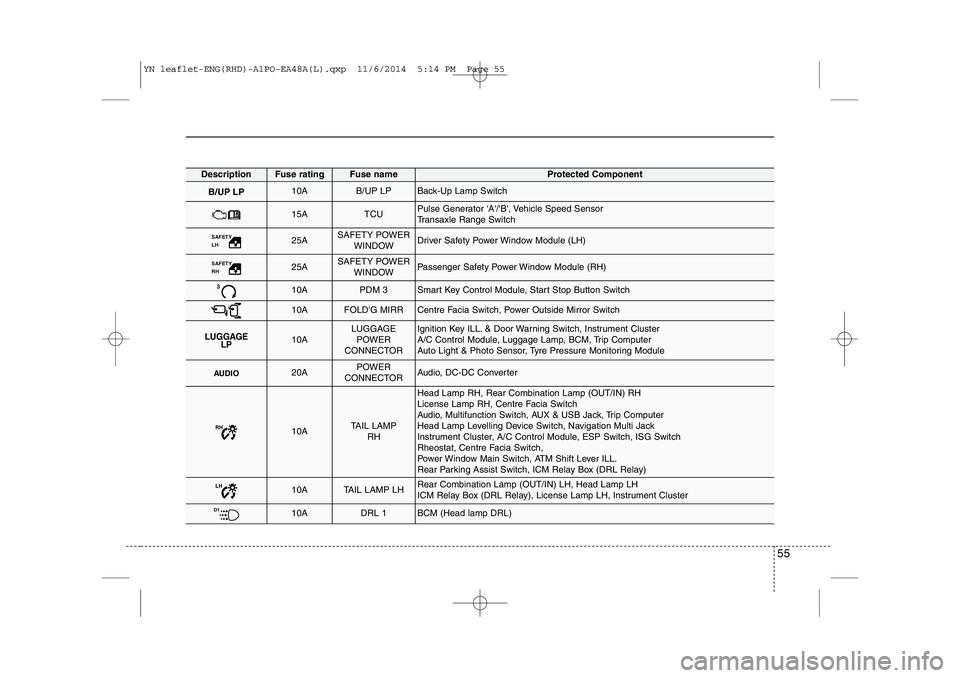
DescriptionFuse ratingFuse nameProtected Component
B/UP LP10AB/UP LPBack-Up Lamp Switch
15ATCUPulse Generator 'A'/'B', Vehicle Speed Sensor
Transaxle Range Switch
SAFETY LH 25ASAFETY POWERWINDOWDriver Safety Power Window Module (LH)
SAFETY RH 25ASAFETY POWERWINDOWPassenger Safety Power Window Module (RH)
310APDM 3Smart Key Control Module, Start Stop Button Switch
10AFOLD'G MIRRCentre Facia Switch, Power Outside Mirror Switch
LUGGAGE LP10ALUGGAGE
POWER
CONNECTORIgnition Key ILL. & Door Warning Switch, Instrument Cluster
A/C Control Module, Luggage Lamp, BCM, Trip Computer
Auto Light & Photo Sensor, Tyre Pressure Monitoring Module
AUDIO20APOWER
CONNECTORAudio, DC-DC Converter
RH10ATAIL LAMP RH
Head Lamp RH, Rear Combination Lamp (OUT/IN) RH
License Lamp RH, Centre Facia Switch
Audio, Multifunction Switch, AUX & USB Jack, Trip Computer
Head Lamp Levelling Device Switch, Navigation Multi Jack
Instrument Cluster, A/C Control Module, ESP Switch, ISG Switch
Rheostat, Centre Facia Switch,
Power Window Main Switch, ATM Shift Lever ILL.
Rear Parking Assist Switch, ICM Relay Box (DRL Relay)
LH10ATAIL LAMP LHRear Combination Lamp (OUT/IN) LH, Head Lamp LH
ICM Relay Box (DRL Relay), License Lamp LH, Instrument Cluster
D110ADRL 1BCM (Head lamp DRL)
YN leaflet-ENG(RHD)-A1PO-EA48A(L).qxp 11/6/2014 5:14 PM Page 55
Page 57 of 480
57
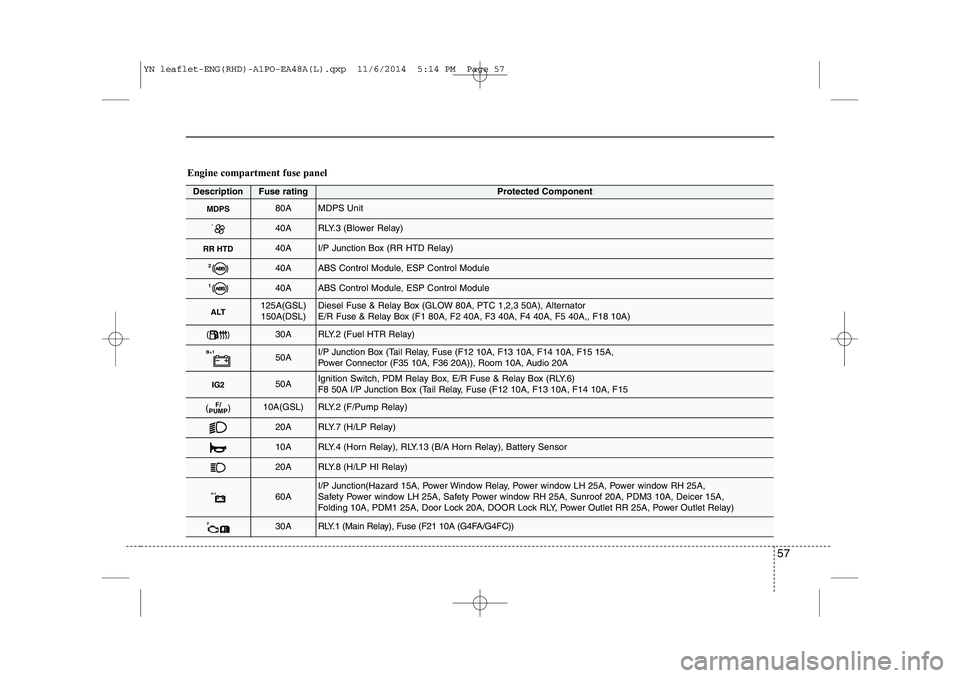
Engine compartment fuse panel
DescriptionFuse ratingProtected Component
MDPS80AMDPS Unit
140ARLY.3 (Blower Relay)
RR HTD40AI/P Junction Box (RR HTD Relay)
240AABS Control Module, ESP Control Module
140AABS Control Module, ESP Control Module
ALT125A(GSL)150A(DSL)Diesel Fuse & Relay Box (GLOW 80A, PTC 1,2,3 50A), Alternator
E/R Fuse & Relay Box (F1 80A, F2 40A, F3 40A, F4 40A, F5 40A,, F18 10A)
30ARLY.2 (Fuel HTR Relay)
B+150AI/P Junction Box (Tail Relay, Fuse (F12 10A, F13 10A, F14 10A, F15 15A,
Power Connector (F35 10A, F36 20A)), Room 10A, Audio 20A
IG250AIgnition Switch, PDM Relay Box, E/R Fuse & Relay Box (RLY.6)
F8 50A I/P Junction Box (Tail Relay, Fuse (F12 10A, F13 10A, F14 10A, F15
F/
PUMP( )10A(GSL)RLY.2 (F/Pump Relay)
20ARLY.7 (H/LP Relay)
10ARLY.4 (Horn Relay), RLY.13 (B/A Horn Relay), Battery Sensor
20ARLY.8 (H/LP HI Relay)
B+260AI/P Junction(Hazard 15A, Power Window Relay, Power window LH 25A, Power window RH 25A,
Safety Power window LH 25A, Safety Power window RH 25A, Sunroof 20A, PDM3 10A, Deicer 15A,
Folding 10A, PDM1 25A, Door Lock 20A, DOOR Lock RLY, Power Outlet RR 25A, Power Outlet Relay)
230ARLY.1 (Main Relay), Fuse (F21 10A (G4FA/G4FC))
YN leaflet-ENG(RHD)-A1PO-EA48A(L).qxp 11/6/2014 5:14 PM Page 57
Page 58 of 480
58
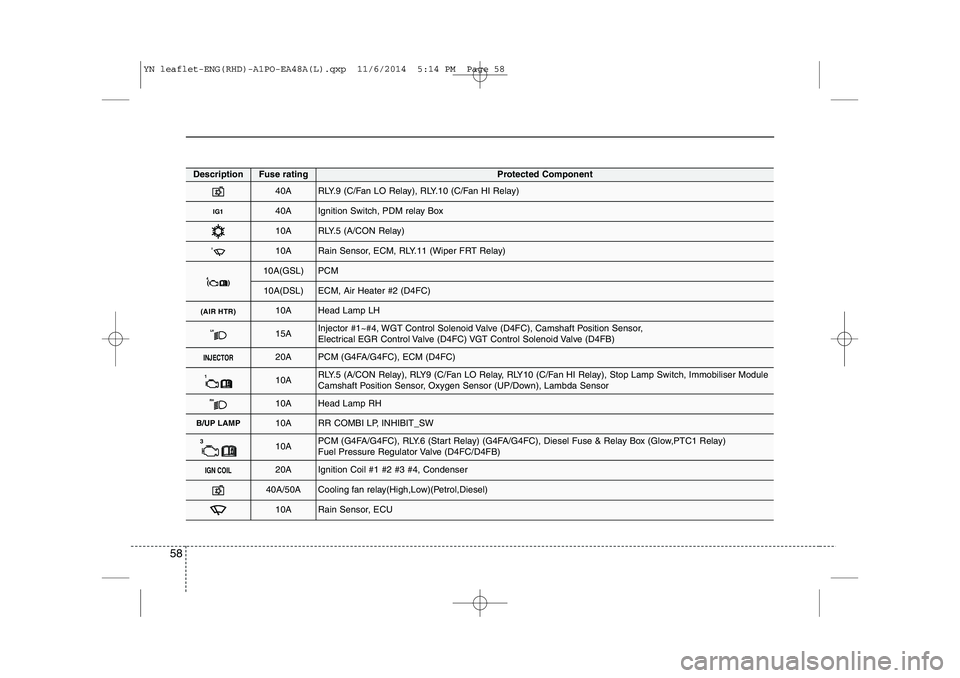
DescriptionFuse ratingProtected Component
40ARLY.9 (C/Fan LO Relay), RLY.10 (C/Fan HI Relay)
IG140AIgnition Switch, PDM relay Box
10ARLY.5 (A/CON Relay)
210ARain Sensor, ECM, RLY.11 (Wiper FRT Relay)
4( )10A(GSL)PCM
10A(DSL)ECM, Air Heater #2 (D4FC)
(AIR HTR)10AHead Lamp LH
LH15AInjector #1~#4, WGT Control Solenoid Valve (D4FC), Camshaft Position Sensor,
Electrical EGR Control Valve (D4FC) VGT Control Solenoid Valve (D4FB)
INJECTOR20APCM (G4FA/G4FC), ECM (D4FC)
110ARLY.5 (A/CON Relay), RLY9 (C/Fan LO Relay, RLY10 (C/Fan HI Relay), Stop Lamp Switch, Immobiliser Module
Camshaft Position Sensor, Oxygen Sensor (UP/Down), Lambda Sensor
RH10AHead Lamp RH
B/UP LAMP10ARR COMBI LP, INHIBIT_SW
310APCM (G4FA/G4FC), RLY.6 (Start Relay) (G4FA/G4FC), Diesel Fuse & Relay Box (Glow,PTC1 Relay)
Fuel Pressure Regulator Valve (D4FC/D4FB)
IGN COIL20AIgnition Coil #1 #2 #3 #4, Condenser
40A/50ACooling fan relay(High,Low)(Petrol,Diesel)
10ARain Sensor, ECU
YN leaflet-ENG(RHD)-A1PO-EA48A(L).qxp 11/6/2014 5:14 PM Page 58
Page 92 of 480
39
Safety features of your vehicle
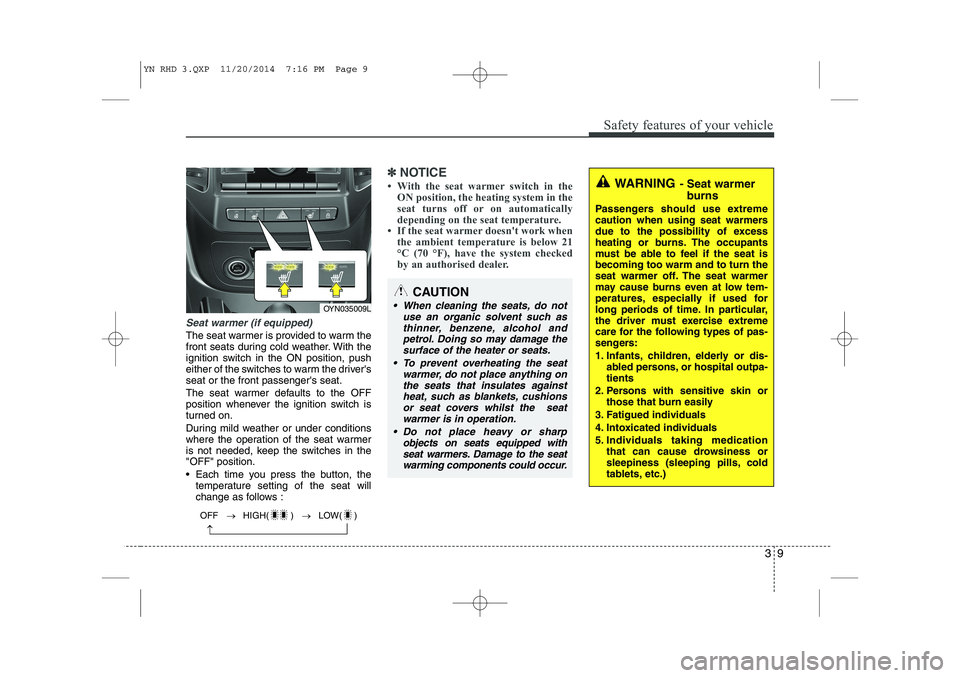
Seat warmer (if equipped)
The seat warmer is provided to warm the
front seats during cold weather. With the
ignition switch in the ON position, push
either of the switches to warm the driver'sseat or the front passenger's seat.
The seat warmer defaults to the OFF
position whenever the ignition switch is
turned on.
During mild weather or under conditions
where the operation of the seat warmer
is not needed, keep the switches in the"OFF" position.
Each time you press the button, thetemperature setting of the seat will
change as follows :
✽✽ NOTICE
With the seat warmer switch in the ON position, the heating system in the
seat turns off or on automatically
depending on the seat temperature.
If the seat warmer doesn't work when
the ambient temperature is below 21
°C (70 °F), have the system checked
by an authorised dealer.WARNING - Seat warmer
burns
Passengers should use extreme
caution when using seat warmers
due to the possibility of excess
heating or burns. The occupants
must be able to feel if the seat isbecoming too warm and to turn the
seat warmer off. The seat warmer
may cause burns even at low tem-
peratures, especially if used for
long periods of time. In particular,
the driver must exercise extreme
care for the following types of pas-
sengers:
1. Infants, children, elderly or dis- abled persons, or hospital outpa- tients
2. Persons with sensitive skin or those that burn easily
3. Fatigued individuals
4. Intoxicated individuals
5. Individuals taking medication that can cause drowsiness or
sleepiness (sleeping pills, cold
tablets, etc.)
OYN035009L
CAUTION
When cleaning the seats, do not
use an organic solvent such asthinner, benzene, alcohol andpetrol. Doing so may damage the surface of the heater or seats.
To prevent overheating the seat warmer, do not place anything onthe seats that insulates against heat, such as blankets, cushions
or seat covers whilst the seatwarmer is in operation.
Do not place heavy or sharp objects on seats equipped withseat warmers. Damage to the seat
warming components could occur.
OFF HIGH( ) LOW( )
YN RHD 3.QXP 11/20/2014 7:16 PM Page 9
Page 99 of 480
Safety features of your vehicle
16
3
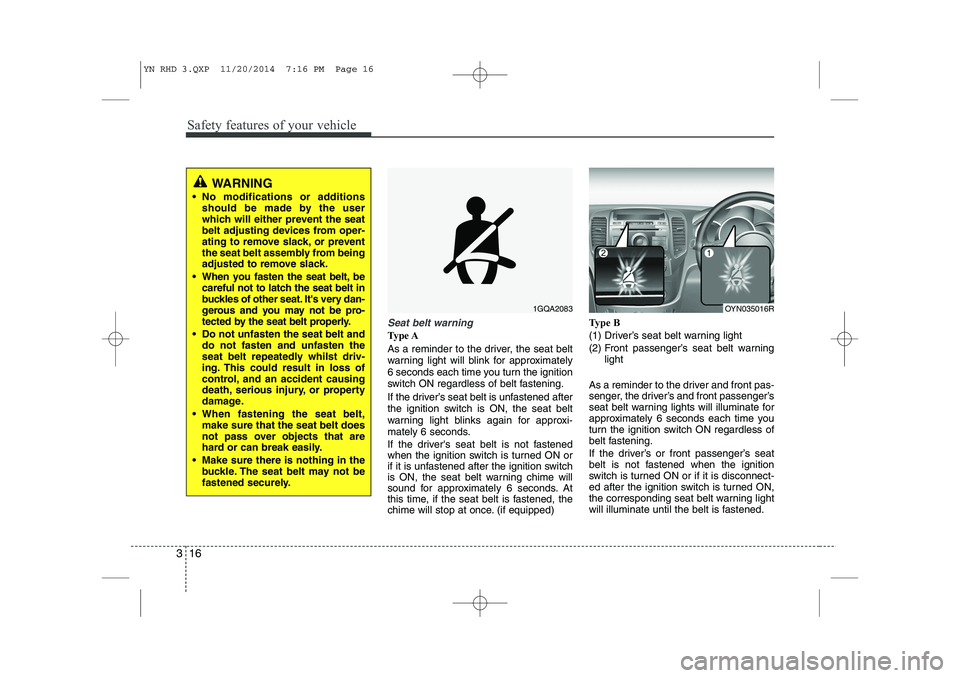
Seat belt warning
Type A
As a reminder to the driver, the seat belt
warning light will blink for approximately
6 seconds each time you turn the ignition
switch ON regardless of belt fastening.
If the driver’s seat belt is unfastened after
the ignition switch is ON, the seat belt
warning light blinks again for approxi-
mately 6 seconds.
If the driver's seat belt is not fastened
when the ignition switch is turned ON or
if it is unfastened after the ignition switch
is ON, the seat belt warning chime will
sound for approximately 6 seconds. At
this time, if the seat belt is fastened, the
chime will stop at once. (if equipped) Type B
(1) Driver’s seat belt warning light
(2) Front passenger’s seat belt warning
light
As a reminder to the driver and front pas-
senger, the driver’s and front passenger’s
seat belt warning lights will illuminate for
approximately 6 seconds each time you
turn the ignition switch ON regardless of
belt fastening.
If the driver’s or front passenger’s seat
belt is not fastened when the ignition
switch is turned ON or if it is disconnect-
ed after the ignition switch is turned ON,
the corresponding seat belt warning light
will illuminate until the belt is fastened.
1GQA2083OYN035016R
WARNING
No modifications or additions should be made by the user
which will either prevent the seat
belt adjusting devices from oper-
ating to remove slack, or prevent
the seat belt assembly from being
adjusted to remove slack.
When you fasten the seat belt, be careful not to latch the seat belt in
buckles of other seat. It's very dan-
gerous and you may not be pro-
tected by the seat belt properly.
Do not unfasten the seat belt and do not fasten and unfasten the
seat belt repeatedly whilst driv-
ing. This could result in loss of
control, and an accident causing
death, serious injury, or property
damage.
When fastening the seat belt, make sure that the seat belt does
not pass over objects that are
hard or can break easily.
Make sure there is nothing in the buckle. The seat belt may not be
fastened securely.
YN RHD 3.QXP 11/20/2014 7:16 PM Page 16
Page 106 of 480
323
Safety features of your vehicle
✽✽NOTICE
Both the driver's and front passen- ger's pre-tensioner seat belts will be
activated in certain frontal collisions.
The pre-tensioner seat belts can be
activated, where the frontal collision is
severe enough, together with the air
bags.
When the pre-tensioner seat belts are activated, a loud noise may be heard
and fine dust, which may appear to be
smoke, may be visible in the passenger
compartment. These are normal oper-
ating conditions and are not haz-
ardous.
Although it is harmless, the fine dust may cause skin irritation and should
not be breathed for prolonged periods.
Wash all exposed skin areas thorough-
ly after an accident in which the pre-
tensioner seat belts were activated.
✽
✽ NOTICE
Because the sensor that activates the
SRS air bag is connected with the pre-
tensioner seat belt, the SRS air bag
warning light ( ) on the instrument
panel will illuminate for approximately
6 seconds after the ignition switch has
been turned to the ON position, and
then it should turn off.
WARNING
Pre-tensioners are designed to operate only one time. After acti-
vation, pre-tensioner seat belts
must be replaced. All seat belts,
of any type, should always be
replaced after they have been
worn during a collision.
(Continued)
CAUTION
If the pre-tensioner seat belt is notworking properly, this warning light
will illuminate even if there is nomalfunction of the SRS air bag. Ifthe SRS air bag warning light does not illuminate when the ignition
switch is turned to ON, or if it remains illuminated after illuminat-ing for approximately 6 seconds, or
if it illuminates whilst the vehicle isbeing driven, we recommend that the system be inspected by anauthorised Kia dealer.WARNING
To obtain maximum benefit from a pre-tensioner seat belt:
1. The seat belt must be worn cor- rectly and adjusted to the proper
position. Please read and follow
all of the important information
and precautions about your vehi-
cle’s occupant safety features –
including seat belts and air bags –
that are provided in this manual.
2. Be sure you and your passen- gers always wear seat belts prop-
erly.
YN RHD 3.QXP 11/20/2014 7:16 PM Page 23
Page 122 of 480
339
Safety features of your vehicle
How does the air bag system operate
Air bags are activated (able to inflate ifnecessary) only when the ignition
switch is turned to the ON or STARTposition.
Air bags inflate instantly in the event of serious frontal or side collision (if
equipped with side air bag or curtainair bag) in order to help protect the
occupants from serious physical injury.
There is no single speed at which the air bags will inflate.
Generally, air bags are designed to
inflate based upon the severity of a col-
lision and its direction. These two fac-
tors determine whether the sensors
produce an electronic deployment/inflation signal.
Air bag deployment depends on a number of factors including vehiclespeed, angles of impact and the densi-
ty and stiffness of the vehicles or
objects which your vehicle hits in the
collision. The determining, factors are
not limited to those mentioned above.
The front air bags will completely inflate and deflate in an instant. It is virtually impossible for you to see
the air bags inflate during an accident.
It is much more likely that you will sim-ply see the deflated air bags hanging
out of their storage compartments afterthe collision.
In order to help provide protection in a severe collision, the air bags must
inflate rapidly. The speed of air bag
inflation is a consequence of extremely
short time in which a collision occursand the need to get the air bag
between the occupant and the vehicle
structures before the occupant impacts
those structures. This speed of inflation
reduces the risk of serious or life-
threatening injuries in a severe collision
and is thus a necessary part of air bagdesign.
However, air bag inflation can also
cause injuries which can include facial
abrasions, bruises and broken bonesbecause the inflation speed also caus-
es the air bags to expand with a great
deal of force.
There are even circumstances under which contact with the steer-
ing wheel air bag can cause fatal
injuries, especially if the occupant
is positioned excessively close tothe steering wheel.
WARNING
To avoid severe personal injury or death caused by deploying air
bags in a collision, the driver
should sit as far back from the
steering wheel air bag as possible
(at least 250 mm (10 inches)
away). The front passenger should
always move their seat as far
back as possible and sit back intheir seat.
Air bag inflates instantly in an event of a collision, passengers
may be injured by the air bag
expansion force if they are not in
a proper position.
Air bag inflation may cause injuries including facial or bodily
abrasions, injuries from broken
glasses or burns.
YN RHD 3.QXP 11/20/2014 7:17 PM Page 39
Page 123 of 480
Safety features of your vehicle
40
3
Noise and smoke
When the air bags inflate, they make a loud
noise and they leave smoke and powder in
the air inside of the vehicle. This is normaland is a result of the ignition of the air bag
inflator. After the air bag inflates, you may
feel substantial discomfort in breathing due
to the contact of your chest with both the
seat belt and the air bag, as well as from
breathing the smoke and powder. Open
your doors and/or windows as soon as
possible after impact in order to reduce
discomfort and prevent prolonged
exposure to the smoke and powder.
Though smoke and powder are non-toxic, it
may cause irritation to the skin (eyes, nose
and throat, etc.). If this is the case, wash
and rinse with cold water immediately and
consult the doctor if the symptom persists.
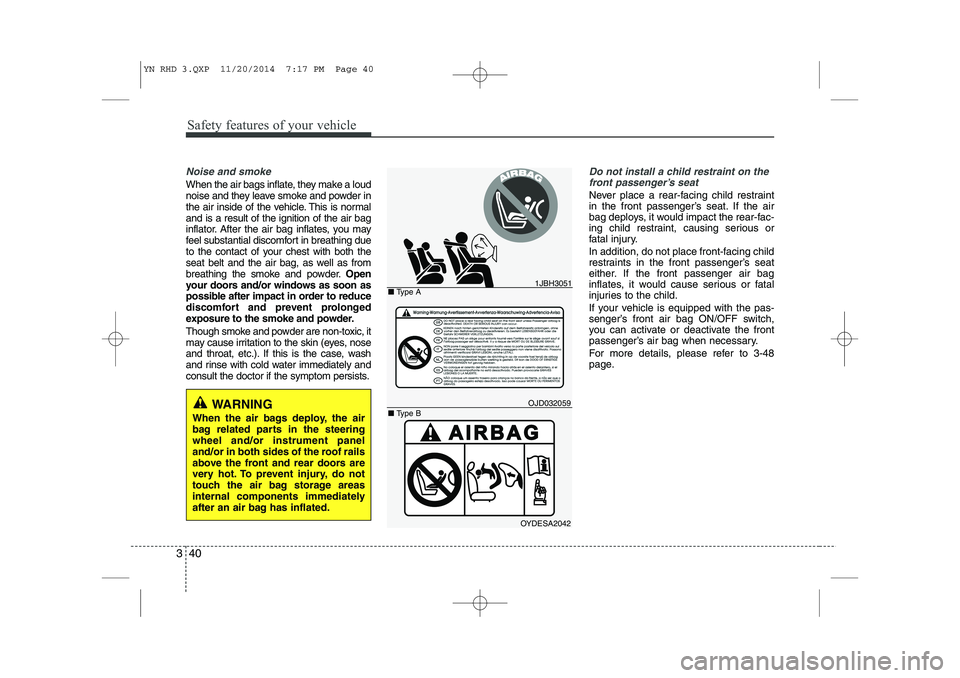
Do not install a child restraint on the
front passenger’s seat
Never place a rear-facing child restraint
in the front passenger’s seat. If the air
bag deploys, it would impact the rear-fac-
ing child restraint, causing serious or
fatal injury.
In addition, do not place front-facing child
restraints in the front passenger’s seat
either. If the front passenger air bag
inflates, it would cause serious or fatal
injuries to the child.
If your vehicle is equipped with the pas-
senger’s front air bag ON/OFF switch,
you can activate or deactivate the front
passenger’s air bag when necessary.
For more details, please refer to 3-48
page.
WARNING
When the air bags deploy, the air
bag related parts in the steeringwheel and/or instrument panel
and/or in both sides of the roof rails
above the front and rear doors are
very hot. To prevent injury, do not
touch the air bag storage areas
internal components immediately
after an air bag has inflated.
OYDESA2042
1JBH3051
■ Type B■ Type A
OJD032059
YN RHD 3.QXP 11/20/2014 7:17 PM Page 40
Page 124 of 480
341
Safety features of your vehicle
Air bag warning and indicator
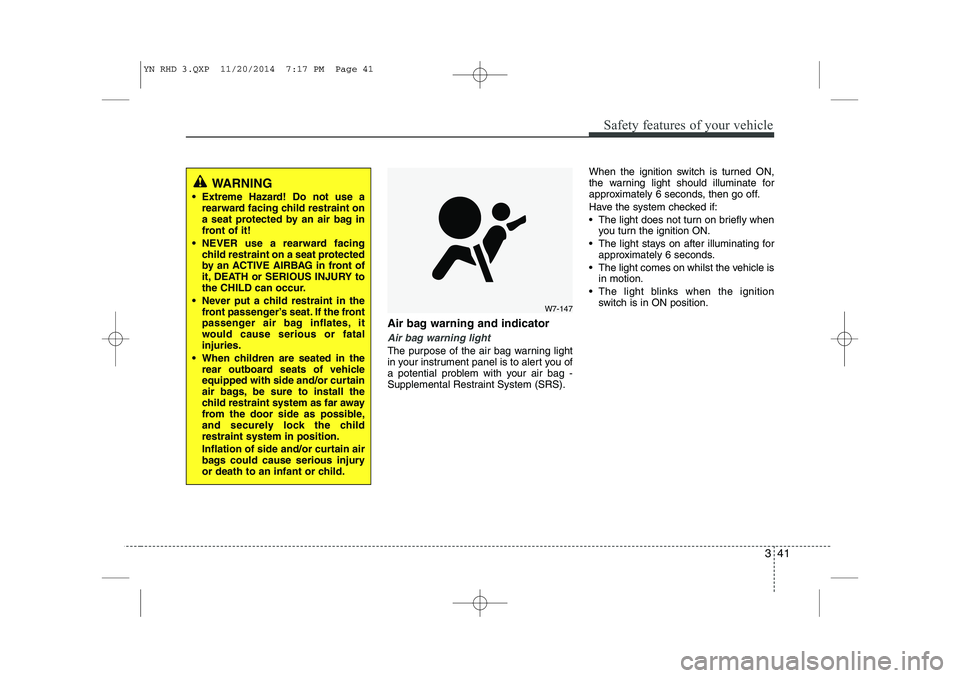
Air bag warning light
The purpose of the air bag warning light
in your instrument panel is to alert you of
a potential problem with your air bag -
Supplemental Restraint System (SRS).When the ignition switch is turned ON,
the warning light should illuminate for
approximately 6 seconds, then go off.
Have the system checked if:
The light does not turn on briefly when
you turn the ignition ON.
The light stays on after illuminating for approximately 6 seconds.
The light comes on whilst the vehicle is in motion.
The light blinks when the ignition switch is in ON position.
WARNING
Extreme Hazard! Do not use a rearward facing child restraint on
a seat protected by an air bag in
front of it!
NEVER use a rearward facing child restraint on a seat protected
by an ACTIVE AIRBAG in front of
it, DEATH or SERIOUS INJURY to
the CHILD can occur.
Never put a child restraint in the front passenger’s seat. If the front
passenger air bag inflates, it
would cause serious or fatalinjuries.
When children are seated in the rear outboard seats of vehicle
equipped with side and/or curtain
air bags, be sure to install the
child restraint system as far away
from the door side as possible,
and securely lock the childrestraint system in position.
Inflation of side and/or curtain air
bags could cause serious injury
or death to an infant or child.
W7-147
YN RHD 3.QXP 11/20/2014 7:17 PM Page 41
Page 125 of 480
Safety features of your vehicle
42
3
Passenger’s front air bag
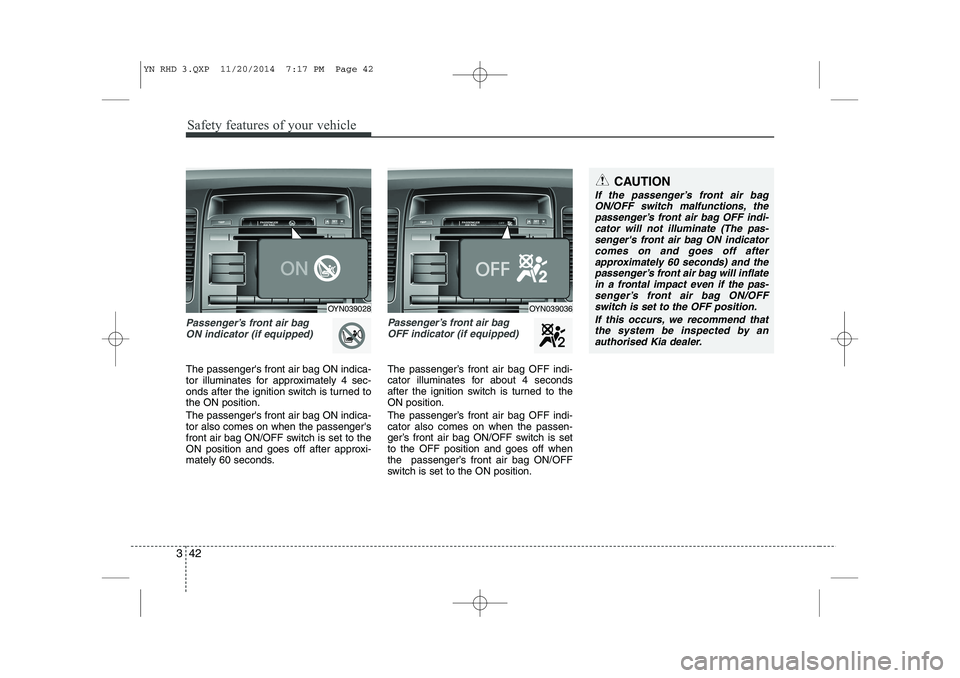
ON indicator (if equipped)
The passenger's front air bag ON indica-
tor illuminates for approximately 4 sec-
onds after the ignition switch is turned tothe ON position. The passenger's front air bag ON indica- tor also comes on when the passenger's
front air bag ON/OFF switch is set to the
ON position and goes off after approxi-
mately 60 seconds.
Passenger’s front air bag OFF indicator (if equipped)
The passenger’s front air bag OFF indi-
cator illuminates for about 4 seconds
after the ignition switch is turned to theON position.
The passenger’s front air bag OFF indi- cator also comes on when the passen-
ger’s front air bag ON/OFF switch is setto the OFF position and goes off when
the passenger’s front air bag ON/OFF
switch is set to the ON position.
OYN039028
CAUTION
If the passenger’s front air bag
ON/OFF switch malfunctions, the
passenger’s front air bag OFF indi-cator will not illuminate (The pas-senger's front air bag ON indicator comes on and goes off after
approximately 60 seconds) and thepassenger’s front air bag will inflate in a frontal impact even if the pas-
senger’s front air bag ON/OFF switch is set to the OFF position.
If this occurs, we recommend thatthe system be inspected by anauthorised Kia dealer.
OYN039036
YN RHD 3.QXP 11/20/2014 7:17 PM Page 42