air condition KIA VENGA 2015 Repair Manual
[x] Cancel search | Manufacturer: KIA, Model Year: 2015, Model line: VENGA, Model: KIA VENGA 2015Pages: 480, PDF Size: 23.15 MB
Page 402 of 480
723
Maintenance
Steering gear box, linkage &
boots/lower arm ball joint
With the vehicle stopped and engine off,
check for excessive free-play in the
steering wheel.
Check the linkage for bends or damage.
Check the dust boots and ball joints for
deterioration, cracks, or damage.
Replace any damaged parts.Drive shafts and boots
Check the drive shafts, boots and clamps
for cracks, deterioration, or damage.
Replace any damaged parts and, if nec-
essary, repack the grease.
Air conditioning refrigerant (if equipped)
Check the air conditioning lines and con-
nections for leakage and damage.
YN RHD 7.QXP 11/20/2014 6:43 PM Page 23
Page 407 of 480
Maintenance
28
7
BRAKE/CLUTCH FLUID (IF EQUIPPED)
Checking the brake/clutch fluid
level
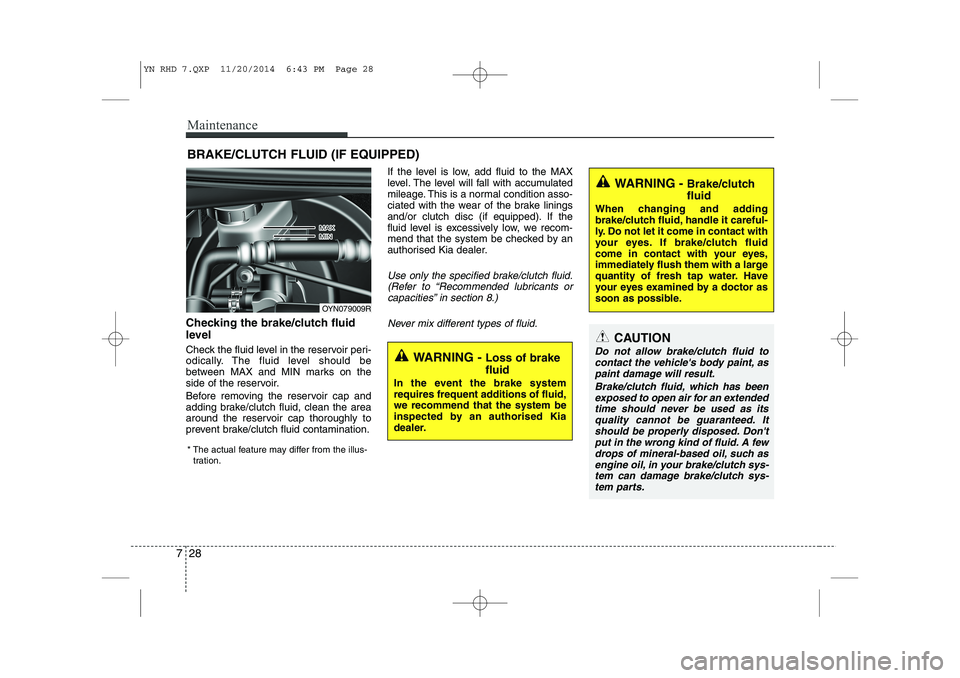
Check the fluid level in the reservoir peri-
odically. The fluid level should be
between MAX and MIN marks on the
side of the reservoir.
Before removing the reservoir cap and
adding brake/clutch fluid, clean the area
around the reservoir cap thoroughly to
prevent brake/clutch fluid contamination. If the level is low, add fluid to the MAX
level. The level will fall with accumulated
mileage. This is a normal condition asso-
ciated with the wear of the brake linings
and/or clutch disc (if equipped). If the
fluid level is excessively low, we recom-
mend that the system be checked by an
authorised Kia dealer.
Use only the specified brake/clutch fluid.
(Refer to “Recommended lubricants or
capacities” in section 8.)
Never mix different types of fluid.
WARNING - Loss of brake fluid
In the event the brake system
requires frequent additions of fluid,we recommend that the system be
inspected by an authorised Kia
dealer.
WARNING - Brake/clutch fluid
When changing and adding
brake/clutch fluid, handle it careful-
ly. Do not let it come in contact with
your eyes. If brake/clutch fluid
come in contact with your eyes,
immediately flush them with a large
quantity of fresh tap water. Have
your eyes examined by a doctor as
soon as possible.
CAUTION
Do not allow brake/clutch fluid to contact the vehicle's body paint, as
paint damage will result.
Brake/clutch fluid, which has beenexposed to open air for an extendedtime should never be used as itsquality cannot be guaranteed. It
should be properly disposed. Don'tput in the wrong kind of fluid. A few drops of mineral-based oil, such asengine oil, in your brake/clutch sys-
tem can damage brake/clutch sys- tem parts.
OYN079009R
* The actual feature may differ from the illus- tration.
YN RHD 7.QXP 11/20/2014 6:43 PM Page 28
Page 412 of 480
733
Maintenance
AIR CLEANER
Filter replacement
You can clean the filter when inspecting the air cleaner element.
Clean the filter by using compressed air.
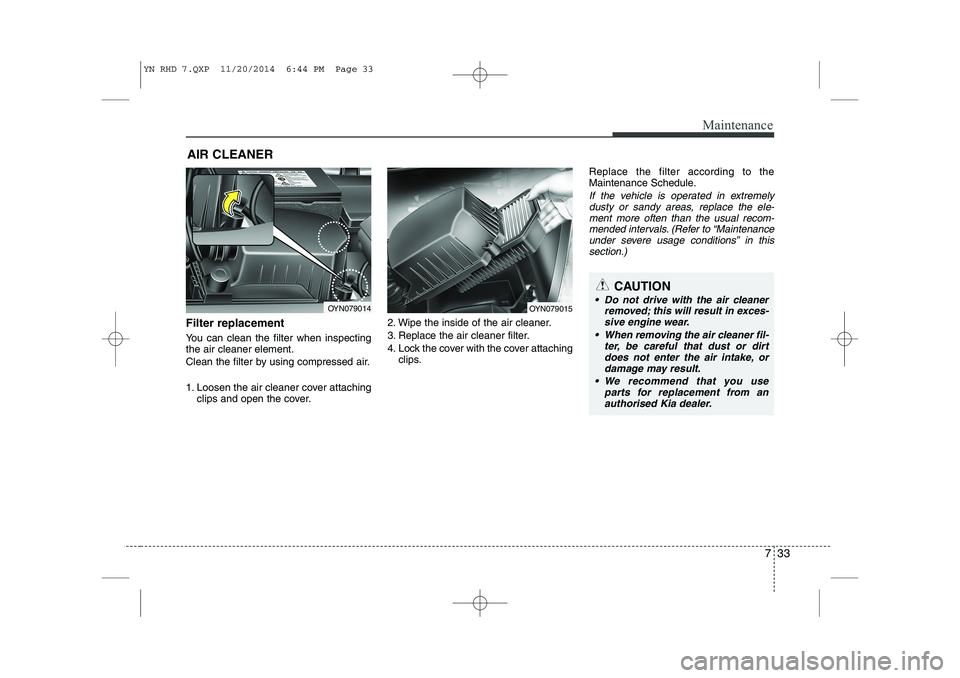
1. Loosen the air cleaner cover attaching clips and open the cover. 2. Wipe the inside of the air cleaner.
3. Replace the air cleaner filter.
4. Lock the cover with the cover attaching
clips. Replace the filter according to the
Maintenance Schedule.
If the vehicle is operated in extremely
dusty or sandy areas, replace the ele- ment more often than the usual recom-
mended intervals. (Refer to “Maintenance under severe usage conditions” in thissection.)
OYN079014OYN079015
CAUTION
Do not drive with the air cleaner
removed; this will result in exces-sive engine wear.
When removing the air cleaner fil- ter, be careful that dust or dirtdoes not enter the air intake, or
damage may result.
We recommend that you use parts for replacement from anauthorised Kia dealer.
YN RHD 7.QXP 11/20/2014 6:44 PM Page 33
Page 423 of 480
Maintenance
44
7
Remove the valve cap from the tyre
valve stem. Press the tyre gage firm-
ly onto the valve to get a pressure
measurement. If the cold tyre infla-tion pressure matches the recom-mended pressure on the tyre and
loading information label, no further
adjustment is necessary. If the pres-
sure is low, add air until you reachthe recommended amount.
If you overfill the tyre, release air by pushing on the metal stem in the
centre of the tyre valve. Recheck the
tyre pressure with the tyre gage. Be
sure to put the valve caps back on
the valve stems. They help prevent
leaks by keeping out dirt and mois-
ture. Tyre rotation
To equalize tread wear, it is recom- mended that the tyres be rotated
every 12,000 km (7,500 miles) or
sooner if irregular wear develops.
During rotation, check the tyres for
correct balance.
When rotating tyres, check for
uneven wear and damage. Abnormal
wear is usually caused by incorrect
tyre pressure, improper wheel align-
ment, out-of-balance wheels, severe
braking or severe cornering. Look for
bumps or bulges in the tread or side
of tyre. Replace the tyre if you find
either of these conditions. Replace
the tyre if fabric or cord is visible.
After rotation, be sure to bring thefront and rear tyre pressures to spec-
ification and check lug nut tightness.
Refer to “Tyre and wheels” in section 8.
WARNING
Inspect your tyres frequently for proper inflation as well as
wear and damage. Always use
a tyre pressure gauge.
Tyres with too much or too lit- tle pressure wear unevenly
causing poor handling, loss of
vehicle control, and suddentyre failure leading to acci-
dents, injuries, and even death.The recommended cold tyre
pressure for your vehicle can
be found in this manual and onthe tyre label located on the
driver's side centre pillar.
Worn tyres can cause acci- dents. Replace tyres that are
worn, show uneven wear, or
are damaged.
Remember to check the pres- sure of your spare tyre. Kia
recommends that you check
the spare every time you
check the pressure of the
other tyres on your vehicle.
YN RHD 7.QXP 11/20/2014 6:44 PM Page 44
Page 429 of 480
Maintenance
50
7
5. Maximum permissible inflation
pressure
This number is the greatest amount of air pressure that should be put in
the tyre. Do not exceed the maximum
permissible inflation pressure. Refer
to the Tyre and Loading Information
label for recommended inflation
pressure.
6. Maximum load rating
This number indicates the maximum
load in kilograms and pounds that
can be carried by the tyre. When
replacing the tyres on the vehicle,
always use a tyre that has the same
load rating as the factory installed
tyre.
7. Uniform tyre quality grading
Quality grades can be found where
applicable on the tyre sidewall
between tread shoulder and maxi-
mum section width.
For example:
TREAD wear 200
TRACTION AA
TEMPERATURE A
Tread wear
The tread wear grade is a compara-
tive rating based on the wear rate ofthe tyre when tested under controlled
conditions on a specified govern-
ment test course. For example, a tyre
graded 150 would wear one-and-a-
half times (1½) as well on the gov-
ernment course as a tyre graded100.
The relative performance of tyres depends upon the actual conditions
of their use, however, and may
depart significantly from the norm
due to variations in driving habits,
service practices and differences in
road characteristics and climate. These grades are molded on the
side-walls of passenger vehicle
tyres. The tyres available as standard
or optional equipment on your vehi-
cle may vary with respect to grade.
Traction - AA, A, B & C
The traction grades, from highest to
lowest, are AA, A, B and C. Those
grades represent the tyre’s ability to
stop on wet pavement measuredunder controlled conditions on spec-
ified government test surfaces of
asphalt and concrete. A tyre marked
C may have poor traction perform-
ance.
WARNING
The traction grade assigned to this tyre is based on straight-ahead braking traction tests,
and does not include accelera-
tion, cornering, hydroplaning,
or peak traction characteristics.
YN RHD 7.QXP 11/20/2014 6:44 PM Page 50
Page 430 of 480
751
Maintenance
Temperature -A, B & C
The temperature grades are A (the
highest), B, and C, representing the
tyre’s resistance to the generation ofheat and its ability to dissipate heatwhen tested under controlled condi-
tions on a specified indoor laboratorytest wheel.
Sustained high temperature can
cause the material of the tyre to
degenerate and reduce tyre life, and
excessive temperature can lead to
sudden tyre failure. Grades B and A
represent higher levels of perform-
ance on the laboratory test wheel
than the minimum required by law.Low aspect ratio tyre (if equipped)
Low aspect ratio tyres, whose aspect
ratio is lower than 50, are provided
for sporty looks.
Because the low aspect ratio tyres
are optimized for handling and brak-
ing, it may be more uncomfortable to
ride in and there is more noise com-
pare with normal tyres.
WARNING
- Tyre
temperature
The temperature grade for this
tyre is established for a tyre that
is properly inflated and not over-
loaded. Excessive speed, under-
inflation, or excessive loading,
either separately or in combina-
tion, can cause heat build-up
and sudden tyre failure. This can
cause loss of vehicle control
and serious injury or death.
CAUTION
Because the sidewall of the low aspect ratio tyre is shorter thanthe normal, the wheel and tyre of the low aspect ratio tyre iseasier to be damaged. So, followthe instructions below.
- When driving on a rough road or off road, drive cautiouslybecause tyres and wheels maybe damaged. And after driving, inspect tyres and wheels.
- When passing over a pothole, speed bump, manhole, or kerbstone, drive slowly so that thetyres and wheels are not dam- aged.
(Continued)
(Continued)- If the tyre is impacted, we rec- ommend that you inspect thetyre condition or contact an authorised Kia dealer.
- To prevent damage to the tyre, inspect the tyre condition andpressure every 3,000km.
CAUTION
It is not easy to recognize the tyre damage with your owneyes. But if there is the slight- est hint of tyre damage, eventhough you cannot see thetyre damage with your own eyes, have the tyre checked orreplaced because the tyredamage may cause air leak- age from the tyre.
If the tyre is damaged by driv- ing on a rough road, off road,pothole, manhole, or kerbstone, it will not be covered by the warranty.
You can find out the tyre infor- mation on the tyre sidewall.
YN RHD 7.QXP 11/20/2014 6:44 PM Page 51
Page 455 of 480
Maintenance
76
7
Corrosion protection
Protecting your vehicle from corrosion
By using the most advanced design and
construction practices to combat corro-
sion, we produce vehicles of the highest
quality. However, this is only part of the
job. To achieve the long-term corrosion
resistance your vehicle can deliver, the
owner's cooperation and assistance isalso required.
Common causes of corrosion The most common causes of corrosion
on your vehicle are:
Road salt, dirt and moisture that is
allowed to accumulate underneath the
vehicle.
Removal of paint or protective coatings by stones, gravel, abrasion or minor
scrapes and dents which leave unpro-
tected metal exposed to corrosion. High-corrosion areas
If you live in an area where your vehicle
is regularly exposed to corrosive materi-
als, corrosion protection is particularly
important. Some of the common causes
of accelerated corrosion are road salts,
dust control chemicals, ocean air and
industrial pollution.
Moisture breeds corrosion Moisture creates the conditions in which
corrosion is most likely to occur. For
example, corrosion is accelerated by
high humidity, particularly when tempera-
tures are just above freezing. In such
conditions, the corrosive material is kept
in contact with the vehicle’s surface by
moisture that slowly evaporates.
Mud is particularly corrosive because it
dries slowly and holds moisture in con-
tact with the vehicle. Although the mud
appears to be dry, it can still retain mois-ture and promote corrosion.
High temperatures can also accelerate
corrosion of parts that are not properly
ventilated so the moisture can be dis-
persed. For all these reasons, it is par-
ticularly important to keep your vehicle
clean and free of mud or accumulations
of other materials. This applies not only
to the visible surfaces but particularly to
the underside of the vehicle.
YN RHD 7.QXP 11/20/2014 6:46 PM Page 76
Page 460 of 480
781
Maintenance
Do not operate the engine in confinedor closed areas (such as garages) any
more than what is necessary to move
the vehicle in or out of the area.
When the vehicle is stopped in an open area for more than a short time
with the engine running, adjust the
ventilation system (as needed) to draw
outside air into the vehicle.
Never sit in a parked or stopped vehi- cle for any extended time with the
engine running.
When the engine stalls or fails to start, excessive attempts to restart the
engine may cause damage to theemission control system.Operating precautions for catalytic
converters (if equipped)Your vehicle is equipped with a catalytic
converter emission control device.
Therefore, the following precautions
must be observed:
Use only UNLEADED FUEL for petrol engine.
Do not operate the vehicle when there are signs of engine malfunction, such
as misfire or a noticeable loss of per-
formance.
Do not misuse or abuse the engine. Examples of misuse are coasting withthe ignition off and descending steep
grades in gear with the ignition off.
Do not operate the engine at high idle speed for extended periods (5 minutesor more).
Do not modify or tamper with any part of the engine or emission control sys-
tem. We recommend that the system
be inspected by an authorised Kia
dealer.
Avoid driving with a extremely low fuel level. Running out of fuel could cause
the engine to misfire, damaging the
catalytic converter.
Failure to observe these precautionscould result in damage to the catalytic
converter and to your vehicle.
Additionally, such actions could void your
warranties.
WARNING - Fire
A hot exhaust system can ignite flammable items under your vehi-
cle. Do not park, idle, or drive the
vehicle over or near flammable
objects, such as grass, vegeta-
tion, paper, leaves, etc.
The exhaust system and catalytic system are very hot whilst the
engine is running or immediately
after the engine is turned off.
Keep away from the exhaust sys-
tem and catalytic, you may get
burned.
Also, do not remove the heat sink
around the exhaust system, do
not seal the bottom of the vehicle
or do not coat the vehicle for cor-
rosion control. It may present a
fire risk under certain conditions.
YN RHD 7.QXP 11/20/2014 6:46 PM Page 81
Page 461 of 480
Maintenance
82
7
Diesel Particulate Filter (if equipped)
The Diesel Particulate Filter (DPF) sys-
tem removes the soot in the exhaust gas.
Unlike a disposable air filter, the DPF
system automatically burns (oxidizes)
and removes the accumulated soot
according to the driving condition. In
other words, the active burning by engine
control system and high exhaust gas
temperature caused by normal/high driv-
ing condition burns and removes the
accumulated soot.
However, if the vehicle continues to be
driven at repeated short distance or driv-
en at low speed for long time, the accu-
mulated soot may not be automatically
removed because of low exhaust gas
temperature. More than a certain amountof soot deposited, the malfunction indica-
tor light ( ) illuminates. When the malfunction indicator light
blinks, it may stop blinking by driving the
vehicle at more than 60km/h (37 mph) orat more than second gear with 1500 ~
2500 engine rpm for a certain time (for
about 25 minutes). If the malfunction indicator light contin-
ues to be blinked in spite of the proce-
dure, we recommend that the system be
checked by an authorised Kia dealer.
If you continue to drive with the malfunc-
tion indicator light blinking for a long
time, the DPF system can be damaged
and fuel consumption can be worsen.
Lean NOx Trap (if equipped)
The Lean NOx Trap (LNT) system
removes the nitrogen oxide in the
exhaust gas. The smell can occur in the
exhaust gas depending on the quality of
the fuel and it can degrade NOx reduc-
tion performance, please use the regulat-
ed automotive diesel fuel.
CAUTION
- Diesel Fuel
(if equipped with DPF)
It is recommended to use the regu- lated automotive diesel fuel for
diesel vehicle equipped with the DPF system.
If you use diesel fuel including highsulfur (more than 50 ppm sulfur) and unspecified additives, it can
cause the DPF system to be dam- aged and white smoke can be emit-ted.
YN RHD 7.QXP 11/20/2014 6:46 PM Page 82
Page 462 of 480
8
Dimensions / 8-2
Bulb wattage / 8-3
Tyres and wheels / 8-4
Load and speed capacity tyres / 8-4
Recommended lubricants and capacities / 8-5
Vehicle identification number (VIN) / 8-8
Vehicle certification label / 8-8
Tyre specification and pressure label / 8-9
Engine number / 8-9
Air conditioner compressor label / 8-10
Declaration of conformity / 8-10
Specifications & Consumer information
YN RHD 8.QXP 11/20/2014 6:48 PM Page 1