towing KIA VENGA 2015 Owners Manual
[x] Cancel search | Manufacturer: KIA, Model Year: 2015, Model line: VENGA, Model: KIA VENGA 2015Pages: 480, PDF Size: 23.15 MB
Page 1 of 480
1
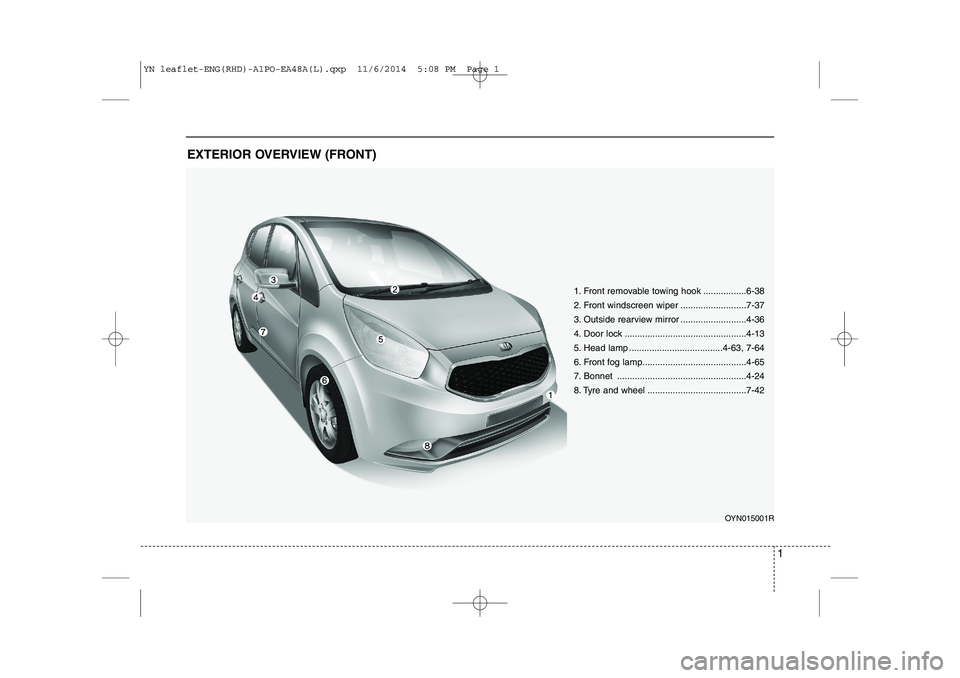
EXTERIOR OVERVIEW (FRONT)
1. Front removable towing hook .................6-38
2. Front windscreen wiper ..........................7-37
3. Outside rearview mirror ..........................4-36
4. Door lock ................................................4-13
5. Head lamp .....................................4-63, 7-64
6. Front fog lamp.........................................4-65
7. Bonnet ...................................................4-24
8. Tyre and wheel .......................................7-42
OYN015001R
YN leaflet-ENG(RHD)-A1PO-EA48A(L).qxp 11/6/2014 5:08 PM Page 1
Page 2 of 480
2
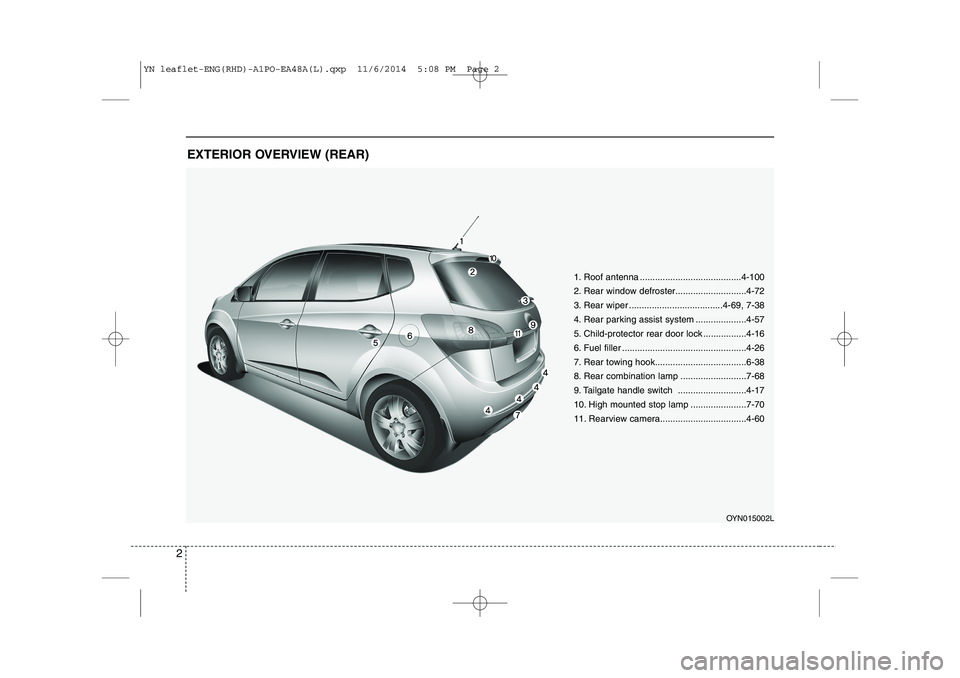
EXTERIOR OVERVIEW (REAR)
1. Roof antenna ........................................4-100
2. Rear window defroster............................4-72
3. Rear wiper .....................................4-69, 7-38
4. Rear parking assist system ....................4-57
5. Child-protector rear door lock .................4-16
6. Fuel filler .................................................4-26
7. Rear towing hook....................................6-38
8. Rear combination lamp ..........................7-68
9. Tailgate handle switch ...........................4-17
10. High mounted stop lamp ......................7-70
11. Rearview camera..................................4-60OYN015002L
YN leaflet-ENG(RHD)-A1PO-EA48A(L).qxp 11/6/2014 5:08 PM Page 2
Page 30 of 480
30
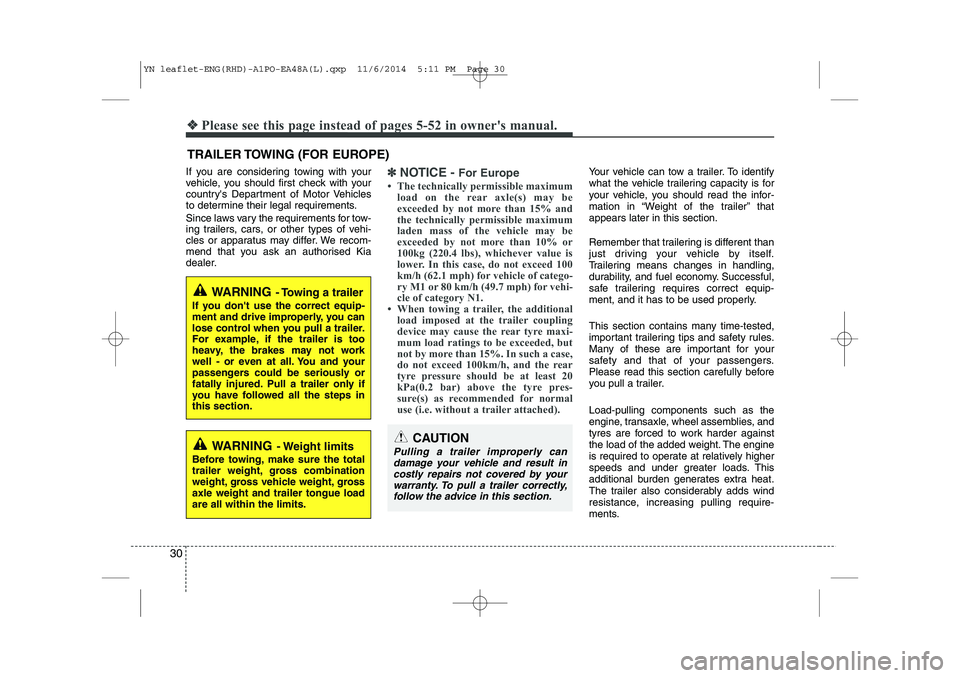
❖❖Please see this page instead of pages 5-52 in owner's manual.
If you are considering towing with your
vehicle, you should first check with your
country's Department of Motor Vehicles
to determine their legal requirements.
Since laws vary the requirements for tow-
ing trailers, cars, or other types of vehi-
cles or apparatus may differ. We recom-
mend that you ask an authorised Kia
dealer.✽✽NOTICE - For Europe
The technically permissible maximum load on the rear axle(s) may be
exceeded by not more than 15% and
the technically permissible maximum
laden mass of the vehicle may be
exceeded by not more than 10% or
100kg (220.4 lbs), whichever value is
lower. In this case, do not exceed 100
km/h (62.1 mph) for vehicle of catego-
ry M1 or 80 km/h (49.7 mph) for vehi-
cle of category N1.
When towing a trailer, the additional load imposed at the trailer coupling
device may cause the rear tyre maxi-
mum load ratings to be exceeded, but
not by more than 15%. In such a case,
do not exceed 100km/h, and the rear
tyre pressure should be at least 20
kPa(0.2 bar) above the tyre pres-
sure(s) as recommended for normal
use (i.e. without a trailer attached).Your vehicle can tow a trailer. To identify
what the vehicle trailering capacity is for
your vehicle, you should read the infor-
mation in “Weight of the trailer” thatappears later in this section.
Remember that trailering is different than
just driving your vehicle by itself.
Trailering means changes in handling,
durability, and fuel economy. Successful,
safe trailering requires correct equip-
ment, and it has to be used properly.
This section contains many time-tested,
important trailering tips and safety rules.
Many of these are important for your
safety and that of your passengers.
Please read this section carefully before
you pull a trailer. Load-pulling components such as the
engine, transaxle, wheel assemblies, and
tyres are forced to work harder against
the load of the added weight. The engine
is required to operate at relatively higher
speeds and under greater loads. This
additional burden generates extra heat.
The trailer also considerably adds wind
resistance, increasing pulling require-
ments.
TRAILER TOWING (FOR EUROPE)
WARNING
- Towing a trailer
If you don't use the correct equip-
ment and drive improperly, you can
lose control when you pull a trailer.
For example, if the trailer is too
heavy, the brakes may not work
well - or even at all. You and your
passengers could be seriously or
fatally injured. Pull a trailer only if
you have followed all the steps inthis section.
WARNING - Weight limits
Before towing, make sure the total
trailer weight, gross combination
weight, gross vehicle weight, grossaxle weight and trailer tongue loadare all within the limits.CAUTION
Pulling a trailer improperly can damage your vehicle and result incostly repairs not covered by your warranty. To pull a trailer correctly,follow the advice in this section.
YN leaflet-ENG(RHD)-A1PO-EA48A(L).qxp 11/6/2014 5:11 PM Page 30
Page 41 of 480
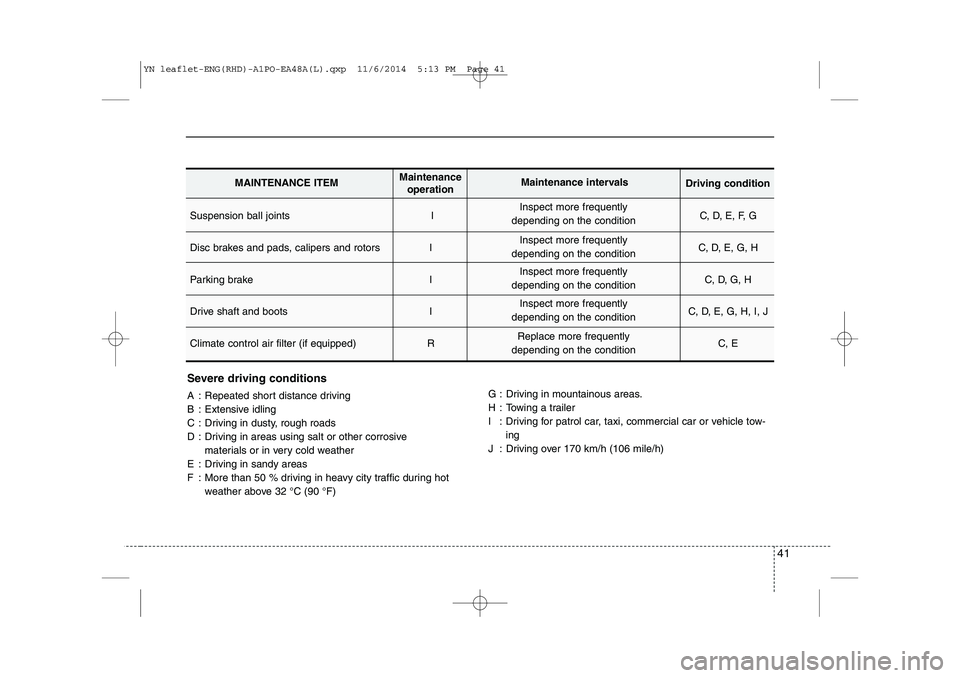
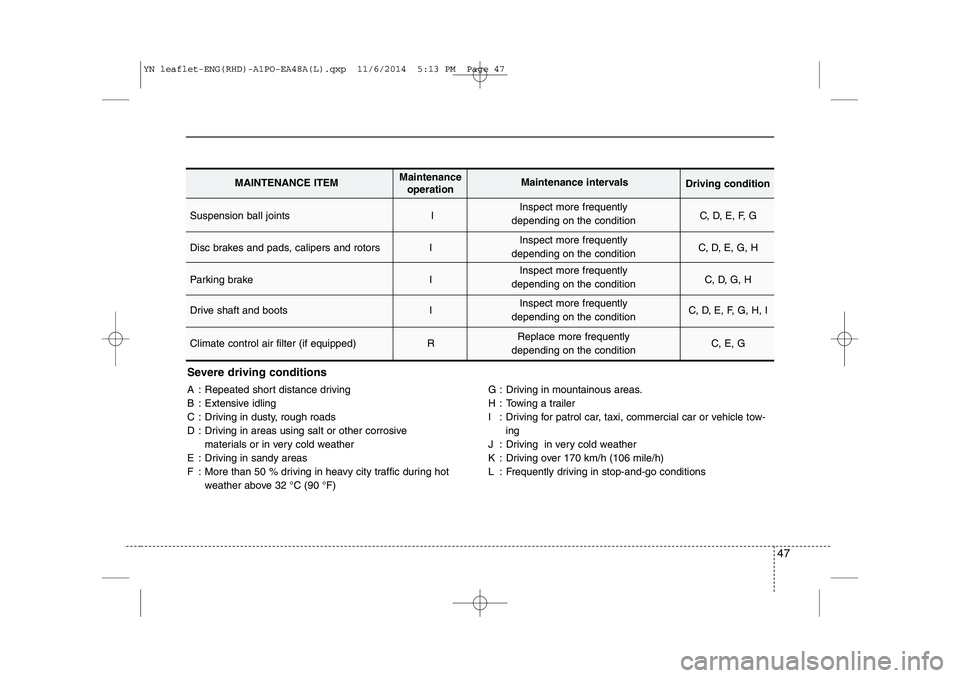
Severe driving conditions
A : Repeated short distance driving
B : Extensive idling
C : Driving in dusty, rough roads
D : Driving in areas using salt or other corrosive materials or in very cold weather
E : Driving in sandy areas
F : More than 50 % driving in heavy city traffic during hot weather above 32 °C (90 °F) G : Driving in mountainous areas.
H : Towing a trailer
I : Driving for patrol car, taxi, commercial car or vehicle tow-
ing
J : Driving over 170 km/h (106 mile/h)
Suspension ball jointsI C, D, E, F, G
Disc brakes and pads, calipers and rotors I C, D, E, G, H
Parking brake I C, D, G, H
Drive shaft and boots I C, D, E, G, H, I, J
Climate control air filter (if equipped) R C, E
MAINTENANCE ITEMMaintenance
operation Maintenance intervals
Inspect more frequently
depending on the condition
Inspect more frequently
depending on the condition
Inspect more frequently
depending on the condition
Inspect more frequently
depending on the condition
Replace more frequently
depending on the condition Driving condition
41
YN leaflet-ENG(RHD)-A1PO-EA48A(L).qxp 11/6/2014 5:13 PM Page 41
Page 47 of 480
Severe driving conditions
A : Repeated short distance driving
B : Extensive idling
C : Driving in dusty, rough roads
D : Driving in areas using salt or other corrosive materials or in very cold weather
E : Driving in sandy areas
F : More than 50 % driving in heavy city traffic during hot weather above 32 °C (90 °F) G : Driving in mountainous areas.
H : Towing a trailer
I : Driving for patrol car, taxi, commercial car or vehicle tow-
ing
J : Driving in very cold weather
K : Driving over 170 km/h (106 mile/h)
L : Frequently driving in stop-and-go conditions
Suspension ball jointsI C, D, E, F, G
Disc brakes and pads, calipers and rotors I C, D, E, G, H
Parking brake I C, D, G, H
Drive shaft and boots I C, D, E, F, G, H, I
Climate control air filter (if equipped) R C, E, G
MAINTENANCE ITEMMaintenance
operation Maintenance intervals
Driving condition
Inspect more frequently
depending on the condition
Inspect more frequently
depending on the condition
Inspect more frequently
depending on the condition
Inspect more frequently
depending on the condition
Replace more frequently
depending on the condition
47
YN leaflet-ENG(RHD)-A1PO-EA48A(L).qxp 11/6/2014 5:13 PM Page 47
Page 79 of 480
Your vehicle at a glance
2
2
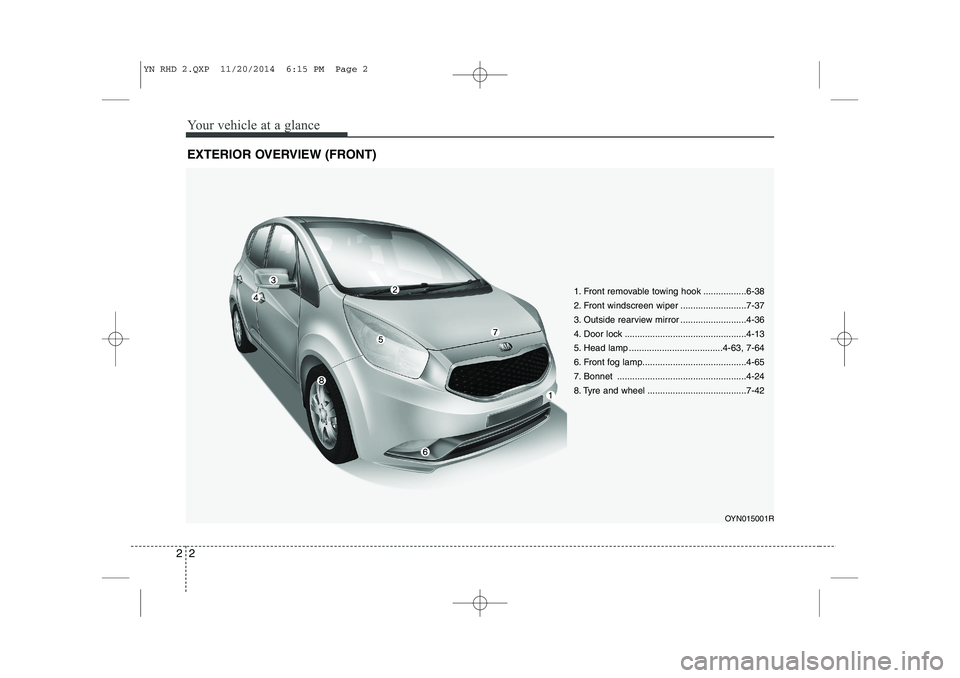
EXTERIOR OVERVIEW (FRONT)
1. Front removable towing hook .................6-38
2. Front windscreen wiper ..........................7-37
3. Outside rearview mirror ..........................4-36
4. Door lock ................................................4-13
5. Head lamp .....................................4-63, 7-64
6. Front fog lamp.........................................4-65
7. Bonnet ...................................................4-24
8. Tyre and wheel .......................................7-42
OYN015001R
YN RHD 2.QXP 11/20/2014 6:15 PM Page 2
Page 80 of 480
23
Your vehicle at a glance
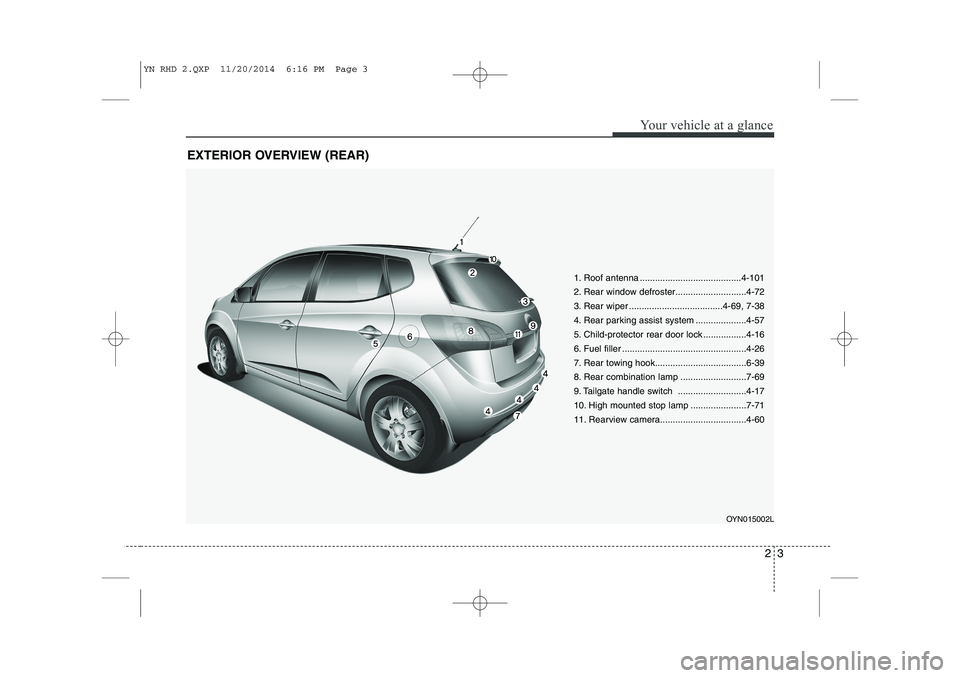
EXTERIOR OVERVIEW (REAR)
1. Roof antenna ........................................4-101
2. Rear window defroster............................4-72
3. Rear wiper .....................................4-69, 7-38
4. Rear parking assist system ....................4-57
5. Child-protector rear door lock .................4-16
6. Fuel filler .................................................4-26
7. Rear towing hook....................................6-39
8. Rear combination lamp ..........................7-69
9. Tailgate handle switch ...........................4-17
10. High mounted stop lamp ......................7-71
11. Rearview camera..................................4-60OYN015002L
YN RHD 2.QXP 11/20/2014 6:16 PM Page 3
Page 102 of 480
319
Safety features of your vehicle
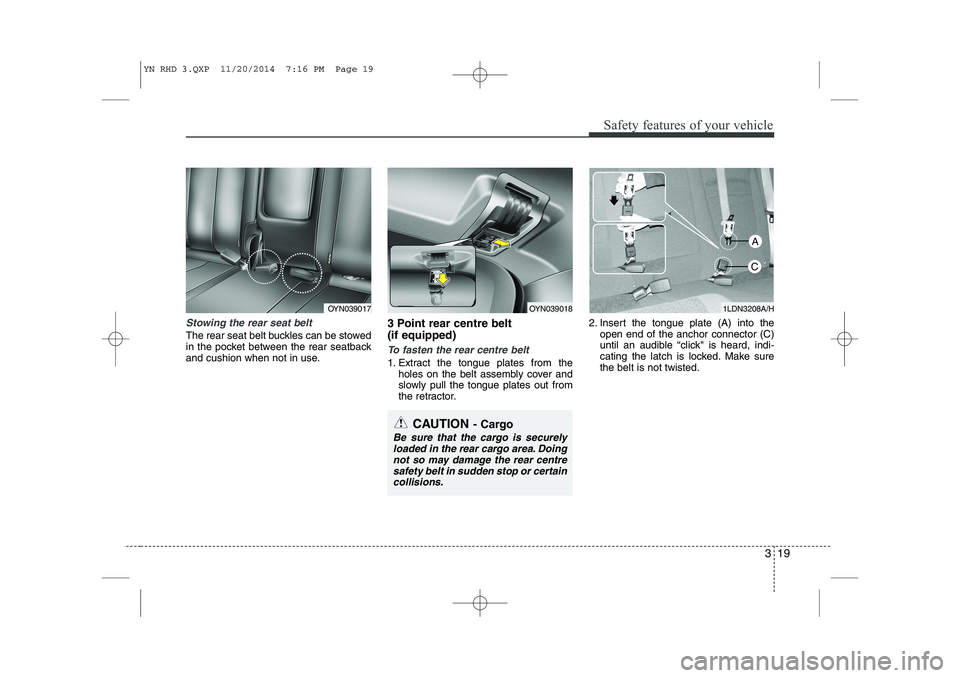
Stowing the rear seat belt
The rear seat belt buckles can be stowed
in the pocket between the rear seatback
and cushion when not in use.3 Point rear centre belt (if equipped)
To fasten the rear centre belt
1. Extract the tongue plates from the
holes on the belt assembly cover and
slowly pull the tongue plates out from
the retractor. 2. Insert the tongue plate (A) into the
open end of the anchor connector (C)
until an audible “click" is heard, indi-
cating the latch is locked. Make surethe belt is not twisted.
OYN039018OYN0390171LDN3208A/H
CAUTION - Cargo
Be sure that the cargo is securely
loaded in the rear cargo area. Doing not so may damage the rear centresafety belt in sudden stop or certain collisions.
A
C
YN RHD 3.QXP 11/20/2014 7:16 PM Page 19
Page 201 of 480
Features of your vehicle
58
4
The sensing distance while the rear
parking assist system is in operation is
approximately 120 cm (47 in.).
When more than two objects are sensed at the same time, the closest
one will be recognized first.
Types of warning sound
When an object is 120 cm to 61 cm (47in. to 24 in.) from the rear bumper:
Buzzer beeps intermittently
When an object is 60 cm to 31 cm (23 in. to 12 in.) from the rear bumper:
Buzzer beeps more frequently
When an object is within 30 cm (11 in.) of the rear bumper:
Buzzer sounds continuously. Non-operational conditions of rear parking assist system
The rear parking assist system may
not operate properly when:
1. Moisture is frozen to the sensor. (It will
operate normally when the moisture has been cleared.)
2. The sensor is covered with foreign matter, such as snow or water, or the
sensor cover is blocked. (It will operate
normally when the material is removed
or the sensor is no longer blocked.)
3. Driving on uneven road surfaces (unpaved roads, gravel, bumps, gradi-ent).
4. Objects generating excessive noise (vehicle horns, loud motorcycle
engines, or truck air brakes) are within
range of the sensor.
5. Heavy rain or water spray exists.
6. Wireless transmitters or mobile phones are within range of the sensor.
7. The sensor is covered with snow.
8. Trailer towing. The detecting range may decrease when:
1. The sensor is stained with foreign mat-
ter such as snow or water. (The sens-
ing range will return to normal when
removed.)
2. Outside air temperature is extremely hot or cold.
The following objects may not be rec-
ognized by the sensor:
1. Sharp or slim objects such as ropes, chains or small poles.
2. Objects which tend to absorb the sen- sor frequency such as clothes, spongy
material or snow.
3. Undetectable objects smaller than 1 m (40 in.) and narrower than 14 cm (6 in.)
in diameter.
Page 278 of 480
5
Before driving / 5-3
Key positions / 5-4
Engine start/stop button / 5-8
ISG(idle stop and go) system / 5-14
Manual transaxle / 5-17
Automatic transaxle / 5-20
Brake system / 5-25
Cruise control system / 5-36
Speed limit control system / 5-40
Economical operation / 5-42
Special driving conditions / 5-44
Winter driving / 5-49
Trailer towing / 5-53
Vehicle weight / 5-61
Driving your vehicle
YN RHD 5.QXP 11/20/2014 6:37 PM Page 1