drive KIA VENGA 2016 Owners Manual
[x] Cancel search | Manufacturer: KIA, Model Year: 2016, Model line: VENGA, Model: KIA VENGA 2016Pages: 404, PDF Size: 21.96 MB
Page 360 of 404
757
Maintenance
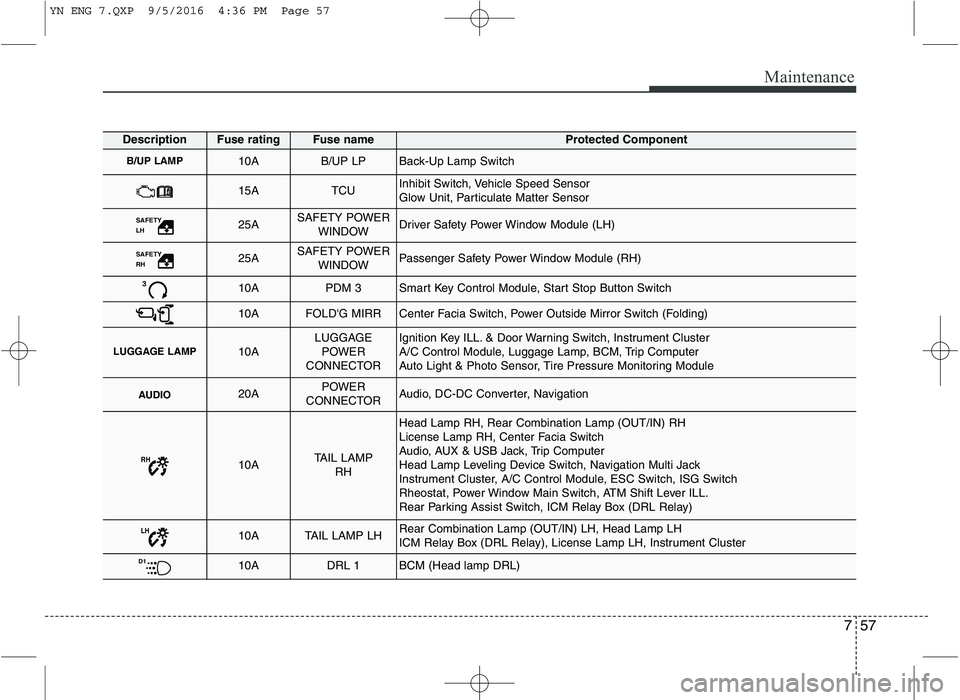
DescriptionFuse ratingFuse nameProtected Component
B/UP LAMP10AB/UP LPBack-Up Lamp Switch
15ATCUInhibit Switch, Vehicle Speed Sensor
Glow Unit, Particulate Matter Sensor
SAFETY
LH 25ASAFETY POWER
WINDOWDriver Safety Power Window Module (LH)
SAFETY
RH 25ASAFETY POWER
WINDOWPassenger Safety Power Window Module (RH)
310APDM 3Smart Key Control Module, Start Stop Button Switch
10AFOLD'G MIRRCenter Facia Switch, Power Outside Mirror Switch (Folding)
LUGGAGE LAMP10ALUGGAGEPOWER
CONNECTORIgnition Key ILL. & Door Warning Switch, Instrument Cluster
A/C Control Module, Luggage Lamp, BCM, Trip Computer
Auto Light & Photo Sensor, Tire Pressure Monitoring Module
AUDIO20APOWER
CONNECTORAudio, DC-DC Converter, Navigation
RH10ATAIL LAMP RH
Head Lamp RH, Rear Combination Lamp (OUT/IN) RH
License Lamp RH, Center Facia Switch
Audio, AUX & USB Jack, Trip Computer
Head Lamp Leveling Device Switch, Navigation Multi Jack
Instrument Cluster, A/C Control Module, ESC Switch, ISG Switch
Rheostat, Power Window Main Switch, ATM Shift Lever ILL.
Rear Parking Assist Switch, ICM Relay Box (DRL Relay)
LH10ATAIL LAMP LHRear Combination Lamp (OUT/IN) LH, Head Lamp LH
ICM Relay Box (DRL Relay), License Lamp LH, Instrument Cluster
D110ADRL 1BCM (Head lamp DRL)
YN ENG 7.QXP 9/5/2016 4:36 PM Page 57
Page 369 of 404
Maintenance
66
7
✽✽
NOTICE
We recommend that the headlight aim-
ing be adjusted after an accident or
after the headlight assembly is rein-
stalled at an authorized Kia dealer.
DRL (LED type, if equipped)
If the light does not operate, we recom-
mend that the system be checked by an
authorized Kia dealer.
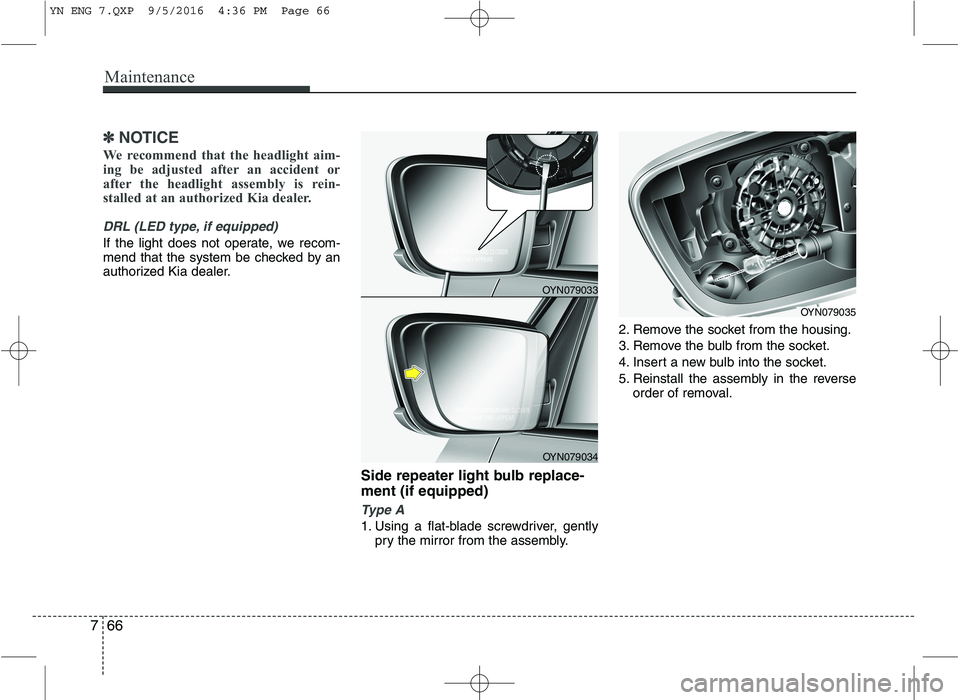
Side repeater light bulb replace- ment (if equipped)
Type A
1. Using a flat-blade screwdriver, gentlypry the mirror from the assembly. 2. Remove the socket from the housing.
3. Remove the bulb from the socket.
4. Insert a new bulb into the socket.
5. Reinstall the assembly in the reverse
order of removal.
OYN079033
OYN079034
OYN079035
YN ENG 7.QXP 9/5/2016 4:36 PM Page 66
Page 370 of 404
767
Maintenance
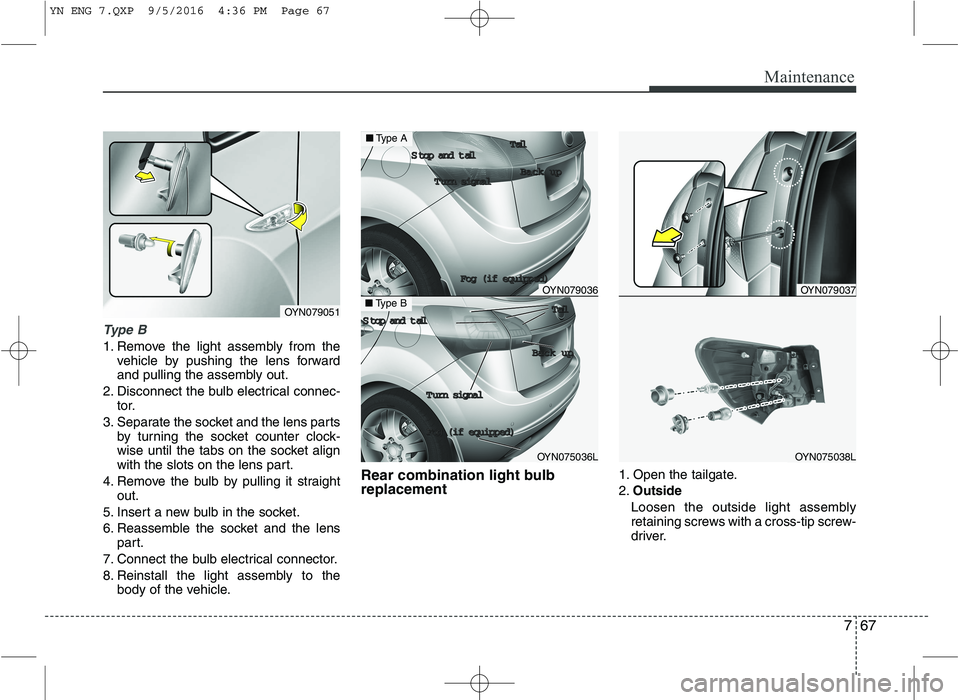
Type B
1. Remove the light assembly from thevehicle by pushing the lens forward
and pulling the assembly out.
2. Disconnect the bulb electrical connec- tor.
3. Separate the socket and the lens parts by turning the socket counter clock-
wise until the tabs on the socket align
with the slots on the lens part.
4. Remove the bulb by pulling it straight out.
5. Insert a new bulb in the socket.
6. Reassemble the socket and the lens part.
7. Connect the bulb electrical connector.
8. Reinstall the light assembly to the body of the vehicle. Rear combination light bulb replacement
1. Open the tailgate. 2.
Outside
Loosen the outside light assembly
retaining screws with a cross-tip screw-
driver.
OYN079051
OYN079037
OYN075038L
OYN079036
OYN075036L
TTTTaaaaiiiillll
TTTTaaaaiiiillll
BBBBaaaacccckkkk uuuupppp
BBBBaaaacccckkkk uuuupppp
TTTTuuuurrrrnnnn ssssiiiiggggnnnnaaaallll
TTTTuuuurrrrnnnn ssssiiiiggggnnnnaaaallll
SSSSttttoooopppp aaaannnndddd ttttaaaaiiiillll
FFFFoooogggg ((((iiiiffff eeeeqqqquuuuiiiippppppppeeeedddd))))
FFFFoooogggg ((((iiiiffff eeeeqqqquuuuiiiippppppppeeeedddd))))
■ Type A
■Type B
SSSSttttoooopppp aaaannnndddd ttttaaaaiiiillll
YN ENG 7.QXP 9/5/2016 4:36 PM Page 67
Page 373 of 404
Maintenance
70
7
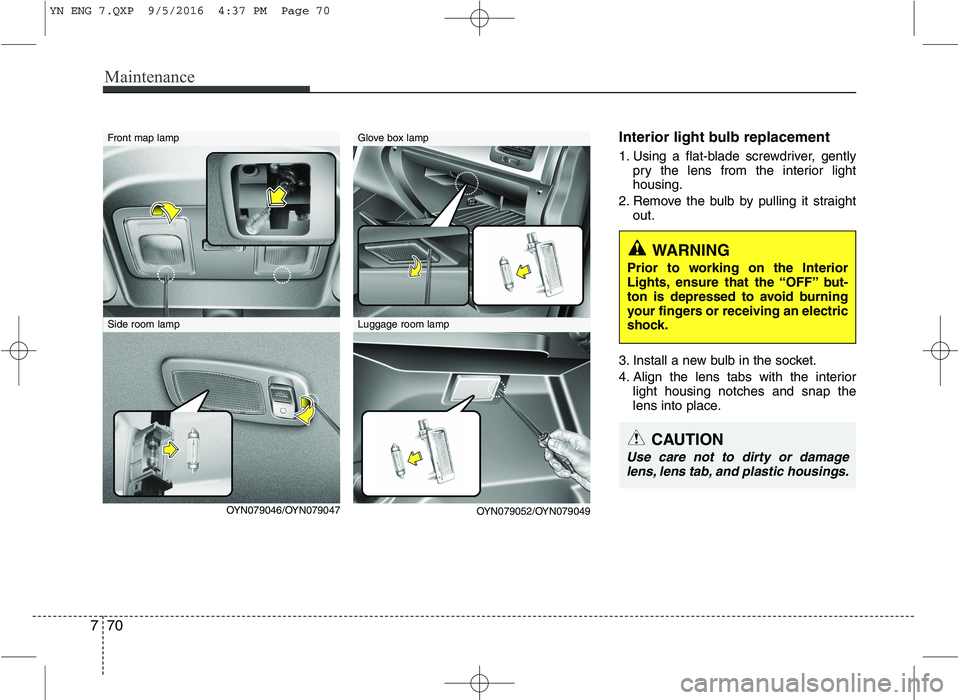
Interior light bulb replacement
1. Using a flat-blade screwdriver, gently
pry the lens from the interior light housing.
2. Remove the bulb by pulling it straight out.
3. Install a new bulb in the socket.
4. Align the lens tabs with the interior light housing notches and snap the
lens into place.Front map lamp
Side room lamp
OYN079052/OYN079049
Glove box lamp
Luggage room lamp
OYN079046/OYN079047
WARNING
Prior to working on the Interior
Lights, ensure that the “OFF” but-
ton is depressed to avoid burning
your fingers or receiving an electric
shock.
CAUTION
Use care not to dirty or damage lens, lens tab, and plastic housings.
YN ENG 7.QXP 9/5/2016 4:37 PM Page 70
Page 378 of 404
775
Maintenance
To help prevent corrosion
You can help prevent corrosion from get-
ting started by observing the following:
Keep your vehicle clean
The best way to prevent corrosion is to
keep your vehicle clean and free of cor-
rosive materials. Attention to the under-
side of the vehicle is particularly impor-tant.
If you live in a high-corrosion area —where road salts are used, near the
ocean, areas with industrial pollution,
acid rain, etc.—, you should take extra
care to prevent corrosion. In winter,
hose off the underside of your vehicleat least once a month and be sure toclean the underside thoroughly when
winter is over. When cleaning underneath the vehicle,
give particular attention to the compo-
nents under the fenders and other
areas that are hidden from view. Do a
thorough job; just dampening the accu-
mulated mud rather than washing it
away will accelerate corrosion rather
than prevent it. Water under high pres-
sure and steam are particularly effec-
tive in removing accumulated mud and
corrosive materials.
rocker panels and frame members, be
sure that drain holes are kept open sothat moisture can escape and not be
trapped inside to accelerate corrosion.
Keep your garage dry
Don't park your vehicle in a damp, poorly
ventilated garage. This creates a favor-
able environment for corrosion. This is
particularly true if you wash your vehicle
in the garage or drive it into the garage
when it is still wet or covered with snow,
ice or mud. Even a heated garage can
contribute to corrosion unless it is well
ventilated so moisture is dispersed. Keep paint and trim in good condition
Scratches or chips in the finish should be
covered with "touch-up" paint as soon as
possible to reduce the possibility of cor-
rosion. If bare metal is showing through,the attention of a qualified body and paintshop is recommended.
Bird droppings : Bird droppings are high-
ly corrosive and may damage painted
surfaces in just a few hours. Always
remove bird droppings as soon as possi-
ble. Don't neglect the interior Moisture can collect under the floor mats
and carpeting and cause corrosion.
Check under the mats periodically to be
sure the carpeting is dry. Use particular
care if you carry fertilizers, cleaning
materials or chemicals in the vehicle.
These should be carried only in proper
containers and any spills or leaks should
be cleaned up, flushed with clean water
and thoroughly dried.
YN ENG 7.QXP 9/5/2016 4:37 PM Page 75
Page 382 of 404
779
Maintenance
Canister
Fuel vapors generated inside the fuel tank are absorbed and stored in the
onboard canister. When the engine is
running, the fuel vapors absorbed in the
canister are drawn into the surge tank
through the purge control solenoid valve.
Purge Control Solenoid Valve (PCSV)
The purge control solenoid valve is con-
trolled by the Engine Control Module
(ECM); when the engine coolant temper-
ature is low during idling, the PCSV clos-
es so that evaporated fuel is not taken
into the engine. After the engine warms
up during ordinary driving, the PCSV
opens to introduce evaporated fuel to the
engine.3. Exhaust emission control
system
The Exhaust Emission Control System is
a highly effective system which controls
exhaust emissions while maintaining
good vehicle performance.
Vehicle modifications
This vehicle should not be modified. Modification of your vehicle could
affect its performance, safety or dura-
bility and may even violate governmen-
tal safety and emissions regulations.
In addition, damage or performance
problems resulting from any modification
may not be covered under warranty.
If you use unauthorized electric devices, it may cause the vehicle to
operate abnormally, wire damage, bat-
tery discharge and fire. For your safety,
do not use unauthorized electric
devices.
Engine exhaust gas precautions (car-
bon monoxide)
Carbon monoxide can be present with other exhaust fumes. Therefore, if you
smell exhaust fumes of any kind inside
your vehicle, have it inspected and
repaired immediately. If you ever sus-
pect exhaust fumes are coming into
your vehicle, drive it only with all the
windows fully open. Have your vehicle
checked and repaired immediately.
WARNING - Exhaust
Engine exhaust gases contain car-
bon monoxide (CO). Though color-
less and odorless, it is dangerousand could be lethal if inhaled.
Follow the instructions on this
page to avoid CO poisoning.
YN ENG 7.QXP 9/5/2016 4:37 PM Page 79
Page 383 of 404
Maintenance
80
7
Do not operate the engine in confined
or closed areas (such as garages) any
more than what is necessary to move
the vehicle in or out of the area.
When the vehicle is stopped in an open area for more than a short time
with the engine running, adjust the
ventilation system (as needed) to draw
outside air into the vehicle.
Never sit in a parked or stopped vehi- cle for any extended time with the
engine running.
When the engine stalls or fails to start, excessive attempts to restart the
engine may cause damage to theemission control system.Operating precautions for catalytic
converters (if equipped)Your vehicle is equipped with a catalytic
converter emission control device.
Therefore, the following precautions
must be observed:
Use only UNLEADED FUEL for gaso- line engine.
Do not operate the vehicle when there are signs of engine malfunction, such
as misfire or a noticeable loss of per-
formance.
Do not misuse or abuse the engine. Examples of misuse are coasting withthe ignition off and descending steep
grades in gear with the ignition off.
Do not operate the engine at high idle speed for extended periods (5 minutesor more).
Do not modify or tamper with any part of the engine or emission control sys-
tem. We recommend that the system
be inspected by an authorized Kia
dealer.
Avoid driving with an extremely low fuel level. Running out of fuel could cause
the engine to misfire, damaging the
catalytic converter.
Failure to observe these precautionscould result in damage to the catalytic
converter and to your vehicle.
Additionally, such actions could void your
warranties.
WARNING - Fire
A hot exhaust system can ignite flammable items under your vehi-
cle. Do not park, idle, or drive the
vehicle over or near flammable
objects, such as grass, vegeta-
tion, paper, leaves, etc.
The exhaust system and catalytic system are very hot while the
engine is running or immediately
after the engine is turned off. Keep
away from the exhaust system
and catalytic, you may get burned.
Also, do not remove the heat sink
around the exhaust system, do
not seal the bottom of the vehicle
or do not coat the vehicle for cor-
rosion control. It may present a
fire risk under certain conditions.
YN ENG 7.QXP 9/5/2016 4:37 PM Page 80
Page 384 of 404
781
Maintenance
Diesel Particulate Filter (if equipped)
The Diesel Particulate Filter (DPF) sys-
tem removes the soot in the exhaust gas.
Unlike a disposable air filter, the DPF
system automatically burns (oxidizes)
and removes the accumulated soot
according to the driving condition. In
other words, the active burning by engine
control system and high exhaust gas
temperature caused by normal/high driv-
ing condition burns and removes the
accumulated soot.
However, if the vehicle continues to be
driven at repeated short distance or driv-
en at low speed for long time, the accu-
mulated soot may not be automatically
removed because of low exhaust gas
temperature. More than a certain amountof soot deposited, the malfunction indica-
tor light ( ) illuminates. When the malfunction indicator light
blinks, it may stop blinking by driving the
vehicle at more than 60km/h (37 mph) orat more than second gear with 1500 ~
2500 engine rpm for a certain time (for
about 25 minutes).If the malfunction indicator light contin-
ues to be blinked in spite of the proce-
dure, we recommend that the system be
checked by an authorized Kia dealer.
If you continue to drive with the malfunc-
tion indicator light blinking for a long
time, the DPF system can be damaged
and fuel consumption can be worsen.
Lean NOx Trap (if equipped)
The Lean NOx Trap (LNT) system
removes the nitrogen oxide in the
exhaust gas. The smell can occur in the
exhaust gas depending on the quality of
the fuel and it can degrade NOx reduc-
tion performance, please use the regulat-
ed automotive diesel fuel.
CAUTION
- Diesel Fuel
(if equipped with DPF)
It is recommended to use the regu- lated automotive diesel fuel for
diesel vehicle equipped with theDPF system.
If you use diesel fuel including highsulfur (more than 50 ppm sulfur) andunspecified additives, it can cause
the DPF system to be damaged and white smoke can be emitted.
YN ENG 7.QXP 9/5/2016 4:37 PM Page 81
Page 393 of 404
89
Specifications & Consumer information
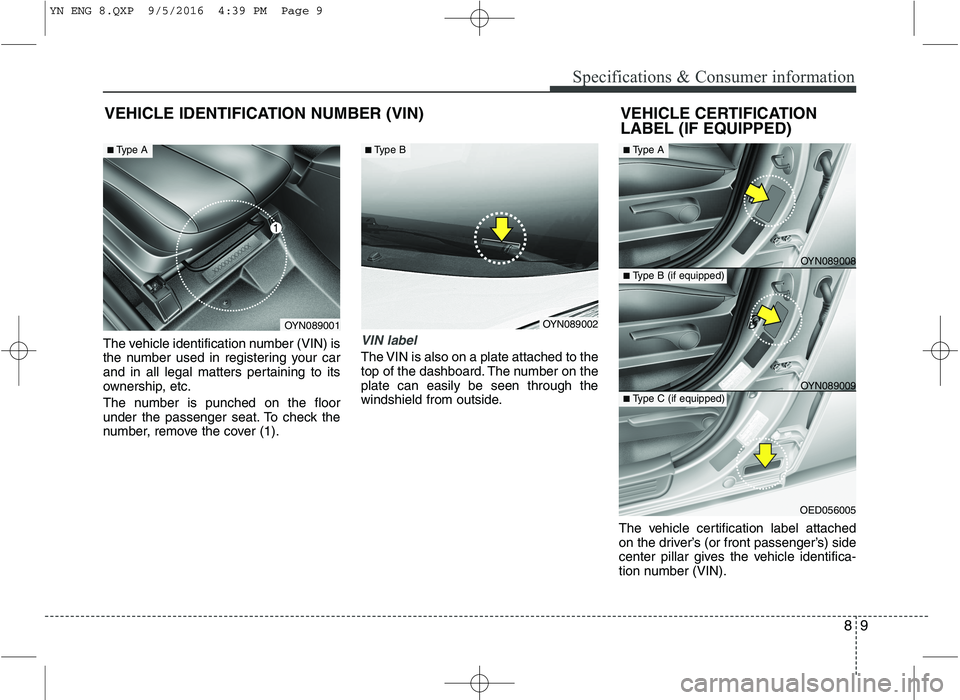
The vehicle identification number (VIN) is
the number used in registering your car
and in all legal matters pertaining to its
ownership, etc.
The number is punched on the floor
under the passenger seat. To check the
number, remove the cover (1).VIN label
The VIN is also on a plate attached to the
top of the dashboard. The number on theplate can easily be seen through the
windshield from outside.The vehicle certification label attached
on the driver’s (or front passenger’s) side
center pillar gives the vehicle identifica-
tion number (VIN).
VEHICLE IDENTIFICATION NUMBER (VIN) VEHICLE CERTIFICATION
LABEL (IF EQUIPPED)
OYN089008
OYN089009
OED056005
OYN089001
■ Type A
OYN089002
■Type B■Type A
■Type B (if equipped)
■Type C (if equipped)
YN ENG 8.QXP 9/5/2016 4:39 PM Page 9
Page 394 of 404
Specifications & Consumer information
10
8
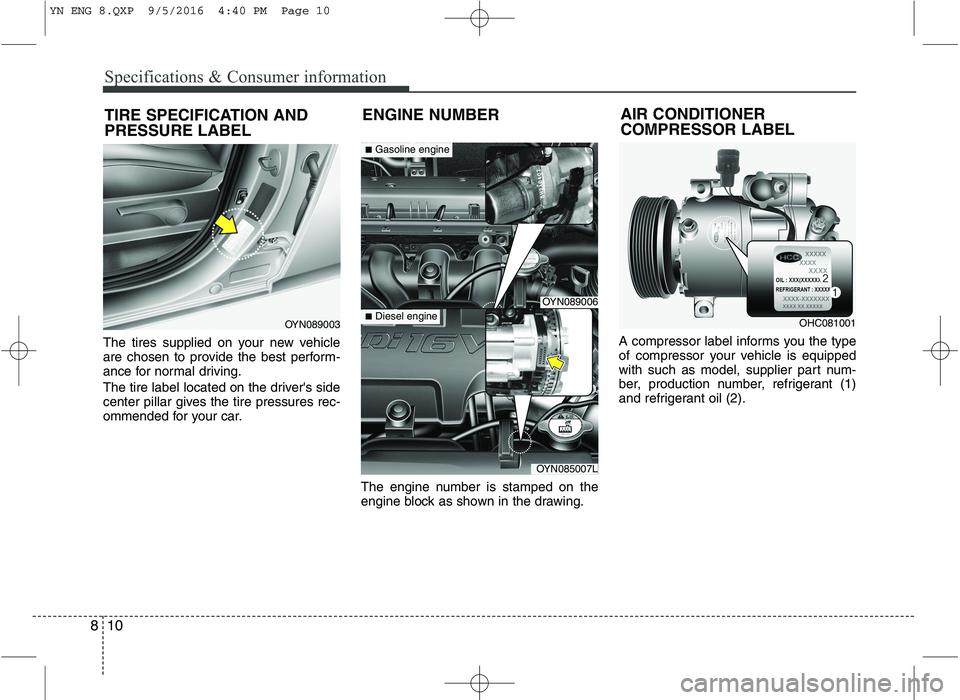
The tires supplied on your new vehicle
are chosen to provide the best perform-
ance for normal driving.
The tire label located on the driver's side
center pillar gives the tire pressures rec-
ommended for your car.
The engine number is stamped on the
engine block as shown in the drawing.A compressor label informs you the type
of compressor your vehicle is equipped
with such as model, supplier part num-
ber, production number, refrigerant (1)
and refrigerant oil (2).
OYN089003
TIRE SPECIFICATION AND PRESSURE LABEL
ENGINE NUMBER
OYN089006
OYN085007L
■
Gasoline engine
■Diesel engineOHC081001
AIR CONDITIONER COMPRESSOR LABEL
YN ENG 8.QXP 9/5/2016 4:40 PM Page 10