radiator Lancia Flavia 2012 Owner handbook (in English)
[x] Cancel search | Manufacturer: LANCIA, Model Year: 2012, Model line: Flavia, Model: Lancia Flavia 2012Pages: 233, PDF Size: 2.61 MB
Page 114 of 233
INSTRUMENT CLUSTER
DESCRIPTIONS
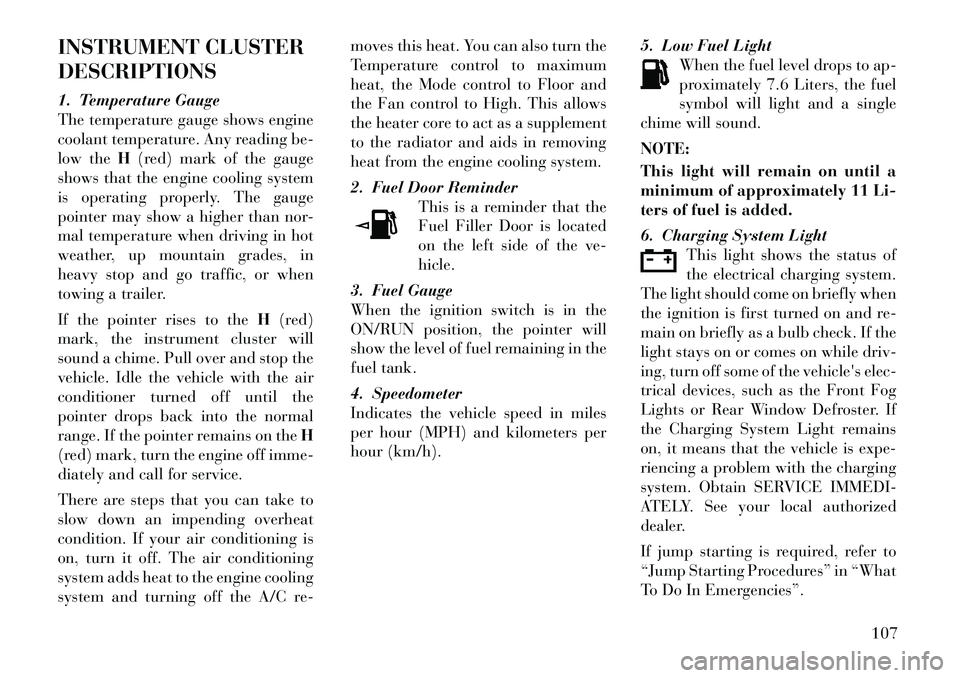
1. Temperature Gauge
The temperature gauge shows engine
coolant temperature. Any reading be-
low theH(red) mark of the gauge
shows that the engine cooling system
is operating properly. The gauge
pointer may show a higher than nor-
mal temperature when driving in hot
weather, up mountain grades, in
heavy stop and go traffic, or when
towing a trailer.
If the pointer rises to the H(red)
mark, the instrument cluster will
sound a chime. Pull over and stop the
vehicle. Idle the vehicle with the air
conditioner turned off until the
pointer drops back into the normal
range. If the pointer remains on the H
(red) mark, turn the engine off imme-
diately and call for service.
There are steps that you can take to
slow down an impending overheat
condition. If your air conditioning is
on, turn it off. The air conditioning
system adds heat to the engine cooling
system and turning off the A/C re- moves this heat. You can also turn the
Temperature control to maximum
heat, the Mode control to Floor and
the Fan control to High. This allows
the heater core to act as a supplement
to the radiator and aids in removing
heat from the engine cooling system.
2. Fuel Door Reminder
This is a reminder that the
Fuel Filler Door is located
on the left side of the ve-
hicle.
3. Fuel Gauge
When the ignition switch is in the
ON/RUN position, the pointer will
show the level of fuel remaining in the
fuel tank.
4. Speedometer
Indicates the vehicle speed in miles
per hour (MPH) and kilometers per
hour (km/h). 5. Low Fuel Light
When the fuel level drops to ap-
proximately 7.6 Liters, the fuel
symbol will light and a single
chime will sound.
NOTE:
This light will remain on until a
minimum of approximately 11 Li-
ters of fuel is added.
6. Charging System Light This light shows the status of
the electrical charging system.
The light should come on briefly when
the ignition is first turned on and re-
main on briefly as a bulb check. If the
light stays on or comes on while driv-
ing, turn off some of the vehicle'selec-
trical devices, such as the Front Fog
Lights or Rear Window Defroster. If
the Charging System Light remains
on, it means that the vehicle is expe-
riencing a problem with the charging
system. Obtain SERVICE IMMEDI-
ATELY. See your local authorized
dealer.
If jump starting is required, refer to
“Jump Starting Procedures” in “What
To Do In Emergencies”.
107
Page 131 of 233
AUTOMATIC
TEMPERATURE CONTROL
(ATC)
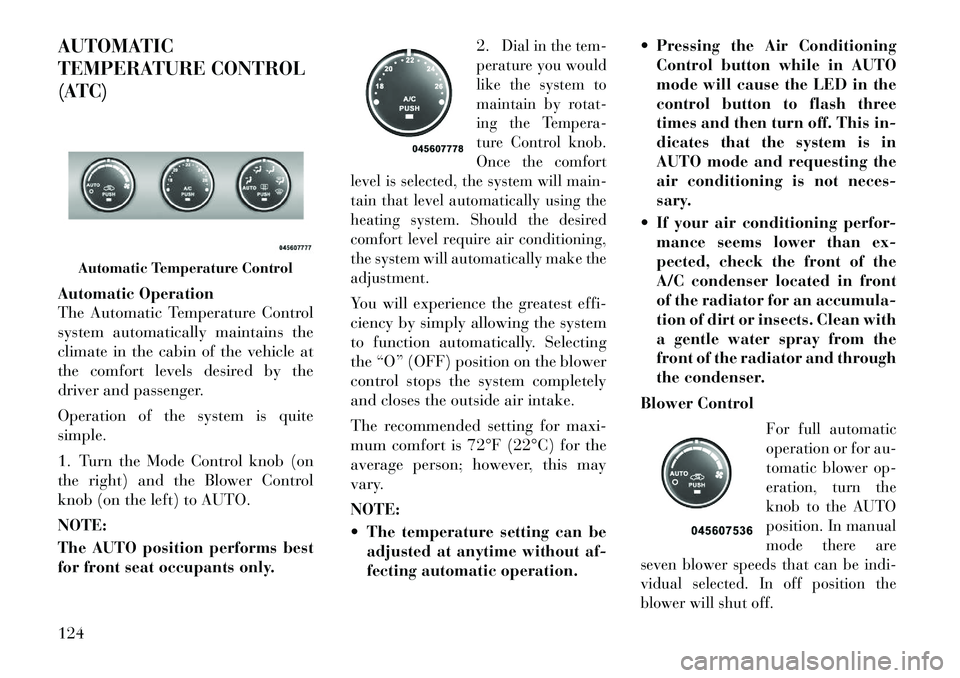
Automatic Operation
The Automatic Temperature Control
system automatically maintains the
climate in the cabin of the vehicle at
the comfort levels desired by the
driver and passenger.
Operation of the system is quite
simple.
1. Turn the Mode Control knob (on
the right) and the Blower Control
knob (on the left) to AUTO.
NOTE:
The AUTO position performs best
for front seat occupants only.2.
Dial in the tem-
perature you would
like the system to
maintain by rotat-
ing the Tempera-
ture Control knob.
Once the comfort
level is selected, the system will main-
tain that level automatically using the
heating system. Should the desired
comfort level require air conditioning,
the system will automatically make the
adjustment.
You will experience the greatest effi-
ciency by simply allowing the system
to function automatically. Selecting
the “O” (OFF) position on the blower
control stops the system completely
and closes the outside air intake.
The recommended setting for maxi-
mum comfort is 72°F (22°C) for the
average person; however, this may
vary.
NOTE:
The temperature setting can be adjusted at anytime without af-
fecting automatic operation. Pressing the Air Conditioning
Control button while in AUTO
mode will cause the LED in the
control button to flash three
times and then turn off. This in-
dicates that the system is in
AUTO mode and requesting the
air conditioning is not neces-
sary.
If your air conditioning perfor- mance seems lower than ex-
pected, check the front of the
A/C condenser located in front
of the radiator for an accumula-
tion of dirt or insects. Clean with
a gentle water spray from the
front of the radiator and through
the condenser.
Blower Control
For full automatic
operation or for au-
tomatic blower op-
eration, turn the
knob to the AUTO
position. In manual
mode there are
seven blower speeds that can be indi-
vidual selected. In off position the
blower will shut off.
Automatic Temperature Control
124
Page 173 of 233

HAZARD WARNING
FLASHERS
The Hazard Warning flasher switch is
located on the instrument panel, be-
low the radio.Press the switch to turn on the
Hazard Warning flasher. When
the switch is activated, all di-
rectional turn signals will flash on and
off to warn oncoming traffic of an
emergency. Press the switch a second
time to turn off the Hazard Warning
flashers.
This is an emergency warning system
and it should not be used when the
vehicle is in motion. Use it when your
vehicle is disabled and it is creating a
safety hazard for other motorists.
When you must leave the vehicle to
seek assistance, the Hazard Warning
flashers will continue to operate even
though the ignition is placed in the
OFF position.
NOTE:
With extended use the Hazard
Warning flashers may wear down
your battery. IF YOUR ENGINE
OVERHEATS
In any of the following situations, you
can reduce the potential for overheat-
ing by taking the appropriate action.
On the highways — Slow down.
In city traffic — While stopped, put
transaxle in NEUTRAL, but do not
increase engine idle speed.
CAUTION!
Driving with a hot cooling system
could damage your vehicle. If tem-
perature gauge reads “H”, pull over
and stop the vehicle with the engine
at idle, when safe. Turn the air con-
ditioner off and wait until the
pointer drops back into the normal
range. After appropriate action has
been taken, if the pointer remains on
the “H”, turn the engine off imme-
diately, and call for service.
NOTE:
There are steps that you can take to
slow down an impending overheat
condition: If your air conditioner (A/C) is
on, turn it off. The A/C system
adds heat to the engine cooling
system and turning the A/C off
can help remove this heat.
You can also turn the tempera- ture control to maximum heat,
the mode control to floor and the
blower control to high. This al-
lows the heater core to act as a
supplement to the radiator and
aids in removing heat from the
engine cooling system.
WARNING!
You or others can be badly burned
by hot engine coolant (antifreeze) or
steam from your radiator. If you see
or hear steam coming from under
the hood, do not open the hood until
the radiator has had time to cool.
Never try to open a cooling system
pressure cap when the radiator or
coolant bottle is hot.
166
Page 180 of 233

PREPARATIONS FOR
JUMP-START
The battery in your vehicle is located
between the left front headlight as-
sembly and the left front wheel splash
shield. To allow jump-starting there
are remote battery posts located on
the left side of the engine compart-
ment.WARNING!
Take care to avoid the radiatorcooling fan whenever the hood is
raised. It can start anytime the
ignition switch is on. You can be
injured by moving fan blades.
(Continued)
WARNING!(Continued)
Remove any metal jewelry such as
watch bands or bracelets that
might make an inadvertent elec-
trical contact. You could be seri-
ously injured.
Batteries contain sulfuric acid
that can burn your skin or eyes
and generate hydrogen gas which
is flammable and explosive. Keep
open flames or sparks away from
the battery.
1. Set the parking brake, shift the
automatic transmission into PARK
and turn the ignition to LOCK.
2. Turn off the heater, radio, and all
unnecessary electrical accessories.
3. Remove the protective cover over
the remote positive (+)battery post.
To remove the cover, press the locking
tab and pull upward on the cover. 4. If using another vehicle to jump-
start the battery, park the vehicle
within the jumper cables reach, set
the parking brake and make sure the
ignition is OFF.
WARNING!
Do not allow vehicles to touch each
other as this could establish a
ground connection and personal in-
jury could result.
JUMP-STARTING
PROCEDUREWARNING!
Failure to follow this procedure
could result in personal injury or
property damage due to battery ex-
plosion.
Remote Battery Posts
1 — Remote Positive (+) Post (cov-
ered with protective cap)
2 — Remote Negative (-) Post
Locking Tab
173
Page 195 of 233

CAUTION!
Car maintenance should be done at
a LANCIA Dealership. For routine
and minor maintenance operations
you wish to carry out yourself, we do
recommend you have the proper
equipment, genuine LANCIA spare
parts and the necessary fluids; do
not however carry out these opera-
tions if you have no experience.
WINDSHIELD WIPER
BLADES
Clean the rubber edges of the wiper
blades and the windshield periodi-
cally with a sponge or soft cloth and a
mild non-abrasive cleaner or use the
washer solvent. This will remove ac-
cumulations of salt, waxes, or road
film and help reduce streaking and
smearing.
Operation of the wipers on dry glass
for long periods may cause deteriora-
tion of the wiper blades. Always use
washer fluid when using the wipers to
remove salt or dirt from a dry wind-
shield. Avoid using the wiper blades to re-
move frost or ice from the windshield.
Make sure that they are not frozen to
the glass before turning them on to
avoid damaging the blade.
NOTE:
Life expectancy of wiper blades
varies depending on geographical
area and frequency of use. Poor
performance of blades may be
present with chattering, marks,
water lines or wet spots. If any of
these conditions are present, clean
the wiper blades or replace as nec-
essary.
ADDING WASHER FLUID
The windshield washer and the rear
window washer share the same fluid
reservoir. The fluid reservoir is lo-
cated in the engine compartment. Be
sure to check the fluid level in the
reservoir at regular intervals. Fill the
reservoir with windshield washer sol-
vent (not radiator antifreeze) and op-
erate the system for a few seconds to
flush out the residual water.
When refilling the washer fluid reser-
voir, apply some washer fluid to acloth or towel and wipe the wiper
blades clean. This will help blade per-
formance.
To prevent freeze-up of your wind-
shield washer system in cold weather,
select a solution or mixture that meets
or exceeds the temperature range of
your climate. This rating information
can be found on most washer fluid
containers.
WARNING!
Commercially available windshield
washer solvents are flammable.
They could ignite and burn you.
Care must be exercised when filling
or working around the washer solu-
tion.CAUTION!
Car maintenance should be done at
a LANCIA Dealership. For routine
and minor maintenance operations
you wish to carry out yourself, we do
recommend you have the proper
equipment, genuine LANCIA spare
parts and the necessary fluids; do
not however carry out these opera-
tions if you have no experience.
188
Page 197 of 233

In unusual situations involving
grossly malfunctioning engine opera-
tion, a scorching odor may suggest
severe and abnormal catalyst over-
heating. If this occurs, stop the ve-
hicle, turn off the engine and allow it
to cool. Service, including a tune-up
to manufacturer's specifications,
should be obtained immediately.
To minimize the possibility of cata-
lytic converter damage:
Do not shut off the engine or inter- rupt the ignition, when the trans-
mission is in gear and the vehicle is
in motion.
Do not try to start the engine by pushing or towing the vehicle.
Do not idle the engine with any spark plug wires disconnected or
removed, such as when diagnostic
testing, or for prolonged periods
during very rough idle or malfunc-
tioning operating conditions. COOLING SYSTEM
WARNING!
When working near the radiator
cooling fan, disconnect the fan
motor lead or turn the ignition
switch to the LOCK position. The
fan is temperature controlled and
can start at anytime the ignition
switch is in the ON position.
You or others can be badly burned
by hot engine coolant (antifreeze)
or steam from your radiator. If
you see or hear steam coming
from under the hood, do not open
the hood until the radiator has
had time to cool. Never try to open
a cooling system pressure cap
when the radiator is hot.
CAUTION!
Car maintenance should be done at
a LANCIA Dealership. For routine
and minor maintenance operations
you wish to carry out yourself, we do
recommend you have the proper
equipment, genuine LANCIA spare
parts and the necessary fluids; do
not however carry out these opera-
tions if you have no experience.
Coolant ChecksCheck engine coolant (antifreeze) pro-
tection every 12 months (before the on-
set of freezing weather, where appli-
cable). If the engine coolant (antifreeze)
is dirty or rusty in appearance, the sys-
tem should be drained, flushed, and re-
filled with fresh engine coolant (anti-
freeze). Check the front of the A/C
condenser for any accumulation of bugs,
leaves, etc. If dirty, clean by gently
spraying water from a garden hose ver-
tically down the face of the condenser.Check the coolant recovery bottle
tubing for brittle rubber, cracking,
tears, cuts, and tightness of the con-
nection at the bottle and radiator. In-
spect the entire system for leaks.
190
Page 198 of 233

Cooling System – Drain, Flush,
And Refill
If the engine coolant (antifreeze) is
dirty or contains a considerable
amount of sediment, clean and flush
with a reliable cooling system cleaner.
Follow with a thorough rinsing to re-
move all deposits and chemicals.
Properly dispose of the old engine
coolant (antifreeze).
Refer to the “Maintenance Schedule”
for the proper maintenance intervals.
Selection Of Coolant
Use the manufacturer’s recom-
mended coolant or a quality-
equivalent product. Refer to “Fluids,
Lubricants, and Genuine Parts” in
“Maintaining Your Vehicle” for fur-
ther information.
CAUTION!
Mixing of engine coolant (anti-freeze) other than specified HOAT
engine coolant (antifreeze), may
result in engine damage and may
decrease corrosion protection. If a
non-HOAT engine coolant (anti-
freeze) is introduced into the cool-
ing system in an emergency, it
should be replaced with the speci-
fied engine coolant (antifreeze) as
soon as possible.
Do not use water alone or alcohol-
based engine coolant (antifreeze)
products. Do not use additional
rust inhibitors or antirust prod-
ucts, as they may not be compat-
ible with the engine coolant (anti-
freeze) and may plug the radiator.
This vehicle has not been de-
signed for use with Propylene Gly-
col based engine coolant (anti-
freeze). Use of Propylene Glycol
based engine coolant (antifreeze)
is not recommended. Adding Coolant
Your vehicle has been built with an
improved engine coolant (antifreeze)
that allows extended maintenance in-
tervals. This engine coolant (anti-
freeze) can be used up to five years or
168 000 km before replacement. To
prevent reducing this extended main-
tenance period, it is important that
you use the same engine coolant (an-
tifreeze) throughout the life of your
vehicle.
When adding engine coolant (anti-
freeze):
Use only high purity water such as
distilled or deionized water when
mixing the water/engine coolant (an-
tifreeze) solution. The use of lower
quality water will reduce the amount
of corrosion protection in the engine
cooling system.
Please note that it is the
owner's re-
sponsibility to maintain the proper
level of protection against freezing ac-
cording to the temperatures occurring
in the area where the vehicle is oper-
ated.
191
Page 199 of 233

NOTE:
Mixing engine coolant (antifreeze)
types will decrease the life of the
engine coolant (antifreeze) and
will require more frequent coolant
changes.
Cooling System Pressure Cap
The cap must be fully tightened to
prevent loss of engine coolant (anti-
freeze), and to ensure that the engine
coolant (antifreeze) will return to the
radiator from the coolant recovery
bottle.
The cap should be inspected and
cleaned if there is any accumulation
of foreign material on the sealing sur-
faces.
WARNING!
The warning words “DO NOTOPEN HOT” on the cooling sys-
tem pressure cap are a safety pre-
caution. Never add engine coolant
(antifreeze) when the engine is
overheated. Do not loosen or re-
move the cap to cool an over-
heated engine. Heat causes pres-
sure to build up in the cooling
system. To prevent scalding or in-
jury, do not remove the pressure
cap while the system is hot or un-
der pressure.
Do not use a pressure cap other
than the one specified for your
vehicle. Personal injury or engine
damage may result.
Disposal Of Used Engine Coolant
Used ethylene glycol based engine
coolant (antifreeze) is a regulated
substance requiring proper disposal.
Check with your local authorities to
determine the disposal rules for your
community. To prevent ingestion by
animals or children, do not store eth-
ylene glycol based engine coolant (an-
tifreeze) in open containers or allow it to remain in puddles on the ground. If
ingested by a child or pet, seek emer-
gency assistance immediately. Clean
up any ground spills immediately.
Coolant Level
Four-Cylinder Engines –
the cool-
ant bottle provides a quick visual
method for determining that the en-
gine coolant (antifreeze) level is ad-
equate. With the engine idling and
warm to normal operating tempera-
ture, the level of the engine coolant
(antifreeze) in the bottle should be
between the “ADD” and “FULL”
lines, shown on the bottle.
The radiator normally remains com-
pletely full, so there is no need to
remove the radiator cap unless check-
ing for engine coolant (antifreeze)
freeze point or replacing coolant. Ad-
vise your service attendant of this. As
long as the engine operating tempera-
ture is satisfactory, the coolant bottle
need only be checked once a month.
When additional engine coolant (an-
tifreeze) is needed to maintain the
proper level, it should be added to the
coolant bottle. Do not overfill.
192
Page 200 of 233

Points To Remember
NOTE:
When the vehicle is stopped after a
few kilometers of operation, you
may observe vapor coming from
the front of the engine compart-
ment. This is normally a result of
moisture from rain, snow, or high
humidity accumulating on the ra-
diator and being vaporized when
the thermostat opens, allowing hot
engine coolant (antifreeze) to enter
the radiator.
If an examination of your engine com-
partment shows no evidence of radia-
tor or hose leaks, the vehicle may be
safely driven. The vapor will soon dis-
sipate.
Do not overfill the coolant recoverybottle.
Check engine coolant (antifreeze) freeze point in the radiator and in
the coolant recovery bottle. If en-
gine coolant (antifreeze) needs to
be added, the contents of the cool-
ant recovery bottle must also be
protected against freezing. If frequent engine coolant (anti-
freeze) additions are required, or if
the level in the coolant recovery
bottle does not drop when the en-
gine cools, the cooling system
should be pressure tested for leaks.
Maintain engine coolant (anti- freeze) concentration at 50% en-
gine coolant (antifreeze) (mini-
mum) and distilled water for
proper corrosion protection of your
engine, which contains aluminum
components.
Make sure that the radiator and coolant recovery bottle overflow
hoses are not kinked or obstructed.
Keep the front of the radiator clean. If your vehicle is equipped with air
conditioning, keep the front of the
condenser clean.
Do not change the thermostat for Summer or Winter operation. If re-
placement is ever necessary, install
ONLY the correct type thermostat.
Other designs may result in unsat-
isfactory cooling performance, poor
gas mileage, and increased emis-
sions. BRAKE SYSTEM
In order to assure brake system per-
formance, all brake system compo-
nents should be inspected periodi-
cally. Refer to the “Maintenance
Schedule” for the proper maintenance
intervals.
WARNING!
Riding the brakes can lead to brake
failure and possibly a collision. Driv-
ing with your foot resting or riding
on the brake pedal can result in ab-
normally high brake temperatures,
excessive lining wear, and possible
brake damage. You would not have
your full braking capacity in an
emergency.CAUTION!
Car maintenance should be done at
a LANCIA Dealership. For routine
and minor maintenance operations
you wish to carry out yourself, we do
recommend you have the proper
equipment, genuine LANCIA spare
parts and the necessary fluids; do
not however carry out these opera-
tions if you have no experience.
193
Page 208 of 233

CavityCartridge Fuse Mini Fuse Description
14 —10 Amp Red Instrument Panel
15 40 Amp Green —Radiator Fan Relay
16 —15 Amp Lt. Blue Sunroof (for versions/markets, where pro-
vided)
17 —10 Amp RedWireless Control Module (WCM)/Clock/
Steering Control Module (SCM)
18 40 Amp Green —Auto Shutdown (ASD) Relay
19 —20 Amp Yellow Audio Amplifier (for versions/markets,
where provided)
20 —15 Amp Lt. Blue Radio
21 —10 Amp Red Siren (for versions/markets, where provided)
22 —10 Amp RedIgnition Run – Climate Controls/Hot Cup-
holder (for versions/markets, where pro-
vided)
23 —15 Amp Lt. Blue Auto Shutdown (ASD) Relay 3
24 —25 Amp Natural Sunroof (for versions/markets, where pro-
vided)
25 —10 Amp RedIgnition Run — Heated Mirrors (for
versions/markets, where provided)
26 —15 Amp Lt. Blue Auto Shutdown (ASD) Relay 2
27 —10 Amp RedIgnition Run – Occupant Classification Mod-
ule (OCM)/Occupant Restraint Controller
(ORC)
28 —10 Amp RedIgnition Run — Occupant Classification
Module (OCM)/Occupant Restraint Control-
ler (ORC)
29 — —Hot Car (No Fuse Required)
30 —20 Amp Yellow Ignition Run – Heated Seats (for versions/
markets, where provided)
201