belt Lancia Thema 2014 Owner handbook (in English)
[x] Cancel search | Manufacturer: LANCIA, Model Year: 2014, Model line: Thema, Model: Lancia Thema 2014Pages: 332, PDF Size: 3.46 MB
Page 10 of 332
INTRODUCTION
Congratulations on selecting your
new LANCIA vehicle. Be assured that
it represents precision workmanship,
distinctive styling, and high quality -
all essentials that are traditional to
our vehicles.
Before you start to drive this vehicle,
read this Owner's Manual and all the
supplements. Be sure you are familiar
with all vehicle controls, particularly
those used for braking, steering, and
transmission shifting. Learn how your
vehicle handles on different road sur-
faces. Your driving skills will improve
with experience, but as in driving any
vehicle, take it easy as you begin. Al-
ways observe local laws wherever you
drive.
NOTE: After reviewing the owner
information, it should be stored in
the vehicle for convenient refer-
encing and remain with the vehicle
when sold.
Failure to operate this vehicle cor-
rectly may result in loss of control or a
collision.Operating this vehicle at excessive
speeds or while intoxicated may result
in loss of control, collision with other
vehicles or objects, going off the road,
or overturning; any of which may lead
to serious injury or death. Also, failure
to use seat belts subjects the driver
and passengers to a greater risk of
injury or death.
To keep your vehicle running at its
best, have your vehicle serviced at
recommended intervals by an autho-
rized dealer who has the qualified per-
sonnel, special tools, and equipment
to perform all service.
The manufacturer and its distributors
are vitally interested in your complete
satisfaction with this vehicle. If you
encounter a service or warranty prob-
lem, which is not resolved to your
satisfaction, discuss the matter with
your dealer's management.
Your authorized dealer will be happy
to assist you with any questions about
your vehicle.
IMPORTANT NOTICE
ALL MATERIAL CONTAINED IN
THIS PUBLICATION IS BASED ON
THE LATEST INFORMATION
AVAILABLE AT TIME OF PUBLI-
CATION APPROVAL. THE RIGHT
IS RESERVED TO PUBLISH REVI-
SIONS AT ANY TIME.
This Owner's Manual has been pre-
pared with the assistance of service
and engineering specialists to ac-
quaint you with the operation and
maintenance of your new vehicle. It is
supplemented by a Warranty Infor-
mation Booklet and various
customer-oriented documents. You
are urged to read these publications
carefully. Following the instructions
and recommendations in this Owner's
Manual will help assure safe and en-
joyable operation of your vehicle.
After you have read the Owner’s
Manual, it should be stored in the
vehicle for convenient reference and
remain with the vehicle when sold.
4
Page 16 of 332

TO UNLOCK THE DOORS.................18
TO LOCK THE DOORS ....................19
TO UNLATCH THE TRUNK ................19
TRANSMITTER BATTERY REPLACEMENT . . .19
GENERAL INFORMATION .................20
DOOR LOCKS ............................20
MANUAL DOOR LOCKS ...................20
POWER DOOR LOCKS ...................21
CHILD-PROTECTION DOOR LOCK SYSTEM — REAR DOORS ..........................22
KEYLESS ENTER-N-GO™ ..................23
WINDOWS ..............................25
POWER WINDOWS ......................25
WINDBUFFETING ......................27
TRUNK LOCK AND RELEASE ................27
TRUNK SAFETY WARNING ..................28
TRUNK EMERGENCY RELEASE ............28
OCCUPANT RESTRAINTS ...................28
LAP/SHOULDER BELTS ..................31
LAP/SHOULDER BELT UNTWISTING PROCEDURE ...........................33
SEAT BELTS IN PASSENGER SEATING POSITIONS ............................34
AUTOMATIC LOCKING RETRACTOR MODE (ALR) .................................34
ENERGY MANAGEMENT FEATURE ..........35
SEAT BELT PRETENSIONERS .............35
10
Page 17 of 332

ACTIVE HOOD SYSTEM (for versions/markets,where provided) .........................35
ENHANCED SEAT BELT USE REMINDER SYSTEM (BeltAlert®) ....................37
SEAT BELTS AND PREGNANT WOMEN .......38
SUPPLEMENTAL RESTRAINT SYSTEM (SRS) — AIR BAGS .............................38
AIR BAG DEPLOYMENT SENSORS AND CONTROLS ............................41
EVENT DATA RECORDER (EDR) ............46
CHILD RESTRAINTS ....................47
ENGINE BREAK-IN RECOMMENDATIONS ......58
ADDITIONAL REQUIREMENTS FOR DIESEL ENGINE ...............................59
SAFETYTIPS ............................59
TRANSPORTING PASSENGERS .............59
EXHAUST GAS ..........................59
SAFETY CHECKS YOU SHOULD MAKE INSIDE THE VEHICLE .........................60
PERIODIC SAFETY CHECKS YOU SHOULD MAKE OUTSIDE THE VEHICLE ............61
11
Page 34 of 332
With the ignition in the ON/RUN po-
sition, the Trunk Open symbol will
display in the instrument cluster indi-
cating that the trunk is open. The
odometer display will reappear once
the trunk is closed.
With the ignition in the OFF position,
the Trunk Open symbol will display
until the trunk is closed.
Refer to “Keyless Enter-N-Go™” in
“Things To Know Before Starting
Your Vehicle” for more information
on trunk operation with the Passive
Entry feature.TRUNK SAFETY
WARNING
WARNING!
Do not allow children to have ac-
cess to the trunk, either by climbing
into the trunk from outside, or
through the inside of the vehicle.
Always close the trunk lid when
your vehicle is unattended. Once in
the trunk, young children may not
be able to escape, even if they en-
tered through the rear seat. If
trapped in the trunk, children can
die from suffocation or heat stroke.
TRUNK EMERGENCY
RELEASE
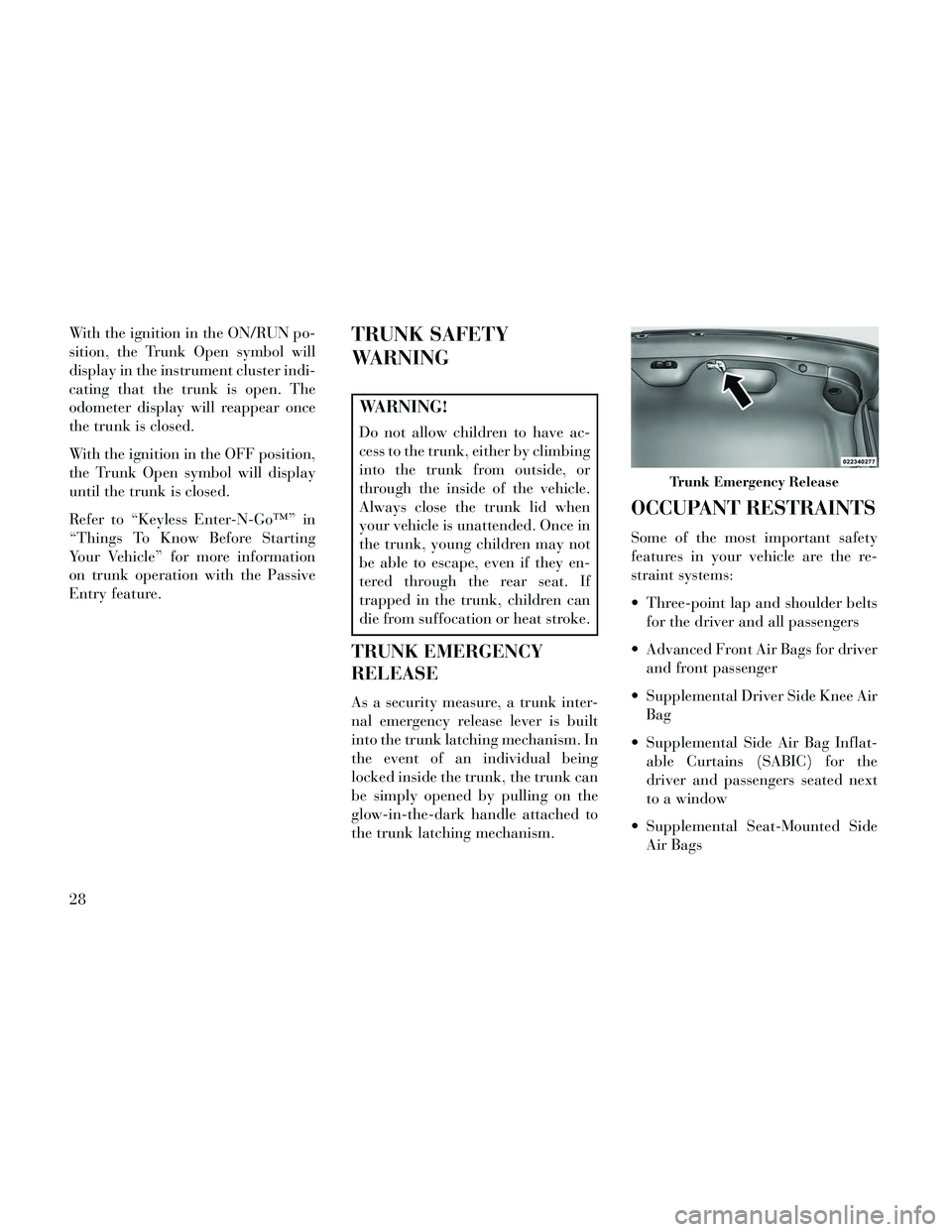
As a security measure, a trunk inter-
nal emergency release lever is built
into the trunk latching mechanism. In
the event of an individual being
locked inside the trunk, the trunk can
be simply opened by pulling on the
glow-in-the-dark handle attached to
the trunk latching mechanism.
OCCUPANT RESTRAINTS
Some of the most important safety
features in your vehicle are the re-
straint systems:
Three-point lap and shoulder beltsfor the driver and all passengers
Advanced Front Air Bags for driver and front passenger
Supplemental Driver Side Knee Air Bag
Supplemental Side Air Bag Inflat- able Curtains (SABIC) for the
driver and passengers seated next
to a window
Supplemental Seat-Mounted Side Air Bags
Trunk Emergency Release
28
Page 35 of 332
An energy-absorbing steering col-umn and steering wheel
Active Hood System
Knee bolsters/blockers for front seat occupants
Front seat belts incorporate preten- sioners that may enhance occupant
protection by managing occupant
energy during an impact event
All seat belt systems (except the driver’s and front passenger's) in-
clude Automatic Locking Retrac-
tors (ALRs), which lock the seat
belt webbing into position by ex-
tending the belt all the way out and
then adjusting the belt to the de-
sired length to restrain a child seat
or secure a large item in a seat
Please pay close attention to the infor-
mation in this section. It tells you how
to use your restraint system properly,
to keep you and your passengers as
safe as possible.
If you will be carrying children too
small for adult-sized seat belts, the
seat belts or the ISOFIX feature also can be used to hold infant and child
restraint systems. For more informa-
tion, refer to ISOFIX — Child Seat
Anchorage System.
NOTE: The Advanced Front Air
Bags have a multistage inflator de-
sign. This allows the air bag to
have different rates of inflation
based on several factors, including
the severity and type of collision.
Here are some simple steps you can
take to minimize the risk of harm
from a deploying air bag:
1.
Children 12 years old and un-
der should always ride buckled up
in a rear seat.
WARNING!
Never place a rear facing infant seat in front of an air bag. A de-
ploying Passenger Advanced
Front Air Bag can cause death or
serious injury to a child 12 years
or younger, including a child in a
rearward facing infant seat.
(Continued)
WARNING!(Continued)
Only use a rearward-facing childrestraint in a vehicle with a rear
seat.
Children that are not big enough to
wear the vehicle seat belt properly
(see section on Child Restraints)
should be secured in the rear seat in
child restraints or belt-positioning
booster seats. Older children who do
not use child restraints or belt-
positioning booster seats should ride
properly buckled up in the rear seat.
Never allow children to slide the
shoulder belt behind them or under
their arm.
You should read the instructions pro-
vided with your child restraint to
make sure that you are using it prop-
erly.
2. All occupants should always
wear their lap and shoulder belts
properly.
3. The driver and front passenger
seats should be moved back as far
as practical to allow the Advanced
Front Air Bags room to inflate.
29
Page 36 of 332
4.Do not lean against the door or
window. If your vehicle has side
air bags, and deployment occurs,
the side air bags will inflate force-
fully into the space between you
and the door.
5. If the air bag system in this ve-
hicle needs to be modified to ac-
commodate a disabled person,
contact the Customer Center.
Phone numbers are provided un-
der (If You Need Assistance).
WARNING!
Infants in rear facing child re-
straints should never ride in the
front seat of a vehicle with a Pas-
senger Advanced Front Air Bag. An
air bag deployment can cause se-
vere injury or death to infants in
that position.
Buckle up even though you are an
excellent driver, even on short trips.
Someone on the road may be a poor
driver and cause a collision that in-
cludes you. This can happen far away
from home or on your own street.
WARNING!
Relying on the air bags alone could lead to more severe injuries
in a collision. The air bags work
with your seat belt to restrain you
properly. In some collisions, the
air bags won't deploy at all. Al-
ways wear your seat belts even
though you have air bags.
Being too close to the steering wheel or instrument panel during
Advanced Front Air Bag deploy-
ment could cause serious injury,
including death. Air bags need
room to inflate. Sit back, com-
fortably extending your arms to
reach the steering wheel or in-
strument panel.
Supplemental Side Air Bag Inflat- able Curtain (SABIC) and Seat-
Mounted Side Air Bags (SAB)
also need room to inflate. Do not
lean against the door or window.
Sit upright in the center of the
seat.
(Continued)
WARNING!(Continued)
In a collision, you and your pas-sengers can suffer much greater
injuries if you are not properly
buckled up. You can strike the
interior of your vehicle or other
passengers, or you can be thrown
out of the vehicle. Always be sure
you and others in your vehicle are
buckled up properly.
Being too close to the Supplemen- tal Side Air Bag Inflatable Cur-
tain (SABIC) and/or Seat-
Mounted Side Air Bag (SAB)
during deployment could cause
you to be severely injured or
killed.
Research has shown that seat belts
save lives, and they can reduce the
seriousness of injuries in a collision.
Some of the worst injuries happen
when people are thrown from the ve-
hicle. Seat belts reduce the possibility
of ejection and the risk of injury
caused by striking the inside of the
vehicle. Everyone in a motor vehicle
should be belted at all times.
30
Page 37 of 332
LAP/SHOULDER BELTS
All seating positions in your vehicle
are equipped with combination lap/
shoulder belts.
The belt webbing retractor is de-
signed to lock during very sudden
stops or impacts. This feature allows
the shoulder part of the belt to move
freely with you under normal condi-
tions. However, in a collision, the belt
will lock and reduce your risk of strik-
ing the inside of the vehicle or being
thrown out.
WARNING!
It is dangerous to ride in a cargoarea, inside or outside of a ve-
hicle. In a collision, people riding
in these areas are more likely to
be seriously injured or killed.
Do not allow people to ride in any area of your vehicle that is not
equipped with seats and seat
belts.
(Continued)
WARNING!(Continued)
Be sure everyone in your vehicle isin a seat and using a seat belt
properly.
Wearing a seat belt incorrectly is dangerous. Seat belts are de-
signed to go around the large
bones of your body. These are the
strongest parts of your body and
can take the forces of a collision
the best.
Wearing your belt in the wrong
place could make your injuries in a
collision much worse. You might
suffer internal injuries, or you
could even slide out of part of the
belt. Follow these instructions to
wear your seat belt safely and to
keep your passengers safe, too.
Two people should never be belted into a single seat belt.
People belted together can crash
into one another in a collision,
hurting one another badly. Never
use a lap/shoulder belt or lap belt
for more than one person, no
matter what their size. LAP/SHOULDER BELT
OPERATING INSTRUCTIONS
1. Enter the vehicle and close the
door. Sit back and adjust the front
seat.
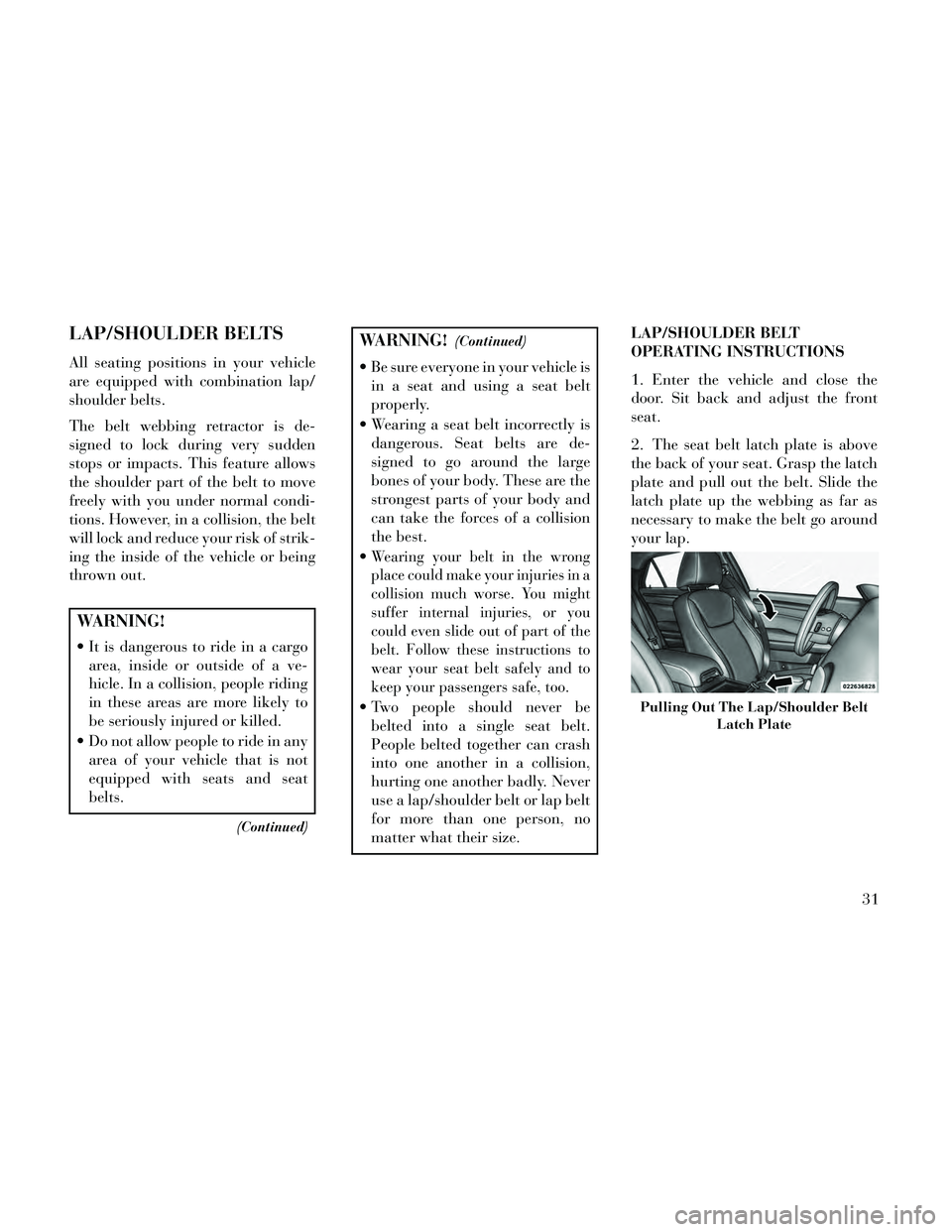
2. The seat belt latch plate is above
the back of your seat. Grasp the latch
plate and pull out the belt. Slide the
latch plate up the webbing as far as
necessary to make the belt go around
your lap.Pulling Out The Lap/Shoulder Belt
Latch Plate
31
Page 38 of 332

3. When the belt is long enough to fit,
insert the latch plate into the buckle
until you hear a “click.”
WARNING!
A belt that is buckled into thewrong buckle will not protect you
properly. The lap portion could
ride too high on your body, possi-
bly causing internal injuries. Al-
ways buckle your belt into the
buckle nearest you.
A belt that is too loose will not protect you properly. In a sudden
stop, you could move too far for-
ward, increasing the possibility of
injury. Wear your seat belt snug.
(Continued)
WARNING!(Continued)
A belt that is worn under yourarm is dangerous. Your body
could strike the inside surfaces of
the vehicle in a collision, increas-
ing head and neck injury. A belt
worn under the arm can cause
internal injuries. Ribs are not as
strong as shoulder bones. Wear
the belt over your shoulder so that
your strongest bones will take the
force in a collision.
A shoulder belt placed behind you will not protect you from in-
jury during a collision. You are
more likely to hit your head in a
collision if you do not wear your
shoulder belt. The lap and shoul-
der belt are meant to be used to-
gether.
4. Position the lap belt across your
thighs, below your abdomen. To re-
move slack in the lap belt portion, pull
up a bit on the shoulder belt. To
loosen the lap belt if it is too tight, tilt
the latch plate and pull on the lap
belt. A snug belt reduces the risk of
sliding under the belt in a collision.
WARNING!
A lap belt worn too high can in- crease the risk of injury in a colli-
sion. The belt forces won't be at
the strong hip and pelvic bones,
but across your abdomen. Always
wear the lap part of your seat belt
as low as possible and keep it
snug.
A twisted belt may not protect you properly. In a collision, it
could even cut into you. Be sure
the belt is straight. If you can't
straighten a belt in your vehicle,
take it to your authorized dealer
immediately and have it fixed.Inserting Latch Plate Into Buckle
Removing Slack From Belt
32
Page 39 of 332
5. Position the shoulder belt on your
chest so that it is comfortable and not
resting on your neck. The retractor
will withdraw any slack in the belt.
6. To release the belt, push the red
button on the buckle. The belt will
automatically retract to its stowed po-
sition. If necessary, slide the latch
plate down the webbing to allow the
belt to retract fully.
WARNING!
A frayed or torn belt could rip apart
in a collision and leave you with no
protection. Inspect the belt system
periodically, checking for cuts,
frays, or loose parts. Damaged
parts must be replaced immedi-
ately. Do not disassemble or modify
the system. Seat belt assemblies
must be replaced after a collision if
they have been damaged (i.e., bent
retractor, torn webbing, etc.).ADJUSTABLE UPPER
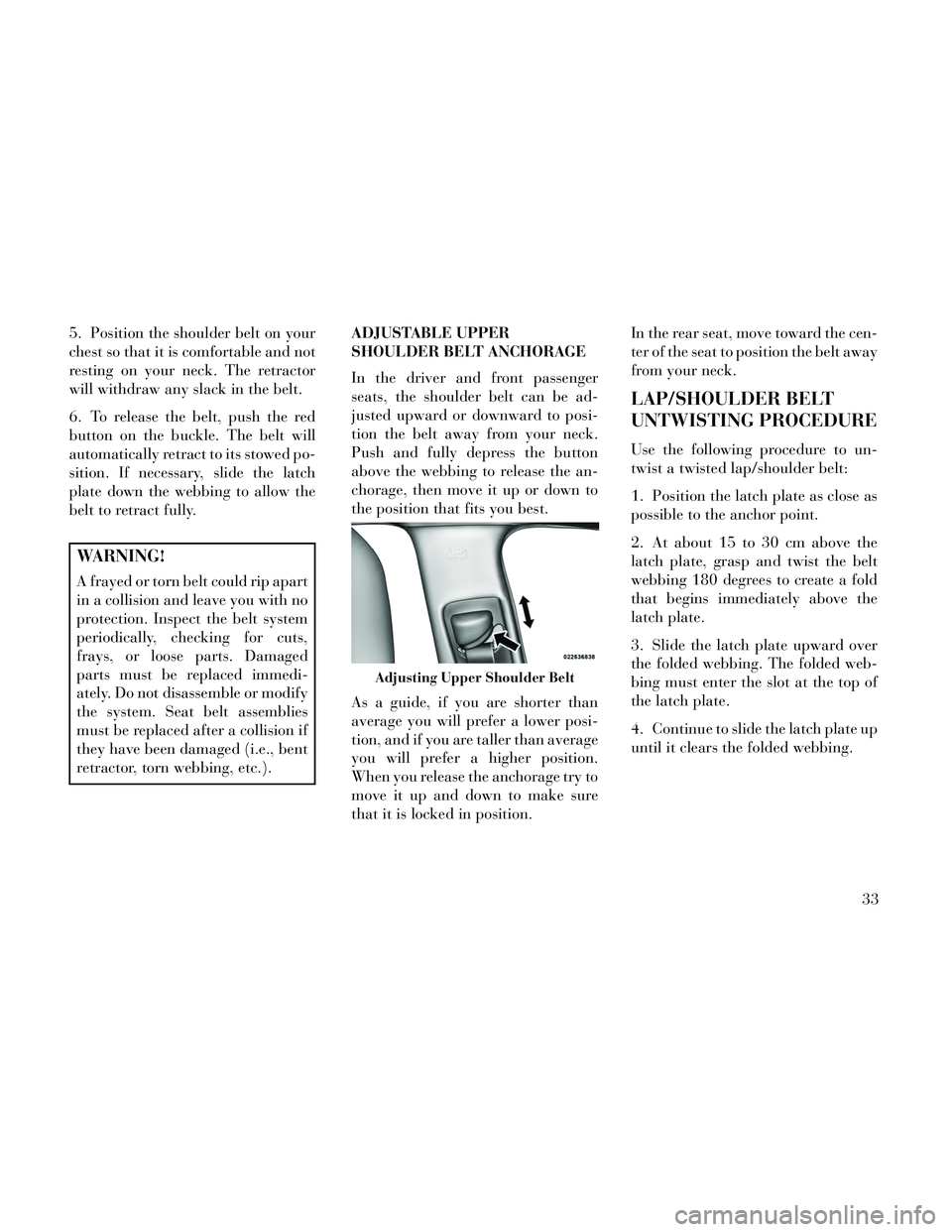
SHOULDER BELT ANCHORAGE
In the driver and front passenger
seats, the shoulder belt can be ad-
justed upward or downward to posi-
tion the belt away from your neck.
Push and fully depress the button
above the webbing to release the an-
chorage, then move it up or down to
the position that fits you best.
As a guide, if you are shorter than
average you will prefer a lower posi-
tion, and if you are taller than average
you will prefer a higher position.
When you release the anchorage try to
move it up and down to make sure
that it is locked in position. In the rear seat, move toward the cen-
ter of the seat to position the belt away
from your neck.
LAP/SHOULDER BELT
UNTWISTING PROCEDURE
Use the following procedure to un-
twist a twisted lap/shoulder belt:
1. Position the latch plate as close as
possible to the anchor point.
2. At about 15 to 30 cm above the
latch plate, grasp and twist the belt
webbing 180 degrees to create a fold
that begins immediately above the
latch plate.
3. Slide the latch plate upward over
the folded webbing. The folded web-
bing must enter the slot at the top of
the latch plate.
4. Continue to slide the latch plate up
until it clears the folded webbing.
Adjusting Upper Shoulder Belt
33
Page 40 of 332

SEAT BELTS IN
PASSENGER SEATING
POSITIONS
The seat belts in the rear passenger
seating positions are equipped with
Automatic Locking Retractors (ALR)
which are used to secure a child re-
straint system. For additional infor-
mation, refer to “Installing Child Re-
straints Using The Vehicle Seat Belt”
under the “Child Restraints” section.
The chart below defines the type of
feature for each seating position.
Driver Cen-terPas-
senger
First Row N/A N/A ALR
Second Row ALR ALR ALR
N/A — Not Applicable
ALR — Automatic Locking Retrac- tor If the passenger seating position is
equipped with an ALR and is being
used for normal usage:
Only pull the belt webbing out far
enough to comfortably wrap around
the occupant's mid-section so as to
not activate the ALR. If the ALR is
activated, you will hear a ratcheting
sound as the belt retracts. Allow the
webbing to retract completely in this
case and then carefully pull out only
the amount of webbing necessary to
comfortably wrap around the occu-
pant's mid-section. Slide the latch
plate into the buckle until you hear a
"click."
AUTOMATIC LOCKING
RETRACTOR MODE (ALR)
In this mode, the shoulder belt is au-
tomatically pre-locked. The belt will
still retract to remove any slack in the
shoulder belt. The Automatic Locking
Mode is available on all passenger-
seating positions with a combination
lap/shoulder belt. Use the Automatic
Locking Mode anytime a child safety
seat is installed in a seating position that has a belt with this feature. Chil-
dren 12 years old and under should
always be properly restrained in the
rear seat.
How To Engage The Automatic
Locking Mode
1. Buckle the combination lap and
shoulder belt.
2. Grasp the shoulder portion and
pull downward until the entire belt is
extracted.
3. Allow the belt to retract. As the
belt retracts, you will hear a clicking
sound. This indicates the safety belt is
now in the Automatic Locking Mode.
How To Disengage The Automatic
Locking Mode
Unbuckle the combination lap/
shoulder belt and allow it to retract
completely to disengage the Auto-
matic Locking Mode and activate the
vehicle sensitive (emergency) locking
mode.
34