brake Lancia Thesis 2007 Owner handbook (in English)
[x] Cancel search | Manufacturer: LANCIA, Model Year: 2007, Model line: Thesis, Model: Lancia Thesis 2007Pages: 386, PDF Size: 8.69 MB
Page 179 of 386

178
fig. 135
L0A0275b
fig. 134
L0A0274b
Fault indication
The system is controlled by an elec-
tronic control unit signalling possible
failures by turning on the s! warn-
ing light on the multifunction display
together with the message “EPB
FAULT - GO TO DEALER”.
For a higher safety, every time the
parking brake button is pressed dur-
ing a failure, a buzzer will sound to
draw the driver’s attention and the
xwarning light will turn on.
If the parking brake does not reach
the required working force (e.g.
when the battery is partially flat),
the instrument panel warning light
xstarts flashing.
In case of instrument panel warn-
ing light xfault, the s!warning
light on the multifunction display
turns on together with the message
“EPB INDICATOR FAULT - GO TO
DEALER” to informthe driver
about the dangerous situation. In case of failure indi-
cated by the related
warning light and mes-
sage turning on, drive carefully to
a Lancia Dealership because the
parking brake might not work.
Emergency disengagement
The electric parking brake is fitted
with an independent battery which
can be used to disengage the brake,
for instance when the car main bat-
tery is completely flat or it has bro-
ken after an accident.The additional battery, always
kept charged by a dedicated elec-
tronic control unit, can engage and
disengage the parking brake when it
is necessary to push manually the
car.
To engage and disengage the elec-
tric parking brake when the car
main battery is completely flat, turn
the key to MARand press the main
button on the central console.
Page 180 of 386

179
The car is fitted also with an emer-
gency button A(fig. 134), placed in
the boot right compartment, which
can be used to unblock the car if it has
been stopped on the road for a break-
down or an accident and the key can-
not be turned to MAR(accident with
fire risk). To reach the button remove
the compartment cover turning the
catch A(fig. 135) to 1with the igni-
tion key.
To disengage the parking brake
through the emergency button pro-
ceed as follows:
– press and release the main button
on the central console
– press and release the emergency
button in the boot
– press again and release the main
button on the central console.
The time elapsed between these
operations should be lower than 30
seconds.MANUAL GEARBOX
To engage the gears, press down
the clutch and put the gear lever into
one of the positions shown in the
diagram (fig. 136); the diagram is
also on the gear lever knob.
To engage reverse (R), wait for the
car to come to a standstill and lift
the ring Aunder the knob (with the
fingers of the hand operating the
lever).
Release the ring after engaging
reverse gear. You do not need to lift
the ring to disengage reverse.To change gear properly
you must push the clutch
pedal fully down. It is
therefore essential that there is
nothing under the pedals: make
sure mats are lying flat and do
not get in the way of the pedals.
Reverse can only be
engaged when the car is at
a standstill. Wait for two
seconds or longer with the clutch
fully pressed before engaging
reverse when the engine is run-
ning to prevent scraping and
damaging the gears.
Do not drive with your
hand resting on the gear
stick as the force exerted,
even if only slight, could lead to
premature wearing of the gear-
box internal components.
fig. 136
L0A0357b
Page 181 of 386
180
ELECTRONIC
AUTOMATIC
GEARBOX
(COMFORTRONIC)
The electronic automatic gearbox,
besides the usual provided opera-
tions, enables a manual operation
sequential gear selection by shifting
the related lever into the special sec-
tor.
IMPORTANTIn order to use the
automatic gearbox in the right way
it is necessary to read this paragraph
fully, to learn from the very begin-
ning how to perform correct opera-
tions, also on the basis of the Shift-
lock and Key-lock functions the
automatic gearbox is fitted with.STARTING THE ENGINE
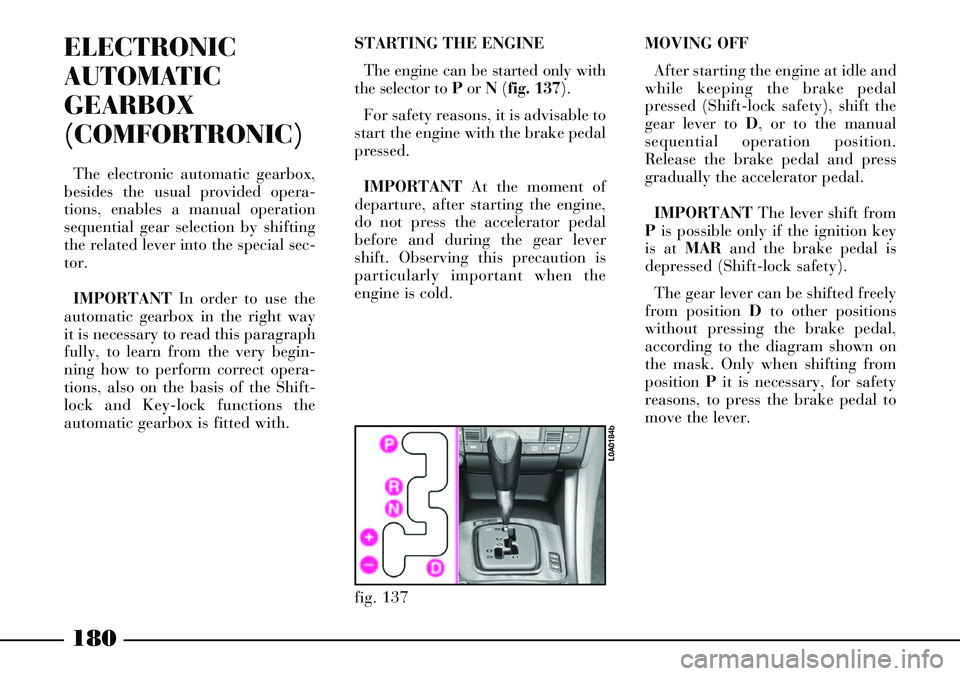
The engine can be started only with
the selector to Por N (fig. 137).
For safety reasons, it is advisable to
start the engine with the brake pedal
pressed.
IMPORTANTAt the moment of
departure, after starting the engine,
do not press the accelerator pedal
before and during the gear lever
shift. Observing this precaution is
particularly important when the
engine is cold.MOVING OFF
After starting the engine at idle and
while keeping the brake pedal
pressed (Shift-lock safety), shift the
gear lever to D, or to the manual
sequential operation position.
Release the brake pedal and press
gradually the accelerator pedal.
IMPORTANTThe lever shift from
Pis possible only if the ignition key
is at MARand the brake pedal is
depressed (Shift-lock safety).
The gear lever can be shifted freely
from position Dto other positions
without pressing the brake pedal,
according to the diagram shown on
the mask. Only when shifting from
position Pit is necessary, for safety
reasons, to press the brake pedal to
move the lever.
fig. 137
L0A0184b
Page 182 of 386

181
Do not tax the engine
until it has not reached
operating temperature.
STOPPING THE CAR
To stop the car press the brake
pedal, regardless of the gear lever
position.
If the brake pedal is not
pressed, when the gear
lever is to D or R and the
engine is running idle, even on a
flat ground, the car starts moving.The ignition key can be extracted
from the ignition switch only when
the gear lever is at P(Key-lock safe-
ty) and the ignition key is at STOP.
Letter Pon the instrument panel
display (fig. 138) will come on for
30 seconds, then it will go off.IMPORTANTIn case of emer-
gency (failures, flat battery, etc.), it
is possible to remove the ignition key
even if the gear lever is not at P. To
do this, turn the key to STOP, press
button A(fig. 139) and at the same
time remove the key.
fig. 138
L0A0238b
fig. 139
L0A0178b
Page 183 of 386

182
SELECTING THE AUTOMATIC/
MANUAL SEQUENTIAL
OPERATION
The main characteristic of this
gearbox is the possibility to be used
in automatic mode or in manual
sequential mode.
The operating mode can be select-
ed by setting the gear lever to the
right sector at D(automatic mode)
or to the left sector at (+/-) (manual
sequential mode).
On display A(fig. 140) of the
instrument panel it is possible to see
the engaged gear (1to 5in manual
sequential mode) or the symbol D
(automatic gearbox mode).AUTOMATIC OPERATION
To activate automatic operation,
move the lever to the right sector
(fig. 137) to one of the following
positions:
P- parking (the engine can be
started)
R- reverse
N- neutral (engine can be started)
D- automatic forward gear.
IMPORTANTThe lever can be
shifted from position Pis possible
only with the ignition key at MAR
and the brake pedal pressed (Shift-
lock safety).
The gear lever can be shifted freely
from position Dto other positions
without pressing the brake pedal,
according to the diagram shown on
the mask. Only when shifting from
position Pit is necessary, for safety
reasons, to press the brake pedal to
move the lever.
fig. 140
L0A0239b
P - Parking
When parking the car shift the gear
lever to this position. A gearbox
device will block the driving wheels.
To avoid accidental engaging, shift
from position P to any other position
is possible only with the brake pedal
pressed.
To bring the lever back to position
Pit is not necessary to press the
brake pedal, but as a rule it is sug-
gested to keep the brake pedal
pressed even in this case.
IMPORTANTShift the lever to P
only when the car is stationary.
Page 184 of 386

183
R - Reverse
Shift the lever to Rwith the car
stationary, the engine running idle
and the brake pedal pressed.
When the lever is at Rbackup
lights turn on and a buzzer will
sound for about 4 seconds to warn
other people that reversing is in
progress.
IMPORTANTEven with the lever
in position R, the reverse gear can-
not be engaged if the car speed is
higher than the established value.
When the speed is reduced, the
reverse gear can be engaged and it
remains engaged even if the car
speed overcomes that limit.N - Neutral
This is the position to be used when
the car must be pushed or towed.
D - Forward gear (automatic)
This is the position to be used when
all automatic gearbox functions are
required.
The electronic control unit controls
that the five gears are engaged auto-
matically according to car speed,
engine rpm, accelerator pedal posi-
tion and pressing speed, together
with the main driving conditions
such as hills, slopes, curves and
braking.
Indeed, the electronic automatic
gearbox is able to choose, according
to the type of driving adopted by the
driver, different programmes subdi-
vided into comfortable driving,
economy driving and sporty driving,
with shift points ranging between
low and high. Before leaving the car,
check that the electric
parking brake (EPB) is
on. Shift the lever to position P
even when the car is left with the
engine running.
In case of emergency (failures, flat
battery, etc.), it is possible to shift
the lever from position Pto N, D or
Rby pressing lever A(fig. 141) set
under the gear lever mask. To reach
the lever, remove the press-fit odd-
ment compartment shelf Bin front
of the gearshift lever.
fig. 141
L0A0276b
Page 185 of 386
184
If the accelerator pedal is pressed
rapidly, the gearbox selects the sporty
driving programme to meet the re-
quest for a higher car performance.
To disengage this function, release the
accelerator gradually.
If the accelerator pedal is pressed
more slowly, the economy programme
is automatically selected.
The electronic control unit is able
to recognize particular situations
like a curve, detected as a different
speed of front wheel instant rotation
through the ABS active sensors, thus
preventing shifting to the higher
gear until the engine revolution limit
is reached. Only with this condition
or at the end of the curve will it be
possible to shift gear. This strategy is
useful to improve the car balance
and to guarantee a prompt accelera-
tion when coming out of the curve,
since the car has already the right
gear engaged.Likely, during sudden braking, the
lower gear is engaged to exploit the
engine braking action at best. In
case of a curve, the new gear will be
engaged during slowing down before
the curve, therefore when coming
out of the curve it will not be neces-
sary to shift gear to accelerate.
Sporty driving on mixed roads is
recognized by the control unit
because the accelerator pedal is
released rapidly; if this condition is
detected, the gear selected is main-
tained even if the accelerator has
been released, without shifting to
higher gears, in order to increase the
engine efficiency for the following
acceleration. The gear electronic control unit is
able to recognize hills as a result of
the torque signals coming from the
engine on the basis of the car speed,
therefore it is able to eliminate use-
less gear shifts when the accelerator
is released (e.g. before cornering)
and to use only those gears required
to improve the driving comfort.
Likely, the control unit is able to
recognize slopes and to prevent
shifting to higher gears when the
accelerator is released, in order to
use the “exhaust brake” at best to
the advantage of the braking system
and the car control.
IMPORTANTThe “exhaust brake”
function and shifting to a lower gear
during braking is not activated when
the ABS is operating.
A longer gear (5
th) can be used
when the car is driving for long dis-
tances with constant high speed, but
limited engine rpm, thus reducing
driving noise and fuel consumption.
That is why, when a higher car per-
Page 186 of 386

185
Winter programme
When starting to drive with a
reduced road grip (snow-covered,
icy road, etc.), the shift control unit
automatically engage the “ICE” pro-
gramme.
This programme allows starting
with the 2
ndgear engaged, in order to
improve the gear shift efficiency
according to grip conditions.
“ICE” programme activation is
possible only when the gear lever is
at D. If the lever is in the sequential
gear sector, the gear engaged at the
moment of moving off is always that
selected by the driver.
When the “ICE” programme has
been activated, Kickdown is not
operating.Kick down
When maximum acceleration is
required (e.g. during overtaking), if
the accelerator is rapidly and fully
depressed, lower gears are automat-
ically engaged, provided the engine
rpm enable this operation.
Later, when the accelerator pedal
is released, the gear engaged is
selected according to the type of dri-
ving and the position of the acceler-
ator.
Kick-down can be engaged only
when the gear lever is at D.
IMPORTANTIt is suggested to use
Kick-down only when required, e.g.
during overtaking, to limit the fuel
consumption.
When the engine is run-
ning idle and the lever is
at D, the car starts moving
even if on a flat ground: keep the
brake pedal pressed until moving
off. formance is requested in terms of
acceleration and maximum speed,
this gear is almost never selected.
The electronic automatic gearbox
is fitted with a device reducing
inside gearing dragging when the car
is stationary and the brake pedal
depressed. The advantages of such a
function are a considerable noise
reduction, with consequent vibra-
tion reduction and limited fuel con-
sumption.
Page 190 of 386

189
If these rules are not
respected, the automatic
gearbox might be severely
damaged.
The car can be towed only for
short distances and at a low
speed: if it is necessary to tow it
for a longer distance, raise the
driving wheels so that the gear-
box is not dragged during towing. TOWING THE CAR
IMPORTANTTo tow the car
observe local current laws and fol-
low the instructions contained in
chapter “In an emergency”.
If the car must be towed, observe
the following precautions:
– if possible, transfer the car on a
towtruck
– otherwise, tow the car by raising
the front driving wheels
– even if the latter solution is not
possible, the car can be towed for
less than 50 Km at a speed of 50
km/h.
Towing shall be performed with
gear lever to N.Before starting towing,
disengage the parking
brake as described in the
relevant paragraph and leave the
Keyless System CID (if any) in the
passenger’s compartment to pre-
vent automatic steering lock. Do
not tow the car with the engine
running.
ESP AND ASR
SYSTEMS
ESP SYSTEM (ELECTRONIC
STABILITY PROGRAM):
GENERAL
ESP is an electronic system con-
trolling the car stability which
affects the driving torque and brakes
the wheels in a different way in case
of grip loss, thus making the car
recover the right driving direction.
During driving the car is subject to
side and longitudinal forces which
can be controlled by the driver until
tire grip is acceptable. When the lat-
ter is lower than the minimum level,
the car starts skidding.
If the road bed is uneven (bumpy
road, presence of ice, mould, etc.)
tyre grip is considerably reduced. In
these conditions, when extreme
manoeuvres are made, the car might
start skidding.
Page 191 of 386
190
If the sensors detect the conditions
which might cause car skidding, the
ESP system affects the engine and
the brakes by generating a torque
which makes the car recover the
right driving direction.
The system operations,
in terms of safety, should
not make the driver run
useless risks. The driving behav-
iour must always be appropriate,
according to the conditions of the
road bed, visibility and traffic.
Anyway, the driver is held
responsible for a safe driving.
The ESP system helps the driver
control the car in case of tyre grip
loss, however the forces used by
the system to control the car sta-
bility still depend on the grip
ratio between tyres and road bed.ESP SYSTEM OPERATION
ESP is automatically started when
the car is started and it cannot be
disengaged. On the contrary, it is
possible to exclude the ASR system
by pressing the related button on the
central console.
The ESP main components are the
following:
– an electric-hydraulic control unit
processing signals coming from the
various sensors and choosing the
most appropriate strategy by operat-
ing solenoid valves and the engine
control unit;
– a sensor detecting the steering
wheel rotation angle;
– 4 sensors detecting the rotation
speed of each wheel;
– a sensor detecting the car rota-
tion around a vertical axis;
– a sensor detecting side accelera-
tion (centrifugal force).The ESP core is a sensor, of aero-
nautic origin, detecting the car rota-
tions around its vertical axis.
Centrifugal forces generated when
the car is cornering are detected by a
high-sensitive side acceleration sen-
sor.
The ESP stabilizing action is based
on the signals coming from the steer-
ing wheel rotation sensors, from the
side acceleration sensors and the
wheel speed sensors, thus recogniz-
ing the driving direction selected by
the driver when turning the steering
wheel.
The control unit processes each
information coming from the sensors
and is able to recognize every single
moment of the car position and to
compare it with the direction the
driver is willing to follow. In case of
discrepancy, the control unit
instantly selects and controls the
most appropriate actions to make
the car recover the required direc-
tion: it brakes with a different inten-
sity one or more wheels and, if nec-
essary, reduces the power supplied
by the engine. Corrections are con-