fuel LAND ROVER DISCOVERY 1999 Owners Manual
[x] Cancel search | Manufacturer: LAND ROVER, Model Year: 1999, Model line: DISCOVERY, Model: LAND ROVER DISCOVERY 1999Pages: 1529, PDF Size: 34.8 MB
Page 337 of 1529
ENGINE MANAGEMENT SYSTEM - V8
18-2-38 DESCRIPTION AND OPERATION
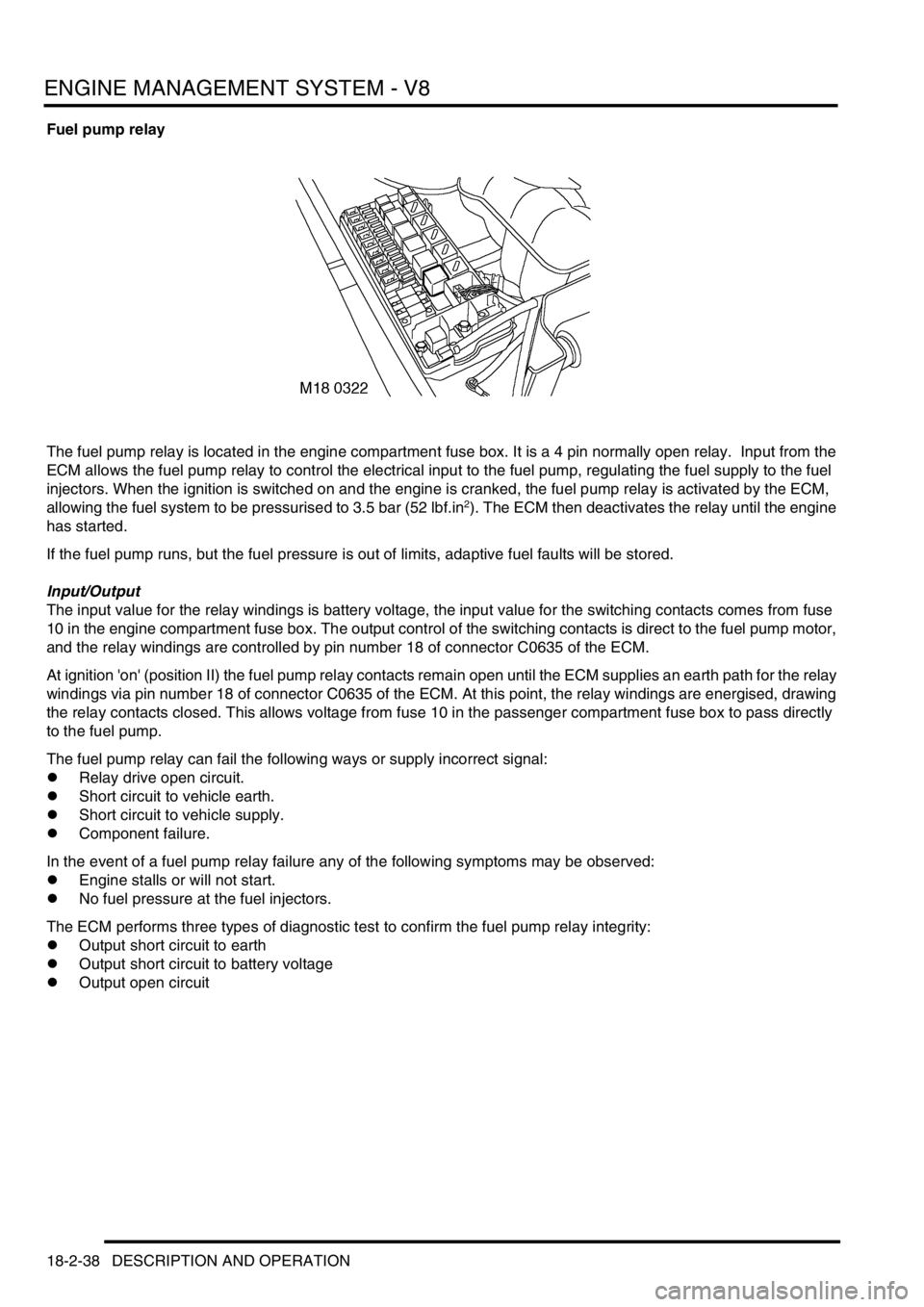
Fuel pump relay
The fuel pump relay is located in the engine compartment fuse box. It is a 4 pin normally open relay. Input from the
ECM allows the fuel pump relay to control the electrical input to the fuel pump, regulating the fuel supply to the fuel
injectors. When the ignition is switched on and the engine is cranked, the fuel pump relay is activated by the ECM,
allowing the fuel system to be pressurised to 3.5 bar (52 lbf.in
2). The ECM then deactivates the relay until the engine
has started.
If the fuel pump runs, but the fuel pressure is out of limits, adaptive fuel faults will be stored.
Input/Output
The input value for the relay windings is battery voltage, the input value for the switching contacts comes from fuse
10 in the engine compartment fuse box. The output control of the switching contacts is direct to the fuel pump motor,
and the relay windings are controlled by pin number 18 of connector C0635 of the ECM.
At ignition 'on' (position II) the fuel pump relay contacts remain open until the ECM supplies an earth path for the relay
windings via pin number 18 of connector C0635 of the ECM. At this point, the relay windings are energised, drawing
the relay contacts closed. This allows voltage from fuse 10 in the passenger compartment fuse box to pass directly
to the fuel pump.
The fuel pump relay can fail the following ways or supply incorrect signal:
lRelay drive open circuit.
lShort circuit to vehicle earth.
lShort circuit to vehicle supply.
lComponent failure.
In the event of a fuel pump relay failure any of the following symptoms may be observed:
lEngine stalls or will not start.
lNo fuel pressure at the fuel injectors.
The ECM performs three types of diagnostic test to confirm the fuel pump relay integrity:
lOutput short circuit to earth
lOutput short circuit to battery voltage
lOutput open circuit
Page 338 of 1529

ENGINE MANAGEMENT SYSTEM - V8
DESCRIPTION AND OPERATION 18-2-39
Should a malfunction of the component occur the following fault codes may be evident and can be retrieved by
TestBook.
Evaporative emissions
Refer to Emissions section for description of the evaporative emissions system components.
+ EMISSION CONTROL - V8, DESCRIPTION AND OPERATION, Evaporative Emission Control System.
Secondary air injection (NAS only)
Refer to Emissions section for description of the secondary air injection system components.
+ EMISSION CONTROL - V8, DESCRIPTION AND OPERATION, Secondary Air Injection System.
Fuel tank pressure sensor (NAS only)
Refer to Fuel Delivery section for description of the fuel system components.
+ FUEL DELIVERY SYSTEM - V8, DESCRIPTION AND OPERATION, Description.
Refer to Emissions section for description of the fuel tank pressure sensor.
+ EMISSION CONTROL - V8, DESCRIPTION AND OPERATION, Evaporative Emission Control System.
P Code J2012 Description Land Rover Description
P1230 Fuel pump relay malfunction Fuel pump relay open circuit - not the fuel pump
P1231 Fuel pump relay circuit low Fuel pump relay short circuit to battery supply - not the
fuel pump
P1232 Fuel pump relay circuit high Fuel pump relay short circuit to earth - not the fuel pump
Page 341 of 1529

ENGINE MANAGEMENT SYSTEM - V8
18-2-42 DESCRIPTION AND OPERATION
Knock Sensor (KS)
The ECM uses two knock sensors located between the centre two cylinders of each bank to detect pre-ignition. The
knock sensors consist of piezo ceramic crystals that oscillate to create a voltage signal. During pre-ignition the
frequency of crystal oscillation increases, which alters the signal output to the ECM. The ECM compares the signal
to known signal profiles in its memory. If pre-ignition is detected the ECM retards ignition timing for a number of cycles.
If no more pre-ignition is detected, the timing is gradually advanced to the original setting.
The ignition is calibrated to run on 95 RON premium fuel, but the system will run satisfactorily on 91 RON regular fuel.
If the vehicle is refuelled with a lower grade fuel, some audible detonation will initially be heard. This is non-damaging
and ceases when the system adaption is completed.
Input/Output
Because of the nature of its operation, the knock sensors do not require any electrical input source. The KS output
for LH bank (cylinders 1, 3, 5, 7) is measured via pin 49 of connector C0636 of the ECM. The KS output for RH bank
(cylinders 2, 4, 6, 8) is measured via pin 36 of connector C0636 of the ECM. Both knock sensors have a screened
earth to protect the integrity of the sensor signals. The KS earth for LH bank (cylinders 1, 3, 5, 7) is via pin 48 of
connector C0636 of the ECM. The KS earth for RH bank (cylinders 2, 4, 6, 8) is via pin 35 of connector C0636 of the
ECM.
The connector and sensor terminals are gold plated for corrosion and temperature resistance, care must be exercised
while probing the connector and sensor terminals.
The KS can fail the following ways or supply incorrect signal:
lSensor open circuit.
lShort circuit to vehicle battery supply.
lShort circuit to vehicle earth.
lFaulty component.
lIncorrectly tightened sensor.
In the event of a KS signal failure any of the following symptoms may be observed:
lKS disabled, the ECM refers to a 'safe ignition map'.
lRough running.
lEngine performance concern.
Page 343 of 1529

ENGINE MANAGEMENT SYSTEM - V8
18-2-44 DESCRIPTION AND OPERATION
High tension (ht) leads
The ht leads are located on top of the engine, below the plenum chamber. Their function is to transfer the ht voltage
generated by the ignition coils to the spark plugs in the engine.
Input/Output
The input to the ht lead is ht voltage from the ignition coil pack. The ht lead then supplies this voltage to the spark
plug. Output ht voltage is used by the spark plugs to ignite the air/fuel mixture in the combustion chamber.
The ht leads can fail in the following ways:
lConnector/ Wiring fault.
lFaulty component causing spark tracking to chassis earth.
lDamage to ht leads during component removal.
In the event of a ht lead failure the following symptom may be observed:
lMisfire on specific cylinder.
All ignition system related faults are diagnosed by the misfire detection system and its fault codes.
Hill Decent Control (HDC)
Refer to Brakes for description of the hill descent control.
+ BRAKES, DESCRIPTION AND OPERATION, Description.
High/Low ratio switch
Refer to Transfer Box for description of the high/ low ratio switch transfer box components.
+ TRANSFER BOX - LT230SE, DESCRIPTION AND OPERATION, Description.
Page 348 of 1529

ENGINE MANAGEMENT SYSTEM - V8
DESCRIPTION AND OPERATION 18-2-49
Operation - engine management
Fuel quantity
The ECM controls engine fuel quantity by providing sequential injection to the cylinders. Sequential injection allows
each injector to deliver fuel to the cylinders in the required firing order.
To achieve optimum fuel quantity under all driving conditions, the ECM provides an adaptive fuel strategy.
Conditions
Adaptive fuel strategy must be maintained under all throttle positions except:
lCold starting.
lHot starting.
lWide open throttle.
lAcceleration.
All of the throttle positions mentioned above are deemed to be 'open loop'. Open loop fuelling does not rely on
information from the HO
2 sensors, but the air/ fuel ratio is set directly by the ECM. During cold start conditions the
ECM uses ECT information to allow more fuel to be injected into the cylinders to facilitate cold starting. This strategy
is maintained until the HO
2 sensors are at working temperature and can pass exhaust gas information to the ECM.
Because of the specific nature of the other functions e.g. hot starting, idle, wide open throttle, and acceleration they
also require an 'open loop' strategy. For NAS vehicles with secondary air injection for cold start conditions, refer to
the Emissions section.
+ EMISSION CONTROL - V8, DESCRIPTION AND OPERATION, Secondary Air Injection System.
Adaptive fuel strategy also allows for wear in the engine and components, as well as slight differences in component
signals, as no two components will give exactly the same readings.
Function
To be able to calculate the amount of fuel to be injected into each cylinder, the ECM needs to determine the amount
of air mass drawn into each cylinder. To perform this calculation, the ECM processes information from the following
sensors:
lMass air flow (MAF) sensor.
lCrank speed and position (CKP) sensor.
lEngine coolant temperature (ECT) sensor.
lThrottle position (TP) sensor.
During one engine revolution, 4 of the 8 cylinders draw in air. The ECM uses CKP sensor information to determine
that one engine revolution has taken place, and the MAF sensor information to determine how much air has been
drawn into engine. The amount of air drawn into each cylinder is therefore 1/4 of the total amount measured by the
ECM via the MAF sensor.
The ECM refers the measured air mass against a fuel quantity map in its memory and then supplies an earth path to
the relevant fuel injector for a period corresponding to the exact amount of fuel to be injected into the lower inlet
manifold. This fuel quantity is in direct relation to the air mass drawn into each cylinder to provide the optimum ratio.
During adaptive fuelling conditions, information from the heated oxygen sensors (HO
2S) is used by the ECM to correct
the fuel quantity to keep the air/ fuel ratio as close to the stoichiometric ideal as possible.
Closed loop fuelling
The ECM uses a closed loop fuelling system as part of its fuelling strategy. The operation of the three-way catalytic
converter relies on the ECM being able to optimise the air/ fuel mixture, switching between rich and lean either side
of lambda one. Closed loop fuelling is not standard for all markets, vehicles that are not fitted with HO
2S do not have
closed loop fuelling.
The ideal stoichiometric ratio is represented by λ =1. The ratio can be explained as 14.7 parts of air to every 1 part of
fuel.
Page 349 of 1529

ENGINE MANAGEMENT SYSTEM - V8
18-2-50 DESCRIPTION AND OPERATION
Conditions
To achieve closed loop fuelling, the ECM interacts with the following components:
lHO
2S.
lFuel injectors.
Closed loop fuelling is a rolling process controlled by the ECM. The ECM uses information gained from the CKP, ECT,
MAF/ IAT and the TP sensors, to operate under the following conditions:
lPart throttle.
lLight engine load.
lCruising.
lIdle.
Function
When the engine is operating in the above conditions, the ECM implements the closed loop fuelling strategy. The air/
fuel mixture is ignited by the high tension (ht) spark in the combustion chambers and the resulting gas is expelled into
the exhaust pipe. Upon entering the exhaust pipe the exhaust gas passes over the protruding tip of the HO
2S. The
HO
2S measures the oxygen content of the gas compared to that of ambient air and converts it into a voltage, which
is measured by the ECM.
The voltage signal read by the ECM is proportional to the oxygen content of the exhaust gas. This signal can then be
compared to stored values in the ECM's memory and an adaptive strategy can be implemented.
If the HO
2S informs the ECM of an excess of oxygen (lean mixture), the ECM extends the opening time of the fuel
injectors via the Injector Pulse Width (IPW) signal. Once this new air/ fuel ratio has been 'burnt' in the combustion
chambers the HO
2S can again inform the ECM of the exhaust gas oxygen content, this time there will be a lack of
oxygen or a rich mixture. The ECM reduces the opening time of the injectors via the IPW signal using the ECM's
adaptive fuel strategy. During closed loop fuelling the HO
2S will constantly switch from rich to lean and back again,
this indicates that the ECM and the HO
2S are operating correctly.
Open loop fuelling
Open loop fuelling does not rely on information from the HO
2S, but the air/ fuel ratio is set directly by the ECM, which
uses information gained from the ECT, MAF/ IAT, the TP sensors and also the vehicle speed sensor (VSS). The ECM
uses open loop fuelling under the following conditions:
lCold start.
lHot start.
lWide open throttle.
lAcceleration.
The ECM uses open loop fuelling to control fuel quantity in all non adaptive strategy conditions. The ECM implements
fuelling information carried in the form of specific mapped data contained within its memory.
Because there is no sensor information (e.g. HO
2S), provided back to the ECM, the process is called an 'open loop'.
The ECM will also go into open loop fuelling if a HO
2S fails.
Ignition timing
The ignition timing is an important part of the ECM adaptive strategy. Ignition is controlled by a direct ignition system
using two four-ended coils operating on the wasted spark principle.
When the ECM triggers an ignition coil to spark, current from the coil travels to one spark plug, then jumps the gap at
the spark plug electrodes, igniting the mixture in the cylinder in the process. Current continues to travel along the earth
path (via the cylinder head) to the spark plug negative electrode at the cylinder that is on the exhaust stroke. The
current jumps across the spark plug electrodes and back to the coil completing the circuit. Since it has simultaneously
sparked in a cylinder that is on the exhaust stroke, it has not provided an ignition source there and is consequently
termed 'wasted'.
Page 350 of 1529

ENGINE MANAGEMENT SYSTEM - V8
DESCRIPTION AND OPERATION 18-2-51
Conditions
The ECM calculates ignition timing using input from the following:
lCKP sensor.
lKnock sensors (KS).
lMAF sensor.
lTP sensor (idle only).
lECT sensor.
Function
At engine start up, the ECM sets ignition timing dependent on ECT information and starting rev/min from the CKP. As
the running characteristics of the engine change, the ignition timing changes. The ECM compares the CKP signal to
stored values in its memory, and if necessary advances or retards the spark via the ignition coils.
Ignition timing is used by the ECM for knock control.
Knock control
The ECM uses active knock control to prevent possible engine damage due to pre-ignition. This is achieved by
converting engine block noise into a suitable electrical signal that can be processed by the ECM. A major contributing
factor to engine 'knock' is fuel quality, the ECM can function satisfactorily on 91 RON fuel as well as the 95 RON fuel
that it is calibrated for.
Conditions
The ECM knock control system operates as follows:
lHot running engine.
l91 or 95 RON fuel.
Function
The ECM knock control uses two sensors located one between the centre two cylinders of each bank. The knock
sensors consist of piezo ceramic crystals that oscillate to create a voltage signal. During pre-ignition, the frequency
of crystal oscillation increases which alters the signal output to the ECM.
If the knock sensors detect pre-ignition in any of the cylinders, the ECM retards the ignition timing by 3° for that
particular cylinder. If this action stops the engine knock, the ignition timing is restored to its previous figure in
increments of 0.75°. If this action does not stop engine knock then the ECM retards the ignition timing a further 3° up
to a maximum of -15° and then restores it by 0.75° and so on until the engine knock is eliminated.
The ECM also counteracts engine knock at high intake air temperatures by retarding the ignition as above. The ECM
uses the IAT signal to determine air temperature.
Idle speed control
The ECM regulates the engine speed at idling. The ECM uses the idle air control valve (IACV) to compensate for the
idle speed drop that occurs when the engine is placed under greater load than usual. When the throttle is in the rest
position i.e. it has not been pressed, the majority of intake air that the engine consumes comes from the idle air control
valve.
IACV control idle speed
Conditions in which the ECM operates the IACV control idle speed is as follows:
lIf any automatic transmission gears other than P or N are selected.
lIf air conditioning is switched on.
lIf cooling fans are switched on.
lAny electrical loads activated by the driver.
Function
The idle air control valve utilises two coils that use opposing pulse width modulated (PWM) signals to control the
position of a rotary valve. If one of the circuits that supplies the PWM signal fails, the ECM closes down the remaining
signal preventing the idle air control valve from working at its maximum/ minimum setting. If this should occur, the idle
air control valve assumes a default idle position at which the engine idle speed is raised to 1200 rev/min with no load
placed on the engine.
Page 351 of 1529

ENGINE MANAGEMENT SYSTEM - V8
18-2-52 DESCRIPTION AND OPERATION
Evaporative emission control
Due to increasing legislation, all new vehicles must be able to limit evaporative emissions (fuel vapour) from the fuel
tank.
The ECM controls the emission control system using the following components:
lEVAP canister.
lPurge valve.
lCanister vent solenoid (CVS) valve – (NAS vehicles with vacuum type EVAP system leak detection capability
only)
lFuel tank pressure sensor – (NAS vehicles with vacuum type EVAP system leak detection capability only)
lFuel leak detection pump – (NAS vehicles with positive pressure type EVAP system leak detection capability
only)
lInterconnecting pipe work.
Refer to Emissions section for operating conditions of evaporative emission systems.
+ EMISSION CONTROL - V8, DESCRIPTION AND OPERATION, Evaporative Emission Control
Operation.
On-Board Diagnostics (OBD) - North American Specification vehicles only
The ECM monitors performance of the engine for misfires, catalyst efficiency, exhaust leaks and evaporative control
loss. If a fault occurs, the ECM stores the relevant fault code and warns the driver of component failure by illuminating
the Malfunction Indicator Light in the instrument pack.
On vehicles fitted with automatic gearbox, the ECM combines with the Electronic Automatic Transmission (EAT) ECU
to provide the OBD strategy.
Conditions
If the OBD function of the ECM flags a fault during its operation, it falls into one of the following categories:
lmin = minimum value of the signal exceeded.
lmax = maximum value of the signal exceeded.
lsignal = signal not present.
lplaus = an implausible condition has been diagnosed.
Function
All of the ECM's internal diagnostic fault paths are monitored by the OBD system. Specific faults have their own
numeric code relating to certain sensors or actuators etc. These specific faults fall into two types, error codes (E xxx)
or cycle codes (Z xxx). E codes represent instantaneous faults and Z codes relate to codes generated after completion
of a drive cycle.
If an emission relevant fault occurs on a drive cycle, the ECM stores a temporary fault code, if the fault does not occur
on subsequent drive cycles the fault code stays as a temporary fault code. If the fault recurs on subsequent drive
cycles the ECM stores the fault code as a permanent code, and depending on which component has failed the ECM
will illuminate the MIL.
Immobilisation system
The ECM and the body control unit (BCU) security system comprise the immobilisation system.
The ECM and the BCU combine to prevent the engine from running unless the appropriate security criteria are met.
The ECM and the BCU are a matched pair, if either one is replaced for any reason, the system will not operate unless
the replaced unit is correctly matched to its original specification. TestBook must be used to reconfigure the
immobilisation system.
Conditions
The ECM operates immobilisation in three states:
l'New'.
l'Secure'.
l'No Code'.
Page 356 of 1529

ENGINE MANAGEMENT SYSTEM - V8
DESCRIPTION AND OPERATION 18-2-57
Low fuel level signal
When the fuel level in the fuel tank becomes low enough to illuminate the low fuel level warning lamp in the instrument
cluster, the instrument cluster generates a low fuel level signal. If the low fuel level signal is present during the ECM
misfire detection function the ECM can use it to check for a 'false misfire'.
Conditions
The fuel sender generates the low fuel level signal when the fuel sender resistance is greater than 158 ± 8 ohms.
Function
The illumination of the low fuel level warning lamp in the instrument cluster triggers the low fuel level signal to be sent
to the ECM. This signal is processed via pin 8 of connector C0637 of the ECM.
Should a misfire occur while the fuel level is low, the following fault code may be evident and can be retrieved by
TestBook.
Coolant temperature gauge signal
The ECM controls the temperature gauge in the instrument cluster. The ECM sends a coolant temperature signal to
the temperature gauge in the instrument cluster in the form of a PWM square wave signal.
The frequency of the signal determines the level of the temperature gauge.
Conditions
The ECM operates the PWM signal under the following parameters:
l-40 °C (-40 °F) = a pulse width of 768 µs.
l140 °C (284 °F) = a pulse width of 4848 µs.
Function
The coolant temperature signal is an output from the ECM to the instrument cluster. The coolant temperature signal
is generated via pin 44 of connector C0636 of the ECM.
The coolant temperature signal can fail in the following ways:
lWiring short circuit to vehicle supply.
lWiring short circuit to vehicle earth.
lWiring open circuit.
In the event of a coolant temperature signal failure any of the following symptoms may be observed:
lCoolant temperature gauge will read cold at all times.
lCoolant temperature warning lamp remains on at all times.
Controller Area Network (CAN) system
The controller area network (CAN) system is a high speed serial interface between the ECM and the Electronic
Automatic Transmission (EAT) ECU. The CAN system uses a 'data bus' to transmit information messages between
the ECM and the EAT ECU. Because there are only two components in this CAN system, one will transmit information
messages and the other will receive information messages, and vice-versa.
P Code J2012 Description Land Rover Description
P1319 Misfire detected at low fuel level Misfire detected with low fuel level
Page 358 of 1529
ENGINE MANAGEMENT SYSTEM - V8
DESCRIPTION AND OPERATION 18-2-59
⇒ Drive cycle C:
1Switch ignition on for 30 seconds.
2Ensure engine coolant temperature is less than 60°C (140°F).
3Start the engine and allow to idle for 2 minutes.
4Perform 2 light accelerations (0 to 35 mph (0 to 60 km/h) with light pedal pressure).
5Perform 2 medium accelerations (0 to 45 mph (0 to 70 km/h) with moderate pedal pressure).
6Perform 2 hard accelerations (0 to 55 mph (0 to 90 km/h) with heavy pedal pressure).
7Cruise at 60 mph (100 km/h) for 8 minutes.
8Cruise at 50 mph (80 km/h) for 3 minutes.
9Allow engine to idle for 3 minutes.
10Connect TestBook and with the engine still running, check for fault codes.
NOTE: The following areas have an associated readiness test which must be flagged as complete, before a problem
resolution can be verified:
lcatalytic converter fault;
lEvaporative loss system fault;
lHO
2 sensor fault;
lHO
2 sensor heater fault.
When carrying out a drive cycle C to determine a fault in any of the above areas, select the readiness test icon to
verify that the test has been flagged as complete.
⇒ Drive cycle D:
1Switch ignition on for 30 seconds.
2Ensure engine coolant temperature is less than 35°C (95°F).
3Start the engine and allow to idle for 2 minutes.
4Perform 2 light accelerations (0 to 35 mph (0 to 60 km/h) with light pedal pressure).
5Perform 2 medium accelerations (0 to 45 mph (0 to 70 km/h) with moderate pedal pressure).
6Perform 2 hard accelerations (0 to 55 mph (0 to 90 km/h) with heavy pedal pressure).
7Cruise at 60 mph (100 km/h) for 5 minutes.
8Cruise at 50 mph (80 km/h) for 5 minutes.
9Cruise at 35 mph (60 km/h) for 5 minutes.
10Allow engine to idle for 2 minutes.
11Connect TestBook and check for fault codes.
⇒ Drive cycle E:
1Ensure fuel tank is at least a quarter full.
2Carry out Drive Cycle A.
3Switch off ignition.
4Leave vehicle undisturbed for 20 minutes.
5Switch on ignition.
6Connect TestBook and check for fault codes.