fuel LAND ROVER DISCOVERY 1999 Repair Manual
[x] Cancel search | Manufacturer: LAND ROVER, Model Year: 1999, Model line: DISCOVERY, Model: LAND ROVER DISCOVERY 1999Pages: 1529, PDF Size: 34.8 MB
Page 273 of 1529

EMISSION CONTROL - V8
17-2-40 DESCRIPTION AND OPERATION
To maintain driveability and effective emission control, EVAP canister purging must be closely controlled by the
engine management ECM, as a 1% concentration of fuel vapour from the EVAP canister in the air intake may shift
the air:fuel ratio by as much as 20%. The ECM must purge the fuel vapour from the EVAP canister at regular intervals
as its storage capacity is limited and an excessive build up of evaporated fuel pressure in the system could increase
the likelihood of vapour leaks. Canister purging is cycled with the fuelling adaptation as both cannot be active at the
same time. The ECM alters the PWM signal to the purge valve to control the rate of purging of the canister to maintain
the correct stoichiometric air:fuel mixture for the engine.
Fuel Leak Detection System Operation (vacuum type) – NAS only
The advanced evaporative loss control system used on NAS vehicles is similar to the standard system, but also
includes a CVS valve and fuel tank pressure sensor and is capable of detecting holes in the fuel evaporative system
down to 1 mm (0.04 in.). The test is carried out in three parts. First the purge valve and the canister vent solenoid
valve closes off the storage system and the vent pressure increases due to the fuel vapour pressure level in the tank.
If the pressure level is greater than the acceptable limit, the test will abort because a false leak test response will
result. In part two of the test, the purge valve is opened and the fuel tank pressure will decrease due to the depression
from the intake manifold, evident at the purge port of the EVAP canister during purge operation. In part three of the
test, the leak measurement test is performed. The pressure response of the tests determines the level of leak, and if
this is greater than the acceptable limit on two consecutive tests, the ECM stores the fault in diagnostic memory and
the MIL light on the instrument pack is illuminated. The test is only carried out at engine idle with the vehicle stationary,
and a delay of 15 minutes after engine start is imposed before diagnosis is allowed to commence.
Page 274 of 1529

EMISSION CONTROL - V8
DESCRIPTION AND OPERATION 17-2-41
EVAP System, Leak Detection Diagnostic (vacuum type)
The EVAP system leak detection is performed as follows:
1The ECM checks that the signal from the fuel tank pressure sensor is within the expected range. If the signal is
not within range, the leakage test will be cancelled.
2Next the purge valve is held closed and the canister vent solenoid (CVS) valve is opened to atmosphere. If the
ECM detects a rise in pressure with the valves in this condition, it indicates there is a blockage in the fuel
evaporation line between the CVS valve and the EVAP canister, or that the CVS valve is stuck in the closed
position and thus preventing normalisation of pressure in the fuel evaporation system. In this instance, the
leakage test will be cancelled.
3The CVS valve and the purge valve are both held in the closed position while the ECM checks the fuel tank
pressure sensor. If the fuel tank pressure sensor detects a decline in pressure, it indicates that the purge valve
is not closing properly and vapour is leaking past the valve seat face under the influence of the intake manifold
depression. In this instance, the leakage test will be cancelled.
4If the preliminary checks are satisfactory, a compensation measurement is determined next. Variations in fuel
level occur within the fuel tank, which will influence the pressure signal detected by the fuel tank pressure
sensor. The pressure detected will also be influenced by the rate of change in the fuel tank pressure, caused by
the rate of fuel evaporation which itself is dependent on the ambient temperature conditions. Because of these
variations, it is necessary for the ECM to evaluate the conditions prevailing at a particular instance when testing,
to ensure that the corresponding compensation factor is included in its calculations.
The CVS valve and purge valves are both closed while the ECM checks the signal from the fuel tank pressure
sensor. The rise in fuel pressure detected over a defined period is used to determine the rate of fuel evaporation
and the consequent compensation factor necessary.
5With the CVS valve still closed, the purge valve is opened. The inlet manifold depression present while the purge
valve is open, decreases EVAP system pressure and sets up a small vacuum in the fuel tank. The fuel tank
pressure sensor is monitored by the ECM and if the vacuum gradient does not increase as expected, a large
system leak is assumed by the ECM (e.g. missing or leaking fuel filler cap) and the diagnostic test is terminated.
If the EVAP canister is heavily loaded with hydrocarbons, purging may cause the air:fuel mixture to become
excessively rich, resulting in the upstream oxygen sensors requesting a leaner mix from the ECM to bring the
mixture back to the stoichiometric ideal. This may cause instability in the engine idle speed and consequently
the diagnostic test will have to be abandoned. The ECM checks the status of the upstream oxygen sensors
during the remainder of the diagnostic, to ensure the air:fuel mixture does not adversely affect the engine idle
speed.
6When the fuel tank pressure sensor detects that the required vacuum has been reached (-800 Pa), the purge
valve is closed and the EVAP system is sealed. The ECM then checks the change in the fuel tank pressure
sensor signal (diminishing vacuum) over a period of time, and if it is greater than expected (after taking into
consideration the compensation factor due to fuel evaporation within the tank, determined earlier in the
diagnostic), a leak in the EVAP system is assumed. If the condition remains, the MIL warning light will be turned
on after two drive cycles.
The decrease in vacuum pressure over the defined period must be large enough to correspond to a hole
equivalent to 1 mm (0.04 in.) diameter or greater, to be considered significant enough to warrant the activation
of an emissions system failure warning.
The diagnostic test is repeated at regular intervals during the drive cycle, when the engine is at idle condition. The
diagnostic test will not be able to be performed under the following conditions:
lDuring EVAP canister purging
lDuring fuelling adaption
lIf excess slosh in the fuel tank is detected (excess fuel vapour will be generated, invalidating the result)
Following the test, the system returns to normal purge operation after the canister vent solenoid opens. Possible
reasons for an EVAP system leak test failure are listed below:
lFuel filler not tightened or cap missing.
lSensor or actuator open circuit.
lShort circuit to vehicle supply or ground.
lEither purge or CVS valve stuck open.
lEither purge or CVS valve stuck shut or blocked pipe.
lPiping broken or not connected.
lLoose or leaking connection.
Page 275 of 1529

EMISSION CONTROL - V8
17-2-42 DESCRIPTION AND OPERATION
If the piping is broken forward of the purge valve or is not connected, the engine may run rough and fuelling adaptions
will drift. The fault will not be detected by the leak detection diagnostic, but it will be determined by the engine
management ECM through the fuelling adaption diagnostics.
The evaluation of leakage is dependent on the differential pressure between the fuel tank and ambient atmospheric
pressure, the diagnostic is disabled above altitudes of 9500 ft. (2800 m) to avoid false detection of fuel leaks due to
the change in atmospheric pressure at altitude.
Fuel Leak Detection System Operation (positive pressure leak detection type) – NAS only
The EVAP system with positive pressure leak detection capability used on NAS vehicles is similar to the standard
system, but also includes a fuel evaporation leak detection pump with integral solenoid valve. It is capable of detecting
holes in the EVAP system down to 0.5 mm (0.02 in.). The test is carried out at the end of a drive cycle, when the
vehicle is stationary and the ignition switch has been turned off. The ECM maintains an earth supply to the Main relay
to hold it on, so that power can be supplied to the leak detection pump.
First a reference measurement is established by passing the pressurised air through a by-pass circuit containing a
fixed sized restriction. The restriction assimilates a 0.5 mm (0.02 in) hole and the current drawn by the pump motor
during this procedure is recorded for comparison against the value to be obtained in the system test. The purge valve
is held closed, and the reversing valve in the leak detection pump module is not energised while the leak detection
pump is switched on. The pressurised air from the leak detection pump is forced through an orifice while the current
drawn by the pump motor is monitored.
Next the EVAP system diagnostic is performed; the solenoid valve is energised so that it closes off the EVAP system's
vent line to atmosphere, and opens a path for the pressurised air from the leak detection pump to be applied to the
closed EVAP system.
The current drawn by the leak detection pump is monitored and checked against that obtained during the reference
measurement. If the current is less than the reference value, this infers there is a hole in the EVAP system greater
than 0.5 mm (0.02 in) which is allowing the positive air pressure to leak out. If the current drawn by the pump motor
is greater than the value obtained during the reference check, the system is sealed and free from leaks. If an EVAP
system leak is detected, the ECM stores the fault in diagnostic memory and the MIL light on the instrument pack is
illuminated.
On NAS vehicles, the ECM works on a 2 trip cycle before illuminating the MIL. On EU-3 vehicles, the ECM works on
a 3 trip cycle before illuminating the MIL.
Following the test, the solenoid valve is opened to normalise the EVAP system pressure and the system returns to
normal purge operation at the start of the next drive cycle. Possible reasons for an EVAP system leak test failure are
listed below:
lFuel filler not tightened or cap missing.
lSensor or actuator open circuit.
lShort circuit to vehicle supply or ground.
lEither purge or solenoid valve stuck open.
lEither purge or solenoid valve stuck shut.
lBlocked pipe or air filter.
lPiping broken or not connected.
lLoose or leaking connection.
If the piping is broken forward of the purge valve or is not connected, the engine may run rough and fuelling adaptions
will drift. The fault will not be detected by the leak detection test, but will be determined by the engine management
ECM through the fuelling adaption diagnostics. This test can be run from TestBook/T4.
Page 285 of 1529

EMISSION CONTROL - V8
17-2-52 REPAIRS
Canister - EVAP - Models with Fuel Leak
Detection Pump - up to 03MY
$% 17.15.13
Remove
1.Raise vehicle on lift.
2.Remove 3 Torx screws securing fuel leak
detection pump to mounting bracket.
3.Remove 3 bolts securing EVAP canister
mounting bracket to chassis longitudinal.4.Remove 2 bolts securing EVAP canister to
mounting bracket and collect clamp.
5.Remove mounting bracket.
6.Position cloth to absorb any fuel spillage.
7.Release purge and tank vent pipes from EVAP
canister.
8.Remove clip securing fuel leak detection pump
pipe to EVAP canister.
9.Release pipe from EVAP canister and remove
canister.
CAUTION: Plug the connections.
Refit
1.Remove plugs and ensure all connections are
clean.
2.Connect fuel leak detection pump pipe to EVAP
canister and secure with clip.
3.Connect purge and tank vent pipes to EVAP
canister.
4.Position mounting bracket to EVAP canister
and secure with bolts.
5.Position mounting bracket to chassis
longitudinal and tighten bolts.
6.Fit Torx screws securing fuel leak detection
pump to mounting bracket.
7.Lower vehicle.
M17 02192
M17 0220
M17 0221
4
4
4
9
7
7
5
8
Page 286 of 1529

EMISSION CONTROL - V8
REPAIRS 17-2-53
Canister - EVAP - Models with Fuel Leak
Detection Pump - from 03MY
$% 17.15.13
Remove
1.Raise the vehicle on lift.
2.Disconnect multiplug from the fuel leak
detection pump.
3.Disconnect the fuel leak detection filter pipe
from the fuel leak detection pump.
4.Release clips and disconnect 2 vent pipes from
the EVAP canister.
CAUTION: Always fit plugs to open
connections to prevent contamination.5.Remove and discard 4 bolts securing EVAP
canister mounting bracket to the chassis and
remove the EVAP canister assembly.
NOTE: Do not carry out further dismantling if
component is removed for access only.
6.Remove bolt securing EVAP canister retaining
clamp to the mounting bracket and collect the
clamp.
7.Remove nut and bolt securing EVAP canister to
the mounting bracket.
Page 287 of 1529

EMISSION CONTROL - V8
17-2-54 REPAIRS
8.Remove and discard clip securing fuel leak
detection pump fuel pipe to the EVAP canister
and disconnect the fuel pipe.
9.Remove the EVAP canister.
Refit
1.Position EVAP canister to the mounting
bracket.
2.Connect fuel leak detection pump fuel pipe to
the EVAP canister and secure with a new clip.
3.Fit nut and bolt securing EVAP canister to the
mounting bracket and tighten to 10 Nm (7 lbf.ft).
4.Position EVAP canister retaining clamp to the
mounting bracket, fit bolt and tighten to 10 Nm
(7 lbf.ft).
5.Position EVAP canister mounting bracket to the
chassis, fit new bolts and tighten to 25 Nm (18
lbf.ft).
6.Connect vent pipes to the EVAP canister.
7.Connect multiplug to the fuel leak detection
pump.
8.Connect the fuel leak detection filter pipe to the
fuel leak detection pump.
9.Lower the vehicle lift.
Valve - purge control
$% 17.15.39
Remove
1.Disconnect multiplug from purge control valve.
2.Release clips securing hoses to purge control
valve.
3.Disconnect hoses from purge control valve and
remove valve.
CAUTION: Always fit plugs to open
connections to prevent contamination.
Refit
1.Position purge control valve and connect
hoses.
2.Fit clips to secure hoses to purge control valve.
3.Connect multiplug to purge control valve.
Page 297 of 1529
EMISSION CONTROL - V8
17-2-64 REPAIRS
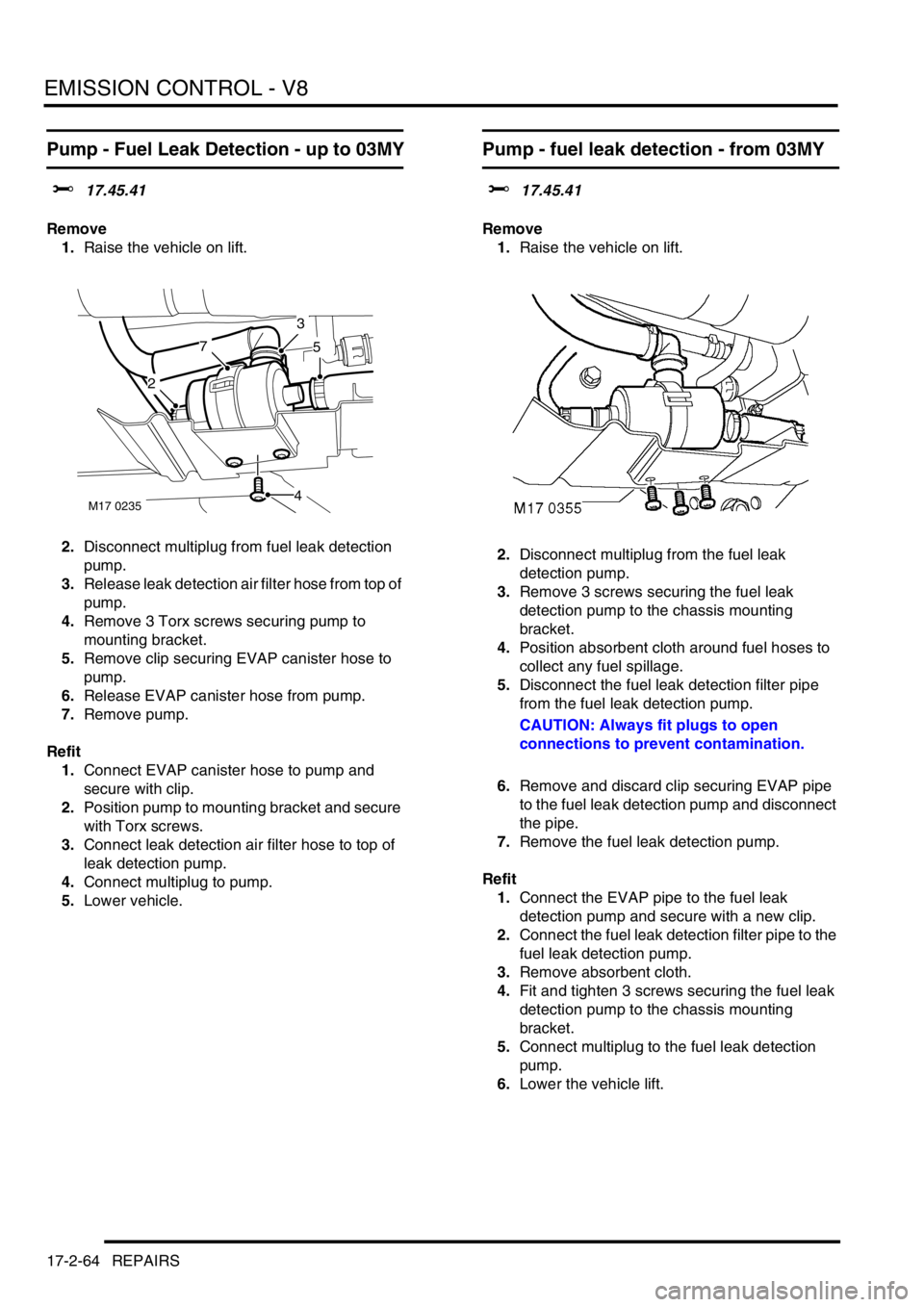
Pump - Fuel Leak Detection - up to 03MY
$% 17.45.41
Remove
1.Raise the vehicle on lift.
2.Disconnect multiplug from fuel leak detection
pump.
3.Release leak detection air filter hose from top of
pump.
4.Remove 3 Torx screws securing pump to
mounting bracket.
5.Remove clip securing EVAP canister hose to
pump.
6.Release EVAP canister hose from pump.
7.Remove pump.
Refit
1.Connect EVAP canister hose to pump and
secure with clip.
2.Position pump to mounting bracket and secure
with Torx screws.
3.Connect leak detection air filter hose to top of
leak detection pump.
4.Connect multiplug to pump.
5.Lower vehicle.
Pump - fuel leak detection - from 03MY
$% 17.45.41
Remove
1.Raise the vehicle on lift.
2.Disconnect multiplug from the fuel leak
detection pump.
3.Remove 3 screws securing the fuel leak
detection pump to the chassis mounting
bracket.
4.Position absorbent cloth around fuel hoses to
collect any fuel spillage.
5.Disconnect the fuel leak detection filter pipe
from the fuel leak detection pump.
CAUTION: Always fit plugs to open
connections to prevent contamination.
6.Remove and discard clip securing EVAP pipe
to the fuel leak detection pump and disconnect
the pipe.
7.Remove the fuel leak detection pump.
Refit
1.Connect the EVAP pipe to the fuel leak
detection pump and secure with a new clip.
2.Connect the fuel leak detection filter pipe to the
fuel leak detection pump.
3.Remove absorbent cloth.
4.Fit and tighten 3 screws securing the fuel leak
detection pump to the chassis mounting
bracket.
5.Connect multiplug to the fuel leak detection
pump.
6.Lower the vehicle lift.
M17 0235
2
3
4
57
Page 298 of 1529
EMISSION CONTROL - V8
REPAIRS 17-2-65
Filter - fuel leak detection pump - up to
03MY
$% 17.45.42
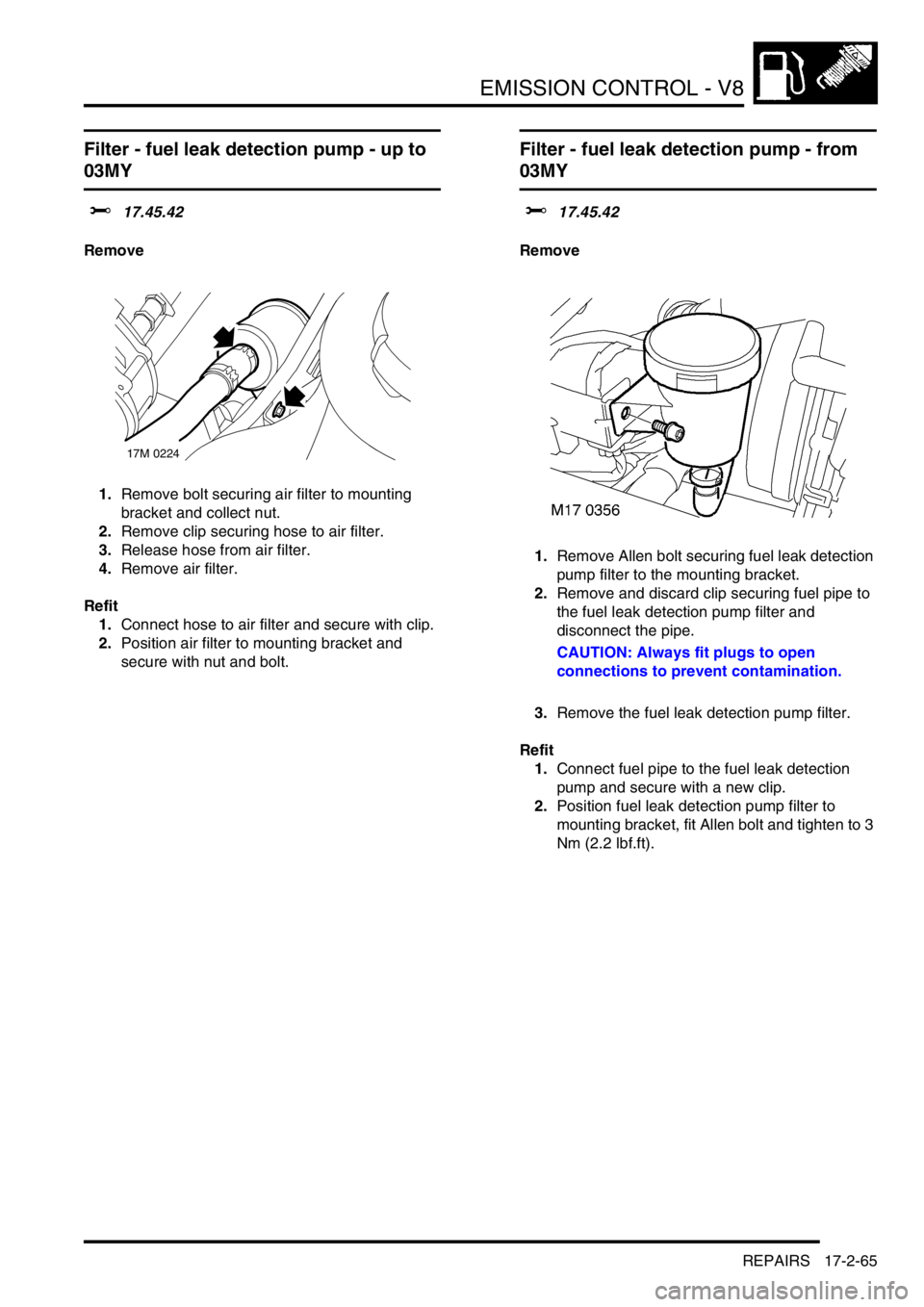
Remove
1.Remove bolt securing air filter to mounting
bracket and collect nut.
2.Remove clip securing hose to air filter.
3.Release hose from air filter.
4.Remove air filter.
Refit
1.Connect hose to air filter and secure with clip.
2.Position air filter to mounting bracket and
secure with nut and bolt.
Filter - fuel leak detection pump - from
03MY
$% 17.45.42
Remove
1.Remove Allen bolt securing fuel leak detection
pump filter to the mounting bracket.
2.Remove and discard clip securing fuel pipe to
the fuel leak detection pump filter and
disconnect the pipe.
CAUTION: Always fit plugs to open
connections to prevent contamination.
3.Remove the fuel leak detection pump filter.
Refit
1.Connect fuel pipe to the fuel leak detection
pump and secure with a new clip.
2.Position fuel leak detection pump filter to
mounting bracket, fit Allen bolt and tighten to 3
Nm (2.2 lbf.ft).
17M 0224
Page 302 of 1529

ENGINE MANAGEMENT SYSTEM - V8
DESCRIPTION AND OPERATION 18-2-3
1Mass air flow/ inlet air temperature sensor
2Fuel injectors
3High tension leads/spark plugs
4Fuel pump relay
5ATC compressor clutch relay/ cooling fan relay
6Throttle position sensor
7Heated oxygen sensor
8Idle air control valve
9Ignition coils
10Engine coolant temperature sensor
11Crankshaft speed and position sensor
12Knock sensor
13Camshaft position sensor
Page 304 of 1529

ENGINE MANAGEMENT SYSTEM - V8
DESCRIPTION AND OPERATION 18-2-5
1Engine control module
2Crankshaft speed and position sensor
3Camshaft position sensor
4Engine coolant temperature sensor
5Mass air flow/ inlet air temperature sensor
6Throttle position sensor
7Heated oxygen sensors
8Fuel injectors
9Idle air control valve
10Fuel pump relay
11EVAP canister
12EVAP canister vent valve
13EVAP canister purge valve
14Fuel tank pressure sensor15Ignition coils
16Knock sensor
17Spark plugs
18High/ Low ratio switch
19Malfunction indication lamp
20Diagnostic connector
21Air temperature control clutch relay
22Air temperature control cooling fan relay
23ATC ECU
24CAN link to EAT
25SLABS ECU
26BCU
27Instrument cluster
28Thermostat monitoring sensor (where fitted)