Gear ratio LAND ROVER DISCOVERY 1999 User Guide
[x] Cancel search | Manufacturer: LAND ROVER, Model Year: 1999, Model line: DISCOVERY, Model: LAND ROVER DISCOVERY 1999Pages: 1529, PDF Size: 34.8 MB
Page 154 of 1529
MAINTENANCE
PROCEDURES 10-31
Road/roller test
WARNING: Roller test must be restricted to 3
mph (5 km/h). If 2 wheel rolling road is to be used,
disconnect propeller shaft from the transfer box
output shaft driving the axle which is NOT on the
rolling road.
Testing
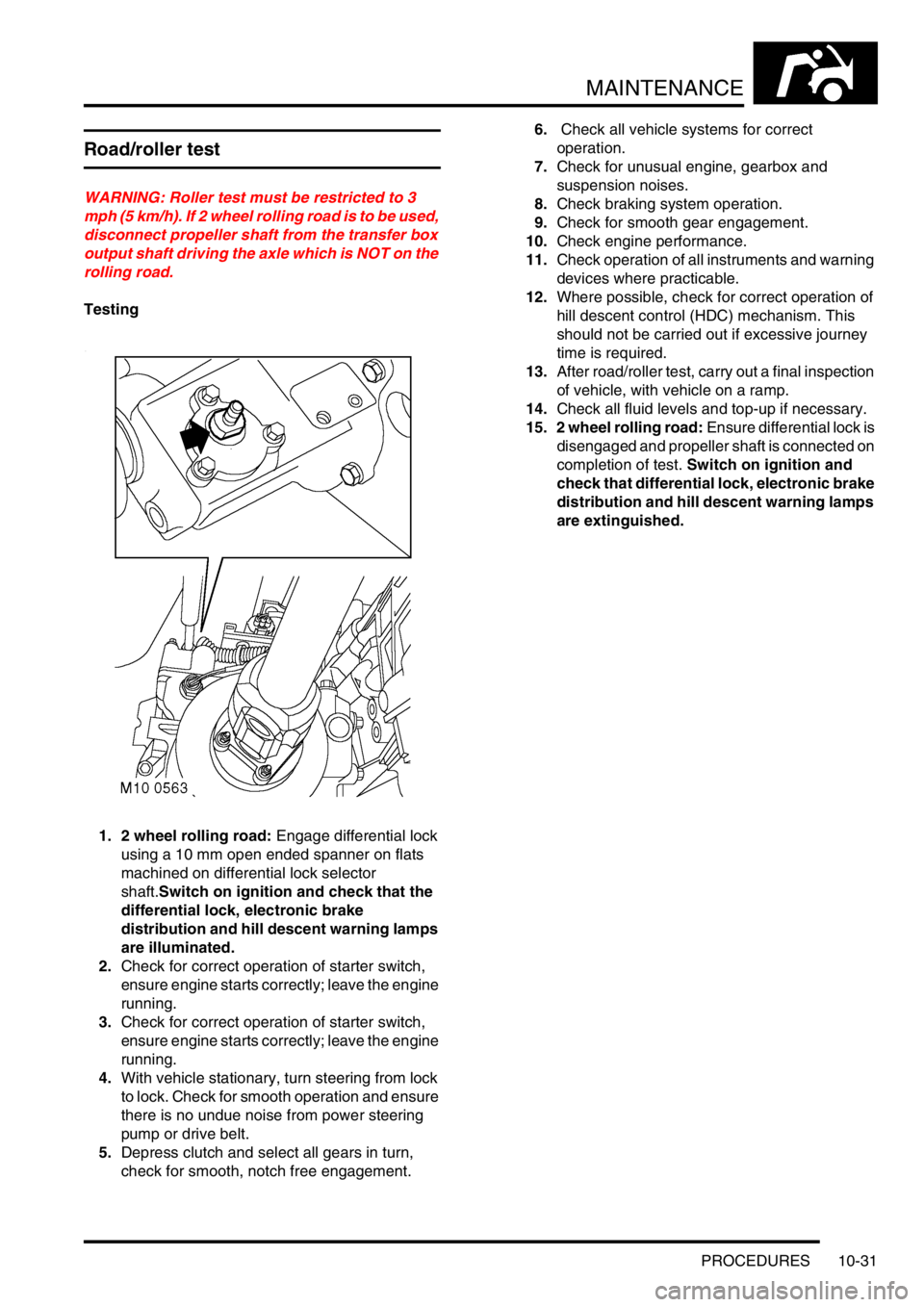
1. 2 wheel rolling road: Engage differential lock
using a 10 mm open ended spanner on flats
machined on differential lock selector
shaft.Switch on ignition and check that the
differential lock, electronic brake
distribution and hill descent warning lamps
are illuminated.
2.Check for correct operation of starter switch,
ensure engine starts correctly; leave the engine
running.
3.Check for correct operation of starter switch,
ensure engine starts correctly; leave the engine
running.
4.With vehicle stationary, turn steering from lock
to lock. Check for smooth operation and ensure
there is no undue noise from power steering
pump or drive belt.
5.Depress clutch and select all gears in turn,
check for smooth, notch free engagement.6. Check all vehicle systems for correct
operation.
7.Check for unusual engine, gearbox and
suspension noises.
8.Check braking system operation.
9.Check for smooth gear engagement.
10.Check engine performance.
11.Check operation of all instruments and warning
devices where practicable.
12.Where possible, check for correct operation of
hill descent control (HDC) mechanism. This
should not be carried out if excessive journey
time is required.
13.After road/roller test, carry out a final inspection
of vehicle, with vehicle on a ramp.
14.Check all fluid levels and top-up if necessary.
15. 2 wheel rolling road: Ensure differential lock is
disengaged and propeller shaft is connected on
completion of test. Switch on ignition and
check that differential lock, electronic brake
distribution and hill descent warning lamps
are extinguished.
Page 160 of 1529

ENGINE - V8
DESCRIPTION AND OPERATION 12-2-5
1Core plugs
2Cylinder block
3Camshaft
4Dipstick tube, clamp and bolt
5Woodruff key
6Timing chain
7Camshaft timing gear
8Washer
9Bolt - camshaft timing gear
10Thrust plate - camshaft end-float
11Bolt - camshaft thrust plate
12Gasket - timing cover
13Timing cover
14Oil pressure switch
15Bolt
16Crankshaft front oil seal
17Oil filter element
18Crankshaft front pulley
19Washer
20Bolt - crankshaft front pulley
21Upper main bearing shell
22Upper centre main bearing shell and thrust
washer
23Crankshaft
24Woodruff key
25Crankshaft timing gear
26Lower main bearing shells
27Numbers 1, 2 and 3 main bearing caps
28Bolt - main bearing caps
29Oil pick-up pipe and strainer30'O' ring
31Bolt - oil pick-up pipe
32Gasket - sump
33Sump
34Bolt - sump
35Sump oil drain plug
36Sealing washer
37Spacer, washers and nut - oil pick-up pipe
38Number 4 main bearing cap
39Bolt - connecting rod big-end bearing cap
40Connecting rod big-end bearing shell - lower
41Connecting rod big-end bearing cap
42Number 5 - rear main bearing cap
43Cruciform seal - rear main bearing cap
44Number 5 - rear main bearing shell
45Crankshaft rear oil seal
46Crankshaft knock sensor
47Side bolt - main bearing cap
48Side Allen bolt - main bearing cap
49Dowty washers
50Connecting rod big-end bearing shell - upper
51Connecting rod
52Piston
53Gudgeon pin
54Oil control ring
55Top compression ring
562nd compression ring
57Flywheel/drive plate and starter ring gear
58Bolt - flywheel/drive plate
Page 161 of 1529

ENGINE - V8
12-2-6 DESCRIPTION AND OPERATION
Description
General
The V8 petrol engine is an eight cylinder, water cooled unit having two banks of four cylinders positioned at 90 degrees
to each other. The engine comprises five main castings - two cylinder heads, cylinder block, timing cover and the oil
sump, all of which are manufactured from aluminium alloy.
NAS market vehicles from 03 model year receive a 4.6 litre version of the V8 engine to replace the previous 4.0 litre
version.
Cylinder heads
The cylinder heads are fitted with replaceable valve guides and valve seat inserts with the combustion chambers
formed in the head. Each cylinder head is sealed to the cylinder block with a gasket. The exhaust manifolds are bolted
to the outside of each cylinder head whilst the inlet manifolds are located in the centre of the 'Vee' and are bolted to
the inside face of each head. Inlet and exhaust manifolds are sealed to the cylinder heads by means of gaskets.
Each cylinder has a single inlet and exhaust valve. The exhaust valves are of the 'carbon break' type, a recess on the
valve stem prevents a build-up of carbon in the valve guide by dislodging particles of carbon as the valve stem moves
up and down the guide. Inlet and exhaust valve stem oil seals are fitted at the top of each valve guide. Valve operation
is by means of rocker arms, push rods and hydraulic tappets. Each of the rocker arms is located on a rocker shaft
which is supported by means of pedestals bolted to the cylinder heads. A spring, positioned on either side of each
rocker arm, maintains the correct relative position of the arm to its valve stem. The rocker arms are operated directly
by the push rods which pass through drillings in the cylinder heads and cylinder block. The bottom end of each push
rod locates in a hydraulic tappet operated by the single, chain driven camshaft.
The rocker covers are bolted to the cylinder heads and are sealed to the heads by a rubber gasket. Stub pipes for
crankcase ventilation hose connections are fitted to each rocker cover, the pipe in the right hand cover incorporates
an oil separator. The engine oil filler cap is situated in the right hand cover.
Cylinder block and camshaft
The cylinder block is fitted with cast iron cylinder liners which are shrink fitted and locate on stops in the block. The
camshaft is positioned in the centre of the cylinder block and runs in one piece bearing shells which are line bored
after fitting. Camshaft end-float is controlled by a thrust plate bolted to the front of the cylinder block. A timing gear,
chain driven by the crankshaft timing gear is bolted to the front of the camshaft.
Crankshaft and main bearings
The crankshaft is carried in five main bearings. The upper main bearing shell locations are an integral part of the
cylinder block casting. The lower main bearing caps are bolted to the cylinder block on either side of the upper bearing
shell locations with an additional bolt being inserted into each cap from either side of the cylinder block. The rear
main bearing cap carries the crankshaft rear oil seal and is sealed to the cylinder block by means of cruciform shaped
seals in each side of the cap. Number four main bearing cap carries the stud fixing for the oil pick-up pipe. Lower
main bearing shells are plain whilst the upper shells have an oil feed hole and are grooved. Crankshaft end-float is
controlled by the thrust faces of the upper centre shell. The crankshaft timing gear is located on the front of the
crankshaft by means of a Woodruff key which is also used to drive the gear type oil pump. The flywheel/drive plate
carries the crankshaft position sensor reluctor ring and is dowel located and bolted to the flywheel.
Timing cover
The timing cover is bolted to the front of the cylinder block and is sealed to the block with a gasket. The disposable,
full flow oil filter canister is screwed on to the timing cover which also carries the oil pressure switch, oil pressure relief
valve and crankshaft front oil seal. The gear type oil pump is integral with the cover which also has an internal oilway
to direct oil from the oil cooler to the filter.
NOTE: Oil coolers are only fitted to vehicles up to VIN 756821.
Page 193 of 1529

ENGINE - V8
12-2-38 REPAIRS
16.Remove 12 bolts securing sump flange to
engine.
17.Manoeuvre sump over front axle and remove
sump.
18.Discard sump gasket.
Refit
1.Clean all traces of sealant from the sump and
sump mating faces using a plastic scraper or
solvent.
2.Ensure bolt holes in cylinder block are clean
and dry.
3.Apply a 5 mm (0.2 in) wide bead of sealant, Part
No. STC 50550, across the cylinder block to
front cover joint and across the cylinder block to
rear main bearing joint. Apply a globule of
sealant to cover the ends of the cruciform
seals, (see illustration).
4.Fit new gasket, dry, to sump, ensuring that
locating tags are correctly positioned.
5.Manoeuvre sump into position, fit and lightly
tighten 2 bolts to retain sump in place, then fit
and lightly tighten remainder of bolts.
6.Working in the sequence illustrated, tighten the
sump bolts to 22 Nm (16 lbf.ft).
7.Position side clip bracket, fit and tighten bolt. 8.Position oil cooler pipe clips, fit and tighten
nuts.
9.Clean gearbox oil cooler pipe 'O' ring recess
and mating face.
10.Lubricate and fit new 'O' ring to gearbox oil
cooler pipe.
11.Position pipe and tighten nut.
12.Lower front of vehicle.
13.Position cross member to chassis, fit bolts and
tighten to 25 Nm (18 lbf.ft).
14.Refill engine oil and fit dipstick.
15.Connect battery earth lead.
16.Fit battery cover and retain with fixings.
Page 314 of 1529
ENGINE MANAGEMENT SYSTEM - V8
DESCRIPTION AND OPERATION 18-2-15
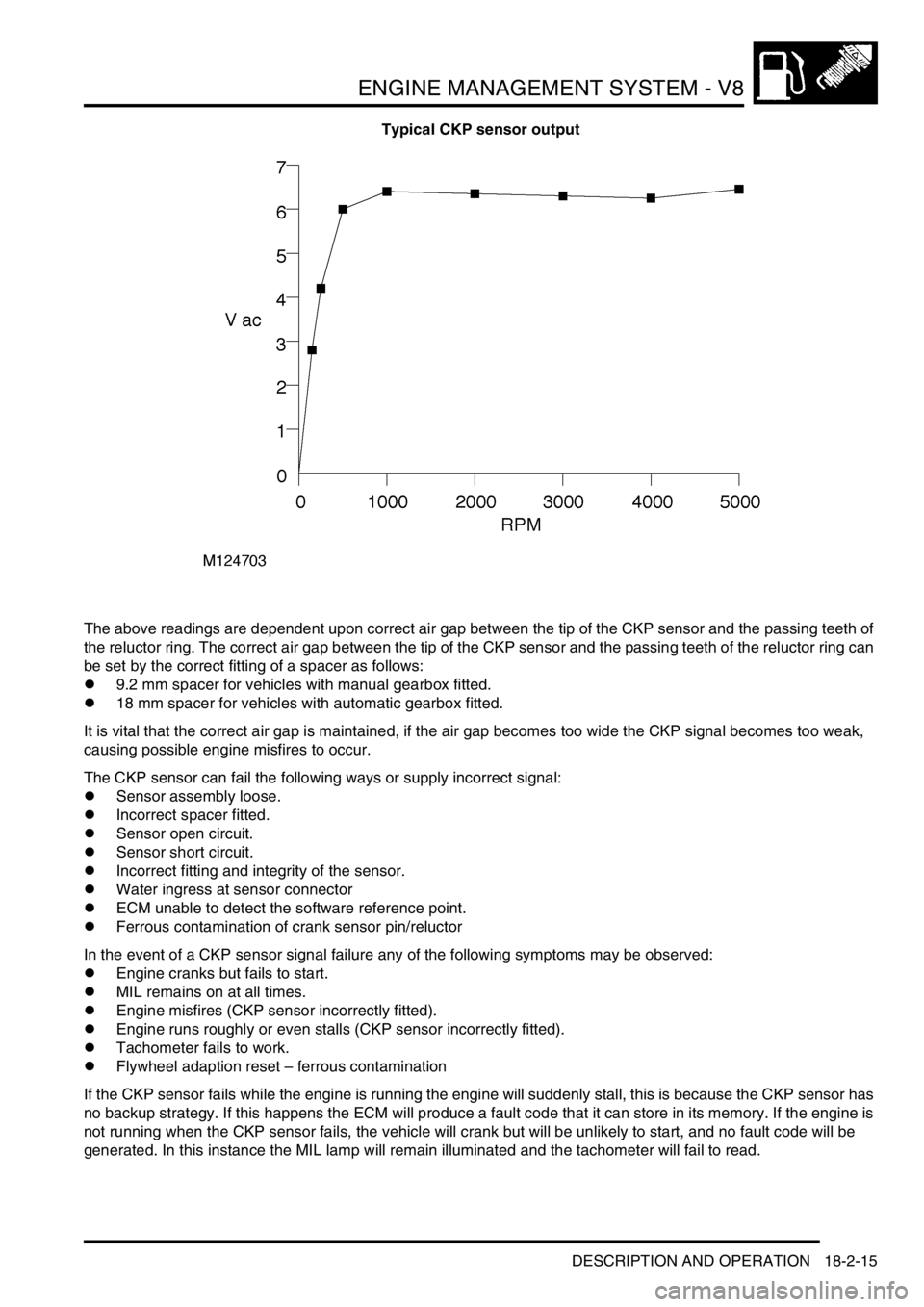
Typical CKP sensor output
The above readings are dependent upon correct air gap between the tip of the CKP sensor and the passing teeth of
the reluctor ring. The correct air gap between the tip of the CKP sensor and the passing teeth of the reluctor ring can
be set by the correct fitting of a spacer as follows:
l9.2 mm spacer for vehicles with manual gearbox fitted.
l18 mm spacer for vehicles with automatic gearbox fitted.
It is vital that the correct air gap is maintained, if the air gap becomes too wide the CKP signal becomes too weak,
causing possible engine misfires to occur.
The CKP sensor can fail the following ways or supply incorrect signal:
lSensor assembly loose.
lIncorrect spacer fitted.
lSensor open circuit.
lSensor short circuit.
lIncorrect fitting and integrity of the sensor.
lWater ingress at sensor connector
lECM unable to detect the software reference point.
lFerrous contamination of crank sensor pin/reluctor
In the event of a CKP sensor signal failure any of the following symptoms may be observed:
lEngine cranks but fails to start.
lMIL remains on at all times.
lEngine misfires (CKP sensor incorrectly fitted).
lEngine runs roughly or even stalls (CKP sensor incorrectly fitted).
lTachometer fails to work.
lFlywheel adaption reset – ferrous contamination
If the CKP sensor fails while the engine is running the engine will suddenly stall, this is because the CKP sensor has
no backup strategy. If this happens the ECM will produce a fault code that it can store in its memory. If the engine is
not running when the CKP sensor fails, the vehicle will crank but will be unlikely to start, and no fault code will be
generated. In this instance the MIL lamp will remain illuminated and the tachometer will fail to read.
Page 316 of 1529
ENGINE MANAGEMENT SYSTEM - V8
DESCRIPTION AND OPERATION 18-2-17
Camshaft Position (CMP) sensor (C0176)
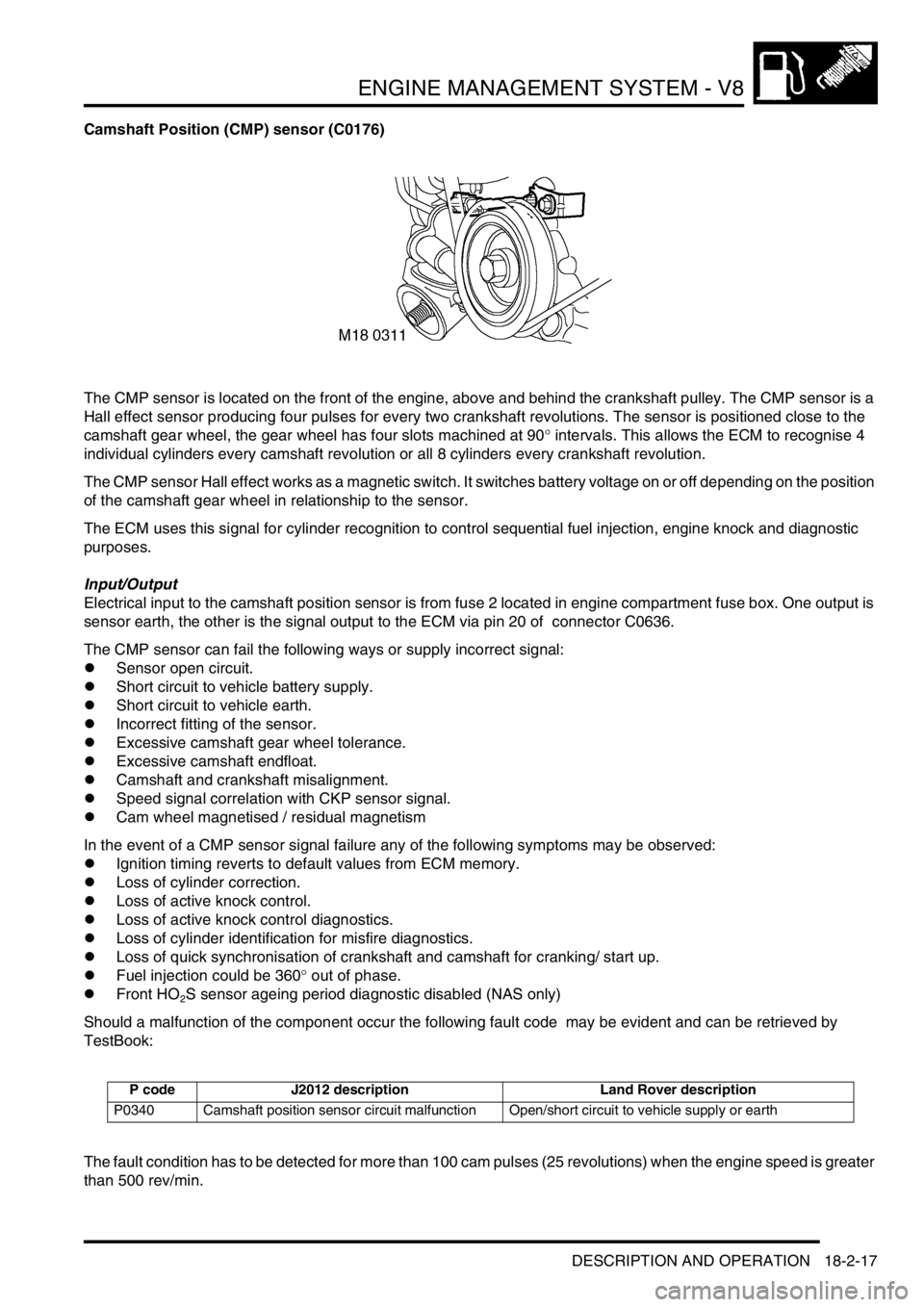
The CMP sensor is located on the front of the engine, above and behind the crankshaft pulley. The CMP sensor is a
Hall effect sensor producing four pulses for every two crankshaft revolutions. The sensor is positioned close to the
camshaft gear wheel, the gear wheel has four slots machined at 90° intervals. This allows the ECM to recognise 4
individual cylinders every camshaft revolution or all 8 cylinders every crankshaft revolution.
The CMP sensor Hall effect works as a magnetic switch. It switches battery voltage on or off depending on the position
of the camshaft gear wheel in relationship to the sensor.
The ECM uses this signal for cylinder recognition to control sequential fuel injection, engine knock and diagnostic
purposes.
Input/Output
Electrical input to the camshaft position sensor is from fuse 2 located in engine compartment fuse box. One output is
sensor earth, the other is the signal output to the ECM via pin 20 of connector C0636.
The CMP sensor can fail the following ways or supply incorrect signal:
lSensor open circuit.
lShort circuit to vehicle battery supply.
lShort circuit to vehicle earth.
lIncorrect fitting of the sensor.
lExcessive camshaft gear wheel tolerance.
lExcessive camshaft endfloat.
lCamshaft and crankshaft misalignment.
lSpeed signal correlation with CKP sensor signal.
lCam wheel magnetised / residual magnetism
In the event of a CMP sensor signal failure any of the following symptoms may be observed:
lIgnition timing reverts to default values from ECM memory.
lLoss of cylinder correction.
lLoss of active knock control.
lLoss of active knock control diagnostics.
lLoss of cylinder identification for misfire diagnostics.
lLoss of quick synchronisation of crankshaft and camshaft for cranking/ start up.
lFuel injection could be 360° out of phase.
lFront HO
2S sensor ageing period diagnostic disabled (NAS only)
Should a malfunction of the component occur the following fault code may be evident and can be retrieved by
TestBook:
The fault condition has to be detected for more than 100 cam pulses (25 revolutions) when the engine speed is greater
than 500 rev/min.
P code J2012 description Land Rover description
P0340 Camshaft position sensor circuit malfunction Open/short circuit to vehicle supply or earth
Page 327 of 1529
ENGINE MANAGEMENT SYSTEM - V8
18-2-28 DESCRIPTION AND OPERATION
Throttle Position (TP) sensor (C0175)
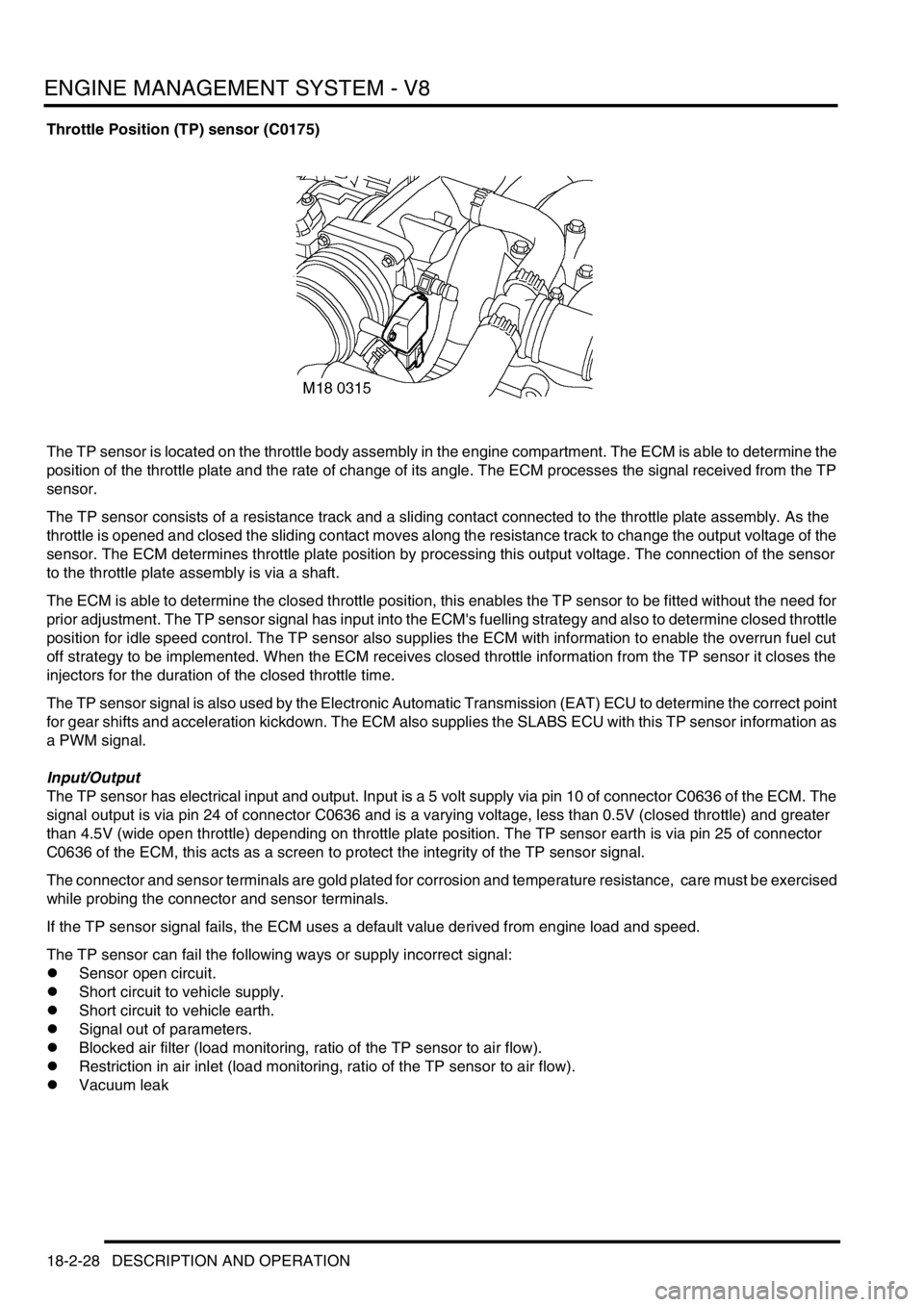
The TP sensor is located on the throttle body assembly in the engine compartment. The ECM is able to determine the
position of the throttle plate and the rate of change of its angle. The ECM processes the signal received from the TP
sensor.
The TP sensor consists of a resistance track and a sliding contact connected to the throttle plate assembly. As the
throttle is opened and closed the sliding contact moves along the resistance track to change the output voltage of the
sensor. The ECM determines throttle plate position by processing this output voltage. The connection of the sensor
to the throttle plate assembly is via a shaft.
The ECM is able to determine the closed throttle position, this enables the TP sensor to be fitted without the need for
prior adjustment. The TP sensor signal has input into the ECM's fuelling strategy and also to determine closed throttle
position for idle speed control. The TP sensor also supplies the ECM with information to enable the overrun fuel cut
off strategy to be implemented. When the ECM receives closed throttle information from the TP sensor it closes the
injectors for the duration of the closed throttle time.
The TP sensor signal is also used by the Electronic Automatic Transmission (EAT) ECU to determine the correct point
for gear shifts and acceleration kickdown. The ECM also supplies the SLABS ECU with this TP sensor information as
a PWM signal.
Input/Output
The TP sensor has electrical input and output. Input is a 5 volt supply via pin 10 of connector C0636 of the ECM. The
signal output is via pin 24 of connector C0636 and is a varying voltage, less than 0.5V (closed throttle) and greater
than 4.5V (wide open throttle) depending on throttle plate position. The TP sensor earth is via pin 25 of connector
C0636 of the ECM, this acts as a screen to protect the integrity of the TP sensor signal.
The connector and sensor terminals are gold plated for corrosion and temperature resistance, care must be exercised
while probing the connector and sensor terminals.
If the TP sensor signal fails, the ECM uses a default value derived from engine load and speed.
The TP sensor can fail the following ways or supply incorrect signal:
lSensor open circuit.
lShort circuit to vehicle supply.
lShort circuit to vehicle earth.
lSignal out of parameters.
lBlocked air filter (load monitoring, ratio of the TP sensor to air flow).
lRestriction in air inlet (load monitoring, ratio of the TP sensor to air flow).
lVacuum leak
Page 328 of 1529

ENGINE MANAGEMENT SYSTEM - V8
DESCRIPTION AND OPERATION 18-2-29
In the event of a TP sensor signal failure any of the following symptoms may be observed:
lEngine performance concern.
lDelayed throttle response.
lFailure of emission control.
lClosed loop idle speed control inoperative.
lAutomatic gearbox kickdown inoperative.
lIncorrect altitude adaptation.
lMIL illuminated (NAS only).
There are three throttle position sensor diagnostic checks:
lTP sensor signal is greater than the maximum threshold value – the engine speed must be greater than 400 rev/
min for longer than 2 seconds and the signal must be greater than 96% for longer than 50 ms.
lTP sensor signal is less than the minimum threshold – the engine speed must be greater than 400 rev/min for
longer than 2 seconds and the signal must be less than 4% for longer than 50 ms.
lRatio of throttle position to mass of air flow – the calculated throttle angle must be outside limits when the engine
speed is between 800 rev/min and 4000 rev/min, the engine load is between 2 and 6.5 and the coolant
temperature is above -10°C (14°F).
Should a malfunction of the TP sensor occur the following fault codes may be evident and can be retrieved by
TestBook.
P code J2012 description Land Rover description
P0101 Mass or volume air flow circuit range/
performance problemLoad monitoring, the ratio of throttle position to air flow
P0122 TPS a circuit low input Signal < minimum threshold
P0123 TPS a circuit high input Signal > maximum threshold
Page 339 of 1529

ENGINE MANAGEMENT SYSTEM - V8
18-2-40 DESCRIPTION AND OPERATION
Ignition coils
Two double ended ignition coils are located at the rear of the engine, below the inlet plenum camber mounted on a
bracket. The ignition system operates on the wasted spark principle. When the ECM triggers an ignition coil to spark,
current from the coil travels to one spark plug jumping the gap at the spark plug electrodes igniting the mixture in the
cylinder. Current continues to travel along the earth path (via the cylinder head) to the spark plug negative electrode
at the cylinder that is on the exhaust stroke. The current jumps across the spark plug electrodes and back to the coil
completing the circuit. Since it has sparked simultaneously in a cylinder that is on the exhaust stroke it has not done
any work, therefore it is wasted.
The coils are paired in the following cylinder order:
l1 and 6.
l8 and 5.
l4 and 7.
l3 and 2.
The ECM calculates the dwell timing from battery voltage, and engine speed to ensure constant secondary energy.
This ensures sufficient spark energy is always available without excessive primary current flow and thus avoiding
overheating or damage to the coils. Individual cylinder spark timing is calculated from the following signals:
lEngine speed.
lEngine load.
lEngine temperature.
lKnock control.
lAutomatic gearbox shift control.
lIdle speed control.
During engine warm up ignition timing should be an expected value of 12° BTDC.
TestBook can not directly carry out diagnostics on the high-tension side of the ignition system. Ignition related faults
are monitored indirectly by the misfire detection system.
Page 350 of 1529

ENGINE MANAGEMENT SYSTEM - V8
DESCRIPTION AND OPERATION 18-2-51
Conditions
The ECM calculates ignition timing using input from the following:
lCKP sensor.
lKnock sensors (KS).
lMAF sensor.
lTP sensor (idle only).
lECT sensor.
Function
At engine start up, the ECM sets ignition timing dependent on ECT information and starting rev/min from the CKP. As
the running characteristics of the engine change, the ignition timing changes. The ECM compares the CKP signal to
stored values in its memory, and if necessary advances or retards the spark via the ignition coils.
Ignition timing is used by the ECM for knock control.
Knock control
The ECM uses active knock control to prevent possible engine damage due to pre-ignition. This is achieved by
converting engine block noise into a suitable electrical signal that can be processed by the ECM. A major contributing
factor to engine 'knock' is fuel quality, the ECM can function satisfactorily on 91 RON fuel as well as the 95 RON fuel
that it is calibrated for.
Conditions
The ECM knock control system operates as follows:
lHot running engine.
l91 or 95 RON fuel.
Function
The ECM knock control uses two sensors located one between the centre two cylinders of each bank. The knock
sensors consist of piezo ceramic crystals that oscillate to create a voltage signal. During pre-ignition, the frequency
of crystal oscillation increases which alters the signal output to the ECM.
If the knock sensors detect pre-ignition in any of the cylinders, the ECM retards the ignition timing by 3° for that
particular cylinder. If this action stops the engine knock, the ignition timing is restored to its previous figure in
increments of 0.75°. If this action does not stop engine knock then the ECM retards the ignition timing a further 3° up
to a maximum of -15° and then restores it by 0.75° and so on until the engine knock is eliminated.
The ECM also counteracts engine knock at high intake air temperatures by retarding the ignition as above. The ECM
uses the IAT signal to determine air temperature.
Idle speed control
The ECM regulates the engine speed at idling. The ECM uses the idle air control valve (IACV) to compensate for the
idle speed drop that occurs when the engine is placed under greater load than usual. When the throttle is in the rest
position i.e. it has not been pressed, the majority of intake air that the engine consumes comes from the idle air control
valve.
IACV control idle speed
Conditions in which the ECM operates the IACV control idle speed is as follows:
lIf any automatic transmission gears other than P or N are selected.
lIf air conditioning is switched on.
lIf cooling fans are switched on.
lAny electrical loads activated by the driver.
Function
The idle air control valve utilises two coils that use opposing pulse width modulated (PWM) signals to control the
position of a rotary valve. If one of the circuits that supplies the PWM signal fails, the ECM closes down the remaining
signal preventing the idle air control valve from working at its maximum/ minimum setting. If this should occur, the idle
air control valve assumes a default idle position at which the engine idle speed is raised to 1200 rev/min with no load
placed on the engine.