catalytic converter LAND ROVER DISCOVERY 1999 User Guide
[x] Cancel search | Manufacturer: LAND ROVER, Model Year: 1999, Model line: DISCOVERY, Model: LAND ROVER DISCOVERY 1999Pages: 1529, PDF Size: 34.8 MB
Page 272 of 1529

EMISSION CONTROL - V8
DESCRIPTION AND OPERATION 17-2-39
Evaporative Emission Control Operation
Fuel vapour is stored in the activated charcoal (EVAP) canister for retention when the vehicle is not operating. When
the vehicle is operating, fuel vapour is drawn from the canister into the engine via a purge control valve. The vapour
is then delivered to the intake plenum chamber to be supplied to the engine cylinders where it is burned in the
combustion process.
During fuel filling the fuel vapour displaced from the fuel tank is allowed to escape to atmosphere, valves within the
fuel filler prevent any vapour escaping through to the EVAP canister as this can adversely affect the fuel cut-off height.
Only fuel vapour generated whilst driving is prevented from escaping to atmosphere by absorption into the charcoal
canister. The fuel filler shuts off to leave the tank approximately 10% empty to ensure the ROVs are always above
the fuel level and so vapour can escape to the EVAP canister and the tank can breathe. The back pressures normally
generated during fuel filling are too low to open the pressure relief valve, but vapour pressures accumulated during
driving are higher and can open the pressure relief valve. Should the vehicle be overturned, the ROVs shut off to
prevent any fuel spillage.
Fuel vapour generated from within the fuel tank as the fuel heats up is stored in the tank until the pressure exceeds
the operating pressure of the two-way valve. When the two-way valve opens, the fuel vapour passes along the vent
line from the fuel tank (via the fuel tank vapour separator) to the evaporation inlet port of the EVAP canister. The fuel
tank vents between 5.17 and 6.9 kPa.
Fuel vapour evaporating from the fuel tank is routed to the EVAP canister through the fuel vapour separator and vent
line. Liquid fuel must not be allowed to contaminate the charcoal in the EVAP canister. To prevent this, the fuel vapour
separator fitted to the fuel neck allows fuel to drain back into the tank. As the fuel vapour cools, it condenses and is
allowed to flow back into the fuel tank from the vent line by way of the two-way valve.
The EVAP canister contains charcoal which absorbs and stores fuel vapour from the fuel tank while the engine is not
running. When the canister is not being purged, the fuel vapour remains in the canister and clean air exits the canister
via the air inlet port.
The engine management ECM controls the electrical output signal to the purge valve. The system will not work
properly if there is leakage or clogging within the system or if the purge valve cannot be controlled.
+ ENGINE MANAGEMENT SYSTEM - V8, DESCRIPTION AND OPERATION, Description - engine
management.
When the engine is running, the ECM decides when conditions are correct for vapour to be purged from the EVAP
canister and opens the canister purge valve. This connects a manifold vacuum line to the canister and fuel vapour
containing the hydrocarbons is drawn from the canister's charcoal element to be burned in the engine. Clean air is
drawn into the canister through the atmosphere vent port to fill the displaced volume of vapour.
The purge valve remains closed below preset coolant and engine speed values to protect the engine tune and
catalytic converter performance. If the EVAP canister was purged during cold running or at idling speed, the additional
enrichment in the fuel mixture would delay the catalytic converter light off time and cause erratic idle. When the purge
valve is opened, fuel vapour from the EVAP canister is drawn into the plenum chamber downside of the throttle
housing, to be delivered to the combustion chambers for burning.
The purge valve is opened and closed in accordance with a pulse width modulated (PWM) signal supplied from the
engine management ECM. The system will not work properly if the purge valve cannot be controlled. Possible failure
modes associated with the purge valve are listed below:
lValve drive open circuit.
lShort circuit to vehicle supply or ground.
lPurge valve or pipework blocked or restricted.
lPurge valve stuck open.
lPipework joints leaking or disconnected.
Possible symptoms associated with a purge valve or associated pipework failure is listed below:
lEngine may stall on return to idle if purge valve is stuck open.
lPoor idling quality if the purge valve is stuck open
lFuelling adaptions forced excessively lean if the EVAP canister is clear and the purge valve is stuck open.
lFuelling adaptions forced excessively rich if the EVAP canister is saturated and the purge valve is stuck open.
lSaturation of the EVAP canister if the purge valve is stuck closed.
Page 289 of 1529

EMISSION CONTROL - V8
17-2-56 REPAIRS
Sensor - heated oxygen (HO2S) - pre-
catalytic converter
$% 19.22.16
Remove
1.Raise vehicle on a ramp.
2.Release HO
2S multiplug from support bracket.
3.Release HO
2S harness from clip and
disconnect multiplug from HO
2S .
4.Using a 22 mm crow's-foot spanner, remove
HO
2S.
CAUTION: HO
2 sensors are easily damaged
by dropping, excessive heat or
contamination. Care must be taken not to
damage the sensor housing or tip.Refit
1.Clean sensor and exhaust pipe mating
surfaces.
2.If refitting existing sensor, apply anti-seize
compound to sensor threads.
WARNING: Some types of anti-seize
compound used in service are a health
hazard. Avoid skin contact.
NOTE: A new HO
2 sensor is supplied pre-
treated with anti-seize compound.
3.Fit a new sealing washer to HO
2S
4.Fit HO
2S and tighten to 45 Nm (33 lbf.ft).
5. Connect multiplug to HO
2S, and secure to
support bracket and harness clip.
6.Lower vehicle.
Page 290 of 1529

EMISSION CONTROL - V8
REPAIRS 17-2-57
Sensor - heated oxygen (HO2S) - post-
catalytic converter
$% 19.22.17
Remove
1.Raise vehicle on ramp.
2.Release HO
2S multiplug from support bracket.
3.Disconnect HO
2S multiplug from harness.
4.Using a 22 mm crowsfoot spanner, remove
HO
2S.
CAUTION: HO2 sensors are easily damaged
by dropping, excessive heat or
contamination. Care must be taken not to
damage the sensor housing or tip.Refit
1.Clean sensor and exhaust pipe mating
surfaces.
2.If refitting existing sensor, apply anti-seize
compound to sensor threads.
WARNING: Some types of anti-seize
compound used in service are a health
hazard. Avoid skin contact.
NOTE: A new HO2 sensor is supplied pre-
treated with anti-seize compound.
3.Fit a new sealing washer to HO
2S
4.Fit HO
2S and tighten to 45 Nm (33 lbf.ft).
5. Connect HO
2S multiplug to harness and fit
harness to bracket.
6.Secure harness to clip.
7.Lower vehicle.
Page 329 of 1529
ENGINE MANAGEMENT SYSTEM - V8
18-2-30 DESCRIPTION AND OPERATION
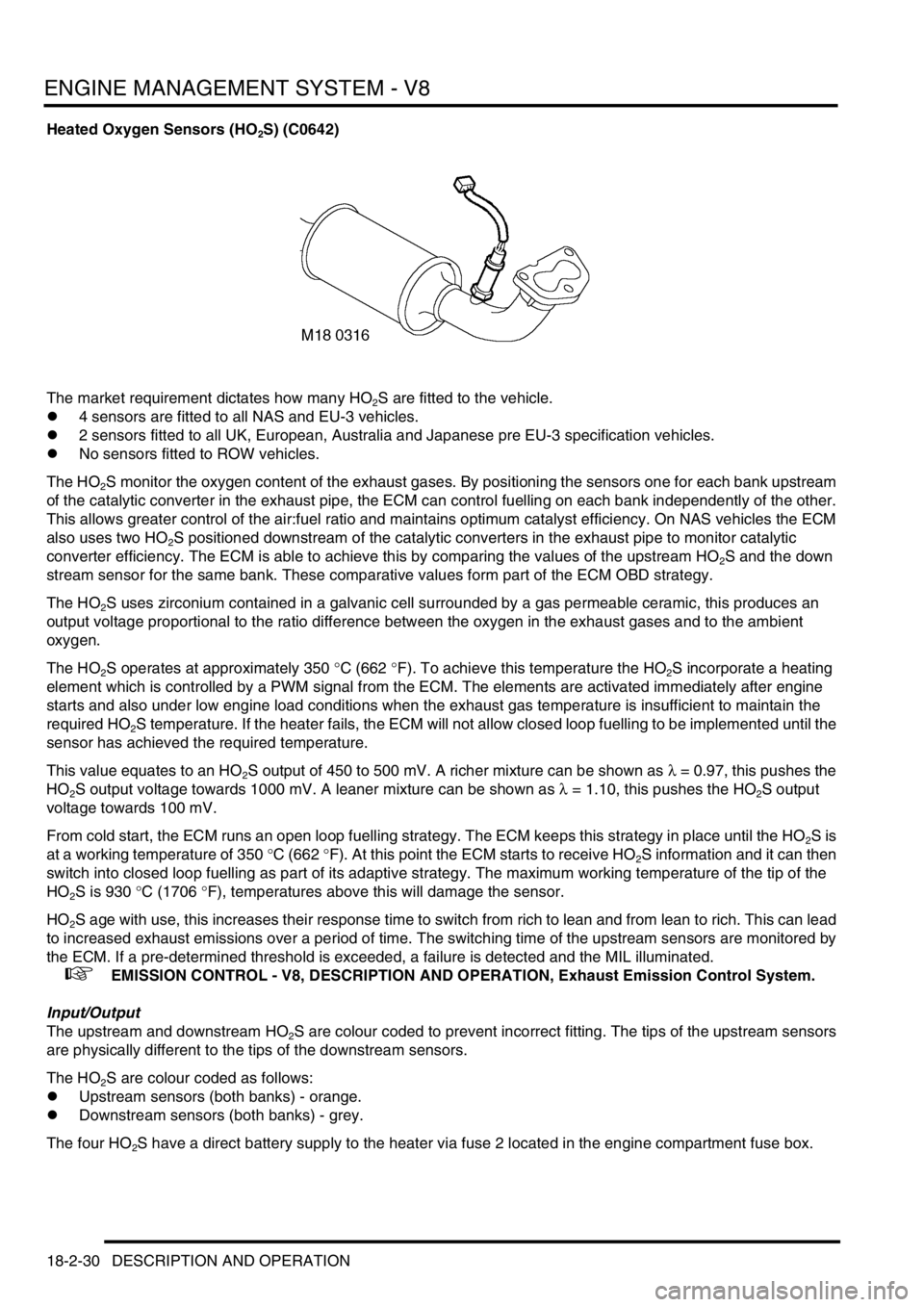
Heated Oxygen Sensors (HO2S) (C0642)
The market requirement dictates how many HO
2S are fitted to the vehicle.
l4 sensors are fitted to all NAS and EU-3 vehicles.
l2 sensors fitted to all UK, European, Australia and Japanese pre EU-3 specification vehicles.
lNo sensors fitted to ROW vehicles.
The HO
2S monitor the oxygen content of the exhaust gases. By positioning the sensors one for each bank upstream
of the catalytic converter in the exhaust pipe, the ECM can control fuelling on each bank independently of the other.
This allows greater control of the air:fuel ratio and maintains optimum catalyst efficiency. On NAS vehicles the ECM
also uses two HO
2S positioned downstream of the catalytic converters in the exhaust pipe to monitor catalytic
converter efficiency. The ECM is able to achieve this by comparing the values of the upstream HO
2S and the down
stream sensor for the same bank. These comparative values form part of the ECM OBD strategy.
The HO
2S uses zirconium contained in a galvanic cell surrounded by a gas permeable ceramic, this produces an
output voltage proportional to the ratio difference between the oxygen in the exhaust gases and to the ambient
oxygen.
The HO
2S operates at approximately 350 °C (662 °F). To achieve this temperature the HO2S incorporate a heating
element which is controlled by a PWM signal from the ECM. The elements are activated immediately after engine
starts and also under low engine load conditions when the exhaust gas temperature is insufficient to maintain the
required HO
2S temperature. If the heater fails, the ECM will not allow closed loop fuelling to be implemented until the
sensor has achieved the required temperature.
This value equates to an HO
2S output of 450 to 500 mV. A richer mixture can be shown as λ = 0.97, this pushes the
HO
2S output voltage towards 1000 mV. A leaner mixture can be shown as λ = 1.10, this pushes the HO2S output
voltage towards 100 mV.
From cold start, the ECM runs an open loop fuelling strategy. The ECM keeps this strategy in place until the HO
2S is
at a working temperature of 350 °C (662 °F). At this point the ECM starts to receive HO
2S information and it can then
switch into closed loop fuelling as part of its adaptive strategy. The maximum working temperature of the tip of the
HO
2S is 930 °C (1706 °F), temperatures above this will damage the sensor.
HO
2S age with use, this increases their response time to switch from rich to lean and from lean to rich. This can lead
to increased exhaust emissions over a period of time. The switching time of the upstream sensors are monitored by
the ECM. If a pre-determined threshold is exceeded, a failure is detected and the MIL illuminated.
+ EMISSION CONTROL - V8, DESCRIPTION AND OPERATION, Exhaust Emission Control System.
Input/Output
The upstream and downstream HO
2S are colour coded to prevent incorrect fitting. The tips of the upstream sensors
are physically different to the tips of the downstream sensors.
The HO
2S are colour coded as follows:
lUpstream sensors (both banks) - orange.
lDownstream sensors (both banks) - grey.
The four HO
2S have a direct battery supply to the heater via fuse 2 located in the engine compartment fuse box.
Page 348 of 1529

ENGINE MANAGEMENT SYSTEM - V8
DESCRIPTION AND OPERATION 18-2-49
Operation - engine management
Fuel quantity
The ECM controls engine fuel quantity by providing sequential injection to the cylinders. Sequential injection allows
each injector to deliver fuel to the cylinders in the required firing order.
To achieve optimum fuel quantity under all driving conditions, the ECM provides an adaptive fuel strategy.
Conditions
Adaptive fuel strategy must be maintained under all throttle positions except:
lCold starting.
lHot starting.
lWide open throttle.
lAcceleration.
All of the throttle positions mentioned above are deemed to be 'open loop'. Open loop fuelling does not rely on
information from the HO
2 sensors, but the air/ fuel ratio is set directly by the ECM. During cold start conditions the
ECM uses ECT information to allow more fuel to be injected into the cylinders to facilitate cold starting. This strategy
is maintained until the HO
2 sensors are at working temperature and can pass exhaust gas information to the ECM.
Because of the specific nature of the other functions e.g. hot starting, idle, wide open throttle, and acceleration they
also require an 'open loop' strategy. For NAS vehicles with secondary air injection for cold start conditions, refer to
the Emissions section.
+ EMISSION CONTROL - V8, DESCRIPTION AND OPERATION, Secondary Air Injection System.
Adaptive fuel strategy also allows for wear in the engine and components, as well as slight differences in component
signals, as no two components will give exactly the same readings.
Function
To be able to calculate the amount of fuel to be injected into each cylinder, the ECM needs to determine the amount
of air mass drawn into each cylinder. To perform this calculation, the ECM processes information from the following
sensors:
lMass air flow (MAF) sensor.
lCrank speed and position (CKP) sensor.
lEngine coolant temperature (ECT) sensor.
lThrottle position (TP) sensor.
During one engine revolution, 4 of the 8 cylinders draw in air. The ECM uses CKP sensor information to determine
that one engine revolution has taken place, and the MAF sensor information to determine how much air has been
drawn into engine. The amount of air drawn into each cylinder is therefore 1/4 of the total amount measured by the
ECM via the MAF sensor.
The ECM refers the measured air mass against a fuel quantity map in its memory and then supplies an earth path to
the relevant fuel injector for a period corresponding to the exact amount of fuel to be injected into the lower inlet
manifold. This fuel quantity is in direct relation to the air mass drawn into each cylinder to provide the optimum ratio.
During adaptive fuelling conditions, information from the heated oxygen sensors (HO
2S) is used by the ECM to correct
the fuel quantity to keep the air/ fuel ratio as close to the stoichiometric ideal as possible.
Closed loop fuelling
The ECM uses a closed loop fuelling system as part of its fuelling strategy. The operation of the three-way catalytic
converter relies on the ECM being able to optimise the air/ fuel mixture, switching between rich and lean either side
of lambda one. Closed loop fuelling is not standard for all markets, vehicles that are not fitted with HO
2S do not have
closed loop fuelling.
The ideal stoichiometric ratio is represented by λ =1. The ratio can be explained as 14.7 parts of air to every 1 part of
fuel.
Page 358 of 1529
ENGINE MANAGEMENT SYSTEM - V8
DESCRIPTION AND OPERATION 18-2-59
⇒ Drive cycle C:
1Switch ignition on for 30 seconds.
2Ensure engine coolant temperature is less than 60°C (140°F).
3Start the engine and allow to idle for 2 minutes.
4Perform 2 light accelerations (0 to 35 mph (0 to 60 km/h) with light pedal pressure).
5Perform 2 medium accelerations (0 to 45 mph (0 to 70 km/h) with moderate pedal pressure).
6Perform 2 hard accelerations (0 to 55 mph (0 to 90 km/h) with heavy pedal pressure).
7Cruise at 60 mph (100 km/h) for 8 minutes.
8Cruise at 50 mph (80 km/h) for 3 minutes.
9Allow engine to idle for 3 minutes.
10Connect TestBook and with the engine still running, check for fault codes.
NOTE: The following areas have an associated readiness test which must be flagged as complete, before a problem
resolution can be verified:
lcatalytic converter fault;
lEvaporative loss system fault;
lHO
2 sensor fault;
lHO
2 sensor heater fault.
When carrying out a drive cycle C to determine a fault in any of the above areas, select the readiness test icon to
verify that the test has been flagged as complete.
⇒ Drive cycle D:
1Switch ignition on for 30 seconds.
2Ensure engine coolant temperature is less than 35°C (95°F).
3Start the engine and allow to idle for 2 minutes.
4Perform 2 light accelerations (0 to 35 mph (0 to 60 km/h) with light pedal pressure).
5Perform 2 medium accelerations (0 to 45 mph (0 to 70 km/h) with moderate pedal pressure).
6Perform 2 hard accelerations (0 to 55 mph (0 to 90 km/h) with heavy pedal pressure).
7Cruise at 60 mph (100 km/h) for 5 minutes.
8Cruise at 50 mph (80 km/h) for 5 minutes.
9Cruise at 35 mph (60 km/h) for 5 minutes.
10Allow engine to idle for 2 minutes.
11Connect TestBook and check for fault codes.
⇒ Drive cycle E:
1Ensure fuel tank is at least a quarter full.
2Carry out Drive Cycle A.
3Switch off ignition.
4Leave vehicle undisturbed for 20 minutes.
5Switch on ignition.
6Connect TestBook and check for fault codes.
Page 439 of 1529

MANIFOLDS AND EXHAUST SYSTEMS - V8
30-2-4 DESCRIPTION AND OPERATION
Exhaust system component layout
1Tail pipe assembly
2Nut 11 off
3Catalytic converter
4Front pipe to manifold gasket 2 off
5Catalytic converter6Front pipe assembly
7Intermediate pipe/silencer assembly
8Gasket
9Mounting rubber 3 off
Page 440 of 1529

MANIFOLDS AND EXHAUST SYSTEMS - V8
DESCRIPTION AND OPERATION 30-2-5
Description
General
The inlet manifold on the V8 engine is located on the top of the engine, between the cylinders. The manifold directs
intake air into the cylinders. The intake air is mixed with fuel delivered by the injectors prior to ignition in the cylinders.
The inlet manifold comprises three separate aluminium castings.
Two exhaust manifolds are used, one for each bank of four cylinders. Each exhaust manifold allows combustion
gases from the cylinders to leave the engine and directs them into the exhaust system.
The exhaust system is connected to each exhaust manifold and merges into one pipe midway along the underside of
the vehicle. A catalytic converter (where fitted) is located in the front pipe from each manifold. A silencer is installed
midway along the system and a second tail silencer is located at the rear of the vehicle.
Inlet manifold
The inlet manifold comprises three aluminium castings; a lower manifold, an upper manifold and a plenum. The inlet
manifold is located on the top of the engine and feeds air into the cylinders.
Lower manifold
The lower manifold is a one piece machined aluminium casting which locates in the vee on the top of the engine and
is secured to each cylinder head with six bolts per head. A one piece coated metal gasket seals the lower manifold to
each cylinder head and also serves as a cover for the cylinder block.
Eight injectors are fitted into the lower manifold, four on each side. Each injector is sealed in the manifold with O-ring
seals and retained in position by the fuel rails. A fuel rail is attached to each side of the manifold and secured with two
bolts.
Eight air intake ports are cast and machined on the top of the manifold, each port directing intake air into one cylinder.
These ports mate with matching ports in the upper manifold and are sealed with a coated metal gasket between the
two manifolds.
A cavity at the front of the manifold collects coolant flow from the engine. A coolant outlet pipe is sealed and attached
to the front of the manifold and provides for coolant to flow through the cavity in the casting to the radiator top hose.
A smaller port in the manifold also allows coolant to flow from the cavity to the heater matrix. The lower manifold also
locates the Engine Coolant Temperature (ECT) sensor in a port in the front of the manifold.
Upper manifold
The upper manifold is a one piece machined aluminium casting. The manifold has eight ports on its lower face which
mate with the eight ports on the lower manifold. The joint between the upper and lower manifolds is sealed with a
coated metal gasket and secured with six bolts.
The manifold divides from the eight ports into eight branches, four on each side. Each set of four branches merge into
one gallery on each side of the manifold. Each gallery has an opening at its forward end which mates with the intake
plenum.
The upper manifold provides attachment for the Idle Air Control (IAC) valve and for brackets which retain pipes, plug
leads and throttle cables.
Inlet plenum
The plenum is mounted transversely on the front of the upper manifold. The plenum divides into two galleries which
connect with the galleries on the upper manifold. The plenum is secured to the upper manifold with four bolts and
sealed with a coated metal gasket.
The plenum provides attachment for the throttle housing, which is secured with four bolts and sealed with a coated
metal gasket. The plenum also has vacuum connections for brake servo, rocker cover breather and fuel vapour from
the charcoal canister. A port on the top of the plenum connects via a hose to the IAC valve.
Page 441 of 1529

MANIFOLDS AND EXHAUST SYSTEMS - V8
30-2-6 DESCRIPTION AND OPERATION
Exhaust manifolds
Two handed, cast iron exhaust manifolds are used on the V8 engine. Each manifold has four ports which merge into
one flanged outlet positioned centrally on the manifold.
Each manifold is attached to its cylinder head with eight Torx bolts. Each bolt is fitted with a 'cotton reel' shaped spacer
which allows for a longer bolt resulting in increased torque loading on each bolt. Two laminated metal gaskets seal
each manifold to its cylinder head. The flanged outlet on each manifold provides the attachment for the front pipe of
the exhaust system.
Exhaust system
The exhaust system comprises a front pipe assembly with two front pipes each incorporating a catalytic converter, an
intermediate pipe incorporating a silencer and a tail pipe assembly which also has a silencer. The exhaust system is
constructed mainly of 63 mm (2.48 in) diameter extruded pipe with a 1.5 mm (0.06 in) wall thickness. All pipes are
aluminized to resist corrosion and the silencers are fabricated from stainless steel sheet.
Front pipe assembly
The front pipe assembly is of welded and fabricated construction. A front pipe from each exhaust manifold merges
into one flanged connection. Two captive studs on the flange provide attachment to the intermediate pipe with
locknuts. Each front pipe has a welded flange which is attached to each manifold and secured with three studs and
flanged nuts and sealed with a metal laminated gasket. The gasket comprises a heat resistant fibre between two thin
metallic layers to enhance the sealing properties of the gasket.
A catalytic converter is located in each front pipe. The catalytic converters are different shapes to allow clearance
between the body and transmission. Both catalytic converters are of similar internal construction.
+ EMISSION CONTROL - V8, DESCRIPTION AND OPERATION, Emission Control Systems.
CAUTION: Ensure the exhaust system is free from leaks. Exhaust gas leaks upstream of the catalytic
converter could cause internal damage to the catalytic converter.
From the catalytic converters, the front pipes merge into one pipe which terminates at a flanged joint. The flange
connects with the intermediate pipe, sealed with an olive and secured with studs and locknuts.
Intermediate pipe and silencer
The intermediate pipe is of welded and fabricated tubular construction. It connects at its forward end with a flange on
the front pipe assembly and is secured with locknuts to captive studs in the front pipe assembly flange. The rear
section of the intermediate pipe connects to the tail pipe assembly via a flanged joint, sealed with a metal gasket and
secured with locknuts and studs.
The forward and rear sections are joined by a silencer. The silencer is fabricated from stainless steel sheet to form
the body of the silencer. An end plate closes each end of the silencer and is attached to the body with seam joints.
Perforated baffle tubes inside the silencer are connected to the inlet and outlet pipes on each end plate. Internal baffle
plates support the baffle tubes and together with a stainless steel fibre absorb combustion noise as the exhaust gases
pass through the silencer.
The intermediate pipe is attached by two brackets, positioned at each end of the silencer, and mounting rubbers to
the chassis. The mounting rubbers allow ease of alignment and vibration absorption. The two mounting rubbers are
fitted with removable heat deflectors to prevent heat from the silencer damaging the material.
Tail pipe assembly
The tail pipe is of welded and fabricated construction. It connects to the intermediate pipe with a flanged joint secured
with studs and locknuts and sealed with a metal gasket. The pipe is shaped to locate above the rear axle allowing
clearance for axle articulation. The pipe is also curved to clear the left hand side of the fuel tank which has a reflective
shield to protect the tank from heat generated from the pipe.
A fabricated silencer is located at the rear of the tail pipe. The silencer is circular in section and is constructed from
stainless steel sheet. A baffle tube is located inside the silencer and the space around the baffle tube is packed with
a stainless steel fibre. The holes in the baffle tube allow the packing to further reduce combustion noise from the
engine. The tail pipe from the silencer is curved downwards at the rear of the vehicle and directs exhaust gases
towards the ground. The curved pipe allows the exhaust gases to be dissipated by the airflow under the vehicle and
prevents gases being drawn behind the vehicle.
The tail pipe is attached by a bracket, positioned forward of the silencer, and a mounting rubber to the chassis. The
mounting rubber allows ease of alignment and vibration absorption.