fuel pump LAND ROVER DISCOVERY 1999 User Guide
[x] Cancel search | Manufacturer: LAND ROVER, Model Year: 1999, Model line: DISCOVERY, Model: LAND ROVER DISCOVERY 1999Pages: 1529, PDF Size: 34.8 MB
Page 200 of 1529
ENGINE - V8
OVERHAUL 12-2-45
OVERHAUL
Gasket - inlet manifold
$% 30.15.08.01
Disassembly
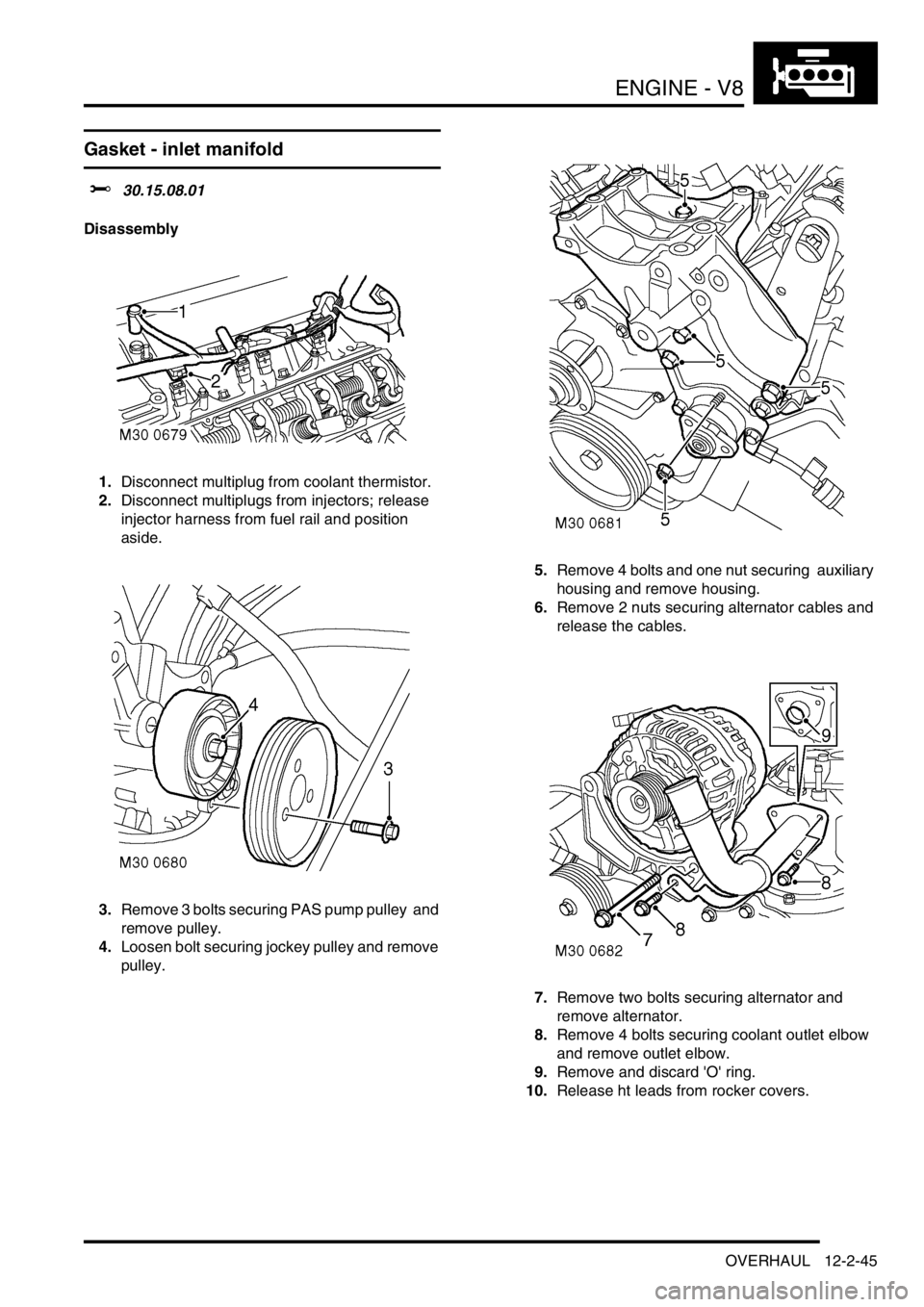
1.Disconnect multiplug from coolant thermistor.
2.Disconnect multiplugs from injectors; release
injector harness from fuel rail and position
aside.
3.Remove 3 bolts securing PAS pump pulley and
remove pulley.
4.Loosen bolt securing jockey pulley and remove
pulley. 5.Remove 4 bolts and one nut securing auxiliary
housing and remove housing.
6.Remove 2 nuts securing alternator cables and
release the cables.
7.Remove two bolts securing alternator and
remove alternator.
8.Remove 4 bolts securing coolant outlet elbow
and remove outlet elbow.
9.Remove and discard 'O' ring.
10.Release ht leads from rocker covers.
Page 237 of 1529

EMISSION CONTROL - V8
17-2-4 DESCRIPTION AND OPERATION
Evaporative emission system (with
positive pressure leak detection)
component layout (NAS only)
1Purge valve
2Service port
3Air filter canister
4EVAP canister breather tube
5Leak detection pump
6EVAP canister
7Vent pipe – fuel tank to EVAP canister
8Liquid vapour separator (metal)9Fuel filler cap
10Fuel filler
11Fuel tank breather assembly
12Vent hose
13Roll over valves (inside fuel tank)
14Fuel tank
15Purge line connection to engine manifold
M17 0208
3
1
7
4
14
11
6
8
10
13
12
15
2
5
9
Page 238 of 1529

EMISSION CONTROL - V8
DESCRIPTION AND OPERATION 17-2-5
Evaporative emission system control
diagram
1Battery
2Fuse 13 (engine compartment fusebox)
3Inertia switch
4Main relay (engine compartment fusebox)
5Engine Control Module (ECM)
6Purge Valve (black harness connector)
7Canister vent solenoid (CVS) valve – NAS
vehicles with vacuum type EVAP system leak
detection capability only8Leak detection pump – NAS vehicles with
positive pressure type EVAP system leak
detection capability only
9Fuel tank pressure sensor – NAS vehicles with
vacuum type EVAP system leak detection
capability only
10Instrument pack (MIL warning light)
M17 0210
12
3
4
5
6
7
9
8
10
Page 242 of 1529

EMISSION CONTROL - V8
DESCRIPTION AND OPERATION 17-2-9
Emission Control Systems
Engine design has evolved in order to minimise the emission of harmful by-products. Emission control systems are
fitted to Land Rover vehicles which are designed to maintain the emission levels within the legal limits pertaining for
the specified market.
Despite the utilisation of specialised emission control equipment, it is still necessary to ensure that the engine is
correctly maintained and is in good mechanical order so that it operates at its optimal condition. In particular, ignition
timing has an effect on the production of HC and NO
x emissions, with the harmful emissions rising as the ignition
timing is advanced.
CAUTION: In many countries it is against the law for a vehicle owner or an unauthorised dealer to modify or
tamper with emission control equipment. In some cases, the vehicle owner and/or the dealer may even be
liable for prosecution.
The engine management ECM is fundamental for controlling the emission control systems. In addition to controlling
normal operation, the system complies with On Board Diagnostic (OBD) system strategies. The system monitors and
reports on faults detected with ignition, fuelling and exhaust systems which cause an excessive increase in tailpipe
emissions. This includes component failures, engine misfire, catalyst damage, catalyst efficiency, fuel evaporative
loss and exhaust leaks.
When an emission relevant fault is determined, the fault condition is stored in the ECM memory. For NAS vehicles,
the MIL warning light on the instrument pack will be illuminated when the fault is confirmed. Confirmation of a fault
condition occurs if the fault is still found to be present during the driving cycle subsequent to the one when the fault
was first detected.
+ ENGINE MANAGEMENT SYSTEM - V8, DESCRIPTION AND OPERATION, Description - engine
management.
The following types of supplementary control system are used to reduce harmful emissions released into the
atmosphere from the vehicle:
1Crankcase emission control – also known as blow-by gas emissions from the engine crankcase.
2Exhaust emission control – to limit the undesirable by-products of combustion.
3Fuel vapour evaporative loss control – to restrict the emission of fuel through evaporation from the fuel
system.
4Fuel leak detection system (NAS only) – there are two types of system which may be used to check the
evaporative emission system for the presence of leaks from the fuel tank to purge valve.
aVacuum leak detection test – checks for leaks down to 1 mm (0.04 in.) in diameter.
bPositive pressure leak detection test – utilises a leak detection pump to check for leaks down to 0.5 mm (0.02
in.) in diameter.
5Secondary air injection system (Where fitted) – to reduce emissions experienced during cold starting.
Page 246 of 1529
EMISSION CONTROL - V8
DESCRIPTION AND OPERATION 17-2-13
Catalytic converters for NAS low emission vehicles (LEVs) from 2000MY have active constituents of
palladium and rhodium only. The active constituents are 14PD: 1Rh and the palladium coating is used to
oxidise the carbon monoxide and hydrocarbons in the exhaust gas.
The metallic coating of platinum and palladium oxidize the carbon monoxide and hydrocarbons and convert them into
water (H
2O) and carbon dioxide (CO2). The coating of rhodium removes the oxygen from nitrogen oxide (NOx) and
converts it into nitrogen (N
2).
CAUTION: Catalytic converters contain ceramic material, which is very fragile. Avoid heavy impacts on the
converter casing.
Downstream of the catalytic converters, the exhaust front pipes merge into a single pipe terminating at a flange joint
which connects to the exhaust intermediate pipe.
WARNING: To prevent personal injury from a hot exhaust system, do not attempt to disconnect any
components until the exhaust system has cooled down.
CAUTION: Serious damage to the catalytic converter will occur if leaded fuel is used. The fuel tank filler neck
is designed to accommodate only unleaded fuel pump nozzles.
CAUTION: Serious damage to the engine may occur if a lower octane number fuel than recommended is used.
Serious damage to the catalytic converter will occur if leaded fuel is used.
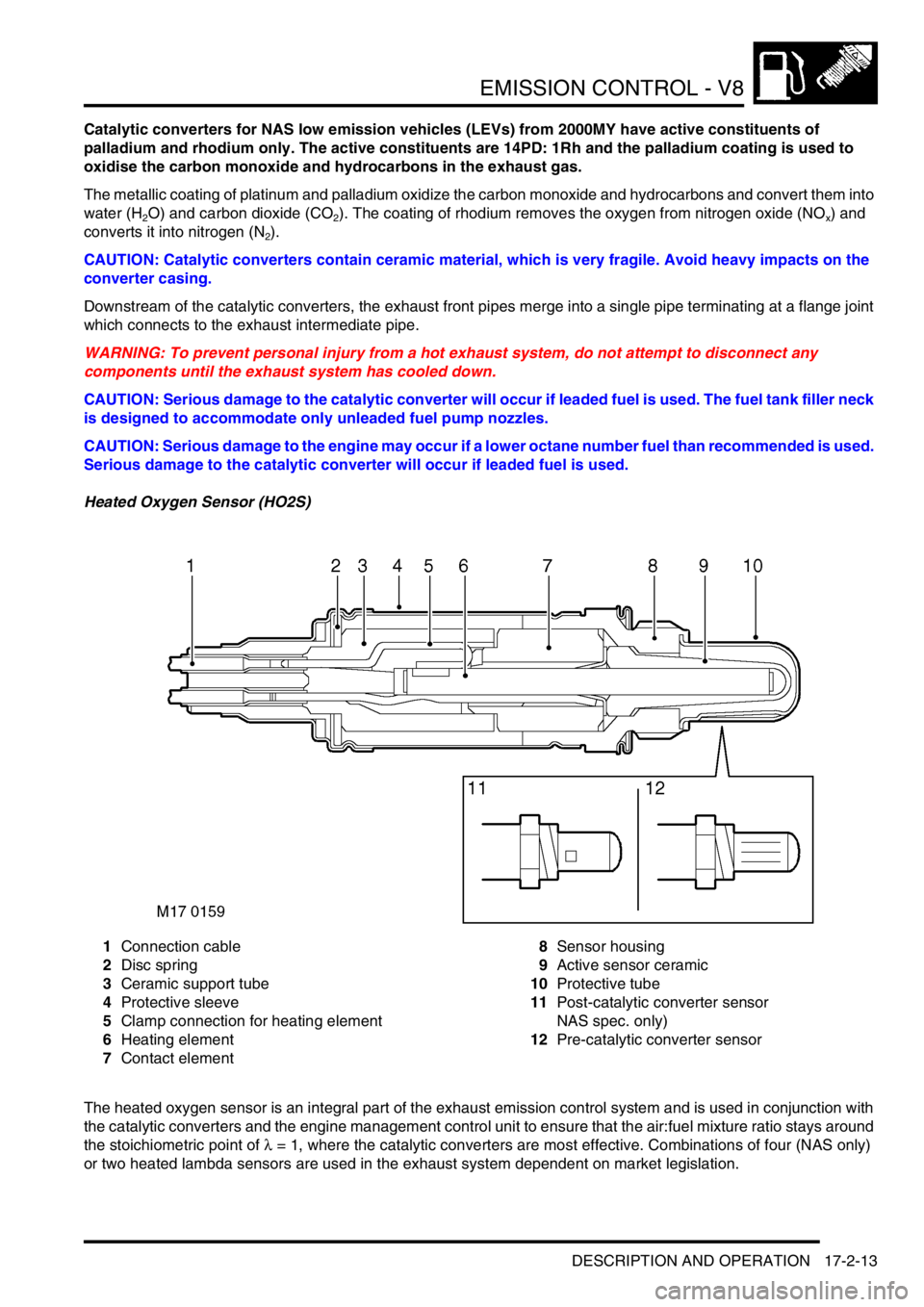
Heated Oxygen Sensor (HO2S)
1Connection cable
2Disc spring
3Ceramic support tube
4Protective sleeve
5Clamp connection for heating element
6Heating element
7Contact element8Sensor housing
9Active sensor ceramic
10Protective tube
11Post-catalytic converter sensor
NAS spec. only)
12Pre-catalytic converter sensor
The heated oxygen sensor is an integral part of the exhaust emission control system and is used in conjunction with
the catalytic converters and the engine management control unit to ensure that the air:fuel mixture ratio stays around
the stoichiometric point of λ = 1, where the catalytic converters are most effective. Combinations of four (NAS only)
or two heated lambda sensors are used in the exhaust system dependent on market legislation.
Page 249 of 1529

EMISSION CONTROL - V8
17-2-16 DESCRIPTION AND OPERATION
The ECM connectors and pins which are pertinent to evaporative emission control are listed in the following table:
Fuel Leak Detection System (vacuum type) – NAS only
The advanced evaporative loss control system equipped with a vacuum type, fuel evaporation leak detection
capability is similar to the standard evaporative loss system, but also includes additional components to enable the
engine control module (ECM) to perform a fuel evaporation leak detection test. The system includes an EVAPs
canister and purge valve, and in addition, a canister vent solenoid (CVS) valve and a fuel tank pressure sensor.
The function of the CVS valve is to block the atmospheric vent side of the EVAP canister under the control of the ECM
so that an evaporation system leak check can be performed. The test is carried out when the vehicle is stationary and
the engine is running at idle speed. The system test uses the natural rate of fuel evaporation and engine manifold
depression. Failure of the leak check will result in illumination of the Malfunction Indicator Lamp (MIL).
The fuel evaporation leak detection is part of the On-Board Diagnostics (OBD) strategy and it is able to determine
vapour leaks from holes or breaks greater than 1 mm (0.04 in.) in diameter. Any fuel evaporation system leaks which
occur between the output of the purge valve and the connection to the inlet manifold cannot be determined using this
test, but these will be detected through the fuelling adaption diagnostics.
Connector / Pin No. Function Signal type Control
C0635-23 Main relay output Output drive Switch to ground
C0635-24 Leak detection pump motor (NAS vehicles
with positive pressure type EVAP system
leak detection only)Output drive Switch to ground
C0636-3 Purge valve drive Output signal PWM 12 - 0V
C0636-6 Fuel tank pressure sensor (NAS vehicles
with vacuum type EVAP system leak
detection only)Ground 0V
C0636-30 Canister vent solenoid (CVS) valve (NAS
vehicles with vacuum type EVAP system
leak detection only) / Fuel leak detection
pump (NAS vehicles with positive pressure
type EVAP system leak detection only)Output drive Switch to ground
C0637-9 Fuel tank pressure sensor (NAS vehicles
with vacuum type EVAP system leak
detection only)Output reference 5V
C0637-12 Analogue fuel level (NAS vehicles with
positive pressure type EVAP system leak
detection only)Input Analogue 0 - 5V
C0637-14 Fuel tank pressure sensor (NAS vehicles
with vacuum type EVAP system leak
detection only)Input signal Analogue 0 - 5V
C0637-20 MIL "ON" Output drive Switch to ground
Page 250 of 1529

EMISSION CONTROL - V8
DESCRIPTION AND OPERATION 17-2-17
Fuel Leak Detection System (positive pressure type) – NAS only
The evaporative loss control system equipped with a positive pressure type, fuel evaporation leak detection capability
is similar to the vacuum type, but it is capable of detecting smaller leaks by placing the evaporation system under the
influence of positive air pressure. The system includes an EVAPs canister and purge valve, and in addition, a leak
detection pump comprising a motor and solenoid valve.
The solenoid valve contained in the leak detection pump assembly performs a similar function to the CVS valve
utilised on the vacuum type pressure test. The solenoid valve is used to block the atmospheric vent side of the EVAP
canister under the control of the ECM so that an EVAP system leak check can be performed. At the same time,
pressurised air from the pump is allowed past the valve into the EVAP system to set up a positive pressure. The test
is carried out at the end of a drive cycle when the vehicle is stationary and the ignition is switched off. The test is
delayed for a brief period (approximately 10 seconds) after the engine is switched off to allow any slosh in the fuel
tank to stabilise. Component validity checks and pressure signal reference checking takes a further 10 seconds before
the pressurised air is introduced into the EVAP system.
During reference checking, the purge valve is closed and the leak detection pump solenoid valve is not energised,
while the leak detection pump is operated. The pressurised air is bypassed through a restrictor which corresponds to
a 0.5 mm (0.02 in) leak while the current consumption of the leak detection pump motor is monitored.
The system test uses the leak detection pump to force air into the EVAP system when the purge valve and solenoid
valves are both closed (solenoid valve energised), to put the evaporation lines, components and fuel tank under the
influence of positive air pressure. Air is drawn into the pump through an air filter which is located in the engine
compartment.
The fuel leak detection pump current consumption is monitored by the ECM while the EVAP system is under pressure,
and compared to the current noted during the reference check. A drop in the current drawn by the leak detection pump
motor, indicates that air is being lost through holes or leaks in the system which are greater than the reference value
of 0.5 mm (0.02 in). An increase in the current drawn by the leak detection pump motor, indicates that the EVAP
system is well sealed and that there are no leaks present which are greater than 0.5 mm (0.02 in).
The presence of leakage points indicates the likelihood of hydrocarbon emissions to atmosphere from the
evaporation system outside of test conditions and the necessity for rectification work to be conducted to seal the
system. Failure of the leak check will result in illumination of the Malfunction Indicator Lamp (MIL).
The fuel evaporation leak detection is part of the On-Board Diagnostics (OBD) strategy and it is able to determine
vapour leaks from holes or breaks down to 0.5 mm (0.02 in.) diameter. Any fuel evaporation leaks which occur
between the output of the purge valve and the connection to the inlet manifold cannot be determined using this test,
but these will be detected through the fuelling adaption diagnostics.
Evaporative Emission Control Components
The evaporative emission control components and the fuel evaporation leak detection test components (NAS only)
are described below:
Page 251 of 1529
EMISSION CONTROL - V8
17-2-18 DESCRIPTION AND OPERATION
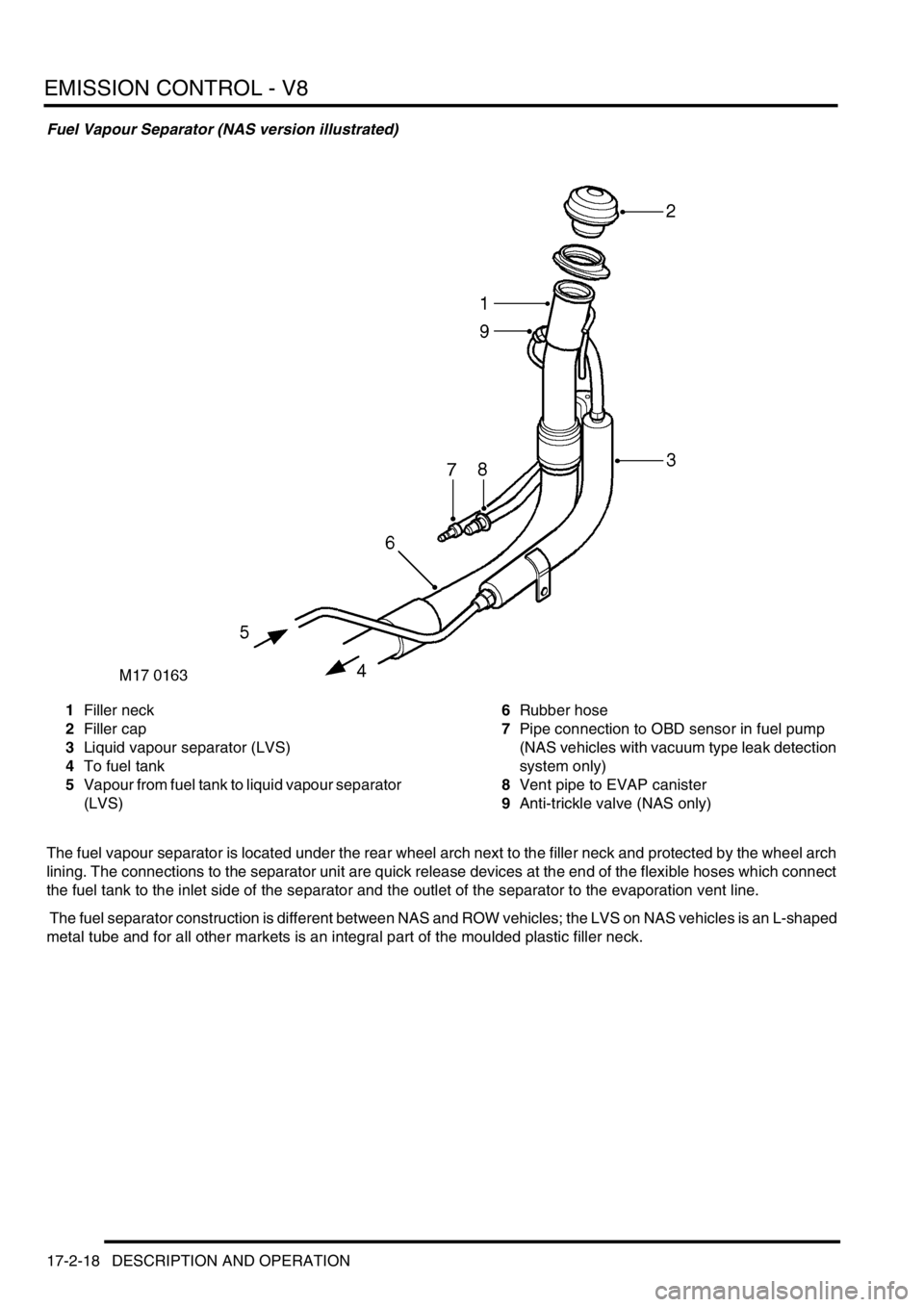
Fuel Vapour Separator (NAS version illustrated)
1Filler neck
2Filler cap
3Liquid vapour separator (LVS)
4To fuel tank
5Vapour from fuel tank to liquid vapour separator
(LVS)6Rubber hose
7Pipe connection to OBD sensor in fuel pump
(NAS vehicles with vacuum type leak detection
system only)
8Vent pipe to EVAP canister
9Anti-trickle valve (NAS only)
The fuel vapour separator is located under the rear wheel arch next to the filler neck and protected by the wheel arch
lining. The connections to the separator unit are quick release devices at the end of the flexible hoses which connect
the fuel tank to the inlet side of the separator and the outlet of the separator to the evaporation vent line.
The fuel separator construction is different between NAS and ROW vehicles; the LVS on NAS vehicles is an L-shaped
metal tube and for all other markets is an integral part of the moulded plastic filler neck.
Page 253 of 1529
EMISSION CONTROL - V8
17-2-20 DESCRIPTION AND OPERATION
For NAS vehicles with positive pressure, EVAP system leak detection capability, the atmosphere vent line from the
EVAP canister connects to a port on the fuel leak detection pump via a short, large bore hose which is secured to the
component ports by crimped metal clips at each end. A large bore plastic hose from the top of the leak detection pump
is routed to the RH side of the engine bay where it connects to an air filter canister. Under normal operating conditions
(when the fuel leak detection solenoid valve is not energised), the EVAP canister is able to take in clean air via the
air filter, through the pipework and past the open solenoid valve to allow normal purge operation to take place and
release any build up of EVAP system pressure to atmosphere.
The EVAP system pipes are clipped at various points along the pipe runs and tied together with tie straps at suitable
points along the runs.
The NAS and ROW EVAP canisters are of similar appearance, but use charcoal of different consistency. The ROW
vehicles use granular charcoal of 11 bwc (butane working capacity) and NAS vehicles use pelletised charcoal with a
higher absorption capacity of 15 bwc. All canisters are of rectangular shape and have capacities of 1.8 litres (3 1/8
imp. pts) with purge foam retention.
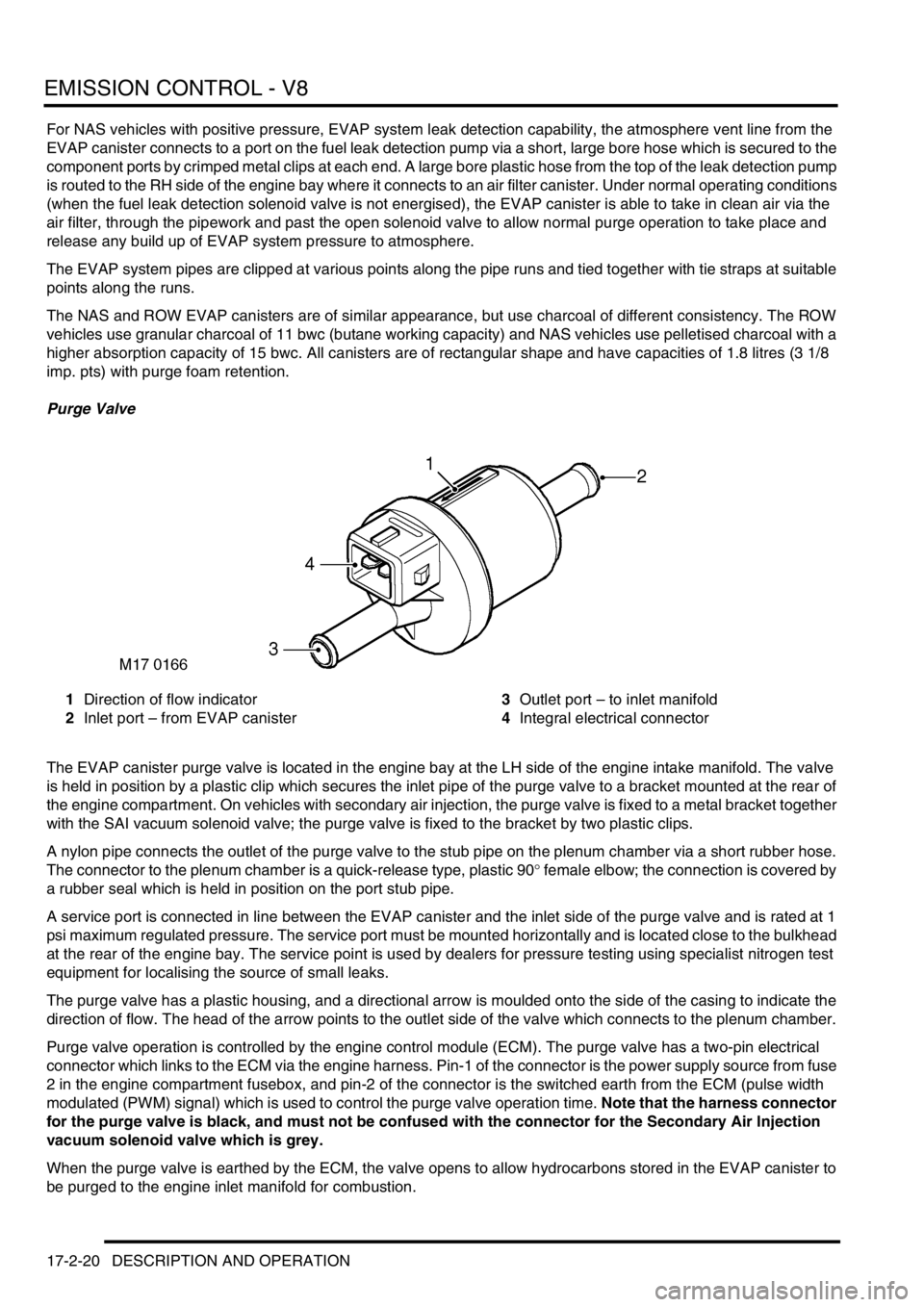
Purge Valve
1Direction of flow indicator
2Inlet port – from EVAP canister3Outlet port – to inlet manifold
4Integral electrical connector
The EVAP canister purge valve is located in the engine bay at the LH side of the engine intake manifold. The valve
is held in position by a plastic clip which secures the inlet pipe of the purge valve to a bracket mounted at the rear of
the engine compartment. On vehicles with secondary air injection, the purge valve is fixed to a metal bracket together
with the SAI vacuum solenoid valve; the purge valve is fixed to the bracket by two plastic clips.
A nylon pipe connects the outlet of the purge valve to the stub pipe on the plenum chamber via a short rubber hose.
The connector to the plenum chamber is a quick-release type, plastic 90° female elbow; the connection is covered by
a rubber seal which is held in position on the port stub pipe.
A service port is connected in line between the EVAP canister and the inlet side of the purge valve and is rated at 1
psi maximum regulated pressure. The service port must be mounted horizontally and is located close to the bulkhead
at the rear of the engine bay. The service point is used by dealers for pressure testing using specialist nitrogen test
equipment for localising the source of small leaks.
The purge valve has a plastic housing, and a directional arrow is moulded onto the side of the casing to indicate the
direction of flow. The head of the arrow points to the outlet side of the valve which connects to the plenum chamber.
Purge valve operation is controlled by the engine control module (ECM). The purge valve has a two-pin electrical
connector which links to the ECM via the engine harness. Pin-1 of the connector is the power supply source from fuse
2 in the engine compartment fusebox, and pin-2 of the connector is the switched earth from the ECM (pulse width
modulated (PWM) signal) which is used to control the purge valve operation time. Note that the harness connector
for the purge valve is black, and must not be confused with the connector for the Secondary Air Injection
vacuum solenoid valve which is grey.
When the purge valve is earthed by the ECM, the valve opens to allow hydrocarbons stored in the EVAP canister to
be purged to the engine inlet manifold for combustion.
Page 255 of 1529
EMISSION CONTROL - V8
17-2-22 DESCRIPTION AND OPERATION
The valve is normally open, allowing any build up of air pressure within the evaporation system to escape, whilst
retaining the environmentally harmful hydrocarbons in the EVAP canister. When the ECM is required to run a fuel
system test, the CVS valve is closed to seal the system. The ECM is then able to measure the pressure in the fuel
evaporative system using the fuel tank pressure sensor.
The ECM performs electrical integrity checks on the CVS valve to determine wiring or power supply faults. The ECM
can also detect a valve blockage if the signal from the fuel tank pressure sensor indicates a depressurising fuel tank
while the CVS valve should be open to atmosphere.
The following failure modes are possible:
lConnector or harness wiring fault (open or short circuit)
lValve stuck open or shut
lValve blocked
If the CVS valve malfunctions, the following fault codes may be stored in the ECM diagnostic memory, which can be
retrieved using TestBook/T4:
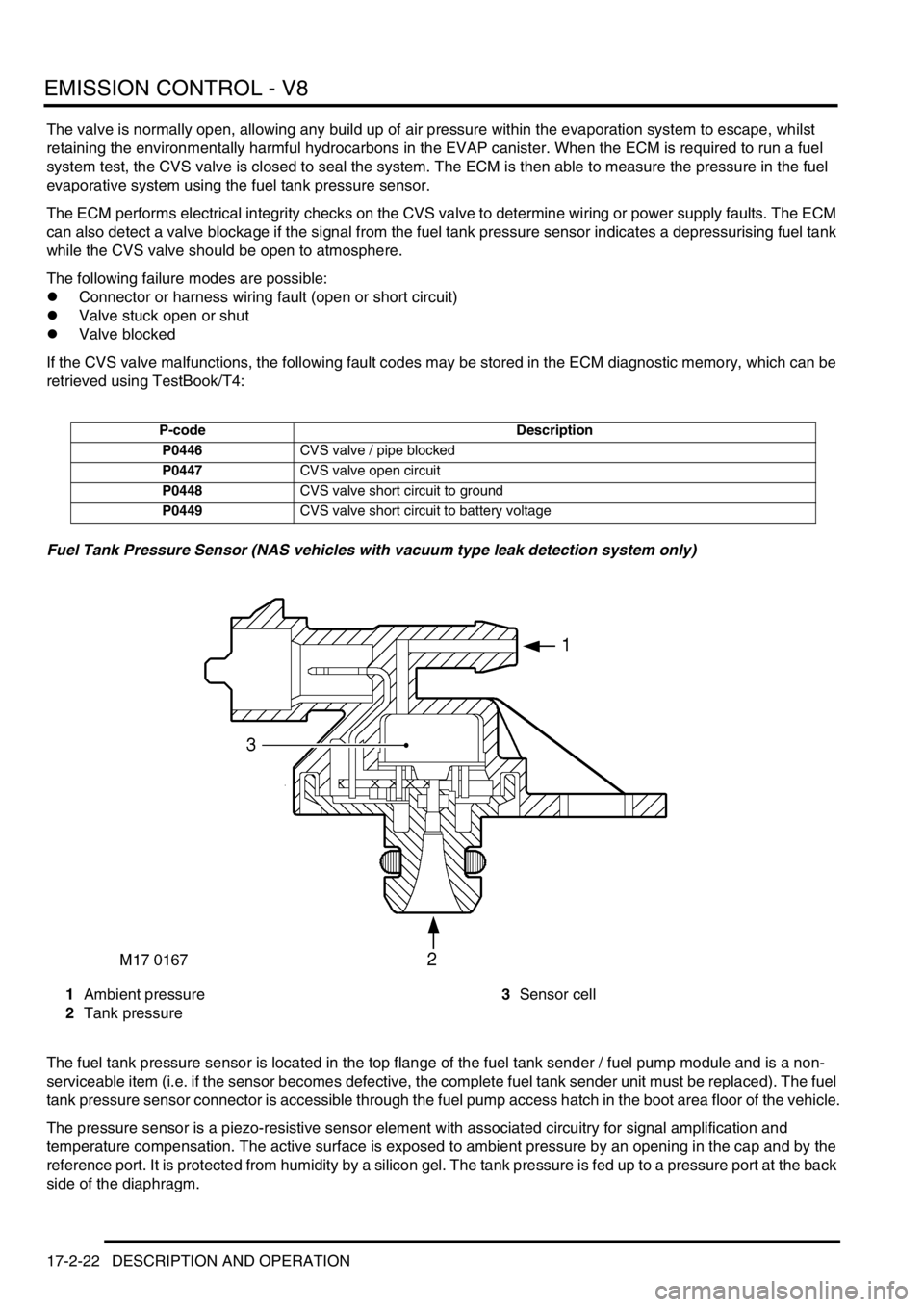
Fuel Tank Pressure Sensor (NAS vehicles with vacuum type leak detection system only)
1Ambient pressure
2Tank pressure3Sensor cell
The fuel tank pressure sensor is located in the top flange of the fuel tank sender / fuel pump module and is a non-
serviceable item (i.e. if the sensor becomes defective, the complete fuel tank sender unit must be replaced). The fuel
tank pressure sensor connector is accessible through the fuel pump access hatch in the boot area floor of the vehicle.
The pressure sensor is a piezo-resistive sensor element with associated circuitry for signal amplification and
temperature compensation. The active surface is exposed to ambient pressure by an opening in the cap and by the
reference port. It is protected from humidity by a silicon gel. The tank pressure is fed up to a pressure port at the back
side of the diaphragm.
P-code Description
P0446CVS valve / pipe blocked
P0447CVS valve open circuit
P0448CVS valve short circuit to ground
P0449CVS valve short circuit to battery voltage