fuel pump LAND ROVER DISCOVERY 1999 Owner's Manual
[x] Cancel search | Manufacturer: LAND ROVER, Model Year: 1999, Model line: DISCOVERY, Model: LAND ROVER DISCOVERY 1999Pages: 1529, PDF Size: 34.8 MB
Page 257 of 1529

EMISSION CONTROL - V8
17-2-24 DESCRIPTION AND OPERATION
Leak Detection Pump (NAS vehicles with positive pressure EVAP system leakage test only)
1Harness connector
2Leak detection pump motor
3Atmosphere connection to/from EVAP canister4Atmosphere connection to/from air filter
5Leak detection pump solenoid valve
The fuel evaporation leak detection pump is mounted forward of the EVAP canister on a bracket fitted beneath the
vehicle on the RH side of the vehicle chassis. The leak detection pump is fixed to the bracket by three screws through
the bottom of the bracket.
A short hose connects between the atmosphere vent port of the EVAP canister and a port at the rear of the fuel
evaporation leak detection pump. The hose is secured to the ports at each end by crimped metal band clips.
An elbowed quick fit connector on the top of the fuel evaporation leak detection pump connects to atmosphere via a
large bore pipe. The pipe is routed along the underside of the vehicle chassis and up into the RH side of the engine
compartment where it connects to an air filter canister.
The leak detection pump incorporates a 3–pin electrical connector. Pin-1 is the earth switched supply to the ECM for
control of the pump solenoid valve. Pin-2 is the earth switched supply to the ECM for the operation of the pump motor.
Pin-3 is the power supply to the pump motor and solenoid valve and is switched on at system start up via the main
relay and fuse 2 in the engine compartment fusebox.
Under normal circumstances (i.e. when the leak detection pump is not operating and the solenoid is not energised),
the EVAP canister vent port is connected to atmosphere via the open solenoid valve.
The pump is operated at the end of a drive cycle when the vehicle is stationary and the ignition is switched off.
The leak detection pump module contains an integral air by-pass circuit with restrictor (reference-leak orifice) which
is used for providing a reference value for the leak detection test. The restrictor corresponds to an air leak equivalent
to 0.5 mm (0.02 in) diameter. With the solenoid valve open and the purge valve closed, the pump forces pressurised
air through the orifice while the current drawn by the leak detection pump motor is monitored to obtain the reference
value. The orifice must be kept free from contamination, otherwise the reference restriction may appear less than for
a 0.5 mm leak and consequently adversely affect the diagnostic results.
M17 0213
3
4
5
1
2
Page 258 of 1529

EMISSION CONTROL - V8
DESCRIPTION AND OPERATION 17-2-25
During the leakage test, the solenoid valve is energised, closing the atmosphere vent line between the EVAP canister
and atmosphere and opening a path to the pressurised air supplied from the leak detection pump motor. Air is pumped
into the EVAP system, while the current drawn by the pump motor is monitored. The current drawn during the leakage
test is compared against the value obtained during the reference check, to determine if an EVAP system leak is
present.
The fuel leak detection pump is powered from a 12V supply and operates at a working pressure of 3 kPa.
Air Filter – (NAS vehicles with positive pressure leak detection system only)
1Air vents through canister lid
2Air filter canister3To fuel leak detection pump
(EVAP canister atmosphere vent)
A paper element air filter (40 µm) is located in a plastic canister at the RH side of the engine compartment. The air
filter canister is fixed to the cruise control mounting bracket by a single nut and bolt. A large bore plastic pipe is
connected to a port at the base of the air filter canister and is secured to the port by a short nylon hose and two crimped
metal band clips.
The air filter is used to prevent particulate contaminants down to 40 µm from entering the fuel leak detection pump.
A press-fit lid on top of the canister contains slots to allow the passage of air into and out of the EVAP system.
The bottom end of the paper element is sealed to the canister and is non-serviceable (i.e fit for life). If necessary, the
canister and paper filter must be replaced as a single, complete assembly.
M17 0203
2
1
3
Page 259 of 1529

EMISSION CONTROL - V8
17-2-26 DESCRIPTION AND OPERATION
Secondary Air Injection System
The secondary air injection (SAI) system comprises the following components:
lSecondary air injection pump
lSAI vacuum solenoid valve
lSAI control valves (2 off, 1 for each bank of cylinders)
lSAI pump relay
lVacuum reservoir
lVacuum harness and pipes
The secondary air injection system is used to limit the emission of carbon monoxide (CO) and hydrocarbons (HCs)
that are prevalent in the exhaust during cold starting of a spark ignition engine. The concentration of hydrocarbons
experienced during cold starting at low temperatures are particularly high until the engine and catalytic converter
reach normal operating temperature. The lower the cold start temperature, the greater the prevalence of
hydrocarbons emitted from the engine.
There are several reasons for the increase of HC emissions at low cold start temperatures, including the tendency for
fuel to be deposited on the cylinder walls, which is then displaced during the piston cycle and expunged during the
exhaust stroke. As the engine warms up through operation, the cylinder walls no longer retain a film of fuel and most
of the hydrocarbons will be burnt off during the combustion process.
The SAI pump is used to provide a supply of air into the exhaust ports in the cylinder head, onto the back of the
exhaust valves, during the cold start period. The hot unburnt fuel particles leaving the combustion chamber mix with
the air injected into the exhaust ports and immediately combust. This subsequent combustion of the unburnt and
partially burnt CO and HC particles help to reduce the emission of these pollutants from the exhaust system. The
additional heat generated in the exhaust manifold also provides rapid heating of the exhaust system catalytic
converters. The additional oxygen which is delivered to the catalytic converters also generate an exothermic reaction
which causes the catalytic converters to 'light off' quickly.
The catalytic converters only start to provide effective treatment of emission pollutants when they reach an operating
temperature of approximately 250°C (482°F) and need to be between temperatures of 400°C (752°F) and 800°C
(1472°F) for optimum efficiency. Consequently, the heat produced by the secondary air injection “afterburning”,
reduces the time delay before the catalysts reach an efficient operating temperature.
The ECM checks the engine coolant temperature when the engine is started in addition to the elapsed time since the
engine was last started. The engine coolant temperature must be below 55°C (131°F) for the SAI pump to run.
NOTE: The ambient air temperature must also be above 8
°C (46°F) for the SAI pump to run.
Also, depending on the long term 'modelled' ambient temperature determined by the ECM, the minimum elapsed time
required since the last engine start can be up to 8.25 hours. The period of time that the SAI pump runs for depends
on the starting temperature of the engine and varies from approximately 96 seconds at 8°C (46°F) to 30 seconds at
55°C (131°F).
Air from the SAI pump is supplied to the SAI control valves via pipework and an intermediate T-piece which splits the
air flow evenly to each bank.
At the same time the secondary air pump is started, the ECM operates a SAI vacuum solenoid valve, which opens to
allow vacuum from the reservoir to be applied to the vacuum operated SAI control valves on each side of the engine.
When the vacuum is applied to the SAI control valves, they open simultaneously to allow the air from the SAI pump
through to the exhaust ports. Secondary air is injected into the inner most exhaust ports on each bank.
When the ECM breaks the ground circuit to de-energise the SAI vacuum solenoid valve, the vacuum supply to the
SAI control valves is cut off and the valves close to prevent further air being injected into the exhaust manifold. At the
same time as the SAI vacuum solenoid valve is closed, the ECM opens the ground circuit to the SAI pump relay, to
stop the SAI pump.
A vacuum reservoir is included in the vacuum line between the intake manifold and the SAI vacuum solenoid valve.
This prevents changes in vacuum pressure from the intake manifold being passed on to cause fluctuations of the
secondary air injection solenoid valve. The vacuum reservoir contains a one way valve and ensures a constant
vacuum is available for the SAI vacuum solenoid valve operation. This is particularly important when the vehicle is at
high altitude.
Page 275 of 1529

EMISSION CONTROL - V8
17-2-42 DESCRIPTION AND OPERATION
If the piping is broken forward of the purge valve or is not connected, the engine may run rough and fuelling adaptions
will drift. The fault will not be detected by the leak detection diagnostic, but it will be determined by the engine
management ECM through the fuelling adaption diagnostics.
The evaluation of leakage is dependent on the differential pressure between the fuel tank and ambient atmospheric
pressure, the diagnostic is disabled above altitudes of 9500 ft. (2800 m) to avoid false detection of fuel leaks due to
the change in atmospheric pressure at altitude.
Fuel Leak Detection System Operation (positive pressure leak detection type) – NAS only
The EVAP system with positive pressure leak detection capability used on NAS vehicles is similar to the standard
system, but also includes a fuel evaporation leak detection pump with integral solenoid valve. It is capable of detecting
holes in the EVAP system down to 0.5 mm (0.02 in.). The test is carried out at the end of a drive cycle, when the
vehicle is stationary and the ignition switch has been turned off. The ECM maintains an earth supply to the Main relay
to hold it on, so that power can be supplied to the leak detection pump.
First a reference measurement is established by passing the pressurised air through a by-pass circuit containing a
fixed sized restriction. The restriction assimilates a 0.5 mm (0.02 in) hole and the current drawn by the pump motor
during this procedure is recorded for comparison against the value to be obtained in the system test. The purge valve
is held closed, and the reversing valve in the leak detection pump module is not energised while the leak detection
pump is switched on. The pressurised air from the leak detection pump is forced through an orifice while the current
drawn by the pump motor is monitored.
Next the EVAP system diagnostic is performed; the solenoid valve is energised so that it closes off the EVAP system's
vent line to atmosphere, and opens a path for the pressurised air from the leak detection pump to be applied to the
closed EVAP system.
The current drawn by the leak detection pump is monitored and checked against that obtained during the reference
measurement. If the current is less than the reference value, this infers there is a hole in the EVAP system greater
than 0.5 mm (0.02 in) which is allowing the positive air pressure to leak out. If the current drawn by the pump motor
is greater than the value obtained during the reference check, the system is sealed and free from leaks. If an EVAP
system leak is detected, the ECM stores the fault in diagnostic memory and the MIL light on the instrument pack is
illuminated.
On NAS vehicles, the ECM works on a 2 trip cycle before illuminating the MIL. On EU-3 vehicles, the ECM works on
a 3 trip cycle before illuminating the MIL.
Following the test, the solenoid valve is opened to normalise the EVAP system pressure and the system returns to
normal purge operation at the start of the next drive cycle. Possible reasons for an EVAP system leak test failure are
listed below:
lFuel filler not tightened or cap missing.
lSensor or actuator open circuit.
lShort circuit to vehicle supply or ground.
lEither purge or solenoid valve stuck open.
lEither purge or solenoid valve stuck shut.
lBlocked pipe or air filter.
lPiping broken or not connected.
lLoose or leaking connection.
If the piping is broken forward of the purge valve or is not connected, the engine may run rough and fuelling adaptions
will drift. The fault will not be detected by the leak detection test, but will be determined by the engine management
ECM through the fuelling adaption diagnostics. This test can be run from TestBook/T4.
Page 285 of 1529

EMISSION CONTROL - V8
17-2-52 REPAIRS
Canister - EVAP - Models with Fuel Leak
Detection Pump - up to 03MY
$% 17.15.13
Remove
1.Raise vehicle on lift.
2.Remove 3 Torx screws securing fuel leak
detection pump to mounting bracket.
3.Remove 3 bolts securing EVAP canister
mounting bracket to chassis longitudinal.4.Remove 2 bolts securing EVAP canister to
mounting bracket and collect clamp.
5.Remove mounting bracket.
6.Position cloth to absorb any fuel spillage.
7.Release purge and tank vent pipes from EVAP
canister.
8.Remove clip securing fuel leak detection pump
pipe to EVAP canister.
9.Release pipe from EVAP canister and remove
canister.
CAUTION: Plug the connections.
Refit
1.Remove plugs and ensure all connections are
clean.
2.Connect fuel leak detection pump pipe to EVAP
canister and secure with clip.
3.Connect purge and tank vent pipes to EVAP
canister.
4.Position mounting bracket to EVAP canister
and secure with bolts.
5.Position mounting bracket to chassis
longitudinal and tighten bolts.
6.Fit Torx screws securing fuel leak detection
pump to mounting bracket.
7.Lower vehicle.
M17 02192
M17 0220
M17 0221
4
4
4
9
7
7
5
8
Page 286 of 1529

EMISSION CONTROL - V8
REPAIRS 17-2-53
Canister - EVAP - Models with Fuel Leak
Detection Pump - from 03MY
$% 17.15.13
Remove
1.Raise the vehicle on lift.
2.Disconnect multiplug from the fuel leak
detection pump.
3.Disconnect the fuel leak detection filter pipe
from the fuel leak detection pump.
4.Release clips and disconnect 2 vent pipes from
the EVAP canister.
CAUTION: Always fit plugs to open
connections to prevent contamination.5.Remove and discard 4 bolts securing EVAP
canister mounting bracket to the chassis and
remove the EVAP canister assembly.
NOTE: Do not carry out further dismantling if
component is removed for access only.
6.Remove bolt securing EVAP canister retaining
clamp to the mounting bracket and collect the
clamp.
7.Remove nut and bolt securing EVAP canister to
the mounting bracket.
Page 287 of 1529

EMISSION CONTROL - V8
17-2-54 REPAIRS
8.Remove and discard clip securing fuel leak
detection pump fuel pipe to the EVAP canister
and disconnect the fuel pipe.
9.Remove the EVAP canister.
Refit
1.Position EVAP canister to the mounting
bracket.
2.Connect fuel leak detection pump fuel pipe to
the EVAP canister and secure with a new clip.
3.Fit nut and bolt securing EVAP canister to the
mounting bracket and tighten to 10 Nm (7 lbf.ft).
4.Position EVAP canister retaining clamp to the
mounting bracket, fit bolt and tighten to 10 Nm
(7 lbf.ft).
5.Position EVAP canister mounting bracket to the
chassis, fit new bolts and tighten to 25 Nm (18
lbf.ft).
6.Connect vent pipes to the EVAP canister.
7.Connect multiplug to the fuel leak detection
pump.
8.Connect the fuel leak detection filter pipe to the
fuel leak detection pump.
9.Lower the vehicle lift.
Valve - purge control
$% 17.15.39
Remove
1.Disconnect multiplug from purge control valve.
2.Release clips securing hoses to purge control
valve.
3.Disconnect hoses from purge control valve and
remove valve.
CAUTION: Always fit plugs to open
connections to prevent contamination.
Refit
1.Position purge control valve and connect
hoses.
2.Fit clips to secure hoses to purge control valve.
3.Connect multiplug to purge control valve.
Page 297 of 1529
EMISSION CONTROL - V8
17-2-64 REPAIRS
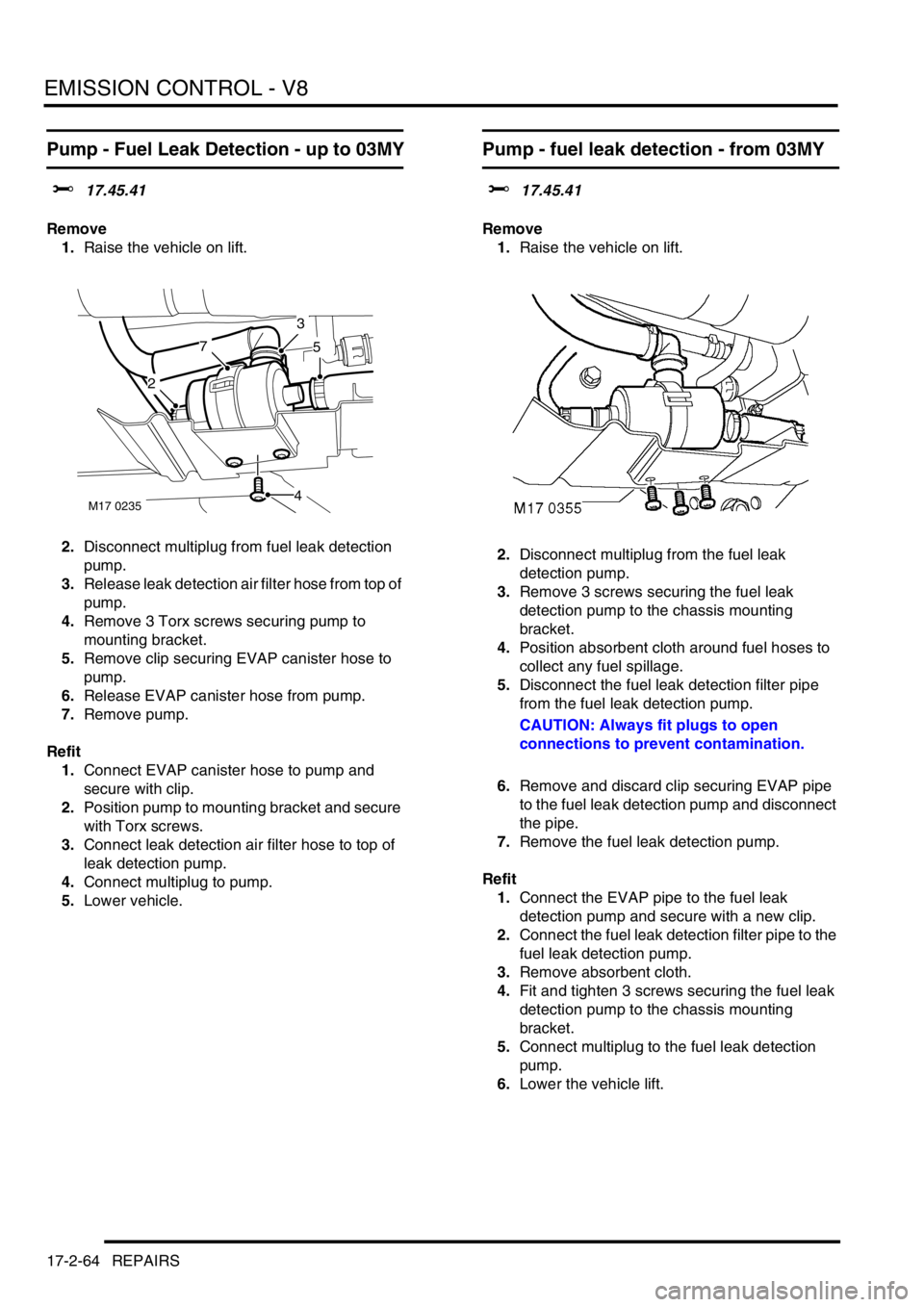
Pump - Fuel Leak Detection - up to 03MY
$% 17.45.41
Remove
1.Raise the vehicle on lift.
2.Disconnect multiplug from fuel leak detection
pump.
3.Release leak detection air filter hose from top of
pump.
4.Remove 3 Torx screws securing pump to
mounting bracket.
5.Remove clip securing EVAP canister hose to
pump.
6.Release EVAP canister hose from pump.
7.Remove pump.
Refit
1.Connect EVAP canister hose to pump and
secure with clip.
2.Position pump to mounting bracket and secure
with Torx screws.
3.Connect leak detection air filter hose to top of
leak detection pump.
4.Connect multiplug to pump.
5.Lower vehicle.
Pump - fuel leak detection - from 03MY
$% 17.45.41
Remove
1.Raise the vehicle on lift.
2.Disconnect multiplug from the fuel leak
detection pump.
3.Remove 3 screws securing the fuel leak
detection pump to the chassis mounting
bracket.
4.Position absorbent cloth around fuel hoses to
collect any fuel spillage.
5.Disconnect the fuel leak detection filter pipe
from the fuel leak detection pump.
CAUTION: Always fit plugs to open
connections to prevent contamination.
6.Remove and discard clip securing EVAP pipe
to the fuel leak detection pump and disconnect
the pipe.
7.Remove the fuel leak detection pump.
Refit
1.Connect the EVAP pipe to the fuel leak
detection pump and secure with a new clip.
2.Connect the fuel leak detection filter pipe to the
fuel leak detection pump.
3.Remove absorbent cloth.
4.Fit and tighten 3 screws securing the fuel leak
detection pump to the chassis mounting
bracket.
5.Connect multiplug to the fuel leak detection
pump.
6.Lower the vehicle lift.
M17 0235
2
3
4
57
Page 298 of 1529
EMISSION CONTROL - V8
REPAIRS 17-2-65
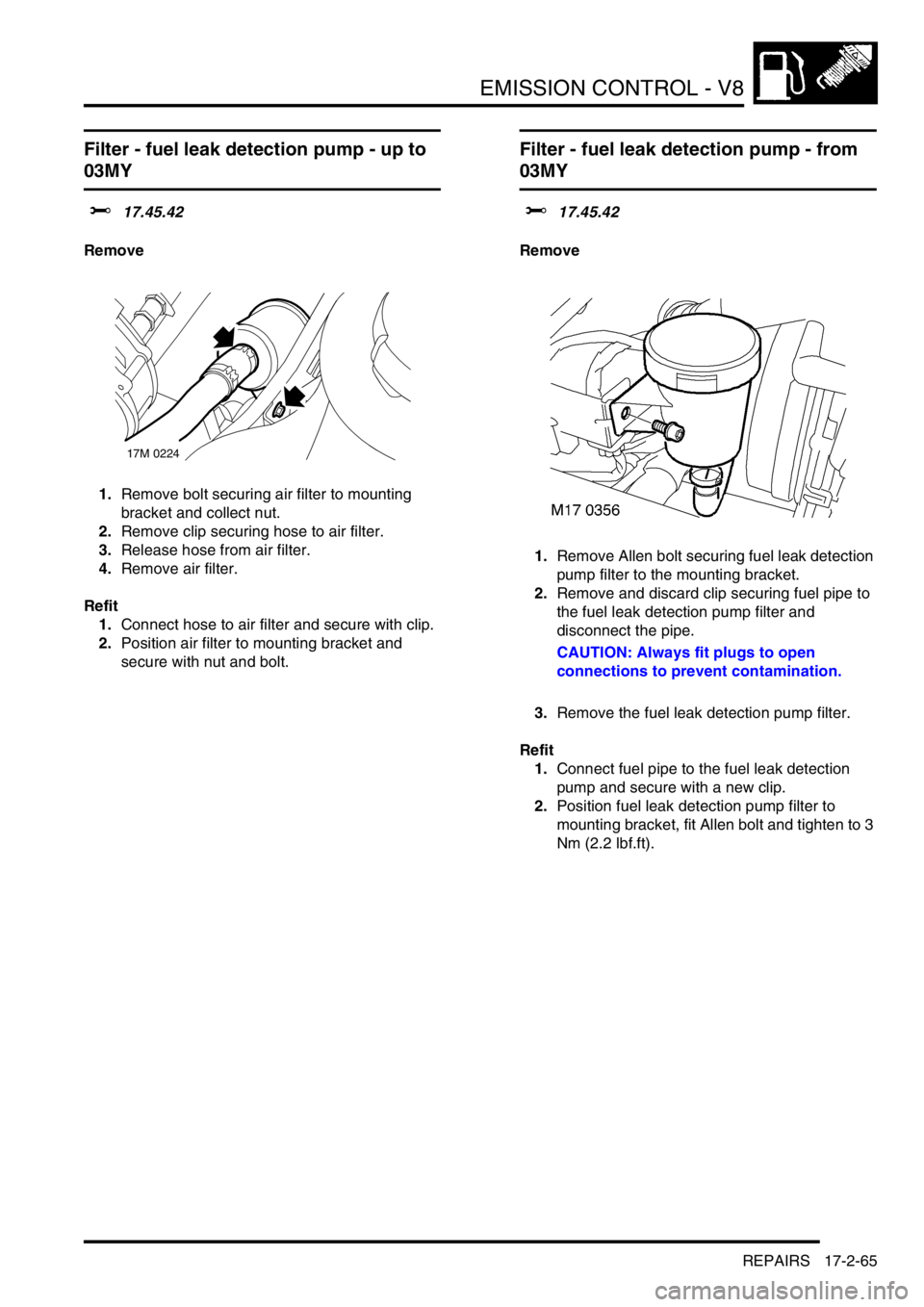
Filter - fuel leak detection pump - up to
03MY
$% 17.45.42
Remove
1.Remove bolt securing air filter to mounting
bracket and collect nut.
2.Remove clip securing hose to air filter.
3.Release hose from air filter.
4.Remove air filter.
Refit
1.Connect hose to air filter and secure with clip.
2.Position air filter to mounting bracket and
secure with nut and bolt.
Filter - fuel leak detection pump - from
03MY
$% 17.45.42
Remove
1.Remove Allen bolt securing fuel leak detection
pump filter to the mounting bracket.
2.Remove and discard clip securing fuel pipe to
the fuel leak detection pump filter and
disconnect the pipe.
CAUTION: Always fit plugs to open
connections to prevent contamination.
3.Remove the fuel leak detection pump filter.
Refit
1.Connect fuel pipe to the fuel leak detection
pump and secure with a new clip.
2.Position fuel leak detection pump filter to
mounting bracket, fit Allen bolt and tighten to 3
Nm (2.2 lbf.ft).
17M 0224
Page 302 of 1529

ENGINE MANAGEMENT SYSTEM - V8
DESCRIPTION AND OPERATION 18-2-3
1Mass air flow/ inlet air temperature sensor
2Fuel injectors
3High tension leads/spark plugs
4Fuel pump relay
5ATC compressor clutch relay/ cooling fan relay
6Throttle position sensor
7Heated oxygen sensor
8Idle air control valve
9Ignition coils
10Engine coolant temperature sensor
11Crankshaft speed and position sensor
12Knock sensor
13Camshaft position sensor