wiring LAND ROVER DISCOVERY 1999 User Guide
[x] Cancel search | Manufacturer: LAND ROVER, Model Year: 1999, Model line: DISCOVERY, Model: LAND ROVER DISCOVERY 1999Pages: 1529, PDF Size: 34.8 MB
Page 342 of 1529

ENGINE MANAGEMENT SYSTEM - V8
DESCRIPTION AND OPERATION 18-2-43
The ECM performs the following diagnostic checks to confirm correct knock sensor operation:
lKS signal level is less than the minimum threshold (dependent on engine speed) – the engine must be running,
coolant temperature above 60°C (140°F), number of camshaft revolutions since start greater than 50 and the KS
signal profile must be less than the threshold value at a given engine speed for a fault condition to be flagged
lKS signal is greater than the maximum threshold (dependent on engine speed) – the engine must be running,
coolant temperature above 60°C (140°F), number of camshaft revolutions since start greater than 50 and the KS
signal profile must be greater than the threshold value at a given engine speed for a fault condition to be flagged
lError counter for verification of knock internal circuitry exceeded – the engine must be running, coolant
temperature above 60°C (140°F), number of camshaft revolutions since start greater than 50 and the error
counter greater than the threshold value at a given engine speed for a fault condition to be flagged
Should a malfunction of the component occur the following fault codes may be evident and can be retrieved by
TestBook:
Spark plugs
The spark plugs are platinum tipped on both centre and earth electrodes. The platinum tips give a long maintenance
free life.
Cleaning or resetting the spark plug gap is not recommended as this could result in damaging the platinum tips and
thereby reducing reliability.
The misfire detection system will malfunction and store erroneous codes if the incorrect spark plugs are used.
Input/Output
The ignition coils provide a voltage to the spark plugs via the ht leads. The cylinder head via the individual thread of
each spark plug provides the earth path.
The spark plugs can fail in the following ways:
lFaulty component.
lConnector or wiring fault.
lBreakdown of high tension lead causing tracking to chassis earth.
lIncorrect spark plugs fitted.
In the event of a spark plug failure, misfire on specific cylinder may be observed:
P Code J2012 Description Land Rover Description
P0327 Knock sensor 1 circuit low input (bank 1 or single
sensor)LH bank signal less than threshold determined from
ECM model above 2200 rev/min
P0328 Knock sensor 1 circuit high input (bank 1 or
single sensor)LH bank signal greater than threshold determined from
ECM model above 2200 rev/min
P0332 Knock sensor 2 circuit low input (bank 2) RH bank signal less than threshold determined from
ECM model above 2200 rev/min
P0333 Knock sensor 2 circuit high input (bank 2) RH bank signal greater than threshold determined from
ECM model above 2200 rev/min
Page 343 of 1529

ENGINE MANAGEMENT SYSTEM - V8
18-2-44 DESCRIPTION AND OPERATION
High tension (ht) leads
The ht leads are located on top of the engine, below the plenum chamber. Their function is to transfer the ht voltage
generated by the ignition coils to the spark plugs in the engine.
Input/Output
The input to the ht lead is ht voltage from the ignition coil pack. The ht lead then supplies this voltage to the spark
plug. Output ht voltage is used by the spark plugs to ignite the air/fuel mixture in the combustion chamber.
The ht leads can fail in the following ways:
lConnector/ Wiring fault.
lFaulty component causing spark tracking to chassis earth.
lDamage to ht leads during component removal.
In the event of a ht lead failure the following symptom may be observed:
lMisfire on specific cylinder.
All ignition system related faults are diagnosed by the misfire detection system and its fault codes.
Hill Decent Control (HDC)
Refer to Brakes for description of the hill descent control.
+ BRAKES, DESCRIPTION AND OPERATION, Description.
High/Low ratio switch
Refer to Transfer Box for description of the high/ low ratio switch transfer box components.
+ TRANSFER BOX - LT230SE, DESCRIPTION AND OPERATION, Description.
Page 345 of 1529

ENGINE MANAGEMENT SYSTEM - V8
18-2-46 DESCRIPTION AND OPERATION
Input/Output
The operation of the ATC request is via a switch being connected to earth. Voltage is supplied via pin 38 of connector
C0637 of the ECM, at the point at when the switch is pressed the connection is made and the ATC clutch is engaged.
The ATC request can fail as follows:
lOpen circuit.
lShort circuit to voltage supply.
lShort circuit to vehicle earth.
lWiring loom fault.
In the event of an ATC request failure, the ATC system does not work.
Should a malfunction of the component occur the following fault codes may be evident and can be retrieved by
TestBook.
P Code J2012 Description Land Rover Description
P1535 Air conditioning compressor request
malfunctionATC requested when not in standby mode
Page 354 of 1529

ENGINE MANAGEMENT SYSTEM - V8
DESCRIPTION AND OPERATION 18-2-55
Vehicle Speed Signal (VSS)
The VSS is used, by the ECM, to control idle speed and overrun cut off. The ECM receives the signal through a hard
wired connection direct from the SLABS ECU.
For vehicles fitted with an automatic gearbox, two vehicle speed signals are received by the ECM. The second signal
is derived from the main gearbox output shaft speed, and is sent to the ECM by the Electronic Automatic Transmission
(EAT) ECU though the Controller Area Network (CAN). The ECM compares the vehicle speed signal generated by
the SLABS ECU with that supplied via the CAN.
The ECM also receives transfer box information. This allows the ECM to take in to account the vehicle being driven
using low range gearing and compensate as necessary.
On vehicles with manual transmission, the SLABS signal is checked against a threshold value stored in ECM memory.
If other engine parameters indicate the engine is at high load and the VSS is below the threshold, a fault condition is
registered in the diagnostic memory.
The vehicle speed signal generated by the SLABS ECU is in the form of a pulse width modulated signal (PWM).
Pulses are generated at 8000 per mile, and the frequency of the signal changes in accordance with road speed. At
zero road speed the ECU outputs a reference signal at a frequency of 2Hz for diagnostic purposes.
Function
The input signal for the SLABS ECU is measured via pin 22 of connector C0637 of the ECM. The SLABS ECU
generates a PWM signal switching between 0 and 12 volts at a frequency of 8000 pulses per mile. For vehicles with
automatic gearbox the input signal for the EAT ECU is measured via pins 36 and 37 of connector C0637 of the ECM.
These pin numbers provide a bi-directional communications link using the CAN data bus.
In the case of a VSS failure on vehicles with automatic gearboxes, the ECM applies default values derived from the
EAT ECU. There are no default values for manual gearbox vehicles.
The VSS can fail in the following ways:
lWiring short circuit to vehicle supply.
lWiring short circuit to vehicle earth.
lWiring open circuit.
In the event of a VSS failure, any of the following symptoms may be observed:
lMIL illuminated after 2 driving cycles (NAS only).
lVehicle speed limiting disabled (manual transmission vehicles only).
lSLABS/HDC warning lamp on and audible warning.
Should a malfunction of the component occur the following fault codes may be evident and can be retrieved by
TestBook:
Rough road signal
When the vehicle travels across rough terrain, or on rough roads instability becomes evident in the drive train. The
ECM could interpret these vibrations as a 'false misfire'. To counteract this 'false misfire' the SLABS ECU generates
a rough road signal, sends it to the ECM so that the ECM can suspend misfire detection for as long as the vehicle is
travelling on the 'rough road'.
P Code J2012 Description Land Rover Description
P0500 Vehicle speed sensor malfunction VSS short or open circuit
P0501 Vehicle speed sensor range/performance VSS implausible
Page 356 of 1529

ENGINE MANAGEMENT SYSTEM - V8
DESCRIPTION AND OPERATION 18-2-57
Low fuel level signal
When the fuel level in the fuel tank becomes low enough to illuminate the low fuel level warning lamp in the instrument
cluster, the instrument cluster generates a low fuel level signal. If the low fuel level signal is present during the ECM
misfire detection function the ECM can use it to check for a 'false misfire'.
Conditions
The fuel sender generates the low fuel level signal when the fuel sender resistance is greater than 158 ± 8 ohms.
Function
The illumination of the low fuel level warning lamp in the instrument cluster triggers the low fuel level signal to be sent
to the ECM. This signal is processed via pin 8 of connector C0637 of the ECM.
Should a misfire occur while the fuel level is low, the following fault code may be evident and can be retrieved by
TestBook.
Coolant temperature gauge signal
The ECM controls the temperature gauge in the instrument cluster. The ECM sends a coolant temperature signal to
the temperature gauge in the instrument cluster in the form of a PWM square wave signal.
The frequency of the signal determines the level of the temperature gauge.
Conditions
The ECM operates the PWM signal under the following parameters:
l-40 °C (-40 °F) = a pulse width of 768 µs.
l140 °C (284 °F) = a pulse width of 4848 µs.
Function
The coolant temperature signal is an output from the ECM to the instrument cluster. The coolant temperature signal
is generated via pin 44 of connector C0636 of the ECM.
The coolant temperature signal can fail in the following ways:
lWiring short circuit to vehicle supply.
lWiring short circuit to vehicle earth.
lWiring open circuit.
In the event of a coolant temperature signal failure any of the following symptoms may be observed:
lCoolant temperature gauge will read cold at all times.
lCoolant temperature warning lamp remains on at all times.
Controller Area Network (CAN) system
The controller area network (CAN) system is a high speed serial interface between the ECM and the Electronic
Automatic Transmission (EAT) ECU. The CAN system uses a 'data bus' to transmit information messages between
the ECM and the EAT ECU. Because there are only two components in this CAN system, one will transmit information
messages and the other will receive information messages, and vice-versa.
P Code J2012 Description Land Rover Description
P1319 Misfire detected at low fuel level Misfire detected with low fuel level
Page 357 of 1529

ENGINE MANAGEMENT SYSTEM - V8
18-2-58 DESCRIPTION AND OPERATION
Conditions
The CAN system is used by the EAT ECU and the ECM for transmission of the following information:
lGearshift torque control information.
lEAT OBD information.
lMIL request.
lVehicle speed signal.
lEngine temperature.
lEngine torque and speed.
lGear selected.
lGear change information.
lAltitude adaptation factor
lAir intake temperature
lThrottle angle / pedal position
Function
The CAN system uses a twisted pair of wires to form the 'data bus' to minimise electrical interference. This method of
serial interface is very reliable and very fast. The information messages are structured so that each of the receivers
(ECM or EAT ECU) is able to interpret and react to the messages sent.
The CAN 'data bus' is directly connected between pin 36 of connector C0637 of the ECM and pin 16 of connector
C0193 at the EAT ECU, and pin 37 of connector C0637 of the ECM and pin 44 of connector C0193 at the EAT ECU.
The CAN system can fail in the following ways:
lCAN data bus wiring open circuit.
lCAN data bus wiring short circuit.
In the event of a CAN data bus failure any of the following symptoms may be observed:
lMIL illuminated after 2 drive cycles (NAS only).
lEAT defaults to 3rd gear only.
lHarsh gearshifts.
l'Sport' and 'manual' lights flash alternately.
Should a malfunction of the component occur the following fault codes may be evident and can be retrieved by
TestBook.
Drive cycles
The following are the TestBook drive cycles:
⇒ Drive cycle A:
1Switch on the ignition for 30 seconds.
2Ensure engine coolant temperature is less than 60°C (140°F).
3Start the engine and allow to idle for 2 minutes.
4Connect TestBook and check for fault codes.
⇒ Drive cycle B:
1Switch ignition on for 30 seconds.
2Ensure engine coolant temperature is less than 60°C (140°F).
3Start the engine and allow to idle for 2 minutes.
4Perform 2 light accelerations (0 to 35 mph (0 to 60 km/h) with light pedal pressure).
5Perform 2 medium accelerations (0 to 45 mph (0 to 70 km/h) with moderate pedal pressure).
6Perform 2 hard accelerations (0 to 55 mph (0 to 90 km/h) with heavy pedal pressure).
7Allow engine to idle for 2 minutes.
8Connect TestBook and with the engine still running, check for fault codes.
P Code J2012 Description Land Rover Description
P0600 Serial communication link malfunction CAN time out
P1776 Transmission control system torque interface
malfunctionEAT torque interface error
Page 602 of 1529

AUTOMATIC GEARBOX - ZF4HP22 - 24
DESCRIPTION AND OPERATION 44-5
Selector lever assembly
1Release button
2Mode switch
3Electrical connector
4Interlock solenoid (where fitted)
5Base6Gasket
7Securing bolt
8Lever
9Cover
10Position indicators
The selector lever assembly consists of a lever and a cover attached to a base. The base is located on a gasket and
secured to the transmission tunnel. The lever is hinged to the base. A latch in the lever engages with detents in the
base to provide the lever positions P, R, N, D, 3, 2, 1. The latch is disengaged by pressing a release button on the
lever knob. Except for lever movement between positions D and 3, the button must be pressed before the lever can
be moved. In some markets, vehicles incorporate an interlock solenoid at the bottom of the lever, which prevents the
lever being moved from P unless the ignition switch is in position II and the foot brake is applied. If the battery
becomes flat, the interlock system will prevent selector lever movement and removal of the ignition key.
The cover incorporates lever position indicators and the mode switch. The lever position indicators illuminate to show
the position of the selector lever. Illumination is controlled by the Body Control Unit (BCU). The mode switch is a non-
latching hinged switch that, when pressed, connects an earth to the EAT ECU to request a change of mode.
An electrical connector at the rear of the cover connects the selector lever assembly to the vehicle wiring.
Selector cable
The selector cable is a Bowden type cable that connects the selector lever assembly to a selector lever on the
gearbox. 'C' clips secure the ends of the outer cable to brackets on the selector lever assembly and the selector lever.
The inner cable is adjustable at the connection of the inner cable with the gearbox selector lever.
Page 607 of 1529

AUTOMATIC GEARBOX - ZF4HP22 - 24
44-10 DESCRIPTION AND OPERATION
The lock-up and brake clutches are operated by pressurised transmission fluid from the valve block in the sump. A
manual valve and four solenoid valves, also known as Motorised Valves (MV), control the supply of pressurised
transmission fluid from the valve block:
lThe manual valve controls the supply in P, R, N and D.
lSolenoid valves MV 1 and MV 2 control the supplies that operate the brake clutches for shift control.
lSolenoid valve MV 3 controls the supply that operates the lock-up clutch.
lSolenoid valve MV 4 modulates the pressure of the supplies to the brake clutches, to control shift quality.
Operation of the manual valve is controlled by the selector lever assembly. In the gearbox, a selector shaft engages
with the manual valve. The selector shaft is connected to the selector lever assembly via the selector cable and a
selector lever on the left side of the gearbox. The selector shaft also operates a mechanism that locks the output shaft
when P is selected.
Operation of the solenoid valves is controlled by the EAT ECU.
An output shaft speed sensor in the gearbox housing outputs a signal to the EAT ECU. The EAT ECU compares
output shaft speed with engine speed to determine the engaged gear, and output shaft speed with vehicle speed to
confirm the range selected on the transfer box.
A bayonet lock electrical connector in the gearbox casing, to the rear of the selector lever, connects the solenoid
valves and the output shaft speed sensor to the vehicle wiring.
A pressed steel sump encloses the valve block and collects transmission fluid draining from the gearbox housing. A
suction pipe and filter on the underside of the valve block connect to the inlet side of the fluid pump. A magnet is
installed in the sump to collect any magnetic particles that may be present. A level plug and a drain plug are installed
in the sump for servicing.
Rear extension housing
The rear extension housing provides the interface between the gearbox housing and the transfer box. A splined
extension shaft, secured to the gearbox output shaft by a bolt, transmits the drive from the gearbox to the transfer
box. A seal in the rear of the housing prevents leakage past the extension shaft. A breather pipe, attached to the left
side of the rear extension housing, ventilates the interior of the gearbox and rear extension housings to atmosphere.
The open end of the breather pipe is located in the engine compartment at the right front corner of the engine sump
on gearboxes fitted to early vehicles and is clipped to the top of the gearbox on later vehicles.
Gearbox power flows
The following Figures show the power flow through the gearbox for each forward gear when D is selected, and for
reverse. The key to the Item numbers on the Figures, and in parenthesis in the accompanying text, can be found on
the 'Sectioned view of gearbox' Figure, above.
1st Gear (D selected)
Clutches (4) and (11) are engaged. The front planet gear carrier of gear set (9) locks against the gearbox housing
through freewheel (15) when the engine powers the vehicle, and freewheels when the vehicle is coasting. Gear set
(10) rotates as a solid unit with the front planet gear carrier. In 1st gear hold brake clutch (8) is applied to provide
overrun braking.
Page 609 of 1529
AUTOMATIC GEARBOX - ZF4HP22 - 24
44-12 DESCRIPTION AND OPERATION
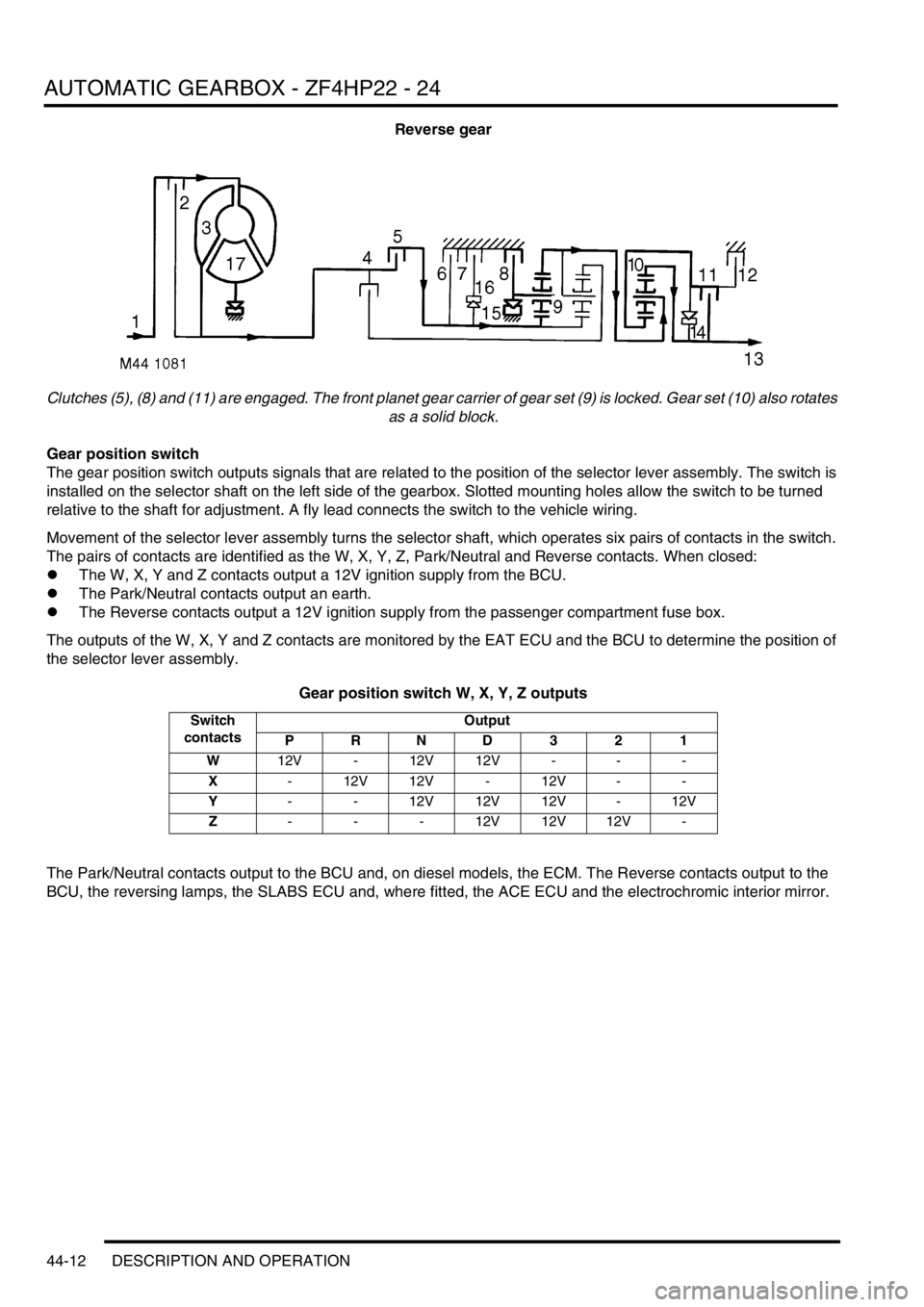
Reverse gear
Clutches (5), (8) and (11) are engaged. The front planet gear carrier of gear set (9) is locked. Gear set (10) also rotates
as a solid block.
Gear position switch
The gear position switch outputs signals that are related to the position of the selector lever assembly. The switch is
installed on the selector shaft on the left side of the gearbox. Slotted mounting holes allow the switch to be turned
relative to the shaft for adjustment. A fly lead connects the switch to the vehicle wiring.
Movement of the selector lever assembly turns the selector shaft, which operates six pairs of contacts in the switch.
The pairs of contacts are identified as the W, X, Y, Z, Park/Neutral and Reverse contacts. When closed:
lThe W, X, Y and Z contacts output a 12V ignition supply from the BCU.
lThe Park/Neutral contacts output an earth.
lThe Reverse contacts output a 12V ignition supply from the passenger compartment fuse box.
The outputs of the W, X, Y and Z contacts are monitored by the EAT ECU and the BCU to determine the position of
the selector lever assembly.
Gear position switch W, X, Y, Z outputs
The Park/Neutral contacts output to the BCU and, on diesel models, the ECM. The Reverse contacts output to the
BCU, the reversing lamps, the SLABS ECU and, where fitted, the ACE ECU and the electrochromic interior mirror.
Switch
contactsOutput
PRND 3 2 1
W12V - 12V 12V - - -
X- 12V 12V - 12V - -
Y- - 12V 12V 12V - 12V
Z- - - 12V 12V 12V -
Page 610 of 1529

AUTOMATIC GEARBOX - ZF4HP22 - 24
DESCRIPTION AND OPERATION 44-13
Oil cooler
1Inlet connection
2Fixing bracket
3Outlet connection4Fixing bracket
5Temperature sensor
Transmission fluid from the gearbox is circulated through a cooler attached to the front of the radiator. Quick release
connectors on the transmission fluid lines attach to connections on each end tank of the cooler. A temperature sensor
on the RH end tank provides the instrument pack with an input of transmission fluid temperature. If the temperature
exceeds a preset limit, the instrument pack illuminates the transmission temperature warning lamp. The warning lamp
remains illuminated until the temperature of the fluid returns within limits.
EAT ECU
The EAT ECU operates the solenoid valves in the gearbox to provide automatic control of gear shifts and torque
converter lock-up. The EAT ECU is attached to a protective bracket which is secured to the cabin floor below the LH
front seat. A 55 pin connector links the EAT ECU to the vehicle wiring.
Software in the EAT ECU monitors hard wired inputs and exchanges information with the ECM on a Controller Area
Network (CAN) bus to determine gear shift and torque converter lock-up requirements. Resultant control signals are
then output to the gearbox solenoid valves.