ABS LAND ROVER DISCOVERY 1999 Owner's Manual
[x] Cancel search | Manufacturer: LAND ROVER, Model Year: 1999, Model line: DISCOVERY, Model: LAND ROVER DISCOVERY 1999Pages: 1529, PDF Size: 34.8 MB
Page 272 of 1529

EMISSION CONTROL - V8
DESCRIPTION AND OPERATION 17-2-39
Evaporative Emission Control Operation
Fuel vapour is stored in the activated charcoal (EVAP) canister for retention when the vehicle is not operating. When
the vehicle is operating, fuel vapour is drawn from the canister into the engine via a purge control valve. The vapour
is then delivered to the intake plenum chamber to be supplied to the engine cylinders where it is burned in the
combustion process.
During fuel filling the fuel vapour displaced from the fuel tank is allowed to escape to atmosphere, valves within the
fuel filler prevent any vapour escaping through to the EVAP canister as this can adversely affect the fuel cut-off height.
Only fuel vapour generated whilst driving is prevented from escaping to atmosphere by absorption into the charcoal
canister. The fuel filler shuts off to leave the tank approximately 10% empty to ensure the ROVs are always above
the fuel level and so vapour can escape to the EVAP canister and the tank can breathe. The back pressures normally
generated during fuel filling are too low to open the pressure relief valve, but vapour pressures accumulated during
driving are higher and can open the pressure relief valve. Should the vehicle be overturned, the ROVs shut off to
prevent any fuel spillage.
Fuel vapour generated from within the fuel tank as the fuel heats up is stored in the tank until the pressure exceeds
the operating pressure of the two-way valve. When the two-way valve opens, the fuel vapour passes along the vent
line from the fuel tank (via the fuel tank vapour separator) to the evaporation inlet port of the EVAP canister. The fuel
tank vents between 5.17 and 6.9 kPa.
Fuel vapour evaporating from the fuel tank is routed to the EVAP canister through the fuel vapour separator and vent
line. Liquid fuel must not be allowed to contaminate the charcoal in the EVAP canister. To prevent this, the fuel vapour
separator fitted to the fuel neck allows fuel to drain back into the tank. As the fuel vapour cools, it condenses and is
allowed to flow back into the fuel tank from the vent line by way of the two-way valve.
The EVAP canister contains charcoal which absorbs and stores fuel vapour from the fuel tank while the engine is not
running. When the canister is not being purged, the fuel vapour remains in the canister and clean air exits the canister
via the air inlet port.
The engine management ECM controls the electrical output signal to the purge valve. The system will not work
properly if there is leakage or clogging within the system or if the purge valve cannot be controlled.
+ ENGINE MANAGEMENT SYSTEM - V8, DESCRIPTION AND OPERATION, Description - engine
management.
When the engine is running, the ECM decides when conditions are correct for vapour to be purged from the EVAP
canister and opens the canister purge valve. This connects a manifold vacuum line to the canister and fuel vapour
containing the hydrocarbons is drawn from the canister's charcoal element to be burned in the engine. Clean air is
drawn into the canister through the atmosphere vent port to fill the displaced volume of vapour.
The purge valve remains closed below preset coolant and engine speed values to protect the engine tune and
catalytic converter performance. If the EVAP canister was purged during cold running or at idling speed, the additional
enrichment in the fuel mixture would delay the catalytic converter light off time and cause erratic idle. When the purge
valve is opened, fuel vapour from the EVAP canister is drawn into the plenum chamber downside of the throttle
housing, to be delivered to the combustion chambers for burning.
The purge valve is opened and closed in accordance with a pulse width modulated (PWM) signal supplied from the
engine management ECM. The system will not work properly if the purge valve cannot be controlled. Possible failure
modes associated with the purge valve are listed below:
lValve drive open circuit.
lShort circuit to vehicle supply or ground.
lPurge valve or pipework blocked or restricted.
lPurge valve stuck open.
lPipework joints leaking or disconnected.
Possible symptoms associated with a purge valve or associated pipework failure is listed below:
lEngine may stall on return to idle if purge valve is stuck open.
lPoor idling quality if the purge valve is stuck open
lFuelling adaptions forced excessively lean if the EVAP canister is clear and the purge valve is stuck open.
lFuelling adaptions forced excessively rich if the EVAP canister is saturated and the purge valve is stuck open.
lSaturation of the EVAP canister if the purge valve is stuck closed.
Page 285 of 1529

EMISSION CONTROL - V8
17-2-52 REPAIRS
Canister - EVAP - Models with Fuel Leak
Detection Pump - up to 03MY
$% 17.15.13
Remove
1.Raise vehicle on lift.
2.Remove 3 Torx screws securing fuel leak
detection pump to mounting bracket.
3.Remove 3 bolts securing EVAP canister
mounting bracket to chassis longitudinal.4.Remove 2 bolts securing EVAP canister to
mounting bracket and collect clamp.
5.Remove mounting bracket.
6.Position cloth to absorb any fuel spillage.
7.Release purge and tank vent pipes from EVAP
canister.
8.Remove clip securing fuel leak detection pump
pipe to EVAP canister.
9.Release pipe from EVAP canister and remove
canister.
CAUTION: Plug the connections.
Refit
1.Remove plugs and ensure all connections are
clean.
2.Connect fuel leak detection pump pipe to EVAP
canister and secure with clip.
3.Connect purge and tank vent pipes to EVAP
canister.
4.Position mounting bracket to EVAP canister
and secure with bolts.
5.Position mounting bracket to chassis
longitudinal and tighten bolts.
6.Fit Torx screws securing fuel leak detection
pump to mounting bracket.
7.Lower vehicle.
M17 02192
M17 0220
M17 0221
4
4
4
9
7
7
5
8
Page 297 of 1529
EMISSION CONTROL - V8
17-2-64 REPAIRS
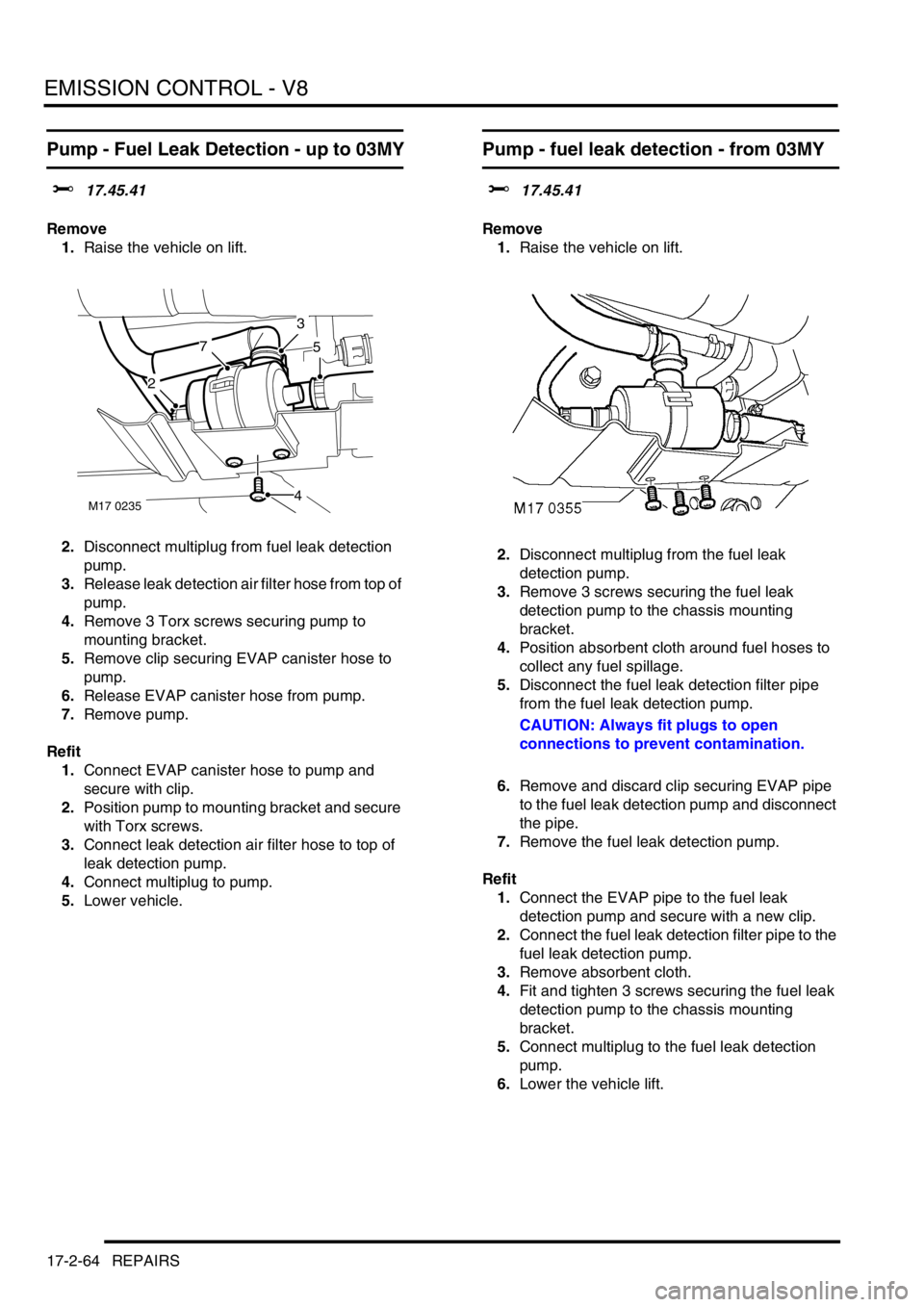
Pump - Fuel Leak Detection - up to 03MY
$% 17.45.41
Remove
1.Raise the vehicle on lift.
2.Disconnect multiplug from fuel leak detection
pump.
3.Release leak detection air filter hose from top of
pump.
4.Remove 3 Torx screws securing pump to
mounting bracket.
5.Remove clip securing EVAP canister hose to
pump.
6.Release EVAP canister hose from pump.
7.Remove pump.
Refit
1.Connect EVAP canister hose to pump and
secure with clip.
2.Position pump to mounting bracket and secure
with Torx screws.
3.Connect leak detection air filter hose to top of
leak detection pump.
4.Connect multiplug to pump.
5.Lower vehicle.
Pump - fuel leak detection - from 03MY
$% 17.45.41
Remove
1.Raise the vehicle on lift.
2.Disconnect multiplug from the fuel leak
detection pump.
3.Remove 3 screws securing the fuel leak
detection pump to the chassis mounting
bracket.
4.Position absorbent cloth around fuel hoses to
collect any fuel spillage.
5.Disconnect the fuel leak detection filter pipe
from the fuel leak detection pump.
CAUTION: Always fit plugs to open
connections to prevent contamination.
6.Remove and discard clip securing EVAP pipe
to the fuel leak detection pump and disconnect
the pipe.
7.Remove the fuel leak detection pump.
Refit
1.Connect the EVAP pipe to the fuel leak
detection pump and secure with a new clip.
2.Connect the fuel leak detection filter pipe to the
fuel leak detection pump.
3.Remove absorbent cloth.
4.Fit and tighten 3 screws securing the fuel leak
detection pump to the chassis mounting
bracket.
5.Connect multiplug to the fuel leak detection
pump.
6.Lower the vehicle lift.
M17 0235
2
3
4
57
Page 304 of 1529

ENGINE MANAGEMENT SYSTEM - V8
DESCRIPTION AND OPERATION 18-2-5
1Engine control module
2Crankshaft speed and position sensor
3Camshaft position sensor
4Engine coolant temperature sensor
5Mass air flow/ inlet air temperature sensor
6Throttle position sensor
7Heated oxygen sensors
8Fuel injectors
9Idle air control valve
10Fuel pump relay
11EVAP canister
12EVAP canister vent valve
13EVAP canister purge valve
14Fuel tank pressure sensor15Ignition coils
16Knock sensor
17Spark plugs
18High/ Low ratio switch
19Malfunction indication lamp
20Diagnostic connector
21Air temperature control clutch relay
22Air temperature control cooling fan relay
23ATC ECU
24CAN link to EAT
25SLABS ECU
26BCU
27Instrument cluster
28Thermostat monitoring sensor (where fitted)
Page 306 of 1529

ENGINE MANAGEMENT SYSTEM - V8
DESCRIPTION AND OPERATION 18-2-7
The ECM controls the following outputs:
lFuel injectors (1 per cylinder).
lIgnition coils/ high tension leads/ spark plugs.
lFuel pump relay.
lIdle air control valve.
lHeated oxygen sensors.
lEVAP canister purge valve.
lEVAP canister vent solenoid (CVS) valve (where fitted).
lMalfunction Indicator Lamp (MIL)/ service engine soon lamp (where fitted).
lHill descent control (via SLABS interface).
lEVAP system fuel leak detection pump (where fitted)
lSecondary air injection pump (where fitted)
The ECM also interfaces with the following:
lDiagnostics via diagnostic connector with TestBook.
lController Area Network (CAN) link to EAT ECU.
lAir conditioning system.
lSelf Levelling & Anti-lock Braking System (SLABS) ECU.
lImmobilisation system via the body control unit (BCU).
lInstrument cluster.
lCruise control ECU
lActive Cornering Enhancement (ACE) ECU
Page 327 of 1529
ENGINE MANAGEMENT SYSTEM - V8
18-2-28 DESCRIPTION AND OPERATION
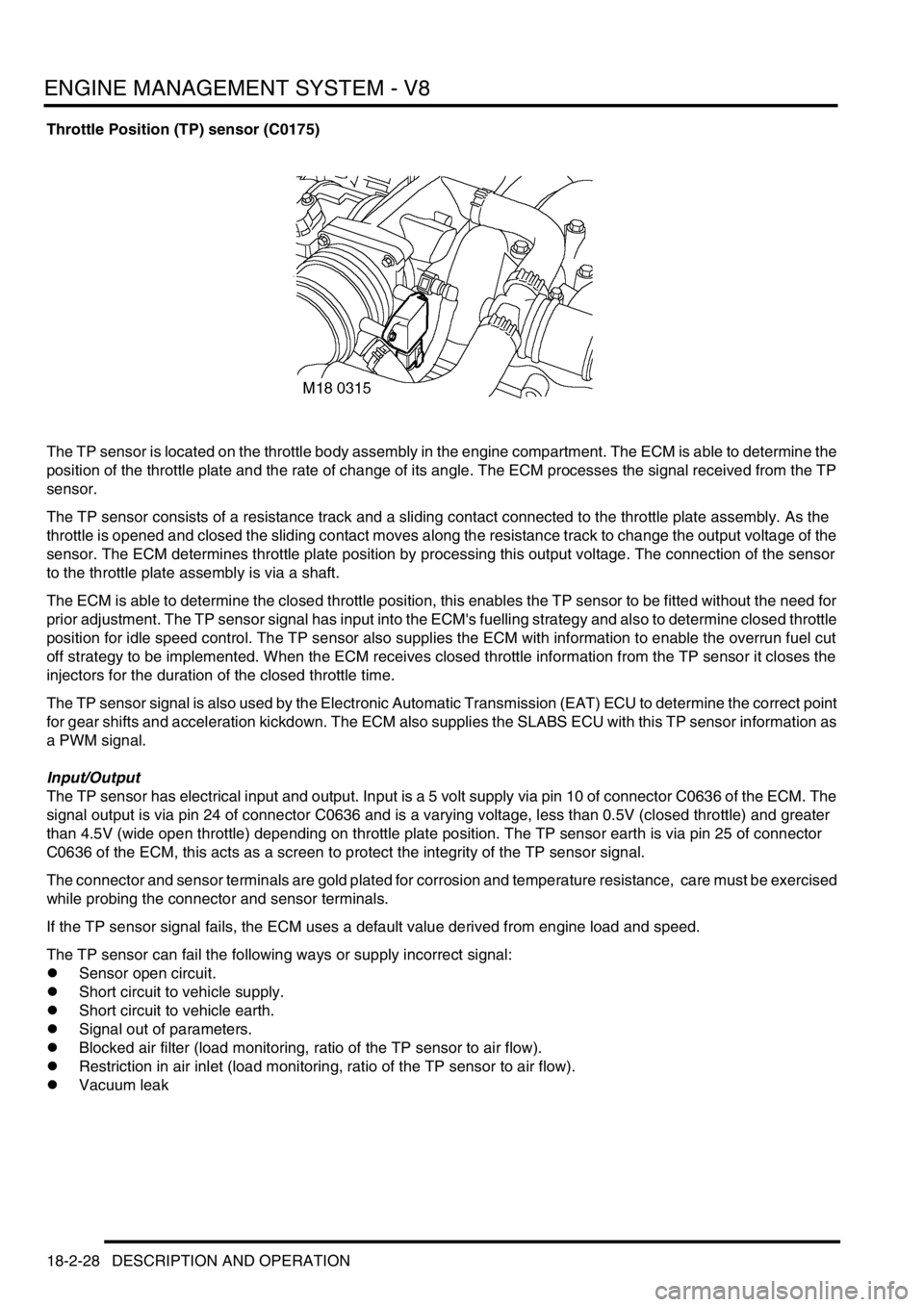
Throttle Position (TP) sensor (C0175)
The TP sensor is located on the throttle body assembly in the engine compartment. The ECM is able to determine the
position of the throttle plate and the rate of change of its angle. The ECM processes the signal received from the TP
sensor.
The TP sensor consists of a resistance track and a sliding contact connected to the throttle plate assembly. As the
throttle is opened and closed the sliding contact moves along the resistance track to change the output voltage of the
sensor. The ECM determines throttle plate position by processing this output voltage. The connection of the sensor
to the throttle plate assembly is via a shaft.
The ECM is able to determine the closed throttle position, this enables the TP sensor to be fitted without the need for
prior adjustment. The TP sensor signal has input into the ECM's fuelling strategy and also to determine closed throttle
position for idle speed control. The TP sensor also supplies the ECM with information to enable the overrun fuel cut
off strategy to be implemented. When the ECM receives closed throttle information from the TP sensor it closes the
injectors for the duration of the closed throttle time.
The TP sensor signal is also used by the Electronic Automatic Transmission (EAT) ECU to determine the correct point
for gear shifts and acceleration kickdown. The ECM also supplies the SLABS ECU with this TP sensor information as
a PWM signal.
Input/Output
The TP sensor has electrical input and output. Input is a 5 volt supply via pin 10 of connector C0636 of the ECM. The
signal output is via pin 24 of connector C0636 and is a varying voltage, less than 0.5V (closed throttle) and greater
than 4.5V (wide open throttle) depending on throttle plate position. The TP sensor earth is via pin 25 of connector
C0636 of the ECM, this acts as a screen to protect the integrity of the TP sensor signal.
The connector and sensor terminals are gold plated for corrosion and temperature resistance, care must be exercised
while probing the connector and sensor terminals.
If the TP sensor signal fails, the ECM uses a default value derived from engine load and speed.
The TP sensor can fail the following ways or supply incorrect signal:
lSensor open circuit.
lShort circuit to vehicle supply.
lShort circuit to vehicle earth.
lSignal out of parameters.
lBlocked air filter (load monitoring, ratio of the TP sensor to air flow).
lRestriction in air inlet (load monitoring, ratio of the TP sensor to air flow).
lVacuum leak
Page 354 of 1529

ENGINE MANAGEMENT SYSTEM - V8
DESCRIPTION AND OPERATION 18-2-55
Vehicle Speed Signal (VSS)
The VSS is used, by the ECM, to control idle speed and overrun cut off. The ECM receives the signal through a hard
wired connection direct from the SLABS ECU.
For vehicles fitted with an automatic gearbox, two vehicle speed signals are received by the ECM. The second signal
is derived from the main gearbox output shaft speed, and is sent to the ECM by the Electronic Automatic Transmission
(EAT) ECU though the Controller Area Network (CAN). The ECM compares the vehicle speed signal generated by
the SLABS ECU with that supplied via the CAN.
The ECM also receives transfer box information. This allows the ECM to take in to account the vehicle being driven
using low range gearing and compensate as necessary.
On vehicles with manual transmission, the SLABS signal is checked against a threshold value stored in ECM memory.
If other engine parameters indicate the engine is at high load and the VSS is below the threshold, a fault condition is
registered in the diagnostic memory.
The vehicle speed signal generated by the SLABS ECU is in the form of a pulse width modulated signal (PWM).
Pulses are generated at 8000 per mile, and the frequency of the signal changes in accordance with road speed. At
zero road speed the ECU outputs a reference signal at a frequency of 2Hz for diagnostic purposes.
Function
The input signal for the SLABS ECU is measured via pin 22 of connector C0637 of the ECM. The SLABS ECU
generates a PWM signal switching between 0 and 12 volts at a frequency of 8000 pulses per mile. For vehicles with
automatic gearbox the input signal for the EAT ECU is measured via pins 36 and 37 of connector C0637 of the ECM.
These pin numbers provide a bi-directional communications link using the CAN data bus.
In the case of a VSS failure on vehicles with automatic gearboxes, the ECM applies default values derived from the
EAT ECU. There are no default values for manual gearbox vehicles.
The VSS can fail in the following ways:
lWiring short circuit to vehicle supply.
lWiring short circuit to vehicle earth.
lWiring open circuit.
In the event of a VSS failure, any of the following symptoms may be observed:
lMIL illuminated after 2 driving cycles (NAS only).
lVehicle speed limiting disabled (manual transmission vehicles only).
lSLABS/HDC warning lamp on and audible warning.
Should a malfunction of the component occur the following fault codes may be evident and can be retrieved by
TestBook:
Rough road signal
When the vehicle travels across rough terrain, or on rough roads instability becomes evident in the drive train. The
ECM could interpret these vibrations as a 'false misfire'. To counteract this 'false misfire' the SLABS ECU generates
a rough road signal, sends it to the ECM so that the ECM can suspend misfire detection for as long as the vehicle is
travelling on the 'rough road'.
P Code J2012 Description Land Rover Description
P0500 Vehicle speed sensor malfunction VSS short or open circuit
P0501 Vehicle speed sensor range/performance VSS implausible
Page 355 of 1529

ENGINE MANAGEMENT SYSTEM - V8
18-2-56 DESCRIPTION AND OPERATION
Function
Input for the rough road signal is measured via pin 34 of connector C0637 of the ECM. The SLABS ECU generates
a PWM signal that varies in accordance with changing road conditions. The rough road PWM signal operates at a
frequency of 2.33 Hz ± 10%. The significance of changes in the PWM signal are shown in the following table:
The rough road signal can fail in the following ways:
lHarness or connector damage
lSLABS failure — wheel speed sensor
A rough road signal failure may be evident from the following:
lHDC / ABS warning light on
Should a malfunction of the rough road signal occur, the following fault codes may be evident and can be retrieved
by TestBook:
Hill Descent Control (HDC) signal
The ECM transmits throttle angle, engine torque, engine identification (Td5 or V8), and transmission type (automatic
or manual) data to the SLABS ECU to support the Hill Descent Control system. The information is transmitted via a
0 – 12V pulse width modulated (PWM) signal at a frequency of 179.27 Hz.
Function
The HDC signal output from the ECM is via pin 29 of connector C0636. The ECM generates a PWM signal that varies
in pulse width in accordance with changing throttle angle or engine torque. The throttle angle data is transmitted on
pulses 1, 3, 5 and 37. The engine torque data is transmitted on pulses 2,4,6 and 38. The engine and transmission
information is transmitted on pulse 39. A synchronising pulse is transmitted after every 39th pulse.
The HDC signal can fail in the following ways:
lHarness or connector damage
A HDC signal failure may be evident from the following:
lHDC / ABS warning light on
lHDC inoperative
lAudible warning
Should a malfunction of the HDC signal occur, the following fault codes may be evident and can be retrieved by
TestBook:
PWM signal Indication
<10% Electrical short circuit to ground
25% ± 5 % Smooth road
50% ± 5 % SLABS error
75% ± 5% Rough road
>90% Electrical short circuit to battery voltage
P Code J2012 Description Land Rover Description
P1590 ABS rough road signal circuit malfunction Hardware is OK, but SLABS ECU is sending an error
signal
P1591 ABS rough road signal circuit low Signal from SLABS ECU short circuit to earth
P1592 ABS rough road signal circuit high Signal from SLABS ECU short circuit to vehicle battery
supply
P Code J2012 Description Land Rover Description
P1663 Throttle angle/Torque signal circuit malfunction SLABS HDC link open circuit
P1664 Throttle angle/Torque signal circuit low SLABS HDC link short circuit to ground
P1665 Throttle angle/Torque signal circuit high SLABS HDC link short circuit to battery voltage
Page 360 of 1529

ENGINE MANAGEMENT SYSTEM - V8
DESCRIPTION AND OPERATION 18-2-61
DESCRIPTION AND OPERAT ION
Cruise control component layout
1Cruise control ECU
2Cruise control master switch
3SET+ switch
4RES switch
5Brake pedal switch
6Clutch pedal switch7BCU
8Vacuum pump assembly
9Pneumatic actuator
10SLABS ECU
11Automatic gear selector lever
Page 361 of 1529
ENGINE MANAGEMENT SYSTEM - V8
18-2-62 DESCRIPTION AND OPERATION
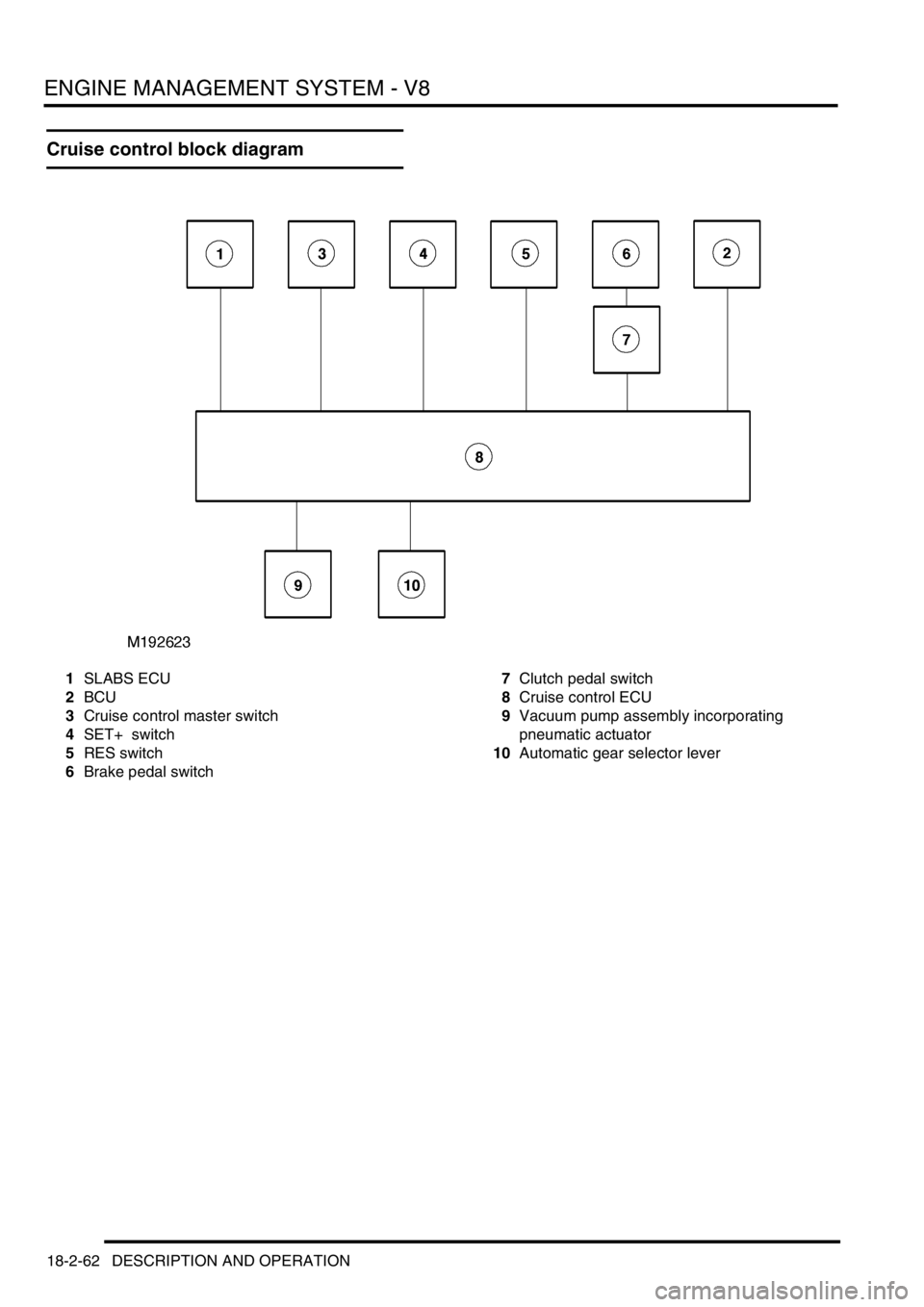
Cruise control block diagram
1SLABS ECU
2BCU
3Cruise control master switch
4SET+ switch
5RES switch
6Brake pedal switch7Clutch pedal switch
8Cruise control ECU
9Vacuum pump assembly incorporating
pneumatic actuator
10Automatic gear selector lever