ABS LAND ROVER DISCOVERY 1999 Repair Manual
[x] Cancel search | Manufacturer: LAND ROVER, Model Year: 1999, Model line: DISCOVERY, Model: LAND ROVER DISCOVERY 1999Pages: 1529, PDF Size: 34.8 MB
Page 671 of 1529
REAR AXLE
51-6 REPAIRS
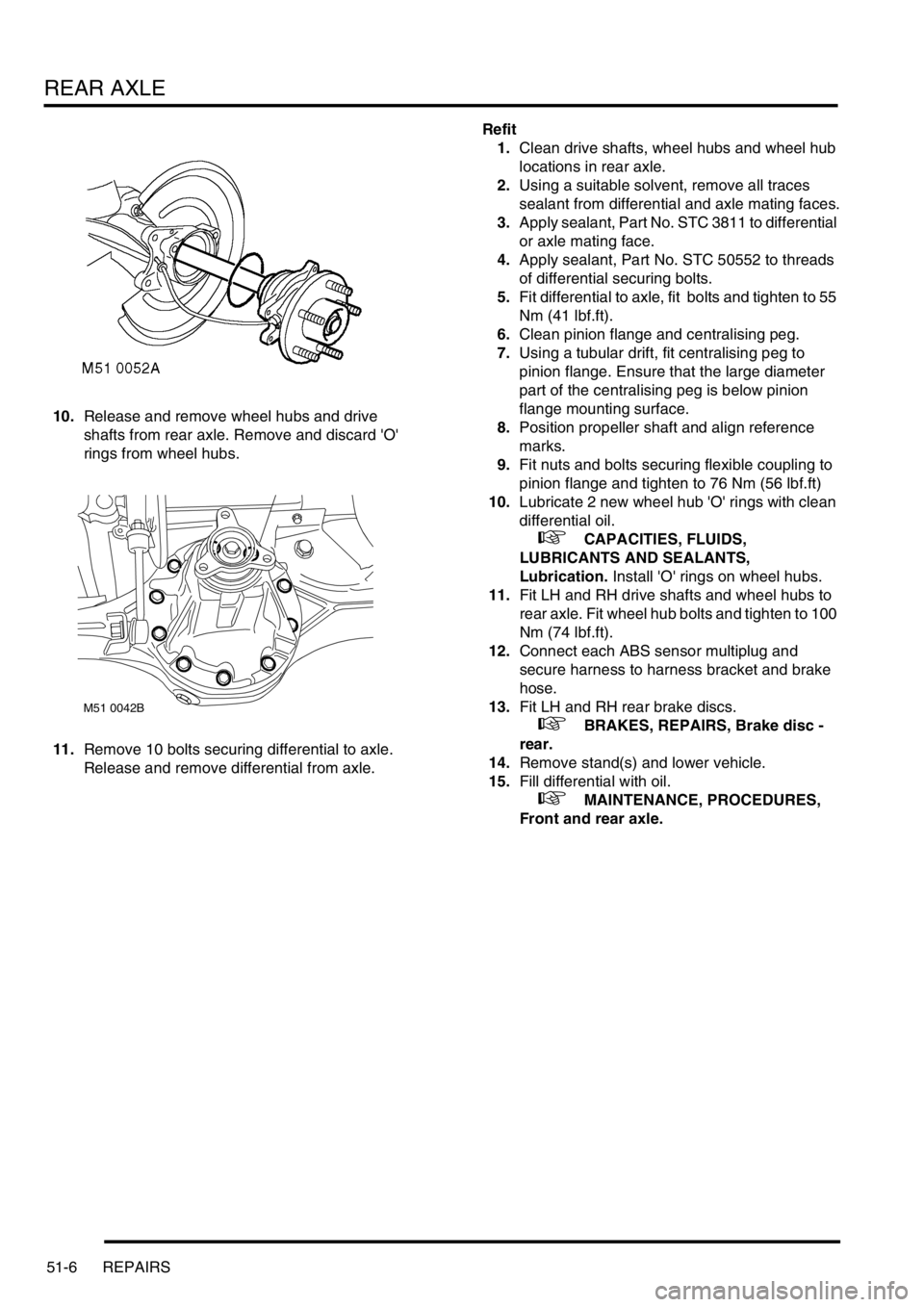
10.Release and remove wheel hubs and drive
shafts from rear axle. Remove and discard 'O'
rings from wheel hubs.
11.Remove 10 bolts securing differential to axle.
Release and remove differential from axle. Refit
1.Clean drive shafts, wheel hubs and wheel hub
locations in rear axle.
2.Using a suitable solvent, remove all traces
sealant from differential and axle mating faces.
3.Apply sealant, Part No. STC 3811 to differential
or axle mating face.
4.Apply sealant, Part No. STC 50552 to threads
of differential securing bolts.
5.Fit differential to axle, fit bolts and tighten to 55
Nm (41 lbf.ft).
6.Clean pinion flange and centralising peg.
7.Using a tubular drift, fit centralising peg to
pinion flange. Ensure that the large diameter
part of the centralising peg is below pinion
flange mounting surface.
8.Position propeller shaft and align reference
marks.
9.Fit nuts and bolts securing flexible coupling to
pinion flange and tighten to 76 Nm (56 lbf.ft)
10.Lubricate 2 new wheel hub 'O' rings with clean
differential oil.
+ CAPACITIES, FLUIDS,
LUBRICANTS AND SEALANTS,
Lubrication. Install 'O' rings on wheel hubs.
11.Fit LH and RH drive shafts and wheel hubs to
rear axle. Fit wheel hub bolts and tighten to 100
Nm (74 lbf.ft).
12.Connect each ABS sensor multiplug and
secure harness to harness bracket and brake
hose.
13.Fit LH and RH rear brake discs.
+ BRAKES, REPAIRS, Brake disc -
rear.
14.Remove stand(s) and lower vehicle.
15.Fill differential with oil.
+ MAINTENANCE, PROCEDURES,
Front and rear axle.
M51 0042B
Page 682 of 1529
FRONT AXLE
DESCRIPTION AND OPERATION 54-3
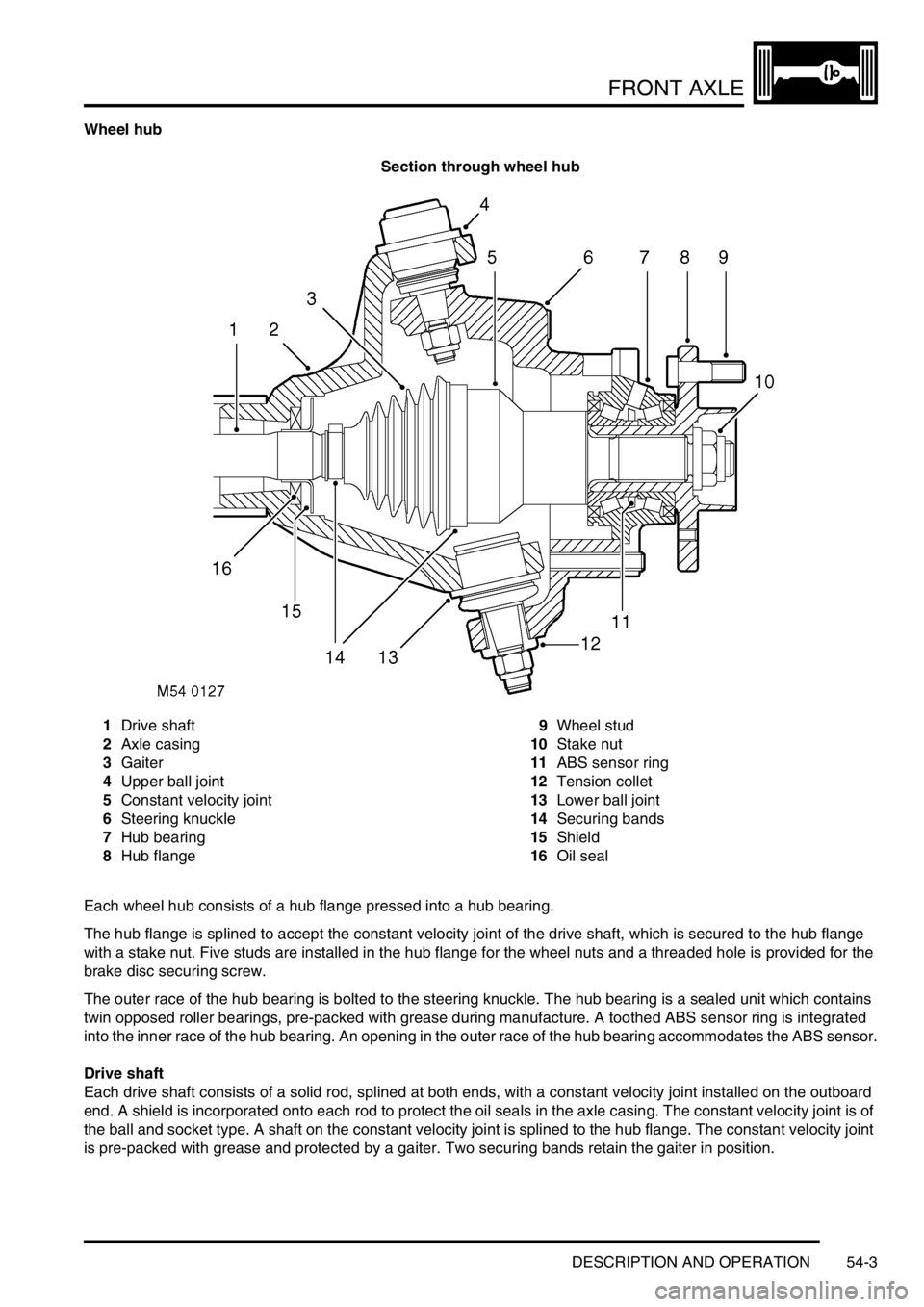
Wheel hub
Section through wheel hub
1Drive shaft
2Axle casing
3Gaiter
4Upper ball joint
5Constant velocity joint
6Steering knuckle
7Hub bearing
8Hub flange9Wheel stud
10Stake nut
11ABS sensor ring
12Tension collet
13Lower ball joint
14Securing bands
15Shield
16Oil seal
Each wheel hub consists of a hub flange pressed into a hub bearing.
The hub flange is splined to accept the constant velocity joint of the drive shaft, which is secured to the hub flange
with a stake nut. Five studs are installed in the hub flange for the wheel nuts and a threaded hole is provided for the
brake disc securing screw.
The outer race of the hub bearing is bolted to the steering knuckle. The hub bearing is a sealed unit which contains
twin opposed roller bearings, pre-packed with grease during manufacture. A toothed ABS sensor ring is integrated
into the inner race of the hub bearing. An opening in the outer race of the hub bearing accommodates the ABS sensor.
Drive shaft
Each drive shaft consists of a solid rod, splined at both ends, with a constant velocity joint installed on the outboard
end. A shield is incorporated onto each rod to protect the oil seals in the axle casing. The constant velocity joint is of
the ball and socket type. A shaft on the constant velocity joint is splined to the hub flange. The constant velocity joint
is pre-packed with grease and protected by a gaiter. Two securing bands retain the gaiter in position.
Page 684 of 1529
FRONT AXLE
REPAIRS 54-5
REPAIRS
Differential - assembly
$% 54.10.01
Remove
1.Raise front of vehicle.
WARNING: Do not work on or under a
vehicle supported only by a jack. Always
support the vehicle on safety stands.
2.Remove front road wheels.
3.Drain oil from differential.
+ MAINTENANCE, PROCEDURES,
Front and rear axle.
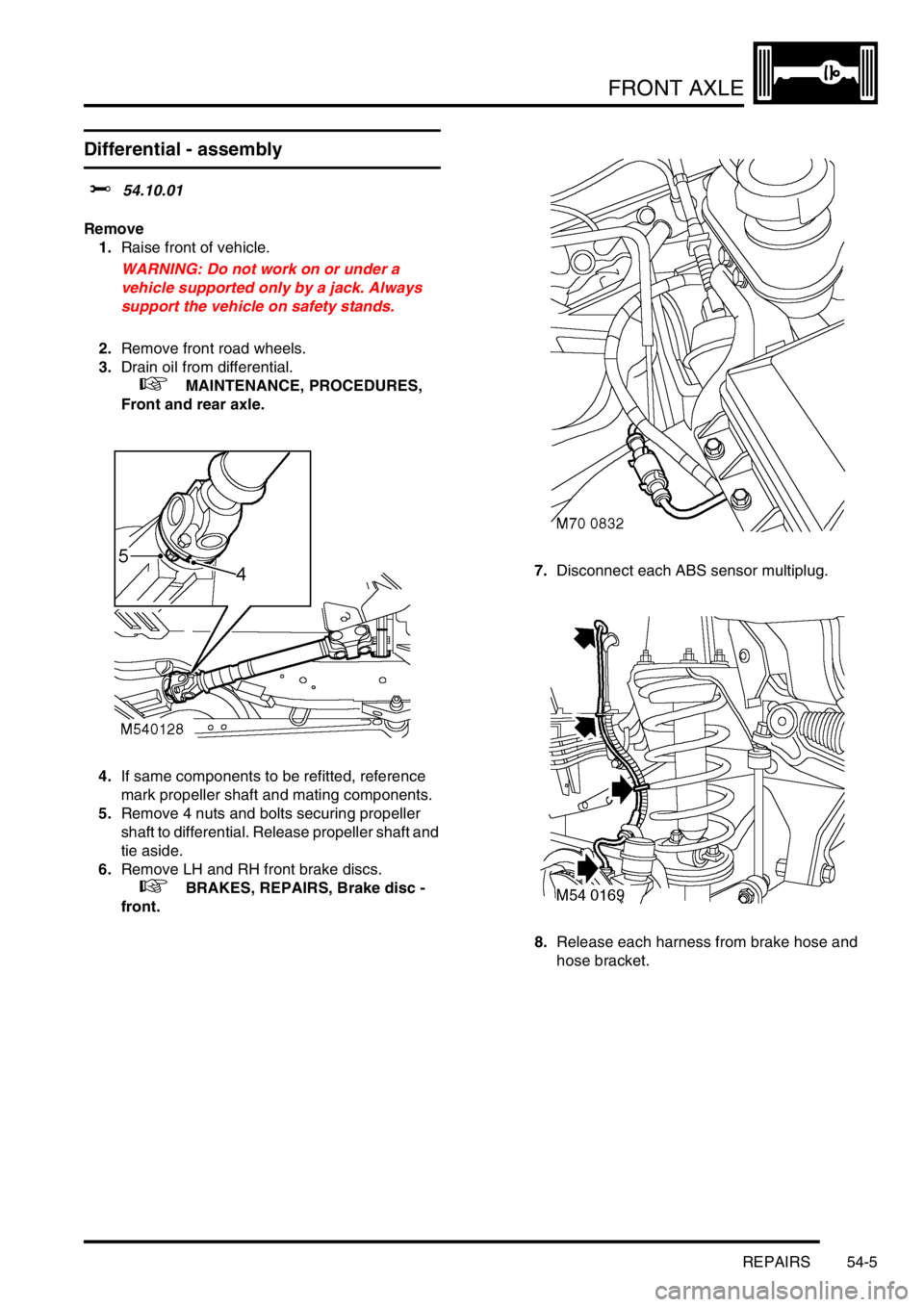
4.If same components to be refitted, reference
mark propeller shaft and mating components.
5.Remove 4 nuts and bolts securing propeller
shaft to differential. Release propeller shaft and
tie aside.
6.Remove LH and RH front brake discs.
+ BRAKES, REPAIRS, Brake disc -
front.7.Disconnect each ABS sensor multiplug.
8.Release each harness from brake hose and
hose bracket.
Page 685 of 1529
FRONT AXLE
54-6 REPAIRS
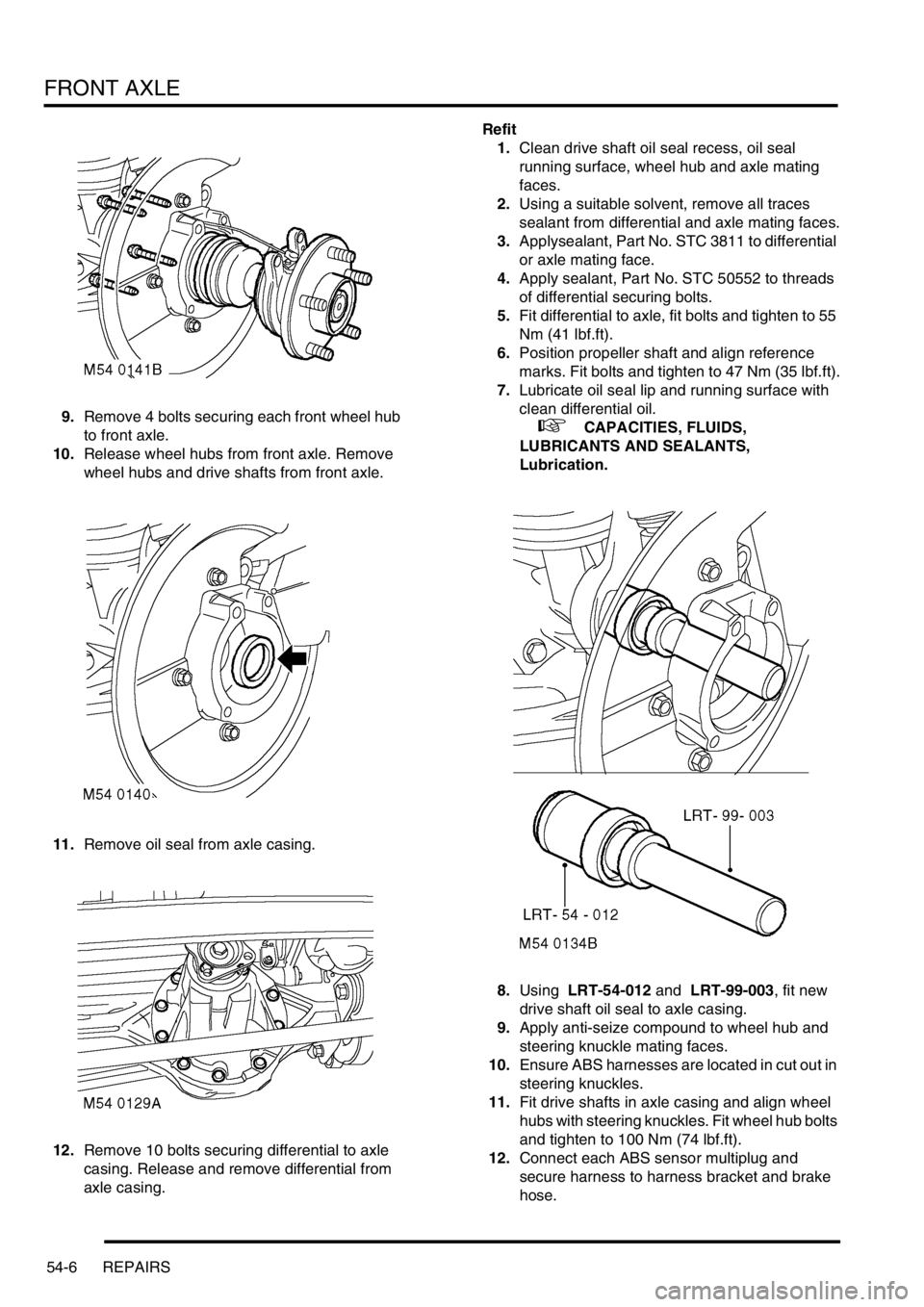
9.Remove 4 bolts securing each front wheel hub
to front axle.
10.Release wheel hubs from front axle. Remove
wheel hubs and drive shafts from front axle.
11.Remove oil seal from axle casing.
12.Remove 10 bolts securing differential to axle
casing. Release and remove differential from
axle casing.Refit
1.Clean drive shaft oil seal recess, oil seal
running surface, wheel hub and axle mating
faces.
2.Using a suitable solvent, remove all traces
sealant from differential and axle mating faces.
3.Applysealant, Part No. STC 3811 to differential
or axle mating face.
4.Apply sealant, Part No. STC 50552 to threads
of differential securing bolts.
5.Fit differential to axle, fit bolts and tighten to 55
Nm (41 lbf.ft).
6.Position propeller shaft and align reference
marks. Fit bolts and tighten to 47 Nm (35 lbf.ft).
7.Lubricate oil seal lip and running surface with
clean differential oil.
+ CAPACITIES, FLUIDS,
LUBRICANTS AND SEALANTS,
Lubrication.
8.Using LRT-54-012 and LRT-99-003, fit new
drive shaft oil seal to axle casing.
9.Apply anti-seize compound to wheel hub and
steering knuckle mating faces.
10.Ensure ABS harnesses are located in cut out in
steering knuckles.
11.Fit drive shafts in axle casing and align wheel
hubs with steering knuckles. Fit wheel hub bolts
and tighten to 100 Nm (74 lbf.ft).
12.Connect each ABS sensor multiplug and
secure harness to harness bracket and brake
hose.
Page 688 of 1529
FRONT AXLE
REPAIRS 54-9
Seal - oil - front axle casing
$% 54.15.04
Remove
1.Raise front of vehicle.
WARNING: Do not work on or under a
vehicle supported only by a jack. Always
support the vehicle on safety stands.
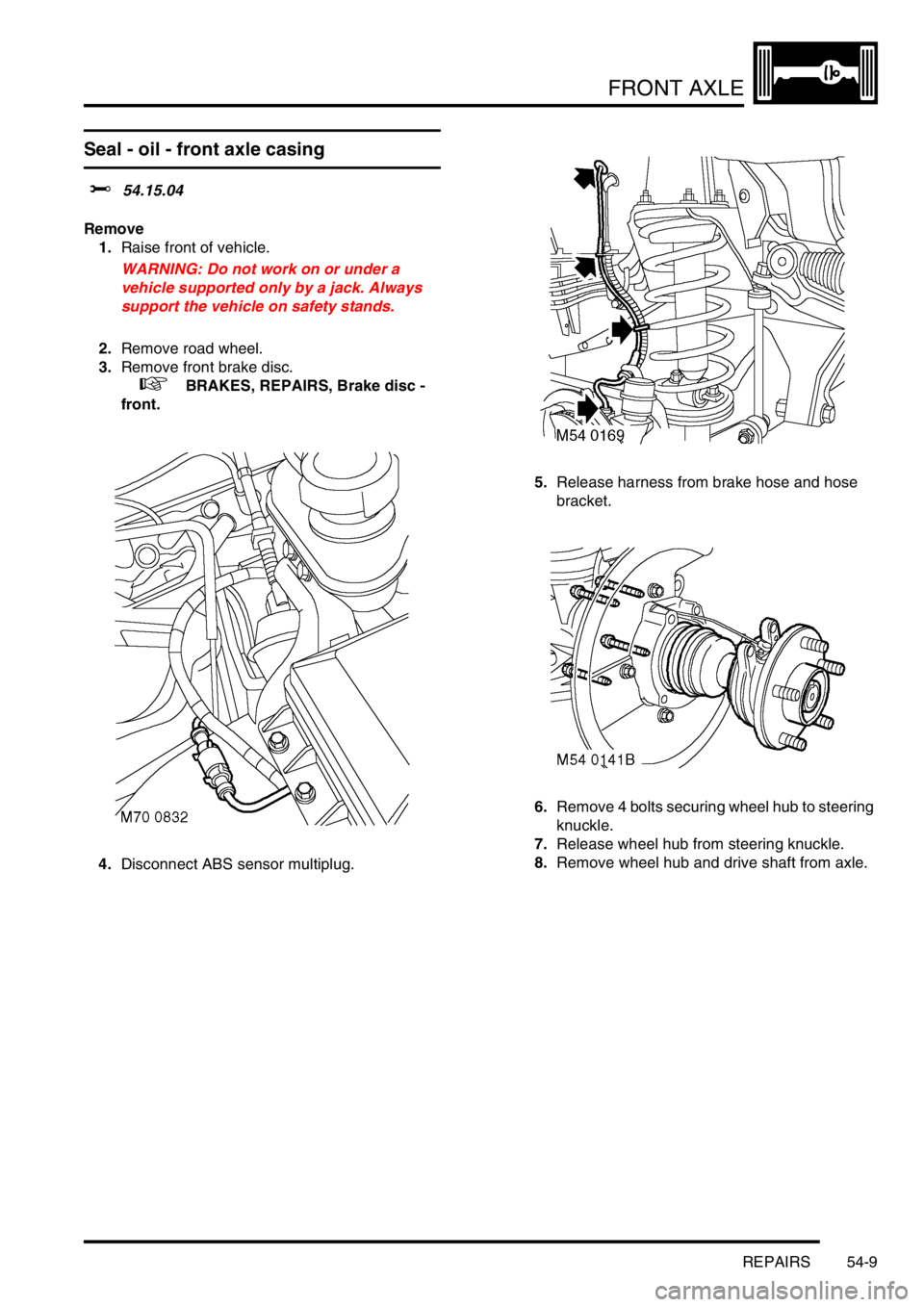
2.Remove road wheel.
3.Remove front brake disc.
+ BRAKES, REPAIRS, Brake disc -
front.
4.Disconnect ABS sensor multiplug.5.Release harness from brake hose and hose
bracket.
6.Remove 4 bolts securing wheel hub to steering
knuckle.
7.Release wheel hub from steering knuckle.
8.Remove wheel hub and drive shaft from axle.
Page 689 of 1529
FRONT AXLE
54-10 REPAIRS
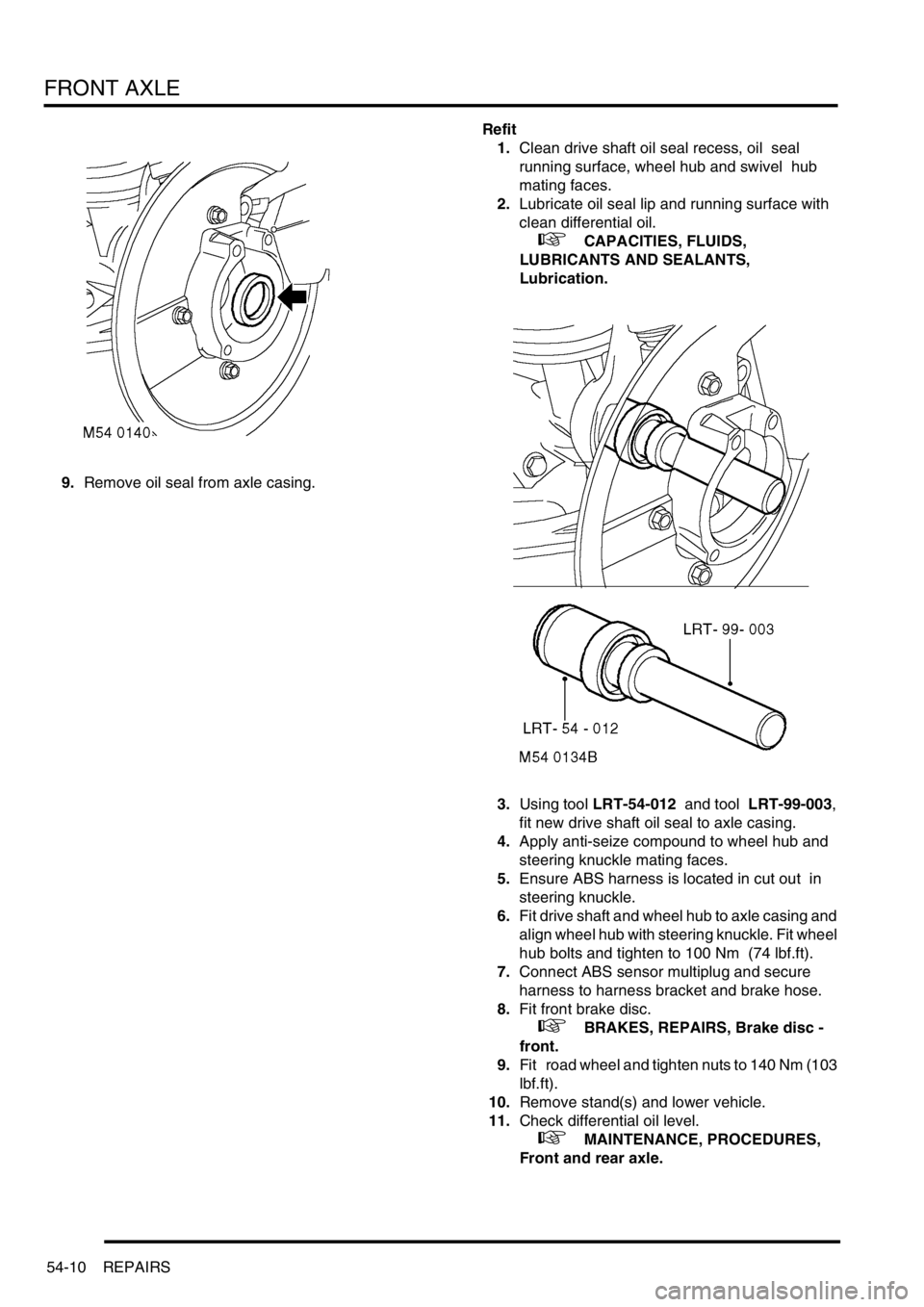
9.Remove oil seal from axle casing.Refit
1.Clean drive shaft oil seal recess, oil seal
running surface, wheel hub and swivel hub
mating faces.
2.Lubricate oil seal lip and running surface with
clean differential oil.
+ CAPACITIES, FLUIDS,
LUBRICANTS AND SEALANTS,
Lubrication.
3.Using tool LRT-54-012 and tool LRT-99-003,
fit new drive shaft oil seal to axle casing.
4.Apply anti-seize compound to wheel hub and
steering knuckle mating faces.
5.Ensure ABS harness is located in cut out in
steering knuckle.
6.Fit drive shaft and wheel hub to axle casing and
align wheel hub with steering knuckle. Fit wheel
hub bolts and tighten to 100 Nm (74 lbf.ft).
7.Connect ABS sensor multiplug and secure
harness to harness bracket and brake hose.
8.Fit front brake disc.
+ BRAKES, REPAIRS, Brake disc -
front.
9.Fit road wheel and tighten nuts to 140 Nm (103
lbf.ft).
10.Remove stand(s) and lower vehicle.
11.Check differential oil level.
+ MAINTENANCE, PROCEDURES,
Front and rear axle.
Page 698 of 1529
STEERING
DESCRIPTION AND OPERATION 57-5
Description
General
The major steering components comprise an impact absorbing telescopic steering column, a Power Assisted Steering
(PAS) box, a PAS pump, and fluid reservoir. Hydraulic fluid from the fluid reservoir is filtered and then supplied
through the suction line to the inlet on the PAS pump. The PAS pump supplies fluid to the steering box through a
pressure line routed above the front cross member. Fluid returns to the reservoir along the same route through a
return line. On LH drive vehicles the pipe route above the front cross member is still used, the length of pipe acting
as an oil cooler.
To minimise driver's injury in the event of an accident the steering system has a number of safety features including
a collapsible steering column. An additional safety feature is an air bag located in the steering wheel.
+ RESTRAINT SYSTEMS, DESCRIPTION AND OPERATION, Description - SRS.
Steering column assembly and intermediate shaft
The steering column central shaft comprises of two shafts, the upper shaft is splined to accept the steering wheel and
located in bearings in the column tube. A universal joint is located on the bottom of the upper shaft, the joint allows
for angular movement between the upper and lower shafts. The lower shaft is made in two parts, the top section of
the lower shaft is located outside of the lower section. The two sections of the lower shaft are connected by two nylon
injection moulded shear pins. The lower shaft goes through a lower bearing attached to the bulkhead, the lower shaft
is connected by a universal joint to the intermediate shaft in the engine compartment.
Steering column
An upper column tube provides for the location of the steering lock and ignition switch and also the steering switch
gear and a rotary coupler. The rotary coupler provides the electrical connection for the steering wheel mounted airbag,
switches and horn. The upper mounting bracket has two slots, a slotted metal bracket is held in each slot by four resin
shear pins.
The column is mounted on four captive studs which are located on a column mounting bracket. The captive studs
pass through the metal brackets, locknuts secure the steering column to the bulkhead. The two lower mountings are
fixed and cannot move when loads are applied to them. The upper mounting is designed to disengage or deform when
a load is applied, allowing the column to collapse in the event of an accident. The steering column must be replaced
as a complete assembly if necessary.
When an axial load is applied to the upper column tube, energy absorption is achieved by the following mechanism:
lthe mounting bracket deforms,
lthe resin shear pins holding the slotted metal brackets shear,
lthe top mounting bracket slides out of the slotted metal brackets.
The slotted metal brackets remain on the captive studs on the bulkhead. If the column mounting moves, injection
moulded shear pins retaining the two sections of the lower column shaft will shear. This allows the two sections of the
lower shaft to 'telescope' together.
In the event of a collision where the steering box itself moves, two universal joints in the column allow the intermediate
shaft to articulate, minimising movement of the column towards the driver. If movement continues energy absorption
is achieved by the following mechanism:
lthe decouple joint in the intermediate shaft will disengage,
lthe lower section of the steering column shaft will move through the lower bearing,
lthe injection moulded shear pins retaining the two sections of the lower column shaft will shear.
This allows the two sections of the lower shaft to 'telescope' together reducing further column intrusion. Protection to
the drivers face and upper torso is provided by an SRS airbag module located in the centre of the steering wheel.
+ RESTRAINT SYSTEMS, DESCRIPTION AND OPERATION, Description - SRS.
Page 708 of 1529

STEERING
DESCRIPTION AND OPERATION 57-15
As the pump rotor rotates towards the pump inlet the volume between the roller vanes and the pump housing
increases, this action causes a depression in the chamber between the pump roller vanes and the housing. As the
rotation continues the chamber is opened to the pump inlet, and the depression in the chamber causes fluid to be
drawn in. The roller vanes continue past the inlet port, closing off the inlet port and trapping the fluid in the chamber
between the rollers and the pump housing.
The internal 'cam' shape of the pump housing causes the rollers to move closer together as the pump rotor rotates
towards the outlet port. The reduced volume of the chamber between the roller vanes causes the fluid to become
pressurised. When the chamber is opened to the outlet port of the pump the fluid escapes at high pressure. The roller
vanes continue turning and go past the outlet port, closing off the chamber between the two roller vanes.
As rotation continues the inlet sequence begins again. The inlet and pressurisation/outlet sequences continue as the
pump rotates, and is repeated between each two roller vanes. The pump is a positive displacement type and the
potential pump output increases with engine (drive pulley) speed. The pressure relief and flow control valve regulates
flow/pressure by diverting fluid back to the pump inlet through internal recirculation passages in the pump body.
Steering damper
The steering damper is located behind and just below the first cross member of the chassis. The ends of the steering
damper have steel 'eyes' welded on, rubber bushes are installed in each 'eye'. The steering damper is attached
between brackets on the chassis rail and the drag link. Each end of the steering damper is secured by a bolt and
locknut. The hydraulic damper absorbs shocks in the steering, caused by road wheel deflections when operating on
rough terrain.
Page 715 of 1529

STEERING
57-22 ADJUSTMENTS
38.Fit new seal, connect PAS cooler pipe and
tighten union nut to 24 Nm (18 lbf ft).
39. LHD only: Fit turbocharger intercooler feed
pipe and vacuum connection. Fit new seal to air
cleaner. Connect air intake hose and secure
clips. Connect multiplug to MAF sensor.
40.Clean chassis and surrounding area.
41.Fit underbelly panel.
+ EXTERIOR FITTINGS, REPAIRS,
Panel - underbelly.
42.Remove adaptor and hose set from tool LRT-
57-041.
43.Check PAS fluid level.
44.Connect battery earth lead.
Power steering pressure check - V8 LHD
models
$% 57.90.10.01
Check
1.Disconnect battery earth lead.
2.Syphon PAS fluid from reservoir.
3.Raise front of vehicle and support on stands.
4.Turn steering on LH lock.
5.Remove 3 screws securing LH splash shield
and remove shield.
6.Release clip securing PAS pipes.
7.Position absorbent cloth to catch spillage.
8.Position container to collect PAS fluid spillage.
Page 749 of 1529
FRONT SUSPENSION
60-4 DESCRIPTION AND OPERATION
Description
General
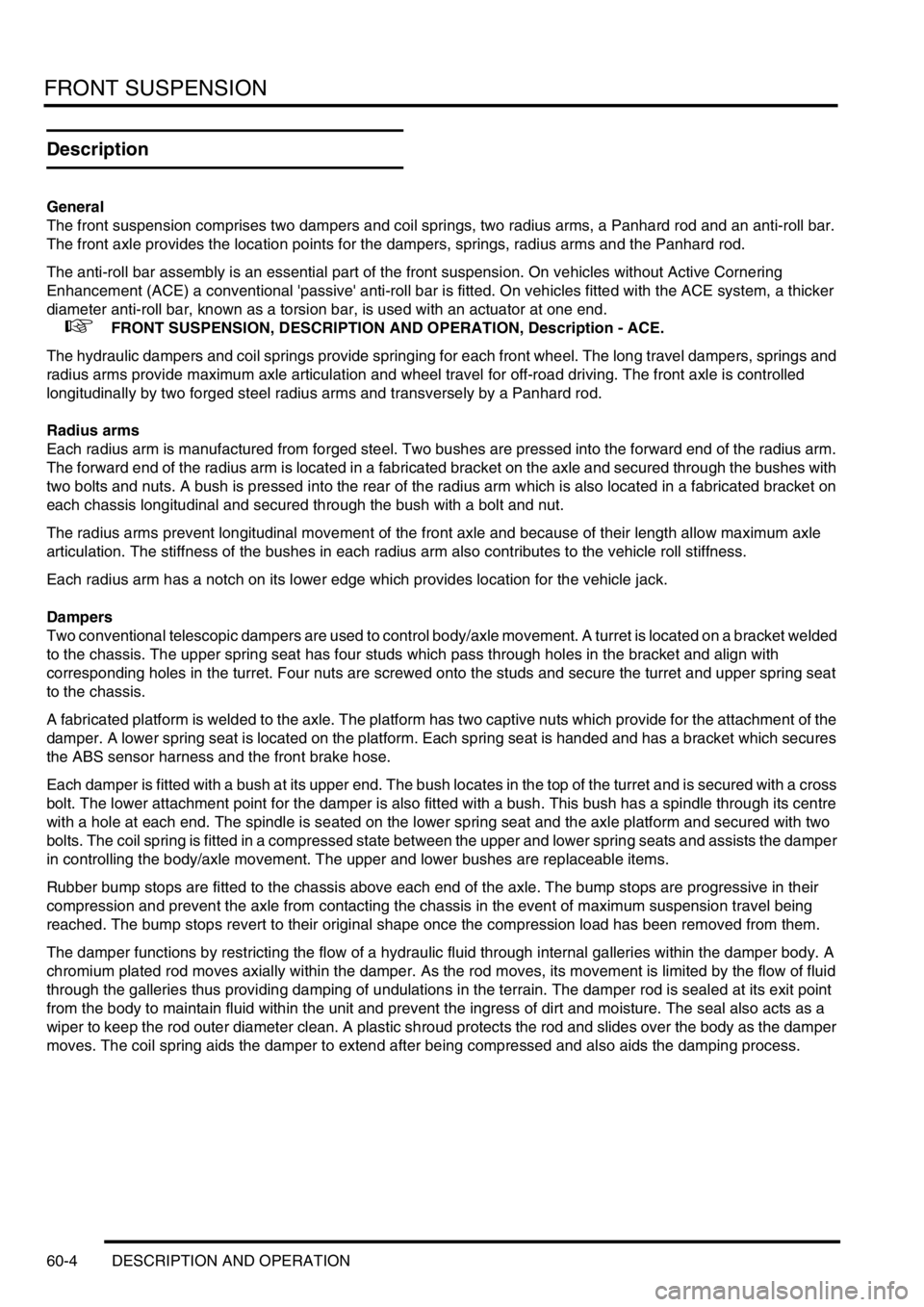
The front suspension comprises two dampers and coil springs, two radius arms, a Panhard rod and an anti-roll bar.
The front axle provides the location points for the dampers, springs, radius arms and the Panhard rod.
The anti-roll bar assembly is an essential part of the front suspension. On vehicles without Active Cornering
Enhancement (ACE) a conventional 'passive' anti-roll bar is fitted. On vehicles fitted with the ACE system, a thicker
diameter anti-roll bar, known as a torsion bar, is used with an actuator at one end.
+ FRONT SUSPENSION, DESCRIPTION AND OPERATION, Description - ACE.
The hydraulic dampers and coil springs provide springing for each front wheel. The long travel dampers, springs and
radius arms provide maximum axle articulation and wheel travel for off-road driving. The front axle is controlled
longitudinally by two forged steel radius arms and transversely by a Panhard rod.
Radius arms
Each radius arm is manufactured from forged steel. Two bushes are pressed into the forward end of the radius arm.
The forward end of the radius arm is located in a fabricated bracket on the axle and secured through the bushes with
two bolts and nuts. A bush is pressed into the rear of the radius arm which is also located in a fabricated bracket on
each chassis longitudinal and secured through the bush with a bolt and nut.
The radius arms prevent longitudinal movement of the front axle and because of their length allow maximum axle
articulation. The stiffness of the bushes in each radius arm also contributes to the vehicle roll stiffness.
Each radius arm has a notch on its lower edge which provides location for the vehicle jack.
Dampers
Two conventional telescopic dampers are used to control body/axle movement. A turret is located on a bracket welded
to the chassis. The upper spring seat has four studs which pass through holes in the bracket and align with
corresponding holes in the turret. Four nuts are screwed onto the studs and secure the turret and upper spring seat
to the chassis.
A fabricated platform is welded to the axle. The platform has two captive nuts which provide for the attachment of the
damper. A lower spring seat is located on the platform. Each spring seat is handed and has a bracket which secures
the ABS sensor harness and the front brake hose.
Each damper is fitted with a bush at its upper end. The bush locates in the top of the turret and is secured with a cross
bolt. The lower attachment point for the damper is also fitted with a bush. This bush has a spindle through its centre
with a hole at each end. The spindle is seated on the lower spring seat and the axle platform and secured with two
bolts. The coil spring is fitted in a compressed state between the upper and lower spring seats and assists the damper
in controlling the body/axle movement. The upper and lower bushes are replaceable items.
Rubber bump stops are fitted to the chassis above each end of the axle. The bump stops are progressive in their
compression and prevent the axle from contacting the chassis in the event of maximum suspension travel being
reached. The bump stops revert to their original shape once the compression load has been removed from them.
The damper functions by restricting the flow of a hydraulic fluid through internal galleries within the damper body. A
chromium plated rod moves axially within the damper. As the rod moves, its movement is limited by the flow of fluid
through the galleries thus providing damping of undulations in the terrain. The damper rod is sealed at its exit point
from the body to maintain fluid within the unit and prevent the ingress of dirt and moisture. The seal also acts as a
wiper to keep the rod outer diameter clean. A plastic shroud protects the rod and slides over the body as the damper
moves. The coil spring aids the damper to extend after being compressed and also aids the damping process.