air condition LAND ROVER DISCOVERY 1999 Owner's Manual
[x] Cancel search | Manufacturer: LAND ROVER, Model Year: 1999, Model line: DISCOVERY, Model: LAND ROVER DISCOVERY 1999Pages: 1529, PDF Size: 34.8 MB
Page 121 of 1529

CAPACITIES, FLUIDS, LUBRICANTS AND SEALANTS
09-4
Gearbox oil
Manual Gearbox: Use Texaco MTF 94 oil for refill
and topping-up.
Automatic Gearbox: Use Texamatic 9226, ATF
Dexron 11D or Dexron 111 for refill and topping-up
Transfer box
Use Texaco Multi-Gear 75W/90R or oil meeting
specification API GL5.
Front and rear axles
Use Texaco Multi-Gear 75W/90R.
Air Conditioning
Use lubricating oil Nippon Denso ND-8.
General Greasing
Use Multipurpose Lithium Base Grease N.L.G.I.
consistency No. 2.
Bonnet latch
Lubricate cable and latch with oil.
Sealants
The following table lists those sealants which are
used during repair / overhaul procedures covered in
this manual; it is essential that the sealant specified
for a particular procedure is used at all times.
Component Application Land Rover
Part No.
Td5 Engine Timing chain fixed
guide Allen screwSTC 50552
Td5 Engine Camshaft cover
gasket joint lineSTC 50550
Td5 Engine Oil pick-up strainer
Torx screwsSTC 50552
Td5 Engine Oil pump drive
sprocket retaining
boltSTC 50552
Td5 Engine Timing chain cover,
crankshaft rear oil
seal and sump
gasket joint linesSTC 50550
Td5 Engine Oil pressure relief
valve plugSTC 50552
Td5 Engine Camshaft carrier to
cylinder headSTC 4600
Td5 Engine Timing cover STC 50550
V8 Engine Sump gasket to
cylinder blockSTC 50550
V8 Engine 'V' grooves at end
of cylinder head -
Inlet manifold
gasketSTC 50550
V8 Engine Cruciform seal
endsSTC 50550
V8 Engine Dipstick tube STC 50554
V8 Engine Timing cover bolts STC 50552
Engine
Management
System - V8Engine coolant
temperature (ECT)
sensor threadsSTC 50552
Manifolds and
Exhaust
System - V8'V' grooves at end
of cylinder head -
Inlet manifold
gasketSTC 50550
Manual
Gearbox -
R380Gear selector
housingSTC 4404
Manual
Gearbox -
R380Selector housing
boltsSTC 50552
Manual
Gearbox -
R380Input shaft oil seal
housingSTC 4404
Manual
Gearbox -
R380Reverse inhibitor
shaft threadsSTC 50552
Page 132 of 1529
MAINTENANCE
PROCEDURES 10-9
Air suspension intake filter
Check
1.Check condition of filter and that filter is clean,
replace if necessary.
+ REAR SUSPENSION, REPAIRS,
Filter - intake - SLS.
Anti-freeze
Replace
1.Replace anti-freeze.
+ COOLING SYSTEM - Td5,
ADJUSTMENTS, Drain and refill.
+ COOLING SYSTEM - V8,
ADJUSTMENTS, Drain and refill.
Cooling system
Check
1.Check cooling, intercooler and heating systems
for leaks; hoses and oil pipes for security and
condition.
2.Check accessible hose clips for tightness.
3.Check coolant level, top-up if necessary.
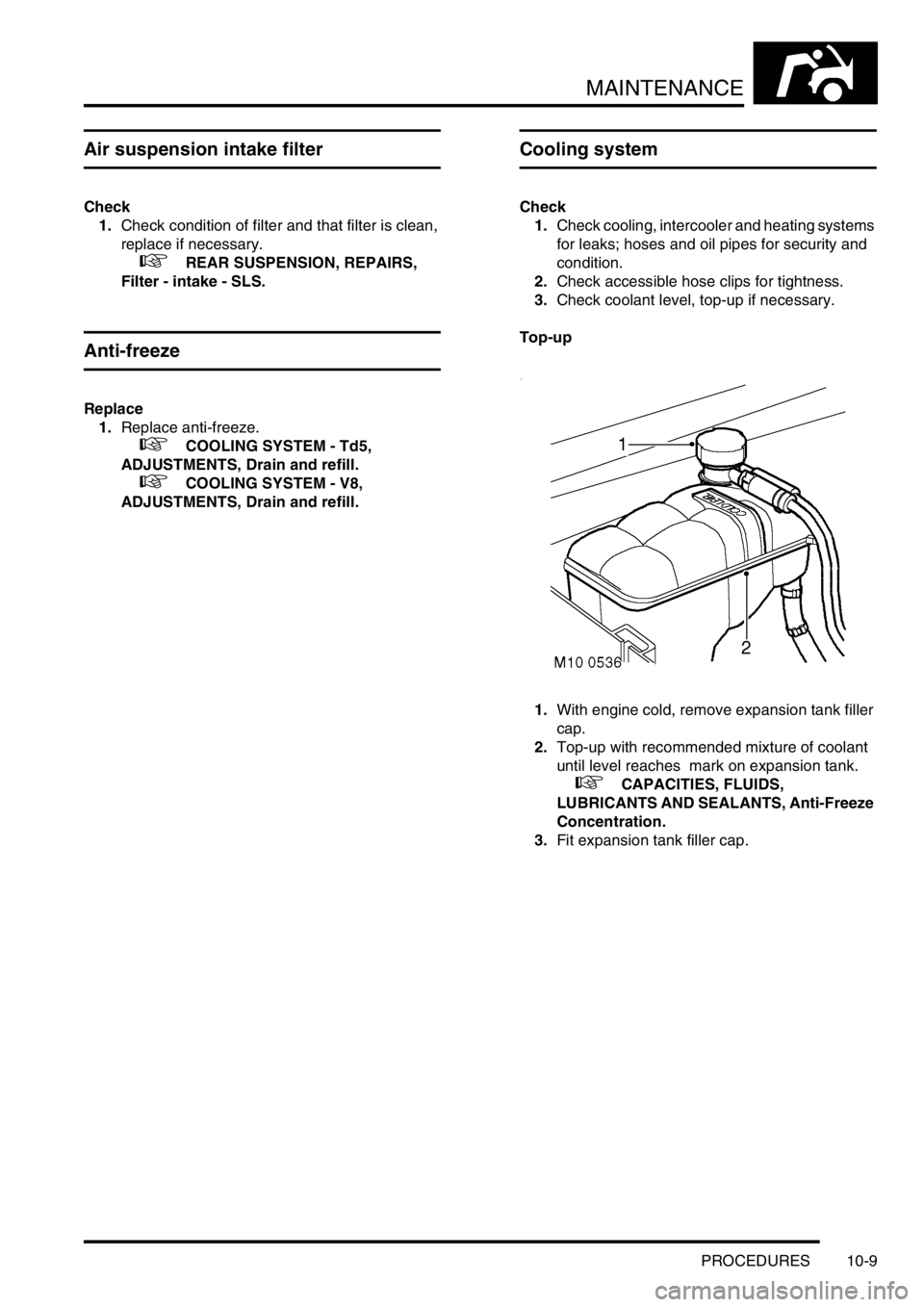
Top-up
1.With engine cold, remove expansion tank filler
cap.
2.Top-up with recommended mixture of coolant
until level reaches mark on expansion tank.
+ CAPACITIES, FLUIDS,
LUBRICANTS AND SEALANTS, Anti-Freeze
Concentration.
3.Fit expansion tank filler cap.
Page 166 of 1529
ENGINE - V8
ADJUSTMENTS 12-2-11
ADJUST ME NTS
Engine oil pressure check
$% 12.90.09.01
Check
1.Remove oil pressure switch.
+ ENGINE - V8, REPAIRS, Switch - oil
pressure.
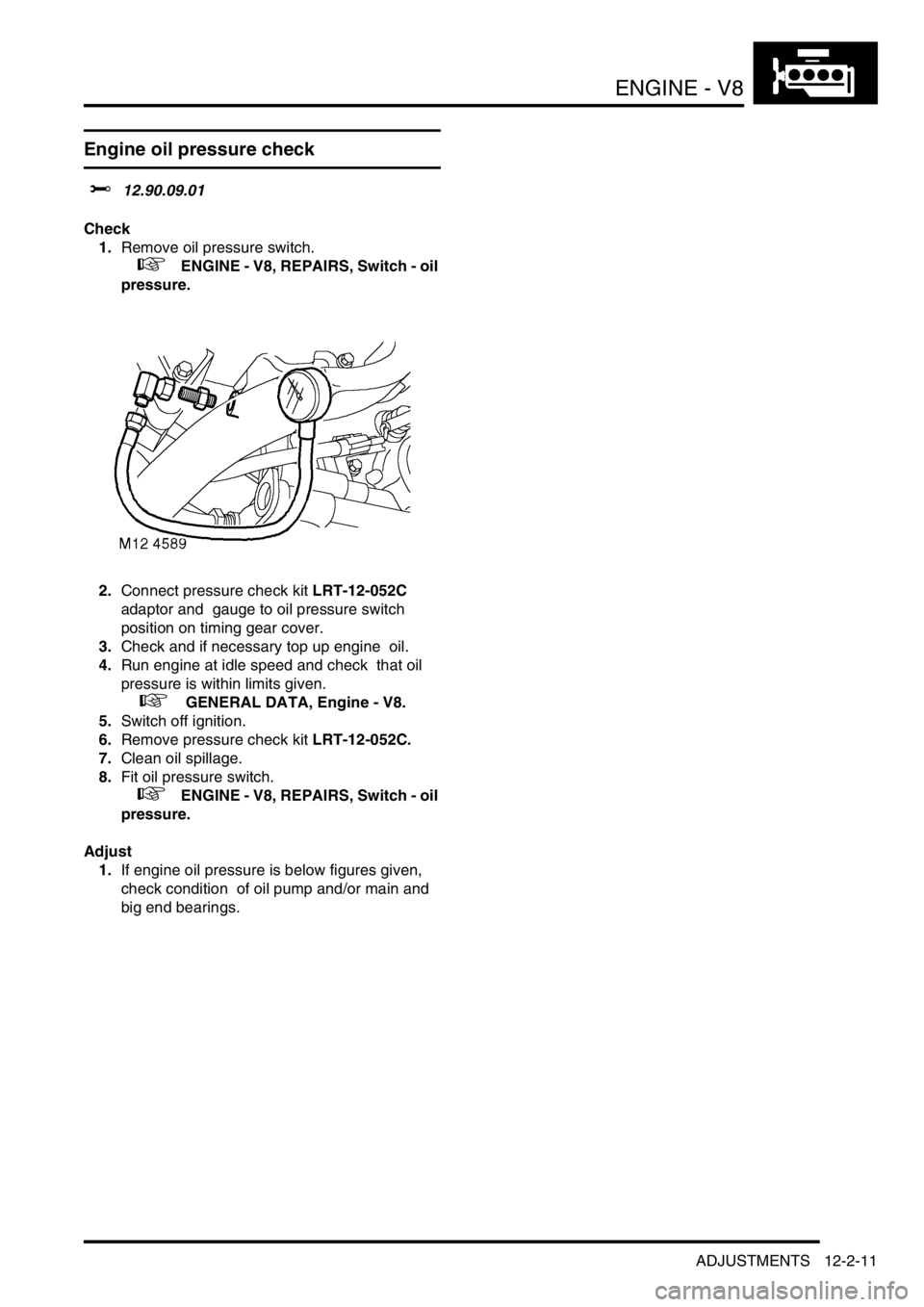
2.Connect pressure check kit LRT-12-052C
adaptor and gauge to oil pressure switch
position on timing gear cover.
3.Check and if necessary top up engine oil.
4.Run engine at idle speed and check that oil
pressure is within limits given.
+ GENERAL DATA, Engine - V8.
5.Switch off ignition.
6.Remove pressure check kit LRT-12-052C.
7.Clean oil spillage.
8.Fit oil pressure switch.
+ ENGINE - V8, REPAIRS, Switch - oil
pressure.
Adjust
1.If engine oil pressure is below figures given,
check condition of oil pump and/or main and
big end bearings.
Page 174 of 1529

ENGINE - V8
REPAIRS 12-2-19
Gasket - rocker cover - LH
$% 12.29.40
Remove
1.Remove upper inlet manifold gasket.
+ MANIFOLDS AND EXHAUST
SYSTEMS - V8, REPAIRS, Gasket - inlet
manifold - upper - Without Secondary Air
Injection.
2. Models with air conditioning: Release 4
clips and remove fan cowl.
3. Models with air conditioning: Release
tension on auxiliary drive belt and remove belt
from air conditioning compressor. Disconnect
compressor multiplug. Remove 4 bolts
securing compressor and position compressor
aside. 4.Release ht leads from rocker cover clips.
5.Remove screw securing dip stick tube.
6.Noting fitted position of 2 long screws or multi-
hex bolts, remove and discard screws/bolts
securing rocker cover; remove rocker cover.
CAUTION: Screws/bolts must be replaced
with new 'patched' multi-hex bolts.
7.Remove and discard rocker cover gasket.
Page 175 of 1529

ENGINE - V8
12-2-20 REPAIRS
Refit
1.Clean mating faces of rocker cover and
cylinder head, ensure bolt holes are clean and
dry.
2.Fit a new gasket dry, position rocker cover
ensuring gasket is correctly located.
3.Fit new 'patched' multi-hex rocker cover bolts
ensuring that 2 short bolts are on side of rocker
cover nearest centre of engine.
4.Tighten bolts by diagonal selection to:
lStage 1 - 3 Nm (2.5 lbf.ft)
lStage 2 - 8 Nm (6 lbf.ft)
5.Ensure that outer rim of gasket is correctly
positioned around periphery of rocker cover.
6.Fit and tighten screw securing dip stick tube.
7.Secure ht leads in rocker cover clips.
8. Models with air conditioning: Clean
compressor dowels and dowel holes. Position
compressor, fit bolts and tighten to 22 Nm (16
lbf.ft). Release auxiliary drive belt tensioner
and fit belt to compressor.
9. Models with air conditioning: Position fan
cowl and secure clips.
10.Fit upper inlet manifold.
+ MANIFOLDS AND EXHAUST
SYSTEMS - V8, REPAIRS, Gasket - inlet
manifold - upper - Without Secondary Air
Injection.
Gasket - rocker cover - RH
$% 12.29.41
Remove
1.Drain cooling system.
+ COOLING SYSTEM - V8,
ADJUSTMENTS, Drain and refill.
2.Remove upper inlet manifold gasket.
+ MANIFOLDS AND EXHAUST
SYSTEMS - V8, REPAIRS, Gasket - inlet
manifold - upper - Without Secondary Air
Injection.
3. Models with SAI: Disconnect 2 air manifold
unions from adapters in cylinder head and
remove manifold.
CAUTION: Take care that air manifold pipes
are not damaged during removal of union
nuts.
4.Remove 2 bolts securing coolant rails to inlet
manifold.
Page 195 of 1529

ENGINE - V8
12-2-40 REPAIRS
6.Remove 2 bolts securing radiator LH and RH
upper mounting brackets to body panel and
remove brackets.
7.Remove 4 screws securing air conditioning
condenser LH and RH upper mounting
brackets to condenser.
8.Remove condenser upper mounting brackets
with rubber mounts from radiator extension
brackets.
9.Remove 2 bolts securing LH and RH extension
brackets to radiator and remove brackets.
10.Position absorbent cloth under each oil cooler
hose connection to collect oil spillage. 11.Push against coupling release rings and
disconnect both hoses from oil cooler.
CAUTION: Always fit plugs to open
connections to prevent contamination.
12.Remove screw securing oil cooler to radiator.
13.Release cooler from its location on radiator.
14.Release radiator lower mountings from
location in chassis and carefully move radiator
towards engine sufficiently only to release
engine oil cooler from radiator.
15.Remove engine oil cooler.
Refit
1.Fit engine oil cooler to radiator, engage in
location and secure with screw.
2.Fit radiator to location in chassis.
3.Ensure connections are clean, then secure
hoses to oil cooler.
4.Fit extension brackets to radiator and secure
with bolts.
5.Fit brackets with rubber mounts to extension
brackets and secure to air conditioning
condenser with screws.
6.Fit radiator upper mounting brackets and
secure to body with bolts.
7.Fit LH horn and secure with nut.
8.Fit LH and RH air deflectors to front panel and
secure with scrivets.
9.Fit front grille.
+ EXTERIOR FITTINGS, REPAIRS,
Grille - front - up to 03MY..
10.Fit cooling fan cowl and secure with fixings.
11.Fit battery cover and secure with fixings.
12.Top up engine oil.
Page 242 of 1529

EMISSION CONTROL - V8
DESCRIPTION AND OPERATION 17-2-9
Emission Control Systems
Engine design has evolved in order to minimise the emission of harmful by-products. Emission control systems are
fitted to Land Rover vehicles which are designed to maintain the emission levels within the legal limits pertaining for
the specified market.
Despite the utilisation of specialised emission control equipment, it is still necessary to ensure that the engine is
correctly maintained and is in good mechanical order so that it operates at its optimal condition. In particular, ignition
timing has an effect on the production of HC and NO
x emissions, with the harmful emissions rising as the ignition
timing is advanced.
CAUTION: In many countries it is against the law for a vehicle owner or an unauthorised dealer to modify or
tamper with emission control equipment. In some cases, the vehicle owner and/or the dealer may even be
liable for prosecution.
The engine management ECM is fundamental for controlling the emission control systems. In addition to controlling
normal operation, the system complies with On Board Diagnostic (OBD) system strategies. The system monitors and
reports on faults detected with ignition, fuelling and exhaust systems which cause an excessive increase in tailpipe
emissions. This includes component failures, engine misfire, catalyst damage, catalyst efficiency, fuel evaporative
loss and exhaust leaks.
When an emission relevant fault is determined, the fault condition is stored in the ECM memory. For NAS vehicles,
the MIL warning light on the instrument pack will be illuminated when the fault is confirmed. Confirmation of a fault
condition occurs if the fault is still found to be present during the driving cycle subsequent to the one when the fault
was first detected.
+ ENGINE MANAGEMENT SYSTEM - V8, DESCRIPTION AND OPERATION, Description - engine
management.
The following types of supplementary control system are used to reduce harmful emissions released into the
atmosphere from the vehicle:
1Crankcase emission control – also known as blow-by gas emissions from the engine crankcase.
2Exhaust emission control – to limit the undesirable by-products of combustion.
3Fuel vapour evaporative loss control – to restrict the emission of fuel through evaporation from the fuel
system.
4Fuel leak detection system (NAS only) – there are two types of system which may be used to check the
evaporative emission system for the presence of leaks from the fuel tank to purge valve.
aVacuum leak detection test – checks for leaks down to 1 mm (0.04 in.) in diameter.
bPositive pressure leak detection test – utilises a leak detection pump to check for leaks down to 0.5 mm (0.02
in.) in diameter.
5Secondary air injection system (Where fitted) – to reduce emissions experienced during cold starting.
Page 244 of 1529
EMISSION CONTROL - V8
DESCRIPTION AND OPERATION 17-2-11
Exhaust Emission Control System
The fuel injection system provides accurately metered quantities of fuel to the combustion chambers to ensure the
most efficient air to fuel ratio under all operating conditions. A further improvement to combustion is made by
measuring the oxygen content of the exhaust gases to enable the quantity of fuel injected to be varied in accordance
with the prevailing engine operation and ambient conditions; any unsatisfactory composition of the exhaust gas is
then corrected by adjustments made to the fuelling by the ECM.
The main components of the exhaust emission system are two catalytic converters which are an integral part of the
front exhaust pipe assembly. The catalytic converters are included in the system to reduce the emission to
atmosphere of carbon monoxide (CO), oxides of nitrogen (NO
x) and hydrocarbons (HC). The active constituents of
the catalytic converters are platinum (Pt), palladium (PD) and rhodium (Rh). Catalytic converters for NAS low
emission vehicles (LEVs) from 2000MY have active constituents of palladium and rhodium only. The correct
functioning of the converters is dependent upon close control of the oxygen concentration in the exhaust gas entering
the catalyst.
The two catalytic converters are shaped differently to allow sufficient clearance between the body and transmission,
but they remain functionally identical since they have the same volume and use the same active constituents.
The basic control loop comprises the engine (controlled system), the heated oxygen sensors (measuring elements),
the engine management ECM (control) and the injectors and ignition (actuators). Other factors also influence the
calculations of the ECM, such as air flow, air intake temperature and throttle position. Additionally, special driving
conditions are compensated for, such as starting, acceleration, deceleration, overrun and full load.
The reliability of the ignition system is critical for efficient catalytic converter operation, since misfiring will lead to
irreparable damage of the catalytic converter due to the overheating that occurs when unburned combustion gases
are burnt inside it.
CAUTION: If the engine is misfiring, it should be shut down immediately and the cause rectified. Failure to do
so will result in irreparable damage to the catalytic converter.
CAUTION: Ensure the exhaust system is free from leaks. Exhaust gas leaks upstream of the catalytic
converter could cause internal damage to the catalytic converter.
CAUTION: Serious damage to the engine may occur if a lower octane number fuel than recommended is used.
Serious damage to the catalytic converter and oxygen sensors will occur if leaded fuel is used.
Air : Fuel Ratio
The theoretical ideal air:fuel ratio to ensure complete combustion and minimise emissions in a spark-ignition engine
is 14.7:1 and is referred to as the stoichiometric ratio.
The excess air factor is denoted by the Lambda symbol λ, and is used to indicate how far the air:fuel mixture ratio
deviates from the theoretical optimum during any particular operating condition.
lWhen λ = 1, the air to fuel ratio corresponds to the theoretical optimum of 14.7:1 and is the desired condition for
minimising emissions.
lWhen λ > 1, (i.e. λ = 1.05 to λ = 1.3) there is excess air available (lean mixture) and lower fuel consumption can
be attained at the cost of reduced performance. For mixtures above λ = 1.3, the mixture ceases to be ignitable.
lWhen λ < 1, (i.e. λ = 0.85 to λ = 0.95) there is an air deficiency (rich mixture) and maximum output is available,
but fuel economy is impaired.
The engine management system used with V8 engines operates in a narrower control range about the stoichiometric
ideal between λ = 0.97 to 1.03 using closed-loop control techniques. When the engine is warmed up and operating
under normal conditions, it is essential to maintain λ close to the ideal (λ = 1) to ensure the effective treatment of
exhaust gases by the three-way catalytic converters installed in the downpipes from each exhaust manifold.
Changes in the oxygen content has subsequent effects on the levels of exhaust emissions experienced. The levels
of hydrocarbons and carbon monoxide produced around the stoichiometric ideal control range are minimised, but
peak emission of oxides of nitrogen are experienced around the same range.
Page 248 of 1529

EMISSION CONTROL - V8
DESCRIPTION AND OPERATION 17-2-15
Evaporative Emission Control System
The evaporation emission control (EVAP) system is used to reduce the level of hydrocarbons emitted into the
atmosphere from the fuel system. The system comprises an EVAP canister which stores the hydrocarbons from the
fuel tank, pressure valves, vent lines and a purge control solenoid valve.
Fuel vapour is stored in the canister until it is ready to be purged to the inlet manifold under the control of the Engine
Control Module (ECM).
A two-way valve is included in the vent line between the fuel tank and the EVAP canister in all markets except NAS.
A fuel vapour separator is fitted next to the fuel filler neck, the construction is different between NAS and ROW
vehicles; the liquid vapour separator (LVS) on NAS vehicles is an L-shaped metal tube and for all other markets it is
an integral part of the moulded plastic filler neck.
+ FUEL DELIVERY SYSTEM - V8, DESCRIPTION AND OPERATION, Description.
NAS vehicles have stainless steel filler necks whilst all other markets use moulded plastic filler necks. On NAS fillers,
a valve closes the roll-over valve (ROV) vent line when the fuel filler cap is removed; for all other markets a pressure
relief valve is fitted into the ROV vent line.
+ FUEL DELIVERY SYSTEM - V8, DESCRIPTION AND OPERATION, Description.
Four ROV's are fitted to the fuel tank, for NAS vehicles the valves are fitted inside the fuel tank and for ROW vehicles
the ROV's are welded external to the fuel tank. Nylon vent lines from the ROV's connect to the liquid vapour separator
allowing vapour to pass to the EVAP canister via the LVS. To prevent the canister from being overloaded (particularly
in hot ambient conditions) and to prevent wastage of fuel, the vapour is allowed to condense within the LVS and flow
back through the ROVs into the tank.
+ FUEL DELIVERY SYSTEM - V8, DESCRIPTION AND OPERATION, Description.
Pressure / vacuum relief valves are incorporated into the fuel filler cap which operate in the event of an evaporation
system failure (e.g. blockage in the evaporation system line to atmosphere). The cap relieves fuel tank pressure to
atmosphere at approximately 1.8 to 2.0 psi (12 to 14 kPa) and opens in the opposite direction at approximately – 0.7
psi (- 5kPa) vacuum. All plastic bodied fuel fillers are fitted with a tank overpressure relief valve.
A vent line flow restrictor (anti-trickle valve) is fitted to the filler pipe in the line between the tank and the canister on
NAS vehicles. The purpose of the anti-trickle valve is to preserve the vapour space in the tank by blocking the vent
line during the fuel filling process. The valve is operated by the action of inserting the filler gun, so that when the fuel
in the tank reaches the level of the filling breather, flow cut off occurs due to fuel filling the filler pipe.
+ FUEL DELIVERY SYSTEM - V8, DESCRIPTION AND OPERATION, Description.
The breather ports from the EVAP canister are located high up in the engine bay (CVS unit on NAS vehicles with
vacuum type, fuel evaporation leak detection capability; via an air filter on NAS vehicles with positive pressure type,
fuel evaporation leak detection capability; snorkel tubes on ROW vehicles), to prevent water ingress during vehicle
wading.
Page 250 of 1529

EMISSION CONTROL - V8
DESCRIPTION AND OPERATION 17-2-17
Fuel Leak Detection System (positive pressure type) – NAS only
The evaporative loss control system equipped with a positive pressure type, fuel evaporation leak detection capability
is similar to the vacuum type, but it is capable of detecting smaller leaks by placing the evaporation system under the
influence of positive air pressure. The system includes an EVAPs canister and purge valve, and in addition, a leak
detection pump comprising a motor and solenoid valve.
The solenoid valve contained in the leak detection pump assembly performs a similar function to the CVS valve
utilised on the vacuum type pressure test. The solenoid valve is used to block the atmospheric vent side of the EVAP
canister under the control of the ECM so that an EVAP system leak check can be performed. At the same time,
pressurised air from the pump is allowed past the valve into the EVAP system to set up a positive pressure. The test
is carried out at the end of a drive cycle when the vehicle is stationary and the ignition is switched off. The test is
delayed for a brief period (approximately 10 seconds) after the engine is switched off to allow any slosh in the fuel
tank to stabilise. Component validity checks and pressure signal reference checking takes a further 10 seconds before
the pressurised air is introduced into the EVAP system.
During reference checking, the purge valve is closed and the leak detection pump solenoid valve is not energised,
while the leak detection pump is operated. The pressurised air is bypassed through a restrictor which corresponds to
a 0.5 mm (0.02 in) leak while the current consumption of the leak detection pump motor is monitored.
The system test uses the leak detection pump to force air into the EVAP system when the purge valve and solenoid
valves are both closed (solenoid valve energised), to put the evaporation lines, components and fuel tank under the
influence of positive air pressure. Air is drawn into the pump through an air filter which is located in the engine
compartment.
The fuel leak detection pump current consumption is monitored by the ECM while the EVAP system is under pressure,
and compared to the current noted during the reference check. A drop in the current drawn by the leak detection pump
motor, indicates that air is being lost through holes or leaks in the system which are greater than the reference value
of 0.5 mm (0.02 in). An increase in the current drawn by the leak detection pump motor, indicates that the EVAP
system is well sealed and that there are no leaks present which are greater than 0.5 mm (0.02 in).
The presence of leakage points indicates the likelihood of hydrocarbon emissions to atmosphere from the
evaporation system outside of test conditions and the necessity for rectification work to be conducted to seal the
system. Failure of the leak check will result in illumination of the Malfunction Indicator Lamp (MIL).
The fuel evaporation leak detection is part of the On-Board Diagnostics (OBD) strategy and it is able to determine
vapour leaks from holes or breaks down to 0.5 mm (0.02 in.) diameter. Any fuel evaporation leaks which occur
between the output of the purge valve and the connection to the inlet manifold cannot be determined using this test,
but these will be detected through the fuelling adaption diagnostics.
Evaporative Emission Control Components
The evaporative emission control components and the fuel evaporation leak detection test components (NAS only)
are described below: