height LAND ROVER DISCOVERY 1999 Owner's Manual
[x] Cancel search | Manufacturer: LAND ROVER, Model Year: 1999, Model line: DISCOVERY, Model: LAND ROVER DISCOVERY 1999Pages: 1529, PDF Size: 34.8 MB
Page 677 of 1529
REAR AXLE
51-12 OVERHAUL
Inspect
1.Clean and inspect all components for wear and
damage.
2.Fit planet gears and rotate to align cross shaft
holes.
3.Fit cross shaft, ensure roll pin hole is aligned.
4.Secure cross shaft with new roll pin.
5.Fit crown wheel to carrier, fit new bolts and
tighten to 60 Nm (44 lbf.ft).
6.Ensure original head bearing shim is clean and
free from burrs and fit under bearing race.
7.Ensure pinion bearing cup recesses are clean
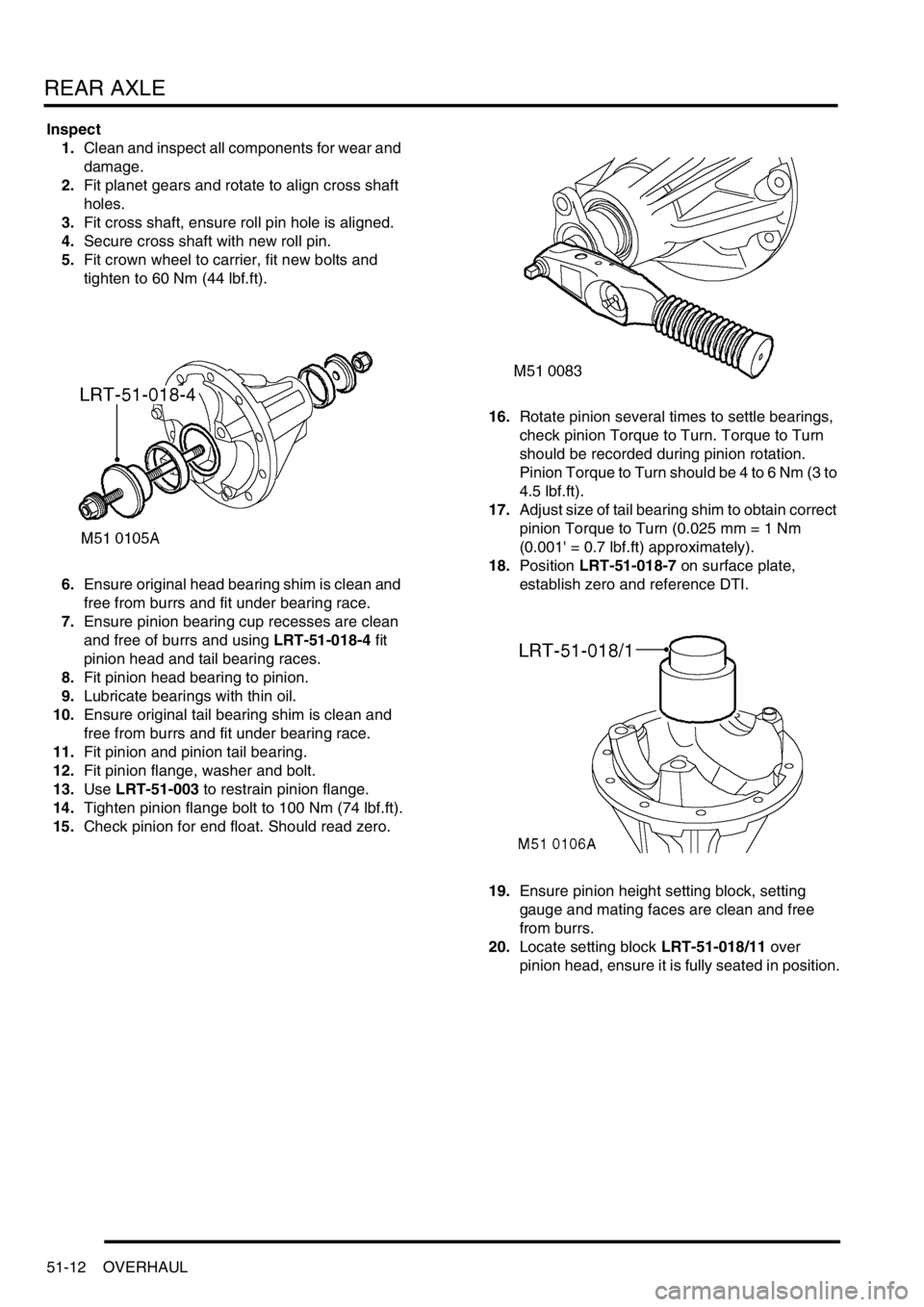
and free of burrs and using LRT-51-018-4 fit
pinion head and tail bearing races.
8.Fit pinion head bearing to pinion.
9.Lubricate bearings with thin oil.
10.Ensure original tail bearing shim is clean and
free from burrs and fit under bearing race.
11.Fit pinion and pinion tail bearing.
12.Fit pinion flange, washer and bolt.
13.Use LRT-51-003 to restrain pinion flange.
14.Tighten pinion flange bolt to 100 Nm (74 lbf.ft).
15.Check pinion for end float. Should read zero.16.Rotate pinion several times to settle bearings,
check pinion Torque to Turn. Torque to Turn
should be recorded during pinion rotation.
Pinion Torque to Turn should be 4 to 6 Nm (3 to
4.5 lbf.ft).
17.Adjust size of tail bearing shim to obtain correct
pinion Torque to Turn (0.025 mm = 1 Nm
(0.001' = 0.7 lbf.ft) approximately).
18.Position LRT-51-018-7 on surface plate,
establish zero and reference DTI.
19.Ensure pinion height setting block, setting
gauge and mating faces are clean and free
from burrs.
20.Locate setting block LRT-51-018/11 over
pinion head, ensure it is fully seated in position.
Page 678 of 1529

REAR AXLE
OVERHAUL 51-13
21. Pinion height setting procedure:
l'A' = Nominal pinion height setting, 74.390.
l'B' = Setting block height.
l'C' = Head height setting.
l'C' = 'A' - 'B'. Subtract nominal pinion height
'A' from setting block height 'B' (on side of
setting block).
lExample: 74.390 - 73.130 = 1.26 mm
(2.929' - 2.88' = 0.049'). Therefore pinion
head height reading is 1.260 mm ± 0.025
mm (0.049' ± 0.001').
CAUTION: Setting block height must be
checked using figures on side of block.
22.Align setting gauge LRT-51-018/7 to setting
block, rock gauge to obtain minimum reading. If
reading is lower than required reading,
decrease shim size. If reading is higher than
required reading, increase shim size.
23.Using LRT-51-003 to restrain pinion flange,
remove bolt and washer. Remove pinion
flange.
24.Remove pinion, collect tail bearing and tail
bearing shim.
25.Remove pinion head bearing outer race and
shim. Discard shim. Ensure bearing race
recess is clean and free from burrs.26.Fit calculated shim, and using LRT-51-018/4 fit
head bearing outer race.
27.Fit pinion, pinion tail bearing and tail bearing
shim.
28.Fit pinion flange and bolt and washer. Using
LRT-51-003 to restrain pinion flange, tighten
bolt to 100 Nm (74 lbf.ft).
29.Rotate pinion in both directions to settle
bearings.
30.Recheck pinion Torque to Turn, adjust if
necessary.
31.Recheck pinion head height.
32.Using LRT-51-003 to restrain pinion flange,
remove bolt and washer. Remove pinion
flange.
33.Discard bolt.
34.Using LRT-51-010 fit pinion seal.
35.Ensure spacer and tail bearing are correctly
located.
36.Fit pinion, pinion flange and washer.
37.Fit new pinion flange bolt and tighten to 100 Nm
(74 lbf.ft).
38.Lightly oil differential bearings.
39.Ensure spring dowels are fitted in bearing caps.
40.Fit differential bearing outer races and locate
differential assembly into housing.
41.Fit bearing caps and tighten bolts to 10 Nm (7.5
lbf.ft).
Page 750 of 1529

FRONT SUSPENSION
DESCRIPTION AND OPERATION 60-5
Coil springs
Coil springs are fitted to the front axle of the vehicle. The front springs differ between petrol and Diesel variants. Each
spring is retained at its base by the lower spring seat. The top of each spring is located in the upper spring seat
isolator. The upper spring seat is manufactured from natural rubber , with a bonded metal plate and four bonded studs
which provide for the attachment of the damper turret. The rubber isolator reduces noise transmitted to the chassis
and body from the suspension.
The coil springs must be installed correctly. The bottom coil of the spring locates in a recess in the lower spring seat.
The top coil of the spring is ground flat to locate the upper spring seat isolator.
Coil Spring Specifications – Models up to 03 Model Year
The front springs on petrol variants are manufactured from carbon chrome 13.9 mm (0.55 in) diameter bar. The spring
has 7.6 coils and a free length of 377 mm (14.8 in). The petrol front spring is identified by a pink and orange stripe
painted on a number of coils.
The front springs on Diesel variants are manufactured from carbon chrome 13.9 mm (0.55 in) diameter bar. The spring
has 7.6 coils and a free length of 383 mm (15.0 in). The Diesel front spring is identified by a white and purple stripe
painted on a number of coils.
Coil Spring Specifications – Models from 03 Model Year
The introduction of the 03MY vehicle introduced a range of additional spring fitments. These were introduced to cover
the introduction of the 4.6l V8 engine, the fitment of a front mounted winch and to optimise the vehicle trim heights.
The coil springs are manufactured from silicon manganese 13.8 mm or 13.9 mm (0.54 in or 0.55 in) diameter bar. The
following spring data table shows the colour codes, number of coils and spring free length.
Spring Data
The following table shows spring fitment applicablity.
Spring Fitment Applicability
The following table shows standard springs and uprated springs required when a front winch is fitted.
Winch Fitment Spring Applicability
Colour Code Total No. of Coils Free Length
Red/Purple 7.4 371 mm (14.6 in)
Yellow/Purple 7.4 378.4 mm (14.9 in)
Blue/Purple 7.4 365 mm (14.4 in)
Grey/Purple 7.4 387 mm (15.2 in)
Purple/Purple 7.4 373.8 mm (14.7 in)
Yellow/Orange 7.4 394.6 mm (15.5 in)
Green/Orange 7.4 382.6 mm (15 in)
Pink/Brown 7.6 405.6 mm (15.9 in)
Left Hand Drive Right Hand Drive
RH side LH side RH side LH side
Red/Purple Red/Purple Yellow/Purple Blue/Purple
Yellow/Purple Yellow/Purple Grey/Purple Purple/Purple
Grey/Purple Grey/Purple Yellow/Orange Green/Orange
Standard Spring Winch Fitted Spring
RH Side LH Side Both Sides
Red/Purple Red/Purple Grey/Purple
Yellow/Purple Blue/Purple Yellow/Orange
Yellow/Purple Yellow/Purple Yellow/Orange
Grey/Purple Purple/Purple Green/Orange
Grey/Purple Grey/Purple Green/Orange
Yellow/Orange Green/Orange Pink/Brown
Page 815 of 1529

REAR SUSPENSION
64-6 DESCRIPTION AND OPERATION
Description
General
The rear suspension comprises two dampers, two radius arms, a Watts linkage and an anti-roll bar assembly. On
vehicles without Self Levelling Suspension (SLS) coil springs are used. On vehicles with SLS air springs are used.
The anti-roll bar is an essential part of the rear suspension. On vehicles without ACE, a conventional 'passive' anti-
roll bar is fitted. On vehicles fitted with the ACE system, a thicker diameter anti-roll bar, known as a torsion bar, is used
with an actuator at one end.
+ FRONT SUSPENSION, DESCRIPTION AND OPERATION, Description - ACE.
The hydraulic dampers and springs provide springing for each rear wheel. The long travel dampers, springs and
radius arms provide maximum axle articulation and wheel travel for off-road driving. The rear axle is controlled
longitudinally by two forged steel radius arms and transversely by a Watts linkage.
Radius arms
Each radius arm is manufactured from forged steel. Two bushes are pressed into the rear of the radius arm. The rear
of the radius arm is located between a fabricated bracket on the axle and secured through the bushes with two bolts
and nuts. A bush is pressed into the forward end of the radius arm which is located in a fabricated bracket on each
chassis longitudinal and secured through the bush with a bolt and nut. Each radius arm is similar in its construction
to the front radius arms. The rear radius arms are shorter than the front and have a lug for attachment of the SLS
height sensor (when fitted).
The radius arms prevent longitudinal movement of the rear axle and because of their length allow maximum axle
articulation. The stiffness of the bushes in each radius arm also contributes to the vehicle roll stiffness.
Each radius arm has a notch on its lower edge which provides location for the vehicle jack.
Dampers
Two conventional telescopic dampers are used to control body/axle movement. The upper damper mounting is fitted
with a bush which locates in a bracket on the chassis longitudinal. The damper is secured with a bolt which screws
into a captive nut on the bracket. The lower damper mounting is also fitted with a bush and locates in a fabricated
bracket attached to the rear axle. The lower mounting is secured with a bolt which screws into a captive nut on the
bracket. The upper and lower bushes are replaceable items.
Air springs (vehicles with SLS)
On vehicles with SLS fitted, air springs are fitted between the rear axle and the chassis. Each spring is located at its
base on a fabricated platform on the rear axle. The top of the spring locates in a fabricated bracket attached to the
outside of each chassis longitudinal.
The plastic base of the air spring has two lugs which locate in a slotted hole in the rear axle platform. The spring is
secured by rotating the spring through 90°, locating the lug in the platform. The plastic top of the air spring has two
grooved pins which locate in holes in the bracket on the chassis. Two spring clips locate on the grooved pins and
retain the top of the spring in position.
Each air spring comprises a top plate assembly, an air bag and a base piston. The air bag is attached to the top plate
and the piston with a crimped ring. The air bag is made from a flexible rubber material which allows the bag to expand
with air pressure and deform under load. The top plate assembly comprises the plastic top plate with two bonded
grooved pins on its top face. In the centre of the top face is a female connector which allows for the attachment of the
air hose from the SLS compressor. The piston is made from plastic and is shaped to allow the air bag to roll over its
outer diameter. The base of the piston is recessed with a boss moulded in the centre. The boss has two lugs which
provide attachment to the axle platform.
Coil springs (vehicles without SLS)
On vehicles without SLS fitted, coil springs are fitted between the rear axle and the chassis in place of the SLS air
springs. Each spring is located at its base by the lower spring seat which is secured to a fabricated platform on the
rear axle with two bolts. The top of each spring is located in the upper spring seat. The upper spring seat comprises
a pressed metal plate with an outer coating of natural rubber bonded to the plate. The upper spring seat is retained
in position by the compression of the spring.
Page 816 of 1529

REAR SUSPENSION
DESCRIPTION AND OPERATION 64-7
Coil Spring Specifications – Models up to 03 Model Year
The rear coil springs are of the variable rate type and are manufactured from silicon manganese 16.5 mm (0.65 in.)
diameter bar. Each spring has 9 coils and a free length of 385 mm (15.1 in.). The variable rate of the spring is achieved
by the active coils at one end being closer together. The rear coil spring is identified by a purple stripe painted on a
number of coils.
Coil Spring Specifications – Models From 03 Model Year
The introduction of the 03MY vehicle introduced a range of additional rear coil spring fitments. These were introduced
as a package to optimise vehicle trim heights.
The coil springs are manufactured from silicon manganese 16.35 mm (0.64 in.) diameter bar for springs on five seater
models and 16.57 mm (0.65 in.) diameter bar on seven seater models. The following spring data table shows the
colour codes, number of coils and spring free length.
Spring Data
The following table shows spring fitment applicability.
Spring Fitment Applicability
Watts linkage
A Watts linkage is used to ensure that the rear axle remains centrally located. The Watts linkage comprises two
transverse links and a pivot housing. The transverse links and pivot housing allow the rear axle to move vertically
without any transverse movement.
The transverse links are made from fabricated and welded steel. Each transverse link has a bush press fitted into a
housing at one end. The opposite end has a forked bracket with two cross holes.
The pivot housing is made from cast iron. Three bushes are press fitted in the housing, one in the centre and one at
each end.
The pivot housing is located in a fabricated bracket centrally located on the rear of the axle. The central bush of the
pivot housing is secured in the bracket with a bolt and locknut. Fabricated brackets on each chassis longitudinal
provide for the attachment of each transverse link. Each link is secured through its bush with a bolt and locknut. The
forked end of each link locates over the bushes at each end of the pivot housing and is secured with a bolt and locknut.
The attachment bolts for each link are coated with a clear, dry wax which reduces friction on the bolt and allows the
correct torque to be applied to the clamping of the bushes. The bolts can be re-used, but if bolt replacement is
necessary the correct bolt with the wax coating must be used.
Colour Code Total No. of Coils Free Length Model
Brown/Orange 8.73 384.7 mm (15.14 in) 5 Seat
Grey/Orange 8.73 392 mm (15.43 in) 5 Seat
Yellow/Grey 8.73 376.6 mm (14.82 in) 5 Seat
Pink/Grey 8.73 400.3 mm (15.75 in) 5 Seat
Blue/Grey 9.10 387.8 mm (15.26 in) 7 Seat
Green/Grey 9.10 395.2 mm (15.55 in) 7 Seat
White/Grey 9.10 380.6 mm (14.98 in) 7 Seat
Left Hand Drive Right Hand Drive
Both Sides RH Side LH Side
Brown/Orange Grey/Orange Yellow/Grey
Grey Orange Pink/Grey Brown/Orange
Blue/Grey Green/Grey White/Grey
Page 818 of 1529
REAR SUSPENSION
DESCRIPTION AND OPERATION 64-9
DESCRIPTION AND OPERAT ION
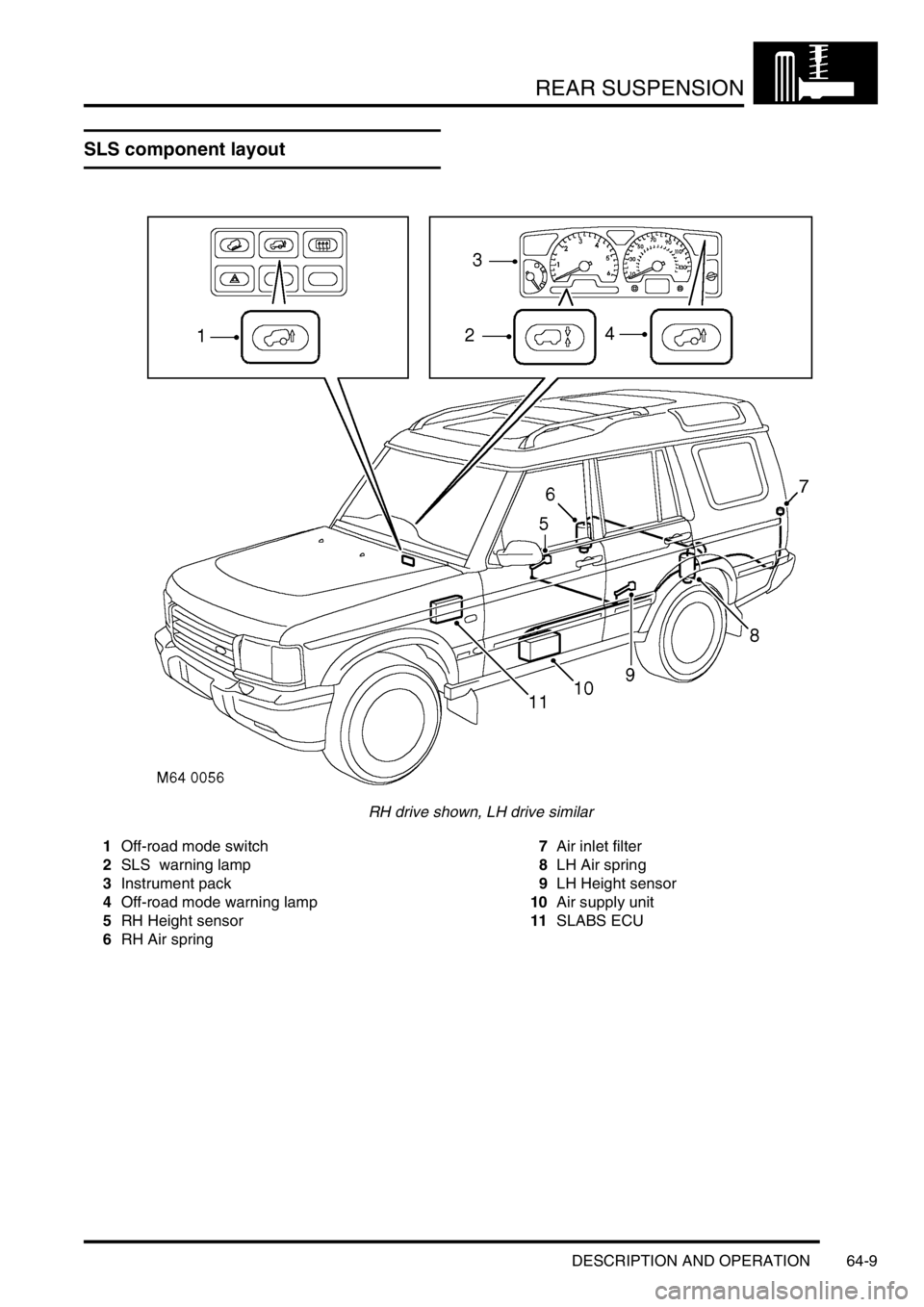
SLS component layout
RH drive shown, LH drive similar
1Off-road mode switch
2SLS warning lamp
3Instrument pack
4Off-road mode warning lamp
5RH Height sensor
6RH Air spring7Air inlet filter
8LH Air spring
9LH Height sensor
10Air supply unit
11SLABS ECU
Page 820 of 1529

REAR SUSPENSION
DESCRIPTION AND OPERATION 64-11
1Battery supply (via SLABS relay)
2Ignition supply
3RH height sensor
4LH height sensor
5Off-road mode warning lamp
6Audible warning speaker
7Instrument pack
8SLS warning lamp
9Fusible link 9
10SLS relay
11Air supply unit
12RH air valve
13LH air valve
14Exhaust valve
15Diagnostic socket
16Off-road mode switch
17SLS remote handset
18Body Control Unit (BCU)
19Door switches
20SLABS ECU
21Engine Control Module (ECM)
Page 821 of 1529

REAR SUSPENSION
64-12 DESCRIPTION AND OPERATION
Description - SLS
General
The Self Levelling Suspension (SLS) system is an optional fitment and comprises an Electronic Control Unit (ECU),
air supply unit, two air springs and two height sensors. The SLS system only operates on the rear suspension and is
designed to keep the vehicle level to compensate for uneven loads or when towing. The system controls the gap
between the chassis and the rear axle to a tolerance of ± 0.5 mm (0.02 in). The ride height of the rear of the vehicle
can be controlled in three modes of operation; normal ride height, Off-Road Mode (ORM) and extended mode. A
transportation mode, initiated using TestBook, is also available for moving the vehicle on a trailer.
The system is controlled electronically by an ECU which is shared with the ABS system and known as the Self
Levelling and Anti-Lock Braking System (SLABS) ECU. The system operates by using an air supply unit to inflate or
deflate the air springs to maintain a constant ride height.
An accessory remote handset is available to remotely operate the SLS system to allow easier connection and
disconnection of trailers.
Two SLS system warning lamps are located in the instrument pack. The warning lamp in the bottom left corner of the
instrument pack is the SLS warning lamp. If a fault is detected in the system, the warning lamp will illuminate
continuously in an amber colour. The warning lamp also flashes in an amber colour when the remote handset is being
used. The second warning lamp, located in the top right of the instrument pack is the ORM warning lamp. When ORM
is selected the warning lamp is continuously illuminated in an amber colour. When the SLS is between standard ride
height and ORM or in extended mode, the warning lamp will flash. Standard ride height, measured between the tip of
the axle bump stop rubber and the axle, is 61.5 mm (2.42 in). ORM ride height, measured between the tip of axle
bump stop and the axle, is 100 mm (3.93 in).
A switch is located in the group of six switches on the fascia and is used to select the ORM. The switch is non-latching
and must be depressed for a minimum of 0.5 seconds to signal the ECU that ORM has been requested.
Page 824 of 1529
REAR SUSPENSION
DESCRIPTION AND OPERATION 64-15
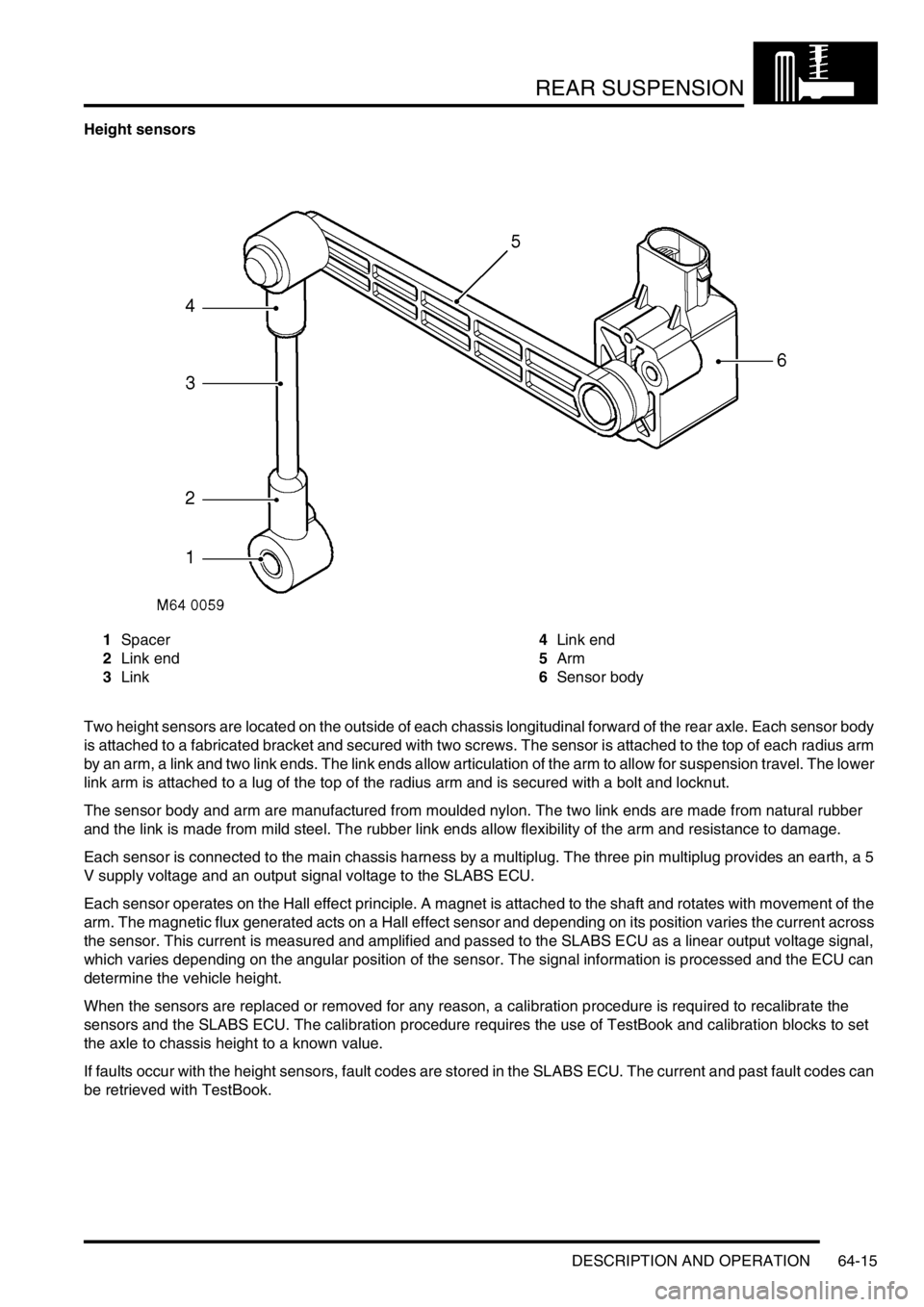
Height sensors
1Spacer
2Link end
3Link4Link end
5Arm
6Sensor body
Two height sensors are located on the outside of each chassis longitudinal forward of the rear axle. Each sensor body
is attached to a fabricated bracket and secured with two screws. The sensor is attached to the top of each radius arm
by an arm, a link and two link ends. The link ends allow articulation of the arm to allow for suspension travel. The lower
link arm is attached to a lug of the top of the radius arm and is secured with a bolt and locknut.
The sensor body and arm are manufactured from moulded nylon. The two link ends are made from natural rubber
and the link is made from mild steel. The rubber link ends allow flexibility of the arm and resistance to damage.
Each sensor is connected to the main chassis harness by a multiplug. The three pin multiplug provides an earth, a 5
V supply voltage and an output signal voltage to the SLABS ECU.
Each sensor operates on the Hall effect principle. A magnet is attached to the shaft and rotates with movement of the
arm. The magnetic flux generated acts on a Hall effect sensor and depending on its position varies the current across
the sensor. This current is measured and amplified and passed to the SLABS ECU as a linear output voltage signal,
which varies depending on the angular position of the sensor. The signal information is processed and the ECU can
determine the vehicle height.
When the sensors are replaced or removed for any reason, a calibration procedure is required to recalibrate the
sensors and the SLABS ECU. The calibration procedure requires the use of TestBook and calibration blocks to set
the axle to chassis height to a known value.
If faults occur with the height sensors, fault codes are stored in the SLABS ECU. The current and past fault codes can
be retrieved with TestBook.
Page 826 of 1529
REAR SUSPENSION
DESCRIPTION AND OPERATION 64-17
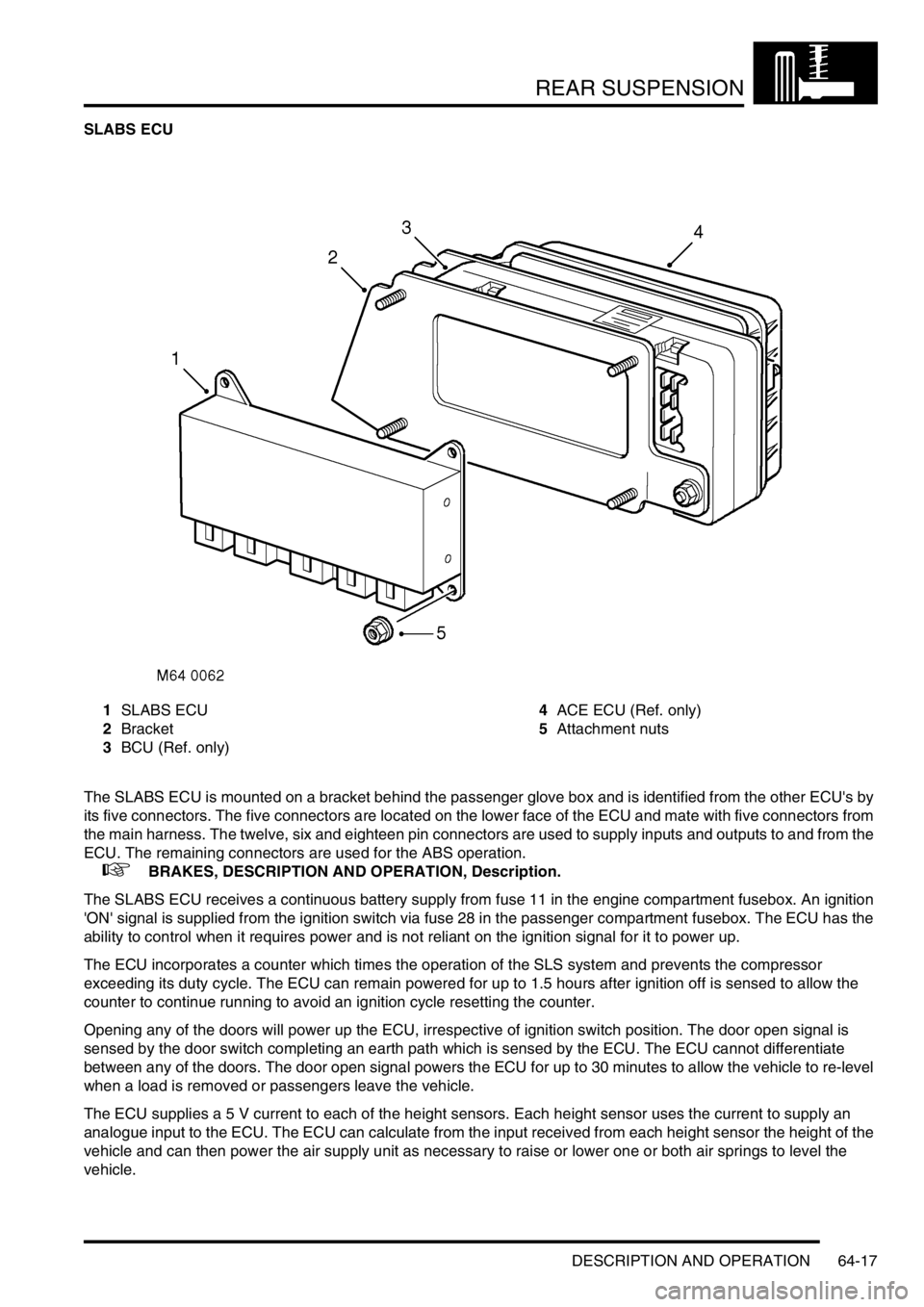
SLABS ECU
1SLABS ECU
2Bracket
3BCU (Ref. only)4ACE ECU (Ref. only)
5Attachment nuts
The SLABS ECU is mounted on a bracket behind the passenger glove box and is identified from the other ECU's by
its five connectors. The five connectors are located on the lower face of the ECU and mate with five connectors from
the main harness. The twelve, six and eighteen pin connectors are used to supply inputs and outputs to and from the
ECU. The remaining connectors are used for the ABS operation.
+ BRAKES, DESCRIPTION AND OPERATION, Description.
The SLABS ECU receives a continuous battery supply from fuse 11 in the engine compartment fusebox. An ignition
'ON' signal is supplied from the ignition switch via fuse 28 in the passenger compartment fusebox. The ECU has the
ability to control when it requires power and is not reliant on the ignition signal for it to power up.
The ECU incorporates a counter which times the operation of the SLS system and prevents the compressor
exceeding its duty cycle. The ECU can remain powered for up to 1.5 hours after ignition off is sensed to allow the
counter to continue running to avoid an ignition cycle resetting the counter.
Opening any of the doors will power up the ECU, irrespective of ignition switch position. The door open signal is
sensed by the door switch completing an earth path which is sensed by the ECU. The ECU cannot differentiate
between any of the doors. The door open signal powers the ECU for up to 30 minutes to allow the vehicle to re-level
when a load is removed or passengers leave the vehicle.
The ECU supplies a 5 V current to each of the height sensors. Each height sensor uses the current to supply an
analogue input to the ECU. The ECU can calculate from the input received from each height sensor the height of the
vehicle and can then power the air supply unit as necessary to raise or lower one or both air springs to level the
vehicle.