fuel type LAND ROVER DISCOVERY 1999 Owner's Guide
[x] Cancel search | Manufacturer: LAND ROVER, Model Year: 1999, Model line: DISCOVERY, Model: LAND ROVER DISCOVERY 1999Pages: 1529, PDF Size: 34.8 MB
Page 400 of 1529

FUEL DELIVERY SYSTEM - V8
DESCRIPTION AND OPERATION 19-2-3
Fuel tank and breather components
(NAS)
1Fuel filler cap
2Filler tube
3OBD pressure sensor atmospheric pipe
4Vent pipe to EVAP canister
5Fuel pump, regulator and fuel gauge sender
assembly
6OBD pressure sensor (vacuum type, EVAP
system leak detection capability only)
7Seal
8Locking ring
9Fuel feed connection
10Fuel gauge sender float
11Fuel tank and breather assembly12Heat shield
13Scrivet 2 off
14Stud plate
15Nut 2 off
16Cradle
17Bolt 2 off
18Nut plate 2 off
19Hose clip
20LVS vent pipe
21Tank breather connection
22Liquid vapour separator (LVS)
23Anti-trickle fill valve
Page 402 of 1529

FUEL DELIVERY SYSTEM - V8
DESCRIPTION AND OPERATION 19-2-5
Fuel tank breather system (all markets except NAS)
The filler tube incorporates a tank vent which allows air and fuel vapour displaced from the tank when filling to vent to
atmosphere via the filler neck. A relief valve in the vent line to the EVAP canister prevents vapour escaping through
the canister during filling. This prevents the customer overfilling the tank and maintains the correct fuel cut-off level.
The filler tube also incorporates an integral Liquid Vapour Separator (LVS). During normal driving excess fuel vapour
is passed via the vent line into the EVAP canister. To prevent the canister from being overloaded with fuel vapour,
especially in hot climates, the vapour is given the opportunity to condense in the LVS. Fuel which condenses in the
LVS flows back into the tank through the ROV's.
A breather spout within the tank controls the tank 'full' height. When fuel covers the spout it prevents fuel vapour and
air from escaping from the tank. This causes the fuel to 'back-up' in the filler tube and shuts off the filler gun. The
position of the spout ensures that when the filler gun shuts off, a vapour space of approximately 10% of the tanks total
capacity remains. This vapour space ensures that Roll Over Valves (ROV's) are always above the fuel level and the
vapour can escape and allow the tank to breathe.
The pressure relief valve fitted in the vent line to the EVAP canister prevents the customer trickle filling the tank.
Trickle filling greatly reduces the vapour space in the tank which in turn affects the tank's ability to breathe properly,
reducing engine performance and safety. When filling the tank, the pressures created are too low to open the pressure
relief valve, preventing the customer from trickle filling the tank. Vapour pressures created during driving are higher
and will open the valve allowing vapour to vent to the EVAP canister.
Four ROV's are welded onto the top surface of the tank. Each ROV is connected by a tube to the main vent line to
the EVAP canister. The ROV's allow fuel vapour to pass through them during normal vehicle operation. In the event
of the vehicle being overturned the valves shut-off, sealing the tank and preventing fuel from spilling from the vent line.
Fuel tank breather system (NAS)
The filler tube incorporates a tank vent which allows air and fuel vapour displaced from the tank when filling to vent to
atmosphere via the filler neck. A filler cap operated valve within the fuel filler neck prevents vapour escaping through
the EVAP canister during filling. This prevents the customer overfilling the tank and maintains the correct fuel cut-off
level.
The filler tube also has an 'L' shaped, stainless steel Liquid Vapour Separator (LVS). During normal driving excess
fuel vapour is passed via the vent line into the EVAP canister. To prevent the canister from being overloaded with fuel
vapour, especially in hot climates, the vapour is given the opportunity to condense in the LVS. Fuel which condenses
in the LVS flows back into the tank via the LVS vent line and through the Roll Over Valves (ROV's).
For NAS vehicles with vacuum type EVAP system leak detection capability, a small tube is located alongside the filler
tube and terminates near to the filler neck. The tube is connected to the On Board Diagnostics (OBD) pressure sensor
in the fuel pump and provides the sensor with a reading of atmospheric pressure to compare against the tank
pressure.
+ EMISSION CONTROL - V8, DESCRIPTION AND OPERATION, Emission Control Systems.
A breather spout within the tank controls the tank 'full' height. When fuel covers the spout it prevents fuel vapour and
air from escaping from the tank. This causes the fuel to 'back-up' in the filler tube and shuts off the filler gun. The
position of the spout ensures that when the filler gun shuts off, a vapour space of approximately 10% of the tanks total
capacity remains. This vapour space ensures that the ROV's are always above the fuel level and the vapour can
escape to the LVS and allow the tank to breathe.
The filler cap operated valve closes the vent line to the EVAP canister to prevent the customer trickle filling the tank.
Trickle filling greatly reduces the vapour space in the tank which in turn affects the tank's ability to breathe properly,
reducing engine performance and safety. When filling the tank, the removal of the filler cap closes the valve and the
vent line preventing the customer from trickle filling the tank. When the cap is installed the valve is opened by the cap
allowing vapour to vent to the EVAP canister.
The four ROV's are welded inside the top surface of the tank. Each ROV is connected internally in the tank by a tube
to the LVS. The ROV's allow fuel vapour to pass through them during normal vehicle operation. In the event of the
vehicle being overturned the valves shut-off, sealing the tank and preventing fuel from spilling from the vent line into
the LVS.
Page 403 of 1529
FUEL DELIVERY SYSTEM - V8
19-2-6 DESCRIPTION AND OPERATION
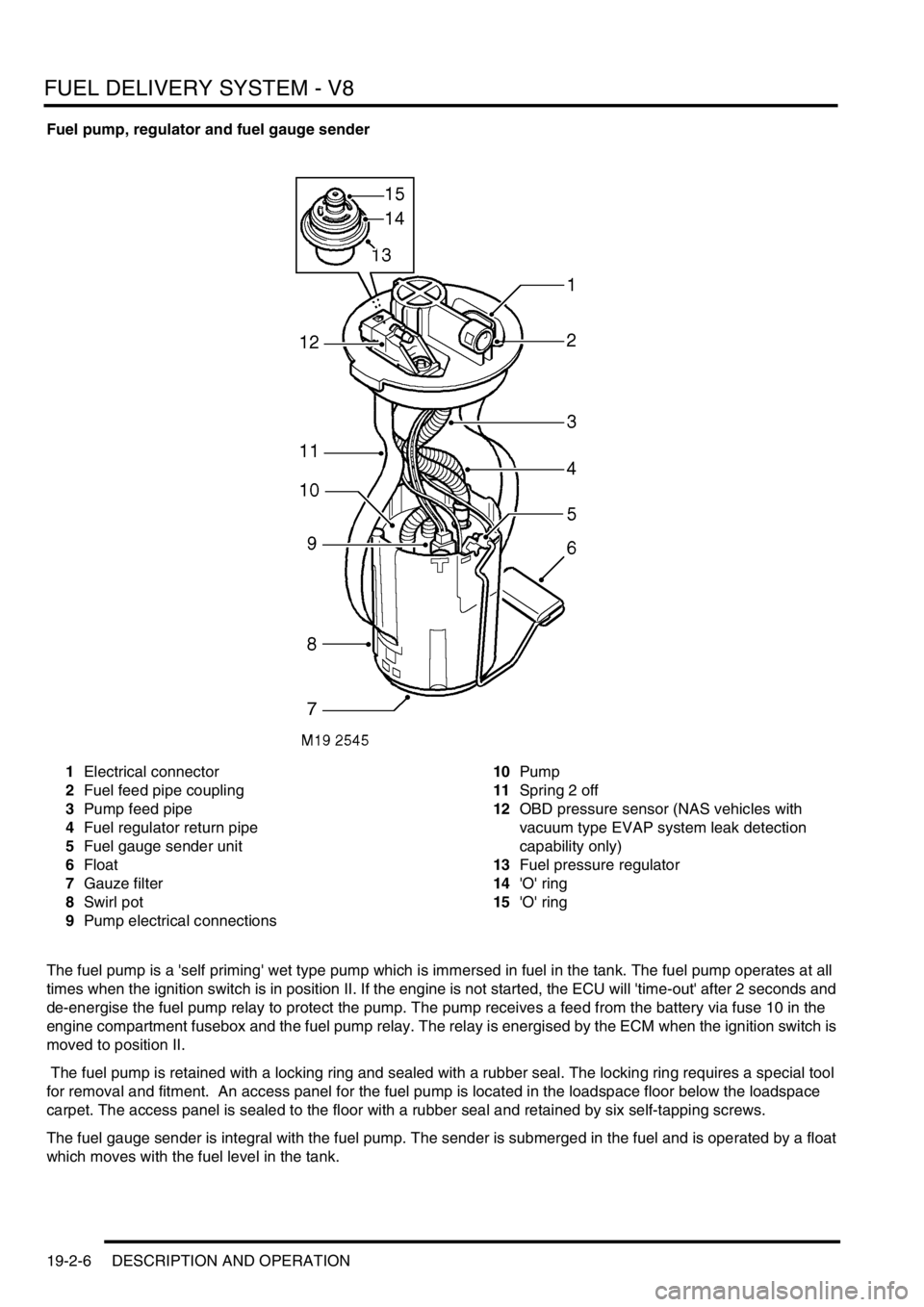
Fuel pump, regulator and fuel gauge sender
1Electrical connector
2Fuel feed pipe coupling
3Pump feed pipe
4Fuel regulator return pipe
5Fuel gauge sender unit
6Float
7Gauze filter
8Swirl pot
9Pump electrical connections10Pump
11Spring 2 off
12OBD pressure sensor (NAS vehicles with
vacuum type EVAP system leak detection
capability only)
13Fuel pressure regulator
14'O' ring
15'O' ring
The fuel pump is a 'self priming' wet type pump which is immersed in fuel in the tank. The fuel pump operates at all
times when the ignition switch is in position II. If the engine is not started, the ECU will 'time-out' after 2 seconds and
de-energise the fuel pump relay to protect the pump. The pump receives a feed from the battery via fuse 10 in the
engine compartment fusebox and the fuel pump relay. The relay is energised by the ECM when the ignition switch is
moved to position II.
The fuel pump is retained with a locking ring and sealed with a rubber seal. The locking ring requires a special tool
for removal and fitment. An access panel for the fuel pump is located in the loadspace floor below the loadspace
carpet. The access panel is sealed to the floor with a rubber seal and retained by six self-tapping screws.
The fuel gauge sender is integral with the fuel pump. The sender is submerged in the fuel and is operated by a float
which moves with the fuel level in the tank.
Page 404 of 1529

FUEL DELIVERY SYSTEM - V8
DESCRIPTION AND OPERATION 19-2-7
Fuel pump
The fuel pump assembly comprises a top cover which locates the fuel pressure regulator, electrical connector and
fuel pipe coupling. The top cover is attached to a plastic cup shaped housing by two metal springs. The housing
locates the pump and the fuel gauge sender unit.
The lower part of the housing is the swirl pot, which maintains a constant fuel level at the fuel pick-up. A feed pipe
from the pump to the coupling connection and a return pipe from the regulator connect between the top cover and the
housing.
A coarse filter is attached to the base of the housing and prevents the ingress of large contaminants into the swirl pot.
A gauze filter prevents particles entering the fuel pump.
Surrounding the pump is a large fine paper filter element which further protects the fuel pressure regulator, engine
and injectors from particulate contamination. The paper filter is not a serviceable item and removes the requirement
for an external in-line filter.
A non-return valve is located in the base of the housing. When the fuel tank is full, fuel pressure keeps the valve lifted
from its seat allowing fuel to flow into the swirl pot. As the tank level reduces, the fuel pressure in the tank reduces
causing the valve to close. When the valve is closed fuel is retained in the swirl pot, ensuring that the swirl pot remains
full and maintains a constant supply to the fuel pump.
A four pin electrical connector is located on the top cover of the pump and provides power feed and return for fuel
pump and fuel gauge rotary potentiometer operation. A single quick release coupling connects the fuel feed pipe to
the outer top surface of the pump.
Two metal springs are attached to the top cover and the housing of the pump. When the pump is installed it seats on
the lower surface inside the tank. The springs exert a downward pressure on the pump and ensure that the pump is
located positively at the bottom of the fuel tank.
The fuel pump has a maximum current draw of 6.5 A at 12.5 V.
On NAS vehicles with vacuum type EVAP system leak detection capability only, the fuel pump top cover is fitted with
an On Board Diagnostics (OBD) pressure sensor. This sensor has a three pin electrical connector which provides a
connection between the sensor and the ECM. The sensor is sealed in the top cover with an 'O' ring and secured with
a clip. The sensor monitors tank pressure during OBD tests of the fuel evaporation system integrity. A hose is
connected to the sensor and is routed across the top of the fuel tank and terminates at the top of the fuel filler tube.
The pipe is open to atmosphere and provides atmospheric pressure for the sensor operation.
+ ENGINE MANAGEMENT SYSTEM - V8, DESCRIPTION AND OPERATION, Description - engine
management.
Fuel pressure regulator
The fuel pressure regulator is located in the underside of the top cover. The regulator is sealed with two 'O' rings and
retained with a clip.
The regulator is connected to the fuel feed pipe at the top of the pump housing and maintains the fuel pump delivery
pressure to 3.5 bar (50 lbf.in
2). When the fuel delivery pressure exceeds 3.5 bar (50 lbf.in2), the regulator opens and
relieves excess pressure back to the swirl pot via a return pipe. The regulator ensures that the fuel rails and injectors
are supplied with a constant pressure.
The fuel pump delivery pressure and pressure regulator operating pressure can be checked using a Schraeder type
valve located at the rear of the engine on the fuel rail. The valve allows the pump delivery pressure to be measured
using a suitable gauge and an adaptor and hose which are special tools.
Page 1295 of 1529

BODY CONTROL UNIT
86-3-8 DESCRIPTION AND OPERATION
C0664 connector pin details
IDM inputs
The IDM inputs are communicated to the BCU using the serial datalink so that the BCU can perform the necessary
logic operations:
The V
in for IDM digital signals are defined as follows:
lLogic 1 when V
in ≥ 8V.
lLogic 0 when V
in ≤ 2V.
IDM input voltages between 2 and 8 volts are indeterminate and cannot be guaranteed.
Pin No. Description Input/Output
1 Front left window down Output
2 Front right window down Output
3 Fuel flap release Output
4 Front left window up Output
5Earth -
6 Front right window up Output
7 Battery power supply Input
Description Signal type System
Inertia switch Digital Locking/ Unlocking/ Alarm
Side lamps Digital Exterior lighting
Headlamp dipped beam Digital Exterior lighting
Headlamp main beam daylight running lamps Analogue Exterior lighting
RH direction indicators current sense Analogue Direction indicators/ Hazards/ Alarm
LH direction indicators current sense Analogue Direction indicators/ Hazards/ Alarm
Front wiper park sense Digital Wipers and washers