battery LAND ROVER DISCOVERY 1999 Repair Manual
[x] Cancel search | Manufacturer: LAND ROVER, Model Year: 1999, Model line: DISCOVERY, Model: LAND ROVER DISCOVERY 1999Pages: 1529, PDF Size: 34.8 MB
Page 344 of 1529

ENGINE MANAGEMENT SYSTEM - V8
DESCRIPTION AND OPERATION 18-2-45
Malfunction Indicator Lamp (MIL)/ service engine soon warning lamp
The MIL/ service engine soon warning lamp is located in the instrument cluster. It illuminates to alert the driver to
system malfunctions. Service engine soon warning lamp is the name for this warning lamp in NAS only, it is called
MIL in all other markets.
During ignition a self-test function of the lamp is carried out. The lamp will illuminate for 3 seconds then it will
extinguish if no faults exist.
+ INSTRUMENTS, DESCRIPTION AND OPERATION, Description.
Input/Output
The MIL is supplied with battery voltage from the instrument cluster. When the ECM detects a fault, it provides an
earth path to illuminate the MIL. Output to the MIL is via pin 20 of connector C0637 of the ECM.
Air Temperature Control (ATC) request
The ATC request comes via the ATC switch located in the facia panel. When the driver operates the switch it acts as
a request from the ATC ECU to engage the ATC clutch to drive the system.
During periods of high driver demand such as hard acceleration or maximum rev/min the ATC clutch will be disabled
for a short time. This is to reduce the load on the engine.
+ AIR CONDITIONING, DESCRIPTION AND OPERATION, Description.
Page 346 of 1529
ENGINE MANAGEMENT SYSTEM - V8
DESCRIPTION AND OPERATION 18-2-47
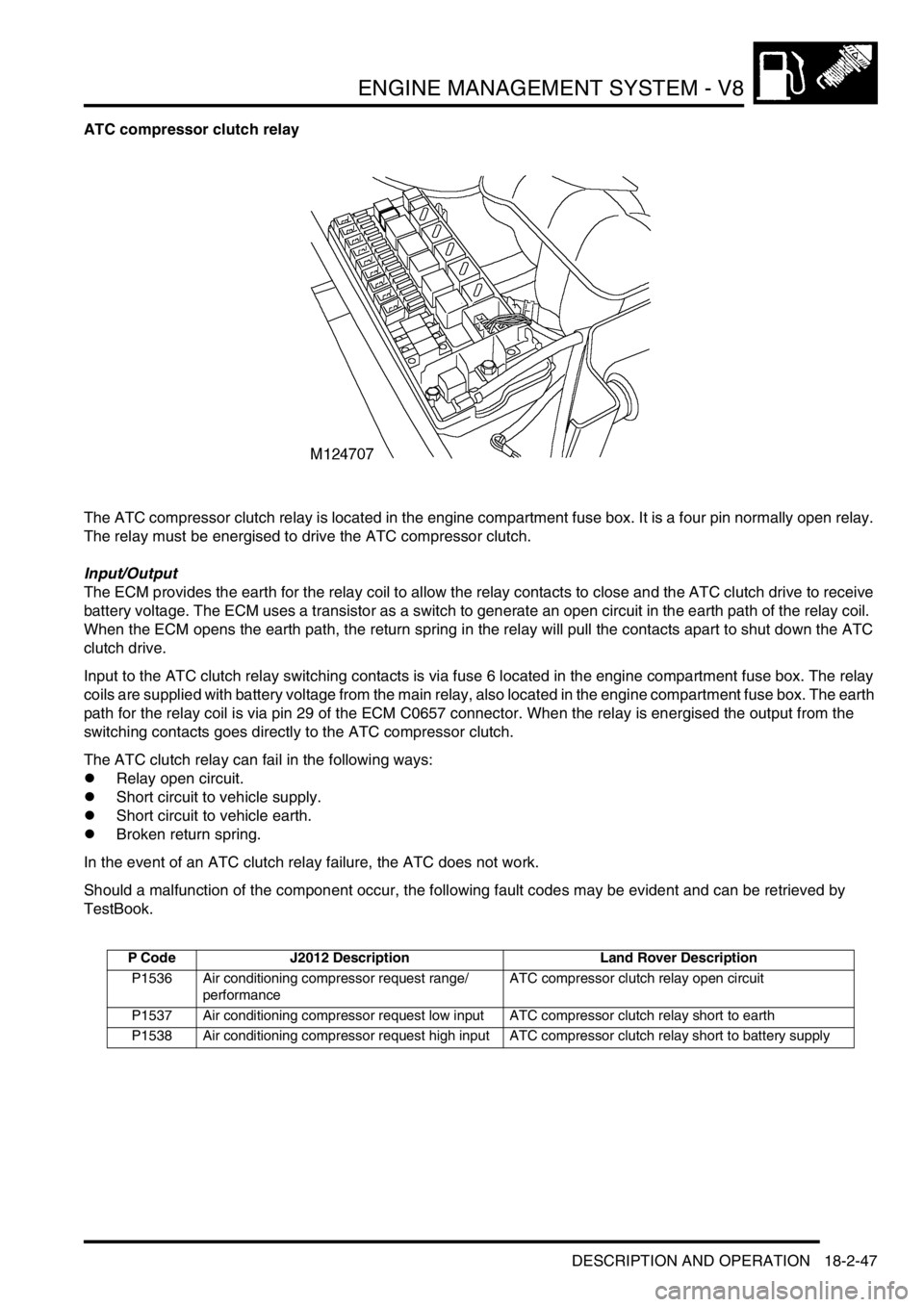
ATC compressor clutch relay
The ATC compressor clutch relay is located in the engine compartment fuse box. It is a four pin normally open relay.
The relay must be energised to drive the ATC compressor clutch.
Input/Output
The ECM provides the earth for the relay coil to allow the relay contacts to close and the ATC clutch drive to receive
battery voltage. The ECM uses a transistor as a switch to generate an open circuit in the earth path of the relay coil.
When the ECM opens the earth path, the return spring in the relay will pull the contacts apart to shut down the ATC
clutch drive.
Input to the ATC clutch relay switching contacts is via fuse 6 located in the engine compartment fuse box. The relay
coils are supplied with battery voltage from the main relay, also located in the engine compartment fuse box. The earth
path for the relay coil is via pin 29 of the ECM C0657 connector. When the relay is energised the output from the
switching contacts goes directly to the ATC compressor clutch.
The ATC clutch relay can fail in the following ways:
lRelay open circuit.
lShort circuit to vehicle supply.
lShort circuit to vehicle earth.
lBroken return spring.
In the event of an ATC clutch relay failure, the ATC does not work.
Should a malfunction of the component occur, the following fault codes may be evident and can be retrieved by
TestBook.
P Code J2012 Description Land Rover Description
P1536 Air conditioning compressor request range/
performanceATC compressor clutch relay open circuit
P1537 Air conditioning compressor request low input ATC compressor clutch relay short to earth
P1538 Air conditioning compressor request high input ATC compressor clutch relay short to battery supply
Page 347 of 1529
ENGINE MANAGEMENT SYSTEM - V8
18-2-48 DESCRIPTION AND OPERATION
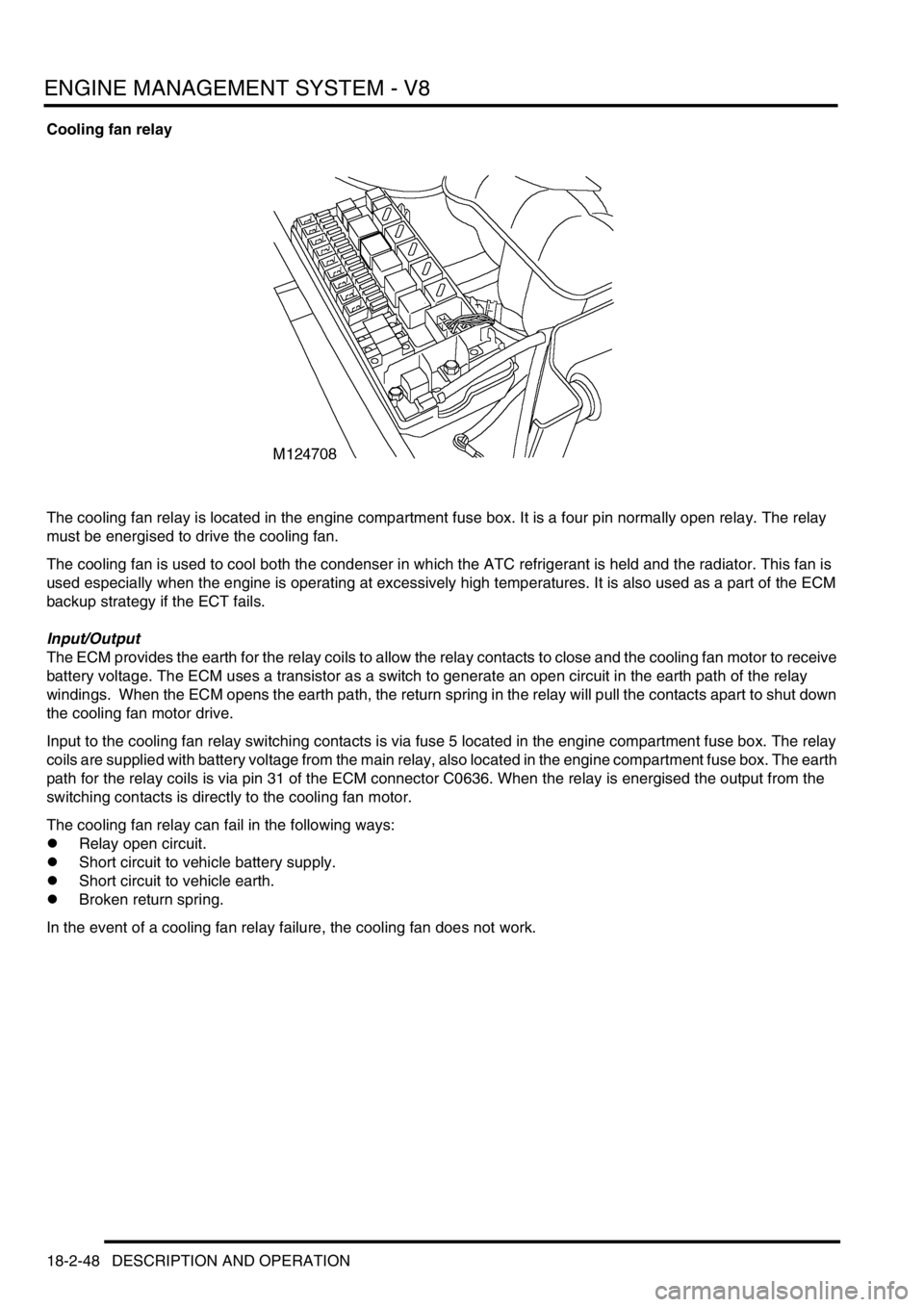
Cooling fan relay
The cooling fan relay is located in the engine compartment fuse box. It is a four pin normally open relay. The relay
must be energised to drive the cooling fan.
The cooling fan is used to cool both the condenser in which the ATC refrigerant is held and the radiator. This fan is
used especially when the engine is operating at excessively high temperatures. It is also used as a part of the ECM
backup strategy if the ECT fails.
Input/Output
The ECM provides the earth for the relay coils to allow the relay contacts to close and the cooling fan motor to receive
battery voltage. The ECM uses a transistor as a switch to generate an open circuit in the earth path of the relay
windings. When the ECM opens the earth path, the return spring in the relay will pull the contacts apart to shut down
the cooling fan motor drive.
Input to the cooling fan relay switching contacts is via fuse 5 located in the engine compartment fuse box. The relay
coils are supplied with battery voltage from the main relay, also located in the engine compartment fuse box. The earth
path for the relay coils is via pin 31 of the ECM connector C0636. When the relay is energised the output from the
switching contacts is directly to the cooling fan motor.
The cooling fan relay can fail in the following ways:
lRelay open circuit.
lShort circuit to vehicle battery supply.
lShort circuit to vehicle earth.
lBroken return spring.
In the event of a cooling fan relay failure, the cooling fan does not work.
Page 355 of 1529

ENGINE MANAGEMENT SYSTEM - V8
18-2-56 DESCRIPTION AND OPERATION
Function
Input for the rough road signal is measured via pin 34 of connector C0637 of the ECM. The SLABS ECU generates
a PWM signal that varies in accordance with changing road conditions. The rough road PWM signal operates at a
frequency of 2.33 Hz ± 10%. The significance of changes in the PWM signal are shown in the following table:
The rough road signal can fail in the following ways:
lHarness or connector damage
lSLABS failure — wheel speed sensor
A rough road signal failure may be evident from the following:
lHDC / ABS warning light on
Should a malfunction of the rough road signal occur, the following fault codes may be evident and can be retrieved
by TestBook:
Hill Descent Control (HDC) signal
The ECM transmits throttle angle, engine torque, engine identification (Td5 or V8), and transmission type (automatic
or manual) data to the SLABS ECU to support the Hill Descent Control system. The information is transmitted via a
0 – 12V pulse width modulated (PWM) signal at a frequency of 179.27 Hz.
Function
The HDC signal output from the ECM is via pin 29 of connector C0636. The ECM generates a PWM signal that varies
in pulse width in accordance with changing throttle angle or engine torque. The throttle angle data is transmitted on
pulses 1, 3, 5 and 37. The engine torque data is transmitted on pulses 2,4,6 and 38. The engine and transmission
information is transmitted on pulse 39. A synchronising pulse is transmitted after every 39th pulse.
The HDC signal can fail in the following ways:
lHarness or connector damage
A HDC signal failure may be evident from the following:
lHDC / ABS warning light on
lHDC inoperative
lAudible warning
Should a malfunction of the HDC signal occur, the following fault codes may be evident and can be retrieved by
TestBook:
PWM signal Indication
<10% Electrical short circuit to ground
25% ± 5 % Smooth road
50% ± 5 % SLABS error
75% ± 5% Rough road
>90% Electrical short circuit to battery voltage
P Code J2012 Description Land Rover Description
P1590 ABS rough road signal circuit malfunction Hardware is OK, but SLABS ECU is sending an error
signal
P1591 ABS rough road signal circuit low Signal from SLABS ECU short circuit to earth
P1592 ABS rough road signal circuit high Signal from SLABS ECU short circuit to vehicle battery
supply
P Code J2012 Description Land Rover Description
P1663 Throttle angle/Torque signal circuit malfunction SLABS HDC link open circuit
P1664 Throttle angle/Torque signal circuit low SLABS HDC link short circuit to ground
P1665 Throttle angle/Torque signal circuit high SLABS HDC link short circuit to battery voltage
Page 371 of 1529

ENGINE MANAGEMENT SYSTEM - V8
18-2-72 DESCRIPTION AND OPERATION
Several fault codes can be generated:
Fault codes
1"Output power LOW when HIGH is expected" is flagged when Pin C0239-11 is shorted to earth.
This could be due to an external fault or an internal ECU fault and will be set if pin C0239-11 is LOW for longer
than 240 milliseconds, while in cruise mode.
2"Output power HIGH when LOW is expected" is flagged when Pin C0239-11 is shorted to battery voltage.
This could be due to an external fault or internal ECU fault and will be set if pin C0239-11 is HIGH for longer than
250 milliseconds while not in cruise mode.
3"Output pump LOW, when High is expected" is flagged when Pin C0239-7 is shorted to earth.
This could be due to an external fault or an internal ECU fault. This fault will be set if pin C0239-11 is HIGH for
longer than 7.5 milliseconds while pin C0239-7 is LOW for longer than 2.5 milliseconds while decelerating under
control of cruise.
4"Output pump HIGH, when LOW is expected" is flagged when Pin C0239-7 is shorted to battery voltage.
This could be due to an external fault or an internal ECU fault. This fault will be set if pin C0239-7 is LOW for
longer than 7.5 milliseconds of the last 8 pulses when the pump is switched on while accelerating under the
control of cruise.
5Output valve LOW, when HIGH is expected is flagged when Pin C0239-7 is shorted to battery voltage.
This could be due to an external fault or an internal ECU fault and will be set if pin C0239-17 is LOW for longer
than 2.5 milliseconds while pin C0239-7 is HIGH for longer than 2.5 milliseconds and pin C0239-11 is also HIGH
for longer than 7.5 milliseconds, while decelerating under control of the cruise control ECU.
6Output valve HIGH, when LOW is expected is flagged when Pin C0239-17 is shorted to battery voltage.
This could be an external fault or an internal ECU fault. The fault will be set if pin C0239-17 remains HIGH for
longer than 35 milliseconds after the vacuum control valve is switched on, while accelerating under control of
the cruise control ECU.
TestBook can be used to determine the fault codes present as well as the general status of the system.
Page 380 of 1529

ENGINE MANAGEMENT SYSTEM - V8
REPAIRS 18-2-81
Engine control module (ECM)
$% 18.30.01
Remove
1.Release fixings and remove battery cover.
2.Disconnect battery earth lead.
3.Remove fixings securing fascia RH closing
panel, release diagnostic socket RH drive
models, and remove panel.
4.Remove 2 fixings and remove 'A' post lower
trim. 5.Remove 2 nuts and release ECM from studs
and location on 'A' post lower panel.
6.Lower ECM into footwell and disconnect 5
multiplugs.
7.Remove ECM.
Refit
1.Position new ECM and connect multiplugs.
2.Fit ECM and secure with nuts.
3.Fit lower trim panel to 'A' post and secure with
fixings.
4.Fit diagnostic socket to closing panel, fit closing
panel and secure with fixings.
5.Connect battery earth lead.
6.Fit battery cover and secure with fixings.
7.Programme ECM and reset adaptions using
TestBook.
Page 381 of 1529

ENGINE MANAGEMENT SYSTEM - V8
18-2-82 REPAIRS
Sensor - engine coolant temperature
(ECT)
$% 18.30.10
Remove
1.Release turnbuckles and remove battery cover.
2.Disconnect battery earth lead.
3.Remove auxiliary drive belt.
+ CHARGING AND STARTING,
REPAIRS, Belt - auxiliary drive.
4.Remove 2 bolts securing alternator, release
alternator from support bracket and position
aside. 5.Disconnect multiplug from ECT sensor.
6.Remove sensor from inlet manifold and discard
sealing washer.
Refit
1.Clean sealant from threads in manifold.
2.Apply sealant, Part No. STC 50552 to sensor
threads.
3.Fit new sealing washer to ECT sensor and
tighten sensor to 10 Nm (7 lbf.ft).
4.Connect multiplug to ECT sensor.
5.Position alternator, fit bolts and tighten to 45
Nm (33 lbf.ft).
6.Fit auxiliary drive belt.
+ CHARGING AND STARTING,
REPAIRS, Belt - auxiliary drive.
7.Top up cooling system.
8.Connect battery earth lead.
9.Fit battery cover and secure with fixings.
Page 382 of 1529

ENGINE MANAGEMENT SYSTEM - V8
REPAIRS 18-2-83
Sensor - crankshaft position (CKP)
$% 18.30.12
Remove
1.Release fixings and remove battery cover.
2.Disconnect battery earth lead.
3.Raise front of vehicle.
WARNING: Do not work on or under a
vehicle supported only by a jack. Always
support the vehicle on safety stands.
4.Release fixings and remove underbelly panel.
5.Release CKP sensor multiplug from bracket.
6.Remove 2 bolts securing CKP sensor heat
shield and position aside.
7.Remove 2 nuts securing CKP sensor, remove
2 spacers, CKP sensor and sensor mounting.
8.Disconnect CKP sensor multiplug from engine
harness. Refit
1.Ensure all components are clean.
2.Connect CKP sensor multiplug to engine
harness.
3.Fit sensor mounting, CKP sensor, 2 spacers
and tighten CKP sensor retaining nuts to 6 Nm
(5 lbf.ft).
4.Fit CKP sensor heat shield and secure with
bolts.
5.Fit underbelly panel and secure with fixings.
6.Remove stand(s) and lower vehicle.
7.Connect battery earth lead.
8.Fit battery cover and secure the fixings.
9.Reset adaptions using TestBook.
Page 383 of 1529

ENGINE MANAGEMENT SYSTEM - V8
18-2-84 REPAIRS
Sensor - radiator temperature
$% 18.30.20
Remove
1.Disconnect battery earth lead.
2.Position container to collect coolant spillage.
3.Disconnect multiplug from sensor.
4.Remove sensor and discard sealing washer.
Refit
1.Fit new sealing washer to sensor.
2.Fit and tighten sensor.
3.Connect multiplug to sensor.
4.Refill cooling system.
5.Connect battery earth lead.
Sensor - camshaft position (CMP)
$% 18.30.24
Remove
1.Release fixings and remove battery cover.
2.Disconnect battery earth lead.
3.Raise front of vehicle.
WARNING: Do not work on or under a
vehicle supported only by a jack. Always
support the vehicle on safety stands.
4.Release fixings and remove underbelly panel.
5.Remove engine oil filter.
+ ENGINE - V8, REPAIRS, Filter - oil.
6.Disconnect engine harness from CMP sensor
and release CMP sensor multiplug from
bracket.
7.Remove bolt from clamp securing CMP sensor
to timing gear cover.
8.Remove clamp and CMP sensor. Discard 'O'
ring from CMP sensor.
Refit
1.Ensure CMP sensor is clean, fit new 'O' ring
and sensor to cover.
2.Fit clamp to CMP sensor and tighten bolt to 8
Nm (6 lbf.ft).
3.Fit sensor multiplug to bracket and connect
engine harness to multiplug.
4.Fit engine oil filter.
+ ENGINE - V8, REPAIRS, Filter - oil.
5.Fit underbelly panel and secure with fixings.
6.Lower vehicle and connect battery earth lead.
7.Fit battery cover and secure with fixings.
Page 384 of 1529

ENGINE MANAGEMENT SYSTEM - V8
REPAIRS 18-2-85
Knock sensor (KS)
$% 18.30.28
Remove
1.Release fixings and remove battery cover.
2.Disconnect battery earth lead.
3.Raise front of vehicle.
WARNING: Do not work on or under a
vehicle supported only by a jack. Always
support the vehicle on safety stands.
4.Remove fixings securing underbelly panel and
remove panel.
5.Disconnect multiplug from KS.
6.Remove nut securing KS to cylinder block and
remove KS. Refit
1.Clean mating faces of KS and cylinder block.
2.Fit KS to cylinder block and tighten nut to 22
Nm (16 lbf.ft).
3.Connect multiplug to KS.
4.Fit underbelly panel and secure with fixings.
5.Remove stand(s) and lower vehicle.
6.Connect battery earth lead.
7.Fit battery cover and secure the fixings.