ECU LAND ROVER DISCOVERY 1999 Workshop Manual
[x] Cancel search | Manufacturer: LAND ROVER, Model Year: 1999, Model line: DISCOVERY, Model: LAND ROVER DISCOVERY 1999Pages: 1529, PDF Size: 34.8 MB
Page 1227 of 1529
AIR CONDITIONING
82-38REPAIRS
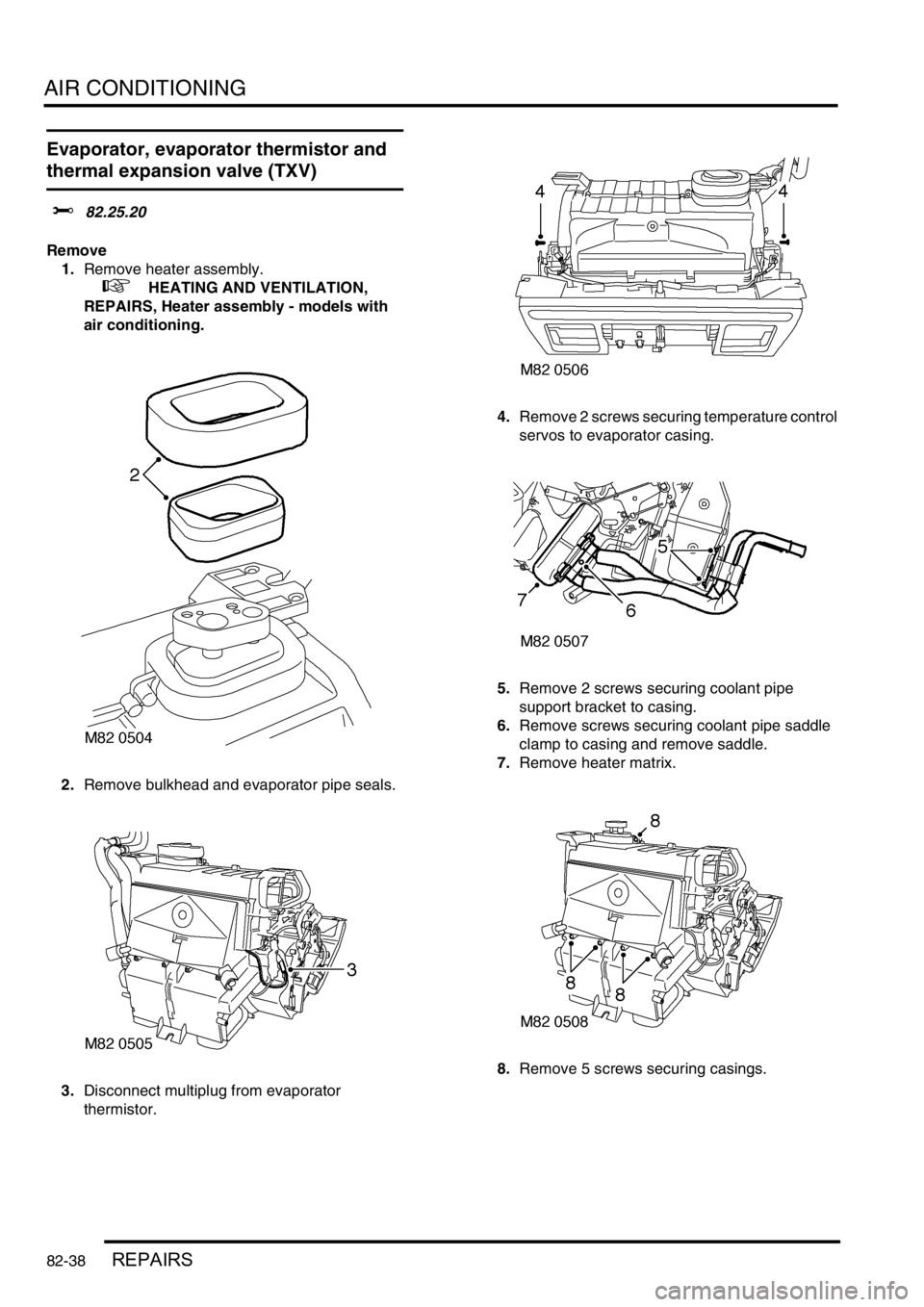
Evaporator, evaporator thermistor and
thermal expansion valve (TXV)
$% 82.25.20
Remove
1.Remove heater assembly.
+ HEATING AND VENTILATION,
REPAIRS, Heater assembly - models with
air conditioning.
2.Remove bulkhead and evaporator pipe seals.
3.Disconnect multiplug from evaporator
thermistor. 4.Remove 2 screws securing temperature control
servos to evaporator casing.
5.Remove 2 screws securing coolant pipe
support bracket to casing.
6.Remove screws securing coolant pipe saddle
clamp to casing and remove saddle.
7.Remove heater matrix.
8.Remove 5 screws securing casings.
Page 1228 of 1529

AIR CONDITIONING
REPAIRS 82-39
9.Remove 12 spring clips securing casings. 10.Remove evaporator casing and collect
insulation.
11.Remove evaporator assembly.
12.Remove evaporator thermistor.
Page 1229 of 1529

AIR CONDITIONING
82-40REPAIRS
13.Remove covering from TX valve, release 2
clips securing TX valve to pipe.
14.Release 2 unions securing TX valve, remove
TX valve, remove and discard 'O' rings.
15.Release pipe union, remove pipe and discard
'O' ring. Refit
1.Using a new 'O' ring, position pipe to
evaporator and tighten union.
2.Using new 'O' rings, position TX valve. Connect
pressure pipe union and tighten to 22 Nm (16
lbf. ft). Connect evaporator pipe and tighten to
32 Nm (24 lbf.ft).
3.Position TX valve sensor to pipe and secure
with clips.
4.Fit sensor covering.
5.Fit evaporator thermistor.
6.Fit evaporator assembly.
7.Fit insulation to evaporator casing and fit
casing.
8.Secure spring clips.
9.Fit and tighten casing screws.
10.Fit heater matrix, ensuring matrix temperature
is correctly positioned.
11.Fit coolant pipe saddle, fit and tighten screws
securing saddle and pipe bracket.
12.Fit and tighten temperature servo screws.
13.Connect multiplug to evaporator thermistor.
14.Clean any bulk head seal from casing.
15.Fit bulkhead and evaporator pipe seals.
16.Fit heater assembly.
+ HEATING AND VENTILATION,
REPAIRS, Heater assembly - models with
air conditioning.
Page 1230 of 1529

AIR CONDITIONING
REPAIRS 82-41
Expansion valve - (TXV) - rear
$% 82.26.01
Remove
1.Depressurise air conditioning system.
+ AIR CONDITIONING, REFRIGERANT
RECOVERY, RECYCLING AND
RECHARGING, Refrigerant recovery,
recycling and recharging.
2.Remove rear lower trim casing.
+ INTERIOR TRIM COMPONENTS,
REPAIRS, Trim casing - side - loadspace.
3.Remove 5 bolts securing seat support bracket
and remove bracket.
4.Release insulation from TXV pipe unions and
sensor.
5.Remove clip securing sensor to pipe and
release sensor. 6.Loosen TXV pipe unions, release pipes and
remove TXV.
7.Remove and discard 'O' rings.
Refit
1.Lubricate new 'O' rings with clean refrigerant oil
and fit to TXV pipes.
2.Position TXV, align pipes and tighten unions.
3.Connect sensor and secure with clip.
4.Fit insulation to TXV valve and sensor.
5.Position seat support bracket, fit bolts and
tighten to 24 Nm (18 lbf.ft)
6.Repressurise air conditioning system.
+ AIR CONDITIONING, REFRIGERANT
RECOVERY, RECYCLING AND
RECHARGING, Refrigerant recovery,
recycling and recharging.
7.Fit rear lower trim casing .
+ INTERIOR TRIM COMPONENTS,
REPAIRS, Trim casing - side - loadspace.
Page 1231 of 1529

AIR CONDITIONING
82-42REPAIRS
Evaporator - rear
$% 82.26.20
Remove
1.Remove evaporator assembly.
+ AIR CONDITIONING, REPAIRS,
Evaporator and motor assembly - rear.
2.Remove insulation from TXV.
3.Release relay from support bracket.
4.Remove ducting seal.
5.Remove 4 screws securing lower part of
casing, release and remove lower casing. 6.Remove 6 screws and 4 clips securing main
casing and remove top half of casing.
7.Loosen and release evaporator pipes unions,
release pipes and remove evaporator.
8.Remove and discard evaporator pipe 'O' rings.
Refit
1.Lubricate new 'O' rings with clean refrigerant oil
and fit to evaporator pipes
2.Position evaporator, connect pipes and tighten
unions.
3.Position main casing and secure with clips and
screws.
4.Position lower part of casing and secure with
screws.
5.Fit ducting seal
6.Secure relay to support bracket.
7.Fit insulation to TXV.
8.Fit evaporator assembly.
+ AIR CONDITIONING, REPAIRS,
Evaporator and motor assembly - rear.
Page 1232 of 1529

AIR CONDITIONING
REPAIRS 82-43
Evaporator and motor assembly - rear
$% 82.26.21
Remove
1.Depressurise air conditioning system.
+ AIR CONDITIONING, REFRIGERANT
RECOVERY, RECYCLING AND
RECHARGING, Refrigerant recovery,
recycling and recharging.
2. V8 models: Remove 4 clips securing rear
exhaust heat shield and remove heat shield.
3.Remove 2 bolts securing high and low
pressure pipes, release pipes and discard 'O'
rings.
CAUTION: Always fit plugs to open
connections to prevent contamination.
4.Remove 2 bolts securing grommet flange to
body and remove flange.
5.Remove LH rear lower trim casing.
+ INTERIOR TRIM COMPONENTS,
REPAIRS, Trim casing - side - loadspace.6.Remove 5 bolts securing seat support bracket
and remove bracket.
7.Disconnect A/C harness multiplugs from body
harness.
Page 1233 of 1529

AIR CONDITIONING
82-44REPAIRS
8.Remove 2 clips securing ducting to A/C
assembly and release ducting.
9.Remove 4 bolts securing evaporator assembly
and remove assembly.
Refit
1.Position evaporator assembly to body fit bolts
and tighten to 16 Nm (12 lbf.ft).
2.Position ducting to evaporator assembly and
secure with clips.
3.Connect harness multiplugs.
4.Position seat support bracket, fit bolts and
tighten to 24 Nm (18 lbf.ft).
5.Fit LH rear lower trim casing.
+ INTERIOR TRIM COMPONENTS,
REPAIRS, Trim casing - side - loadspace.
6.Position grommet flange and tighten bolts.
7.Lubricate new 'O' rings with clean refrigerant oil
and fit to high and low pressure pipes.
8.Position high and low pressure pipes, fit bolts
and tighten to 10 Nm (7 lbf.ft).
9. V8 models: Position exhaust heat shield and
secure with clips.
10.Repressurise air conditioning system.
+ AIR CONDITIONING, REFRIGERANT
RECOVERY, RECYCLING AND
RECHARGING, Refrigerant recovery,
recycling and recharging.
Blower motor assembly - rear
$% 82.26.33
Remove
1.Remove rear lower trim casing.
+ INTERIOR TRIM COMPONENTS,
REPAIRS, Trim casing - side - loadspace.
2.Remove 5 bolts securing third row seat support
bracket and remove bracket.
3.Disconnect blower motor multiplug and release
hose from casing.
4.Remove screws securing blower motor and
remove motor from casing.
Refit
1.Position motor, align to casing and secure with
screws.
2.Connect motor multiplug and secure hose to
casing.
3.Position seat support bracket, fit bolts and
tighten to 24 Nm (18 lbf.ft)
4.Fit rear lower trim casing .
+ INTERIOR TRIM COMPONENTS,
REPAIRS, Trim casing - side - loadspace.
Page 1234 of 1529

AIR CONDITIONING
REPAIRS 82-45
Resistor - blower motor
$% 82.26.48
Remove
1.Remove rear lower trim casing.
+ INTERIOR TRIM COMPONENTS,
REPAIRS, Trim casing - side - loadspace.
2.Disconnect resistor multiplug.
3.Remove 2 screws securing resistor pack to
casing. Remove resistor from casing.
Refit
1.Position resistor and secure with screws.
2.Connect resistor multiplug.
3.Fit rear lower trim casing .
+ INTERIOR TRIM COMPONENTS,
REPAIRS, Trim casing - side - loadspace.
Duct - centre - rear
$% 82.26.70
Remove
1.Remove headlining.
+ INTERIOR TRIM COMPONENTS,
REPAIRS, Headlining.
2.Drill out 4 rivets securing centre duct to roof.
3.Release centre duct from upper side duct and
remove.
4.Drill out 2 rivets securing mounting braces to
duct.
5.Remove braces.
Refit
1.Position braces to duct and secure with rivets.
2.Fit centre duct between upper side ducts.
3.Fit rivets securing centre duct to roof.
4.Fit headlining.
+ INTERIOR TRIM COMPONENTS,
REPAIRS, Headlining.
Page 1243 of 1529

WIPERS AND WASHERS
84-8 DESCRIPTION AND OPERATION
Description
General
All markets have a common wiper system with headlamp powerwash as an option.
The wipers system comprises two front wipers and one rear wiper which are powered by electric motors. A washer
reservoir is located in the front left hand wheel arch and is fitted with two electric pumps. Each pump supplies washer
fluid to either the front or rear screens. On certain models, a third pump can be fitted to operate a headlamp power
wash function. Operation of the front and rear wipers and washers is controlled by the driver using switches located
on a steering column stalk and push button switches on the fascia.
Control of the wipers and washers is achieved by the following components:
lBCU.
lIDM.
lFront wiper relay.
lFront wash/ wipe switch.
lVariable delay switch.
lFront wiper motor assembly.
lFront washer pump motor.
lRear wiper relay.
lRear wiper switch.
lRear washer switch.
lRear wiper motor.
lRear washer pump motor.
Both the Body Control Unit (BCU) and the Intelligent Driver Module (IDM) control the wiper system. The BCU controls
the time delay function of the wiper system and is located below and behind the passenger glovebox. During engine
cranking the BCU prevents wiper functions. Two relays are located in the passenger compartment fusebox. The
relays control the delay operation of the front and rear wipers. The relays are an integral part of the fusebox and
cannot be renewed separately.
Power for the wiper system is supplied by the IDM, which is integral with the passenger fusebox and cannot be
renewed as a component. A serial communication link allows communication between the IDM and the BCU.
The system has diagnostic capabilities through TestBook.
Front wipers
The two front windscreen wipers are operated by a linkage assembly and an electric motor located under the plenum
grill below the windscreen. The linkage and motor assembly is handed for left and right hand drive vehicles. The motor
is an integral part of the linkage and cannot be replaced separately.
The linkage comprises a pressed steel mounting plate which provides for the attachment of a wheel box at each end.
The mounting plate is secured to the bulkhead with flanged nuts which attach to a stud plate located behind the
bulkhead. A link arm is attached to each wheel box by a short link and secured with circlips. The link arm has an
attachment hole centrally located along its length for the electric motor drive link.
The electric motor is mounted in a recess in the bulkhead below a sealed cover plate. The drive spindle of the motor
protrudes through the cover plate and is fitted with a link. The link is attached to a tapered spline on the motor spindle
and is secured with a lock washer and nut. The opposite end of the link is attached to the central attachment point on
the link arm and secured with a circlip.
Each wheel box has a taper splined shaft which allows for the attachment of the wiper arm which is secured with a
washer and nut. The shaft of each wheel box is passed through a rubber sealed aperture in the plenum. The wiper
arm attachment to the splined shaft has a pivot to which the remainder of the arm is attached. The two parts of the
arm are connected by a spring which controls the pressure of the blade on the screen to a predetermined amount.
The wiper blades are attached to the wiper arms with a clips that allow the blade to pivot. Each wiper blade comprises
a number of levers and yokes to which the rubber wiper is attached. The levers and yokes ensure that the pressure
applied by the arm spring is distributed evenly along the full length of the blade. The rubber wiper is held in the yokes
by a pair of stainless steel strips which also contribute to the even distribution of spring pressure along the blade. The
driver's side wiper blade is fitted with an aerofoil which presses the blade onto the screen at high speed. This prevents
the blade from lifting off the screen and maintains the wiping performance.
Page 1247 of 1529

WIPERS AND WASHERS
84-12 DESCRIPTION AND OPERATION
Rear wiper
The rear wiper is driven directly from an electric motor located inside the tail door. The motor is mounted inside the
tail door with two bolts, lock washers and washers. The motor mounting brackets have rubber inserts to prevent motor
operating noise being transferred to the door structure. The motor spindle is fitted with a seal and protrudes through
a hole in the tail door outer skin panel. The motor spindle is secured to the tail door with a washer and nut.
The motor output spindle has a taper splined shaft which allows for the attachment of the wiper arm which is secured
with a nut. The wiper arm attachment to the splined shaft has a pivot to which the remainder of the arm is attached.
The two parts of the arm are connected by a spring which controls the pressure of the blade on the window to a
predetermined amount.
The wiper blade is attached to the wiper arms with a clip which allows the blade to pivot. The wiper blade comprises
of a number of levers and yokes to which the rubber wiper is attached. The levers and yokes ensure that the pressure
applied by the arm spring is evenly distributed along the full length of the blade. The rubber wiper is held in the yokes
by a pair of stainless steel strips which also contribute to the even distribution of spring pressure along the blade.
Rear wiper switch
The rear wiper switch is a latching pushbutton switch and is located on the right hand side of the instrument pack.
Activating the rear wiper switch provides an earth signal to the BCU. The BCU signals the IDM to energise the rear
wiper relay, which provides battery voltage to the rear wiper motor.