fuel cap LAND ROVER DISCOVERY 2002 User Guide
[x] Cancel search | Manufacturer: LAND ROVER, Model Year: 2002, Model line: DISCOVERY, Model: LAND ROVER DISCOVERY 2002Pages: 1672, PDF Size: 46.1 MB
Page 160 of 1672
ENGINE - TD5
DESCRIPTION AND OPERATION 12-1-21
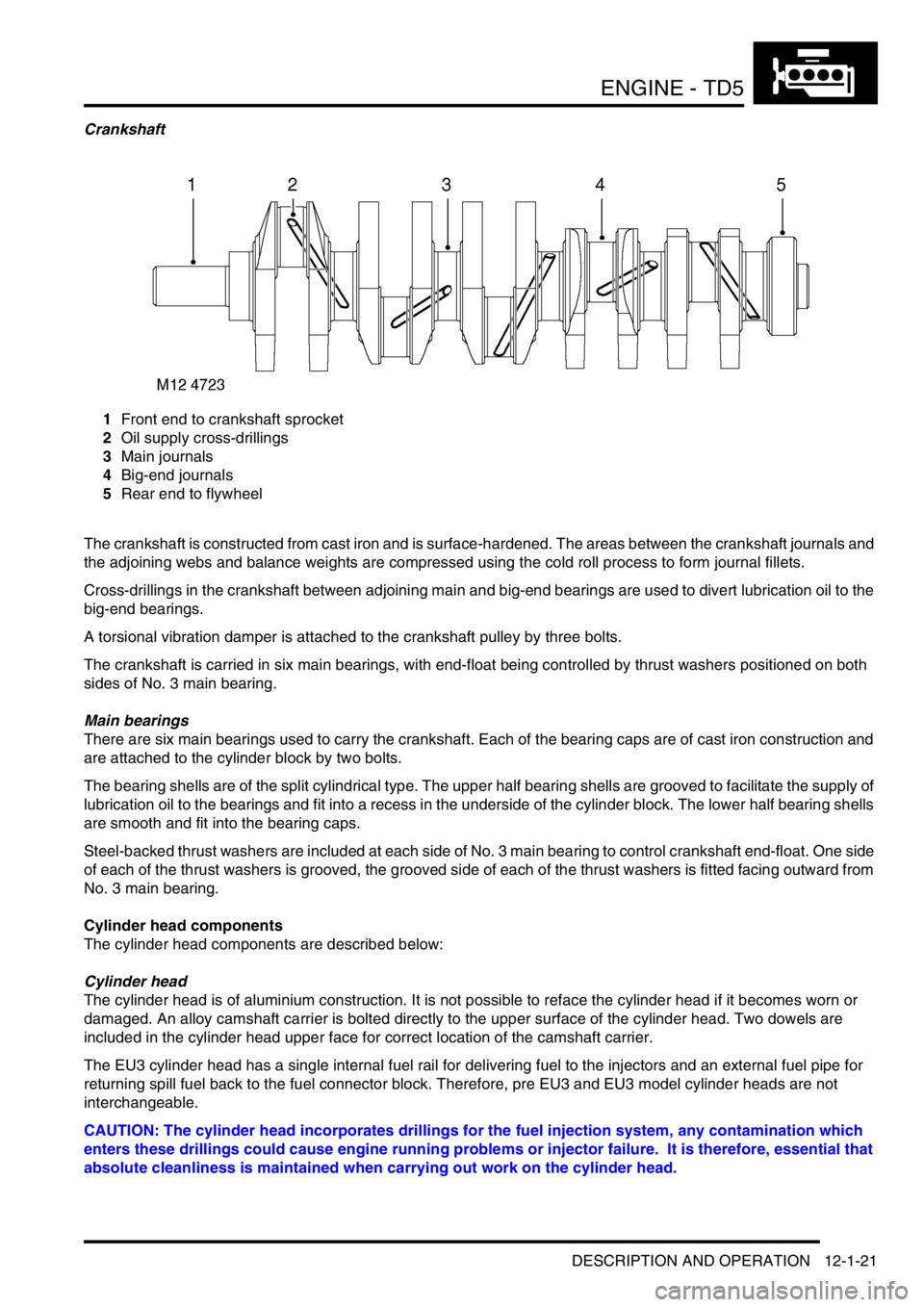
Crankshaft
1Front end to crankshaft sprocket
2Oil supply cross-drillings
3Main journals
4Big-end journals
5Rear end to flywheel
The crankshaft is constructed from cast iron and is surface-hardened. The areas between the crankshaft journals and
the adjoining webs and balance weights are compressed using the cold roll process to form journal fillets.
Cross-drillings in the crankshaft between adjoining main and big-end bearings are used to divert lubrication oil to the
big-end bearings.
A torsional vibration damper is attached to the crankshaft pulley by three bolts.
The crankshaft is carried in six main bearings, with end-float being controlled by thrust washers positioned on both
sides of No. 3 main bearing.
Main bearings
There are six main bearings used to carry the crankshaft. Each of the bearing caps are of cast iron construction and
are attached to the cylinder block by two bolts.
The bearing shells are of the split cylindrical type. The upper half bearing shells are grooved to facilitate the supply of
lubrication oil to the bearings and fit into a recess in the underside of the cylinder block. The lower half bearing shells
are smooth and fit into the bearing caps.
Steel-backed thrust washers are included at each side of No. 3 main bearing to control crankshaft end-float. One side
of each of the thrust washers is grooved, the grooved side of each of the thrust washers is fitted facing outward from
No. 3 main bearing.
Cylinder head components
The cylinder head components are described below:
Cylinder head
The cylinder head is of aluminium construction. It is not possible to reface the cylinder head if it becomes worn or
damaged. An alloy camshaft carrier is bolted directly to the upper surface of the cylinder head. Two dowels are
included in the cylinder head upper face for correct location of the camshaft carrier.
The EU3 cylinder head has a single internal fuel rail for delivering fuel to the injectors and an external fuel pipe for
returning spill fuel back to the fuel connector block. Therefore, pre EU3 and EU3 model cylinder heads are not
interchangeable.
CAUTION: The cylinder head incorporates drillings for the fuel injection system, any contamination which
enters these drillings could cause engine running problems or injector failure. It is therefore, essential that
absolute cleanliness is maintained when carrying out work on the cylinder head.
Page 215 of 1672
ENGINE - TD5
12-1-76 OVERHAUL
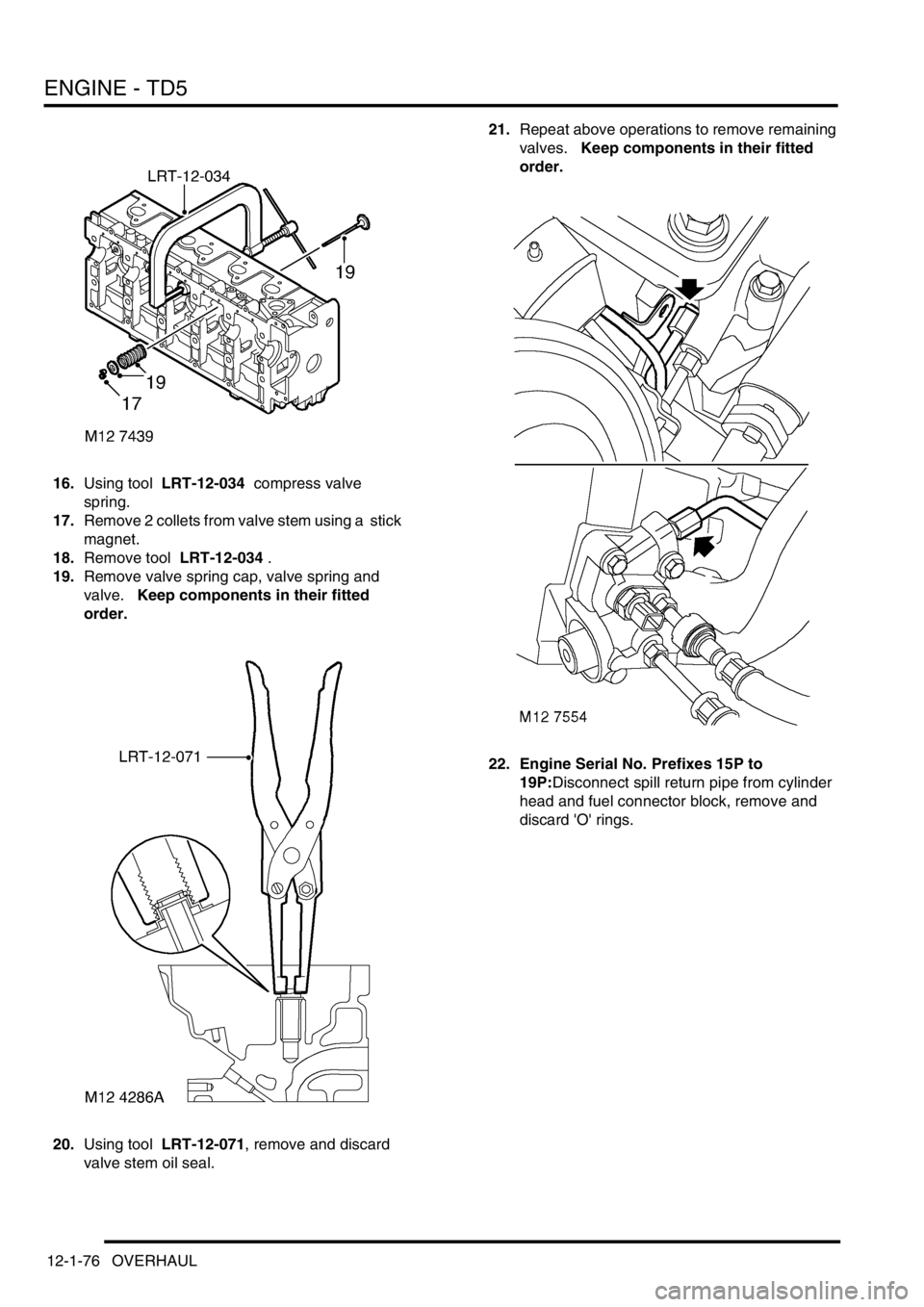
16.Using tool LRT-12-034 compress valve
spring.
17.Remove 2 collets from valve stem using a stick
magnet.
18.Remove tool LRT-12-034 .
19.Remove valve spring cap, valve spring and
valve. Keep components in their fitted
order.
20.Using tool LRT-12-071, remove and discard
valve stem oil seal. 21.Repeat above operations to remove remaining
valves. Keep components in their fitted
order.
22. Engine Serial No. Prefixes 15P to
19P:Disconnect spill return pipe from cylinder
head and fuel connector block, remove and
discard 'O' rings.
Page 340 of 1672
EMISSION CONTROL - V8
DESCRIPTION AND OPERATION 17-2-3
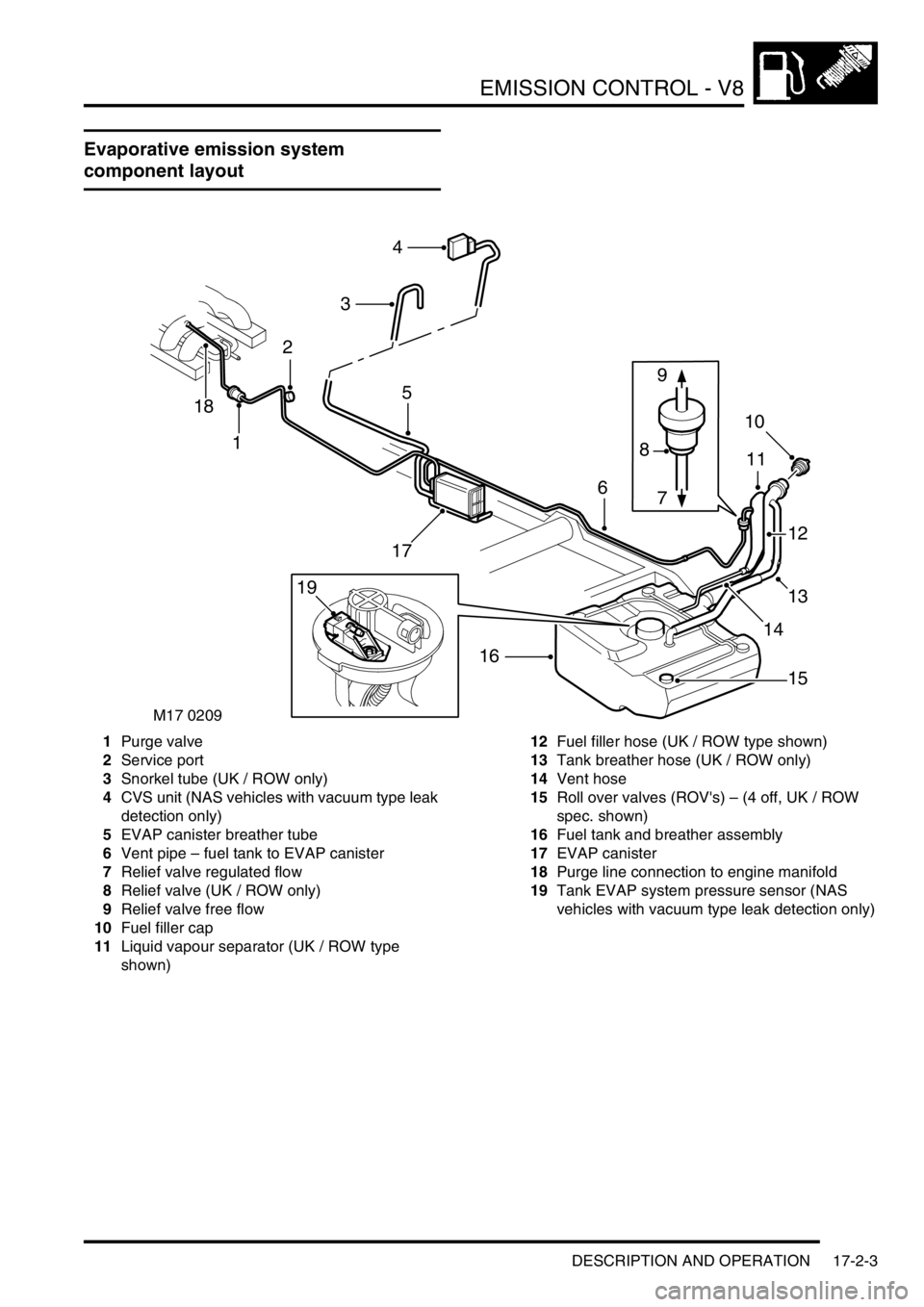
Evaporative emission system
component layout
1Purge valve
2Service port
3Snorkel tube (UK / ROW only)
4CVS unit (NAS vehicles with vacuum type leak
detection only)
5EVAP canister breather tube
6Vent pipe – fuel tank to EVAP canister
7Relief valve regulated flow
8Relief valve (UK / ROW only)
9Relief valve free flow
10Fuel filler cap
11Liquid vapour separator (UK / ROW type
shown)12Fuel filler hose (UK / ROW type shown)
13Tank breather hose (UK / ROW only)
14Vent hose
15Roll over valves (ROV's) – (4 off, UK / ROW
spec. shown)
16Fuel tank and breather assembly
17EVAP canister
18Purge line connection to engine manifold
19Tank EVAP system pressure sensor (NAS
vehicles with vacuum type leak detection only)
M17 0209
4
3
1
6
5
16
10
8
13
17
9
7
11
12
15
14
18
2
19
Page 341 of 1672

EMISSION CONTROL - V8
17-2-4 DESCRIPTION AND OPERATION
Evaporative emission system (with
positive pressure leak detection)
component layout (NAS only)
1Purge valve
2Service port
3Air filter canister
4EVAP canister breather tube
5Leak detection pump
6EVAP canister
7Vent pipe – fuel tank to EVAP canister
8Liquid vapour separator (metal)9Fuel filler cap
10Fuel filler
11Fuel tank breather assembly
12Vent hose
13Roll over valves (inside fuel tank)
14Fuel tank
15Purge line connection to engine manifold
M17 0208
3
1
7
4
14
11
6
8
10
13
12
15
2
5
9
Page 342 of 1672
EMISSION CONTROL - V8
DESCRIPTION AND OPERATION 17-2-5
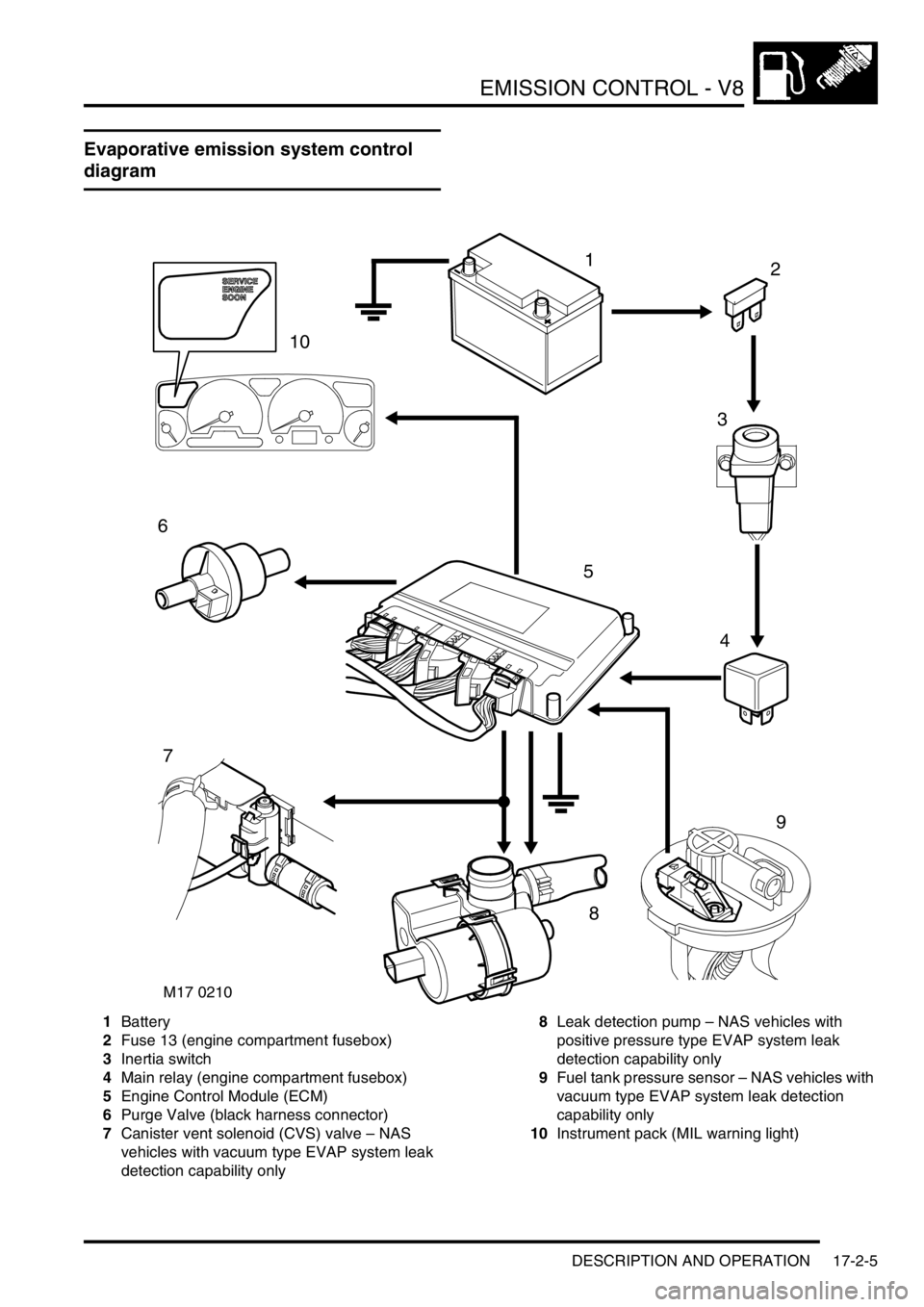
Evaporative emission system control
diagram
1Battery
2Fuse 13 (engine compartment fusebox)
3Inertia switch
4Main relay (engine compartment fusebox)
5Engine Control Module (ECM)
6Purge Valve (black harness connector)
7Canister vent solenoid (CVS) valve – NAS
vehicles with vacuum type EVAP system leak
detection capability only8Leak detection pump – NAS vehicles with
positive pressure type EVAP system leak
detection capability only
9Fuel tank pressure sensor – NAS vehicles with
vacuum type EVAP system leak detection
capability only
10Instrument pack (MIL warning light)
M17 0210
12
3
4
5
6
7
9
8
10
Page 352 of 1672

EMISSION CONTROL - V8
DESCRIPTION AND OPERATION 17-2-15
Evaporative emission control system
The evaporation emission control (EVAP) system is used to reduce the level of hydrocarbons emitted into the
atmosphere from the fuel system. The system comprises an EVAP canister which stores the hydrocarbons from the
fuel tank, pressure valves, vent lines and a purge control solenoid valve.
Fuel vapour is stored in the canister until it is ready to be purged to the inlet manifold under the control of the Engine
Control Module (ECM).
A two-way valve is included in the vent line between the fuel tank and the EVAP canister in all markets except NAS.
A fuel vapour separator is fitted next to the fuel filler neck, the construction is different between NAS and ROW
vehicles; the liquid vapour separator (LVS) on NAS vehicles is an L-shaped metal tube and for all other markets it is
an integral part of the moulded plastic filler neck.
+ FUEL DELIVERY SYSTEM - V8, DESCRIPTION AND OPERATION, Description.
NAS vehicles have stainless steel filler necks whilst all other markets use moulded plastic filler necks. On NAS fillers,
a valve closes the roll-over valve (ROV) vent line when the fuel filler cap is removed; for all other markets a pressure
relief valve is fitted into the ROV vent line.
+ FUEL DELIVERY SYSTEM - V8, DESCRIPTION AND OPERATION, Description.
Four ROV's are fitted to the fuel tank, for NAS vehicles the valves are fitted inside the fuel tank and for ROW vehicles
the ROV's are welded external to the fuel tank. Nylon vent lines from the ROV's connect to the liquid vapour separator
allowing vapour to pass to the EVAP canister via the LVS. To prevent the canister from being overloaded (particularly
in hot ambient conditions) and to prevent wastage of fuel, the vapour is allowed to condense within the LVS and flow
back through the ROVs into the tank.
+ FUEL DELIVERY SYSTEM - V8, DESCRIPTION AND OPERATION, Description.
Pressure / vacuum relief valves are incorporated into the fuel filler cap which operate in the event of an evaporation
system failure (e.g. blockage in the evaporation system line to atmosphere). The cap relieves fuel tank pressure to
atmosphere at approximately 1.8 to 2.0 psi (12 to 14 kPa) and opens in the opposite direction at approximately – 0.7
psi (- 5kPa) vacuum. All plastic bodied fuel fillers are fitted with a tank overpressure relief valve.
A vent line flow restrictor (anti-trickle valve) is fitted to the filler pipe in the line between the tank and the canister on
NAS vehicles. The purpose of the anti-trickle valve is to preserve the vapour space in the tank by blocking the vent
line during the fuel filling process. The valve is operated by the action of inserting the filler gun, so that when the fuel
in the tank reaches the level of the filling breather, flow cut off occurs due to fuel filling the filler pipe.
+ FUEL DELIVERY SYSTEM - V8, DESCRIPTION AND OPERATION, Description.
The breather ports from the EVAP canister are located high up in the engine bay (CVS unit on NAS vehicles with
vacuum type, fuel evaporation leak detection capability; via an air filter on NAS vehicles with positive pressure type,
fuel evaporation leak detection capability; snorkel tubes on ROW vehicles), to prevent water ingress during vehicle
wading.
The ECM connectors and pins which are pertinent to evaporative emission control are listed in the following table:
Connector / Pin No. Function Signal type Control
C0635-23 Main relay output Output drive Switch to ground
C0635-24 Leak detection pump motor (NAS vehicles
with positive pressure type EVAP system
leak detection only)Output drive Switch to ground
C0636-3 Purge valve drive Output signal PWM 12 - 0V
C0636-6 Fuel tank pressure sensor (NAS vehicles
with vacuum type EVAP system leak
detection only)Ground 0V
C0636-30 Canister vent solenoid (CVS) valve (NAS
vehicles with vacuum type EVAP system
leak detection only) / Fuel leak detection
pump (NAS vehicles with positive pressure
type EVAP system leak detection only)Output drive Switch to ground
Page 353 of 1672

EMISSION CONTROL - V8
17-2-16 DESCRIPTION AND OPERATION
Fuel leak detection system (vacuum type) – NAS only
The advanced evaporative loss control system equipped with a vacuum type, fuel evaporation leak detection
capability is similar to the standard evaporative loss system, but also includes additional components to enable the
engine control module (ECM) to perform a fuel evaporation leak detection test. The system includes an EVAPs
canister and purge valve, and in addition, a canister vent solenoid (CVS) valve and a fuel tank pressure sensor.
The function of the CVS valve is to block the atmospheric vent side of the EVAP canister under the control of the ECM
so that an evaporation system leak check can be performed. The test is carried out when the vehicle is stationary and
the engine is running at idle speed. The system test uses the natural rate of fuel evaporation and engine manifold
depression. Failure of the leak check will result in illumination of the Malfunction Indicator Lamp (MIL).
The fuel evaporation leak detection is part of the On-Board Diagnostics (OBD) strategy and it is able to determine
vapour leaks from holes or breaks greater than 1 mm (0.04 in.) in diameter. Any fuel evaporation system leaks which
occur between the output of the purge valve and the connection to the inlet manifold cannot be determined using this
test, but these will be detected through the fuelling adaption diagnostics.
Fuel leak detection system (positive pressure type) – NAS only
The evaporative loss control system equipped with a positive pressure type, fuel evaporation leak detection capability
is similar to the vacuum type, but it is capable of detecting smaller leaks by placing the evaporation system under the
influence of positive air pressure. The system includes an EVAPs canister and purge valve, and in addition, a leak
detection pump comprising a motor and solenoid valve.
The solenoid valve contained in the leak detection pump assembly performs a similar function to the CVS valve
utilised on the vacuum type pressure test. The solenoid valve is used to block the atmospheric vent side of the EVAP
canister under the control of the ECM so that an EVAP system leak check can be performed. At the same time,
pressurised air from the pump is allowed past the valve into the EVAP system to set up a positive pressure. The test
is carried out at the end of a drive cycle when the vehicle is stationary and the ignition is switched off. The test is
delayed for a brief period (approximately 10 seconds) after the engine is switched off to allow any slosh in the fuel
tank to stabilise. Component validity checks and pressure signal reference checking takes a further 10 seconds before
the pressurised air is introduced into the EVAP system.
During reference checking, the purge valve is closed and the leak detection pump solenoid valve is not energised,
while the leak detection pump is operated. The pressurised air is bypassed through a restrictor which corresponds to
a 0.5 mm (0.02 in) leak while the current consumption of the leak detection pump motor is monitored.
The system test uses the leak detection pump to force air into the EVAP system when the purge valve and solenoid
valves are both closed (solenoid valve energised), to put the evaporation lines, components and fuel tank under the
influence of positive air pressure. Air is drawn into the pump through an air filter which is located in the engine
compartment.
The fuel leak detection pump current consumption is monitored by the ECM while the EVAP system is under pressure,
and compared to the current noted during the reference check. A drop in the current drawn by the leak detection pump
motor, indicates that air is being lost through holes or leaks in the system which are greater than the reference value
of 0.5 mm (0.02 in). An increase in the current drawn by the leak detection pump motor, indicates that the EVAP
system is well sealed and that there are no leaks present which are greater than 0.5 mm (0.02 in).
The presence of leakage points indicates the likelihood of hydrocarbon emissions to atmosphere from the
evaporation system outside of test conditions and the necessity for rectification work to be conducted to seal the
system. Failure of the leak check will result in illumination of the Malfunction Indicator Lamp (MIL).
C0637-9 Fuel tank pressure sensor (NAS vehicles
with vacuum type EVAP system leak
detection only)Output reference 5V
C0637-12 Analogue fuel level (NAS vehicles with
positive pressure type EVAP system leak
detection only)Input Analogue 0 - 5V
C0637-14 Fuel tank pressure sensor (NAS vehicles
with vacuum type EVAP system leak
detection only)Input signal Analogue 0 - 5V
C0637-20 MIL "ON" Output drive Switch to ground Connector / Pin No. Function Signal type Control
Page 354 of 1672
EMISSION CONTROL - V8
DESCRIPTION AND OPERATION 17-2-17
The fuel evaporation leak detection is part of the On-Board Diagnostics (OBD) strategy and it is able to determine
vapour leaks from holes or breaks down to 0.5 mm (0.02 in.) diameter. Any fuel evaporation leaks which occur
between the output of the purge valve and the connection to the inlet manifold cannot be determined using this test,
but these will be detected through the fuelling adaption diagnostics.
Evaporative emission control components
The evaporative emission control components and the fuel evaporation leak detection test components (NAS only)
are described below:
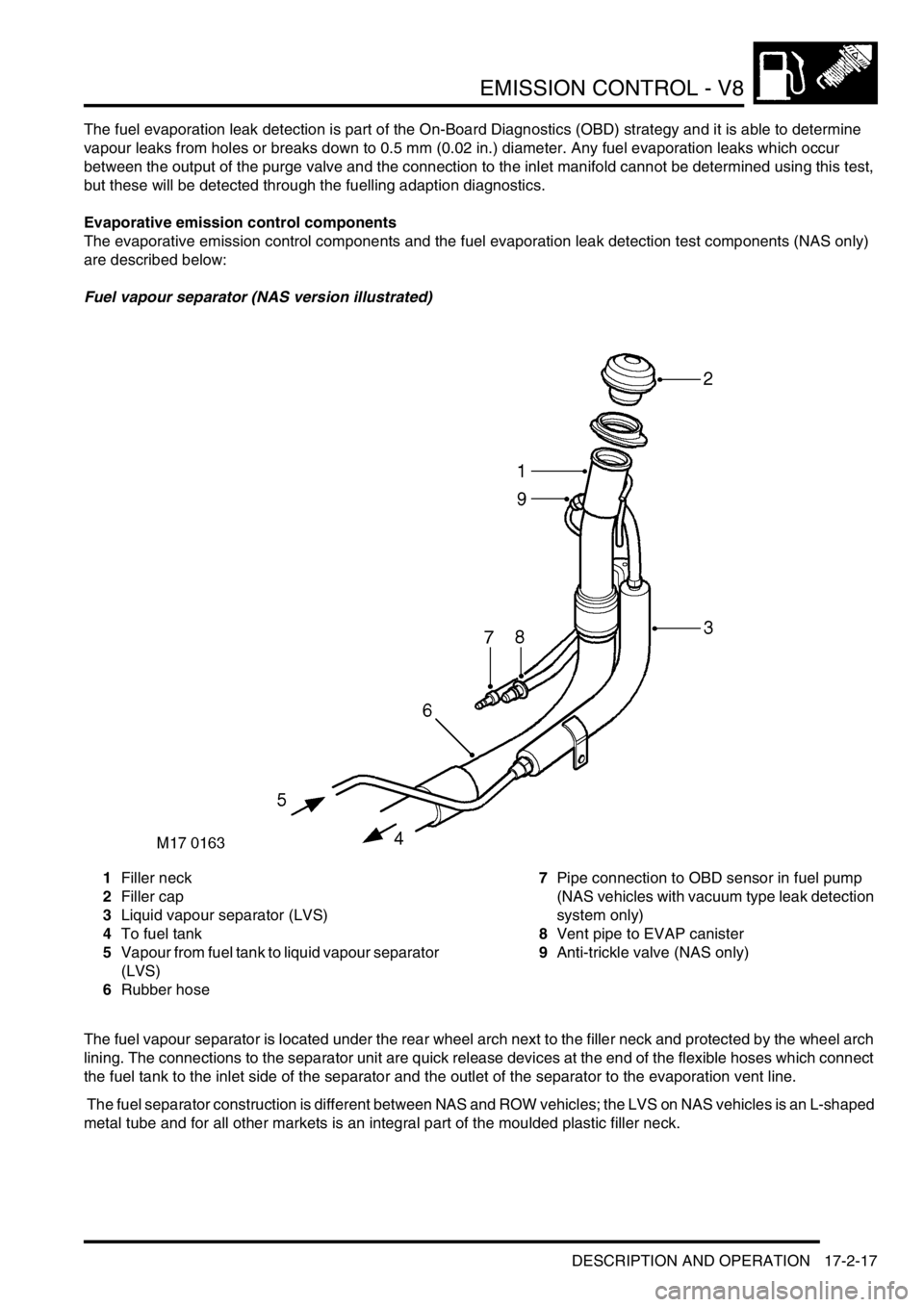
Fuel vapour separator (NAS version illustrated)
1Filler neck
2Filler cap
3Liquid vapour separator (LVS)
4To fuel tank
5Vapour from fuel tank to liquid vapour separator
(LVS)
6Rubber hose7Pipe connection to OBD sensor in fuel pump
(NAS vehicles with vacuum type leak detection
system only)
8Vent pipe to EVAP canister
9Anti-trickle valve (NAS only)
The fuel vapour separator is located under the rear wheel arch next to the filler neck and protected by the wheel arch
lining. The connections to the separator unit are quick release devices at the end of the flexible hoses which connect
the fuel tank to the inlet side of the separator and the outlet of the separator to the evaporation vent line.
The fuel separator construction is different between NAS and ROW vehicles; the LVS on NAS vehicles is an L-shaped
metal tube and for all other markets is an integral part of the moulded plastic filler neck.
Page 356 of 1672
EMISSION CONTROL - V8
DESCRIPTION AND OPERATION 17-2-19
For NAS vehicles with positive pressure, EVAP system leak detection capability, the atmosphere vent line from the
EVAP canister connects to a port on the fuel leak detection pump via a short, large bore hose which is secured to the
component ports by crimped metal clips at each end. A large bore plastic hose from the top of the leak detection pump
is routed to the RH side of the engine bay where it connects to an air filter canister. Under normal operating conditions
(when the fuel leak detection solenoid valve is not energised), the EVAP canister is able to take in clean air via the
air filter, through the pipework and past the open solenoid valve to allow normal purge operation to take place and
release any build up of EVAP system pressure to atmosphere.
The EVAP system pipes are clipped at various points along the pipe runs and tied together with tie straps at suitable
points along the runs.
The NAS and ROW EVAP canisters are of similar appearance, but use charcoal of different consistency. The ROW
vehicles use granular charcoal of 11 bwc (butane working capacity) and NAS vehicles use pelletised charcoal with a
higher absorption capacity of 15 bwc. All canisters are of rectangular shape and have capacities of 1.8 litres (3 1/8
imp. pts) with purge foam retention.
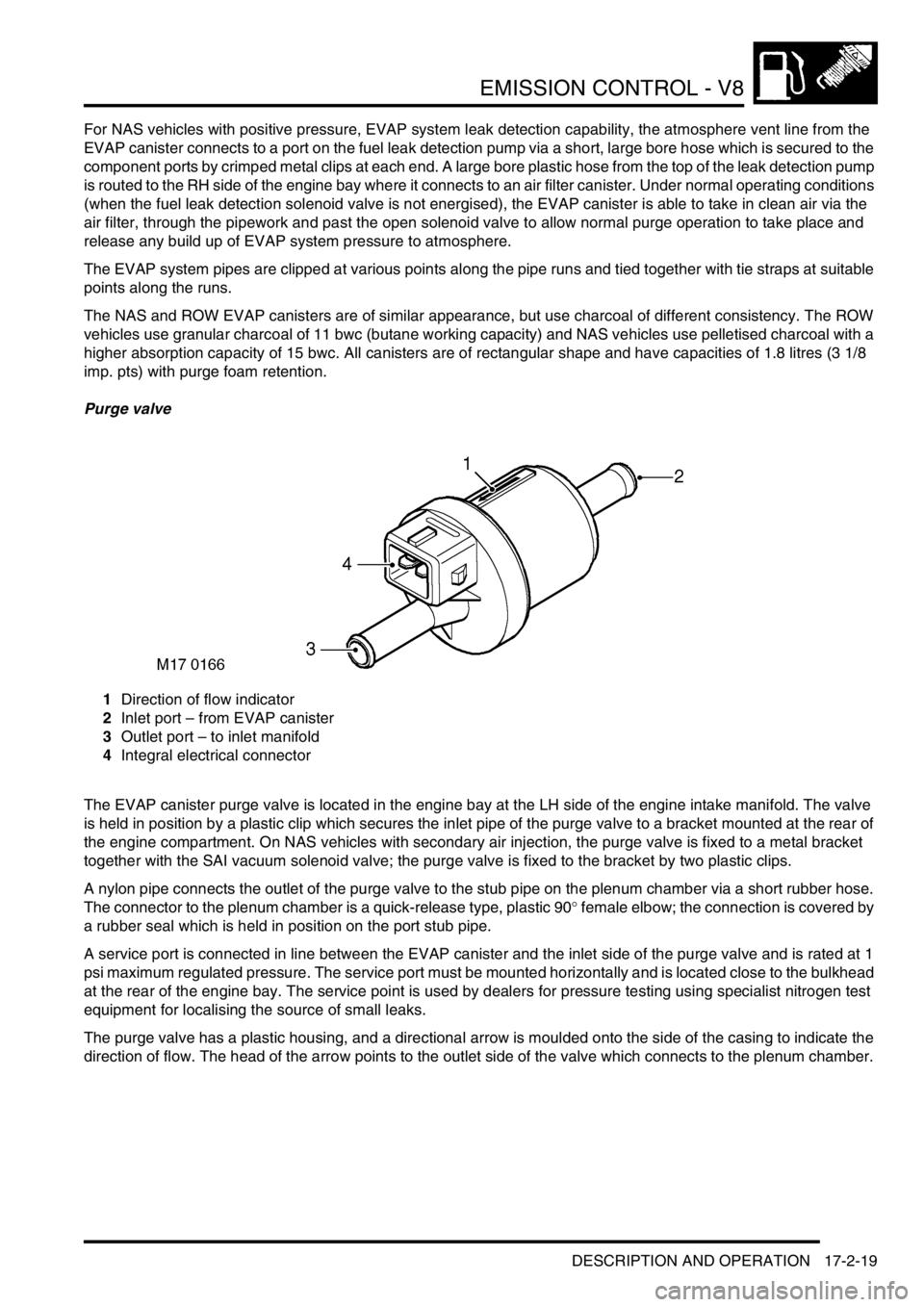
Purge valve
1Direction of flow indicator
2Inlet port – from EVAP canister
3Outlet port – to inlet manifold
4Integral electrical connector
The EVAP canister purge valve is located in the engine bay at the LH side of the engine intake manifold. The valve
is held in position by a plastic clip which secures the inlet pipe of the purge valve to a bracket mounted at the rear of
the engine compartment. On NAS vehicles with secondary air injection, the purge valve is fixed to a metal bracket
together with the SAI vacuum solenoid valve; the purge valve is fixed to the bracket by two plastic clips.
A nylon pipe connects the outlet of the purge valve to the stub pipe on the plenum chamber via a short rubber hose.
The connector to the plenum chamber is a quick-release type, plastic 90
° female elbow; the connection is covered by
a rubber seal which is held in position on the port stub pipe.
A service port is connected in line between the EVAP canister and the inlet side of the purge valve and is rated at 1
psi maximum regulated pressure. The service port must be mounted horizontally and is located close to the bulkhead
at the rear of the engine bay. The service point is used by dealers for pressure testing using specialist nitrogen test
equipment for localising the source of small leaks.
The purge valve has a plastic housing, and a directional arrow is moulded onto the side of the casing to indicate the
direction of flow. The head of the arrow points to the outlet side of the valve which connects to the plenum chamber.
Page 358 of 1672
EMISSION CONTROL - V8
DESCRIPTION AND OPERATION 17-2-21
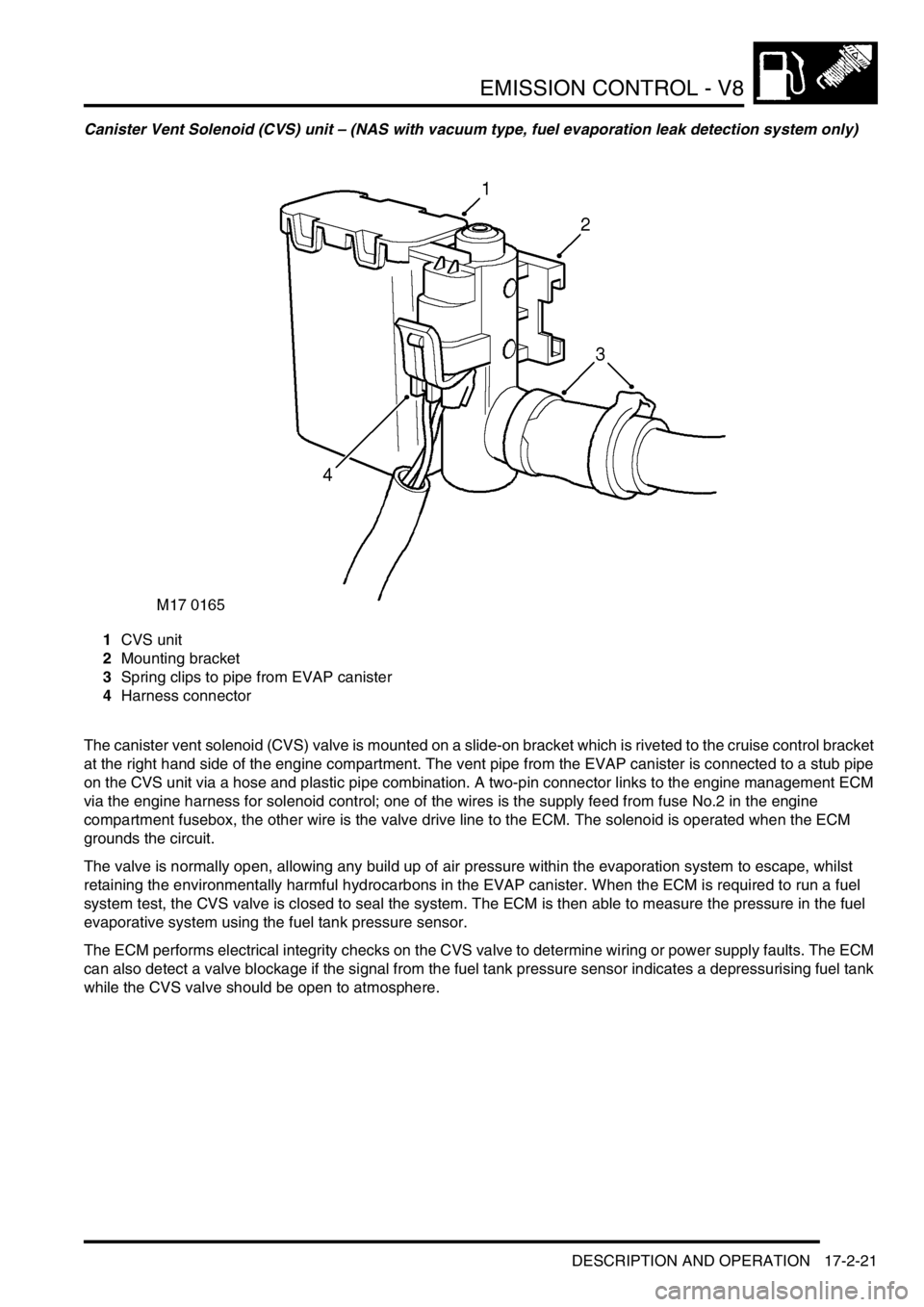
Canister Vent Solenoid (CVS) unit – (NAS with vacuum type, fuel evaporation leak detection system only)
1CVS unit
2Mounting bracket
3Spring clips to pipe from EVAP canister
4Harness connector
The canister vent solenoid (CVS) valve is mounted on a slide-on bracket which is riveted to the cruise control bracket
at the right hand side of the engine compartment. The vent pipe from the EVAP canister is connected to a stub pipe
on the CVS unit via a hose and plastic pipe combination. A two-pin connector links to the engine management ECM
via the engine harness for solenoid control; one of the wires is the supply feed from fuse No.2 in the engine
compartment fusebox, the other wire is the valve drive line to the ECM. The solenoid is operated when the ECM
grounds the circuit.
The valve is normally open, allowing any build up of air pressure within the evaporation system to escape, whilst
retaining the environmentally harmful hydrocarbons in the EVAP canister. When the ECM is required to run a fuel
system test, the CVS valve is closed to seal the system. The ECM is then able to measure the pressure in the fuel
evaporative system using the fuel tank pressure sensor.
The ECM performs electrical integrity checks on the CVS valve to determine wiring or power supply faults. The ECM
can also detect a valve blockage if the signal from the fuel tank pressure sensor indicates a depressurising fuel tank
while the CVS valve should be open to atmosphere.