battery LAND ROVER DISCOVERY 2002 Workshop Manual
[x] Cancel search | Manufacturer: LAND ROVER, Model Year: 2002, Model line: DISCOVERY, Model: LAND ROVER DISCOVERY 2002Pages: 1672, PDF Size: 46.1 MB
Page 1434 of 1672
WIPERS AND WASHERS
DESCRIPTION AND OPERATION 84-13
Front screen washer jets
Two washer jets for the front windscreen are fitted to the top surface of the bonnet and held in place with plastic clips.
Each washer jet is connected via a hose to an in-line valve. The in-line valve prevents the washer fluid draining back
to the reservoir and ensures that the washers operate immediately the washer pump is operated. From each in-line
valve the washers are connected via a short hose to a 'T' connector. From the 'T' connector a single hose connects
to the outlet of the front washer pump. Each jet has two jets which can be adjusted to allow full fluid coverage of the
windscreen.
Rear screen washer jet
A single washer jet for the tail door window is fitted to the rear wiper blade. The jet has four spray orifices which direct
washer fluid to either side and along the length of the wiper blade. The jet is connected by a hose from the wiper blade,
through a sealing grommet in the tail door and connects with the rear washer hose from the rear washer pump. A non-
return valve is used to join the feed hose from the pump to the washer jet hose. The non-return valve prevents fluid
draining to the reservoir and ensures that the washer operates immediately the washer pump is operated. The hose
from the pump to the tail door is located inside the main harness.
Headlamp power washer jets
When fitted, a powerwash jet for each headlamp is located in a housing on the top surface of the front bumper. The
jets are fed with fluid at high pressure from the powerwash pump. A large diameter hose connects each jet to the
pump. Each connection is secured with a metal clip to secure the hose due to the high pressure from the pump. Each
jet directs the high pressure fluid in a wide spray onto the headlamp lens.
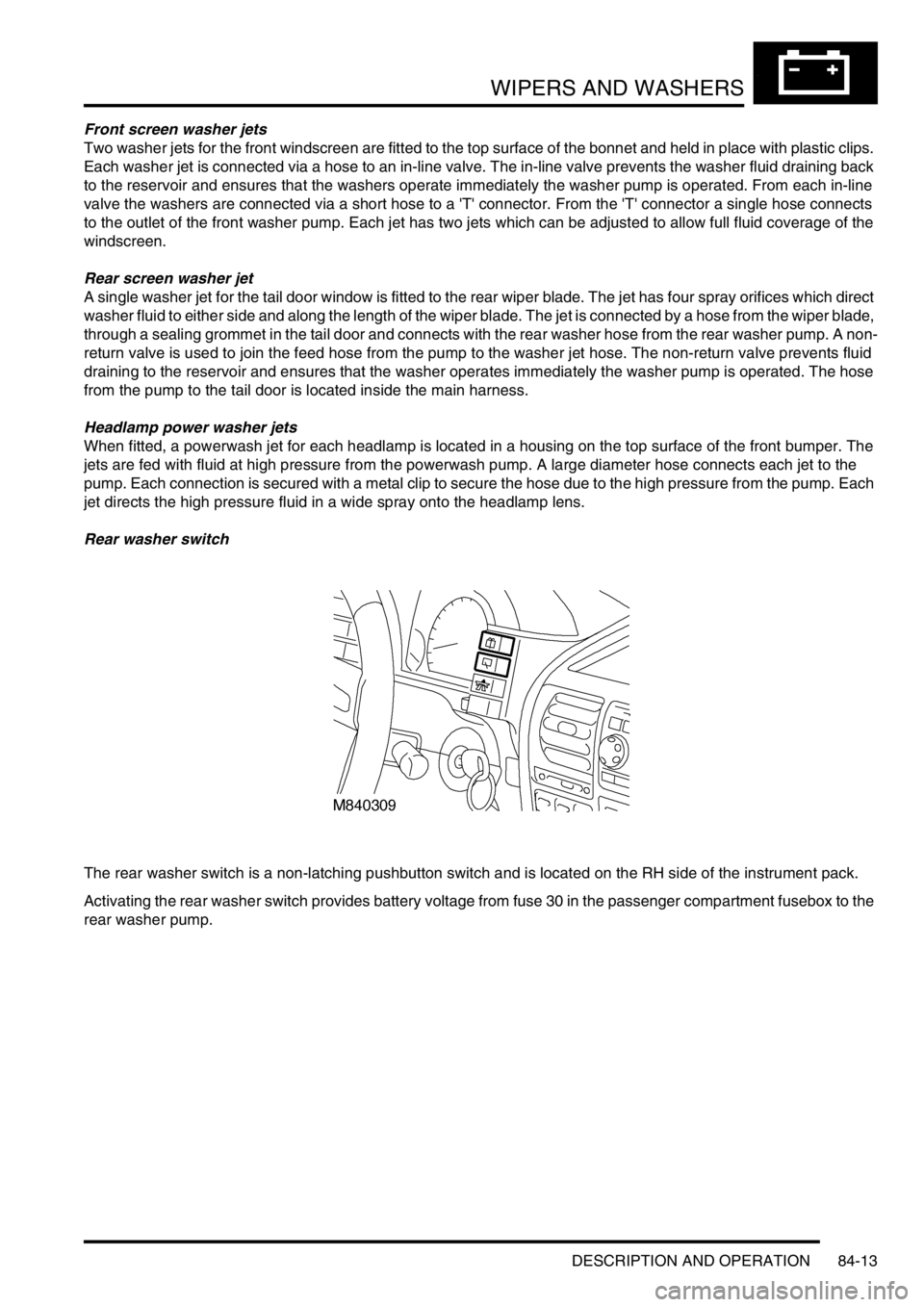
Rear washer switch
The rear washer switch is a non-latching pushbutton switch and is located on the RH side of the instrument pack.
Activating the rear washer switch provides battery voltage from fuse 30 in the passenger compartment fusebox to the
rear washer pump.
Page 1435 of 1672
WIPERS AND WASHERS
84-14 DESCRIPTION AND OPERATION
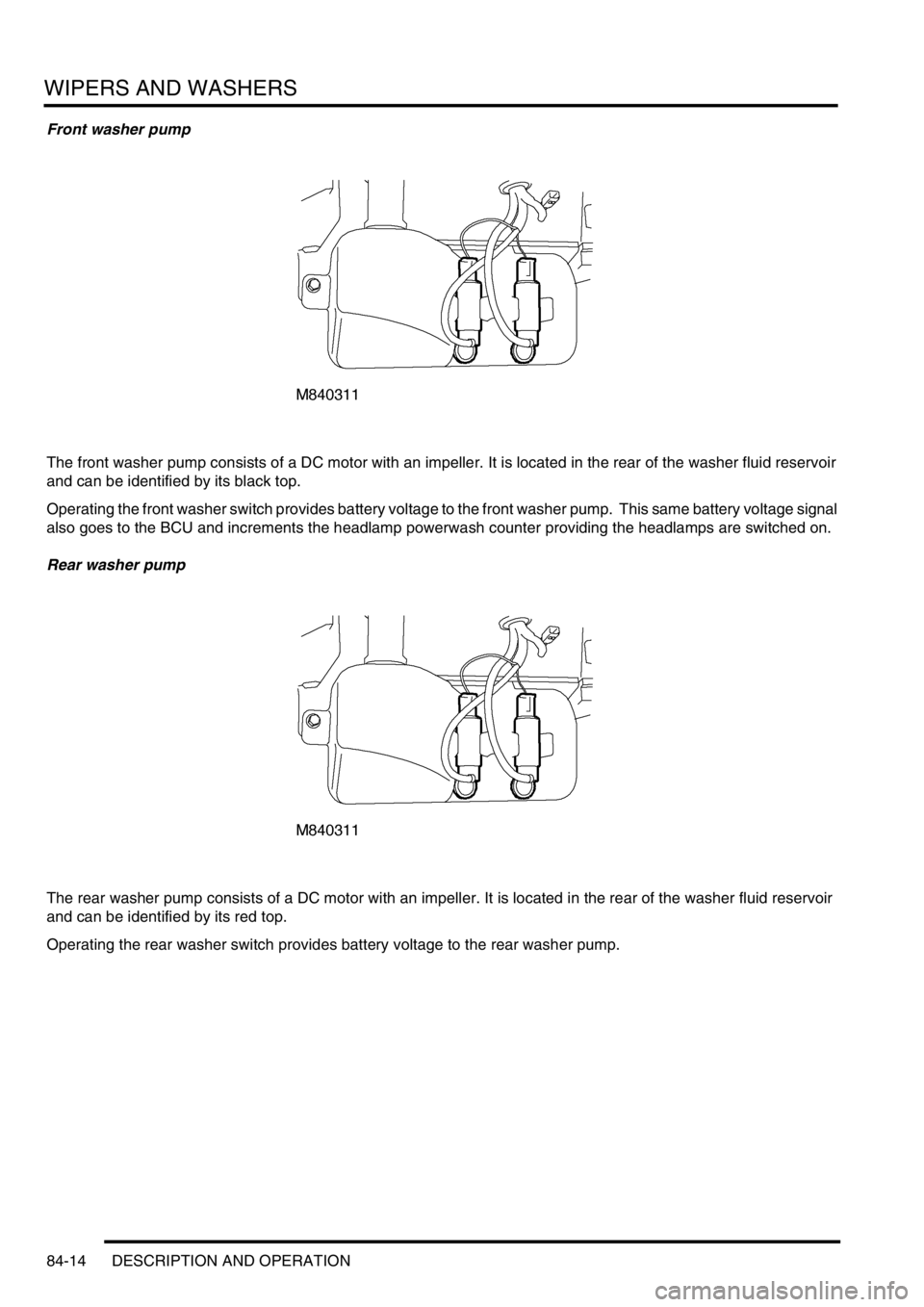
Front washer pump
The front washer pump consists of a DC motor with an impeller. It is located in the rear of the washer fluid reservoir
and can be identified by its black top.
Operating the front washer switch provides battery voltage to the front washer pump. This same battery voltage signal
also goes to the BCU and increments the headlamp powerwash counter providing the headlamps are switched on.
Rear washer pump
The rear washer pump consists of a DC motor with an impeller. It is located in the rear of the washer fluid reservoir
and can be identified by its red top.
Operating the rear washer switch provides battery voltage to the rear washer pump.
Page 1436 of 1672
WIPERS AND WASHERS
DESCRIPTION AND OPERATION 84-15
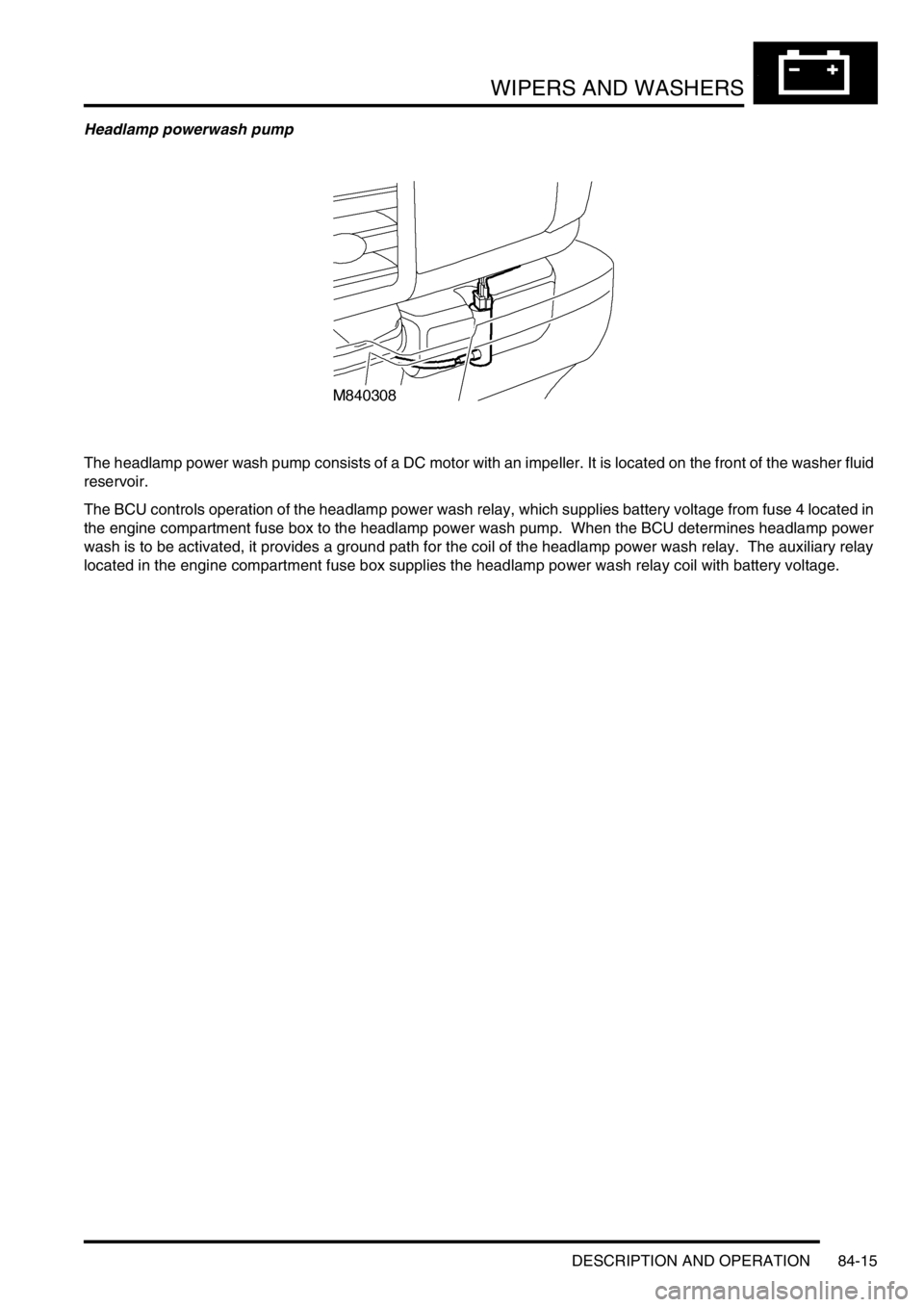
Headlamp powerwash pump
The headlamp power wash pump consists of a DC motor with an impeller. It is located on the front of the washer fluid
reservoir.
The BCU controls operation of the headlamp power wash relay, which supplies battery voltage from fuse 4 located in
the engine compartment fuse box to the headlamp power wash pump. When the BCU determines headlamp power
wash is to be activated, it provides a ground path for the coil of the headlamp power wash relay. The auxiliary relay
located in the engine compartment fuse box supplies the headlamp power wash relay coil with battery voltage.
Page 1439 of 1672

WIPERS AND WASHERS
84-18 DESCRIPTION AND OPERATION
Rear wipe
Rear wipe operation will only activate when the following conditions are met:
lIgnition switch is in position II.
lRear wipe switch is operated.
Operating the rear wiper switch provides an earth input to the BCU. The BCU tells the IDM to activate the rear wiper
relay, which provides battery voltage to the wiper motor through the normally closed contacts of the park switch.
Rear wash
Rear wash will only operate when the following conditions are met:
lIgnition switch is in position II.
lRear wash switch operated.
Operating the rear washer switch for longer than 0.4 second allows the rear washer pump motor and rear wipers to
run as long as the switch is held. The wipers run for 4 seconds after the rear washer switch is released. Flicking the
rear washer switch energises the rear washer pump motor for 0.4 second.
The rear washer operation has a higher priority than the intermittent wipe operation. If the intermittent wipe is active
when a rear washer operation is initiated, the wash cycle executes and the intermittent wipe is re-instated at the end
of the washer operation.
Wiper park switch
The park switch allows the wipers to come to rest in the park position when the wipe switch is turned off in mid-wipe.
The park switch consists of a positive and a negative contact. These two contacts are described as closed at park
and closed when operating. When the wipers first start, the park switch is in the closed at park position. A relay
controls battery voltage to the motor. Battery voltage passes through this relay contact to move the wiper motor from
the park position.
When the motor moves, the park switch moves to the closed when operating position. Battery voltage to this relay
contact is direct from fuse 19. Battery voltage passes through this contact to keep the wiper motor running. The wiper
motor operates for one complete revolution until the park switch moves to the closed at park position again.
Switching off the wipers removes battery voltage from the closed at park contact. When the wipers reach the closed
at park switch an earth is applied and the motor stops abruptly.
Headlamp power wash
Headlamp power wash activates when the following conditions are met:
lIgnition switch in position II.
lHeadlamps switched on.
lFront wash switch operated.
lBCU counter allows headlamp power wash.
Operating the front washer switch with the headlamps switched on energises the IDM, supplying a voltage to the
headlamp powerwash relay, which operates the headlamp powerwash pump and increments a counter within the
BCU. This counter prevents the headlamp powerwash pump from operating every time the front washer switch is
activated. Headlamp powerwash is only operational every third front wash cycle, providing the headlamps are on.
The counter resets when the ignition switch is turned off.
When the BCU permits headlamp power wash operation, the pump motor operates only for 0.5 second.
Page 1453 of 1672
CHARGING AND STARTING
86-1-4 REPAIRS
Battery
$% 86.15.01
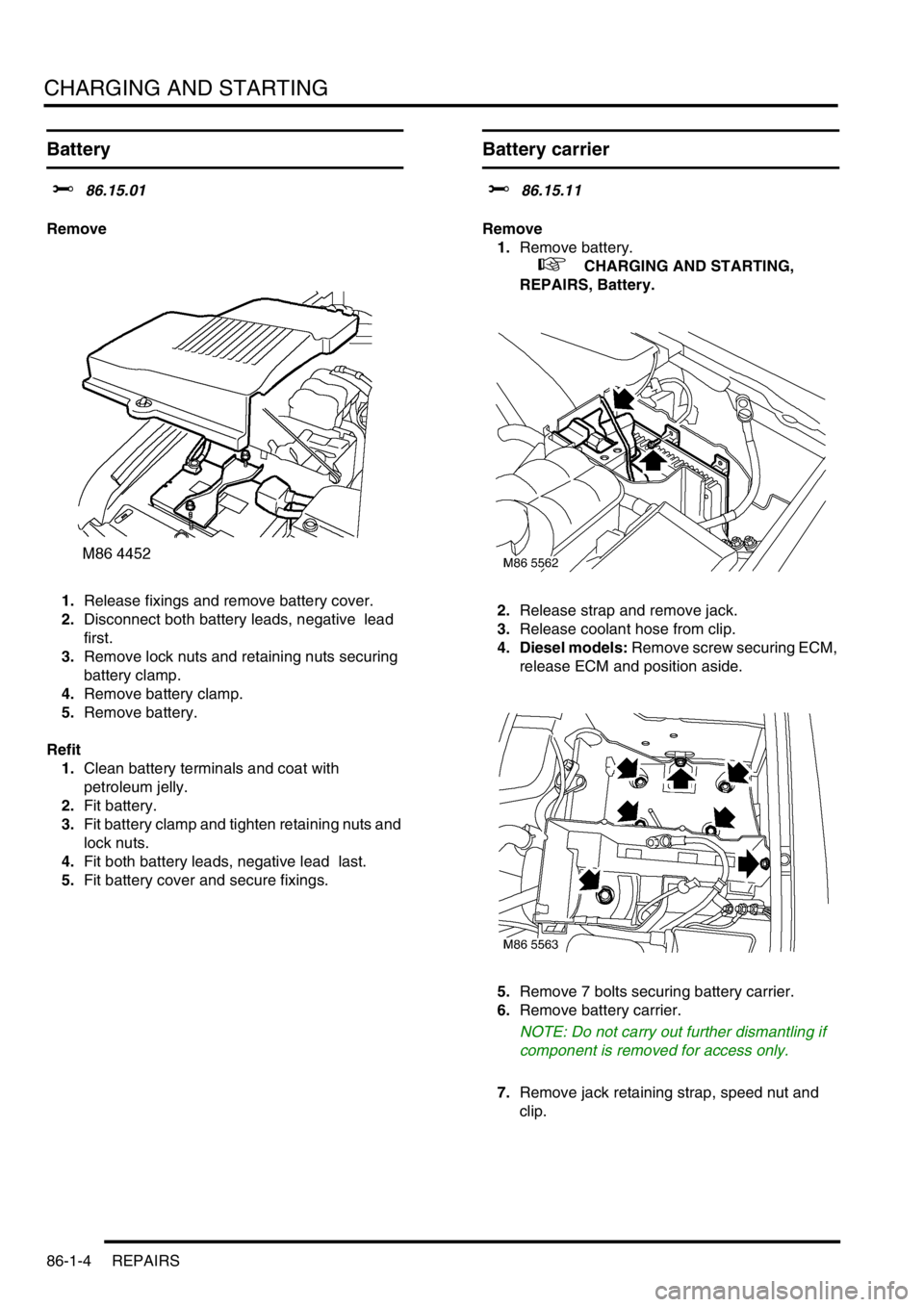
Remove
1.Release fixings and remove battery cover.
2.Disconnect both battery leads, negative lead
first.
3.Remove lock nuts and retaining nuts securing
battery clamp.
4.Remove battery clamp.
5.Remove battery.
Refit
1.Clean battery terminals and coat with
petroleum jelly.
2.Fit battery.
3.Fit battery clamp and tighten retaining nuts and
lock nuts.
4.Fit both battery leads, negative lead last.
5.Fit battery cover and secure fixings.
Battery carrier
$% 86.15.11
Remove
1.Remove battery.
+ CHARGING AND STARTING,
REPAIRS, Battery.
2.Release strap and remove jack.
3.Release coolant hose from clip.
4. Diesel models: Remove screw securing ECM,
release ECM and position aside.
5.Remove 7 bolts securing battery carrier.
6.Remove battery carrier.
NOTE: Do not carry out further dismantling if
component is removed for access only.
7.Remove jack retaining strap, speed nut and
clip.
Page 1454 of 1672

CHARGING AND STARTING
REPAIRS 86-1-5
Refit
1.Fit jack retaining strap, speed nut and clip.
2.Fit battery carrier, fit bolts and tighten to 28 Nm
(21 lbf.ft).
3. Diesel models: Fit ECM and secure with
screw.
4.Secure coolant hose.
5.Fit and secure jack.
6.Fit battery.
+ CHARGING AND STARTING,
REPAIRS, Battery.
Starter motor - diesel
$% 86.60.01
Remove
1.Release fixings and remove battery cover.
2.Disconnect battery earth lead.
3.Raise front of vehicle.
WARNING: Do not work on or under a
vehicle supported only by a jack. Always
support the vehicle on safety stands.
4.Remove underbelly panel.
+ EXTERIOR FITTINGS, REPAIRS,
Panel - underbelly.
5.Disconnect Lucar connector from starter
solenoid.
6.Remove nut and disconnect battery lead from
starter solenoid.
7.Remove nut and 2 bolts securing starter motor
and remove starter motor from engine.
Refit
1.Clean starter motor and mating face on engine.
2.Fit starter motor and tighten nut and 2 bolts to
27 Nm (20 lbf.ft).
3.Connect lead to starter solenoid and tighten nut
to 10 Nm (7 lbf.ft).
4.Connect Lucar connector to starter solenoid.
5.Fit underbelly panel.
+ EXTERIOR FITTINGS, REPAIRS,
Panel - underbelly.
6.Remove stand(s) and lower vehicle.
7.Connect battery earth lead.
8.Fit battery cover and secure the fixings.
Page 1455 of 1672
CHARGING AND STARTING
86-1-6 REPAIRS
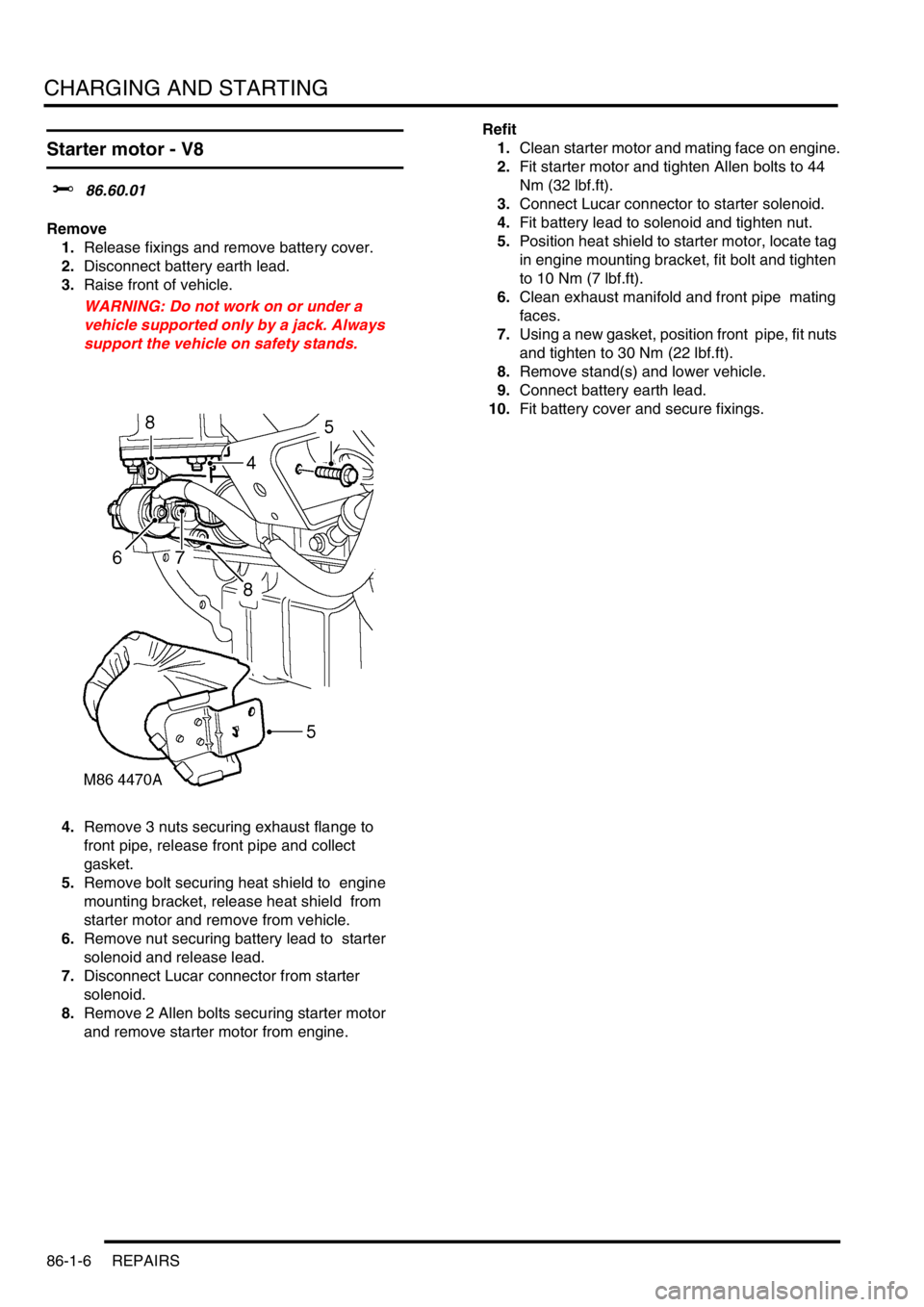
Starter motor - V8
$% 86.60.01
Remove
1.Release fixings and remove battery cover.
2.Disconnect battery earth lead.
3.Raise front of vehicle.
WARNING: Do not work on or under a
vehicle supported only by a jack. Always
support the vehicle on safety stands.
4.Remove 3 nuts securing exhaust flange to
front pipe, release front pipe and collect
gasket.
5.Remove bolt securing heat shield to engine
mounting bracket, release heat shield from
starter motor and remove from vehicle.
6.Remove nut securing battery lead to starter
solenoid and release lead.
7.Disconnect Lucar connector from starter
solenoid.
8.Remove 2 Allen bolts securing starter motor
and remove starter motor from engine. Refit
1.Clean starter motor and mating face on engine.
2.Fit starter motor and tighten Allen bolts to 44
Nm (32 lbf.ft).
3.Connect Lucar connector to starter solenoid.
4.Fit battery lead to solenoid and tighten nut.
5.Position heat shield to starter motor, locate tag
in engine mounting bracket, fit bolt and tighten
to 10 Nm (7 lbf.ft).
6.Clean exhaust manifold and front pipe mating
faces.
7.Using a new gasket, position front pipe, fit nuts
and tighten to 30 Nm (22 lbf.ft).
8.Remove stand(s) and lower vehicle.
9.Connect battery earth lead.
10.Fit battery cover and secure fixings.
Page 1456 of 1672
LIGHTING
ADJUSTMENTS 86-2-1
LIGHTING ADJUST ME NTS
Headlamps beam alignment - up to 03MY
$% 86.40.17
Check
1.Ensure vehicle is unladen and tyres are at
correct pressures.
2. Models with SLS: Ensure vehicle is at
standard ride height.
3. Models with headlamp levelling: Ensure
headlamp levelling switch is set to '0'.
4.Align suitable beam setting equipment to
headlamp.
5.Switch headlamps on and measure main beam
settings. Beam must be 1.4% below the
horizontal and parallel to the vehicle centre line.
If necessary, adjust headlamp to get correct
beam settings.
6.Align beam setting equipment to 2nd headlamp
and repeat check.
7.Switch off headlamps and remove beam setting
equipment.
Adjust
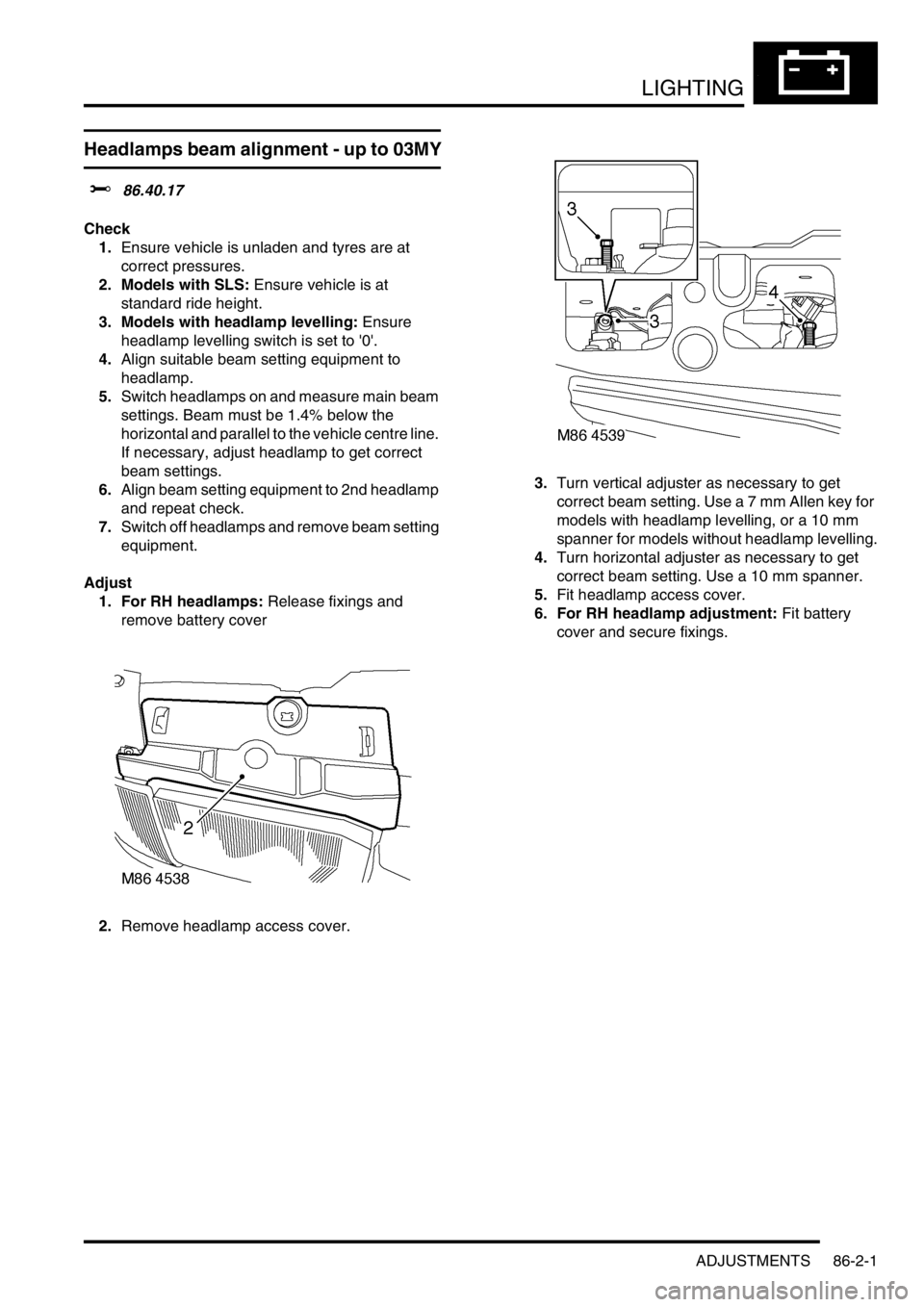
1. For RH headlamps: Release fixings and
remove battery cover
2.Remove headlamp access cover.3.Turn vertical adjuster as necessary to get
correct beam setting. Use a 7 mm Allen key for
models with headlamp levelling, or a 10 mm
spanner for models without headlamp levelling.
4.Turn horizontal adjuster as necessary to get
correct beam setting. Use a 10 mm spanner.
5.Fit headlamp access cover.
6. For RH headlamp adjustment: Fit battery
cover and secure fixings.
Page 1458 of 1672

LIGHTING
REPAIRS 86-2-3
REPAIRS
Lamp - front repeater
$% 86.40.42
Remove
1. For RH repeater lamp: Release fixings and
remove battery cover.
2.Remove headlamp access cover from body.
3.Remove screw securing repeater lamp to body
and release lamp from 2 locating peg sockets in
wing.
4.Disconnect 2 multiplugs from repeater lamp
and remove lamp. Refit
1.Position new repeater lamp and connect
multiplugs.
2.Fit repeater lamp to body and tighten screw.
3.Fit headlamp access cover.
4. For RH repeater lamp: Fit battery cover and
secure fixings.
Page 1459 of 1672

LIGHTING
86-2-4 REPAIRS
Headlamp - up to 03MY
$% 86.40.49
Remove
1. For RH headlamp: Release fixings and
remove battery cover.
2.Remove headlamp access cover from body.
3.Release headlamp from locating sockets.
4.Disconnect multiplugs from headlamp and side
lamp bulbs.
5.Remove headlamp.
NOTE: Do not carry out further dismantling if
component is removed for access only.6.Remove side lamp bulb holder from headlamp.
7.Remove rubber cover from headlamp.
8.Release headlamp bulb retaining clip and
remove headlamp bulb.
9.Remove 6 screws and remove headlamp
retaining sockets.
Refit
1.Fit retaining sockets to new headlamp and
secure with screws.
2.Fit headlamp bulb and secure with clip.
3.Fit rubber cover.
4.Fit side lamp bulb holder.
5.Position headlamp and connect multiplugs.
6.Fit headlamp onto locating pins.
7.Check headlamp beam alignment.
+ LIGHTING, ADJUSTMENTS,
Headlamps beam alignment - up to 03MY.
8.Fit headlamp access cover.
9. For RH headlamp: Fit battery cover and
secure with fixings.