LOCK doors LAND ROVER DISCOVERY 2002 Owner's Manual
[x] Cancel search | Manufacturer: LAND ROVER, Model Year: 2002, Model line: DISCOVERY, Model: LAND ROVER DISCOVERY 2002Pages: 1672, PDF Size: 46.1 MB
Page 1488 of 1672

BODY CONTROL UNIT
DESCRIPTION AND OPERATION 86-3-19
Operation
For IDM inputs which are also inputs for BCU functions, the delay before the BCU recognises the change in input
status is less than 250 ms. The BCU uses a debounce algorithm to ignore changes in input having a duration less
than 100 ms with the exception of automatic gearbox W, X, Y, Z inputs, which have a debounce period of 33 ms.
Transit mode
To prevent excessive battery drain during transit to overseas markets, the vehicle is placed in a transit mode.
To exit the transit mode, simultaneously hold down the heated rear window switch and the rear fog lamp switch, turn
the ignition switch from 0 to II and, after a minimum of 2 seconds, release the switches.
Transit mode can be entered using TestBook. When TestBook communicates with the BCU for diagnostics related to
BCU operation, it first checks that the vehicle is not in transit mode.
Anti-theft system
The BCU uses the driver's door key lock and unlock switches to activate and deactivate the security system. The
driver's door lock is also used for entering the EKA.
+ ALARM SYSTEM AND HORN, DESCRIPTION AND OPERATION, Description.
Immobilisation
For immobilisation, the BCU disables the starter motor relay. When the engine is cranking, the ECM looks for a coded
signal from the BCU. If the signal is not received within one second of cranking, the fuel supply to the engine is
stopped and the injectors are disabled. This also prevents unburnt fuel from entering the catalyst.
If the BCU is disconnected, the engine starter motor will remain isolated by the starter motor relay and the ECM will
remain immobilised. The main wiring for the system is contained within the main harness which is relatively
inaccessible, so preventing intruders from disabling the system by cutting the wires for the immobilisation system.
Once the immobiliser has been activated, destruction of the trigger device or the wiring to it will not disarm the system.
The RF transmitter communicates to the BCU via the RF receiver using a 70 bit code. Pressing the unlock button on
the transmitter will re-mobilise the vehicle. The RF transponder is integrated into the metal key assembly, inserting
the key into the ignition switch will induce a signal in the exciter coil to re-mobilise the vehicle.
Anti-theft alarm
The alarm system provides a warning of unauthorised access to the vehicle and includes perimetric and volumetric
monitoring under the control of the BCU.
The perimetric protection system detects opening of all doors, tail door and bonnet and will also detect the operation
of the ignition key switch. The following conditions must be satisfied before the BCU will operate all of the functions
of perimetric protection:
lAll doors and hinged panels are in the closed position.
lIgnition key out of the ignition switch.
lInertia switch is not tripped.
If all conditions are not satisfied the BCU will enter a mislock condition.
The volumetric sensor uses two ultrasonic sensors mounted in the headlining to detect movement within the vehicle.
The alarm will trigger when the sensor signals the BCU for 200 ms or greater. Within a single setting period the alarm
system will allow a maximum of 10 triggers as a result of any combination of sensor inputs. It is possible to lock the
vehicle without enabling the volumetric alarm by using the key. The same conditions needed to satisfy enabling of the
perimetric protection system is also needed to enable volumetric protection.
Page 1489 of 1672

BODY CONTROL UNIT
86-3-20 DESCRIPTION AND OPERATION
When the alarm system is set the BCU checks the status of all the inputs from the door and bonnet switches to ensure
the integrity of the vehicle before setting the alarm system into operational mode. In some markets, when the alarm
is set the BCU sends a signal to the IDM which will cause the direction indicators to flash three times for a duration of
3 seconds.
If the sensors are triggered the BCU will activate an alarm sounder to provide an audible warning of a theft attempt.
The activation period of the alarm sounder is 25 to 30 seconds. The duty cycle of the alarm sounder is 50:50
± 10%.
In some markets, when the alarm is triggered the BCU also activates the direction indicators, in phase with the audible
warning, to provide an optical warning of a theft attempt. The activation period of the optical alarm is 25 to 30 seconds.
The duty cycle of the optical warning is 50:50
± 10%.
The alarm system relies upon the vehicle battery for power. However, the BCU remembers the status of the security
system if it loses battery supply. If the security system was in a set condition when battery supply was lost the BCU
will trigger the alarm and initiate a visual warning by flashing the hazard lamps when the battery voltage is restored.
On vehicles with a BBUS fitted, the BBUS will sound if the battery is disconnected while the alarm system is set.
Door switches
The BCU uses the door latch switches to indicate if a door is open or closed. The BCU provides power to all door latch
switches; the switches are in the 'normally open' condition when the doors are shut. When a door is opened, the door
switch contacts are closed and the circuit is earthed, signalling a change in state to the BCU. All doors except the
driver's doors are connected in parallel, so the BCU will recognise a passenger door has been opened but will not be
able to distinguish which one. The driver's door has a dedicated signal line which enables the BCU to detect if the
driver's door has been opened or closed.
Door lock actuators
The CDL system has the facility to enable superlocking. All door lock actuators are controlled by the BCU via the IDM.
The driver's door is controlled separately from all other doors, enabling functions like single point entry and key
access.
Driver's door key lock and unlock switches
The BCU uses the driver's door key lock and unlock switches to activate and deactivate the security system. The
driver's door lock is also used for entering the EKA code.
Two separate switches are incorporated into the key lock assembly of the driver's door. The switches are normally
open and the BCU provides a separate power supply to each. The BCU is signalled when a circuit is earthed enabling
it to determine the direction in which the lock has been turned.
Bonnet switch
The bonnet switch is powered from the BCU and is used as a logical input for operation of the security system. The
switch is normally open with the bonnet closed, when the bonnet is opened the switch contacts close to complete a
circuit to earth and signal the change in state to the BCU.
Key-in sensor
When the ignition key is inserted into the lock barrel the key-in sensor contacts close and supply a signal to the BCU.
The BCU monitors the ignition switch for a change in state and triggers the alarm if it receives an ignition signal before
it receives an alarm disarm signal.
Another feed to the ignition switch is provided by the BCU to provide switch illumination.
A key-in warning can be enabled or disabled. When the key-in warning is enabled, an audible warning is generated
if the ignition key is in and the driver's door is opened.
Page 1490 of 1672

BODY CONTROL UNIT
DESCRIPTION AND OPERATION 86-3-21
Passive coil
The passive coil is located around the ignition key barrel. When the BCU detects that the ignition key has been turned
to the crank position, the vehicle's immobilisation system is activated and a signal is sent to the passive coil at a
frequency of 125 kHz. The magnetic field generated in the coil is induced in the remote transmitter to trigger a re-
mobilisation signal.
BBUS/ alarm sounder/ vehicle horn
The BBUS is an audible warning device which operates under the control of the BCU if the anti-theft system is
activated or the vehicle battery is disconnected. The unit contains its own internal battery power source which is
charged via a feed from the passenger compartment fuse box. The BBUS will not sound if the battery is disconnected
while the security system has not been set.
Some markets utilise an alarm sounder which operates independently or in conjunction with the vehicle horn if the
anti-theft system is triggered.
Security system status LED
The LED flashes when the anti-theft system has been set. There are four different flash rates dependent on mode of
operation or other system information.
Central door locking
The doors can be locked by the following methods:
lPressing the lock button on the remote transmitter.
lLocking the vehicle from the driver's door with the key.
lPressing the lower half of the central door lock switch.
lPushing the sill button down (will only lock that particular door).
lBy driving over 7 km/h (4 mph) – ( if the speed related locking function has been enabled).
The BCU will prevent locking if the logical conditions for locking are not satisfied. Conditions which will prevent door
locking include:
lDriver's door open.
lIgnition switch on.
lInertia switch tripped.
lVehicle is already superlocked.
A mislock may occur if the logical conditions are not met.
The doors can be unlocked by the following methods:
lPressing the unlock button on the remote transmitter
lUnlocking the vehicle from the driver's door with the key.
lPressing the upper half of the central door locking switch (not operational if the vehicle is superlocked).
lPulling the interior door handles (not operational if the vehicle is superlocked).
lInertia switch being triggered while the ignition is on and the security system is de-activated.
The BCU supplies information via the serial data bus to the IDM to energise the coil of the relays for each of the door
lock actuators.
The BCU normally checks the following inputs to determine lock/ unlock requirements:
lUnlock request.
lLock request.
lSuperlock request.
lSingle point entry request.
lLock passenger and rear doors request.
Page 1491 of 1672

BODY CONTROL UNIT
86-3-22 DESCRIPTION AND OPERATION
The following outputs are generated by the BCU dependent on the prevailing logic conditions and the input requests
the BCU has detected:
lUnlock all doors enable.
lLock passenger and rear doors enable.
lSuperlock all doors enable.
lLock driver's door enable.
All lock/ unlock pulses have a duration of 800 ms.
Input/Output logic for door lock/unlock
To determine if the vehicle speed is appropriate for enabling speed related locking, the BCU uses the vehicle speed
signal supplied over the serial data bus from the instrument pack.
Electric windows and sunroof
Three modes of operation are available:
lDriver cancel – the front windows, rear windows and sunroof will be disabled 44 seconds after the driver's door
is opened.
lAll cancel – The front windows, rear windows and sunroof will be disabled 44 seconds after any door is opened.
lNo cancel – the front windows, rear windows and sunroof will be disabled when the ignition is turned off.
The BCU will allow window and sunroof operation when the ignition key is in position II. The BCU provides a voltage
to the window control switches. When the switches are pressed, they provide a path to earth to complete the circuit
and initiate window operation. Window and sunroof operation is suspended when the ignition switch is in the crank
position.
For front window operation, the BCU checks the status of the following inputs:
lIgnition state.
lDriver's door open.
lPassenger or rear door open.
lFront right window down.
lFront right window up.
lFront left window down.
lFront left window up.
lRight window stall detect.
lLeft window stall detect.
The front window motors are directly connected to the BCU by two wires. Each wire can be used as a feed or return,
dependent on the required direction for motor operation (open or close). The BCU provides the following outputs:
lRight window up.
lRight window down.
lLeft window up.
lLeft window down.
The electric front windows are enabled when the ignition switch is in position II and is disabled if the ignition switch is
moved to the crank position.
Output/Request Superlock all
doors enableUnlock all doors
enableLock driver's
door enableLock passenger
and rear doors
enable
Unlock request 0100
Lock request 0011
Superlock request 1011
Single point entry request 0101
Lock passenger and rear doors
request0001
Page 1500 of 1672

BODY CONTROL UNIT
DESCRIPTION AND OPERATION 86-3-31
The BCU checks the status of the following inputs to determine the logic action for providing an output to the rear fog
lamp relay:
lIgnition state.
lMain beam state.
lDipped beam.
lFront fogs relay.
lRear fogs selected (press button, not latched).
If the ignition state is crank the state of the rear fog relay is memorised and the relay is switched off. Pressing the front
fog switch during cranking will not be recognised. When the ignition state returns to Ignition after cranking, the
memorised rear fog relay state is restored. If the ignition is turned off, the rear fog relay is turned off.
In the event of a communications link failure occurring while the rear fog relay is on, the rear fog relay will remain on
until the ignition is turned off or the dipped/ main beam is turned off.
Interior courtesy lamps
To determine when to provide an interior courtesy lamps enable output, the BCU checks the following input
conditions:
lIgnition state.
lTransit mode.
lDriver's door open.
lPassenger or rear door open.
The courtesy lamps operate at full brightness when they are first switched on. The BCU then gradually dims the lamps
(fade-out) before completely switching them off. Fade-out occurs over a period of two seconds following the logical
control signal to turn off the lights. When a door is opened, the BCU provides earth paths from the interior lamps, the
load space lamp and the ignition switch illumination. The following table lists the courtesy lamps operation and
duration for holding the lamps on that occurs after the BCU has detected a condition that signals the courtesy lamps
should be switched on:
Instrument pack
The BCU communicates with the instrument pack to provide a range of functions.
Control signal Additional conditions Duration
Door open - 10 minutes
Unlock signal from remote transmitter All doors closed and ignition switch not in
position III1 minute
Unlock signal from the driver's door lock All doors closed and ignition switch not in
position III1 minute
Ignition switch turned from position II or III
to position 0All doors closed 1 minute
Door changed from open to closed All other doors closed and ignition switch
not in position III15 seconds
Ignition switch in position III - Timer cancelled
BCU receives a lock command - Timer cancelled
Vehicle has transit mode enabled - 15 seconds on all occasions
Page 1514 of 1672

ALARM SYSTEM AND HORN
DESCRIPTION AND OPERATION 86-4-5
Description
General
The anti-theft system deters the theft of the vehicle with both active and passive systems. The active systems monitor
the vehicle perimeter and, in some markets the vehicle interior, for intrusion. If the system detects intrusion, an alarm
sounds. The passive systems include a vehicle immobiliser as well as protection against intrusion through super
locking the doors. The vehicle is immobilised whenever the ignition key is removed from the ignition switch. Super
locking prevents the interior door handles from opening the doors. In addition, there are many features and functions
that enhance system operation.
It is possible to perform the various functions associated with the anti-theft system remotely. To accomplish this, the
handset generates a radio frequency when the lock button or unlock button is depressed. This signal is transmitted
to the Body Control Unit (BCU) via a receiver located in front of rear sunroof beneath the headlining. Precise alignment
of the handset to the receiver is not necessary. The approximate operating range between the handset and the
receiver is 10 metres (33 feet).
It is important to understand the configuration of the system on each particular vehicle. There are many
different combinations of features with dedicated operating modes. System configuration for each vehicle
can be determined using TestBook.
The anti-theft system is controlled centrally by the BCU, which is located below and behind the passenger glovebox.
A serial communication link communicates between the Intelligent Driver Module (IDM) located within the fusebox,
the BCU and the LED located in the instrument panel.
The state of the alarm is stored in the BCU. If the battery is disconnected while the alarm is armed, the alarm will be
triggered when the battery is reconnected.
NOTE: Disconnecting the battery while the alarm is armed triggers the alarm. Always disarm the alarm system before
disconnecting the battery.
The BCU also receives inputs from the following components:
lIgnition key in sensor.
lIgnition switch.
lFuel cut off switch.
lFuel flap release switch.
The BCU also interacts with the following components:
lStarter relay.
lVehicle horns.
lDirection indicators.
lFuel flap release actuator.
lCourtesy lamps.
Page 1517 of 1672

ALARM SYSTEM AND HORN
86-4-8 DESCRIPTION AND OPERATION
Door lock actuators
The door lock actuators are D type latches. The door locks allow the vehicle to be locked/unlocked and super locked
to prevent access to the vehicle via the interior door handles.
Input/Output
The driver's door lock actuator has a dedicated 12 volts power supply from the passenger compartment fuse box to
energise the locking action of the door lock actuator. The passenger and rear door lock actuators share a 12 volts
power supply from the passenger compartment fuse box to energise the locking action of the door lock actuator.
To perform the super locking action all the door lock actuators receive a 12 volts power supply from the passenger
compartment fuse box.
To perform the unlocking action for all the doors, a 12 volts power supply from the passenger compartment fuse box
is supplied to the door lock actuators.
Page 1525 of 1672

ALARM SYSTEM AND HORN
86-4-16 DESCRIPTION AND OPERATION
Operation
Standard system functions
All vehicles have the following functions as standard.
lLocking.
lUnlocking.
lFuel cut off switch unlocking.
lInternal locking.
lElectric fuel flap release.
Locking
The doors are locked by pressing the lock button on the handset or by locking the vehicle from the driver's door with
the key.
In order to lock the vehicle, the following conditions must be met:
lThe driver's door is closed.
lThe ignition is off.
lThe fuel cut off switch is not tripped.
lThe bonnet is closed.
lThe vehicle is not super locked.
Depending on system configuration a mislock occurs if these conditions are not met. The doors may lock (depending
on condition not met) and the system may not fully arm, depending on configuration of the system. If a mislock occurs
an audible warning is emitted and the vehicle becomes partially armed.
Unlocking
The doors are unlocked by pressing the unlock button on the handset or by unlocking the vehicle from the driver's
door with the key. This may unlock only the driver's door or it may unlock all doors depending on system configuration.
Fuel cut off switch unlocking
In the event that the vehicle experiences a force strong enough to actuate the switch, all the doors on the vehicle
immediately unlock. The following conditions must be met for this to occur:
lThe security system is not armed.
lThe ignition is on.
This same action causes the fuel pump to shut off and disables the Engine Control Module (ECM). In some markets,
this action may also cause the direction indicators lights to flash.
Page 1526 of 1672
ALARM SYSTEM AND HORN
DESCRIPTION AND OPERATION 86-4-17
Internal locking
Internal locking allows the doors to be locked / unlocked from a central position using switches on the instrument
panel. The internal unlock switch will not operate if the vehicle is super locked.
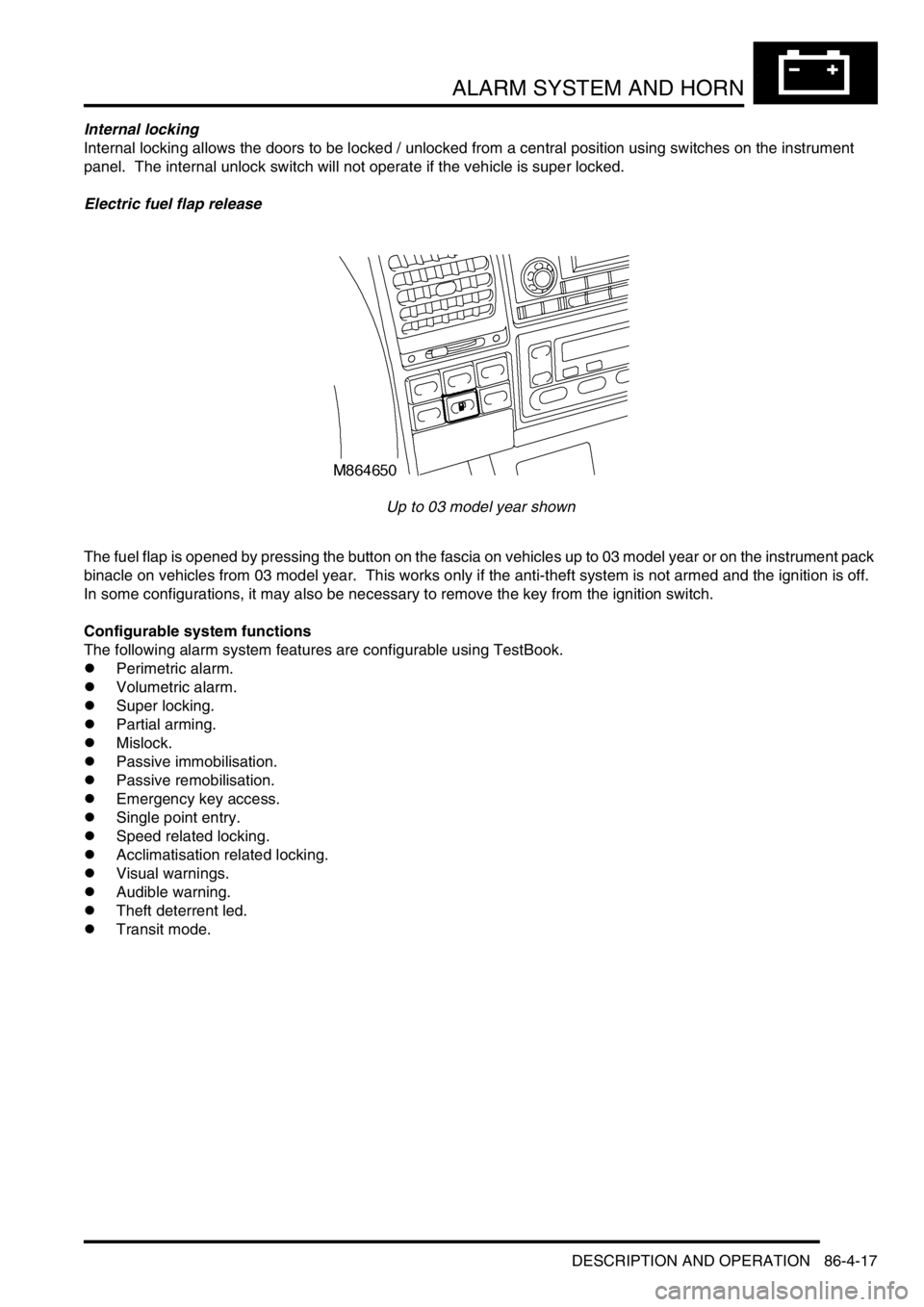
Electric fuel flap release
Up to 03 model year shown
The fuel flap is opened by pressing the button on the fascia on vehicles up to 03 model year or on the instrument pack
binacle on vehicles from 03 model year. This works only if the anti-theft system is not armed and the ignition is off.
In some configurations, it may also be necessary to remove the key from the ignition switch.
Configurable system functions
The following alarm system features are configurable using TestBook.
lPerimetric alarm.
lVolumetric alarm.
lSuper locking.
lPartial arming.
lMislock.
lPassive immobilisation.
lPassive remobilisation.
lEmergency key access.
lSingle point entry.
lSpeed related locking.
lAcclimatisation related locking.
lVisual warnings.
lAudible warning.
lTheft deterrent led.
lTransit mode.
Page 1527 of 1672

ALARM SYSTEM AND HORN
86-4-18 DESCRIPTION AND OPERATION
Perimetric alarm
The perimetric alarm is used by the BCU to detect unauthorised opening of a door or hinged panel. Switches
incorporated into the door latch assemblies and the bonnet determine the state of the panels.
There are two perimetric alarm configurations:
lAlarm not active.
lAlarm active.
Arming: To arm the perimetric alarm, press the lock button on the handset or lock the vehicle using the key in the
driver's door. Once the alarm has been set, the BCU monitors the state of the doors and the bonnet.
In order to arm the perimetric alarm the following conditions must be met:
lDrivers door closed.
lKey not inserted in ignition switch.
lFuel cut-off switch not tripped.
Disarming: To prevent the alarm from triggering when entering the vehicle, the alarm system must be disarmed with
the key or the handset.
There are two perimetric alarm disarming configurations:
lAlways disarm with key.
lOnly disarm with key if locked with key.
The perimetric alarm can be disarmed by unlocking the vehicle with the handset or by using the key in the driver's
door lock, depending on system configuration.
NOTE: The “only disarm with key if locked with key” configuration prevents the alarm from being disarmed by
unlocking the vehicle with the handset if the vehicle has been locked by the key. In this situation the Emergency Key
Access (EKA) code must be entered to disarm the alarm.
In order for the alarm to trigger, the following conditions must be met:
lPerimetric alarm armed.
lBonnet or door opened.
Once triggered, the alarm will remain triggered for 30 seconds before resetting.
Volumetric alarm
The volumetric alarm is used by the BCU to detect movement within the vehicle. This allows the alarm to be triggered
if a window is smashed in an attempt to gain access to the vehicle.
There are two volumetric alarm configurations:
lVolumetric alarm not active.
lVolumetric alarm active.
Two sensors, which transmit and receive ultrasonic signals, detect movement within the vehicle. Theses sensors
detect any change in air movement within the vehicle and then supply the BCU a signal to activate the alarm. Fifteen
seconds after the vehicle is locked with the handset or the key the volumetric alarm is armed. This delay is
incorporated into the BCU software to prevent accidental or nuisance triggering of the alarm.
In order to arm the volumetric alarm, the following conditions must be met:
lDriver's door closed.
lKey not inserted in ignition.
lFuel cut-off switch not tripped.
To prevent the alarm from triggering when entering the vehicle, the alarm system must be disarmed with the key or
the handset.
There are two volumetric alarm disarming configurations:
lAlways disarm with key.
lOnly disarm with key if locked with key.