oil type LAND ROVER DISCOVERY 2002 Owner's Manual
[x] Cancel search | Manufacturer: LAND ROVER, Model Year: 2002, Model line: DISCOVERY, Model: LAND ROVER DISCOVERY 2002Pages: 1672, PDF Size: 46.1 MB
Page 164 of 1672
ENGINE - TD5
DESCRIPTION AND OPERATION 12-1-25
Inlet and exhaust valves
The inlet and exhaust valves are mounted directly above the engine block cylinders.
Each valve is a forged and ground solid one-piece head and stem which is hardened by heat treatment. The stems
are chrome-plated then ground for improved heat transfer, wear resistance and smooth operation. It is not possible
to recut the valve's face angle, but the valves can be lapped to their seats using grinding paste.
The valve springs are made from spring steel and are of the parallel single-coil type. The bottom end of the spring
rests on the flange of a spring seal which has a centre bore that locates on a recess ground into the lower valve stem.
The top end of the spring is held in place by a spring retainer which is held in position at the top end of the valve stem
by split taper collets. The taper collets have grooves on the internal bore that locate to grooves ground into the upper
stems of the valves.
The valve seats and valve guides are sintered and are interference fit into the cylinder head. The valve seats and
guides are non-serviceable.
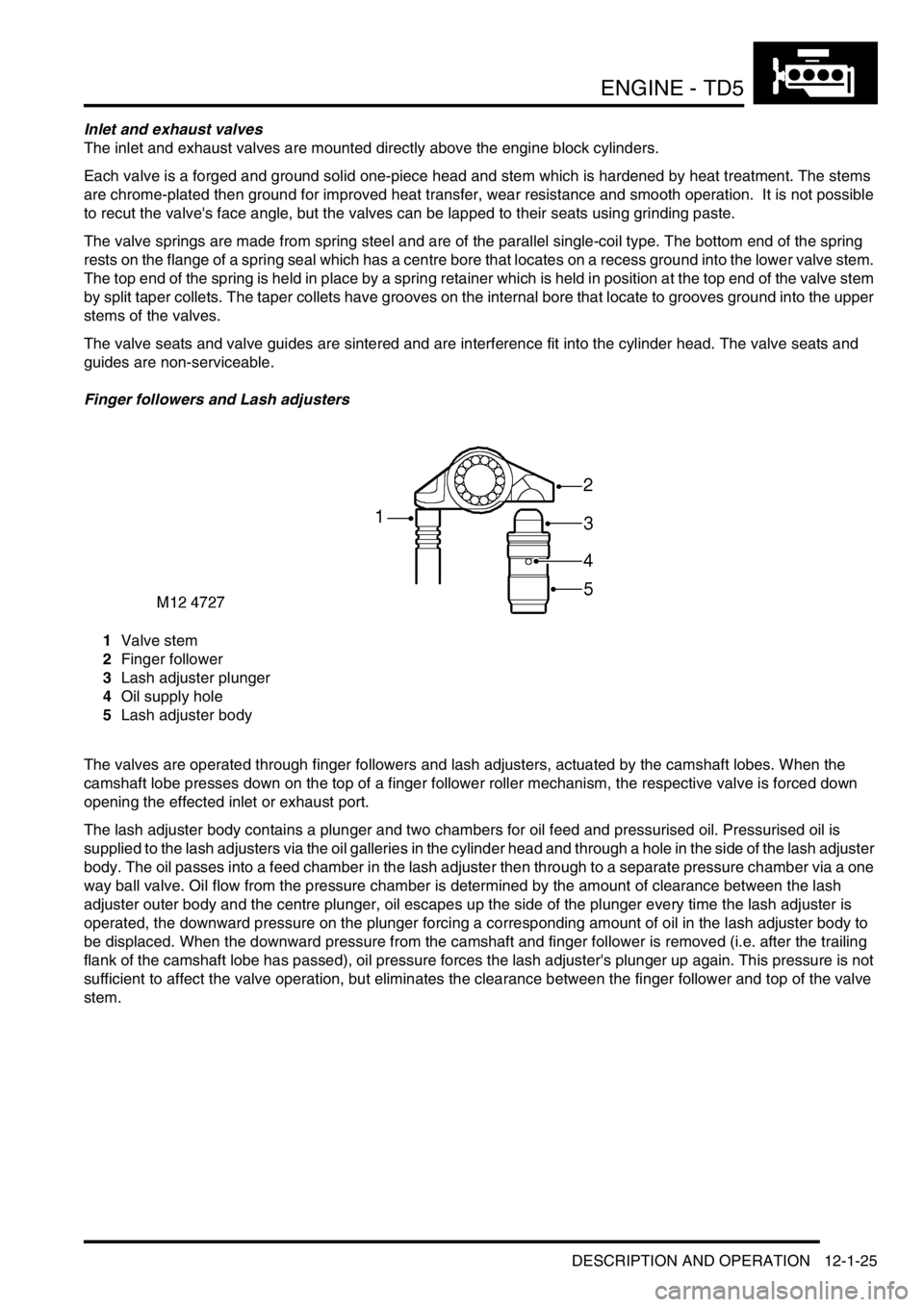
Finger followers and Lash adjusters
1Valve stem
2Finger follower
3Lash adjuster plunger
4Oil supply hole
5Lash adjuster body
The valves are operated through finger followers and lash adjusters, actuated by the camshaft lobes. When the
camshaft lobe presses down on the top of a finger follower roller mechanism, the respective valve is forced down
opening the effected inlet or exhaust port.
The lash adjuster body contains a plunger and two chambers for oil feed and pressurised oil. Pressurised oil is
supplied to the lash adjusters via the oil galleries in the cylinder head and through a hole in the side of the lash adjuster
body. The oil passes into a feed chamber in the lash adjuster then through to a separate pressure chamber via a one
way ball valve. Oil flow from the pressure chamber is determined by the amount of clearance between the lash
adjuster outer body and the centre plunger, oil escapes up the side of the plunger every time the lash adjuster is
operated, the downward pressure on the plunger forcing a corresponding amount of oil in the lash adjuster body to
be displaced. When the downward pressure from the camshaft and finger follower is removed (i.e. after the trailing
flank of the camshaft lobe has passed), oil pressure forces the lash adjuster's plunger up again. This pressure is not
sufficient to affect the valve operation, but eliminates the clearance between the finger follower and top of the valve
stem.
Page 165 of 1672

ENGINE - TD5
12-1-26 DESCRIPTION AND OPERATION
Camshaft cover and engine cover components
The camshaft cover and engine cover components are described below:
Camshaft cover
The camshaft cover is cast from aluminium alloy and is fixed to the camshaft carrier/cylinder head assembly by 13
bolts. The cover has spacers and sealing washers inserted into each of the thirteen bolt holes.
A breather hose is connected to a port at the top of the camshaft cover by means of a hose clip which vents crankcase
gases back to the air intake via a breather valve in the air intake tract, located forward of the turbocharger in the
flexible air intake duct.
A rubber seal is fitted between the camshaft cover.
An oil filler aperture is included in the top of the camshaft cover, which is sealed with a plastic cap with integral rubber
seal.
Camshaft timing chain components
The timing chain cover and timing chain components are described below:
Timing chain cover
The timing chain cover is cast and machined aluminium alloy and is attached to the cylinder head by a bolt at the RH
top of the cover and by a stud and nut at the LH top of the cover. Eight screws are used to attach the timing chain
cover to the front of the engine block. The timing cover is located to the cylinder block front face by two dowels.
A viscous fan is attached to an idler pulley at the front of the engine block. The fan bearing is located on a shaft and
held in place by a circlip and a bearing flange, the inner race of the fan bearing is an interference fit on the shaft. The
fan idler pulley is attached to the bearing hub by three bolts, and the fan itself is secured to the pulley and bearing
shaft by a left hand threaded nut.
+ COOLING SYSTEM - Td5, DESCRIPTION AND OPERATION, Description.
The front of the crankshaft passes through a hole in the lower part of the timing cover. An oil seal is pressed into a
recess in the front of the timing cover to seal the interface between the front of the crankshaft and the timing cover.
A stub pipe is fitted to the front RH side of the timing cover which is used to attach the oil drain pipe from the vacuum
pump by means of a hose and spring clip.
Timing chains
The timing chain between the camshaft and crankshaft sprockets is a duplex type, each chain having 56 links. The
timing chain is contained between a fixed plastic guide and an hydraulically adjustable plastic tensioner arm which
are attached to the front of the engine block.
To cope with higher injection loads of the EU3 engine, the timing drive between the camshaft and crankshaft has been
upgraded. This requires thicker chain links to be used, therefore, the individual pre EU3 and EU3 components are not
interchangeable.
To distinguish between the two timing chains the links are different colours. A pre EU3 chain has blue links and a EU3
chain has bronze links.
The oil pump timing chain is a single type and traverses the oil pump sprocket and the rear crankshaft sprocket.
The timing chains are oil lubricated, with oil being provided by a chain lubrication jet and from oil flow returning back
to the sump from the cylinder head. An oil hole is included at the front left hand side of the cylinder head which supplies
oil from the cylinder head oil galleries.
Page 220 of 1672
ENGINE - TD5
OVERHAUL 12-1-81
54.Remove and discard spring ring retaining
rocker arm on shaft.
55.Remove rocker arm. Remove and discard 2nd
spring ring.
56.Repeat above procedures for remaining rocker
arms keeping them in their fitted order.
57.Clean rocker arms and shaft, ensure oilways
are clear.
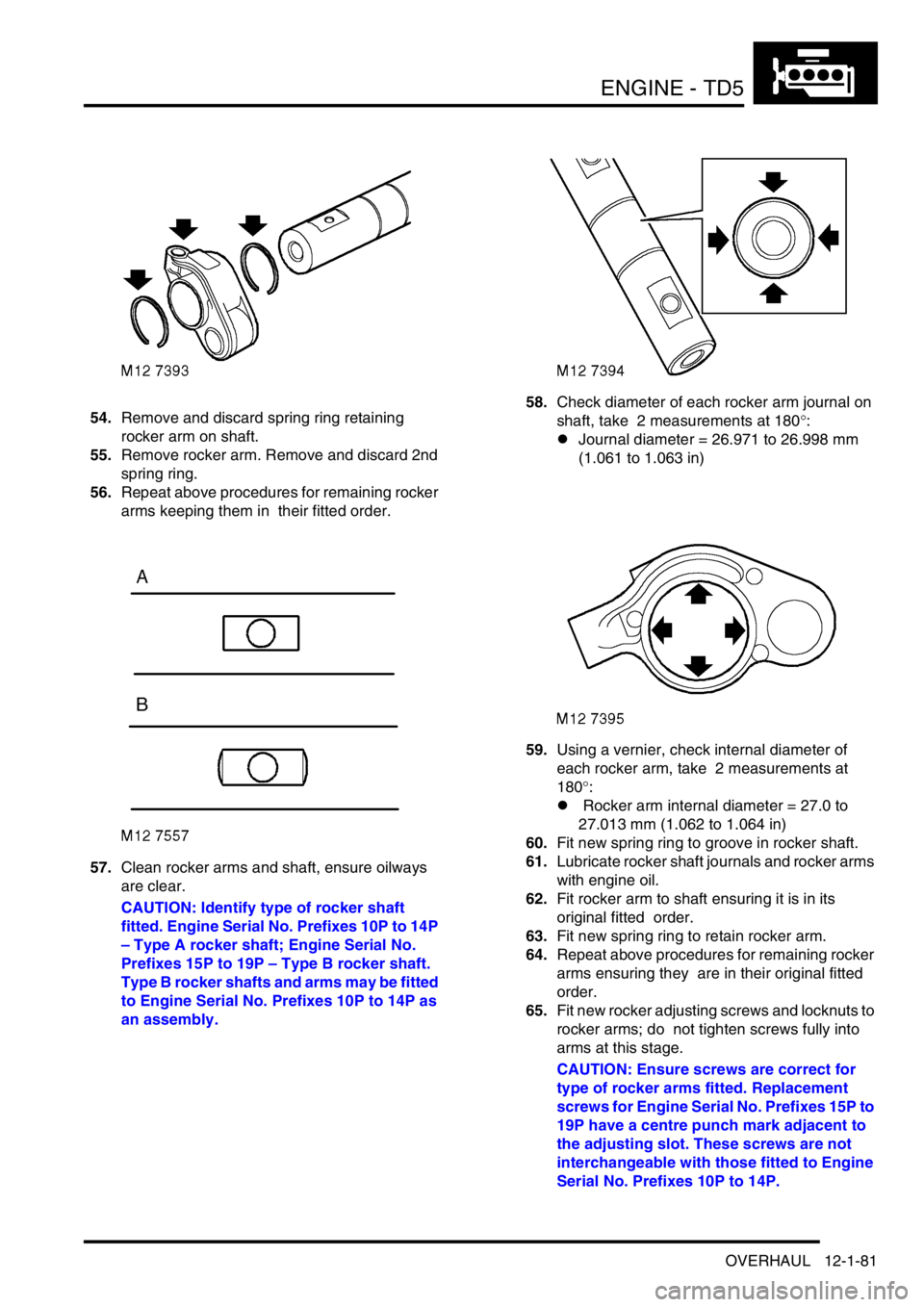
CAUTION: Identify type of rocker shaft
fitted. Engine Serial No. Prefixes 10P to 14P
– Type A rocker shaft; Engine Serial No.
Prefixes 15P to 19P – Type B rocker shaft.
Type B rocker shafts and arms may be fitted
to Engine Serial No. Prefixes 10P to 14P as
an assembly.58.Check diameter of each rocker arm journal on
shaft, take 2 measurements at 180°:
lJournal diameter = 26.971 to 26.998 mm
(1.061 to 1.063 in)
59.Using a vernier, check internal diameter of
each rocker arm, take 2 measurements at
180
°:
l Rocker arm internal diameter = 27.0 to
27.013 mm (1.062 to 1.064 in)
60.Fit new spring ring to groove in rocker shaft.
61.Lubricate rocker shaft journals and rocker arms
with engine oil.
62.Fit rocker arm to shaft ensuring it is in its
original fitted order.
63.Fit new spring ring to retain rocker arm.
64.Repeat above procedures for remaining rocker
arms ensuring they are in their original fitted
order.
65.Fit new rocker adjusting screws and locknuts to
rocker arms; do not tighten screws fully into
arms at this stage.
CAUTION: Ensure screws are correct for
type of rocker arms fitted. Replacement
screws for Engine Serial No. Prefixes 15P to
19P have a centre punch mark adjacent to
the adjusting slot. These screws are not
interchangeable with those fitted to Engine
Serial No. Prefixes 10P to 14P.
Page 236 of 1672
ENGINE - TD5
OVERHAUL 12-1-97
8. Remove and discard big-end bearing shell
from connecting rod.
NOTE: Engine Serial No. Prefixes 10P to 14P:–
The 'sputter type' connecting rod bearing shells
fitted to these engines, identified by them
having a slightly darker colour than the bearing
cap shells should be replaced with the 'plain
type' bearing shells fitted to Engine Serial No.
Prefixes 15P to 19P.
9.Repeat above procedures for remaining big-
end bearings. Keep bearing caps in their
fitted order.
Inspection
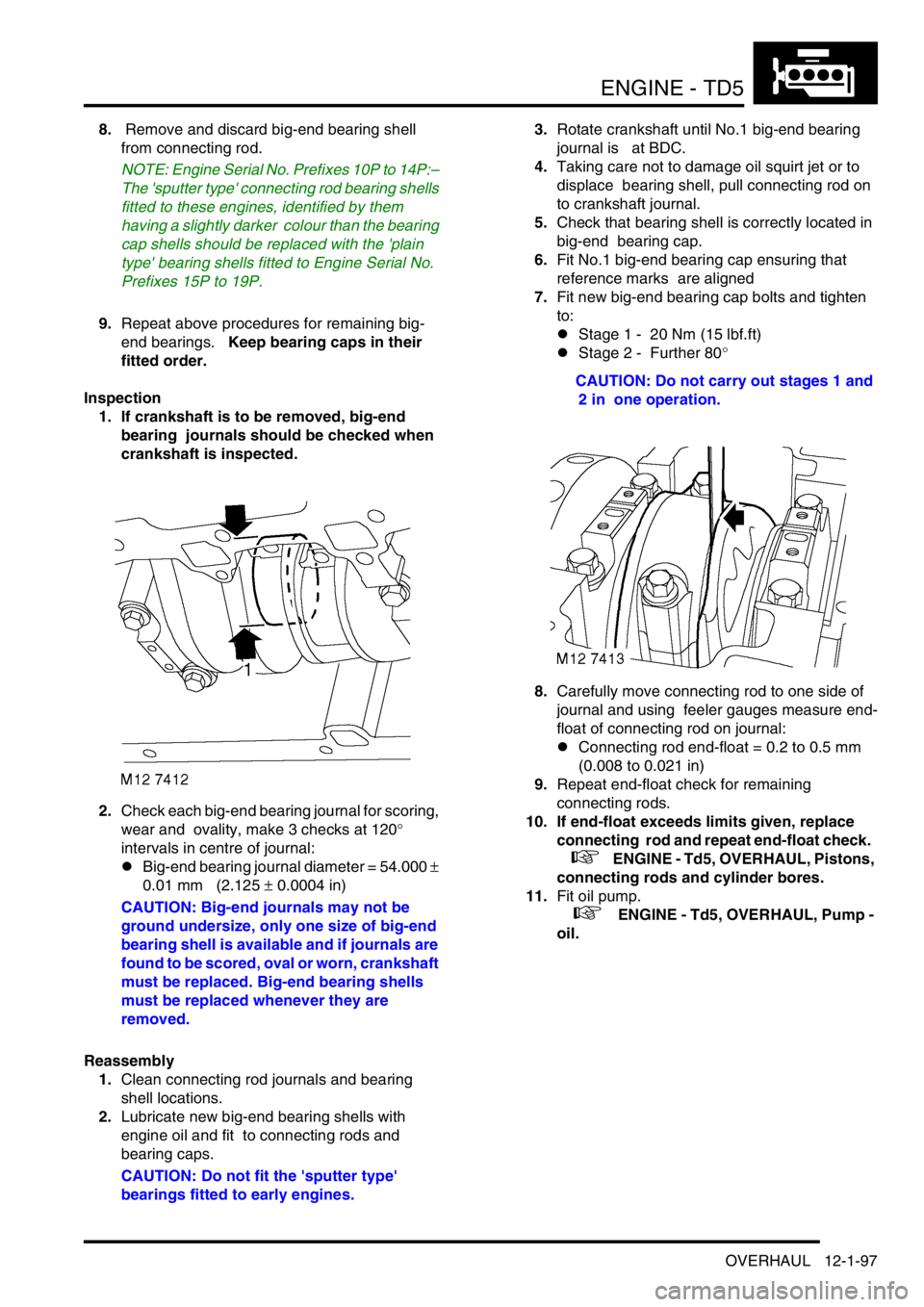
1. If crankshaft is to be removed, big-end
bearing journals should be checked when
crankshaft is inspected.
2.Check each big-end bearing journal for scoring,
wear and ovality, make 3 checks at 120
°
intervals in centre of journal:
lBig-end bearing journal diameter = 54.000
±
0.01 mm (2.125
± 0.0004 in)
CAUTION: Big-end journals may not be
ground undersize, only one size of big-end
bearing shell is available and if journals are
found to be scored, oval or worn, crankshaft
must be replaced. Big-end bearing shells
must be replaced whenever they are
removed.
Reassembly
1.Clean connecting rod journals and bearing
shell locations.
2.Lubricate new big-end bearing shells with
engine oil and fit to connecting rods and
bearing caps.
CAUTION: Do not fit the 'sputter type'
bearings fitted to early engines.3.Rotate crankshaft until No.1 big-end bearing
journal is at BDC.
4.Taking care not to damage oil squirt jet or to
displace bearing shell, pull connecting rod on
to crankshaft journal.
5.Check that bearing shell is correctly located in
big-end bearing cap.
6.Fit No.1 big-end bearing cap ensuring that
reference marks are aligned
7.Fit new big-end bearing cap bolts and tighten
to:
lStage 1 - 20 Nm (15 lbf.ft)
lStage 2 - Further 80
°
CAUTION: Do not carry out stages 1 and
2 in one operation.
8.Carefully move connecting rod to one side of
journal and using feeler gauges measure end-
float of connecting rod on journal:
lConnecting rod end-float = 0.2 to 0.5 mm
(0.008 to 0.021 in)
9.Repeat end-float check for remaining
connecting rods.
10. If end-float exceeds limits given, replace
connecting rod and repeat end-float check.
+ ENGINE - Td5, OVERHAUL, Pistons,
connecting rods and cylinder bores.
11.Fit oil pump.
+ ENGINE - Td5, OVERHAUL, Pump -
oil.
Page 239 of 1672
ENGINE - TD5
12-1-100 OVERHAUL
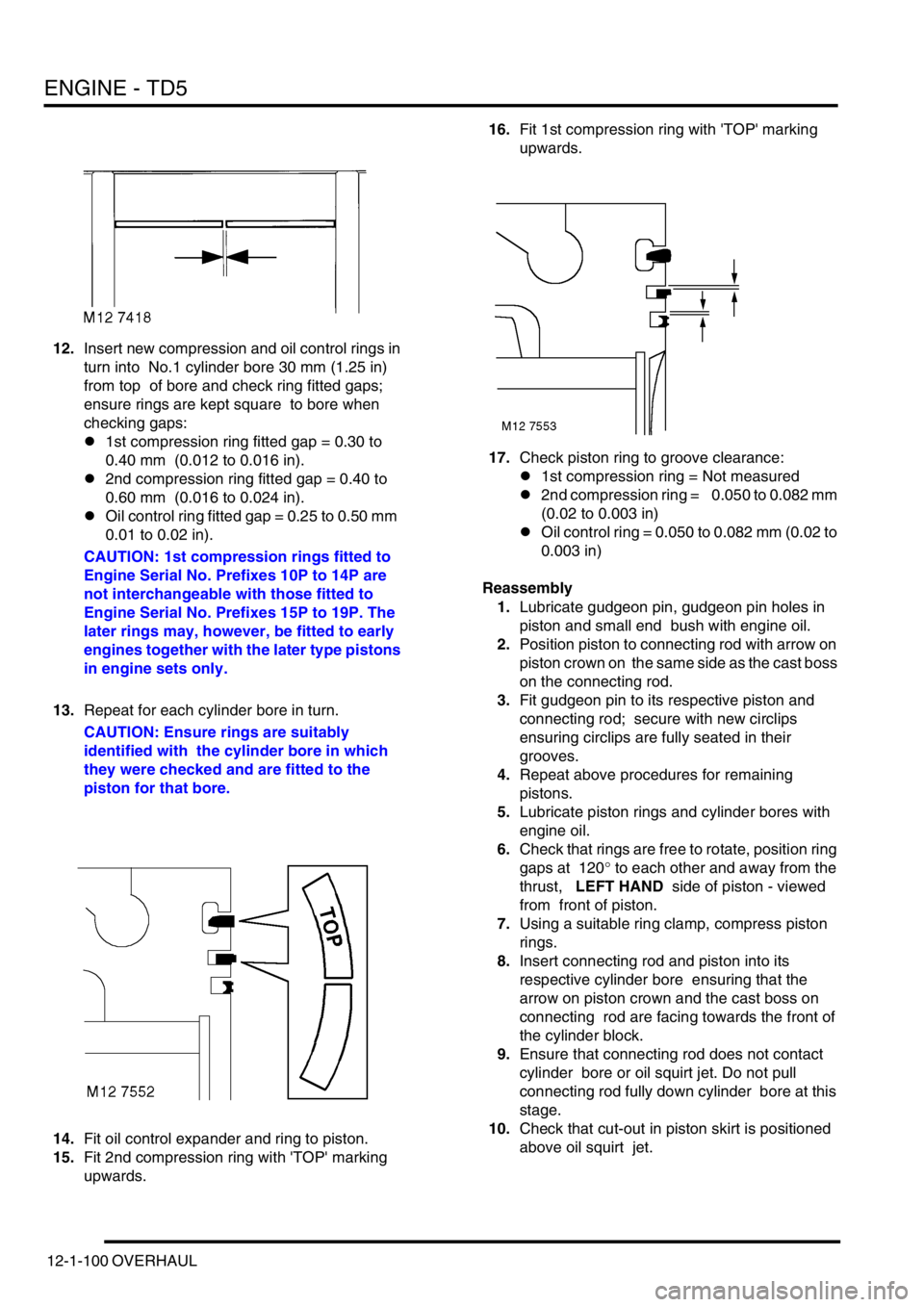
12.Insert new compression and oil control rings in
turn into No.1 cylinder bore 30 mm (1.25 in)
from top of bore and check ring fitted gaps;
ensure rings are kept square to bore when
checking gaps:
l1st compression ring fitted gap = 0.30 to
0.40 mm (0.012 to 0.016 in).
l2nd compression ring fitted gap = 0.40 to
0.60 mm (0.016 to 0.024 in).
lOil control ring fitted gap = 0.25 to 0.50 mm
0.01 to 0.02 in).
CAUTION: 1st compression rings fitted to
Engine Serial No. Prefixes 10P to 14P are
not interchangeable with those fitted to
Engine Serial No. Prefixes 15P to 19P. The
later rings may, however, be fitted to early
engines together with the later type pistons
in engine sets only.
13.Repeat for each cylinder bore in turn.
CAUTION: Ensure rings are suitably
identified with the cylinder bore in which
they were checked and are fitted to the
piston for that bore.
14.Fit oil control expander and ring to piston.
15.Fit 2nd compression ring with 'TOP' marking
upwards. 16.Fit 1st compression ring with 'TOP' marking
upwards.
17.Check piston ring to groove clearance:
l1st compression ring = Not measured
l2nd compression ring = 0.050 to 0.082 mm
(0.02 to 0.003 in)
lOil control ring = 0.050 to 0.082 mm (0.02 to
0.003 in)
Reassembly
1.Lubricate gudgeon pin, gudgeon pin holes in
piston and small end bush with engine oil.
2.Position piston to connecting rod with arrow on
piston crown on the same side as the cast boss
on the connecting rod.
3.Fit gudgeon pin to its respective piston and
connecting rod; secure with new circlips
ensuring circlips are fully seated in their
grooves.
4.Repeat above procedures for remaining
pistons.
5.Lubricate piston rings and cylinder bores with
engine oil.
6.Check that rings are free to rotate, position ring
gaps at 120
° to each other and away from the
thrust, LEFT HAND side of piston - viewed
from front of piston.
7.Using a suitable ring clamp, compress piston
rings.
8.Insert connecting rod and piston into its
respective cylinder bore ensuring that the
arrow on piston crown and the cast boss on
connecting rod are facing towards the front of
the cylinder block.
9.Ensure that connecting rod does not contact
cylinder bore or oil squirt jet. Do not pull
connecting rod fully down cylinder bore at this
stage.
10.Check that cut-out in piston skirt is positioned
above oil squirt jet.
Page 249 of 1672

ENGINE - V8
12-2-6 DESCRIPTION AND OPERATION
Description
General
The V8 petrol engine is an eight cylinder, water cooled unit having two banks of four cylinders positioned at 90 degrees
to each other. The engine comprises five main castings - two cylinder heads, cylinder block, timing cover and the oil
sump, all of which are manufactured from aluminium alloy.
NAS market vehicles from 03 model year receive a 4.6 litre version of the V8 engine to replace the previous 4.0 litre
version.
Cylinder heads
The cylinder heads are fitted with replaceable valve guides and valve seat inserts with the combustion chambers
formed in the head. Each cylinder head is sealed to the cylinder block with a gasket. The exhaust manifolds are bolted
to the outside of each cylinder head whilst the inlet manifolds are located in the centre of the 'Vee' and are bolted to
the inside face of each head. Inlet and exhaust manifolds are sealed to the cylinder heads by means of gaskets.
Each cylinder has a single inlet and exhaust valve. The exhaust valves are of the 'carbon break' type, a recess on the
valve stem prevents a build-up of carbon in the valve guide by dislodging particles of carbon as the valve stem moves
up and down the guide. Inlet and exhaust valve stem oil seals are fitted at the top of each valve guide. Valve operation
is by means of rocker arms, push rods and hydraulic tappets. Each of the rocker arms is located on a rocker shaft
which is supported by means of pedestals bolted to the cylinder heads. A spring, positioned on either side of each
rocker arm, maintains the correct relative position of the arm to its valve stem. The rocker arms are operated directly
by the push rods which pass through drillings in the cylinder heads and cylinder block. The bottom end of each push
rod locates in a hydraulic tappet operated by the single, chain driven camshaft.
The rocker covers are bolted to the cylinder heads and are sealed to the heads by a rubber gasket. Stub pipes for
crankcase ventilation hose connections are fitted to each rocker cover, the pipe in the right hand cover incorporates
an oil separator. The engine oil filler cap is situated in the right hand cover.
Cylinder block and camshaft
The cylinder block is fitted with cast iron cylinder liners which are shrink fitted and locate on stops in the block. The
camshaft is positioned in the centre of the cylinder block and runs in one piece bearing shells which are line bored
after fitting. Camshaft end-float is controlled by a thrust plate bolted to the front of the cylinder block. A timing gear,
chain driven by the crankshaft timing gear is bolted to the front of the camshaft.
Crankshaft and main bearings
The crankshaft is carried in five main bearings. The upper main bearing shell locations are an integral part of the
cylinder block casting. The lower main bearing caps are bolted to the cylinder block on either side of the upper bearing
shell locations with an additional bolt being inserted into each cap from either side of the cylinder block. The rear
main bearing cap carries the crankshaft rear oil seal and is sealed to the cylinder block by means of cruciform shaped
seals in each side of the cap. Number four main bearing cap carries the stud fixing for the oil pick-up pipe. Lower
main bearing shells are plain whilst the upper shells have an oil feed hole and are grooved. Crankshaft end-float is
controlled by the thrust faces of the upper centre shell. The crankshaft timing gear is located on the front of the
crankshaft by means of a Woodruff key which is also used to drive the gear type oil pump. The flywheel/drive plate
carries the crankshaft position sensor reluctor ring and is dowel located and bolted to the flywheel.
Timing cover
The timing cover is bolted to the front of the cylinder block and is sealed to the block with a gasket. The disposable,
full flow oil filter canister is screwed on to the timing cover which also carries the oil pressure switch, oil pressure relief
valve and crankshaft front oil seal. The gear type oil pump is integral with the cover which also has an internal oilway
to direct oil from the oil cooler to the filter.
NOTE: Oil coolers are only fitted to vehicles up to VIN 756821.
Page 325 of 1672

EMISSION CONTROL - TD5
17-1-4 DESCRIPTION AND OPERATION
Emission Control Systems
Engine design has evolved in order to minimise the emission of harmful by-products. Emission control systems fitted
to Land Rover vehicles are designed to maintain the emission levels within the legal limits pertaining for the specified
market.
Despite the utilisation of specialised emission control equipment, it is still necessary to ensure that the engine is
correctly maintained and is in good mechanical order, so that it operates at its optimum condition.
In addition to emissions improvements through engine design and the application of electronic engine management
systems, special emission control systems are used to limit the pollutant levels developed under certain conditions.
Two main types of additional emission control system are utilised with the Td5 engine to reduce the levels of harmful
emissions released into the atmosphere. These are as follows:
1Crankcase emission control – also known as blow-by gas emissions from the engine crankcase.
2Exhaust gas recirculation – to reduce NO
2 emissions.
Crankcase emission control
All internal combustion engines generate oil vapour and smoke in the crankcase as a result of high crankcase
temperatures and piston ring and valve stem blow-by, a closed crankcase ventilation system is used to vent
crankcase gases back to the air induction system and so reduce the emission of hydrocarbons.
Gases from the crankcase are drawn into the inlet manifold to be burnt in the combustion chambers with the fresh air/
fuel mixture. The system provides effective emission control under all engine operating conditions.
Crankcase gases are drawn through the breather port in the top of the camshaft cover and routed through the breather
hose and breather valve on the flexible air intake duct to be drawn into the turbocharger intake for delivery to the air
inlet manifold via an intercooler.
An oil separator plate is included in the camshaft cover which removes the heavy particles of oil before the crankcase
gas leaves via the camshaft cover port. The rocker cover features circular chambers which promote swirl in the oil
mist emanating from the cylinder head and camshaft carrier. As the mist passes through the series of chambers
between the rocker cover and oil separator plate, oil particles are thrown against the separator walls where they
condense and fall back into the cylinder head via two air inlet holes located at each end of the rocker cover.
The breather valve is a depression limiting valve which progressively closes as engine speed increases, thereby
limiting the depression in the crankcase. The valve is of moulded plastic construction and has a port on the underside
which plugs into a port in the flexible air intake duct. A port on the side of the breather valve connects to the camshaft
cover port by means of a breather hose which is constructed from a heavy-duty braided rubber hose which is held in
place by hose clips. A corrugated plastic sleeve is used to give further protection to the breather hose. The breather
valve is orientation sensitive, and “TOP” is marked on the upper surface to ensure it is mounted correctly.
It is important that the system is airtight so hose connections to ports should be checked and the condition of the
breather hose should be periodically inspected to ensure it is in good condition.
Page 346 of 1672
EMISSION CONTROL - V8
DESCRIPTION AND OPERATION 17-2-9
Emission Control Systems
Engine design has evolved in order to minimise the emission of harmful by-products. Emission control systems are
fitted to Land Rover vehicles which are designed to maintain the emission levels within the legal limits pertaining for
the specified market.
Despite the utilisation of specialised emission control equipment, it is still necessary to ensure that the engine is
correctly maintained and is in good mechanical order so that it operates at its optimal condition. In particular, ignition
timing has an effect on the production of HC and NO
x emissions, with the harmful emissions rising as the ignition
timing is advanced.
CAUTION: In many countries it is against the law for a vehicle owner or an unauthorised dealer to modify or
tamper with emission control equipment. In some cases, the vehicle owner and/or the dealer may even be
liable for prosecution.
The engine management ECM is fundamental for controlling the emission control systems. In addition to controlling
normal operation, the system complies with On Board Diagnostic (OBD) system strategies. The system monitors and
reports on faults detected with ignition, fuelling and exhaust systems which cause an excessive increase in tailpipe
emissions. This includes component failures, engine misfire, catalyst damage, catalyst efficiency, fuel evaporative
loss and exhaust leaks.
When an emission relevant fault is determined, the fault condition is stored in the ECM memory. For NAS vehicles,
the MIL warning light on the instrument pack will be illuminated when the fault is confirmed. Confirmation of a fault
condition occurs if the fault is still found to be present during the driving cycle subsequent to the one when the fault
was first detected.
+ ENGINE MANAGEMENT SYSTEM - V8, DESCRIPTION AND OPERATION, Description - engine
management.
The following types of supplementary control system are used to reduce harmful emissions released into the
atmosphere from the vehicle:
1Crankcase emission control – also known as blow-by gas emissions from the engine crankcase.
2Exhaust emission control – to limit the undesirable by-products of combustion.
3Fuel vapour evaporative loss control – to restrict the emission of fuel through evaporation from the fuel
system.
4Fuel leak detection system (NAS only) – there are two types of system which may be used to check the
evaporative emission system for the presence of leaks from the fuel tank to purge valve.
aVacuum leak detection test – checks for leaks down to 1 mm (0.04 in.) in diameter.
bPositive pressure leak detection test – utilises a leak detection pump to check for leaks down to 0.5 mm (0.02
in.) in diameter.
5Secondary air injection system (NAS only) – to reduce emissions experienced during cold starting.
Crankcase emission control system
The concentration of hydrocarbons in the crankcase of an engine is much greater than that in the vehicle's exhaust
system. In order to prevent the emission of these hydrocarbons into the atmosphere, crankcase emission control
systems are employed and are a standard legal requirement.
The crankcase ventilation system is an integral part of the air supply to the engine combustion chambers and it is
often overlooked when diagnosing problems associated with engine performance. A blocked ventilation pipe or filter
or excessive air leak into the inlet system through a damaged pipe or a leaking gasket can affect the air:fuel mixture,
performance and efficiency of the engine. Periodically check the ventilation hoses are not cracked and that they are
securely fitted to form airtight connections at their relevant ports.
The purpose of the crankcase ventilation system is to ensure that any noxious gas generated in the engine crankcase
is rendered harmless by complete burning of the fuel in the combustion chamber. Burning the crankcase vapours in
a controlled manner decreases the HC pollutants that could be emitted and helps to prevent the development of
sludge in the engine oil as well as increasing fuel economy.
Page 365 of 1672

EMISSION CONTROL - V8
17-2-28 DESCRIPTION AND OPERATION
The SAI pump is attached to a bracket at the rear RH side of the engine compartment and is fixed to the bracket by
three studs and nuts. The pump is electrically powered from a 12V battery supply via a dedicated relay and supplies
approximately 35kg/hr of air when the vehicle is at idle in Neutral/Park on a start from 20
°C (68°F).
Air is drawn into the pump through vents in its front cover and is then passed through a foam filter to remove
particulates before air injection. The air is delivered to the exhaust manifold on each side of the engine through a
combination of plastic and metal pipes.
The air delivery pipe is a flexible plastic type, and is connected to the air pump outlet via a plastic quick-fit connector.
The other end of the flexible plastic pipe connects to the fixed metal pipework via a short rubber hose. The part of the
flexible plastic pipe which is most vulnerable to engine generated heat is protected by heat reflective sleeving. The
metal delivery pipe has a fabricated T-piece included where the pressurised air is split for delivery to each exhaust
manifold via the SAI control valves.
The pipes from the T-piece to each of the SAI control valves are approximately the same length, so that the pressure
and mass of the air delivered to each bank will be equal. The ends of the pipes are connected to the inlet port of each
SAI control valve through short rubber hose connections.
The T-piece is mounted at the rear of the engine (by the ignition coils) and features a welded mounting bracket which
is fixed to the engine by two studs and nuts.
The foam filter in the air intake of the SAI pump provides noise reduction and protects the pump from damage due to
particulate contamination. In addition, the pump is fitted on rubber mountings to help prevent noise which is generated
by pump operation from being transmitted through the vehicle body into the passenger compartment.
If the secondary air injection pump malfunctions, the following fault codes may be stored in the ECM diagnostic
memory, which can be retrieved using 'Testbook':
Secondary air injection (SAI) pump relay
The secondary air injection pump relay is located in the engine compartment fusebox. The engine control module
(ECM) is used to control the operation of the SAI pump via the SAI pump relay. Power to the coil of the relay is supplied
from the vehicle battery via the main relay and the ground connection to the coil is via the ECM.
Power to the SAI pump relay contacts is via fusible link FL2 which is located in the engine compartment fusebox.
P-code Description
P0418Secondary air injection pump powerstage fault (e.g. - SAI pump relay fault / SAI
pump or relay not connected / open circuit / harness damage).
Page 469 of 1672
ENGINE MANAGEMENT SYSTEM - V8
18-2-12 DESCRIPTION AND OPERATION
Connector 5 (C0638): This connector contains 9 pins and is used to control the ignition system. The ignition coils are
supplied with power and a switching earth completes the circuit.
Pin out details connector C0638
Crankshaft speed and Position (CKP) sensor (C0168)
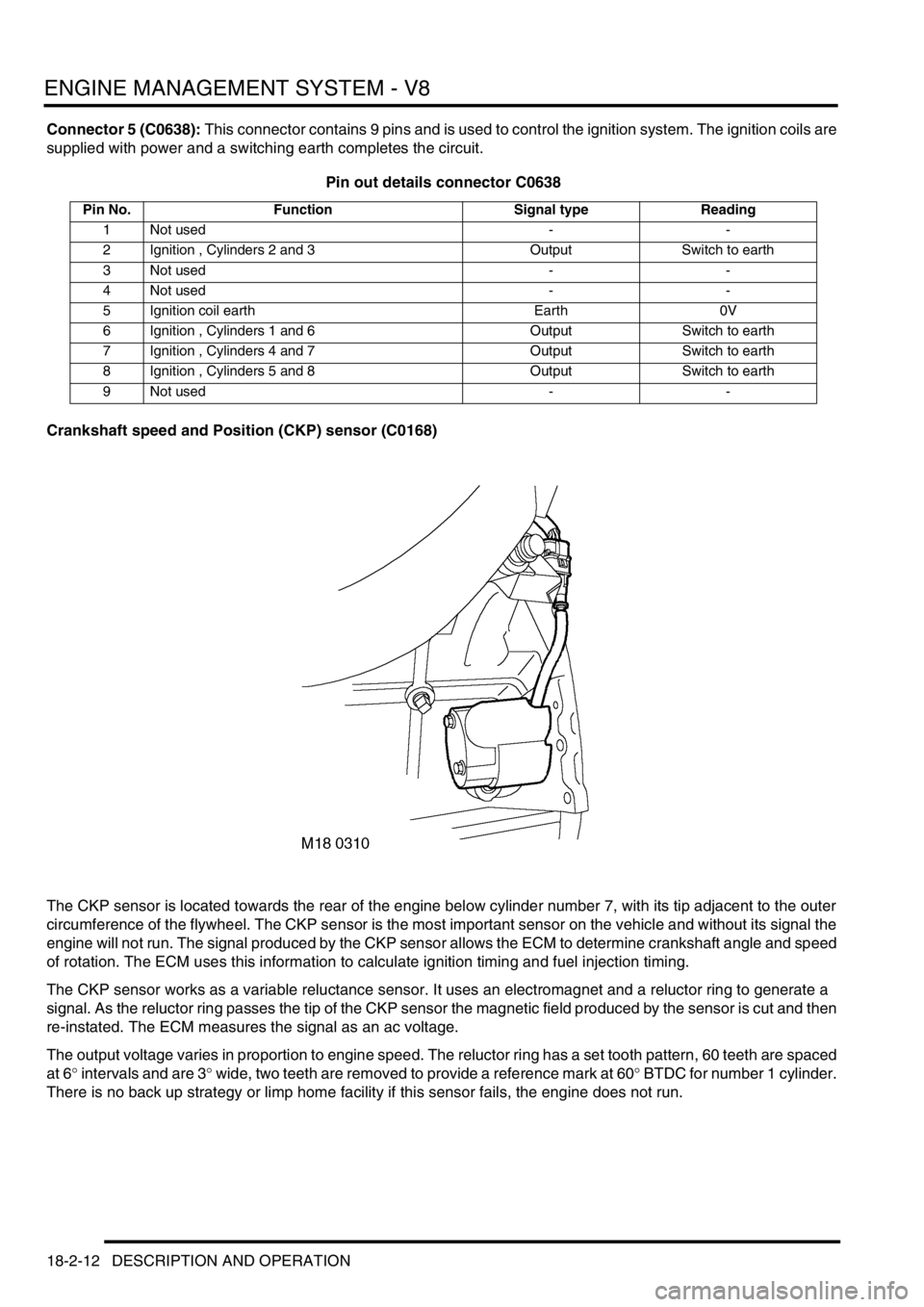
The CKP sensor is located towards the rear of the engine below cylinder number 7, with its tip adjacent to the outer
circumference of the flywheel. The CKP sensor is the most important sensor on the vehicle and without its signal the
engine will not run. The signal produced by the CKP sensor allows the ECM to determine crankshaft angle and speed
of rotation. The ECM uses this information to calculate ignition timing and fuel injection timing.
The CKP sensor works as a variable reluctance sensor. It uses an electromagnet and a reluctor ring to generate a
signal. As the reluctor ring passes the tip of the CKP sensor the magnetic field produced by the sensor is cut and then
re-instated. The ECM measures the signal as an ac voltage.
The output voltage varies in proportion to engine speed. The reluctor ring has a set tooth pattern, 60 teeth are spaced
at 6
° intervals and are 3° wide, two teeth are removed to provide a reference mark at 60° BTDC for number 1 cylinder.
There is no back up strategy or limp home facility if this sensor fails, the engine does not run.
Pin No. Function Signal type Reading
1 Not used - -
2 Ignition , Cylinders 2 and 3 Output Switch to earth
3 Not used - -
4 Not used - -
5 Ignition coil earth Earth 0V
6 Ignition , Cylinders 1 and 6 Output Switch to earth
7 Ignition , Cylinders 4 and 7 Output Switch to earth
8 Ignition , Cylinders 5 and 8 Output Switch to earth
9 Not used - -